ACoAs & Boundary Distortion (Part 2)

no one caresI CAN DO WHATEVER I WANT
because nobody cares about me

PREVIOUS: ACoAs & B. Distortion (Part 1)

SITEs: ▪︎ GENOGRAMS – def
 ▪︎ Genogram explained


PARENTS with distorted Bs don’t know how to connect with their children in a fair & balanced way.  In Boundaries – Defined”, we saw they can be either intrusive or uninvolved . Then children are either:

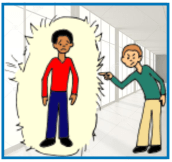
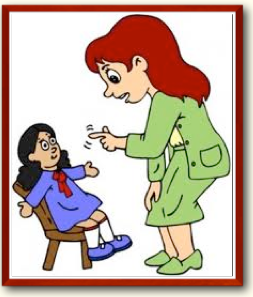
a. Being watched: Some of us grew up with an intrusive parent who needed to control everything & everyone in their environment (not just their kids). They were always on our back about something, overly critical, perfectionistic & boundary-less , sticking their nose in our business when we needed respect & some privacy. This was not a sign of loving concern!

• As a result these ACoAs continue to feel a creepy sense of having a camera over one shoulder – always judging, criticizing… assuming everyone else is also watching, watching, watching – waiting for our next ‘stupidity’ or mistake

d's mouseEXP: Sophie is 5 & it’s the first day of kindergarten. Her mother is fussing, worried that her daughter won’t behave perfectly, which will make the family look bad, & she won’t be there in person to make sure….

She gives all sorts of instructions – how to sit, what to say, what NOT to say…. Sophie is already scared & now she’s overwhelmed, so all she can do is stare. As they leave the house she hears her mother say – almost to her self: “I wish I could be a little mouse on the wall !”

• Sophie’s on her own for the first time, in a big room with other kids, all sitting in their little chairs, listening to the teacher – except for Sophie who is anxiously looking around the bottom edges of the walls, actually expecting to see a little mouse watching her from its hole, maybe with her mother’s eyes!

b. Being ignored: Other parents left us adrift – too much alone, unsupervised, unguided. Yet even as small children we were expected to know how to behave, & participate correctly in all sorts of social events, without being taught directly or setting a proper example. And they were oblivious to the burden they put on us!

hiding in publicOne result is that externally – now we don’t have Bs with others, & internally – we haven’t learned to set Bs with ourself, so we do whatever the WIC feels like, no matter how unhealthy, using unsuccessful ways to get needs met (needs we’re not supposed to have!)

Another result is that many of us who were neglected, are uncomfortable in public, especially with groups. We feel ill-equipped to socialize, sure we don’t know what to say or how to act. We watch other people to see how they manage, & even though we’re great mimics, we still don’t trust ourself to be acceptable. Extroverts will at least try but feel inadequate, & introverts don’t even bother!

EXP: Sheila was a bright, sensitive girl, living in a family that moved many times because of her father’s career. A talkative extrovert, she’d grown up mainly in the company of adults, so even tho’ there always were people around, she was very much alone.  She was expected to be sociable, charming, well-behaved & polite to the grown-ups, but she was deeply lonely, angry & hurt.

To cope, she found escape & solace in all kinds of books (before internet & cell phones) – in the library after school, reading while walking down the street!!, under the covers at night….
Once, when her mother wanted her full attention she commented sarcastically: “I can see it all now – you’ll be reading a book as you walk down the aisle!”

PS: Obviously, the mother’s passive-aggressive anger was showing:
a. her unconscious abandonment buttons got triggered
b. her narcissism kicked in, since she wasn’t a reader & didn’t see what was “so interesting”
c. she was oblivious to her daughter’s need for comfort & for a buffer when around her controlling mother
d. her lack of intellectual interest was obvious, or she would have encouraged the girl’s passion for knowledge

EXT: Boundary Distortion (Part 3)

ACoAs & Boundary Distortion (Part 1)

BIG BROTHER IS WATCHING
Then why do I feel so alone?

PREVIOUS: How ACoAs B. Invade #2

SITES: Balance Theory – Wikipedia
Balancing points (Mobile exercises for students)
• re. Family Systems Theory,  M Dombeck & J Wells-Moran


DYSFUNCTION

Unhealthy parents with rigid or weak boundaries automatically invade the PMES space of their children – they can’t help it! As a result ACoAs grow up co-dependently enmeshed, not just with a specific parent but the whole toxic family system.
From that early model, we recreate our work & personal relationships in similar ways – invading & being invaded or keeping everyone at bay, because we don’t have the ability to enforce our personal space.

• For ACoAs, developing healthy Bs is a long, arduous & imperfect journey.  Remember – as long as we’re consistently reacting to people, places & things from damage (lack of Bs), we’re in the Child ego state – still not emotionally mature.

For those of us well on our way to a Whole Self, whenever we too react without Bs, we’ve regressed to an earlier stage of childhood, but are able to come back to the present more easily & quickly

• A sure sign of not having healthy Bs is when we habitually, compulsively consider ourself only in relation to others (co-dependence).  ACoAs are enmeshed with everyone – not just people we love, or even know. It’s so much a part of how we relate, we don’t recognize it as damage.

• One way it shows up is when we disagree with or disapprove of anything another person says or wants. We get really scared – especially if they don’t like our opinion. We’re confused, talk ourself out of dealing with it, OR we rant about it to others, obsessing about what we should have said or what we will – next time, but never do! The focus is on the other person, rather than ourself.
EXPs:
✓ “I want to tell her I didn’t like what she said last week, so she’ll understand (get it) & not talk to me that way again…..”
✓ “I can’t tell them I don’t want to do that anymore because they will be upset / hurt / angry”
✓ “I’d like to tell him what I think about what’s going on between
use othersus, but he won’t get it, so why bother”….

SINCE we’re not allowed to know what we need, we use others:
— to ‘complete’ us (review symbiosis) AND
— to set limits for us, as if we were still infants!
Their agendas & desires become our blueprint for responses & activities. Without boundaries we’re at everyone else’s whim.
OR use others :
— to have someone to copy (symbiose with). Once we figure out what they want or what they’re doing, we mold ourselves to that, even though very often it’s not what suits us nor that we actually want!

• Since the WIC is looking for a definitive outline of what’s expected of it, in a desperate (usually unconscious) desire to stay connected, to avoid feeling abandoned, to be taken care of – we will do anything to please others, usually at our expense, so they won’t be angry or be hurt, & then go away!

Therefore, ACoAs can get very upset when ‘significant’ people:
— change their minds a lot, are undependable, unpredictable
— expect us to “just know” what they want. Since they don’t say it directly we’re constantly trying to guess
— lie, are chaotic, hard to read, drugged, crazy…..
Without Recovery, we then freeze, run around in circles, get angry or depressed…. because we don’t have our own core to guide us.

RECOVERY
One of the important thing for ACoAs to do on a regular basis is to speak up on behalf of our Inner Child – because the WIC can’t.

With good Bs we can practice saying what’s truly on our mind — we do not need everyone to validate our thoughts, feelings or existence!  and
— it is not necessary for the other person to see us, understand, or change their behavior. Some will & some won’t.
And when dealing with self-centered controllers, we can be sure they will NOT get it. An Al-Anon saying is: “Take the action & let go of the result!”

NEXT: B. Distortions (Part 2)

How ACoAs Boundary Invade (Part 1)

LET ME BE CLOSE TO YOU –
whether you like it or not!

PREVIOUS: ACoAs & Boundaries – #4

REVIEW: “How ACoAs ABANDON  Others”

QUOTEs  : 👩‍❤️‍💋‍👨 ” If a person loves only one other person, & is indifferent to his fellow men, his love is not love but a symbiotic attachment, or an enlarged egotism” — Erich Fromm

REMINDER: All forms of Boundary invasion are expressions of narcissism.

OUR DAMAGE
• It’s only natural that IF our parents —-> invaded us, then we never learned good Bs, so we in turn —> boundary invade others.
We unconsciously assume this is a form of expressing love, & don’t see anything wrong with it. In fact, to many ACoAs it’s not boundary invasion but ‘connection’.  The deep-seated reasons for continuing this pattern are familiar:
to follow our family training, stave off our fear of abandonment, deal with loneliness, feel needed & desired, have a sense of purpose (for Rescuers)….

• SO – when we’re told to back off (even in a nice way) or anytime a person we want to be with – won’t let us be symbiotic – we feel hurt, ashamed & ostracized.
It doesn’t matter that we may feel uncomfortable, even angry, when others violate our Bs.  We want to be able to violate theirs – without objection!
As long as the WIC is running our life, we still want to have that familiar “feeling” of attachment – even when we don’t actually like someone!

• It’s true that some ACoAs, particularly Introverts, find it hard to be in large groups – like shopping, special events or the subway. They can’t handle being ‘space invaded’, while Extroverts are much less bothered, if at all.
However, all humans & even many animals become physically & psychologically stressed when personal Bs are violated, whether they’re aware of it or not – especially over long periods of time.

In his work on Personal Space, Robert Sommer says “The violation of personal space increases tension levels enormously.” He conducted experiments in public places by getting much too close to strangers & observed that it provoked tension-releasing responses — they started tapping their toes, pulling at their hair & getting completely rigid.

• In general, people either shut down (to be polite) or get aggressive (react angrily) when someone is invasive. For those of us with WEAK Bs it’s important to notice when we insist on being the perpetrator, whether intentionally or not. We many think we’re just being ‘friendly’.
We may not like to see ourselves in that light, but need to admit the truth about ways we act out our damage.
• It’s also important to have as much info as possible that will help us change ingrained patterns, if we’re willing, to help us counter the Bad Introject voice. It’s so hard to convince the WIC that what he/she feels most comfortable doing is actually not a good thing for ourself or for others.

EXPL: A attractive, intelligent but terribly insecure 23-year-old has finally found a charming, handsome boyfriend with a good job & a great motorcycle. She can’t believe her luck! Because he lives in another city she doesn’t get to see him very often, so every minute with him is precious. She’s waited her whole life for someone to love her & now she’s ecstatic to spend an occasional weekend in his big apartmeFoAnt.

• On her first visit, that Saturday morning is wonderful – making love, snuggling, listening to the birds chirping & the Country Music station playing.  Desperate to not lose that warm feeling, she follows him into the bathroom, & as he’s sitting on the john she perches on the edge of the tub to talk to him, their knees touching.

It doesn’t take long for him feel uncomfortable being watched, & shoos her out. Over the next few months they go on fun road trips, go dancing & have great sex. But her insecurity, clinging & boundary invasions overshadows all the good times & eventually he has enough. She’s devastated when he backs off, but doesn’t understand what really happened!

NEXT: ACoA Boundary Invading – #2

BOUNDARIES & ACoAs (Part 4)

inner conflict 

YOU’RE GETTING TOO CLOSE –
Hey, where are you going?

PREVIOUS: Bs & ACoAs (Part 3)

REVIEW posts: “Separation & Individuation


3. The SYMBIOTIC DILEMMA  (cont)
a. Fear of Engulfment
b. Feat of Separation

A basic requirement for S & I is a sense of efficacy – able to (allowed to) have an appropriate effect on our environment

SYMPTOMS of poor or no Separation & Individuation (S & I) :
• weak sense of Self: the child’s core injury comes from not receiving a meaningful, empathic emotional response from mother
• narcissistic vulnerability is based on shame of having needs : child is injured by being constantly slighted or ignored
• emotional detachment or clinging: abandonment is played out as “come here – go away” in adult relationships

CONSEQUENCES of symbiosis : creates difficulty with —
✓ feeling all our emotions
✓ loving others unselfishly
✓ nurturing our young
✓ mourning the dead
✓ boundaries re. time & space
✓ caring about the human race
✓ dealing with conflict (isolating) & taming aggression….

✶ These problems make it very hard for ACoAs to have healthy intimacy, often relating to others as if we each were inanimate objects, used to fix unresolved infantile issues

‘COME HERE – GO AWAY’  
A common example of the symbiotic conflict is the push-pull syndrome.
While some ACoAs are primarily Stayers & others primarily Leavers, there are some whose conflict is subtle & very confusing because both are acted out in every relationship. Either way, ACoAs don’t realize we’re recreating our early abandonment – again & again

1. Come-Here/Go-Away : ACoAs very much want to have relationships, but don’t acknowledge our deep fear of emotional closeness. We invite people in, let them come close if they approach, & some of us even compulsively chase after anyone we can snag
✶ At the same time, we have an invisible barrier around us used as a substitute for real Bs others cannot see & that we are rarely aware of
2. As someone gets emotionally & physically closer, wants to know more about us, spend more time, be more permanent – we start to panic. Since we’re not allowed to say what we need, want & don’t want, how we feel…. if we let them in we’ll be taken over by their needs & wants

3. As the person moves in, they inevitably cross that ‘line in the sand’ the WIC is hiding behind BUT which we never acknowledge, so can’t verbalize.
Then how can we possible expect others to know when they’ve gotten too close?
We feel invaded, suffocated, endangered – terrified. At that point the need to protect ourselves is much greater than our fear of being alone!

4. As the terror builds we do or say things that are a slap in the face to this person who cares about us – we verbally punch them in the stomach &/or become distant & unavailable.  They are shocked, hurt, confused, appalled! They try to figure out what they did wrong — but their only sin was getting too close to our wounded self! So naturally they back off & then go away!

5. Now it gets interesting! WE have pushed the person away by cruelty or withholding AND then wonder why they withdrew!  Suddenly our abandonment fear come to the fore & we act confused & surprised at the others reaction!  Where did you go?? & WHY?

6. So without understanding what we’ve done – that we set up the painful outcome – some of us will invite, cajole, beg the person to come back to us.  If they do, AND we still cannot identify where our boundaries are, they’ll come too close again, & the cycle repeats!

• This pattern is crazy-making for us & our friends or partners. It makes them sad & eventually very angry.  We are condemning ourselves to an endless round of seduction & loss.  We look like the crazy one, hate ourselves more, blame others, say we can’t trust anyone, think we can’t love or the ‘universe’ is against us….. without looking at our Symbiotic Conflict!good Bs

RECOVERY – As Usual 😔
•  Admit our damage – cut thru denial
• Feel the old rage & terror
• Nurture the Inner Child
• Reduce S-H, CDs & obeying the PP
• Connect with others in Recovery
• Form an alliance with the loving H.P.

NEXT: How ACoAs Boundary Invade

BOUNDARIES & ACoAs (Part 3)

 no Bs
COME HERE  — GO AWAY

You’re too close! Hey, why are you leaving?

PREVIOUS: Bs & ACoAs (Part 2)


3. The SYMBIOTIC DILEMMA
Sigmund Freud concluded that there were 2 main psychological forces in humans – Eros & Thanatos, love & death, sex & violence (where have we heard that before??).
They are strong instincts which he called “an original self-subsisting instinctual disposition in man”.  These drives give people a kind of psychic “energy” which can be diverted into other areas (not repressed), giving some form of satisfaction.

Modern psychologists (Kohut, Mahler, Winnicut ….) have given us a revised understanding of these 2 forces: Attraction & Repulsion, Connection & Separateness, Attachment & Individuation.  In balance, both extremes are necessary for us to be psychologically sound. To feel safe we need connection, but to be our own person we need to be separate.

• For ACoAs, however, this internal tug-of-war is lose-lose. No matter how ‘wonderful’ we think the various individuals to be (‘my mom is the greatest – honest!’….), in a toxic family system both of these basic needs are distorted.
The wounded caregiver can be:  fearful or angry, withholding or intrusive, distant or controlling – all are scary & damaging. We end up as adults equally afraid of commitment AND of abandonment. push-pull

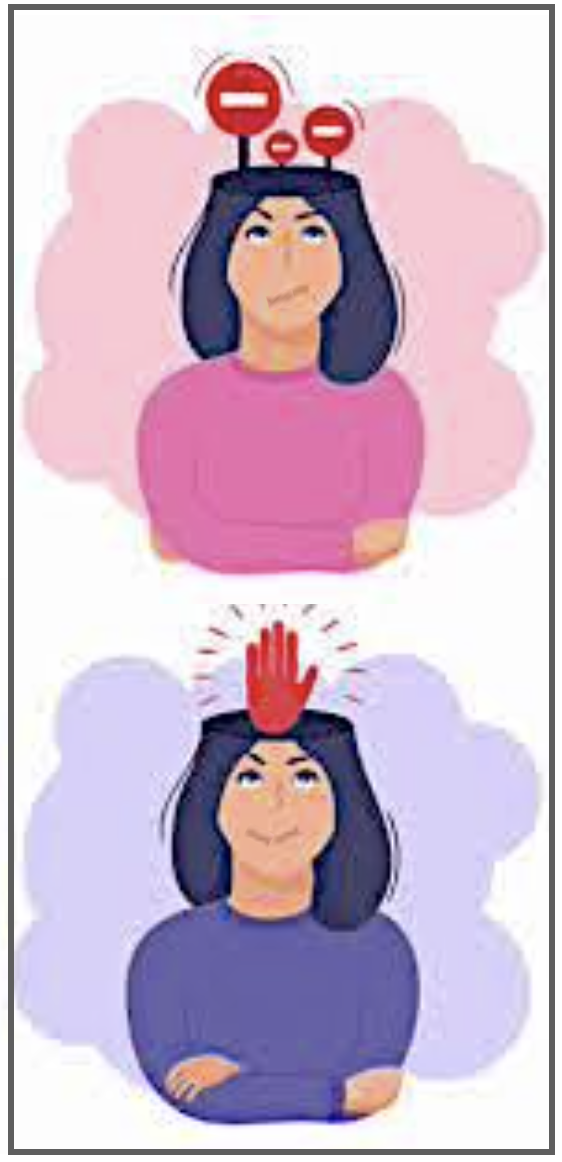
a. Fear of one-ness with mother —> being engulfed.  The result in the child is the need to form Rigid Bs (walls).
Having absorbed an unsafe mother (introjected object), the child feel the threat of loosing it’s True Self because of the caretaker’s lack of Bs.
Any fragments of their own identity are very precious to the child & need to be protected. This may happen by regressing to an ‘autistic’ stage – a normal part of infant development outgrown in a loving environment, but for us became stunted, limited or suppressed
~ AND ~
b. Fear of separateness from mother —-> being abandoned Results in Weak or no Bs: At the same time, because the internalized mother is unhealthy & can’t protect the child’s True Self from her damage, the whole world feels unsafe.
The outside is assumed to be as threatening as our family, so we’re reluctant to venture out & stand on our own.  The fear is that we’ll be set adrift in an alien, chaotic world knowing we don’t have a strong base to return to – so why leave?

Wounded adults who STAY (Ss) too long – the clingers in any type of relationship, and the LEAVERS (Ls) – who are afraid of getting too close  — are very often drawn to each other!
CHART : C = Conscious  //   Un = Unconscious
FoA = Fear of abandonment // FoC = Fear of commitment

• On a conscious level both types seem to be polar opposites – always at odds, demanding what the other cannot give. Ls want freedom, Ss want security.
• The key to understanding this unlikely attraction is what’s going on underneath.  In the unconscious, each had the exact opposite fear, but the Ls are not aware of their FoA, & the Ss vehemently deny their FoC.  The hidden part of each resonates with the other, acting as a magnet which keeps them repeating the pattern set up in their family

BTW what proves that Stayers are afraid of commitment?
They keep is : they keep picking Leavers who are deeply unavailable, physically or emotionally, so they can avoid letting anyone get too close to their WIC. Just because they get married doesn’t mean they’re capable of actual intimacy!

• AND, what do the Leavers get from choosing Ss?
Not only someone who will never leave them, but also someone they can rebel against!
They can have the illusion of being wanted, needed, loved… & still stay at arm’s length.  It’s an illusion, because the Ls are just as afraid of someone knowing how vulnerable they feel inside that armor, & the damaged Ss they hook up with are looking to be taken care of, behind their wall of self-hate.

This core conflict goes unresolved as long as our WIC has a high level of anxiety, which is old FoA terror not discharged (by deep emotional release work) AND a weak or missing Loving Inner Parent to replace the cruel Bad Voice (the UNIT).

NEXT: Bs & ACoAs (Part 4)

BOUNDARIES & ACoAs (Part 2)

love hurts
I DO THE BEST I CAN –
why does love always hurt me?

PREVIOUS: ACoAs & Bs (#1)


2. ACoAs & Boundaries (Bs)  
(cont)

c. Some Results of not having healthy Bs
i.  FAILURE: No matter how badly we were treated or how angry we were about it, like all children – we were/are deeply attached to our parents & didn’t / don’t want to injure them.
They indicated that their unhappiness was our fault (Parents Blaming Us‘) – so we turned ourselves inside out in a desperate attempt to protect them – but it never worked.

Realistically, we could never satisfy them, because what they objected to was:
— normal behavior for a child, with our many developmental needs & limitations
— a reaction to us from their unhealed damage (buttons) which never had anything to do with us

EXP: One young mother would snap at her 8-year-old whenever Katie came home from school excited by a newly learned piece of info: “Mom, mom, did you know that ________?”
The wounded ACoA parent would say with great annoyance: “Of course I know that!” instead of being proud of her daughter. What the mother ‘heard’ was that her own intelligence was being questioned, which came from being constantly put down by her mother!

ii. RISK: We developed a fear of taking any kind of risk, because it wasn’t safe to be ourselves at home where it should have been. How could we expect it to be safe anywhere else in the world, with strangers?

This unconsciously created a fear of ‘leaving home‘ (S & I), so even if we physically move far away, we’re internally loyal to the very system that crippled us, by staying attached to their toxic rules!
We isolate or stay & stay in harmful situations & with unavailable or abusive people, don’t follow our dreams, or if we try – we stop short of reaching our goals….

iii. INTENSITY: Given the message that we were “too much” for them, our child’s grandiosity made us conclude that we were ‘negatively powerful. The conclusion was that IF we were so detrimental to our family, we would naturally hurt everyone else in the world too – especially with our rage – making us afraid to let anyone get too close to us as adults.

✶ALSO, it left many of us with the deep-seated belief that it would be better if we were dead – it would spare our family the suffering we seemed to be causing then but couldn’t change!

People-pleasing / Rescuing
Trying to be here for others but having weak or missing Bs :
To US — we get used by others
— overwhelmed by their damageB-less ACoA
— get burned out & exhausted
— eventually get enraged & attack
— bitter & disappointed with ‘love’

To OTHERS
— they get bored with us, or never let go
— criticize us for not being perfect
— take as much as they can
— unaware of our needs & hurt
— blame us for their weaknesses

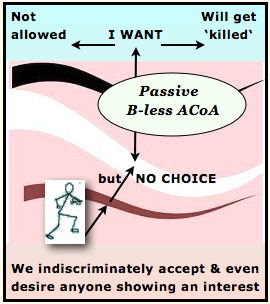
d. No Boundaries – No Choices
Un-recovered ACoAs, even those of us who see ourselves as strong, smart, adventurous…. act like victims because we don’t internal permission to choose who we connect with & who we leave behind, from a deep sense of powerlessness!

Without Bs we fall into the co-dependent trap, because:
• we’re so afraid of having to face our abandonment pain, AND our S-H says no one can possibly love us . What a double bind!

So when someone ‘wants’ us – our WIC is so relieved – that we accept them, even though they may be totally inappropriate, self-centered & just using us as their narcissistic supply.
Often some deep part of us knows they’re unsuitable, it won’t work out & we may not even really like them! BUT —

• we convince ourselves to stay, because they have some qualities we find appealing, maybe similar to ourself – even though it’s not nearly enough to offset the enormity of their dysfunction (addictions, depression, self-hate, immaturity, narcissism, controlling, cruelty…)

• we’re afraid to reject anyone, worry about hurting their feelings, identify with their pain… instead of honoring ourselves (we identify too much with their WIC, while ignoring our own!)
• we focus on fulfilling their needs, wants and demands, so they won’t get upset & shut us out – while most of ours go unmet.

NEXT: ACoAs & Bs (#3)

BOUNDARIES & ACoAs (Part 1)

Screen Shot 2015-06-25 at 12.05.31 AM 

I HATE YOU – DON’T LEAVE ME!
I need you but you’re too close – I can’t breathe

PREVIOUS:
Bs – Healthy Source ( #2)

REMINDER: See ACRONYM page for abbrev.

1. Normal Development – Stable Core (previous 2 posts)

2. ACoAs
Unfortunately, growing up – ACoAs did not originally have that all-important stable core to rely on, so weren’t able to form our own, because of:
• being overstimulated by chaos, emotional volatility & conflict
• being over-controlled, expected to be perfect, judged harshly
• not having role models for self-esteem & appropriate Bs
• not being loved & supported unconditionally

a. Wounded Adults
• Many un-recovered PARENTS are symbiotically enmeshed with their children, to cover their own FoA – ie. both the adults & the kids have similar immature mental drama & temperamental intensity, so they overlap each other, which is emotionally abandoning & terrifying for the children

• These parents function from their WIC’s ego state, so have:
— weak or no Adult & missing Loving Parent aspects
— weak or rigid boundaries, overlapping child’s feelings, as if the child were only an extension of themselves
— a narrow range of emotions available, w/ few nuances
AND
— their focus was on their addictions, bad relationships, financial worries, depression, mental illness, relatives, sickness ….
— often changed the rules arbitrarily or made them unreachable, so no matter how hard we tried to obey, it was inevitably going to be wrong – & then we got attacked & punished! We could ‘never win’.
As kids, this kept us off-balance so we wouldn’t become independent (& eventually be ‘separate’), which requires being sure of oneself.

Al-Anon visual: the alcoholic has their arms around the bottle & the co-dependent has their arms around the alcoholic!
In these households, children are just pawns to be used & burdens to be neglected, ( Games Alcoholics Play’)

b. Limiting our Emotionsnegate Es
• In an alcoholic, narcissistic family, one or both parents limit or repress the type of emotional responses allowed the children, who are expected to act like adults, both mentally & emotionally, long before maturation.
ACoAs were blamed for not behaving ‘right’,  even thought we were not experienced yet in social etiquette or subtleties, didn’t have enough motor co-ordination, weren’t old enough to actually act like adults!….

EXP: Beth was a pretty little girl who grew up in church. On one occasion her mother was at the dais addressing a Ladies Group. Beth was left all alone in the front pew & expected to sit for 2 hours like a perfectly groomed doll. But she was a normal 4-year-old – bored, lonely & fidgeting. Her mother was annoyed at her child’s ‘misbehavior’, confident it would make her look bad.

She gave Beth ‘the look‘, who immediately froze – terrified – knowing the dire consequences of displeasing her mother, but quick obedience saved her this time.
For years afterward her mother proudly liked to tell how the group afterward complemented heron having such a well-behaved child. Sadly – neither the mother or anyone else ever had a clue of the intense terror that was generated that day!

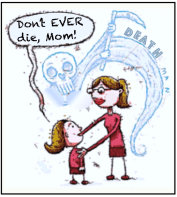
• We learned very early that our emotions & behavior had global impact – they effected the ‘gods’ badly. Our parents let us know blackmailin various ways that we harmed them just by being ourselves (kids). EXP: A mother repeated remarked : “You’ll be the death of me yet!”

• Many ACoAs experienced being emotionally blackmailed controlled using fear, obligation or guiltOur parents’ narcissism & lack of boundaries made it easy for them to:
— treat us the same way they had been – the ‘kick the dog syndrome’, ie. passing on their rage at their parents’ neglect & abuse
— project their self-hate onto us – they couldn’t face that they were considered ‘bad’ children’ so they made us bad instead – to preserve their fragile self-image

EXPs: “If you loved me…. I made that just for you…. If you don’t do your chores, dad will get really mad at me….
BOOKs: “Emotional Blackmail”  & “Toxic Parents“~ Susan Forward

NEXT: ACoAs & Bs (Part 2)

BOUNDARIES – Healthy Source (Part 2)

mom-child bond 

I GET ALL MY NEEDS MET
& I don‘t have to do anything!

PREVIOUS: Bs – Healthy Source (Part 1)

REMINDER: See ACRONYM page for abbrev.


1. NORMAL DEVELOPMENT (cont.)
While going through the Developmental Process, children look to their parents to be the source of all PMES provisions:
• Parents are experienced as ‘gods’ = all-powerful, all-knowing, all-providing, & baby has direct access, without having to earn it

• Small children have strong & erratic emotions. When the mother is not emotionally fragile – their adoration, clinging, neediness, tantrums, withdrawals, rages…. will not injure or topple ‘god’ – ie. Love is NOT conditional on the child’s behavior or reactions towards the parent. When her love is unfailing, the universe is safe!

John Bradshaw often stated: Before the age of 7 children ‘deify their parents, & after 7 they parentalize their Deity’. This means that how we experience a Higher Power is a reflection of how well or how badly our parents treated us! But this is not who God is, since He has no weakness. A truism from ACA meetings is that “God is NOT an alcoholic parent”!

• Without their own boundaries, infants need the mother’s affection & attention to not be ambivalent, because babies have to deal with:
External stressors:
Too much input coming at them from many sources, which thebaby stressy can’t process by themselves. Mother needs to arrange their world to minimize over-stimulation, while also providing the right amount (touch, music, talking…). Her ability to limit internal & external excitement for baby is a substitute for its lack of defenses, until it can mature to form it’s own
Internal stressors:
Physical needs: hunger, wetness, gas / need for safety & comfort…. for caregiver to protect from discomfort & pain = holding, burping, changing, feeding, attention, affection….

Emotional reactions: extreme, all B & W, without grays – rage, terror, intense frustration, as well as over-excitement, joy, pleasure…. Need for mother to tame & channel emotional buildups before they explode, by breaking into the child’s ‘trance’ of intensity, whether too high or too low.
Also to limit & protect child from their own behaviors (pounding their head or first, throwing a tantrum, manically running around, screaming with excitement….)safe connection

Mother needs to have good Bs, so she can:
• be emotionally available & responsive to baby, AND provide a one-way affection bond, allowing the child the freedom to develop in a protected environment, without having to take care of the adult
• give baby reliable non-verbal communications & appropriate interactions, to establish the child’s ability to trust others
• clearly give the message that having needs & getting them met is normal, acceptable & will not harm her in any way
REMEMBER – It’s not possible to have sound boundaries without the right to having needs

In a HEALTHY family, children learn that:
• parents’ emotions are consistent & separate from those of the child
• parents do not compete with their children for anything: not for attention, affection, information, skills, friends, support, validation….
• kids are allowed a wide range of emotions without punishment
• extremes of emotions do not usually indicate ‘reality’ (danger)
• managing all emotions is taught, directly & by example
• a distinction is clearly made between real trauma & small problems

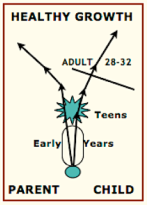
CHART: Healthy Attachment & Separation
Birth: mother & child are ONE – normal symbiosisS & I
Early years: parents are a stable, consistent source of comfort and knowledge. Children’s emotional life is intense & extreme, fluctuating a great deal.
As they grow, they need the opportunity to move away from under the parental wing for self-expression & then back again, knowing they’ll be welcomed without judgment AND without hurting their parent’s feelings or ego for being a separate entity!
The child can make mistakes, be emotionally dramatic, learn about their capacities & limits, knowing there’s a safe base to return to.

Adolescence: a time for more distinct separation & individuation. Some rebellion is necessary, & separation is achieved by forming outside attachments, including limited sexual interplay
Adulthood: a clear sense of self.  Parents are never peers, only other adults whom we value & love but do not n-e-e-d!

Next: ACoAs & Boundaries (#1)

BOUNDARIES – Healthy Source (Part 1)


I HAVE A RIGHT TO BE HERE –
I feel safe & loved

PREVIOUS: Bs Defined (#2)

See ACRONYM page for abbrev.

The TIES THAT BIND
• Having boundaries (Bs) is the opposite of being enmeshed (symbiotic)**. Humans are not born with Bs, & have to develop them with the guidance of healthy nurturing, so the main caregiver (usually the mother) needs to be a secure base from which the infant can safely explore its environment.

A well-grounded mother experiences the child as separate from herself, although from her body, so even if she’s anxious or sick, is able to be nurturing because she finds the helplessness & needs of the baby irresistibly appealing. She is not overwhelmed or put off by them, like in alcoholic / dysfunctional homes

• With the proper care, gradually the all-consuming ME of the child will separate from the NON-ME (all others), & personal boundaries are formed.  Being given a solid foundation is crucial before the age of 9 or 10, as by then our defense mechanisms are SET, & a bad beginning will generate a harmful crop of ‘negative protections” that are hard to change

**Symbiosis: At birth: “….is experienced by both the mother & child as a temporary merging or sharing of their needs”, an important early phase of omnipotent fusion (very deep) between the two, In a safe environment, this merging is gradually given up by the child over a long process of S & I. 

This infant’s experience is: I cried, I got fed, aren’t I great! This sense of invincibility is alternately —
— ascribed by the baby to the grandiose Self –> “I’m all-powerful”
— & about the idealized mother/caretaker –> “She’s all-powerful”
As the child separates & internalizes the parent, IF it’s a loving, healthy experience, he or she can safely become their own person, with a sturdy sense of self-hood, along with a Positive Introject

•  When this satisfying connection is not available or not adequate for the child, it spills over into adulthood, so that in unhealthy relationships: “…. symbiosis is still going on, occurring when two or more individuals behave as though between them they only have one complete personality….”, rather than being 2 separate people.

Neither have a full complement of ego states, so that one person acts from their Adult & Parent while the other only from their Child part – forming one false ‘whole’ ‘between them.
This is why it’s so hard for co-dependents to leave what others may see as destructive attachments – they would be cutting off a ‘part of themselves‘ since they haven’t yet grown their own complete identity.

1. Normal Development
• Children are highly intuitive, intelligent & curious. But at first they experience little difference between Self & others, between inner & outer, fantasy & reality.  The work of Mahler, Kernberg, Hartmann, Spitz et.al. identified 3-4 important developmental stages – not in a straight line but more like a fluctuating helix:

i. Autistic or Undifferentiated = in the first month of life, during which the infant is in its own inner world, with a minimum awareness of ‘others’, focused on reducing physical (hunger, wet diaper…. & emotional tension (fear, uncertainty, loss….)

ii. Symbiotic = for the next 4 months, the infant becomes more aware of the mother / caretaker as the source of fullness & warmth, but not as a separate person

early developmentiii. Separation-Individuation (S & I)  = made up of a series of sub-phases, thru the 3rd or 4th years of life, when the child begins to investigate the world beyond its own body through sight, locomotion, language…. & later, conflicts with mother about needing her vs. needing some independence, which requires much help in balancing

iv. Object Constancy, developed during the S & I period (if allowed!) around age 2 1/2 to 3, when the child is capable of experience both the good /providing & bad /withholding sides of the mother as one whole, as basically dependable & trustworthy, not perfect but not dangerous — assuming she’s mentally & emotionally sound! (MORE….)

NEXT: Bs – Healthy Source (Part 2)

BOUNDARIES Defined (Part 2)

gates 3IT’S UP TO ME
what I allow in, & what I don’t agree to!

PREVIOUS:
Boundaries Defined (#1)

REVIEW: My Rights – Qs. & Having Rights


Joy2MeU
: “One task in recovery is to learn to re-align our defense system with healing & Love, instead of self-destruction.”

VISUAL IMAGES of Boundaries (Bs)
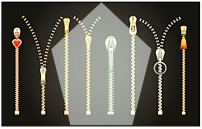
a. As a ZIPPER
Bs can be seen as an impermeable but clear energy container completely surrounding us, with an invisible zipper down the front, from head to toe. We can see out & others can see us, but we are inside a protective shield. The zipper allows for easy access, but what’s of major importance is whether the zipper tab in on the inside or the outside!

➖ EXTERNAL: If the tab is on the outside, anyone we invade us by pulling it up or down, as they please, so we’re always at the mercy of others
➕ INTERNAL: If it’s on the inside, then WE decide when to open ourselves up – or not. ALSO, how far down we pull the tab speaks to how much of ourselves we choose to expose, depending on the situation & our current state of mind (even with the same person or environment).

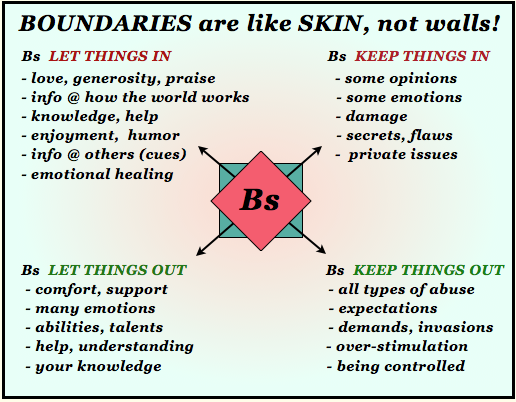
b. As our SKIN (like on our body) IT:
• breathes, so it lets toxins out and take in nutrients
• can be injured, but also repaired
• covers us completely, thus containing all our physical components
• is elastic, so can expand & contract….

Bs as skinPURPOSE of Boundaries
They are ‘Ego Barriers which are needed to guard our Inner Space, so we can:

1. Deal with the OUTSIDE WORLD positively
by Screening : protect from danger or unpleasantness, TO
— cut down intake of too much noise, info, activities, people
— eliminate toxic people, substances, locations – whenever possible
— protect from subtle manipulation, too many demands, confusing communications – anything that can inundate us

by Interpreting: understand the specific meaning of something
— TO be able to read people & situations accurately
— not assume everyone or everything is dangerous to us
— correctly assess what someone is saying or wanting from us
— think of 2-3 different causes for events – not just bad ones

2. Manage our INTERACTIONS with the world
by Modulating oneself: temper, soften, tone down, vary, TO
— not over-react to ‘normal’ situations
— choose when & where to be boisterous vs silent, angry or rageful, when to fight vs back down….
— know when to say something & when not to, and how

by Regulating oneself: adjust according to a standard in order to insure success, TO
— behave appropriately, depending on the venue & event – based on  self-respect
— pick the right time to ask questions, conduct business, communicate our upset or bad news…. with someone
— accomplish a goal : follow the rules of the relevant group we want to interact with – if not in conflict with our personal values

QUADRANTS of Interaction — dealing with struggles, using Bs
Q 1 – Open with Self : identify Bs you can practice on yourself, setting limits on self-defeating acts
Q 2 – Open with others : be available to help or participate with, as it fits who you are
Q 3 – Closed with Others : about the Takers in life, so be sure to set PMES limits with them, to protect your energy output
Q 4 – Closed with Self : TOO self-disciplined – need to release rigid Bs. Take breaks & put the joy back into your life.

NEXT: Boundaries & ACoAs (Part 1)