Personal POWER – in Business


PREVIOUS : ACoA POWERLESSNESS

SITE : “Be Humble, and Proudly….
☆ 
8 Things that Cause your LACK of MOTIVATION (& how to fix them)

NOTE: Here are 3 lists of PERSONAL & LEADERSHIP POWER characteristics – with some overlaps.

A person who uses Power RESPONSIBLY considers it an unwritten psychological contract with a person or group – always to help & improve.

FROMPower: Why Some People Have It – and Others Don’t“∼ Jeffery Pfeffer

❖ Ambition “Success requires effort & hard work as well as persistence.”
ACTION :  Be goal-oriented. Knowing where you want to end up makes it easier to overlook big frustrations & daily annoyances that could otherwise distract you

❖ Ability to Tolerate Conflict “If you can handle difficult conflict & stress-filled situations effectively, you have an advantage over most people.”
ACTION : Build your skill in dealing with conflict, positively & wisely. You’ll have the advantage, since most people are conflict-averse, & so avoid situations where they have to engage others in emotionally difficult conversations.

❖ Confidence “Because power usually allows someone to be acconfident, observers will associate mature behavior with actually having power.”
ACTION : Your title can represent power, but when you’re working with people who don’t know your background, actions speak loudest to prove i

Empathy “Consider other people’s agendas & reactions by putting yourself in their shoes, not just being focused on the end goal & your own objectives.”
ACTION : To succeed at negotiations, assess where the other person or group is coming from

❖ Energy “Energy is contagious, like anger or happiness.”
ACTION : Inspire others by harness your energy, showing your commitment to the group or organization, & the willingness to put your time into achieving goals

❖ Focus … you’re more likely to gain power by narrowing focus & applying your energies to a limited range of activities in a smaller number of areas.”
ACTION : Specialize when you can. It provides a depth of understanding & a substantial web of concentrated relationships

❖ Self-knowledge “There’s no learning & personal development without reflection.”
ACTION : Learn from experience what works & identify what you need to do differently next time
✴︎      ✴︎      ✴︎ 

🤓 PERSONAL MASTERY areas to develop for positive leadership (Alfred Chung) :
🥉 Character & attitude: Cultivate versatility, appreciating multiple world-views different from yours – with curiosity & gratitude, no matter how much you know.  This empowers you to manage yourself, so you can show up with humility, regardless of your role or status.
While Humility is not the boldest of personality traits, it’s an important one. And it’s hard to fake. To increasing your potential for success, work on your core motivations, as well as your personal blindspots.

🥉Emotional mastery: Learn to regulate your internal reactions & emotions, which will enhance your thought process & resourcefulness

🥉Mental rehearsal: Rehearse & refine your thinking with variations & possibilities, to see what will work best in each situation. Be innovative when changes are needed, like generating strategic winning moves in a chess game.

🥉Observational skills: Know what to watch out for. Hone your ability to read people & situations, especially subtle signs & cues. That will allow you to better understand what others are communicating by what they’re not saying.

🥉Sense of timing & rhythm: It’s counterproductive to rush through the process when you’re eager to achieve something.  Using observational skills & Developing multi-intelligences along with observational skills, you’ll know when to come in, when to step back or when to leave – to improve conditions for others to be in peak performance.

🥉Physical agility & resilience: Stay aware of your body posture, gestures, inner sensations, energy & movements – to better align & support the above abilities without burnout.

INVENTORY
❧ What does power mean to me?
❧ Is power important for me to have?
❧ Is there one most important quality to gain power?
❧ 
What qualities do I have that are my strengths?
❧ What qualities would I like to develop ?
❧ What am I already working on?

(FROM: Jennifer Stangl, Director of Professional Development at CUES)

NEXT : POWER

POWER – Employee Resistance to CHANGE

PREVIOUS: Manipulation in biz (#2)

NEGATIVE – RESPONSES
Managers & supervisors need to see employees’ (good or bad) reactions to organizational changes as a normal part of the restructuring process.

√ Anger
Some employees are so resistant to change they become frustrated & angry. a typical reaction when employees feel a loss of control over their work environment, or worry that their job security is being threatened. If they suppress the anger will  cause an increased stress level. If it’s overt, it can end up in emotional outbursts.

√ Gossip
Gossip, always an organizational challenge (& staple), will escalates during periods of change. Employees who experience a loss of power & control can respond with frustration, anger & disbelief, resorting to vicious gossip or “back-stabbing”, which obviously is detrimental to a positive forward movement toward restructuring

√ “Not me!”
Employees asked to do a different job or change the way they currently do a particular task may react with: “Not me!” They may deny being able make the proposed change &/or suggest that someone else is better suited for the job. Their initial reaction is from being satisfied with the status quo, & fear of the unknown.

√ “I quit!”
A few employees prefer to quit rather than make the required changes. Unfortunately for them, changes are going on in other organizations as well. Choosing to stand on one’s principles & fight the ‘new’ by quitting may make their point, but usually at their own expense, not the organization’s.

√ Panic!
Some employee find comfort in predictable routine, & panic at the mere mention of change. They worry about chow to deal with major shifts in the way they normally do their work. They’ll resist, not out of stubbornness, but rather out of fear about how the changes will affect them personally, & so unable to deal rationally with the “new regime”. Some may even become physically ill.

√ “What will this do to my job security?”
It’s natural for employees to first consider the impact of change on their own job security & the possible financial impact, & only secondly regard the needs of the organization. They can’t help wondering what will happen to their position if tech advances are added, or if downsizing creates losses. Will changes result in less work for them, or even do away with their job altogether?

√ “Who’s in charge here?”
When a company is restructuring, it’s natural for employees to question leadership. Working for a new supervisor may make it hard to change allegiance from one  manager to another. If employees have not been kept in the communication loop & so don’t see the benefits of the new policies, they’re likely to question the wisdom of the new leadership.

POSITIVE RESPONSES
These are people with a good amount of self-confidence & clear sense of personal competence. They’re open-minded, seeing change as a benefit – for everyone. When aligned with a supervisor, they can support & ‘sell’ organizational shifts to other employees.

√ Enthusiasm
Some employees naturally approach life’s challenges more enthusiastically than others, able to embrace newness. Instead of picking apart a proposed change to find all the ways it won’t work, they see it as a natural part of the organization’s growth. Supervisors lucky enough to have such employees need to support & nurture them, since their enthusiasm can ‘infect’ coworkers, which helps make implementing changes more palatable for everyone.

√ “Maybe I could adjust to this change . . . .”
Some employees watch from the sidelines, but stay open-minded. After observing for a while, they may agree to give required changes a chance. While not initially eager participants, they’re at least willing to consider adjusting. This includes learning new techniques & procedures, without sabotaging.

√ “This is a challenge!”
Employees who see change as a challenge can rise to the occasion, since they know they have what it takes to be a contributing team player. With a “can do” attitude, they’re open to new ideas, will ask relevant questions & feel confident in their ability to learn whatever new info or skill needed to complete projects. They may admit a new task is difficult, the procedure at first a bit cloudy, & the outcome unknown or questionable, but they’re committed to solving problems.

√ Positive Vision
A few employees look at the big picture & visualize possibilities.Their positive attitude toward change is based on a realistic awareness of the marketplace in their specific industry & the company’s competitive position in it, which helps them trust leadership. Feeling enthusiastic about the company’s future, these employees create a positive vision for their coworkers in a time of confusion, which encourages them to also consider future benefits.
(Modified from peterstark.com)

NEXT :

POWER – RESPONSES to Power Bases


PREVIOUS: Power Bases

SITEs : Right Way to Respond to Negative Feedback 

5 Secrets to Giving Constructive Feedback


REVIEW : 2 main FORMS of Power
1. COERCION (‘Hard’) : threaten to use force, actual use it &/or use negative sanctions.  Pain or punishment is inflicted by person A, who possesses power —> toward B, who has less power

2. INFLUENCE (‘Soft’):  No threat or use of force. Most common & Most effective, esp. important when coercion is not possible.
EXP: political speeches, journalism, media & advertising, inter-personal relations, classrooms….. 

a. by Persuasion: Person A is sincere, using the “force of the better argument”, by explanations, examples, illustrations, justifications.

b. by Manipulation : Person A conceals their true intentions : lying, real reasons not given, lack of informed-consent by actor B.

Aspects of power
Relational : 
 based on the social relationship
Sanctioning : an active component of the power relationship, as direct manipulations of the other’s outcomes, using rewards or punishments.
Dependency : power residing implicitly in the other’s needs, particularly evident in organizations with inter-dependence of personnel & ⬅️ subunits (horizontal power / relationships across departments).

DEPENDENCE is an important aspect of supporting power. Possession of or influence over an organization’s resources which someone needs, gives the resource-holder power. The greater B’s dependence on A, the more power A has. Power increases when the resource are :
🥊 Important = must be valuable & worthwhile, because If nobody wants what you have, there’s no dependence
🥊 Scarce = difficult or impossible to achieve, or to find elsewhere. EXP: If there are few workers relative to demand, they can negotiate compensation & benefit packages
🥊 Not substitutable = one-of-a-kind, so can not be replaced. The fewer viable substitutes for a resource available to the user / consumer, the more options they have to evade dependence.

However, individuals / groups / organizations can minimize dependency by co-opting, contracting, using co-operative strategies & seeking prestige. (Do Tien Long)

❇️ REVUE posts on Power Bases – to see the different managerial styles that employees react to. 

A POWER BASE is effective to the extent that it produces both attitude & behavior compliance. ‘Attitudinal’ refers to how well the subordinate is willing to follow the bosses directives or wishes. ‘Behavioral’ is the accuracy & extent to which the subordinate actually carries out those instructions.

CONSEQUENCES of Positional & Personal Power (UK research, 1999)
Coercive P lead to employee resistance, decreased job satisfaction & increased mistrust of leadership
Legitimate P is the common style to evoke compliance with boss’ requests, but not correlated to task commitment
Expert & Referent P – used as influence by effective leaders : positively correlated with subordinate satisfaction & performance

• Rewards – when announced, lead to higher employee satisfaction & performance – if the reward is what they want
• Punishment – some – when combined with rewards, can have a positive effect on subordinates performance

★ COMPLIANCE = Subordinate is willing to do what the leader asks, but may be apathetic rather than enthusiastic, with only minimal effort
★ COMMITMENT = Subordinate agrees with decisions or requests, & makes a great effort to cary them out effectively

OBEDIENCE / CONFORMITY
Generally, people obey either thru coercion, consent, or some combination. However, at present – obedience has become a form of social conformity, in response to authority. But it is not inevitable & varies in degree depending on the situation.
WHY OBEY ? : 🪞Fear of sanctions (punishment)
🪞Indifference, Habit, level of Tolerance
🪞Lack of confidence in themselves, their judgement or capacity to DO
🪞Psychological or emotional identification with the leader
🪞Moral Obligation  = if command is considered legitimate &/or as an accepted norm of conduct, common good of society, superhuman efforts
🪞Self-interest = direct / indirect financial gain, in relative power position, for personal prestige   (From ‘Dynamics of Power‘)

★ RESISTANCE = Employee is opposed to the leader’s request & tries to avoid it.
A high proportion of change-initiatives flounder because of employee resistance. To succeed, leadership must pay attention to all forms of employee reactions during organizational changes.

LEADING & MOTIVATING
Group Leadership does not consist of one-formula-fits-all. Every team’s needs & desires are different, so specific leadership strategies are needed to achieve differing goals.  (See Leadership styles & Managerial TYPES)

A team member’s motivation may be both extrinsic &/or intrinsic.
• Intrinsic = the energy that comes from within the person – wanting to help achieve the work goal, because it aligns with the person’s own beliefs.
EXP: If team members finds the assigned task specially interesting, it will motivate them to implement it efficiently.

• Extrinsic = from external sources, & the manager is a key component who can use several ways to accomplish this.  EXP: Rewarding &/or punishing team members, to push them to do a certain project.

Intrinsic motivation is considered the best motivator, but managers can also help team members achieve this. (More…. )


NEXT: Employee resistance to change

POWER – BASES : Positional & Personal


PREVIOUS :
POWER Sources, Personal / Positional


Source credibility directly impacts the effectiveness of whichever power base is used to persuade others, that is – a communicator’s positive or negative characteristics will affect the receiver’s acceptance or rejection of a message.


ORIGINS
: Social psychologists John R. P. French and Bertram H. Raven conducted a remarkable study about power in 1959. They divided it into 5 separate & different Power BASES, which explain leadership’s way of thinking, action & decision making. Later research added several other forms.

1. POSITIONAL POWER BASES
a. Coercive
– leader based their interactions on fear, the ability to impose their will by threat of sanction.  They’re in a position to punish others for nor doing what’s needed or what they wanted, such criticism for bad performance, threat of firing, lowering a bonus, changing vacation times, demotion, or firing. Its the opposite of REWARD

b. Ecological – The power to control the physical environment & structure in which people work, & making changes accordingly, understanding that these play a significant role in shaping human behavior.  Such power can be wielded with simple techniques such as temperature or lighting adjustments, or with complex architectural designs meant to enhance specific behaviors of employees.

c. Informational  – The power that come from access to information, such as control of data gathering & distribution, & to influence using facts & data. It’s the basis of decision making & leadership, so analytically strong people use it keep power. On the flip side, there are the gatekeepers or information hoarders, who thrive on the negative power & control, which harm specific teams & the org as a whole

d. Legitimate – The epitome of positional power, it comes from the authority of a person’s place in a hierarchy. But it also depends on a group of people willing to defer to seniority,

e. Reward – This stems from the inducements or rewards a leader can offer for doing what they want others to do or what’s needed to be done for the larger benefit. This can be intangible such as verbal praise & encouragement for good performance, or tangible, such as assigning  projects, giving raises or promotions….

2. PERSONAL POWER BASES
a. Avoiding Power – Refuse to act, get involved, or make decisions (eventually someone will get the message). This can only work if the person has enough personal clout to get away with avoiding going along with someone else’s agenda, either of a peer or a corporate entity without endangering their own position. However, it can harm the organization

b. Connection – This comes through networking – being able to use links to other influential people to support ones own, more direct, power. If the manager or leader does not have much of our own power to offer, the connects are not very useful, which become little more than reflected glory.

c. Expertise – people who have achieved some level of mastery of a subject, gained through knowledge & skills developed through study, practice & experience. but needs to be in kept current to maintain this power base. It gives such a person an authority that often commands great respect. Can be Neg or Pos – others will believe this person because of their level of knowledge, BUT may lead to following their advice against Co. policy or project goal

d. Referent – is the influence gained through personal relationships, charisma & likability, & used with or without integrity. Manager or leader can be being respected or admired by the team or stakeholders because of positive past experiences with this person….).
EXP: Persuasive Power, such as the ‘sales pitch’ – someone who can effectively ‘push‘ people toward a specific outcome or decision. (See future Post: : “Power – Influence Strategies“)

e. Resource – Neither Information nor Connection Power satisfactorily account for the power that certain ‘gatekeepers’ have in organizations. These people control access to wider resources: funds, equipment, supplies….. They’re often middle-ranking, junior or administrative colleagues with little legitimate power, nevertheless wield Resource Power by proxy, to meet their need for control in their workplace.

 NEXT: REACTIONS to Power

POWER – Tactics, Targets


PREVIOUS: POWER Leadership


USE of POWER BASES
DEF: POWER TACTICS (PTs) are the ways a power-user (agent) translates power bases into specific actions.
In 1956 Norman H. Martin & John Howard Sims wrote an article about Power Tactics.
Beneath the general principles, attitudes & ideals of ‘human relations’ lie the actual tactics & day-to-day techniques by which executives achieve, maintain & exercise power. Whether in business, government, education, or the church – executives have power, and use it.
They maneuver & manipulate to get a job done &, in many cases, to strengthen & enhance their own position. Power & politics are concerned with relationships of control or of influence. ” (More….)

Power tactics used to push or prompt others into action can be grouped into :
a. Behavioral – Soft tactics take advantage of the relationship between the power-person & the target. Hard tactics are direct, forceful & harsh, relying on concrete outcomes
b. Rational – make use of reasoning, logic & objective judgment (bargaining, persuasion), whereas non-rational tactics rely on emotionalism & subjectivity (evasion, put-downs)
c. Structural – exploit the relationship between individual roles & positions. Bilateral tactics (collaboration, negotiation) involve reciprocity from both the influencer & the target. Unilateral tactics are used without any participation on the part of the target.

Power involves the ability of one party – the “agent”, to influence another party – the “target”, and sometimes the agent is a group or org. rather than an individual. Influence can be over a single target person or over many, but the agent’s target can also be over things or events, attitudes & behaviors

People tend to vary in their use of power tactics according to who they are trying to influence & based on the group situation. EXP: Interpersonally oriented people tend to use soft tactics, and extroverts employ a greater variety of tactics than do introverts. Studies have shown that men tend to use bilateral & direct tactics, whereas women tend to use unilateral & indirect tactics. In the face of resistance, people are more likely to shift from soft to hard tactics to achieve their aims.

TARGETS : Power involves a reciprocal relationship between the agent (Ag) & the target (T) . This can be boss & worker, parent & child, advertiser & consumer….  teacher & class, minister & congregation, President & the Nation…..
TARGET AUDIENCE – a group of people who share certain characteristics such as ethnicity, values or lifestyle

The effectiveness of power tactics (PTs) will depend on how easily influenced the target is, which will depend on their :
a. Age – susceptibility to influence is strong in young children up to about 8 or 9, then decreases with age until adolescence, when it levels off
b. Culture – characteristics of the target’s culture affect their influenceability. EXP: people from an authoritarian culture are highly susceptible to influence, & vice-versa.

c. Dependency – how strongly the T needs what the Ag has. If the dependency is high, power influence will be high, or vice-versa.
d. Gender – as society’s views of the role of women are changing, there is less of a distinction by gender of influenceability

e. Intelligence – it’s been observed that more intelligent people are less susceptible to influence generated by Positional Power
f. Personality – research studies show a relationship between personality & influenceability. EXP: people who cannot tolerate ambiguity or who are highly anxious are more susceptible

g. Uncertainty – when the Agent is unsure about how appropriate or correct their actions are – it can determine their ability to influence their target about those same actions. Research: the more uncertain someone (T) is about the ‘legitimacy’ of a behavior, the more likely they’re influenced to change that behavior.

The CHOICE & USEFULNESS of PTs is influenced BY:
✫ Culture of the org., which affects user’s choice of tactic
✫ Country-specific culture – local values favor certain PTs over others
✫ Relative power of the tactic user – some tactics work better when applied downward, others are better upward
✫ How the request is taken – is it consistent with the target’s values?
✫ Type of request connected to the PT – is it legitimate?
✫ Sequencing of tactics – softer —-> harder work best
✫ Skillful use of whichever tactic is chosen

NEXT: POWER Characteristics

POWER – Sources, Positional vs. Personal

PREVIOUS :
Power Characteristics (#2)

SITE : Feel the Power: Flexing EQ”


QUOTE: “The desire to impact others (nPow) can be responsibly sought for the purpose of doing good for the organization. NOT ALL power seekers are neurotic, despotic or troubled people (though some clearly are).
They can be effective, well adjusted & highly motivated. It turns out that power is the ultimate resource for human control, a tool that only the mentally healthy can wield successfully.” (McClelland 1982)

 General POWER SOURCES
🧩 Allies : 
numerical strength to support the positions held
🧩 Asset : from an accumulation of assets & possessions that are considered valuable (money, property, art…)
🧩 Authority : Social, Political, Religious, Military.  Demographics (individuals, populations, generations). Having access to human
resources, especially of high quality = educated, loyal & committed
🧩 BATNA availability =”Best Alternative to a Negotiated Agreement”. Having more back-up plans & options lead to more negotiating power

🧩 Bureaucratic : through practical intelligence & knowing how the system works
🧩 Expertise : skills, experience, including  implied knowledge
🧩 Information : being the only source of needed facts, plans, resources, outside connections
🧩 Intangible factors : character, charisma, competence, courage, honor, leadership, morale, prestige of position, reputation, social status

🧩 Material resources : agricultural or industrial output, cybernetic / information, natural resources, military capability
🧩 Mass Media : newspapers, all on line platforms
🧩 Network centrality : one group holding power over other groups
🧩 Sanctions : the ability to impose them, & how effective they are
🧩 Situational : temporary – granted to a person to deal with a specific problem / crisis (disasters), based on their special knowledge & skill
🧩 Time : dealing with time pressure, the ability to set time deadlines & making sure they’re reached, access to arbitrary free time

Expressions of GOOD Power & Politics
PROCESSES 
Acceptance of the rules of the ‘game’, consensus of core values, creative turbulence, empowerment , open conflict, positive-sum ‘games’, shifting coalitions & interests
OUTCOMES
Adaptiveness, abolish unproductive routines, flexibility, increased efficiency, overcome dependency & inertia, root out entrenched interests

MOTIVATION Factors = TURN-ONs
Achievement, Interesting & Challenging Work, Increased Responsibility, Involvement in Decision Making, Recognition for Accomplishments, Personal growth

MAINTENANCE Factors = KEEP-ONs
Administration, Company Policies, Interpersonal Relations, Money, Security, Status, Supervision, Working Conditions

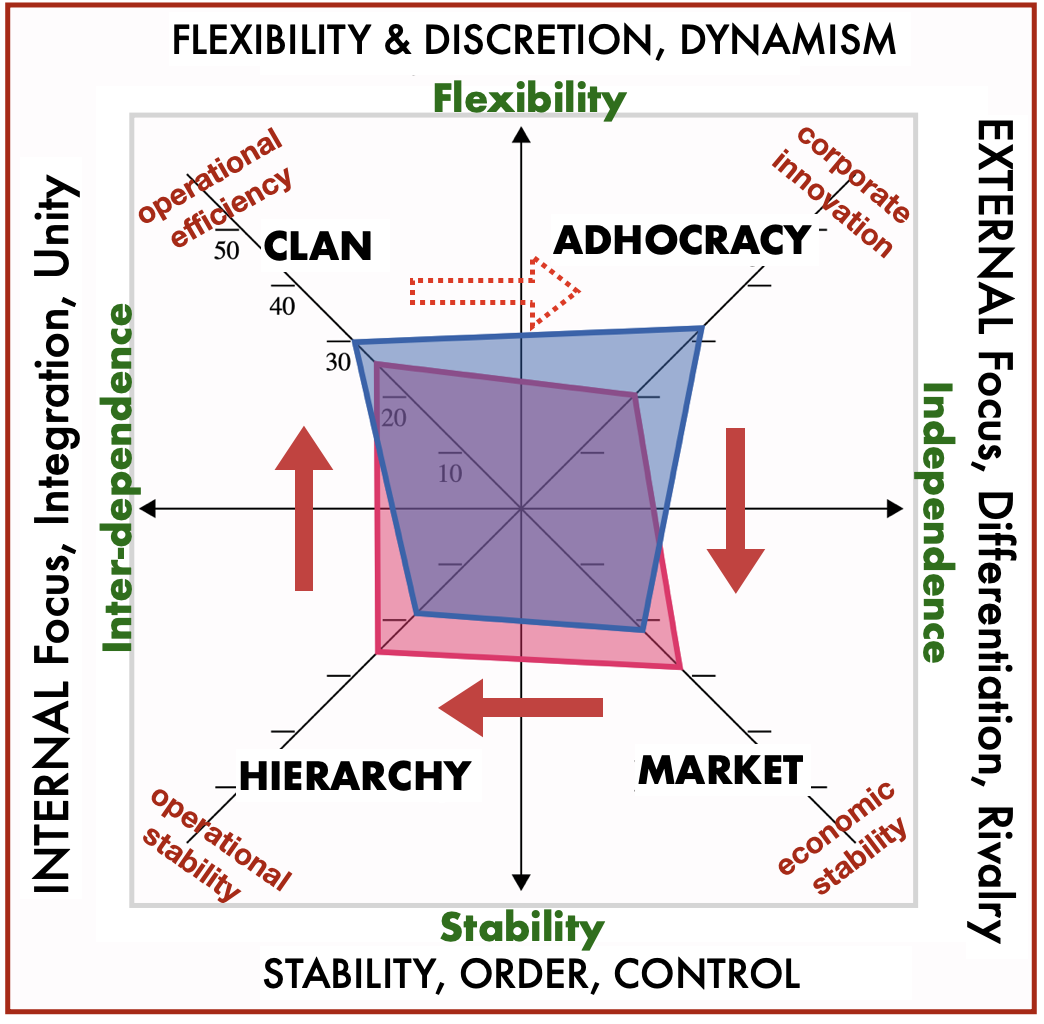
🧳 In the corporate world, Power Styles used by senior managers directly influence the organization’s risk levels. Interestingly, power & politics are unacknowledged topics in the corporate world, so when risk managers do assessments, they ignore both. Depending on the circumstance, a leader needs to use various power styles. CHART compares extremes.


INTERPERSONAL POWER in Organizations (org.)
“Positional” (Hard): This is straight-forward top-down power, & comes with the title, budget, headcount & role – for whoever has the position. The power-holder is bound by organizational / institutional rules & regulations, with the aim of making sure people work together to reach the company’s goals.
Imagined as a math formula it would be:  COO > VP > Director > Mgr > Analyst.
This form does work, but like a hammer – blunt, short-term & tiresome. Like telling your child to do something, & when asked “why”, you answer : “Because I’m your father, & I said so.” It works, but it’s not really the best way to parent.

INDIVIDUAL POWER – in BIZ
“Relational” / Persuasive (Soft) : This is the primary currency in large organizations.  To be a highly effective leader, one needs something more than just a designation or title. Personal power flows from the leader’s internal features, such as credibility, experience, intelligence, skills, self-confidence…. Therefore, it cannot be taken away.

Such power is used to encourage people to work together, help each other out, team-up for success, forgive mistakes, & generally have each other’s back.  History is shared & so they become inter-related.
(“Influence” ∼ Robert Cialdini)

Best ACTIONS for the most profitable use of Power Resources:
Assertiveness, Coalition formation, Exchange, Ingratiation, Rationality, Upward appeal.
Most EFFECTIVE Base : Expert Power – Provides the organization with vital knowledge, abilities & skills. Employees learn from talented managers & internalize what they observe, to use on projects.

NEXT: Power Characteristics #4

Being AUTHENTIC (Part 3)


PREVIOUS : Develop Authenticity (#2)

SITE : “Draw Your #TrueSelfie”  ⬅️ ARTWORK by Gabi @GabiPiper

2. How to MAINTAIN Authenticity 

√ Speak your truth
To speak your authentic truth means knowing who you are, knowing what you need & want, what you believe, & how you feel emotionally.
It does not mean over-sharing, blabbing everything you think & feel, nor saying unkind or insulting things, just because they happen to be true (accurate).

But when you speak up for yourself, ask for what you want or respectfully reject what you don’t want – you show others that you’re responsible, can be trusted, & that you trust others enough to show your genuine, vulnerable self. This requires having good boundaries & good judgement. The response from others is often positive, which make it easier to continue being authentic.

Instead, by being honest – first to yourself & then to others – you signal the subconscious that your imperfections are acceptable – therefore you are acceptable.

√ Make statements & decisions consciously
In our hectic world, we making decisions all the time. Unfortunately, a lot of them are made hastily in the moment, without considering the consequences. So slow down & make sure each decision supports Authentic Self. And don’t let anyone push you into making an important decision before you’re ready.

√ Develop yourself in authentic ways
 You may receive lots of career or relationship advice that’s not suited to Authentic Self. If you follow other people’s ideas, ignoring True Self, you get lost.

Your goals may or may not fit the typical “career ladder” so often promoted by society. So as you move along your life-path, pause to ask yourself if you’re pursuing the right goal, in the right way – for you. If not, you’ll likely to have a hard time enjoying either the process or the outcome, even if it looks great “on paper”.

Continue to monitor yourself
If you keep a behind-the-scenes monitor that keeps you self-aware, you’ll be in a position to catch those “off moments” when you veer away from Authentic Selves. Even if you don’t have time to examine what’s going on in the moment, you can review it later, & decide how to correct it in future.

3. Take Authenticity to the NEXT LEVEL

√ Strive to improve yourself
To keep progressing in life you will need to develop a growth mindset so you can learn from each lesson presented to you – before you can move on to higher insight.
Without the daily homework of paying attention to what life has to teach, you’ll keep getting the same lessons over and over –  until they’re learned. Being open to new inner & outer knowledge will let you grow more quickly, finding the best routes to achieve sustained authenticity.

√ Listen to your inner guidance or intuition
People call inner guidance many things. Following it is key to discovering & enhancing Authentic Self. It is only when Adaptive Self silences intuition that you lose the best path to travel. So keep an ‘open ear’ for the guidance in your gut – that still small voice.

√  Find your life purpose
Authenticity & purpose are closely linked: A deep sense of purpose is an expression of authenticity, while developing authenticity will allow you uncover your purpose!
🔅You may discover the courage of your convictions, & passionately burst to accomplish some worthy goal that moves you deeply enough to champion a specific cause leading to positive change.
🔅You may have an invention you want to promote, a company you want to develop, or a vision you want to manifest. Living authentically will make your purpose clear.

NEXT : Power – Sources

Being AUTHENTIC (Part 2)

PREVIOUS : Being Authentic (#1)

SITE : “The Fine Line Between Helpful & Harmful Authenticity” (in Biz, how honest to be depends on resume & environment)

1. How to DEVELOP Authenticity (cont)

√ Observe yourself objectively
Notice how Adaptive Self lives in the present moment   what you DO feel & believe, how you respond to challenges (problems/ issues) & react under pressure. Identify which ones feel authentic, & which ones are fake.

√ Develop the courage to face your fears
Humans tend to be most comfortable with what’s familiar, so the ‘new’/ unknown makes us uncomfortable, at least at first. Examining your inner core emotions & beliefs can be like exploring a foreign landscape. So when you find a disconnect between Adaptive & Authentic Selves, your heart may pound or hands get clammy, afraid to look too deeply into yourself for fear of what you might find.

For many of us, Authentic Self legitimately also has a lot of fear, sadness & anger from too much hurt, which is why Adaptive Self took over.

However, the original painful secrets we hide from ourselves are part of what make us who we really are now. So – as much as possible, slowly, courageously explore them.  Identifying, experiencing, accepting, & letting go of these buried emotions & memories strengthens Authentic Self.

√ Explore your values
Integrity, ethics & living our personal values is an effective way to be more authentic. The trouble comes when we’re so far from Authentic Self that we don’t even know what our values are. So consider what values you may have, & then think of ways to start living them.

√ Identify What you truly believe
Write down as many negative beliefs as you can hear that rule Adaptive Self. If you listen carefully, they’ll be loud & clear. These bad-parent & self-hating Toxic Rules keep you stuck, & always prevent you from being your True Self. (CRITIC ….)

Work at forming new positive statements about yourself that counter the self-limiting / self-destructive ones. Use info from the  lists of NEEDS, and RIGHTS to come up with realistic & kind phrases. Then repeat them everyday as positive affirmations to get them to stick, until they’re the ‘new norm’ in your head.

Love yourself & have Compassion for others
It takes positive self-regard for Authentic Self to blossom, so adding a daily dose of love & compassion helps your life flow better. One way is to regularly take several deep breaths & a brief time-out every day. 

Imagine each breath infused with loving energy. Whether as ballon balls, sun bursts or rays of colored light, invite love to enter your body.
Draw acceptance into your lungs & disperse it throughout, or send it directly to Authentic Self in your heart. As you feel the lightness, share some of it with friends & loved ones, which will also expand the love within!

√ Replace patterns & beliefs that no longer serve
When you recognize a thought or action that doesn’t represent Authentic Self, work on changing it. Visualization is a good tool for this.  Place the harmful thought or action in a mental bubble, & let it rise until it disappears. Or you can write it on a piece of paper, cross it out, crumple up the paper, even burn it (safely) – physical actions that help your subconscious understand your intentions.

√ Accept that developing authenticity takes time
Examining our True self is a life-long process, if we choose to keep developing. It takes perseverance – a day at a time – to winnow out beliefs & behaviors that no longer serve, & carefully replace them with more authentic ones. With our own patience & encouragement from others, we’ll align with True Self.

√ Go Slow – in developing Authenticity
We can be shocked when uncovering what’s been hidden in our subconscious. New raw awarenesses that come up too suddenly can disrupt our lives in unexpected ways.
Use moderation, proceed cautiously. When you discover a belief or memory that’s been limiting or covering up your authenticity, take as much time as you need to adjust, viewing it with self-compassion. Write about it & then share it with a safe, trusted person or group.

NEXT : How to MAINTAIN Authenticity (Part 1)

Being AUTHENTIC (Part 1)


PREVIOUS : Personal 
Power GROWTH (3e)

SITE: The Authenticity Paradox” (leadership in Biz)

21 POSTS re. “Ego-States – Basics….. ”

CHART ⬆️ “10 Guideposts for Wholehearted Living” , with explanations for each.

FROM : GAMES PEOPLE PLAY, by Eric Berne
Adaptive Self = The Adapted Child ego-state is the young part of us which wants to know how to behave & what’s expected. It will mould itself to the total environment we grow up in. Broadly speaking,
— IF the circumstances are favorable, this part of us will develop into an adult who fits into their world with relative success & comfort
— IF circumstances are consistently difficult or traumatic, the Adapted child ego-state becomes the Wounded Inner Chid (WIC).

As a result, this part tends to run our life, & can include responses heavy with negativity, resistance, reactions or deeper hostility to our environment. This will show up as “character defects”, everything from extreme narcissism, to outright rebellion, to passive-aggression, to people-pleasing, to total passivity.

Authentic Self (Natural)
The Natural Child ego states are the core of our being, from infancy to old age – what we were born as & born to be. It includes :
🪴 all our strengths (talents, attitudes, tastes, genetic tendencies, learning styles, personality type….) as well as
🌱 basic weaknesses (things we’re not good at, are not interested in, or the tendency to be attracted to dangerously exciting / negative influences….).

As a child, the Natural Self is largely un-self-aware, spontaneous, literal & concrete, likes to play, is open, trusting  & vulnerable. As an adult it pushes us to develop all of our capacities, within the limits of our environment.  (MORE….)
😎

20 WAYS to BE a More Authentic Person(Modified from article by Tchiki Davis, Ph.D., & Starr Sites)

NOTE: Many of these points are like the characteristics listed in the “Personal GROWTH” posts. They all have to do with Self-esteem – expressions of the Natural Child, Loving Parent & Healthy Adult.

1. How to DEVELOP Authenticity
√  Examine family-system Belief
Think back to episodes & messages in childhood that led to hiding your Authentic Self, & instead adopt a protective but unhealthy way of existing in this world (False Self). By examining where our present-day behaviors come from, we can learn what’s true & not true

√ Dialogue between Adaptive & Authentic Selves
Invite the 2 ‘persona’ to a dialogue – part of a thought exercise. Respectfully introduce both: Thank the Adaptive Self for helping you function through some painful & chaotic times, and thank Authentic Self for being your whole, real, core personality.

Mentally or in writing – pose questions & then urge each side to express itself fully, listening patiently to the responses. Try to accept what both sides have to say, as they may reveal things you’re not expecting.
EXP: • Authentic Self may be silent, afraid of silent rejection or outright abuse
• Adaptive Self may be overly- responsible, caretaking to protect you from feeling hurt, like so many times before 

These parts are running our lives for a reason. This exercise may help to understand why you act as you do, so you can decide what you want to change & what to keep.

√ Identify Discrepancies
Notice any inconsistencies between your actions & your beliefs.
EXP : If you catch yourself making a racist, sexist or other hurtful remark, check if you really believe these attitudes & beliefs, or are they ideas someone else taught you?

Remember, Adaptive Self just wants to fit in, so will act in ways that are inconsistent with Authentic Self. This was needed growing up. But now – acknowledging what’s truly you will allow you to function from the needs of Authentic Self, which requires self-honesty & self-awareness.

√ Examine Doubts
When trying to identify the qualities of Authentic Self, you may wonder how, and whether it’s actually possible to change Adaptive Self’s deeply ingrained cognitive distortion, or uncover what you don’t know about yourself – yet.

Doubts can be breadcrumbs that lead to Authentic Self. If you’re unsure about the OK-ness of a thought, action, emotion or experience…. ask what’s behind your discomfort or anxiety. Is Authentic Self trying to say “STOP. That’s not me !!” ?
OR are you not allowed to “Know What I Know” ?

NEXT : DEVELOP Authenticity (Part 2)

Personal Power – GROWTH (Part 3e)

PREVIOUS :
PP – Implement (#3d)


3. HOW to IMPLEMENT Personal Power (cont)
🪴d. Speak up & share your opinions & ideas
🪴e. Be in Charge of Social Interactions

🪴f. Create Genuine Connections
PP knows to look for & find personal & professional connections with people who ‘get you’ – not for approval but rather validation, encouragement, fun, companionship & growth.
They need to be individuals & groups who understand what drives you, respecting you for who you are specifically, & are therefore a ‘safe place’ to be your authentic self. When you’re truly supported, it’s easier to express Personal Power. Even when you ‘fall’,  the right ones will encourage you to get back up & keep going. Everyone needs this.

🪴g. Know When to Ask for Help
PP is not afraid of or ashamed to ask for help when you need it. The key is knowing who to ask & how much each person can actually give. Admitting you don’t have all the answers is not a sign of weakness. In fact, powerful people know when to search out for missing info & feedback.
When you know what you need & then line up the resources to reach a goal or solve a problem, you increase the chances of being successful. This is a Power move.

🪴h. Build a Supportive Network
PP provides the courage to search for & use the help of others who have the right knowledge & compassion to see you thru to our True Self. PP knows you can’t create a successful life or career in a vacuum. Seek advice from mentors, sponsorspowerful female role models…. & observe how they express executive presence. Build mutually beneficial relationships with people you can help, & who will also champion your ideas, provide advice & information you need to be successful.

🪴i. Advocate for Yourself & Others
PP allows you to understand your value & how you contribute to successful business outcomes.  Then you can help your company achieve its goals. Look for ways to add value, creating visibility & credibility.
If you’re a boss, you can be the one who helps individuals reach their objectives, since PP is not diminished by advocating for subordinates or colleagues. Promote your team & their accomplishments. Show respect & express pride in their work, & they’ll respond in kind.

🪴j. Stay (be) Present
Personal Power does not exist in the False Self & is the opposite of dissociation (self-hate, being shut down, in denial…) 
Also, PP doesn’t only come from doing ‘more’. Balance is always needed.
Sometimes what’s best is clearing out internal & external distractions, so you can quietly pay attention, & stop missing moments to use your inner resources. Mindfulness can help to stay grounded in the present, so you don’t overlook wonderful & unexpected opportunities.

🪴k. Schedule Quiet Time
PP knows that down-time is part of self-care. Reconnecting with yourself without distractions allows you to find or reinforce your passion & life’s purpose.  In a culture that rewards busyness, it’s challenging to schedule guilt-free down-time to unplug & just ‘be’ with yourself. But it’s often in stillness that creativity can blossom. It’s amazing how spending a little quiet time each day will help you find solutions to long-standing personal or business issues, seen through a more intuitive & strategic lens. 

🪴l. Give it Away
PP is not something to flaunt, but rather control & moderate, depending on the situation or person you’re with. Sometimes, relinquishing PP is appropriate (not having something mainly be for you).
When you want to be authentic, compassionate & vulnerable, giving away your PP can benefit the social interaction & empower the other person. So it becomes your gift, a superpower you choose to temporarily forego – to win the trust & respect of those around you.

🪴m. Practice Forgiveness
PP is neither arrogant, nor ashamed. Holding a grudge against someone who’s hurt you doesn’t punish the other person – only yourself – by wasting time on them when you could be using that energy to be peaceful or productive. Forgiving someone is the best way to take back your power.
But be clear – forgiveness does not say what the hurtful thing someone said or did was OK. It’s choosing to let go of the hurt & anger that interferes with your ability to enjoy life.

NEXT : POWER