
 PREVIOUS: Growth Goals, #2b
SITE: Narcissistic Personality Disorder Treatment & Management
NOTE: Most mental health conditions are treated with a combination of therapy & medication.
But personality disorders, including NPD, do not respond to medication. If drugs are prescribed, they’re used to treat symptoms of co-occurring disorders such as depression, anxiety, OCD, ADD…
IN-PATIENT THERAPY
While outpatient therapy can be effective as a long-term option, NPD sufferers new to recovery should start treatment in a residential mental health treatment facility. It offers more hope for improvement to anyone who’s finally had the courage to admit having problems they can’t solve on their own.
It’s often said that recovery rates for NPD are low. But inpatient treatment can be effective because sufferers are in a calm, non-judgmental environment where they’re not distracted by outside stressors.
They also receive appropriate treatment for symptoms of any co-occurring emotional, behavioral &/or health conditions, such as substance abuse = 40.6%, anxiety = 40%, & other mood disorders = 28.6%…..
✳️ ALL therapies for NPD work toward modifying unhealthy thoughts & actions – to replace them with saner, more effective ones. The main differences are in treatment styles.
OUT-PATIENT THERAPIES
🌱 Cognitive Behavioral Therapy (CBT)
New skills are learned from the therapist in the office. The N will also have homework, to practice the changes between sessions.
Techniques : cognitive restructuring, guided discovery & questioning, journaling, scheduling positive activities & social situation exposure
🌱 Dialectical Behavior Therapy (DBT)
This is a form of CBT with a focus on : distress tolerance, emotion regulation, relationship skills & mindfulness.
It includes individual &/or group sessions where the N can learn & practice new coping strategies. (Mainly for BPD, but also applied to NPD issues)
🌱 Eye movement Desensitization & Reprocessing (EMDR therapy )
A step-by-step process divided into 8 distinct phases. Throughout, the therapist directs the N’s eye movements to divert attention from old beliefs & experiences, lessening the impact of traumatic memories & emotional triggers
🌱 Family therapy
 Narc behavior severely impacts families, so involving loved ones in the Recovery process can help NPD sufferers learn about & hopefully understand the true effects of their self-centered behavior
🌱 Gestalt therapy
Using Field-theory exercises can help clients see what’s really going on right now, rather than what they assume is happening based only on past experience. Clients are encouraged to re-enact old painful ones, identifying blocks to true self-awareness which cause them distress
🌱 Group Therapy
The goal is to help NPD sufferers lean to treat others in more appropriate ways. It provides an opportunity to see how others experience them, & how their specific behaviors impact others.
🌱 Mentalization-based Therapy (MBT)
This focuses on improving clients’ ability to become internally self-reflective, as well as pay attention to the ideas & emotions of others. They learn about the intent behind other people’s behavior, & work on thinking things through before reacting. Then they may be able to connect emotions with behavior patterns. (Mainly for BPD, but also applied to NPD)
🌱 Meta-cognitive Inter-personal Therapy (MIT)
This is a step-by-step treatment designed to :
‣ dismantle N processes by looking at problems in the N’s own life
‣ see their maladaptive patterns in relationships
‣ lessen old behaviors, & build adaptive ones
The therapist will be looking for barriers to therapy effectiveness, & work to help improve it (Book)
🌱 Ration-Emotive Behavioral Therapy (REBT)
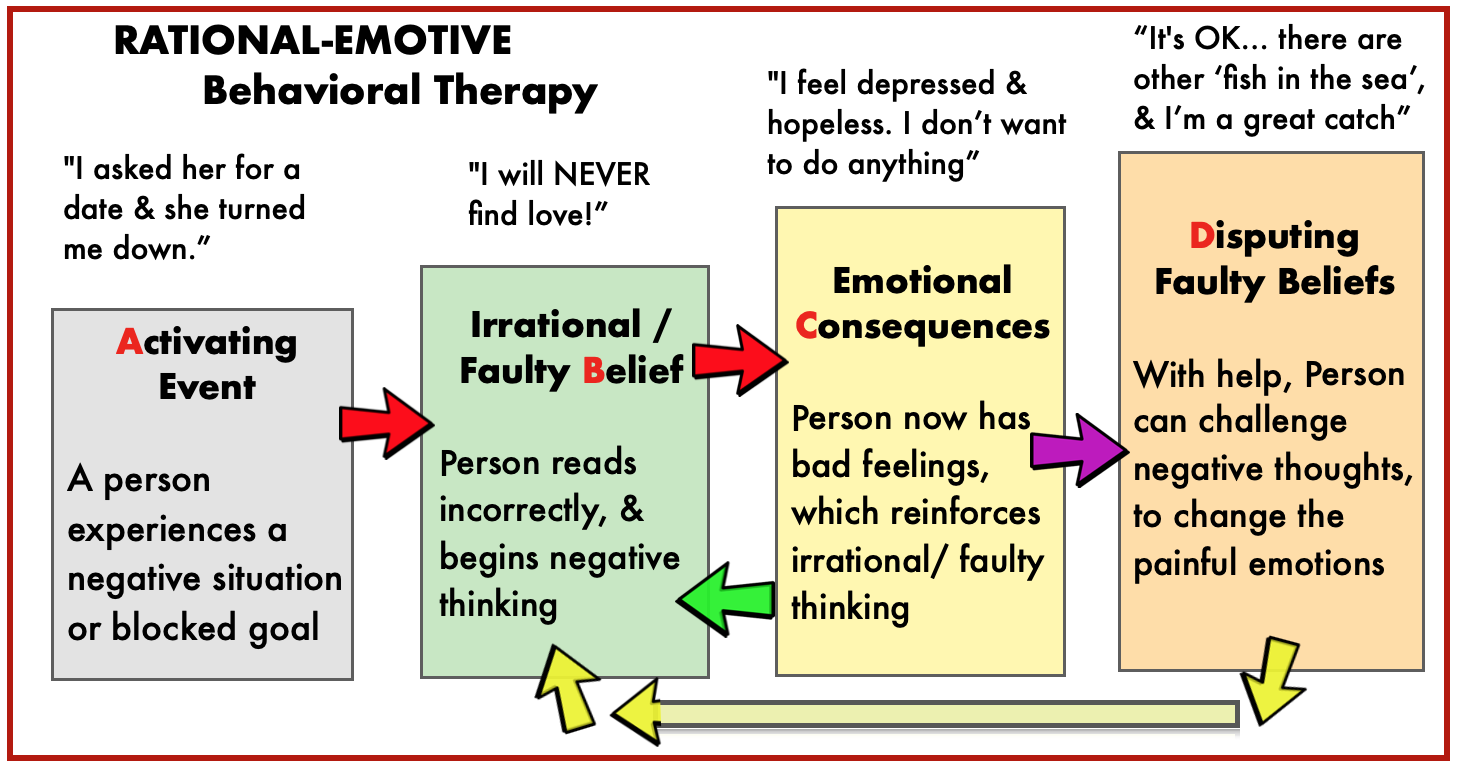 A practical, action-oriented approach for dealing with emotional, cognitive & behavioral problems, to improve personal growth & psychological wellbeing
🌱 Psychoanalysis (Psychotherapy)
This is the original ‘talk therapy’. In one-on-one sessions, clients explore the reasons behind their emotions & actions. As they start to understand & accept painful past events – present day emotions & actions become clearer, so clients can manage them better, & then change the way they react to current triggers
🌱 Schema therapy
This is a newer approach shown to be beneficial in treating Ns, an integrative approach combining parts of Psychotherapy & CBT. The aim is to help clients identify & understand unhelpful coping mechanisms formed from early childhood experiences.
Once maladaptive schemas are uncovered, clients can learn to modify them
🌱 Transference-focused psychotherapy (TFP) 
In this work, clients redirect the N’s desires for -or- intense emotions about another person on to the therapist. This may make it easier to talk things through, as the therapist helps them gain insights.
Clients can identify self-destructive ideas & patterns of interaction – as they come up during a session, rather than only focusing on outside events.
NEXT : Self-Parenting Books


I just typed out a thank you note and wasn’t signed in , when I got signed in the note was deleted …
Basically I said thank you for this site and happy 🎉 newyears ..
LikeLike
Your welcome, & Happy New Year to you too.
LikeLike