ACoAs: OVER-Controlling Ourselves (Part 4)

sileced

I LET THE PP BEAT ME UP – to keep me in line

PREVIOUS: Emotional Over-Control #2

SITEs:  Self-Control (Wikipedia)
▪︎ Over-Controlled Primary Aggressor

See ACRONYM page for abbrev.

AS ADULTS (cont)
• ACoAs
were not raised on the handbook “How to be a Healthy, Happy Human Being”, which left our Inner Child-part impulsive, anxiety-ridden, only able see itself & the world thru distorted alcoholic / narcissistic lenses. So, one way to deal with our trauma is to do what they seemed to want – for us to be dead! Some ACoAs try literal suicide, but most do it by PMES forms of self-destruction & emotional starvation.

Being Over-Controlled is NOT related to being Introvert or Extrovert, which are inborn, but rather about ignoring qualities we all share to varying degrees (intuition, intelligence, being perceptive, artistic…) – which were unacceptable in our family.
At the time, it would have made our lives even more miserable if we hadn’t suppressed those characteristics – although some of us couldn’t hide them well enough to escape being attacked or ignored.

Unhealthy BELIEFS of Over-Controllers 
• Everyone is out to rape me mentally & emotionally
• Don’t trust anyone with your feelings, thoughts or dream
• Never let others know how their behavior or actions effect you
• Never show your anger so you won’t get abandoned
• There’s only one way to survive a crazy world – climb into your shell, & stay there!
SO
• I have to keep control of my feelings so I don’t go crazy
• If I lose control, there will be no sanity in my home (or on the job)
• Losing my cool is unsafe, so I avoid conflict at all costs
• No matter what happens to me, I’ll never cry or need anything again
• No one’s ever going to get under my skin or hurt me again
► Do you hear the voice of the Toxic ROLES?)

HOW we Over-Control ourself
a. DEFENSES – Rigidly held defense mechanisms are used to hide from emotions we’re afraid to experience, but the ‘protection’ ends up running our lives:
Addictions – used as a way to numb the cruel PP voice & to ignore our WIC the same way our parents did, but which actually adds to our suffering

Counter-Phobia – being attracted to things that are scary while not fully aware of the accumulated terror underneath. Dangerous relationships & activities are seen as fun, which keeps the adrenalin pumping. We’ve stuffed the anxiety into the unconscious, but it needs an outlet, so we rush towards unhealthy ‘excitement’. If we stopped running we’d have to feel all that fear

Fear of Engulfment, feeling suffocated & over-controlled by someone else’s need & demands. Not allowed originally to develop our own inner boundaries, we end up erecting a very thick wall against emotional closeness so that we won’t get swallowed up again. It keeps everyone at a distance, while longing for connection. The wall gets activated whenever anyone wants genuine intimacy with us, even if it’s what we say we want

Guilt (post What is guilt?’) – an emotion that controls us TO:
— ensure we never disobey our family’s Toxic Rules
— keep us from learning healthy rules that could improve our life
— prevent us from developing our True Self via S & I, which would unhook us from the family dysfunction
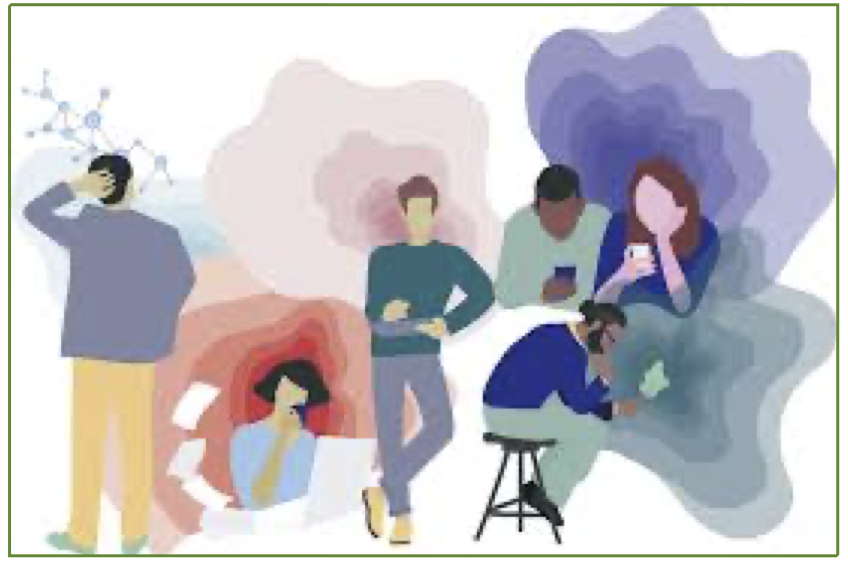
Over-activity, such as workaholism, controls how much & what kinds of emotions we allow ourself to experience = staying so busy that we don’t have to feel anything ’real’, & using it to cover up S-H & a sense of powerlessness

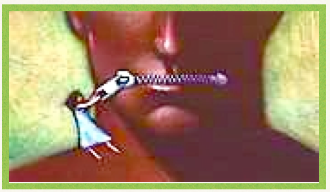
Paralysis, mostly our voice – stopping ourself from saying & doing things that would be good for us, because of fear of punishment, fear of abandonment and fear of visibility…..  which prevent speaking up to stop others from hurting us, enhance our self-esteem & move us toward our dreams

Vagueness / dissociating – staying in ‘la la land’ to not face any reality we’re too terrified to deal with, starting with how badly we’ve been treated by family / school / religion / mates / work…. AND that we’re responsible now for having to care for ourself.
So – we don’t notice how much we spend / eat / drink… how others treat us, how we feel, what we need, how we treat others….

NEXT: O-C Ourselves – Part 4

ACoA CONCLUSIONS re. Painful Events (Part 2b)

defended 

NOTHING SCARES ME! 
as long as I’m defended

PREVIOUS: Conclusions (#2a)


2. CONCLUSIONS – OUR THINKING (cont)
🔩 IT’S ALL THEM a. PERPETRATORS
b. PARANOIA
◀️ One negative approach (Ts) combines Fear & Anger.
MANY ACoAs have at least some tendency to be paranoid. Just as we have a PP camera over our shoulder always judging ourselves, we also constantly scan the whole world for danger (mostly unconscious), assuming everyone’s a potential monster – ie. everyone will definitely abandon / harm us sooner or later!

We apply this ‘rule’ even to situations that are neutral or not about us. True paranoids (PPD) see danger everywhere, where there’s none at all, whereas most ACoAs with a touch of it can still correctly identify reality – it’s just that our CONCLUSIONS are likely to be off – but not always

• Paranoia, even in relatively mild form, comes from legitimately being traumatized (in danger) much of the time growing up. That’s not being crazy or just our ‘perception’, because unfortunately most of the danger really did come from our own family!  It has left us constantly terrified, but it’s hard to admit how deeply vulnerable we still feel

• If our family was unsafe, how much more so are strangers?  With such a background & our symbiotic attachment to our parents, we project that original danger onto the whole world, regardless of present reality.

The awful irony is that while we believe we’re trying to sidestep all the hidden landmines we assume are in our world, paranoia mainly draws us to those people, places & things (PPT) —
— which actually are harmful
— those we experience as harmful, or
— those we projedrunk angerct danger onto, that are safe or neutral.
This compulsion reproduces & adds to the original fear & abandonment we so desperately want to avoid!

• ALSO – we automatically reject genuinely neutral or beneficial people & opportunities! Yes – deliberately, because we’re not only repeating what’s familiar, we’re also looking to validate the ‘rightness’ of our family, so we don’t have to face the pain of who they really were, & still are.

Twisted thinking about anything POSITIVE says :
• don’t even register them: “What compliment? I didn’t notice” …
• it can’t possibly last, so why bother believing it
• it’ll be taken away, anyway, & then I’ll feel even worse than before
• it was just a fluke, an accident, a coincidence
• people don’t really mean the nice thing they say – they’re just being polite
• they’re only saying that because they wants something

Distorted THINKING cancels out the very things around us that would nurture & heal us, if we were to let them in!   Some CDs that paranoia uses : ‘Awful-izing, Jumping to Conclusions, Maximizing, Mind Reading, Unrealistic Comparisons

Another negative approach (Ts) ignores Fear
c. COUNTER-PHOBIA (“against fear”):  At the other extreme, sScreen Shot 2015-07-20 at 1.44.53 AMome ACoAs have hidden our childhood terror behind a defensive wall of brains & bravado. It’s become so dense that we don’t know there’s a WIC hiding back it, who’s still afraid for its life.
This group of ACoAs were subjected to the same chaos, cruelty & neglect in childhood as Paranoids & Victims, but our native personality found a different way to survive.  Even though we don’t stop to think about what we’re doing – that would be too painful – underneath are all the same core issues

✶ Counter-phobia is driven by so much terror & rage which never found an outlet that we became insured to danger. We thumb our noses at everything in the world that might ‘get us’.  We couldn’t protect ourselves as kids but now we’re determined to slay & triumph, not just passively accept

• We pushed the anxiety so far down that we’ve become the complete opposite. NOW nothing scares us!  We joyfully chase all that’s unpredictable & treacherous, calling it exciting.  We’ve become addicted to the adrenalin.  When something does bother a counter-phobic – we stuff it, laugh it off, stay very busy – & find new ways to keep the drama going. ACoA Laundry List : “We’re addicted to excitement” .

NEXT: COUNTER-PHOBIA cont. (Part 2c)

NOTICING Painful EVENTS

Screen Shot 2015-06-20 at 5.24.34 PM 

IT’S EVERYWHERE!
life is full of pain

PREVIOUS: What just happened – 30 Qs


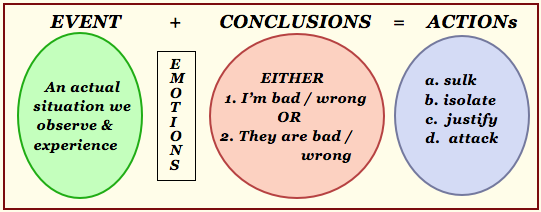
1. EVENT – the Stimulus (Green Oval)
Growing up with emotional & physical stress, we became hyper-alert to our environment, developing big antennae to catch even a whiff of dangerdoor slam

Early sources:  Being kept awake late, even on school nights, waiting anxiously to hear what state dad was in coming home – how did the car sound, how hard was the front door slammed, how heavy were the footsteps, which room was he going into…?

Was there going to be a fight – yelling, hitting – or worse, a ‘visit’ to your bed…?  trying to sleep with one foot on the floor, hating mornings, knowing you’d be a mess at school the next day, as usual being constantly worried…..

This endless pressure has left many of us with only 2 options:
⚠️ Vagueness: the ACoAs who seem to be so out-to-lunch that you wouldn’t think they are actually over-attentive. It’s why they need to be flaky, because internally they’re under overwhelming tension, but it’s split off from their own awareness –  (dissociation)
♨️ Hyper-vigilance: other ACoAs are noticeably anxious, worried, controlling, touchy, always looking around, easily taking offense (sitting with their back to any available wall!) – waiting to be attacked by others
🌀 Some of the paranoia comes from having a BadParent camera over one shoulder, constantly judging everything we say, do, think & feel

We’re still so focused on the possibility of being abused &/or abandoned – again – that we either isolate too much, are belligerent & difficult, or super people-pleaCause & Effectsers.
So every Event that upsets, hurts, disappoints & scares us becomes a cause for emotional drama

Approaches to EVENTS (present day)
CO-DEPENDENCE: disturbing situations are a challenge for the Rescuer to throw all their energy into fixing – the other person or event
COUNTER-PHOBIA: at the other extreme, we look for the most dangerous, drama-filled events to get involved with, while ignoring / denying / swallowing the pain it causes us

ISOLATION / Victim: having been hurt by so many people & events, we starve ourselves of potential benefits in the world, instead of ‘dealing & healing’

PARANOIA:
 the assumption is that the ‘universe’ (everyone & everything) is deliberately targeting us, to cause our suffering. We ignore all the good things in our life, OR explain them away as an accident, a fake / scam or “they’re just being polite”
6a011570338375970c01a511bdd4fb970c-pi
SCAPEGOAT
/ Victim:  we feel blamed for everything that goes wrong, which we agree with. It causes great anxiety & constant anger, but we don’t try to correct it

EXP of ‘Events’ = YOU are :
• going for an interview & do your best, but you’re not called back
• having lunch with a group of casual friends & new acquaintances.  Everyone seems easily engaged in conversation with their neighbors, & almost no-one has talked to you the whole time

• a new members of a long-standing group, out for coffee with them after a meeting. On the way, they all pair up, talking to each other, but no one walks with you – you’re all alone at the back of the ‘line’
• trying to cross a busy street & just then a cab turns the corner, almost hitting you
•  walking down the hall at work, & yet again Georgia  / Sam…. doesn’t acknowledge you

➼ Any of these may create a painful reaction in us. Our observation of the occurrence is accurate – it really did happen.  However – they triggered familiar cognitive distortions (CDs), which make the events more disturbing. That’s where we go off the rails.

‘EVENTS’ can be:
a. Neutral / mild : everyday situations that are not really bad, like – someone in the subway bumping into you, not getting that text you’re waiting for, a delivery being late….
b. Mild / bothersome: occasional annoyances that may or may not be aimed at you, like a rude salesman, your boss angry at you, getting a ticket, your child having trouble with a neighbor……
c. Severe: really painful encounters, like – a parent ignoring you or being cruel, a big fight with a BFF or spouse, your child getting arrested because of drugs….

• Each category will test our ‘mental health quotient’ – how realistic or distorted our thinking is, which will then govern how we act.

NEXT: Noticing painful events (Part 2)