ACoAs & CONFUSION – as Kids (Part 2c)

teaching congusionWHICH WAY DO I TURN?
They’re mixing me up! (# 4)

PREVIOUS: ACoAs & Confusion (#2b)

 
🖌️ Childhood CONFUSION : PARENTAL sources (2b)

📕🖌️
Childhood CONFUSION
(cont) OTHER sources
1. Being LIED to
a. about US
EXP: Sick little boy is dressed up, & some of this things put in a suitcase.
TOLD: “You’re going to a party & staying over for a while”.
REALITY: Child is taken to the hospital for procedure, dropped off & just left!

COMMON LIES parent lying
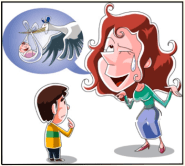
• You killed your mother (at birth)
• Your bad behavior caused your father’s drinking
• You can go play later – when all your work is done
• That therapist is bad for you / confusing you (tells you I hurt you)
• You’re a ‘bad seed’
• You’re father didn’t meant to hurt you/ he really loves you but doesn’t know how to show it….

EXP
:
4 yr. child bumps her head while playing under the dining table. She’s bleeding & goes crying to her mother. Mom (also a drunk) yells at her: “You’re not really hurt!. Go to your room.”

b. about THEM
EXP: A boy’s mother spent most of 20 yrs holed up in her bedroom.
TOLD: Mom is suffering from menopause. (She was in her early 30‘s).
TRUTH: She was either drunk, sleeping it off or hung over!
It was only many years later, as a young man, he learned that menopause usually comes much later in life & doesn’t last 20 yrs!

COMMON LIES
• I’ve never said that! / I didn’t mean the way that sounded (Yes you did!)
• I’m never wrong / I’m perfect
• We’ll go to a movie / beach…..this weekend (not)
• I’ve never done anything wrong to you
• I’ll pick you up after school – but never shows up, or always very late
• I’ll come to see you at the game / in the play…. (not)

EXP: Severe alcoholic father TOLD the same story for years – that he was in WW II, on the front lines, & participated in terrible events.
TRUTH: For the whole war he was a supply clerk, & was never in combat.

EXP: Mom pushed to stay with daughter Marcia on a visit for a week in another city. Marcia kept saying “Come, but you can’t stay here”.lying mother
TOLD: “But I’m coming to see you, I’m just low on money, I won’t get in your way….”.

Marcia felt bad for mom’s ‘poverty’ but couldn’t put her up in the tiny apartment. In spite of Marcia’s explanations, mom decided to spent the last night of her trip at daughter’s place, and then announced this ‘favor’ at the last minute without asking if it was OK.  Marcia felt she could handle that much, so agreed.

TRUTH: Mom brought along a BFF, stayed in a fancy hotel for the week AND between lunch visits with Marcia, went shopping – buying many expensive clothes & shoes – & then showing them off on that last evening! Poor????

c. about OTHERS in the family
EXP: Early Saturday a.m. child looks out front window & sees dad face down on the lawn. Terrified, child rushes to wake mom, screaming “Dad’s dead, dad’s dead!” Mom reluctantly comes down to see, looks out & says: “Oh, your dad just went camping last night”. REALLY??
TRUTH: Dad was out drinking – again – & passed out before he could get in the house. Child is confused. If this is camping, where’s the tent?

EXP: Family myth – Grandpa was a traveling salesman & died tragically in a train derailment
TRUTH: He was on a train, but merchandise wasn’t the only thing he was carrying. He was with one of many ‘girlfriends’, got into a drunken fight with her husbandeath bed lied & was killed. Not a good guy, & not tragic!

EXP: Selena is an only child of 2 severely alcoholic parents – who fought like 2 wet cats for 40 yrs. Dad dies of cirrhosis. A few years later, on her deathbed, Selena’s mom tells her: “Your dad was not your biological father”, & before she’s willing to say more, mom dies.
🔹There are no other relative to get info from, so to this day Selena still doesn’t know if her mom was lying or not!

NEXT: ACoAs & Confusion (#3a)

ACoAs & CONFUSION – as Kids (Part 2b)

confused IDWHO AM I?
what am I supposed to be?

PREVIOUS: ACoAs & Confusion (#2a)

SITE: Identity vs Role Confusion Stage 5

QUOTE
: “May the forces of evil be confused on the way to your house” ~ George Carlin

📕🖌️Childhood CONFUSION (cont.) : PARENTAL sources
1. THEIR Narcissism

• Mother to child: “Put a sweater on, I’m cold”. HUH???
• Bragging about us to others, to make themselves look good – but never complementing us directly – while constantly tearing us down to our face.
We may or may not find out what they’ve been saying behind our back, but it doesn’t help. Are they proud of me or not?? What do others really think?  (3 Types of narc parents ➡️)

• EITHER: We’re absolutely convinced one or both parents are withholding – of love, attention, information, protection, affection….. when in fact they don’t have it to give because of their own damage. The smart, intuitive part of us DOES know it- but is too painful to acknowledge, so we blame ourselves!

OR – one parent is the pillar of the community, giving to others of their time, attention, knowledge, camaraderie…. BUT at home is withholding & distant, or blatantly abusive to wife &/or kids. No one will believe you if you tell – you would be a liar or the crazy one!

OR – he or she gives our toys, clothes, gifts…. to others, without any warning or discussion (stealing from us) to be the big-shot, to make themselves feel better & seem important, be admired. They’re feeding off of others because they’re empty inside.
Confusion: My parent is a ‘good’ & beloved person, so why not to me??

2. Hypocrisy – more likely to occur in externally functioning (dysfunctional) families – but not exclusively. Kids know when adults are being dishonest, but this will cause too much cognitive dissonance, so they end up believing the lies, & then have to work very hard to validate & justify their parents’ actions & statements, just to not feel crazy.
We’re all familiar with the preacher / public servant / spiritual teacher type who publicly advocates purity, sobriety, family values…. but privately does the opposite – until they get caught! (More...)2-faced

• A favorite manipulation of many parents is “Do as I say, not as I do”. This is very confusing, since kids automatically & relentlessly copy what the adults do, as much as absorb what they’re told.

Ironically, those of us who said “I’ll never BE like them” end up either following the same patterns directly (maybe in a disguised form), OR marrying / working for someone just like them. Among many other reasons ACoAs copy them, it’s our loyalty to family, and an attempt to eliminate confusion

3. Mental & Emotional illness (especially harmful when it’s the mother).
From the very beginning of life these children are trapped with real crazinesmental illnesss – someone who never makes any sense, or is only intermittently lucid – so their first relationship is with someone who twists, manipulates, gaslights —> ”false information presented to make a victim doubt their memory, perception & sanity”

• The parent may be psychotic, or ‘just’ severely depressed, drunk / drugged, suicidal…. ending up in the hospital, probably several times, with very little or no explanation given (needed info), with the child not allowed to visit, not knowing if the parent will ever be back….

OR being forced to take care of the debilitated parent at home, along with siblings – for many, many years, subjected all the while to mental confusion & cruelty.
It’s one more way we become deeply ashamed of ourselves (being part of that weird or shameful family). We learn never to rely on or trust others, or on our own intuition & experience.
Am I a child or am I the parent? Am I evil? Am I crazy too???

Early Confusion: Having several caretakers – being sent to live with relatives, having too many sitters, shunted to many foster homes, adopted – but not told, several step-fathers…. Who are my real parents? does anyone truly love me? where do I belong?

NEXT: Confusion  #2b

ACoAs & CONFUSION (Part 1)

state of CONFUSED

IT FEELS LIKE I’M CRAZY
I just can’t get it right!

PREVIOUS: Gifted Children #4

SITE: Sometimes Confusion Is A Good Thing

📙🖌️ OVERVIEW
DEF of Confusion (Cf) 
– Mentally disoriented. The inability to make decisions clearly & quickly
Cf occurs when another person’s Boundaries are vague, not easily understood, or in conflict with themselves

NOTE: These posts refer to Cf which is NOT caused by long-term severe mental illness or physical changes in the brain due to accident, aging, chemicals/ medication, drug use or illness.

Important distinction – confusion is always a cognitive (mental) NOT an emotional issue. It’s about whether or not we can think clearly, based on what’s going on in our head or how someone else is presenting information.

For ACoAs – overcoming life-long confusion is mainly about coming out of denial about our traumatic past. It includes identifying & correcting cognitive distortions (CDs) and toxic family beliefs, which lead to procrastination, self-doubt, perfectionism & self-hate!

To do that we need to know enough about ourselves AND how the world really functions – to not blindly follow what our unhealthy family taught us, or what the WIC has come to believe because of it.SCARF model

The opposite of confusion is Certainty, which is not the same as being rigid, dogmatic or opinionated.
Based on NLP, David Rock explains that there are 5 major goals of the human brain geared towards ‘maintaining’, ie. increasing positives & reducing negatives (the SCARF model): Status, Certainty, Autonomy, Relatedness & Fairness.  (MORE….)

• Executive Coach Ed Batista commented that certainty is a result of the brain’s effort to conserve energy, which comes from the limited capacity of the prefrontal cortex, the seat of executive function….

Human beings resist putting great mental effort into decision-making & impulse control because the body is preserving resources for a possible emergency in the next moment, & the same dynamic contributes to resisting uncertainty.” (CHART & info….)

Some causes of Mental / Psychological confusion
• Complex lifestyles – too much to do & not enough time, constant stress
confusion/stress• Denial – not wanting to admit & accept the way things really are (re. people, places, things), & so create a variety of defenses to mask the truth
• Dysfunctional interactions with others
• deliberately Distorted info – from media, politicians, advertising, cults, corporations …..
• Ignorance – trying to figure out something without enough or the correct info
• Grandiosity – trying to DO something without actually knowing how

• Major changes (Recovery process, new work, moving, divorce…..) without research, mentoring or other info, therefore being unprepared
• Misunderstanding & differences between countries, boss & workers, men & women, people speaking different languages….

• Overwhelming amounts of info from too many different sources (especially for Introverts)
• Transitions : those in-between times, from one inner state or outer situation to another, because we don’t know what to expect

Again, here we’re mainly concerned with the kind of confusion which comes from distorted ways people communicate with themselves or others, with words & body language, either unconsciously or deliberately.

When someone says “I feel confused”, they’re combining emotions & thoughts without expressing either one!
🔺What DO you feel – angry, happy…. ?  It sounds like they’re speaking about an emotion (I feel), but this ‘feel’ only refers to thinking . (See also “Feelings aren’t facts).

🔑 What are you confused ABOUT?  The phrase actually means they doesn’t know what to think about something (the jumble in my head, conflicting opposite needs or desires…. ) – often because of CDs, obsessions & Toxic Rules

• Someone can also be (mentally) confused when we have several or opposite emotions re. the same situation at the same time – happy/sad, lonely/excited…
🟢 Instead of either/or, think in terms of layers, coming from different levels of desire, experience, need or maturity…..

No one taught us (info = mental) that having ➕ / ➖ emotions together is not unusual, & will come from the same or different ego states.
EXP: Parent – loving someone while being angry with them
Adult – relieved someone’s gone away / Inner Child: (yet) missing them…..

🧩 Without knowing this, it may seem like a dilemma. However, feeling many differing emotions at once doesn’t need to be confusing, which only comes from negative beliefs, or having a limited awareness of human complexity.

NEXT: ACoAs & Confusion #2

ACoAs & LISTENING (Part 3)

listening to herYOU MEAN I HAVE TO
be happy for someone else?

PREVIOUS:  ACoAs & Listening (#2)

SITE: The SKILL of LISTENING  ** w/ EXP (Center for Parenting Education)

REVIEW posts : “Healthy Helping

See ACRONYM page for abbrev.

QUOTE: “We have two ears and one mouth so that we can listen”~ Epictetus 

REMINDER: Accurate & compassionate listening means we don’t try to make the other person a carbon copy of us. Even if we strongly identify, listening is about THEM – where they’re at, what they’re feeling & thinking. Don’t talk about yourself too much. You are the listen-er, they are the listen-ee.

3. (AWhen someone wants you to listen to them AND it’s a practical issue (lack of funds, health or relationship problems…..) (in Part 2)

#3 VARIATION (re. actions)
(A) When someone wants you to listen to them AND asks you directly to tell them what to do
a. Naturally if you are sought out as a professional (doctor, decorator, coach, teacher, lawyer…) you’re paid to give your expert opinion & advice.
— However, for psychologists, psychotherapists…  the rules are different. The goal is more about mirroring, giving feedback (true listening), providing the client with options & helping them find what’s right for themselves.

b.
For the rest of us who are not being paid, teach or heal, there are options.
• ASK if they want ‘advice’ OR information – not the same thing!

Advice is telling someone what you think they should do, be, feel, think based on yourself, not who they are! No matter how right or helpful the info is, it’s not listening.

Information is giving knowledge they may not have, including options, without an emotional valence attached. They can use it or not, as they wish We often tell people to DO things they’re already tried. Don’t waste their time or yours! Good listening is hard for ACoAs, but worth the effort!

i. When you know the listen-ee well, you probably know —
if they already know what to do – but in this case refuse. Don’t push
that they may know, but really do need some help implementing a solution.
Suggest someone else who is qualifies & willing, or if it doesn’t harm you, you can offer, but think twice before you do

— that they really don’t know. Then you can decide IF you want to give them info, or suggest where they can get it (on Google, from Al-Anon or AA,  some books you recommend….)

ii. If it’s someone you just met or don’t know well, start by asking some pertinent questions —
— What do they WANT from you? What are they really asking for & how much? See posts “Healthy Helping”. If you can get that far with them, the conversation may take a different turn than how it started

— What have they done about their problem / situation so far? & how have those things turned out? This saves time & energy suggesting things they’ve already covered.
• If they’ve tried a number of things which have all been disappointing, there may be absolutely nothing you can contribute. OR they didn’t try something useful because they didn’t know about it – so you can offer it

• IF their response to any suggestions is always a version of “Yes but… that won’t work / I can’t because….” then either you’re asking the wrong questions or they’re playing the “Yes, But” game from Games People Play, by Eric Berne.

In the latter case they don’t actually want an answer, they want to be parented AND be contrary, which is a child’s way of saying “You can’t control me.” It may be a version of “Come here-Go away“(posts).

With such a person, only try 2-3 times, then shut up. 😑

NEXT: What just Happened? – #1

ACoAs & LISTENING (Part 2)

Screen Shot 2016-06-19 at 5.12.58 AMI FEEL SO POWERLESS
if I don’t DO something to help!

PREVIOUS: ACoAs & Listening (#1)

POSTS: Anxiety & T.E.A

Turkish
proverb: “If Speaking is Silver, then LISTENING is GOLD”


LISTENING ‘situations’
(cont)
1. (E) When someone wants you to listen to them AND….

2. (E) When someone wants you to listen to them AND they’re expressing intense emotions (sadness, anger, fear…) 

BUT their emotional state sounds ‘crazy, irrational, ‘out of proportion’ to the current situation, remember: “If it’s Hysterical, it’s Historical”. It usually means their WIC is in the foreground, who is expressing intense old pain – accumulated from childhood trauma.

It’s not your job to parent them & you’re not their therapist. Here too – trying to make them feel better can be heard by them as denying their experience!
CAVEAT:  If you’re listening to someone deep into the emotion of self-hate, there’s very little you can do to make a difference in that moment.

DO NOT try to talk someone out of Self-Hate. It’s futile. Their WIC has completely regressed into a familiar childhood state & locked in for the time being.
Because S-H is about denying the pain of abandonment & trying to avoid feeling vulnerable, while having a little control over their sense of hopelessness (S-H gives a false sense of power) – they’re not going to come out of it right away.

OPTIONS
◆ You could say: “Wow,_____, I hear that you’re really beating yourself up mercilessly. Why is that?”
◆ You can also ask: “What’s happened recently that hurt you or disappointed you so much?”
If you think they’ll understand, you can gently suggest they’re feeling some deep childhood abandonment
◆ If appropriate, you could add your own reaction: “Your self-hate is really painful for me to hear. It’s like watching someone I care about cut themselves or shoot heroin!”
Yes, that’s how devastating S-H is!
💝   💘   💔
3. (AWhen someone wants you to listen to them AND it’s a practical issue (lack of funds, health or relationship problems…..)

AND you insist on offering a way for them to solve their problem (actions)
you’ve actually failed them, strange as it may seem, because…..
….. when you do for them what they can AND need to do for themselves, you contribute to their sense of inadequacy & fear of taking appropriate risks.
And they can do things for themselves. As adults, they’re not helpless. Maybe discouraged & faltering, but not helpless. Maybe all they need is information – but it has to be something they can apply for themselves.
(Review posts: “Rescuing – False helping” and “Healthy Helping“)

HARMFUL
• ACoAs would rather do for others that themselves. It’s our training & a great distraction from taking care of ourselves- which we don’t want to do.Screen Shot 2016-06-19 at 5.18.42 AM

• IRONY: we use a great deal of intelligence, creativity, money, time – even wisdom – on someone else, BUT genuinely believe we don’t know how to handle our own problems! How is that possible, when we just used all those skills for others?

• REALITY: We use up a lot of energy trying to save someone else, while silently expecting, even demanding, that someone else do the same for us! WE too want to be taken care of, even though we too have the ability to care for ourselves.

HELPFUL
• Rule #1, again – zip the lip!
• Often people just need a non-judgmental sounding board – to hear themselves think.  By running it past a good listener, they can hear the problem for what it is, maybe even find their own answersScreen Shot 2016-06-19 at 5.14.43 AM

• You can ASK if they need practical suggestions, but only give it IF….
…. they say yes & they seem willing to do for themselves (not just trying to be taken care of, or need to be oppositional)
…. you actually know, maybe from experience, what you’re talking about
• You need to CHECK what they….
…. want to do, in the near future
…. have already done, but for some reason didn’t work or didn’t help!

NEXT: ACoAs & Listening (Part 3)

ACoAs & LISTENING (Part 1)

 I’M GOOD A LISTENER, BUT….
… I have to make them feel better!

PREVIOUS: Healthy Opposites #3

POSTS: How ACoAs Abandon Others


LISTENING
can be passive or active, but basically – the less said the better!
Wanting to be listened to is not always asked for directly. When someone starts talking & then keeps going & going – they want to be heard.

• The following 3 examples cover T.E.A. In each case, if the WIC or PP are the ones listening, then what we think are ‘helping’ responses will actually be our own narcissism – the compulsion to tell them what WE would do or say – but is actually NOT about the other person & so not useful. Don’t get in the way of someone else’s process!

LISTENING ‘situations’ 

1. (E) When someone wants you to listen to them, AND they’re having intense emotions (sadness, anger, fear…),

🔓AND you tell them they shouldn’t feel that way – “Don’t be upset”
💚OR automatically tell them how to fix their problem – “You can….”

👣👣 then you’re trampling on their right to feel & express their emotions without interference.
EXP: After my fire, when I told people how sad I was that both my cats were killed by the smoke, some people said: “Well then get new cats”!

HARMFUL
ACoAs who react from their WIC to another person’s emotional expression will over-identify with their distress. Since we didn’t get the support as kids that we needed, we project that on to others, & decide (usually unawares) that we’ll never be like our parents – to leave someone in the lurch. We compulsively have to ‘help’.

PROBLEM with this WIC-logic (T)
When we were originally abandoned, we were very young! But the people we’re usually trying to rescue to now are adults who have many resources & capacities no child can possibly have. So they don’t need us the way we needed someone to soothe us when we were in pain as kids. (See posts: “Rescuing – False helping” and “Healthy Helping“)
ALSO, we’re not their parent, no matter how immaturely they may act!

🖤 Negating a person’s emotions or trying to make them ‘feel better’ wastes everyone’s time because,
• the listen-ee may just shut down & not be able to continue, OR
• they’ll waste a lot of energy convincing you how & why they feel that way
HELPFUL
Rule #1 : YES, zip the lip!
OR if you can’t :  ASK them what they’re feeling – emotionally.
Don’t settle for HEAD answers. Ask what they’re feeling emotionally vs. what are they’re thinking. Anything more than one word (E) is a thought (T). (“Feelings Aren’t Facts”)

If they’re not sure, maybe you can help them identify the words, such as fear, self-hate, frustration OR excitement, joy, love… If you also aren’t clear about what they may be experiencing, be quiet.

• If you’re in the ‘mood’ to respond to their comments, always start by validating whatever emotions they can verbalize. It doesn’t mean that you identify with the feelings or the situation, nor is that necessary. You can say brief, comforting things like:

“Wow, that’s tough, I know what you mean, Sorry to hear that, I’ve been there too….”
Screen Shot 2016-06-19 at 5.06.00 AM“Sound like you’re in a lot of pain, That must really make you angry. Ouch!”.

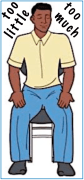
But, DO NOT assume you’re sure you know how someone feels. If they disagree with your opinion, drop it.

A POSSIBILITY – with their permission
If you know them well, have experienced something similar AND you feel like it – you could help them figure out what’s behind their big emotions: old beliefs, the WIC over-reacting, family patters, current similarity to childhood experiences….
Then if they’re willing & able to go deep, the solution to their problem may be obvious to them without any more help from you.

NEXT: ACoAs & Listening (Part 2)

“ACTIONS – Healthy OPPOSITES” (Part 2)

 I’VE BEEN DOING THE OPPOSITE!
 why isn’t it working?

PREVIOUS: Healthy Opposites #1

POST : Letting GO of ACTING Controlling (#2)


“REVERSING self-defeating Behavior IMPROVES our Life” (cont)
A. UNHEALTHY Patterns
(cont.)
ACoAs have a tendency to:
do everything based on B & W thinking (‘always, never, no one, all’…)
• be afraid to do anything that’s against the Toxic Family Rules
• only do what we think others want us to, or what others expect of us

behave in much the same way that our dysfunctional parents did
• use the same type of actions in every situation (no nuance, no variations, no risks, no innovations or what actually works …)

• not learn from our mistakes, just repeat bad patterns & then complain
• blame others for our mistakes, emotional distress or lack of action
• react from a wounded, anxious or angry emotional place (the co-dependent triangle = victim / perpetrator / rescuer)

Here the focus is on the way to choose what category of actions to take. It’s not a guide to what we should do, but rather correcting what seems to us a quite logical – yet misguided – way to solve our problems, which has been to:
➡️ periodically reverse our usual way of handling things – but only knowing how to choose its Unhealthy Opposite!

B. UNHEALTHY Opposites
• From the very beginning of life we’ve been trying to figure out how to survive, fix our family & get our needs met – mostly with corrupted info (G-I / G-O = “garbage in – garbage out”).

ACoAs are very smart, creative & determined – even though we don’t realize or own it. As kids all out talents went into a valiant effort to save our parents & siblings – maybe even friends.
Now we find other dysfunctional people to ‘rescue’ – desperate to make them well enough to be there for us!

EXP: The 4yr old trying to help her drunk father up the stairs that he’s passed out on, the teenager hopelessly trying to convince her mother to go to Al-anon or leave dad, OR as adults – trying to get a heavily addicted lover /spouse sober, or to keep them from killing themselves – whealthy oppositesith little or no success.

• As unrecovered adults we stumble around without mental or emotional clarity – in spite of our high intelligence, because of convoluted & warped info we were fed in childhood.
The ACoA Laundry List says: “We guess at what normal is”, so we obsessively watch normals to figure out what to do (how do they talk, how do they eat sushi, what makes them happy, how do they make friends?…).

Even so, we can only copy them but so far, because we’re still in the grip of our childhood / family templates – used as the foundation for new actions.  It doesn’t work. This is to be expected – it’s how every brain is programmed from birth.
So we always end up in the same old place, defeated & hopeless, thinking that it’s: a) somehow all our fault, & that b) the universe is against us!
Either way, it hurts!
EXP: Afraid to be in social situation because we don’t know how to make small talk, convinced we’ll be boring or sound stupid…..

• And how do we use all our native cleverness & determinatioakwardn for ourselves?
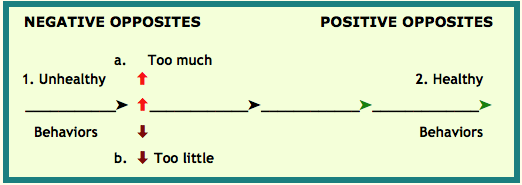
There are many convoluted ways UNhealth can manifest itself. From that mess we choose a set of patterns that most suits our specific personality & our background. We keep trying them out in complex variations & with lots of different people. (Chart in Part 4)

When we get too frustrated by not getting what we need or want, we unconsciously pick through the mental rolodex of distorted options that were forced on us, looking for a better way to handle things, hoping another ‘opposite’  way of behaving will solve our problems.

So we try obvious reversals, BUT all our action-choices are taken from the ‘disease’ end of the spectrum. From a. to b. & back again! (in above chart)
EXP: “I always say the wrong thing, so now I’m not going to talk at all! OR
// My last 3 girlfriends were nightmares, so I’ll never trust another woman….”

NEXT: Healthy opposites #3

“ACTIONS – Healthy OPPOSITES” (Part 1)

 I TRY & TRY –
but I still don’t get anywhere!

PREVIOUS: Self-Esteem – IS

POSTWhy are you stuck?

See Acronyms Page for abbrev.


“REVERSING self-defeating Behavior IMPROVES our Life”
A. UNHEALTHY Patterns
• Many of us know how we would like our life to be:
To HAVE a fulfilling career, loving relationships, less pressure, a little fun… and we’ve been trying, struggling, obsessing – year in & year out – but not much has changed.  We feel stuck, frustrated & depressed – still run by our false beliefs (CDs) & un-processed emotions.

We grew up with years of abuse – around chaos, addictions, criticism, rage, depression, neglect & illness. We learned to survive by adapting to what ‘they’ seemed to need & want, so we cobbled together a set of behaviors as best we could, with very little guidance, which allowed us to survive – but not thrive. We became a ‘human doing’ instead of a Human Being.picture-13We often hear advice like – “Just do it!, Just start somewhere, Do the opposite of what you normally do”, even “Take the action & let go of the result”….  America was built on hard work, perseverance, risk taking & chutzpah.  All of these qualities are action-based.

Anthony Robbins, famous athletes, business moguls & business coaches focus us on taking the next action & the next – no matter what.
➡️This has value, up to a point, but ACoAs know it’s not that simple, because depression gets in the way, & besides – we didn’t have early role models for what right actions actually are.

Dysfunctional Functioning:
a. Some ACoAs have a daily struggle to function at all – maybe from being chemically challenged, not having the vitamins & nutrition needed to be ‘level’ & / or being so devastated by emotional pain that we have little or no passive victimwill to act

b. Some of us waste years of our life just drifting along, not knowing what we want to be ‘when we grow up’!  We’re unhappy & unfulfilled, but don’t have a direction to focus on. Or we fall into whatever jobs that allow us to earn a living.

This is not blame – only identifying the result of being wounded, not from personal defect!  Various forms of Recovery can help us find our True Self, which includes our dreams, goal, talents & abilities

c. Others of us have a strong sense of what we’d like to do – if only we had the support, the education, the opportunity, the connections…..
But we don’t go for it because it would require going against every message we picked up at home, such as – “Don’t out-do us, Don’t be successful, Don’t be the real you….” all of which feels like life-&-death to disobey!
✶ This is not an exaggeration to the WIC, so don’t let anyone tell you you’re being dramatic!

d. An alternative to not doing anything is to either take up a profession that was dictated by our family or a secondary interest of ours (doing stage makeup instead of acting, being a nurse instead of a doctor….) – sometimes even becoming very skilled at it, but without enough satisfaction.
➡️ It’s not unusual for ACoAs to do quite well at what we like to do the least!

e. Many ACoAs fail to take the beneficial actions we absolute need to have a decent life – at the very least, always choosing the worst relationships, the most unsatisfying jobs, isolating ourselves, refusing to take advantage of growth opportunities (personal or material), not caring for our health – not to mention continuing with any number of addictions

f. And then there are the Hero ACoAs, who over-DO all the time. Action is their god, their escape, their addiction. Keeping busy is the only thing keeping their emotions at bay.  ‘Heroes’ are so good at everything they DO, but are hard on themselves & hard on everyone else.  They may or may not be working at a job that suits them, but they’re going to prove they can do anything! What gets ignored is being vulnerable, showing heir softer side.

NEXT: Healthy Opposites – #2

SAYINGS that MISREPRESENT (Part 3)

I’M NOT SURE –
what to ask for!

PREVIOUS: SAYINGS…  (#3)


REVIEW Intro in Part 1 

7. “Be careful what you ask for – you may get it”
❤️ YES – said as a warning
if you’re superstitious, self-destructive, have a habit of choosing badly….

GROWTH : There’s a different YES – not as a negative – but can be stressful at first. This is when we determine to make a positive change in our life, & perhaps ask HP for help – to be released from a bad relationship & find a good one, be provided with a new job/career, to live in a bigger, safer, more suitable location …..

And then it comes our way, not magically but because we did the foot-work and were in the right place at the right time.
BUT – if we’re not fully prepared to receive these blessings, we can feel uncomfortable, scared, unworthy….
That’s OK. If we ride it out & get validation from the right people, eventually we’ll be able to relax into it.

💜 NO – As ACoAs, we don’t want to be so ‘careful’ that we don’t ask, since many of us have a poverty/deprivation approach to life. It’s imperative we give ourselves permission to ask for what we NEED, first & foremost. This requires knowing who we are + knowing what our human rights are + being able to deal with the risk of not getting.

Also it requires that we never go to people who have already proven – a hundred times over – that they’re not capable or willing.
THEN we can begin, slowly, to ask for bigger & better things, healthy things, fun things….. and when we get them – take them in, be happy, be grateful. Enjoy!

8. “A good beginning makes a good ending”
💜 NO –
in most instances for ACoAs before Recovery. If we start by marrying an alcoholic &/or other addict, it’s for-sure going to cause years, even decades of great pain. It’s not uncommon for these to end with a bang.
OR – if we enthusiastically start an unsuitable job, try to do too many things at once, idealize a new partner, be great caretaker….. it’s likely to end in disappointment, frustration, exhaustion & rage

OR – if we start a good thing, such as exercising, a diet, an advanced degree, a recovery book, a 12-Step program or therapy…. all with the best of intentions, but it goes against our Toxic Rules, it’ll peeter out with a whimper. (“Anxiety & T.E.A.” ).

❤️ YES – if we pick the right kind of job/careers, or healthy & suited-to-us friends, mates, therapist, doctors….. then it’s likely that a good beginning would predict at least a neutral if not a good ending – when appropriate or necessary.

9. “Forgive yourself
❤️YES for harmful things you did as a result of your damage
💜 NO for being damaged in the first place!
POST: “Outgrowing Co-Dependent Niceness #6a

10. “Everything that has happened to me is OK because it’s made me the person I am today”.
There are a couple of ways this is wrong. Yes the things that happened in childhood naturally molded us, & for some people that was beneficial.

BUT for ACoAs, saying that what happened to us was OK – is cruel. Was it OK that you were beaten all the time? That you had to take care of everyone but not yourself? That you were mind-f–ed, punished for having emotions? That you were molested, raped, neglected, starved???? 💜NO!
If some or all of these were part of your early years, then all they accomplished was to form a False Self, which we mistakenly believe is who we are. (Our Wounded Inner Child

All the horrifying things that happened to us made us who are today – all right!  – into frightened, self-hating, over-working, ego-less wrecks.
But anyone in FoO Recovery knows that our healing work is to strip away the layers of defenses (self-destructive messages) to get to the person we actually are inside & would have been a long time ago – without the abuse!! (POST: “They did the best they could”)

NEXT: Sayings #4

SAYINGS that MISREPRESENT (Part 2)


WE KEEP PASSING ON – half correct ‘helpfulness’

PREVIOUS: SAYINGS… (#1)

REVIEW Intro in Part 1
3. “I don’t have to be perfect.
What’s wrong with this statement?
💜 NO – Unfortunately, people in Recovery who say this actually consider it a sign of growth, but is in fact one of those sneaky ways our ‘damage’ keeps us hooked. Why? Because:
It implies we COULD be perfect, we just don’t have to be. NOT true!

No one can be perfect except God. So, what is true & accurate is that “Humans are not perfect, & I am human, so I can’t be perfect!” That’s normal. To think otherwise is arrogant. We can only do the very best of our ability given where we are in our life-progress right now.
It means that “To err is human”,  so we must accept the reality of having limitations. This does not minimize our accomplishments or gifts! We can say: ‘There’s nothing wrong with being imperfect, because it’s a universal Truth”

4. “Feelings aren’t facts” is 💜 not about our emotions, as most people assume. The confusion comes from the reality that we use the word ‘feeling’ in 3 completely different ways: As physical sensations, as emotions AND as thoughts.  See POST

5. “The way you do one thing is the way you do everything.”
💜 NO – It’s the word “EVERYTHING” that’s the problem. Taken literally, this is a blatant inaccuracy. Always keeping PMES in mind, how we do the various parts of our life depends on many factors.
It will depend on your fundamental personality, such as indicated by their MBTI or EnneaType – whether you’re more left or right-brained, (scientific vs artistic) Introvert vs Extrovert, AND above all what areas of childhood experiences were allowed & praised or ignored & punished.

So, I can be meticulous about how I dress & do my makeup, but sloppy about keeping my house orderly.  I can be a brilliant scholar & writer, but neglect my family. I can be very talented & dedicated to my native art form but irresponsible if I have to do office work…. .READ article – a Lesson
▶︎ None of us do everything the same way!

(❤️YES) However, if we take this phrase more psychologically, we can use this woman’s experience to indicate where we’re stuck. Each of us can have the same kind of ‘aha’ connections – between everyday ways of doing (or not doing) things & how they’re a reflection of our fears & resistance to change. Such discoveries help us remove blocks which will improve our life.

6. “If you hate a flaw in someone else it means you have that flaw yourself, otherwise you wouldn’t be upset by it”
💜 NO – the things that bother us the most in the present, that push our buttons or ‘trigger us’ are actually the abusive / neglectful things that were done to us by our family (& other perpetrators) over & over throughout our childhood.
They are wounds we need to clean out, but they are not our character defects.
EXP: I’m almost never late anywhere, but I will definitely be angry at anyone who’s consistently late to dates / appointments, because of all the times as a kid I was left waiting to be picked up by my drunk parent….

❤️ YES – Al-Anon says that when we point a finger at someone else, 3 fingers point back at us. So the statement is true to the degree that our denied ‘character defects’ get projected out onto others, & we don’t like what we see of ourselves in them. These flaws are the emotions, beliefs & behaviors (TEAs) we internalized from our family & society, rolled into our Negative Introject’s voice (PP).

BUT that is not who we are. It’s the False Self we developed in reaction to our unhealthy upbringing.
Even so, our True Self sneaks thru in spite of early brainwashing – sometimes indirectly, sometimes obviously.
EXP: a secret interest, types of addictions we chose, our career path, the way we dress, places we love to go….. So the goal is to find out who we really are & live it!

NEXT: Sayings #3