“ACTIONS – Healthy OPPOSITES” (Part 2)

 I’VE BEEN DOING THE OPPOSITE!
 why isn’t it working?

PREVIOUS: Healthy Opposites #1

POST : Letting GO of ACTING Controlling (#2)


“REVERSING self-defeating Behavior IMPROVES our Life” (cont)
A. UNHEALTHY Patterns
(cont.)
ACoAs have a tendency to:
do everything based on B & W thinking (‘always, never, no one, all’…)
• be afraid to do anything that’s against the Toxic Family Rules
• only do what we think others want us to, or what others expect of us

behave in much the same way that our dysfunctional parents did
• use the same type of actions in every situation (no nuance, no variations, no risks, no innovations or what actually works …)

• not learn from our mistakes, just repeat bad patterns & then complain
• blame others for our mistakes, emotional distress or lack of action
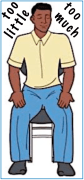
• react from a wounded, anxious or angry emotional place (the co-dependent triangle = victim / perpetrator / rescuer)

Here the focus is on the way to choose what category of actions to take. It’s not a guide to what we should do, but rather correcting what seems to us a quite logical – yet misguided – way to solve our problems, which has been to:
➡️ periodically reverse our usual way of handling things – but only knowing how to choose its Unhealthy Opposite!

B. UNHEALTHY Opposites
• From the very beginning of life we’ve been trying to figure out how to survive, fix our family & get our needs met – mostly with corrupted info (G-I / G-O = “garbage in – garbage out”).

ACoAs are very smart, creative & determined – even though we don’t realize or own it. As kids all out talents went into a valiant effort to save our parents & siblings – maybe even friends.
Now we find other dysfunctional people to ‘rescue’ – desperate to make them well enough to be there for us!

EXP: The 4yr old trying to help her drunk father up the stairs that he’s passed out on, the teenager hopelessly trying to convince her mother to go to Al-anon or leave dad, OR as adults – trying to get a heavily addicted lover /spouse sober, or to keep them from killing themselves – whealthy oppositesith little or no success.
• As unrecovered adults we stumble around without mental or emotional clarity – in spite of our high intelligence, because of convoluted & warped info we were fed in childhood.
The ACoA Laundry List says: “We guess at what normal is”, so we obsessively watch normals to figure out what to do (how do they talk, how do they eat sushi, what makes them happy, how do they make friends?…).

Even so, we can only copy them but so far, because we’re still in the grip of our childhood / family templates – used as the foundation for new actions.  It doesn’t work. This is to be expected – it’s how every brain is programmed from birth.
So we always end up in the same old place, defeated & hopeless, thinking that it’s: a) somehow all our fault, & that b) the universe is against us!
Either way, it hurts!
EXP: Afraid to be in social situation because we don’t know how to make small talk, convinced we’ll be boring or sound stupid…..

• And how do we use all our native cleverness & determinatioakwardn for ourselves?
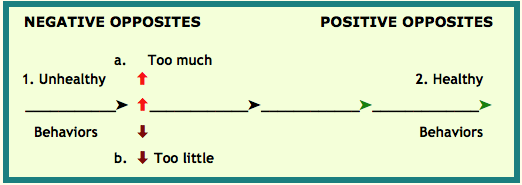
There are many convoluted ways UNhealth can manifest itself. From that mess we choose a set of patterns that most suits our specific personality & our background. We keep trying them out in complex variations & with lots of different people. (Chart in Part 4)

When we get too frustrated by not getting what we need or want, we unconsciously pick through the mental rolodex of distorted options that were forced on us, looking for a better way to handle things, hoping another ‘opposite’  way of behaving will solve our problems.

So we try obvious reversals, BUT all our action-choices are taken from the ‘disease’ end of the spectrum. From a. to b. & back again! (in above chart)
EXP: “I always say the wrong thing, so now I’m not going to talk at all! OR
// My last 3 girlfriends were nightmares, so I’ll never trust another woman….”

NEXT: Healthy opposites #3

ACoAs & PLAYING (Part 3)

rain on meI DON’T KNOW HOW TO PLAY –
only to be compulsive, never relaxed

PREVIOUS: ACoAs & Playing (#2)


💠DEFINITION (Parts 1 & 2)
   

💠 ACoA LAUNDRY LIST’s False Self related to PLAY

• One of the many sad results of having a traumatic childhood is that we were & are still deprived of the joy of relaxing thru playing & having fun. As a result of our damage we fall into several categories (lifestyles) which seem very different, but underneath each has the same problem – our WIC listening to the Negative Introject, believing the Toxic Rules:

“Life is hard / you have to suffer / you can’t play until all your work is done / no one wants to play with you anyway / if you don’t like it you have to stay / don’t be yourself / the world is a dangerous place / you always have to struggle, but never get there!…..”

a. ACoAs guess at what normal is
Here ‘Normal’ means healthy, as opposed to ‘average’. We don’t realize that playing, relaxing & having fun are a legitimate & important part of being healthy, happy & well-balanced. “All work & no play makes Jack a dull boy”.

There’s a tribe in Papua New Guinea that frowns on sex, & bans play. For years anthropologists have considered this tribe too dull to study, but finally someone did. Scholars still don’t know why the tribe developed this philosophy, but it’s certainly not one we should emulate! MORE…)

b. ACoAs have difficulty with intimate relationships
Everyone needs a certain degree of connection with other people, but the amount depends on one’s developmental stage, personality & on their current situation.
And while it’s perfectly normal & acceptable to play alone, playing with others requires a certain capacity for intimacy** to be ‘legitimate’ – since being in authentic play-mode means able to express the True Self without embarrassment or reservation.

This is not easy for ACoAs because our True Self got shrouded in shame & self-hate, making it hard for us to ‘let loose’ & let others get emotionally close to us.  ACoAs are more likely to put others in double binds: “I hate you – Don’t leave me!” OR “I need you – Don’t touch me!”

**INTIMACY: (IN-TO-ME-YOU-SEE) refers to a level of closeness where you feel understood & validated. Genuine intimacy with someone requires honesty, communication, vulnerability & reciprocity.
In relating to others, it’s the ability to connect our ‘deepest nature’ with safe & appropriate others, because we know there’s nothing fundamentally wrong with the Real Me, so we’re not afraid of letting it be seen

c. ACoAs take themselves very (too) seriouslytoo serious
While other children were busy learning to relate, compete, play & develop social skills, we were learning the tough lessons of survival. Many of us never heard our parents laughing, joking or fooling around (unless drunk!)
The air was heavy, filled with the invisible energy of suffering. Life was a hard business & the tone in our house put a damper on anyone enjoying themselves.
So if we did try to play or have fun we were guilted for wasting time OR punished for being frivolous & attacked for being ridiculous, making it stressful & terrifying.

d. ACoAs over-react to changes they can’t control
Genuine play allows us to be in the moment, not knowing the outcome, not having to win, be right or perfect, & not “forcing solutions”.
EXP: when children play, they often change the out of control‘rules’(which they made up in the first place) anytime they feel like it

Adult play doesn’t always have to follow pre-set rules either, sp they can be thrown out the window if it’s more fun to not use  them. This is hard to allow ourself.

Children do need things to be stable & predictable in their every-day life, with clear rules & boundaries, something in very short supply in most dysfunctional homes. Chaos was the order of the day for us, so now we try to keep everything under tight control, which doesn’t fit in with playing. But PLAY is free-form.

NEXT: ACoAs & PLAY #4

ACoAs & PLAYING (Part 1)

having fun 1
HAVE FUN?
What’s that?

PREVIOUS: Inner Child Speaks, #2

See ACRONYM page for abbrev.


QUOTES:

✦“You can discover more about a person in an hour of play than in a year of conversation.”  ∼ Plato
✦ “A little nonsense now & then is cherished by the wisest men.”  ∼ Roald Dahl (children’s books Author)
✦ “Play is the royal road to childhood happiness & adult brilliance.” ∼ Joseph Chiltern Pearce  (child-development books Author)

💠 DEFINITION
Play – with a capital P – is a process, not a specific thing, which lights up our brain, benefiting us in PMES ways (physical, mental, emotional, spiritual). Being a ‘whole’ person means developing a balance between being serious & having fun, but ACoAs tend to live in one extreme or the other, being over-responsible or under-responsible.

In general, it’s any activity someone voluntarily chooses to do (or for ACoAs to not do) because it’s fun, relaxing & enjoyable. It can include being creative, & sometimes even competitive – but without the need to win – otherwise it stops being Play.  Debbie Mandel, Stress Management expert suggests that F-U-N = Feeling Uninhibited Naturally. And a formula for ‘balance’ is: Concentrated Energy + Relaxation = Healthy living.
 
🔆 The purpose & spirit of Play does not require any practical, concrete outcome. It’s not supposed to generate something you can ‘show for it’. It’s a state of being rather than doing.

🔆 However, we can have a hobby that we really love – something creative or a sport, which does includes performing, making or winning something. We may or may not be good at it. The value is not mainly the end product, but the process, which is supposed to be pleasurable & satisfying – suited to our True Self & feeding a part of our soul

🔆 Also, many of us have heard or read about people who say they love their work so much it feels more like playing. In this case there is a tangible product & a financial benefit, but the point they’re making is that it makes them happy! They feel blessed because they get to do it all the time instead of relegating it to their spare time – or not having time for it at all

EXPANDED Def:
1. PLAY (in general) is made up of a wide range of spontaneous, voluntary, internally motivated activities, usually associated with recreational pleasure. It’s driven by an interest or enjoyment in the task itself rather than -necessarily – working towards an external reward.
Play can range from frivolous & pointless —> through spontaneous, free-spirited & relaxed —> to planned or even compulsive

In childhood, Playing is ‘run’ by children who choose the plot, location, characters & props – making up or changing the rules arbitrarily. It’s something that completely engaged their attention, & ends when it’s no longer fun or interesting.
IMP: By this definition – when adults have kids ‘playing a game’ of any kind with pre-set rules – it’s not Play 

“Self-directed play gives kids the opportunity to hone their decision-making skills. Selecting a game, focusing on that activity & seeing it through to the end, is an important element of cognitive control, which helps sharpen their planning skills & attention spans. (For teachers….)

And when children are faced with a problem during play, it tests their reasoning judgment, & ability to find a solution. Brain-teasers, puzzles & strategy-based games help reinforce critical thinking skills”

NEXT: ACoAs & Play (Part 2)

SELF-HATE & ACoAs (Part 1)

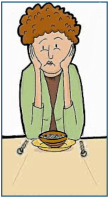
self-hateI’M NO GOOD, & EVERYONE KNOWS IT – so I have to be perfect to make up for it

T.E.A. = Thoughts, Emotions, Actions

REMINDER: See ACRONYM page for abbrev.

FoA = fear of abandonment

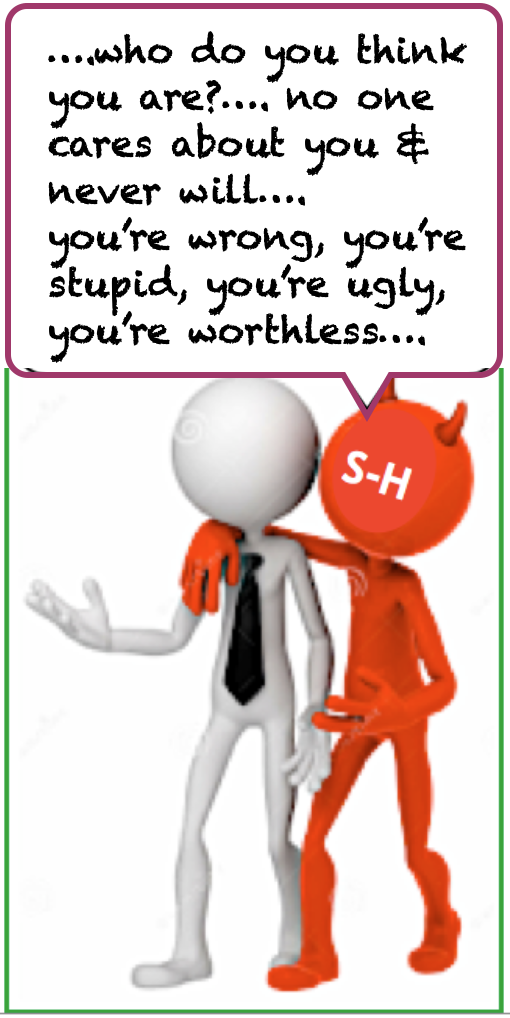
SELF-HATE (S-H) is the #1 deterrent to growth for all ACoAs.
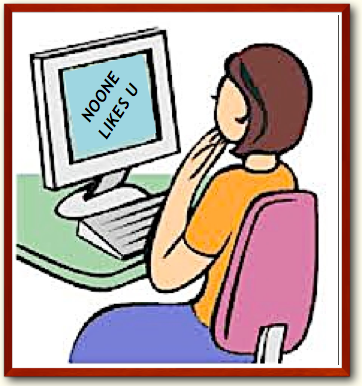
It undermines our ability to function well, to have self-esteem & to be happy. Some people call it being ‘hard on yourself”, but it’s much more than that.  It’s so pervasive in the inner world of many ACoAs, that we don’t even know we have it & if confronted, vehemently deny it.
BUT the symptoms are all there, starting with a persistent nagging anxiety.

1. DEFINITION
✶ In Childhood : being thoroughly convinced that everything bad that happen to us as kids was our fault, that we caused our own pain!
✶ In Adulthood : continuing from the past, we believe in our very cells that anytime we feel hurt, suffer a loss, get ignored, can’t get something we want, have something taken away, have to wait for something … that it’s because we are bad, don’t deserve, did something wrong , failed to do something, don’t have a right to it – anyway

REALITY
ALL self-hate is a LIE
✶  it’s a defense mechanism to deny the original abandonment – by our family & culture. This a crucial point:
✦ S-H tries to cover-up all our abandonment pain
• It’s actually a form of narcissism (ours) – making everything about US, when it rarely is.  We make other people’s bad behavior our fault & our responsibility
• It’s an attempt at feeling in control, to cover our intense sense of powerlessness & vulnerability

• S-H can be expressed in all 3 T.E.A. categories:
Ts: “I caused their accident, since I asked them to come visit me”
Es: “I feel bad & really scared they won’t like me since I said ‘No’”
As: Staying with abusive people, not taking care of ourselves, not pursuing our dreams, not speaking up….

ESSENCE
One of the characteristics on the ACoA Laundry List is being Over-Responsible, a symptom of FoA & S-H.
What make S-H different from taking healthy, balanced Responsibility?
HEALTHY R. acknowledges the reality of having our T.E.A.s – or not. It straightforwardly owns up what IS, which can sound like:
“Yes, I did that” (A), or ‘No, I can’t handle this” (A), or “No, I don’t agree with that”(T) , or “Yes, I love this” (E)….

S-H, on the other hand says : “I_______, & therefore I’m BAD”
• Ironically, it prevents us from admitting to any normal, human imperfections, from shame & for fear of abandonment, OR
•  it can make us ‘confess’ to wrongdoing, even when we are in fact blameless.

In either case, what’s underneath is an unspoken Toxic Lie tacked on to legitimate responsibility, categorically stating that:
✒︎ “I did / didn’t do_______, which proves I’m unlovable & worthless”, no matter what the topic or truth is.

This add-on is implied, but at the core of our self-image. ACoAs will take any opportunity to beat themselves up, even about good things!
🖤 All S-H comes from our wounded child (WIC) staying loyal to our wounded parents.
EXPs of S-H:
“Yes, I did forget to sent the letter out today, so therefore I’m irresponsible”
“No, I don’t how how to do that, therefore I’m incompetent”
“Yes, I went to the show without inviting you, so therefore I’m selfish”
“No, I haven’t ‘grown’ perfectly or as fast as I should, so therefore I’m unfixable”
“Yes, I talked a lot at the meeting, so I’m a limelight hog”
“No, I don’t agree with that, therefore I’m stupid” …..

This is NOT what ‘taking responsibility’ means.
Posts: ACoAs’ Fear of R // Healthy R

So – WHAT IS IT? 
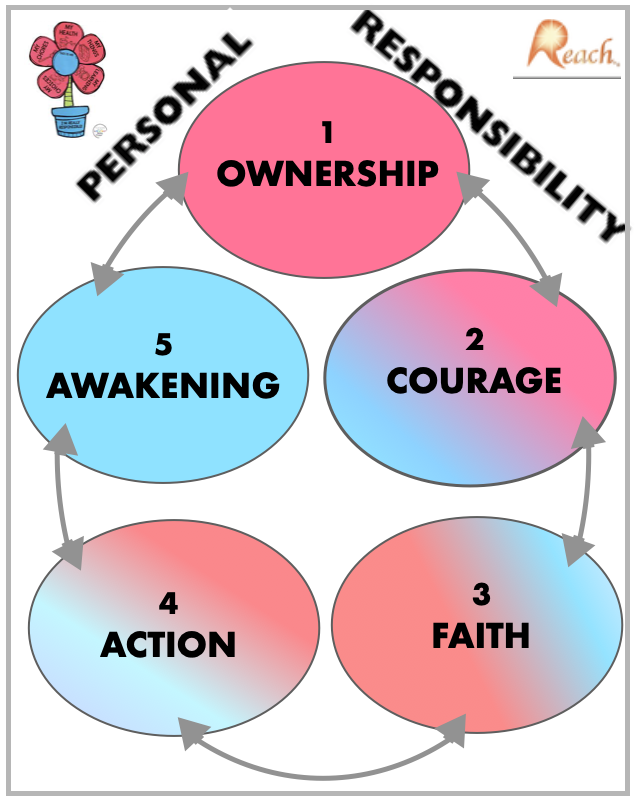
Basically, adult Responsibility (R) is:
★ honestly admitting to ourselves what we feel, think & have done -or- not. (T.E.A.), without judgment, shame or guilt.
MOST of ALL – without mental torture.

✒︎ Healthy R. includes regularly acknowledging both our limitations AND our gifts, our ignorance AND our knowledge. (POST: “The 10th Step“)

This def. applies to us now, as adults.
We are not / were NOT responsible for who our parents are or what they did!
SITE: “Great Responsibility Quotes for Kids” & the WIC

NEXT: SELF-HATE & ACoAs (#2)

Variation of ACoA Laundry List

reading blogI HATE READING THIS INFO!
Even so, it’s a relief to know

SITE: Adult Survivors of Child Abuse: Removing the Splinter

BOOK: Laundry List  Tony A & Dan F

NOTE: See Acronym page for abbrev.

• All the PMES forms of Abandonment by parents forces children to hide the parts of themself that are considered NOT OK by the family, in order to not get rejected: “DON’T make mistakes, don’t have needs, don’t contradict, or successful, or show your emotions …”
Exp: We were told that what we felt was not true or legitimate: “You don’t have anything to cry about, so stop being such a baby,  Stop crying or I’ll really give you something to cry about , That really didn’t hurt  ,  You have no right to be angry, Don’t feel that way” ….S-H

Self-Hate – As a result of being mistreated as kids, the most visible issue for ACoAs now is our intense S-H: “I’m no good, no one will ever love me, I can’t do anything, my need don’t count…..”, the defense mechanism all children develop to protect themselves from experiencing the original pain suffered throughout childhood (abandonment), and from acknowledging to themselves how hurtful their parents were.
S-H says: ‘Everything bad that happened to me  – past or present – was / is my fault.’ SO – any time I’m in pain I did something wrong, & I’m bad

• This belief gives the WIC a false sense of power – “If I caused it, I can fix it!” However, the reality is that we did not create the damage that was done to us – that is the responsibility of the adults who raised us. We were the victim of their wounds – then. NOW, we’re responsible for healing ourselves so that we can become our True Self!

Because of childhood Abuse, Neglect & Abandonment, in the present –  WE:perfectionism

YOU:
• are perfectionistic, driven, rarely satisfied – especially with ourself
• are intimidated by &/or feel enraged at controlling people
• expect others to hurt, judge or take advantage of you
• experience temporary dissociation (pg__), disconnecting from self
• feel chronically empty or numb inside, easily bored, restless
• feel like you’re always under scrutiny – even when alone
• find it hard to relax, laugh or be spontaneous
• keep yourself isolated from shame and so ‘no one can hurt or leave’ us
• frantically try to avoid real or imagined abandonment – by clinging, people-pleasing, being invisible….
• lose yourself in relationships by automatically & continually putting others’ needs before your own
• over-value & then under-value people you get too close to

You HAVE:
• a confused or distorted self-image: “Who am I really? , What do I really look like?” (feel ugly, fat, too thin, too short….)
• chronic obsessive thoughts, spinning  ‘round & ‘round without solutions
• compulsive self-damaging behaviors in 2 or more areas of life = eating disorder, addictions, fights, under-achieving….

• a harsh “inner critic” that torture you, especially after any disappointment or loss
• impulsivity – can’t control your choices & reactions
• inappropriate & intense anger, trouble controlling temper
• mood swings not caused by bipolar disease

• paranoid thinking – as a regular way of experiencing others
• recurring suicidal thoughts or actions
• trouble asserting yourself & not feeling proud of your accomplishments
• trouble finding a spiritual belief, or one that feels right

ACoAs are very intelligent and determined. With the right kind of help we can heal from these wounds and prosper.  Al-Anon, therapy, a spiritual practice, reading, & staying connected with other ACoAs in Recovery make all the difference. Don’t forget: ‘Progress, not Perfection’

ACoA WEBSITE (80+ pages) : www.acoarecovery.com

NEXT: Original LL