ACoAs ‘FEELING SORRY For’ (Part 3)

I CARE ABOUT OTHERS IN PAIN –
but my first responsibility is to my own!

PREVIOUS: “Feeling Sorry For” #2

See ACRONYM page for abbrev.

1a. For OTHERS – POSITIVE
1b. For OTHERS – Negative

2. For OURSELVES
FEELING SORRY for oneself can be healthy or unhealthy.

HARMFUL, coming from others
When we express genuine pain, we often hear cruel reactions 
from ‘authorities’, family or so-called friends (some 12-step members, religious communities, various self-help gurus / books), saying :

“Get off the pity pot , You’re JUST feeling sorry for yourself , Don’t wallow in your pain , Don’t live in the past , That was a long time ago , Are you still going on about that? ….”

These comments come from wounded people in denial about their old wounds (even some in Program) & not working to heal them. Instead, they’re clinging to & protecting their own defense mechanisms & don’t want to be reminded of their damage by our sadness.

However,
we have our own version of “feeling sorry for”, in 2 forms.
a. Negatively (self-pity) endlessly rehashing old traumas, as a way to :
• not care for ourself & stay in damaged-child modeself-pity

blame others, instead of focusing on what we can do now
• stay in the anger – which is ‘safer’ than feeling the pain underneath
• not have to grow up & ‘leave home’ (S & I) — escaping the responsibility of being in charge of our life.

b. PositivelyFirst & foremost, we need to have great compassion for ourself – for what we endured as kids, & also as adults. Feeling sad for & comforting our WIC is NOT selfishness, as we were told. Gaining the trust of our WIC is the main way to heal.

As kids, our suffering was ignored or punished & we were expected to suck it up. Even then, ‘they’ said we were being a baby, too sensitive, over-reacting, making things up, being crazy….

This left us with a tragic inability to be kind & understanding toward ourself!  We’re as unsympathetic as our family was – indeed, just as cruel in the way we talk to & treat ourselves! (Self-Hate)

SO, ‘healthy’ feeling sorry for -ourself- includes:
gain WIC's childrenclearly understand exactly what happened to us in childhood. As long as we don’t / won’t identify & acknowledge it, we’ll keep repeating it
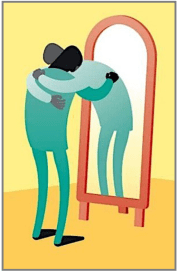
• having others validate our experience, without blame or judgment, because we never got the right kind of mirroring growing up (a crucial aspect of our damage)

• going over & over the traumatic events of childhood in order to get to the emotional pain which they caused – to process it & get it out of our body
• crying, raging & mourning – in safe places, with safe people – so we don’t have to carry it around anymore or take it out on others

This process can take a long time, because there’s such a huge backlog of pain which can’t be accessed quickly or easily, plus our resistance to change.

EXP:  Rob was working on connecting with his Inner Child for several years.  While sharing in an ACoA 12-Step meeting, he suddenly visualized his kid sitting on the floor, hunched over – with knives sticking in him, all over. That’s what all that early verbal abuse had felt like! Rob started to cry.
compassion for WICIn that moment he saw & felt the terrible distress his kid was in but which he hadn’t been allowed to object to or express.
Now his Loving Parent self was able to feel a great rush of sorrow & compassion for his younger self.
After that he couldn’t allow himself to linger in cruel self-talk from the PigP or WIC any more.
It was a turning point in his Recovery.

• Remember : The only source of self-esteem is unconditional love. Having a strong, positive identity means treating ourself with loving kindness, patience & perseverance.
We do need to ‘feel sorry for’ our wounded part – the real-life child we were, who suffered unfairly & alone thru endless days & nights, in our home, school, church & neighborhood – without people noticing, caring or helping!

• If we – as the Loving Inner Parent to our WIC – can feel genuine sorrow for what we endured, through no fault of our own, we can begin healing those wounds.  The child part of us is waiting to be heard!

NEXT: Fear of commitment- #1

ACoAs – Being Negative (Part 4)

negativityISN’T IT CRAZY TO TALK TO MY BODY? 

PREVIOUS: NT (#3)


Negative Thinking (NT)
(cont)
1. re. OURSELVES
2. re. Personal RELATIONSHIPS

3. re. Our BODY
UNREALISTIC
a. At an extreme some ACoAs are hypochondriacs —  with the disorder that makes a person believe that body ‘feelings’ are signs of a serious illness —-> even when medical science can prove otherwise.
It’s their preoccupation with health, misinterpretiimagined illnessng a physical sensation (gas, muscle ache, headache….),  making it something it’s not.

Illness becomes a part of the hypochondriac’s identity, causing relationships & work problems. It occurs in men and women equally.
Relentless NT about the body is a substitute for / defense against feeling the huge backlog of hidden painful emotions we’ve buried. And long-term, it harms our immune system (Psycho-Neuro-Immunology).

b. Body Dysmorphia (BBD) – the distorted, unrealistic image of one’s physical appearance (ugly, fat, too thin… ). Most often it’s the result having been sexually abused as a child. In extreme cases the person cannot “see” their body, only their head, even in the mirror.

ACTUAL – However, many ACoAs suffer real physical problems, FROM :
• years of addictions, self-abuse & neglect
• being under constant emotional, mental & spiritual stress as kids, plus physical/sexual abuse, later creating very real medical conditions = the auto-immune diseases

• hereditary factors in alcoholic families: birth trauma, childhood ailments, mental illness, bad teeth & gums, depression, bipolar disorder, dyslexia, ADD, SAD, EDS, severe food allergies (wheat, sugar, nuts…), environmental illness & other chemical imbalances
SITE:“…severe childhood trauma can alter developing brain”

➼ Whether inherited or self-inflicted – it’s imperative to not use NT toward our bodies. We must never, ever curse our cells or wounded parts!
If we stay fearful, worried, & project the worst, OR rage at our organs, limbs, nervous system… the body absorbs that negative energy & may take longer to heal or maybe not at all. (Cartoons re. responses to Physical vs Mental illness)

Healthy EXP: Jody had a motor-bike accident which damaged a muscle group just above one knee & caused a limp. Along with Feldenkreis & Brain Gym, she spent time doing Positive Inner Dialoguing. Pictured the injury, she talked tenderly to her leg – “I love you & am so sorry you’re hurt. I can see the cells repairing themselves using the healing energy I’m sending you. You’re important to me & I need you. I want you to be strong again… ” While the muscle took longer to heal, the limp cleared up right away & all of the damage was eventually repaired.

5. re. THINGS
• This is a more subtle form of NT – saying bad things about objects, places, events…. anything not alive. Many people think it’s perfectly ok to call things insulting names : ‘Damn that stupid chair! I stub my toe on it every time!’ or ‘My car is such a piece of shit. It’s always breaking down.hate things

• What’s wrong with that? They don’t have feelings, so what’s the big deal? Well, it’s more of the same – projecting our painful childhood experiences onto objects, putting out more negative energy, which can get reinforced by others around us.

NOTE : Negative Reciprocal Attraction :  one person does something harmful to someone else, who then returns “the favor” with an action that’s similarly harmful (attack<–>revenge // glare<–>frown // ignore<–>snub… ). This explains why some people keep moving in the wrong direction, ie. away from ease, comfort & safety.

Reality Check
• Since the chair is inanimate, stubbing your toe may have to do with where it‘s placed, and/or the way you move thru space. In her autobiography  Nancy Friday tells of constantly getting black & blue from bumping into things. In therapy she learned that she was unconsciously punishing herself for her (repressed) rage at her mother

• And the car may be old & breaking down, but it’s not the car’s fault – maybe of the manufacturer, or yours for not taking better care of it – or it’s time to replace it but you’re mad & ashamed because you can’t afford to!

ACoAs tend to get things backwards, blaming things instead of identifying the real source of our pain. To be emotionally & mentally clean we need to identify & own:
😣 our disowned emotions (anger, hopelessness, disappointment, fear…) which then deny / ignoreget projected on to PPT

😡 that we ignore experiences which actually were harmful, then redirect our anger & hurt back on to ourself or at innocuous objects

Blatant negativity is hard to miss, but ours can be so hidden that others may never realize how often we’re thinking that way.

NEXT: “Being Negative” (#5)

Anger & the BRAIN (Part 3)

brain chemicals

DON’T KNOW WHAT’S WRONG
must be those pesky chemicals!

PREVIOUS: Anger & the Brain (Part 2)

SITE: “Helping children with anger


2. EMOTIONAL REACTIONS (cont)
a. The ‘Reptilian’

b. The LIMBIC SYSTEM (cont.)
iii. The Amygdala (cont)
While there are successful action-tools to manage hostile responses to life’s difficulties, chronically angry people may have trouble using them if their brain isn’t producing enough acetyl-choline, the hormone which tempers the more severe effects of adrenaline & helps to schedule REM sleep.

BTW: Introverts generally have higher level of this calming neuro-transmitter, so they’re more comfortable being alone, not needing a lot of stimulation in order to burn off excess adrenaline.(More...)
AND – they’re highly sensitive to Dopamine, so – too much will over-stimulate them.

✤ Under sudden stress, the brain is wired to make us react before we can properly consider the consequences. While the amygdala is very efficient at warning us about a threat –
it can only react from previously stored action-patterns, so it’s not good at judging or evaluating what to do about it.

When flooded with emotions, it hijacksthe rest of the brain, so the prefrontal cortex (PFC) gets temporarily cut off, without the thinking-option of checking if our behavior is reasonable, appropriate or safe.

EXP: When anger takes over, a person will tend to ‘shoot from the hip’ instead of from the head. However, resilient people (emotionally & chemically balanced) are able to make a faster recovery from stress, allowing them to BrainCoherenceEmotionuse the thinking brain more easily to calm emotional intensity.

✤ Emotional flooding does not excuse bad behavior, but it does mean that managing anger properly is a skill that has to be learned, NOT something we’re born able to do instinctively.

NOTE to ACoAs: This is another reason there are times when we can’t seem to respond successfully or at all – until well past the event. It’s when we’re shocked by someone saying or doing something that scares our WIC, whether outrageous, actually harmful, or just because it reminds us of our family.

For many us, it’s only later – sometimes much later – that the cortex is finally able to kick in & lets us think of all the ‘right’ or clever things we could / wish we could have said. Very annoying, especially in the modern world where words are more often needed than fists!
(See ‘Communication discrepancies in “D.M., #5”)

Re. the Amygdala in Animals
Overactive – When their brains were stressed by electronic stimulation, they became aggressive. As the irritation continued (just as ACoAs suffered as kids), the amygdala became overactive, dramatically increasing the subjects’ agitation & short temper
Missing – When the 2 structures were removed, the animals became very tame, no longer responding to things that previously would have caused rage, fear or sexual interest….

FEAR PATHS:
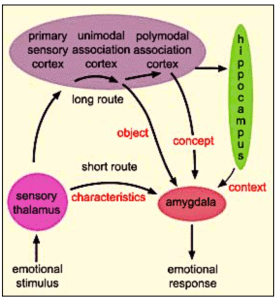
Information (stimuli) first goes to the thalamus & then to 2 parallel pathways:
√ The ‘low road’/ short route (12 milli-sec.) provides a fast, rough impression of the situation, bypassing the ‘thinking’ brain. This creates an emotional response before all the facts are in

√ The ‘high road’ / long route (24 milli-sec.) – goes from emotional input, thru the cortex to the amygdala – allowing the brain to determine if an event is truly life threatening.
If the frontal cortex rationally decides that it’s not, it dampens the intensity of the amygdala’s quick reaction, via the unconscious. (MORE…. birth – age 7) (Circuitry & Sense of SELF)
In Humans
:
When the amygdala is damaged, experiences which should cause alarm don’t get to the cortex for processing (high road), so that person will compulsively go toward dangerous things, even when repeatedly warned against doing so – because the fear response is missing (low road).
too much risk
EXP:  When one woman had her amygdala removed to stop her seizures, those were eliminated.
But also – she was no longer able to recognize fear or anger in herself, or in other people’s voices.
However, she could still identify & understand expressions of sadness, disgust, happiness, & surprise.
◆ In the case of PTSD, the input / event route through the cortex isn’t able to dampen enough of the fear response that has already taken place previously & repeatedly in the low road.

NEXT: Anger & the Brain (Part 4)

PURPOSE of Emotions: SURVIVAL

WE HAVE EMOTIONS FOR GOOD REASONS
– so now I welcome & work with them!

PREVIOUS: Repressing Emotions #2

Review post : “Getting to our Es – Under

PURPOSE
✥ Do you know what to say when you hear someone insist that emotions are a waste of time, unreliable, too much trouble? The next several posts will give important reasons – biological, personal & social – why we have them!

SOCIAL NEEDS
1. For SURVIVAL
• That’s the evolutionists’ answer. According to their theory, animals are aggressive & self-conscious (compared to rivers, mountains, plants….which have also survived) & humans are the most self-conscious, making us increasingly invested & crafty in our efforts to endure.
Over time we developed a wide range of Es & a complex rational thinking system, which allowed us to imagine our own past & future selves, giving us preeminence over fauna & flora. ‘”If you want to create a system that works hard to survive, make it be conscious and emotional. It will want to keep itself around!’”Es for survival

• Researchers believe that Emotion, rather than logic, is the driving force in the human brain. Studies show that Es are responsible for neural integration – linking various brain functions (talking to each other) by tying together physical, cognitive, sensory & social processes, keeping us sane, healthy & functioning effectively

• Robert Plutchik, of the Emotion Wheel, wrote that the purpose of emotions is to form behavioral interactions between a person & a stimulus – event, thing or another person – so that when Es are acted on (correctly, of course) it brings the person back to a state of equilibrium — feeling ok / safe
EXP: You’re in the woods & see a bear loping towards you. You’re very afraid. The fear makes you run away, so the emotion served to produce an action that saves your life. You’re then returned to a calm state (eventually).

2. For CONNECTION
• Humans are fundamentally social animals, needing to rely on each other for survival. So we not only have personal feelings, but also social Es deeply embedded in our nature for connection.  Es motivate & organize individual behavior & social interactions, as well as facilitate communication.  Social needs include acceptance, prestige & access to certain people, events or resources, & provide a mirror for our feelings, attitudes & realitybelonging

• Belonging to a group or community gives us a sense of identity.
Researchers found that people are happier when they’re with others rather than too much alone – & the “boost” is the same for Introverts & Extroverts (only the quantity & time amount differs).

✶ Loving relationships are important to our well-being & happiness because they’re comforting. It creates the psychological space & safety to explore & learn, which builds inner resources for those inevitable times of difficulty.
AND the positive effects are long-lasting. Strong emotional support also reduces immune system abnormalities that contribute to various stress-related disorders.

EXP: The success of the many 12-step Programs (AA, GA, OA / Al-anon, Gamanon, Oanon….). The Al-Anon closing says: “The welcome we give you may not show the warmth we have in our hearts for you. After a while, you’ll discover that though you may not like all of us, you’ll love us in a very special way—the same way we already love you.”

Emotions that serve social functions:
social EsGuilt (not the ACoA type) is legitimate when we’ve done something inappropriate or hurtful, that motivates us to make amends (AA’s 8th & 9th Step)
Responsibility (not co-dependence) to keep us from harming others, or to help where needed….
Altruism, going beyond passively ‘behaving’ oneself to not cause social problems, but rather to actively participate in groups & organizations that provide relief for the needy & suffering

3. For UNITY
• Because Emotions are universal, the ‘positive’ ones may help overcome prejudice & divisions. Tragically, even fatally, many cultural, religious & political beliefs separate us. But Es – such as empathy, cooperation, forgiveness & heroism – can help.
Unifying Emotions:
fun singingCaring: listening to concerns of others helps them feel understood & valued
Faith: a Spiritual belief providing wise rules (of right & wrong) can connect us to like-mined people
Music (& other art forms) emotionally link artists & a wide public
Laughter: a universal language that makes people feel good
Love: fostering acceptance, compassion, education, responsibility, understanding, & spiritual growth.

NEXT: For Communication, #1