ACoAs & HUMILIATION (Part 1)

humiliationI’VE BEEN DOWN SO LONG
I can’t imagine ever getting up!

PREVIOUS: Anger T & F, #2

SITE:Humiliation” (Wikipedia)

QUOTEs: “No one can make you feel inferior without your consent.” ~ Eleanor Roosevelt


» DEF: Being in a state of disgrace, a loss of prestige &/or self-respect.
A person who is continually subjected to severe humiliation will experience major depression, suicidal thoughts or actions, & severe anxiety states, such as post-traumatic stress disorder (PTSD).

RESEARCH: A study at the U of Michigan revealed that the same areas of the brain which light up when we experience a physical injury – are activated when we experience intense social rejection.
In other words, humiliation & isolation are felt just as strongly as body pain.

NOTE
: Humiliation is not the same as humilityThe opposite of Humiliation is Appreciation

HUMILIATION originally comes from external sources – which then get internalized as part of the PP voice (Introject).
✦ THEN – for ACoAs it comes first & foremost from our family, & then often from school, church, neighborhood…. It’s ‘being shamed’ rather than feeling ashamed

✦ NOW- a less severe event may cause us to “take offense” when something is said or done to us, which comes from what or how we think (cognitive, intellectual).
Whereas –
✦ Humiliation is more demeaning & hurtful – visceral, existential – about who we are fundamentally

In the present, most ‘victims’ disagree with the humiliation laid on them – don’t like it, know they don’t deserve it, see the treatment as unjust….but don’t believe they have any options, & so don’t challenge the source or change their environment

1. EXTERNAL Sources
Humiliation involves an event or ongoing situation that indicates unequal power in a relationship, where we are in a one-down position & unjustly diminished.
Often the painful experience(s) are vividly remembered for a long time after, & can lead to anxiety, especially if the exposure was prolonged. It requires:
victim/perp1. a Perpetrator exercising negative power,  in many different settings

2. a Victim who is truly powerless (child, minority, the poor….)
OR who is re-enacting a long-held victim role from childhood, so is who;; vulnerable to being humiliated
3. one or more Witnesses to or observers of – the event(s), such as family members, neighbors, teachers, the general public, peers, officials…. who usually do not object or help  (bystanders, helpers), sometimes even egging the perpetrator(s) on, as in bullying (Flying Monkeys)

➼ The following list was compiled by Leland R. Beaumont at Emotional Competency” & can be applied to children as well as adults.

a. PHYSICAL / SEXUAL (most visible)
Being
• boundary / privacy invaded, trespassed on
• denied basic needs &/or social amenities
• exploited, suppressed, violated
• forced to do or say something distasteful & self-shaming
• injured, assaulted (hit, spit on…), attacked
• isolated or physically abandoned
• the loser in a dominance contest / cheated on
• molested, incested, raped
• often beaten, slapped, kicked, punched
Having  your:elder abuse
• abilities diminished from being disabled, or movement severely limited
• basic personal freedoms lost (mobility, access, autonomy)
• competence / confidence damaged – from being tricked, trapped, mislead, opposed, sabotaged, let down
• goals & plans constantly thwarted, over a long time
• resources diminished from being defrauded, robbed, cheated, evicted
• safety or security reduced by intimidation or threat
• to see / watch a loved one sexually assaulted
• to watch a love interest flirt with another, causing intense jealousy

b. EMOTIONAL /PSYCHOLOGICAL
Being
• blamed for things that have nothing to do with you
• blatantly rejected, treated unfairly, forced to back down
• betrayed, cheated, lied to, defrauded, suckered, duped
• denied basic personal & emotional needs
• deprived of privileges, rights or human dignitymade fun of

• forced to swallow one’s pride
• laughed at, mocked, teased, ridiculed, given a dirty look
• lowered in ones own or another’s estimation, made to feel powerless
• dependent (not by choice), especially on weaker people
Being
 • made to look stupid or foolish
• manipulated, dominated, controlled, forced to submit
• taken for granted, used to fill a need in others
• denigrated for ones values & beliefs, made fun of
• snubbed, put down, disgraced, shamed (not ashamed)
• treated as an equal by someone of a lower-status
• treated like an object (it) or animal, rather than a person

NEXT: Humiliation (Part 2)
Anger – Ways to REACT (Part 1)

Screen Shot 2015-06-07 at 3.15.09 PMI HAVE LOTS OF OPTION
for expressing my anger!

PREVIOUS: Anger – Negative uses  (#2)

SITEs : The Logic of Emotion      

Emotion Wheel app

List of phrases about anger or conflict (date rape, hot-blooded, road rage, tit-for-tat….)   ✦ See ACRONYM page for abbrev.

NOTE: The following 5 posts give several versions of the basic ways to categorize how people react to their own or other people’s anger/rage (Unsafe <—-> Safe)

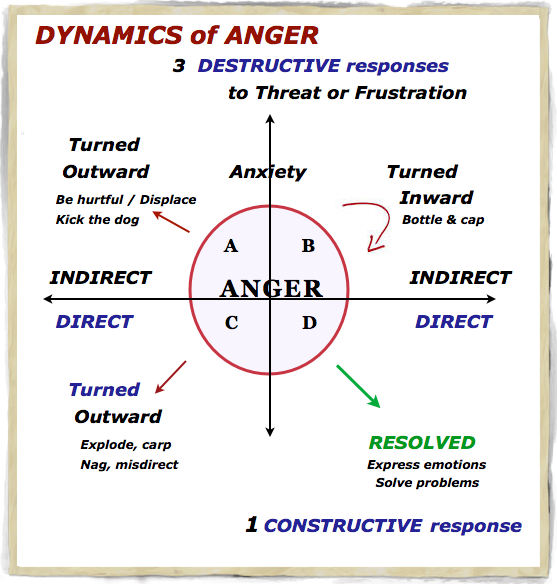
1. DYNAMICS of Anger Chart
A & C – OUTWARD anger at other people, places or things
A Indirect: sneaky or passive – without admitting or dealing with it
C Direct:
• Assaultive – physical, verbal & sexual cruelty
• Aggressive – attack on someone’s identity rather than their actions/ non-actions

MY dynamics of angerB
  
INWARD: suppressed & used against oneself, for FEAR of:
• losing control
• being disliked / rejected
• hurting / offending others
• the emotional intensity
• losing close relationship
• disobeying RULE  “Never get angry”
• too little communication / silent remoteness, depression

D Anger RESOLUTION, finding direct ways to manage, change or leave problem situations, using the Healthy Adult ego state

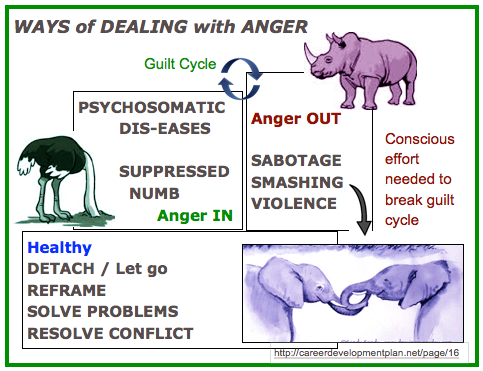
2. ANIMAL Symbolism
⬇️ CHART contrasts 3 ways of dealing with anger :
• Ostrich (Passive) = ignore, deny emotion
• Rhino (Aggressive) = attack, deny responsibility
3 anger ANIMALS• Elephant (Healthy) = be calm, understand, negotiate – expressed by:
a. Knowing ‘anger-signals’, from self or others, & then staying awake for them
b. Using a variety of productive & safe ways to respond (MORE….)

Use the S.M.A.R.T. action plan to deal with issues:
• Face the problem
• Ask questions to gather relevant info
• Re-frame – “What else could this situation mean?”
• Don’t take criticism personally, just learn from it – if possible. Side-step the WIC’s reactions
• Then let go of the whole thing. Forgive yourself, if necessary. (from the ELEPHANT JOURNAL)

3. MOOD MAPS – used to notice anger & in relation to other emotions
MOOD MAPS


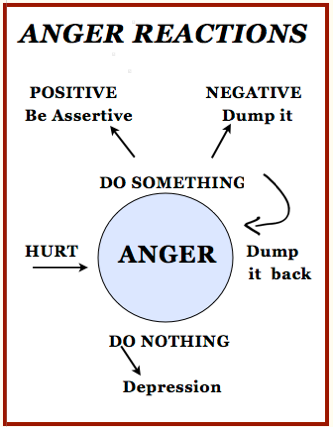
CHART  ↘️
Appropriate expressions of anger are a way to be assertive (not aggressive)
• Unhealthy : dumping it on others or at oneself
• Ignoring : Suppressing it (denial) eventually leads toanger reactions depression4

NOTE: Speaking in a FIRM tone is not automatically an expression of anger. It can simply mean determination, being sure of something, or making a point.  This also applies to teaching, or correcting & providing discipline, which is meant to guide & support

🌀 However, if your WIC hears firmness, corrections or being giving direction as an attack or put-down, when it’s not meant as such, you’ll experience the same fear & weakness as if it were, based on childhood trauma.

4. Three TYPES of Anger

a. Hidden 
“Just because anger is hidden doesn’t mean it’s harmless. Just because it’s under wraps doesn’t mean it’s under control.”
For many of us, the need to deny the strength or even the existence of our anger is so powerful that we develop the ability to deny our anger even exists – unconsciously or by choice

• BUT – “Anger is such a powerful coping mechanism that repression & suppression are not actually successful. The more you try to avoid it, the more time & energy you ahave to spend with it. It’s a paradox.”  Dr. Roland Mairuo, Seattle MD. (+ Bible references)
Burying anger doesn’t diffuse it, it just burrow underground, where it undermines our sense of Self. The force of it will find other, secondary outlets when not allowed out directly & appropriately, usually in damaging ways

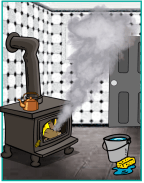
• Freud once likened anger to the smoke in an old-fashioned wood burning stove. The normal avenue for the discharge of smoke is up the flue & out the chimney.
If this is blocked, the smoke will leak out in unintended ways…. around the door, through the grate…. choking everyone in the room. If all avenues of escape are blocked, the fire will go out & the stove is useless.

Humans are the same – if anger is suppressed, it leaks out anyway. If suppressed for too long, we become cold inside & hard outside.
Normal human expression of anger is seen in big physical movements &/or loud vocalization, as in unhappy babies.

HIDDERN anger

NEXT: Ways to React (Part 2)

Enneagram: Triad EMOTIONS – Intro

triad emotions 

UNDERSTANDING MY EMOTIONS
helps me deal with life better

PREVIOUS: Ennea Triad Basics – #2c

SITE: “Personality tool: Understanding the Enneagram. Scroll down for info on each type’s way of expressing emotions

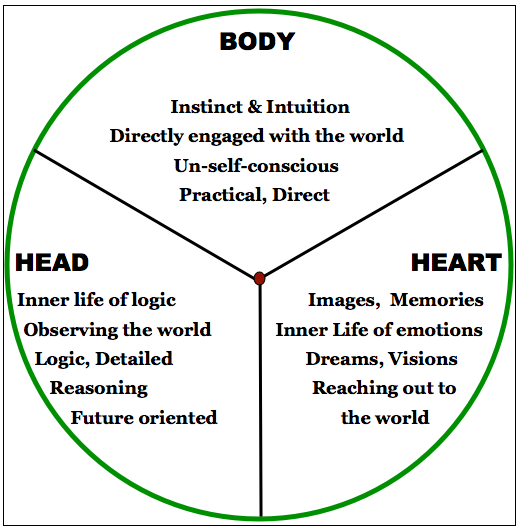
CORE EMOTIONAL responses of the 3 Basic Centers
An important way of using the Enneagram is to identify & properly deal with the emotional essences of each triad – developed out of biological responses to survival threats. They can be seen across ALL mammalian behavior, via modern Affective Neuroscience. The same distress-emotions are triggered when the organism’s 3 BASIC NEEDS are not met.

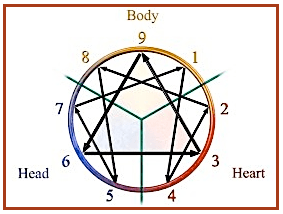
CENTERS: Feeling = Heart (234), Thinking = Head (567) and Gut (891) which includes = Instinctive (digestion, breathing, heartbeat) & Sensory aspects (running…).
Interesting: Gut acts 30,000 times faster than Heart, itself 30,000 times faster than Head. (“The Fourth Way)

◆ EVERY type is capable of experiencing ALL emotions, but each Center is driven by a main one. When things get tough, frustrating, won’t go our way….Screen Shot 2014-09-28 at 10.38.50 AM there’s an inner ‘default’ setting that gets triggered

234s = Grief, Shame
567s = Fear, Anxiety
891s = Anger, Rage
Each Type handles it’s primary emotion differently:
❖ The first # is overt “externalizes” :
2 its shame, 5 its fear, 8 its anger
◆ The second # “represses /covert” :
3 its shame, 6 its fear, 9 its anger
✦ The third # “internalizes /neutral” :
4 its shame, 7 its fear, 1 its anger

Basic FEARS – Triad emotion are our automatic ‘natural’ way of responding to the world, but most people don’t realize it’s what fuels their daily reactions.
When these emotions are cut off from our Core Self, they generate the Type’s defense mechanism, which underpin all dysfunction. While each Center has it’s preferred emotion, Riso & Hudson explained that each TYPE also has an underlying fear OF being: 
enn - Triand INFO1s – corrupt, defective, unbalanced
2s – unwanted, unworthy of love
3s – worthless
4s – without identity or personal significance
5s – helpless, incapable, useless
6s – unable to survive on their own
7s – in pain and deprivation
8s – harmed or controlled by others
9s – lost or separated from self & others

◆ Beatrice Chestnut, psychologist & teacher, condensed a human child’s early needs into 3 challenges – emotional ‘disturbances’ when not properly fulfilled:

A. Need to feel mirrored – when their caregiver makes direct, loving, face-to-face, eye-to-eye contact, so the young child feels ‘seen’ for who they are.

MISSING: Distress/Panic, from the loss of connection & bonding.
Heart types innately pursue this need, but do it incorrectly by creating a False Persona. This makes it hard to be curious about oneself, others & life.
They’re too busy watching what they do, so it will fit their created IMAGE of being:
2s – thoughtful & considerate – so others will respond favorably to ‘such a selfless person’ who only thinks of others
3s – a confident, successful person (so others will respond with respect to such a competent, achieving individual)
4s – a unique person, different from everyone else (so others will at least think they are special rather than lost or deficient).

B. Need to not feel fear – being protected from real danger, or whatever is imagined to be dangerous

MISSING: Fear/Anxiety, when experiencing ta threat, challenge, or danger to our very security
Head
types figure out what makes life certain for themselves. Some fear is necessary & useful if it’s not all-pervasive & overwhelming. When fear overwhelms, it’s very hard to be open to & curious about all the good things available to us.
It’s also imperative to separate fear that’s real from what’s self-created (S-H)

5s – move away from anything that scares them, retreating into a solitary, private world where they only rely on themselves
6s obsessively imagine future danger, &/OR act fearless, as a way of coping with their ever-present fear of life
7s try to avoid fear entirely with constant distractions, sticking to a positive attitude, always considering new possibilities, & planning escapes

C. Need to feel held & supported – seen in very young children who want to be securely wrapped & held, to not feel the threat of being dropped (injured or dead)

MISSING: Anger/Rage, when we experience not being able to depend on our caretakers to ‘back us up’ – neglected, violated & repeatedly deprived
Body Types can sense what’s wrong in their world, know what actions are needed to correct it & how to provide their needs. They want to control their experience & environment to deal with anxiety :
8s try to ‘hold’ everything & everyone by taking charge
9s ‘hold’ by repetitive activities that soothe them (narcotizing)
1s ‘hold’ by being self-controlled, trying to control or structure every aspect of life

LAYERS of the SELF enn -LAYERS of the SELF
Outer = COMPULSIVE : Behavior is automatic
Next = OBSERVING : Beginning of awareness, ability to notice & detach from compulsions
Semi-Inner = HIGHER : Increasing awareness & autonomy, the ability to access higher functions of the Centers
Inner/Center = ESSENTIAL :
Unified consciousness, not trapped in or identified with any one triad
(Chart: ‘Nine Paths’ 12/26/12)

Moving from the outer circle of Stress & Security points – towards our center – requires consistent self-observation.

NEXT: Triad Emotions (Heart)

DEFENSE MECHANISMS (Part 1)

defense typesI USE WHATEVER I CAN
to escape my fears

PREVIOUS: Enneagram Humor #4

REVIEW posts: Abandonment Pain

SITE: Defense Mechanisms Quiz

BOOK:In sheep’s Clothing (re. manipulative people) go to slide 50 ++

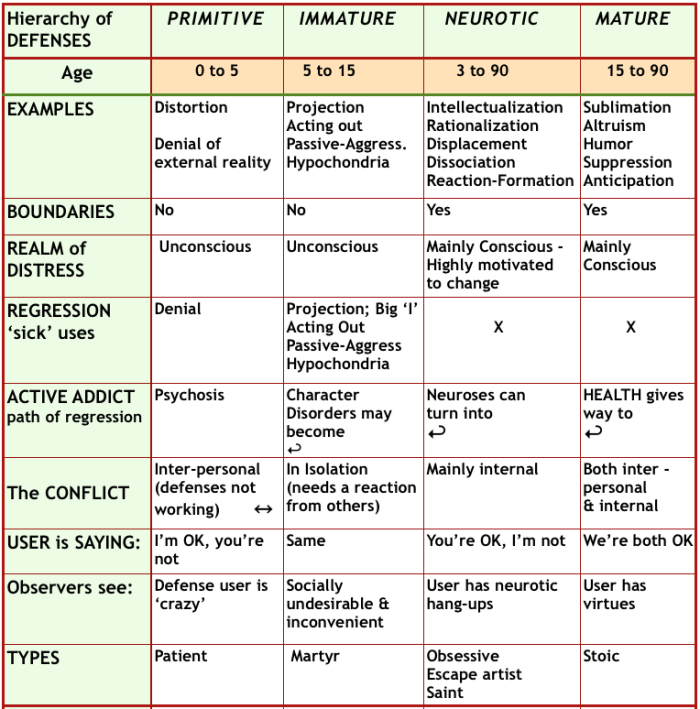
DEF: Unconscious & conscious processes to defend against or escape from conflicts, frustration & depression, so that the person can make useful adjustments to be able to live in their society.

REMINDER – as such, defenses are NOT bad. They’re needed to cope with life’s difficulties, as when we use humor to lighten our mood or altruism to lighten someone else’s load.
At best – most are delaying tactics, giving us breathing room to take a break & re-group.
The problem comes when any one of them become ‘land-locked’, so deeply ingrained that it can’t be given up easily, so rigid that it’s used like a hammer on every problem, regardless of size or importance.
tree of defenses
• In that case they become Negative Benefits” – used to avoid childhood or other trauma which the person does not want to deal face. To better understand what these are, we need to know about Defense Mechanisms, which were first identified by Freud, & then added to over the years by others.
He noted that people have wishes, desired & impulses that are either unacceptable to their society, religion or family – or their own sense of self  (CHART)

• The fact that the impulses don’t go away, but are usually hidden in our unconscious, leaves a residue (like at the bottom of a bottle) of anxiety*.
Keeping the impulses pushed out of awareness takes a lot of energy – which is exhausting, but considered by the ‘user’ to be safer than admitting them
(EXP: wanting to kill one’s parents or oneself). We do this by using Defenses. Which ones we pick will depend on our upbringing & our native personality.

*ANXIETY types, according to Freud
1. Neurotic – the unconscious worry that we’ll lose control of the id‘s urges, resulting in punishment for inappropriate behavior
2. Moral – the fear of violating our own principles
3. Reality – the fear of real-world events, usually easy to identify.
EXP: Fear of being bitten when near a menacing, snarling, barking dog is appropriate – so it’s best to avoid genuinely dangerous situations (PPT) if at all possible.

Defense Mechanisms distort reality
In proper proportion & with limited use they can also be adaptive, allowing us to function normally in very difficult situations, where there are no better options

The big problem comes from over-use, as a way of life, especially when they’re no longer needed. What was once a way to cope then becomes the problem. A goal in Recovery is to make the extreme / harmful use of defenses conscious so the we can develop healthier ways of handling anxiety & stress – without eliminating defenses altogether.

Sdefenses hierarchy


NEXT: 27 Defenses

ARE YOU AN ACoA?

WHY AM I THE WAY I AM?
From being raised by alcoholics,
ACoAs & other narcissist!


50 Qs: A Self-evaluating List for Adult-Children of alcoholics, abusers, abandoners….
Answer: Y = yes, N = no, S = some, D = don’t know

DO YOU…?….
___find that you seek out tension or crisis, & then complain about it
___become anxious around angry people or authority figures
___defend or excuse people when they abuse you, implying you deserve it
___get locked into a course of action without seeing alternatives or outcomes
___react to people & situations, instead of choosing your responses
___worry that your emotions may overpower or hurt you, or others
___tend to lie or exaggerate, when it would be just as easy to tell the truth
___find the needs & wants of others more important than your own
___prevent yourself from experiencing the joy of your successes
___frequently anticipate that situations or life won’t work out for you
___isolate yourself when problems arise, or when you ‘feel bad’hiding
___find yourself in one or more survival ‘roles’ (hero, lost child…)
___mistrust your feelings, thought, perceptions
___tend to see issues in life as B & W, right or wrong
___have a fear of abandonment, especially when criticized
___strongly criticize yourself when not being perfect
___defend or excuse people when they abuse you, implying you deserve it
___get locked into a course of action without seeing alternatives or outcomes
___react to people & situations, instead of choosing your responses
___have trouble relaxing, playing, having fun
___had trouble with close, intimate relationships
___feel responsible for the feelings & actions of others, & try to fix them
___stay in relationships even tho’ you’re being constantly hurt, neglected, lied to, manipulated, hit… not getting any of your needs met
DID YOU…?….
___fight with your family members over a parent’s drinking
___your parents make promises to you & then not keep them
___lose sleep at night due to a parent’s drinking
___take on some of the jobs or responsibilities belonging to your parents
___ever get sick, or worry a lot because of their drinking
___ever do anything to prevent your parent’s drinking
___always believe that no one knew your parents were drunks, when you were growing up
ARE YOU…?…
___able to recognize situation that you have no control over
___super responsible or super irresponsible
___unable to work thru crisis & conflict, or do you aggravate it
___seeing a pattern in your relationships similar to your family of origin
___unable to enjoy your successes & accomplishments
___afraid others may ‘find out’ you’re not good, or that you’re a fraud
___afraid of your emotions, & afraid to express them   get help
___unable to complement yourself
___ashamed of or feel guilty for being who you are
___afraid of going crazy, or becoming a bag lady or bum
___uncomfortable with your life when it’s going smoothly
___unable to ask for help, or do so apologetically
___constantly seeking approval from others
___uncomfortable with being liked, admired, approved of
___always mentally looking over your shoulder to see if you’ll be punished
___out of control with: food, chemicals, work, sex, spending, exercising…
HAVE YOU…?…
___been blaming everyone else for your life’s problems
___staunchly defended your parents’ ‘innocence’ in hurting you as a kid
___had trouble following thru on projects, or never finishing
___tried to hide the fact that your parents drank a lot, beat you or others in the family, incested you or your siblings
___concerned about your mate, children, friends’…use of chemicals
___developed fantasy beliefs about how loved ones may treat you some day
___considered what ‘normal’ is, & believe you’re not
___found yourself sabotaging your success & then feeling ‘more alive’
___been loyal to others (parents, siblings, lovers, children, friends, employers) – even tho’ your loyalty was undeserved, unjustified, un-returned
___been fired more than once & never really understood why
___* learned to have dialogues with your ‘inner child’, & consistently take care of yourself in loving ways ?
♥                            ♥                            ♥
IF you’re even taking this test, it’s likely you come from a damaged, angry, abusive, traumatic, neglected, unhappy backgroundanswers
TOTALS:   ____Yes   ____ No   ____ Some  ____ Don’t Know
IF you answered YES to:
✶ 10-20, you’re either not an ACoA, in denial or in long-term recovery
✶ 20-30, you’re a co-dependent, even if there was no alcoholism in the family
✶ 30 or more, you’re definitely an ACoA (adult-child of alcoholics and other narcissists), which includes mentally ill &/or narcissistic family members

• If you said NO to Qs in the ‘DID YOU…’ section, but still scored high, there may be alcoholism/ drug addiction in some other part of your family, even if you didn’t experience it directly
• You may also be an active addict, yourself – alcohol/ drugs, food, money, sex, relationships…

Look thru this blog (2010 – 2016) and go to Heal & Grow SITE MAP – for info covering issues in this questionnaire at: http://www.acoarecovery.com

• If you are not yet in Recovery from your childhood trauma & present day difficulties, you can seek out 12-step Programs. THEY’RE BASICALLY FREE, & are available on the internet & by phone, for anyone not able to get to these meeting in person.  See pg 55 or some of the 12-step groups.

• Also, there are many recovery books, site, blogs & of course therapy, with someone very familiar with ACoA / addiction issues.
✶  If you are in Recovery, keep up the good fight. It pays off! I know because I’ve been at it for 35 yrs, & it works.

NEXT: Variations of the L.L.