Enneagram Humor (Part 3)

Croatia girlPREVIOUS: Ennea Humor (#3)

SITE: EnneaType foolishness at work

(⬅️ World Costumes by Phillip Martin)


Top Ten Signs You’re a TYPE 5 by Dave
10. You call your plants by their Latin names
9. The more excited people around you get, the more drained you feel
8. You spend time at a party reading the books in the host’s library
7. You communicate almost exclusively by text
6. Most of your friends are on social media, & you haven’t met any of them face to face
5. You consider it a good vacation if you can stay at home with your computer, books, videos, & garden for a week

4. You would like to do point 5 for a living (or already are)
3. You’ve actually read Darwin’s “Origin of the Species” & think it would make an interesting movie
2. Someone asks you how you feel about someone/ thing, & you say you’ll let them know next week after you’ve had time to think about it

1. You bite into a Snickers bar, immediately seeing the correlation between the dissolving chocolate/peanut mixture
AND:
◆ quantum electrodynamics & the potential existence of dark matter in the universe
◆ the association of Mozart’s unfinished symphony & the cryptographic origins of ancient Sumerian linguistics
◆ how the right-handed Cartesian orthogonal system of coordinates aligns with mitochondrial cellular respiration, giving you a new understanding of the role of derivatives in modern financial portfolio analysis
◆ the ennea-grammatic functions inherent in Microsoft’s Windows 98. AND when you try to explain this simple relationship, people have no clue what the H– you’re talking about.

CARTOON TYPES
The PERFORMER
Stype 3 cartoon
Some famous 3s : Truman Capote, Tom Cruise, Cindy Crawford, Anne Coulter, Johnny Cochran, Demi Moore, many CEOs, Oliver North, Oprah Winfrey, Tiger Woods.
EXP:
Sara’s #3 mother’s only response to her #4 daughter – who was in extreme fear over money worries – was: “Your hair is a mess. Why don’t you fix it?”

Twisted Affirmation
To have a successful relationship, I must learn to make it look like I’m giving as much as I’m getting

Fun Quote: Anonymous
You can’t leave footprints in the sands of time if you’re sitting on your butt. And who wants to leave butt prints in the sands of time?

Walking in to a party: Makes sure everyone knows where they went to college, & that they made a million dollars last month

The TRAGIC ROMANTIC
Some famous 4s:  Marlon Brando, Nicholas Cage, Eric Clapton, Ann Rice & her Vampires, Michael Jackson,
Vincent van Gogh, Dennis Rodman, Thomas Merton, Shakespeare, Allen Watts.
EXP:type 4 cartoon
Mitzu’s #4 girlfriend often rants about how women go out in public without putting their face on! “Don’t they know they’d look so much better with makeup?!!”

Twisted Affirmation
I can change any thought that hurts into a reality that hurts even more.

Fun Quote: Kigichi Ishiritari
If life gives you lemons – make grape juice. Then sit back & let people wonder how you did it.

Walking in to a party: Sit by themselves somewhere, & look mysterious.

The OBSERVER
Some famous 5s: Buddha, Dick Cheney, Rene Descartes, Joe DiMaggio, Albert Einstein, T. S. Eliot,
Bill Gates, Lenin, Timothy McVeigh, Jackie O., Sartre, Scrooge
Stype 5 cartoonEXP:
Even tho’ Benny knew his #5 father loved his family, dad spent most of his time locked away in his little office writing & studying, rather than talking to or doing things with the kids – or protecting them.

Twisted Affirmation
I have the power to channel my imagination into ever-soaring levels of suspicion & paranoia

Fun Quote: Garrison Keillor
Intelligence is like four-wheel drive. It allows you to get stuck in more remote places.
Walking in to a party: Look for the exit!

NEXT: HUMOR #4

Enneagram HUMOR (Part 1)

school kids laughing
IT’S ALWAYS GOOD
to laugh at ourselves! 

PREVIOUS: Humor

SITEs: Type Comics 
Ennea DOGS

BOOK: “Enneagram Pop! – Fictional Characters” Damian Hospital & Tony Vahl

Enneagram animalsDINNER PARTY, by Elizabeth Wagele
enneaAnimals

Enneagram TYPE JOKES – gathered from the 4 corners of the earth!
GROAN ALL YOU WANT! Some are better than others!
NOTE: The ‘w’ between numbers means ‘wing’, so 6w7 is a Type 6 with some of the 7’s style. This is an additional feature – the number on either side of your Type – & is more likely to be one rather than the other – 4w3 vs. 4w5….. (Explained in other posts).

TYPE 1
❥ How many 1s does it take to change a light bulb?
Only 1, because no one else can do it right!

TYPE 2
❥ How many 2s does it take to screw in a light bulb? None.
“That’s all right, I’m fine in the dark. But I’ll do it for you if you need it?”
❥ Why did NASA send a 2 into space?
Because you have to pay a dish-washer

TYPE 3
❥ What do you call a 3 who hasn’t moved in 10 minutes? Dead.
❥ How many 3s does it take to screw in a light bulb? Just one. They hold the light bulb & the universe revolves around them
❥ How many 3s does it take to change a light bulb?
Two – one 3w4 to buy the best & brightest one, and one 3w2 to screw it in & then take all the credit for brightening up the room.

TYPE 4
❥ Why do 4s dress in all black? 
Because any other color makes them look fat and they are very self-conscious about it to the point of crying for hours about how fat they are.
❥ Why did the 4 cross the road?
To write an ode to the roadkill on the other side

TYPE 5
❥ What did the male 5 say to the female 5 on their first date?
“ I had so much fun. I’d like to meet you in person.”
❥ Why did the 5 cross the road?
To retrieve the emotions she left on the other side
❥ How many 5s does it take to change a light bulb?
Five: one to change the lightbulb, the other four to stand around pondering the meaning of light, & arguing whether they’re taking the right approach.

TYPE 6
❥ How many 6s does it take to change a light bulb?
5! 1 stands on the chair while the other 4 turn it
❥ Why is 6 afraid of 7? Because 78(ate) 9
❥ Hey, did you hear about that Six who was afraid of the germs on her counter? She was Counter Phobic!

TYPE 7
❥ How many 7s does it take to screw in a light bulb?
None… 7s don’t screw in light bulbs, they screw in hot tubs.
❥ Why are there so many 7w8s on TV?
 Because the murders they commit are big news.

TYPE 8
❥ How many 8s does it take to change a light bulb?
None, 8s aren’t afraid of the dark
❥ What did the 8 say to the 1?
“Why are we doing all the hangin’ while 9 does all the sittin’?”
(8s have the power to make someone happy… by staying single) lol

TYPE 9
❥ How many 9s does it take to change a light bulb?
None, because they forget about it until someone else does it
❥ What did the 9 say to the light bulb?
Nothing, just threw it out because it wasn’t working.

NEXT: HUMOR #2

ACoAs – “Being Negative” (Part 5)

positive thinking

 EVERY DAY I REMEMBER TO FOCUS
my thinking on the good things I already have!

PREVIOUS: Being Negative (Part 4)

SITE: The science of Happiness (“Happify” Website)


TROUBLE letting go
of negative thinking /talking – WHY?
• it’s strongly imprinted in our brain from years of ‘practice’
• it would require S & I from the family, which is never easy
• denial: we have a hard time noticing how often we think / talk that way

• it gives us a sense of false ‘control’
• no one would know how bad we had it growing up
• we get something out of it (Post: Negative Benefits)

• we don’t see the value in thinking/speaking positively, believing it’s for wimps, pollyannas or dummies (who don’t know what’s real!)
• we think it would be denying / our pain & suffering
• we use it to punish ourselves for being imperfect

CONSEQUENCES of Negative Thinking (NT
a. MENTAL: • it leads us to assume that any mistake is a failure, which will expose us to criticism/ judgment, like in our family
• tells us we should be able to make big strides quickly & easily, & that since we can’t – we lazy, stupid or hopelessly stuck
• it prevents being able to think of alternative solutions to problems
• when the brain tries to deal with a complex task, being inundated with NT slows down its capacity to process information & think clearly – by as much as 50%  (More…)

b. EMOTIONAL• can easily lead to depression, assuming we have to be perfect, & to being trapped by our own unrealistic standards
• can cause anxiety, leading to unhealthy coping mechanisms

c. PHYSICAL: • it’s harmful to the body, since negativity lowers its defenses & subtracts from our energy
• because NTs are so painful we can easily turn to addictions to escape (food, money, sex, alcohol/chemicals, relationships….)

d. PSYCHOLOGICAL: • is an obstacle to personal growth, making any change feel too overwhelming & painful
• it makes it hard to see & acknowledge the small steps in progress we DO make
• it denies or ignores possibilities that would improve life, & prevents receiving abundance
• it wastes time & energy, which could be used to heal old wounds & pursue healthy goals
• it convinces us that any form of risk is ‘life-threatening’

e. SOCIAL: • causes many personal, social & work problems
• has a downer effect on others we’re regularly around
• prevents us from relaxing & let our guard down, always second guessing ourselves  (Cognitive Therapy Guide

OUTGROWING NTs – change/modify things that contribute to it:change to positive
• start with AWARENESS of what you’re saying to yourself, what’s causing the ‘stinking thinking’, & the harmful effects it has on your life (& on others)

• slowly clear up practical problems which you have some control over (changing college course, job, spouse…., pay off debts, go to 12-Step meetings, do something creative/artistic….)

• try not to actually speak any negative thought out loud (develop personal boundaries instead of giving in to S-H).
If you feel the urge to criticize or get angry about something, shift to another topic if you NEED to talk

• accept/believe that positive thinking/speaking is a big plus, personally & socially. It does NOT mean being mushy, drippy, girly, sacrificing your opinions/ tastes/ values, or never objecting to something ‘wrong’
•  if you’re depressed, get the help you need to deal with it

• become acutely sensitive to the fact that some topics you’re interested in are intensely emotional (illness, jail, abuse, death, loss, war, politics, putting anything or anyone down….)

By your logic, these topics may be ‘perfectly normal’, interesting, current…. .
But when they’re inherently unpleasant, it is not respectful to foist them on others. It can easily sour the mood of a group, bring up old pain for someone or hurt someone’s feelings.

Naturally, such topics are appropriate in a group specifically designated for that (therapy group, 12-Step programs….)

• Notice how you feel when around another person who’s always a ‘downer’. Be willing to admit you may sound like that, & work on changing your own pattern – from the inside out.

NEXT: Being Negative #6

ACoAs – Being Negative (Part 4)

negativityISN’T IT CRAZY TO TALK TO MY BODY? 

PREVIOUS: NT (#3)


Negative Thinking (NT)
(cont)
1. re. OURSELVES
2. re. Personal RELATIONSHIPS

3. re. Our BODY
UNREALISTIC
a. At an extreme some ACoAs are hypochondriacs —  with the disorder that makes a person believe that body ‘feelings’ are signs of a serious illness —-> even when medical science can prove otherwise.
It’s their preoccupation with health, misinterpretiimagined illnessng a physical sensation (gas, muscle ache, headache….),  making it something it’s not.

Illness becomes a part of the hypochondriac’s identity, causing relationships & work problems. It occurs in men and women equally.
Relentless NT about the body is a substitute for / defense against feeling the huge backlog of hidden painful emotions we’ve buried. And long-term, it harms our immune system (Psycho-Neuro-Immunology).

b. Body Dysmorphia (BBD) – the distorted, unrealistic image of one’s physical appearance (ugly, fat, too thin… ). Most often it’s the result having been sexually abused as a child. In extreme cases the person cannot “see” their body, only their head, even in the mirror.

ACTUAL – However, many ACoAs suffer real physical problems, FROM :
• years of addictions, self-abuse & neglect
• being under constant emotional, mental & spiritual stress as kids, plus physical/sexual abuse, later creating very real medical conditions = the auto-immune diseases

• hereditary factors in alcoholic families: birth trauma, childhood ailments, mental illness, bad teeth & gums, depression, bipolar disorder, dyslexia, ADD, SAD, EDS, severe food allergies (wheat, sugar, nuts…), environmental illness & other chemical imbalances
SITE:“…severe childhood trauma can alter developing brain”

➼ Whether inherited or self-inflicted – it’s imperative to not use NT toward our bodies. We must never, ever curse our cells or wounded parts!
If we stay fearful, worried, & project the worst, OR rage at our organs, limbs, nervous system… the body absorbs that negative energy & may take longer to heal or maybe not at all. (Cartoons re. responses to Physical vs Mental illness)

Healthy EXP: Jody had a motor-bike accident which damaged a muscle group just above one knee & caused a limp. Along with Feldenkreis & Brain Gym, she spent time doing Positive Inner Dialoguing. Pictured the injury, she talked tenderly to her leg – “I love you & am so sorry you’re hurt. I can see the cells repairing themselves using the healing energy I’m sending you. You’re important to me & I need you. I want you to be strong again… ” While the muscle took longer to heal, the limp cleared up right away & all of the damage was eventually repaired.

5. re. THINGS
• This is a more subtle form of NT – saying bad things about objects, places, events…. anything not alive. Many people think it’s perfectly ok to call things insulting names : ‘Damn that stupid chair! I stub my toe on it every time!’ or ‘My car is such a piece of shit. It’s always breaking down.hate things

• What’s wrong with that? They don’t have feelings, so what’s the big deal? Well, it’s more of the same – projecting our painful childhood experiences onto objects, putting out more negative energy, which can get reinforced by others around us.

NOTE : Negative Reciprocal Attraction :  one person does something harmful to someone else, who then returns “the favor” with an action that’s similarly harmful (attack<–>revenge // glare<–>frown // ignore<–>snub… ). This explains why some people keep moving in the wrong direction, ie. away from ease, comfort & safety.

Reality Check
• Since the chair is inanimate, stubbing your toe may have to do with where it‘s placed, and/or the way you move thru space. In her autobiography  Nancy Friday tells of constantly getting black & blue from bumping into things. In therapy she learned that she was unconsciously punishing herself for her (repressed) rage at her mother

• And the car may be old & breaking down, but it’s not the car’s fault – maybe of the manufacturer, or yours for not taking better care of it – or it’s time to replace it but you’re mad & ashamed because you can’t afford to!

ACoAs tend to get things backwards, blaming things instead of identifying the real source of our pain. To be emotionally & mentally clean we need to identify & own:
😣 our disowned emotions (anger, hopelessness, disappointment, fear…) which then deny / ignoreget projected on to PPT

😡 that we ignore experiences which actually were harmful, then redirect our anger & hurt back on to ourself or at innocuous objects

Blatant negativity is hard to miss, but ours can be so hidden that others may never realize how often we’re thinking that way.

NEXT: “Being Negative” (#5)

ACoAs – “Being Negative” (Part 3)

EVERYTHING & EVERYONE sucks up my air!!

PREVIOUS: Negative Thinking (#2)

SITE: ▪︎ Complaining Rewires Brain for Negativity.… 


YOU’re thinking is too negative IF YOU :
• are always complaining about things, even when it’s in a rational, logical-sounding way, “This —- is an interesting tidbit to mull over”
• constantly notice the flaws in things (people, activities, ideas)
• have a tough time seeing the bigger, overall positive picture
IF YOU
• get a secret pleasure being negative along with someone else, or tearing something down
• see a flaw in something & just have to let everyone know, getting a little rush from being ‘right’ & superior
• think positive people are naive or fake, have low standards, easily impressed

YOU’re too negative WHEN:
• even a trivial flaw in something (good) will ruin it for you
• someone suggests an activity or product, & you’re quick to point out why it won’t work or why it’s a bad idea
• things get under your skin &you  ‘have to’ rant about them to anyone who will tolerate listening
negativityWHEN :
• others talk about the positive aspects of something – you just have to say, “Yeah, but…” pointing out its limitations or weaknesses
• something’s realistically going well, but you’ve got plenty reasons why it’s dumb, no good, won’t turn our well, is impractical ….
(from SuceedSocailly.com)

NEGATIVE thinking can come from copying our family, a personality trait that gets over-expressed, or seen as a ‘useful’ trait.  YOU:
• picked up a negative style from people we grew up with or around
• rely on negativity as a crutch in conversations. You wouldn’t know what to say if you weren’t complaining about or trashing something
YOU
• romanticize negativity, thinking it represents being a deep, complicated, tortured soul
• often get worked up about things & then vent, because it feels great
 –OR-
• are a little too rational. Not in touch with your own emotions, & don’t realize negative comments are harmful to others
YOU
• think that getting others caught up in your personal troubles is a reliable way to ‘stay connected’
• think you’re being ‘intellectual’ – as if pointing out flaws in everything (unsolicited, unprovoked) is proves analytical ability & honed critical thinking skills
YOU
• associate negativity with having refined tastes, as if putting down ‘mediocre’ things would show how discerning you are
• connect being cynical & overly skeptical about life with being ‘in the know’ or aware of how the world really works
• may think it’s just your style of humor – a way to be a clever, observational comedian or commentator. NOT!

Negative Thinking (NT)
1. re. OURSELVES
• Anyone reading this blog & other self-growth material, going to 12-step meetings & therapy – knows this category of NT is a core issue for ACoAs. It’s called self-hate (S-H) – powerful, deadly & tenacious! If our parents were unable to love us unconditionally OR not at all (no matter that they said), we concluded it was because we weren’t worth it

✶ So, our WIC is still sure that if the family didn’t make us feel wanted, safe & accepted, why would anyone else?
We think cruel things about ourself & even say them to others, while secretly being smug about being victimized by the whole universe!
Playing the role of the victim -now- allows us to not be responsible for our own life, while protecting the illusion of coming from a loving (or at least an ok) family.

2. re. Personal RELATIONSHIPS
NT (S-H) tells us we’ll NEVER:
• deserve love, validation, respect, peace, joy, success….
• even know what love is, even though we have indeed loved (children, animals, mates, activities, careers, locations, certain foods / arts …)
• be liked (much less valued) by healthy ‘normal’ people
• be able to leave bad relationships because it would condemn us to being completely alone (forever)
NEVER
• have the right to healthy, loving connections (family, friends, lovers…)
• have anything positive to offer others (personality, skills, experience..)
• have the right to look for & interact with accomplished people & other peers who we could enjoy & benefit from
SEE “The 12 Worst Relationship Mindsets (based on CDs)

NEXT: “Being Negative (#4)

ACoAs – Dealing with CRITICISM (Part 2)

being criticized

PREVIOUS:
 Criticism (#1)

SITE:  “Varieties of criticism”(Aesthetic, Moral, Practical….)


Managing CRITICISM
Any form of criticism challenges our thinking, behavior or skill, so it’s normal to feel uncomfortable.
When we are dealing with actual criticism we need to understand what we’re hearing : not just when feeling judged, nor when our essence is being attacked, even just a comment about / disagreement with our ideas or actions.
Is it legitimate vs. negative ‘feedback’? Are the comments constructive or destructive?

1. Are we receiving
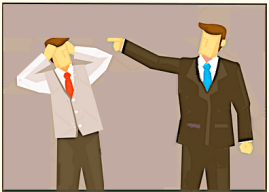
Hurtful criticism? This is most likely a form of thoughtlessness, not consciously meant to injure, but can nevertheless be insulting or just insensitive. It’s usually ‘perpetrated’ by garden-variety narcissists who are simply expressing their point of view, as if it’s a given that others will see the world the same way. (“That’s a stupid thing to say” // “I can’t believe you didn’t know that”…..).
They’re generally unaware of their effect on the listner’s emotions & sensitivities, since only their own feelings & ideas are real to them

Destructive criticism? This type is a direct attack on someone, generally given with the intention to harm, belittle & destroy the other’s creationcriticism, prestige, reputation &/or self-esteem.
It’s malicious & harmful, meant to show that the person or object being attacked has no worth or validity, so no practical advice or suggestions for growth are included.
Naturally, this can do a lot of damage, & in some cases trigger verbal or physical retaliation.

While anyone is capable of this kind of attack – occasionally, & under great stress – here we’re talking about people who use this style as their main way of communicating about anything they don’t like or don’t approve of.

Generally, they’re the angry, controlling narcissists, who may or may not even notice other person’s feelings, and don’t care. They want everyone to be like them & can’t stand anything that isn’t.
Under the facade of superiority they’re deeply insecure, so bringing others down boosts their False Self, & temporarily satisfies their ego.
EXP: “You’re wrong. You’re always wrong! // You shouldn’t dance – you’ll just embarrass yourself // You have lousy taste”……

2. OR are we being offered:
• Constructive criticism? The Sender also points out ‘issues’, but without attacking the Receiver’s identity, AND may include practical advice on how something can be corrected.
That way the Receiver can choose to improve – but only if they agree with the solution AND if it suits their personality.

When using gentler language, constructive criticism aims to help the Receiver function better in the future, by kindly suggesting what to work on, & without arrogance (as in “do it my way or you’re stupid”). Therefore, it allows the Receiver to consider.

EXP: “I like your painting. Would you consider adding brighter colors?” // Your Math grades would improve if you let a tutor help // Practice keeping your back straight so you’ll feel stronger & more confident….”

HOW something is said is just as important as what. Suggestions & alternatives are offered without the Sender being manipulative, insistent, or superior – as if only they have ‘the answer’.  This usually makes it easier to accept, even if it may still hurt a little.
As a Sender:
📌 FIRST, be sure it’s appropriate to put your 2 cents in
◆ if you feel the need to tell someone a harsh truth, be sure it’s not offensive
◆ make it clear it’s your personal taste, & just your opinion – even if it’s based on first-hand knowledge or hard-won experience
◆ if you’ve tried your best to be respectful, but it’s still taken badly, then it’s not your responsibility to fix their hurt feelings or pride

As a Receiver:
a. If you get negative criticism you can say :
• “Thank you for sharing”
• “Ouch, that hurt, now say it nicely”
•  OR – just shake your head, change the subject or walk away.
Do NOT try to convince them they’re wrong, or get into a fight. It never works.  If the comment is simply not relevant to who you are – just say “Thanks for the info” or “That’s not helpful” & move on

b. If you get helpful / constructive criticism:
❥ always take it positively. Think about it, & if it applies, use it to grow. Remember that anyone willing to be careful in how they talk to you is reasonably healthy, & likely care about you as well, so take it as a sign of love or at least of goodwill .

NEXT: Criticism (Part 3)

ACoAs & Being DISAPPOINTED (Part 2)

disappointedEVERYONE LETS ME DOWN – so I stay away from everyone

PREVIOUS: Disappointment – Part 1

SITEs: • “How to Cope with Disappointment

▪︎ Psychology of Disappointment

EXPECTATIONS (Review posts – Over and Under)
No matter which form it takes, expecting others to fill our empty heart & mind, instead of being pro-active, means:Screen Shot 2016-05-31 at 10.13.44 PM
• the WIC is still running our life, waiting to find the ‘right’ parent – magically – so we don’t have to care for ourselves

• we’re functioning from our narcissism – always from the point of view that “Everything is about me!” (and against me)
This assumption was not true about the abuse we grew up with, & it’s not true about what people do to us & around us – now. (ACoA 3 Cs : I didn’t cause – the chaos & trauma”)

We know this because when WE change, in Recovery, those same hurtful responses from others seem to bother us much less!
ARTICLE: “Managing Negative Expectations” w/ chart

ACoAs get disappointed (D) by so many things, because the WIC desperately wants the world to be a certain way (to meet all its needs) rather than our Adult noticing AND accepting the way things are – both good & bad – in our environment.

IRONY: With reality in clear view, we can get our needs met by choosing among the many options that are actually available in the present!

1. COVERT Types of Disappointment
Because we’re not allowed to know our wants, needs & emotions, NOR to ask for anything, we imagine (silently expect, demand) that others will read our mind & provide for us – which comes from the WIC

• We truly believe that if we want something a certain way – without saying it – it will automatically happen
EXP: Your B/day (or any holiday that’s important to you) is coming up & he hints that you’ll do something together. You have it all planned out – exactly what you want to do, how it will look & feel.
But you never say any of it.

Then the day comes & it turns out Screen Shot 2016-05-31 at 10.12.55 PMvery differently – maybe not bad, but not what you imagined. Now you’re angry at him, unappreciative, cranky, attacking – OR you decide he doesn’t really love you at all, you don’t feel the same about him…..
OY! You’re deeply disappointed, but how was he supposed to know?

• We naively assume that everyone means what they say, OR will do what they promise. To ‘feel’ safe we need to believe that others are as literal (& ‘responsible’) as we are
EXP: Josie says she’ll bring the book to work tomorrow that you’ve been wanting to borrow. You not only believe it, but count on it, looking forward in anticipation. Tomorrow comes & she’s ‘forgotten’ the book. You’re angry. You’re convinced she’s messing with you, she lied, she…..

• When going into a new situation (class, work, relationship), the WIC presumes they will be safe, needs the people to be helpful, informative, consistent, appreciative, respectful…. & then they’re NOT. Sometime it/they turn out to be very ‘bad’, but most of the time they’re just not what we secretly (unconsciously) needed & expected.

We’re disappointed, so we get depressed or really mad.
📢 If you’re an introvert, or still in Victim mode, you’ll just sulk, withdraw, not participate, sit in misery, or leave without saying anything

NEXT: OVERT

Positive  HUMOR  from Grant Snider

NEXT:    ACoAs  & CONFUSION

ACoAs & HUMILIATION (Part 1)

humiliationI’VE BEEN DOWN SO LONG
I can’t imagine ever getting up!

PREVIOUS: Anger T & F, #2

SITE:Humiliation” (Wikipedia)

QUOTEs: “No one can make you feel inferior without your consent.” ~ Eleanor Roosevelt


» DEF: Being in a state of disgrace, a loss of prestige &/or self-respect.
A person who is continually subjected to severe humiliation will experience major depression, suicidal thoughts or actions, & severe anxiety states, such as post-traumatic stress disorder (PTSD).

RESEARCH: A study at the U of Michigan revealed that the same areas of the brain which light up when we experience a physical injury – are activated when we experience intense social rejection.
In other words, humiliation & isolation are felt just as strongly as body pain.

NOTE
: Humiliation is not the same as humilityThe opposite of Humiliation is Appreciation

HUMILIATION originally comes from external sources – which then get internalized as part of the PP voice (Introject).
✦ THEN – for ACoAs it comes first & foremost from our family, & then often from school, church, neighborhood…. It’s ‘being shamed’ rather than feeling ashamed

✦ NOW- a less severe event may cause us to “take offense” when something is said or done to us, which comes from what or how we think (cognitive, intellectual).
Whereas –
✦ Humiliation is more demeaning & hurtful – visceral, existential – about who we are fundamentally

In the present, most ‘victims’ disagree with the humiliation laid on them – don’t like it, know they don’t deserve it, see the treatment as unjust….but don’t believe they have any options, & so don’t challenge the source or change their environment

1. EXTERNAL Sources
Humiliation involves an event or ongoing situation that indicates unequal power in a relationship, where we are in a one-down position & unjustly diminished.
Often the painful experience(s) are vividly remembered for a long time after, & can lead to anxiety, especially if the exposure was prolonged. It requires:
victim/perp1. a Perpetrator exercising negative power,  in many different settings

2. a Victim who is truly powerless (child, minority, the poor….)
OR who is re-enacting a long-held victim role from childhood, so is who;; vulnerable to being humiliated
3. one or more Witnesses to or observers of – the event(s), such as family members, neighbors, teachers, the general public, peers, officials…. who usually do not object or help  (bystanders, helpers), sometimes even egging the perpetrator(s) on, as in bullying (Flying Monkeys)

➼ The following list was compiled by Leland R. Beaumont at Emotional Competency” & can be applied to children as well as adults.

a. PHYSICAL / SEXUAL (most visible)
Being
• boundary / privacy invaded, trespassed on
• denied basic needs &/or social amenities
• exploited, suppressed, violated
• forced to do or say something distasteful & self-shaming
• injured, assaulted (hit, spit on…), attacked
• isolated or physically abandoned
• the loser in a dominance contest / cheated on
• molested, incested, raped
• often beaten, slapped, kicked, punched
Having  your:elder abuse
• abilities diminished from being disabled, or movement severely limited
• basic personal freedoms lost (mobility, access, autonomy)
• competence / confidence damaged – from being tricked, trapped, mislead, opposed, sabotaged, let down
• goals & plans constantly thwarted, over a long time
• resources diminished from being defrauded, robbed, cheated, evicted
• safety or security reduced by intimidation or threat
• to see / watch a loved one sexually assaulted
• to watch a love interest flirt with another, causing intense jealousy

b. EMOTIONAL /PSYCHOLOGICAL
Being
• blamed for things that have nothing to do with you
• blatantly rejected, treated unfairly, forced to back down
• betrayed, cheated, lied to, defrauded, suckered, duped
• denied basic personal & emotional needs
• deprived of privileges, rights or human dignitymade fun of
• forced to swallow one’s pride
• laughed at, mocked, teased, ridiculed, given a dirty look
• lowered in ones own or another’s estimation, made to feel powerless
• dependent (not by choice), especially on weaker people
Being
 • made to look stupid or foolish
• manipulated, dominated, controlled, forced to submit
• taken for granted, used to fill a need in others
• denigrated for ones values & beliefs, made fun of
• snubbed, put down, disgraced, shamed (not ashamed)
• treated as an equal by someone of a lower-status
• treated like an object (it) or animal, rather than a person

NEXT: Humiliation (Part 2)

Anger – Ways to REACT (Part 1)

Screen Shot 2015-06-07 at 3.15.09 PMI HAVE LOTS OF OPTION
for expressing my anger!

PREVIOUS: Anger – Negative uses  (#2)

SITEs : The Logic of Emotion      

Emotion Wheel app

List of phrases about anger or conflict (date rape, hot-blooded, road rage, tit-for-tat….)   ✦ See ACRONYM page for abbrev.

NOTE: The following 5 posts give several versions of the basic ways to categorize how people react to their own or other people’s anger/rage (Unsafe <—-> Safe)

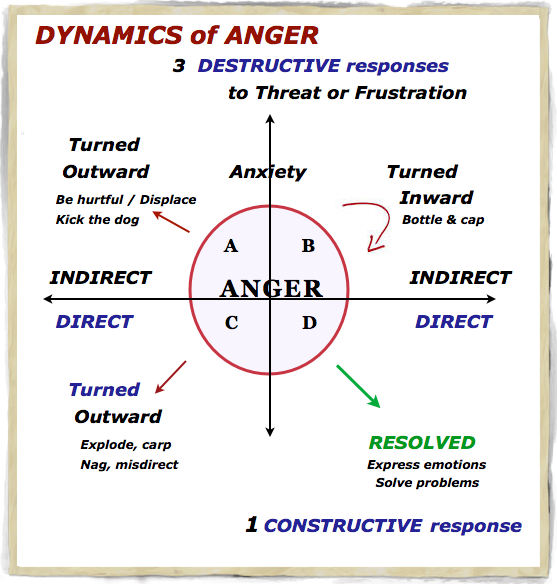
1. DYNAMICS of Anger Chart
A & C – OUTWARD anger at other people, places or things
A Indirect: sneaky or passive – without admitting or dealing with it
C Direct:
• Assaultive – physical, verbal & sexual cruelty
• Aggressive – attack on someone’s identity rather than their actions/ non-actions

MY dynamics of angerB
  
INWARD: suppressed & used against oneself, for FEAR of:
• losing control
• being disliked / rejected
• hurting / offending others
• the emotional intensity
• losing close relationship
• disobeying RULE  “Never get angry”
• too little communication / silent remoteness, depression

D Anger RESOLUTION, finding direct ways to manage, change or leave problem situations, using the Healthy Adult ego state

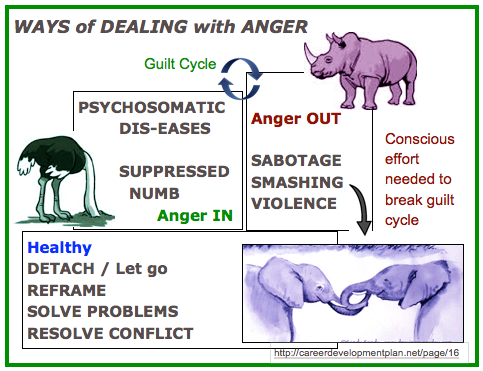
2. ANIMAL Symbolism
⬇️ CHART contrasts 3 ways of dealing with anger :
• Ostrich (Passive) = ignore, deny emotion
• Rhino (Aggressive) = attack, deny responsibility
3 anger ANIMALS• Elephant (Healthy) = be calm, understand, negotiate – expressed by:
a. Knowing ‘anger-signals’, from self or others, & then staying awake for them
b. Using a variety of productive & safe ways to respond (MORE….)

Use the S.M.A.R.T. action plan to deal with issues:
• Face the problem
• Ask questions to gather relevant info
• Re-frame – “What else could this situation mean?”
• Don’t take criticism personally, just learn from it – if possible. Side-step the WIC’s reactions
• Then let go of the whole thing. Forgive yourself, if necessary. (from the ELEPHANT JOURNAL)

3. MOOD MAPS – used to notice anger & in relation to other emotions
MOOD MAPS


CHART  ↘️
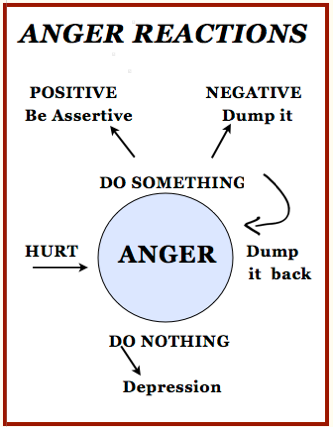
Appropriate expressions of anger are a way to be assertive (not aggressive)
• Unhealthy : dumping it on others or at oneself
• Ignoring : Suppressing it (denial) eventually leads toanger reactions depression4

NOTE: Speaking in a FIRM tone is not automatically an expression of anger. It can simply mean determination, being sure of something, or making a point.  This also applies to teaching, or correcting & providing discipline, which is meant to guide & support

🌀 However, if your WIC hears firmness, corrections or being giving direction as an attack or put-down, when it’s not meant as such, you’ll experience the same fear & weakness as if it were, based on childhood trauma.

4. Three TYPES of Anger

a. Hidden 
“Just because anger is hidden doesn’t mean it’s harmless. Just because it’s under wraps doesn’t mean it’s under control.”
For many of us, the need to deny the strength or even the existence of our anger is so powerful that we develop the ability to deny our anger even exists – unconsciously or by choice

• BUT – “Anger is such a powerful coping mechanism that repression & suppression are not actually successful. The more you try to avoid it, the more time & energy you ahave to spend with it. It’s a paradox.”  Dr. Roland Mairuo, Seattle MD. (+ Bible references)
Burying anger doesn’t diffuse it, it just burrow underground, where it undermines our sense of Self. The force of it will find other, secondary outlets when not allowed out directly & appropriately, usually in damaging ways

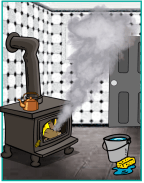
• Freud once likened anger to the smoke in an old-fashioned wood burning stove. The normal avenue for the discharge of smoke is up the flue & out the chimney.
If this is blocked, the smoke will leak out in unintended ways…. around the door, through the grate…. choking everyone in the room. If all avenues of escape are blocked, the fire will go out & the stove is useless.

Humans are the same – if anger is suppressed, it leaks out anyway. If suppressed for too long, we become cold inside & hard outside.
Normal human expression of anger is seen in big physical movements &/or loud vocalization, as in unhappy babies.

HIDDERN anger

NEXT: Ways to React (Part 2)

Anger & the BRAIN (Part 4)

pain/anger ME ANGRY? NAH –
it’s all in my head!

PREVIOUS: Anger & the Brain (# 3)

SITES: The 4 theories of Emotions

Brain Chemical Released When Angry


ANGER on the brain
A normal amount of anger is necessary & appropriate to function well in personal relationships & in the outside world.

The brain processes anger as stress, so it prepares us for the eventuality of fight-or-flight by elevating blood pressure, cortisol, serum glucose levels….
A certain amount of arousal is vital for efficient remembering, but when it’s too high, (as when we’re very angry) it seriously diminishes the ability to concentrate EXP: it’s hard to recall details of a really explosive argument.

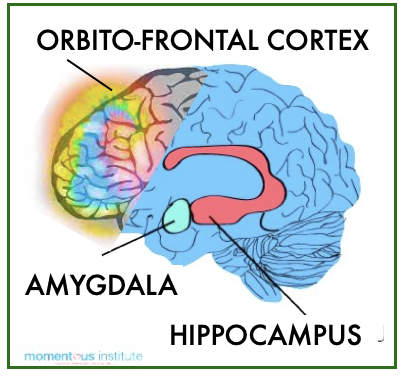
◆ The orbito-frontal cortex (OFC), the lower part of the prefrontal lobes, integrates sensory information from various other parts of the brain, such as weighing the value of reward-to-action, combining sensory input that turns taste into flavor….

Damage to the OFC can result in:
a. addictive behavior (over-eating, gambling…), so that the immediate thrill of a vice is chosen over the greater rewards of healthy choices & emotional stability.
b. over-reactions in behavior when very angry, because our cognitive understanding & interpretation of sensory experiences are distorted (an ‘innocent’ touch, hearing someone laugh, being accidentally bumped….)

◆ In a Harvard study of anger & the brain, MRIs of normal people showed that anger increases blood flow activity to:
> the amygdala, which deals with emotion & vigilance, and
> the cortex, which can cool the ‘heat’ of responses from the central & primitive parts of our brain, allowing a person’s conscious to decide how to respond, or totally inhibit acting on impulses.

However, severely depressed people may not have the correct balance of brain activity, so are not able to recognize & control their anger, which can lead to violent rages. (Darin Dougherty, Asst. Prof.)
SITEs:Trauma response to Anger” // Brain and Development effected after Child Abuse

Researchers at the Hotchkiss Brain Institute in Calgary, Canada, discovered that one of the effects that anger has on the brain – is that neurons in the hypothalamus stop working properly.
Normally these neurons (cells) receive chemical signals that prompt them to either switch on or off.
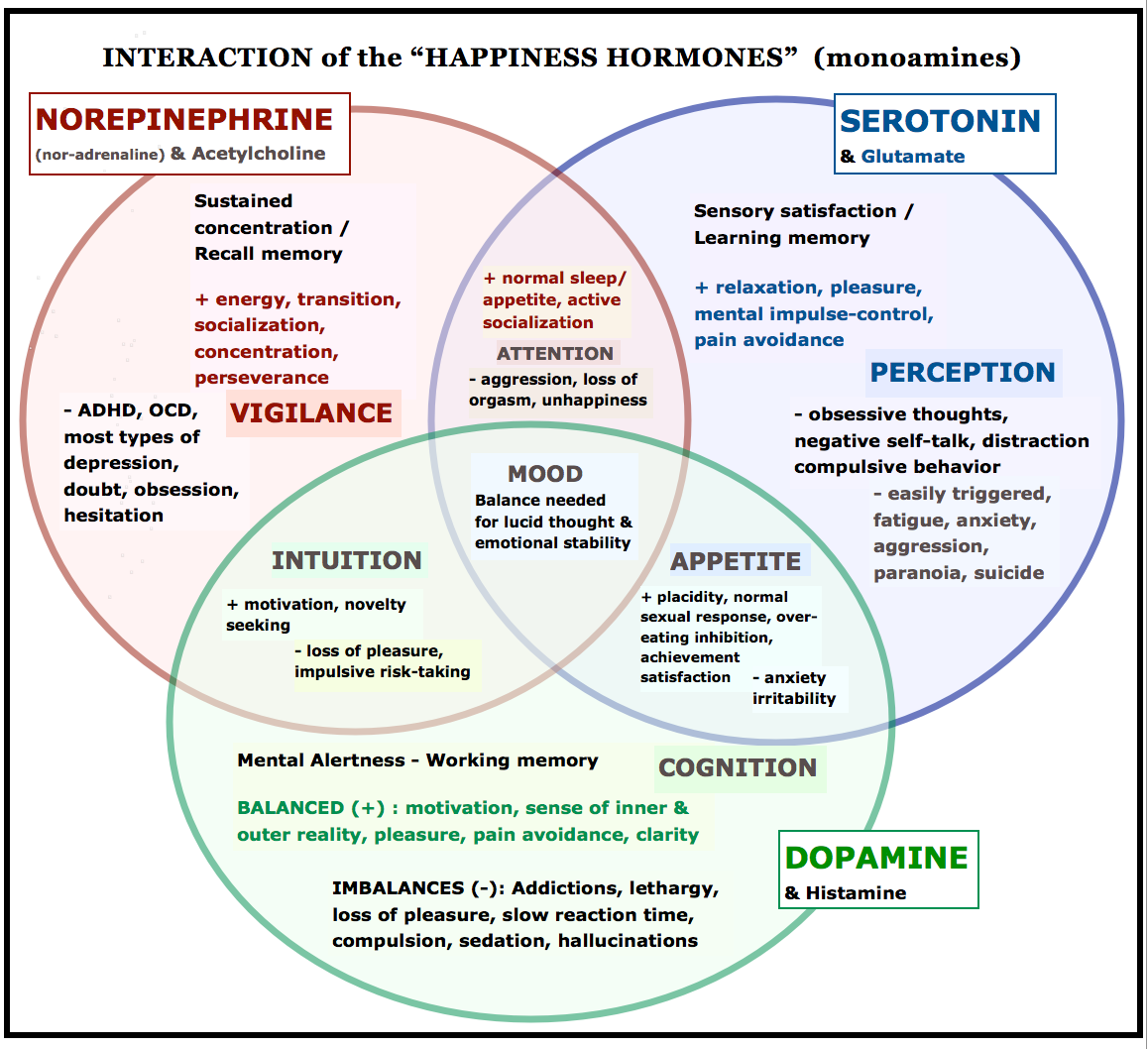
Certain neuro-transmitter chemicals produced when we’re angry interfere with these functions, jeopardizing the brain’s ability to slow itself down, by blocking the growth of new neurons & causing the death MY hormone interactionsof existing ones – leading to depression, memory impairment & learning problems.

Happiness Hormones” are mono-amines, the main neuro-transmitters which animate the brain (how neurons transfer an impulse between them across a synaptic space) .

They’re associated with a variety of moods, playing a vital role in feeling, thinking & acting (T.E.A). When they’re up & running correctly, they produce a sense of well-being. These include:
‣ Serotonin, involved in emotion, overall mood, & keeping aggressive social responses in check. When low, it’s harder to control our reactions when we’re angry
‣ Dopamine is released to push us toward something good, or avoid something very bad. It also determines how angry we get when we’re upset

‣ Nor-epinephrin
(nor-adrenaline) prepares the body for ‘fight or flight’’
√ depressed people have Lower levels of this hormone
√ we get a ‘rush’ from combined epinephrine & nor-epinephrine
SITEs: Leadership chemicals (scroll down) / “Meet your Chemicals” (cute slides)

BTW: Normally, when we get angry, frustrated or feel other ‘uncomfortable’ emotions – because of some real or perceived danger – the adrenals quickly release the catecholamines Dopamine + Epinephrine & Nor-epinephrine, combined in a 80%-20% proportion.

They prepare the body for ‘fight or flight’, so we can deal with whatever is causing the anger, but the influx of these chemicals can also lead to acts of aggression in some situations.
In reverse, when they’re depleted or out of balance they cause physical & emotional disturbances, including anger, depression, anxiety, obsessions…

✤ Interestingly, these same chemicals are also generated by fear. It’s one reason why FEAR & ANGER are directly opposite each other on the Plutchik ‘Wheel of Emotions’. (“Identifying Emotions, #1)

FILL-IN form: FEAR Self-Inventory (+ info, charts, growth….)

NEXT: Anger & the Brain (Part 5)