ACoAs & CONFUSION – as Kids (Part 2a)

CHILDHOOD CONFUSIONI MUST BE CRAZY
I can’t decide anything!

PREVIOUS: ACoAs & CONFUSION (#1)

SITE: Erikson’s Developmental Stages

QUOTE: “Until otherwise proven wrong, assume confusion.”
FromJudgement on the Front Line’~ C. DeRose & N. M. Tichy

📙🖌️ OVERVIEW (Part 1)
📕🖌️ CHILDHOOD confusion

ACoAs grow up with so much distorted, incorrect or missing information that we end up feeling crazy! WE were never crazy – it was the environment. We tried our very best to make sense of what we heard & saw, but that simply was not possible. That was NOT our fault or any lack in us!

• Damaged, narcissistic & addicted parents use many defenses to keep their carefully constructed life-mobile from crashing, so they don’t have to face themselves & change. Consciously or otherwise, they figured the more they could confuse us & keep us off-balance, the less chance we’d have to call them on their crap.

Even so, there’s often one child in the family who really gets what’s going on, who can’t be conned. They’re not confused, but if they let that slip they get severely punished.
In this case you’re in a Double-bind – you=the Receiver & they=the Sender. As a kid this is at best confusing, at worst crazy making.

projectionOne tool sick parents use is Projection (NOT Projecting the worst outcome) when they or anyone else attributes negative qualities – to you – that are only their own.
It can be called emotional dyslexia (getting things backwards) – when they label or accuse you of being something they unconsciously disown or know about themselves, but refuse to admit.

Children want & NEED to understand what’s expected of them – how to behave, where the boundaries are, their chores, their place in the family & the world, how to deal with each other & outsiders….
They’re highly intuitive & focused on their environment, with great curiosity about everything, & to understand what’s going on, so they know how to act & fit in.

Ideally, clearly knowing these things allows children to act appropriately, which leads to staying connected & feeling safe, to mature & flourish, based on what the healthy adults can provide & teachildhood Qsch them.

BUT – If the messages kids receive are crazy, garbled, contradictory, incomplete…. there’s no way they can figure out:
• who they are (identity) and how to behave
• how to correctly follow the adults’ demands, expectations & rules
• why they’re being punished or neglected
• what’s right & wrong, re. their own values or those in their world
• how to interact with others in a reasonable way (can cause isolation)
• when it’s safe to let go, not worry & just have fun

Children’s perceptions aren’t as clouded by years of conditioning as adults. They’re very concrete & literal, with little emotional or verbal filtering. They tend to say exactly what they think & feel, much to the chagrin or rage of adults – until awareness of their environment is beaten & terrified out of them, who then rebels or goes into hiding.

– The ‘good’ child (Hero) will carefully go along, following the script even when it doesn’t make any sense

– The ‘problem’ child (Scapegoat – who sees thru the confusion, but only for a while) will try to cut into the distortions by throwing the ‘truth’ in everyone’s face – without success. NOT quite the same as being scapegoated.

confused man– The ‘invisible’ child (Lost C) simply hides itself, closes it’s ears & tries to escape by physically isolating & staying in its head

– The ‘cute’ child (Mascot) tries to lighten the heavy painful atmosphere by playing dumb but amusing

• So we cobbled together some kind of view of ourselves & the world out of the many forms of twisted communication we were subjected to. It’s like having to weave a tapestry with only old tattered cloth, dead flowers, prickly vines & invisible yarn – forming a nightmare design.

We ended up deeply perplexed about who we are, how things work, what’s possible…. while at the same time having only one way of being/ doing things (according to the Introject), so we don’t realize there are other options in the real world – for us.

NEXT: ACoAs & Confusion (Part 3)
ACoAs & CONFUSION (Part 1)

state of CONFUSED

IT FEELS LIKE I’M CRAZY
I just can’t get it right!

PREVIOUS: Gifted Children #4

SITE: Sometimes Confusion Is A Good Thing

📙🖌️ OVERVIEW
DEF of Confusion (Cf) 
– Mentally disoriented. The inability to make decisions clearly & quickly
Cf occurs when another person’s Boundaries are vague, not easily understood, or in conflict with themselves

NOTE: These posts refer to Cf which is NOT caused by long-term severe mental illness or physical changes in the brain due to accident, aging, chemicals/ medication, drug use or illness.

Important distinction – confusion is always a cognitive (mental) NOT an emotional issue. It’s about whether or not we can think clearly, based on what’s going on in our head or how someone else is presenting information.

For ACoAs – overcoming life-long confusion is mainly about coming out of denial about our traumatic past. It includes identifying & correcting cognitive distortions (CDs) and toxic family beliefs, which lead to procrastination, self-doubt, perfectionism & self-hate!

To do that we need to know enough about ourselves AND how the world really functions – to not blindly follow what our unhealthy family taught us, or what the WIC has come to believe because of it.SCARF model

The opposite of confusion is Certainty, which is not the same as being rigid, dogmatic or opinionated.
Based on NLP, David Rock explains that there are 5 major goals of the human brain geared towards ‘maintaining’, ie. increasing positives & reducing negatives (the SCARF model): Status, Certainty, Autonomy, Relatedness & Fairness.  (MORE….)

• Executive Coach Ed Batista commented that certainty is a result of the brain’s effort to conserve energy, which comes from the limited capacity of the prefrontal cortex, the seat of executive function….

Human beings resist putting great mental effort into decision-making & impulse control because the body is preserving resources for a possible emergency in the next moment, & the same dynamic contributes to resisting uncertainty.” (CHART & info….)

Some causes of Mental / Psychological confusion
• Complex lifestyles – too much to do & not enough time, constant stress
confusion/stress• Denial – not wanting to admit & accept the way things really are (re. people, places, things), & so create a variety of defenses to mask the truth
• Dysfunctional interactions with others
• deliberately Distorted info – from media, politicians, advertising, cults, corporations …..
• Ignorance – trying to figure out something without enough or the correct info
• Grandiosity – trying to DO something without actually knowing how

• Major changes (Recovery process, new work, moving, divorce…..) without research, mentoring or other info, therefore being unprepared
• Misunderstanding & differences between countries, boss & workers, men & women, people speaking different languages….

• Overwhelming amounts of info from too many different sources (especially for Introverts)
• Transitions : those in-between times, from one inner state or outer situation to another, because we don’t know what to expect

Again, here we’re mainly concerned with the kind of confusion which comes from distorted ways people communicate with themselves or others, with words & body language, either unconsciously or deliberately.

When someone says “I feel confused”, they’re combining emotions & thoughts without expressing either one!
🔺What DO you feel – angry, happy…. ?  It sounds like they’re speaking about an emotion (I feel), but this ‘feel’ only refers to thinking . (See also “Feelings aren’t facts).

🔑 What are you confused ABOUT?  The phrase actually means they doesn’t know what to think about something (the jumble in my head, conflicting opposite needs or desires…. ) – often because of CDs, obsessions & Toxic Rules

• Someone can also be (mentally) confused when we have several or opposite emotions re. the same situation at the same time – happy/sad, lonely/excited…
🟢 Instead of either/or, think in terms of layers, coming from different levels of desire, experience, need or maturity…..

No one taught us (info = mental) that having ➕ / ➖ emotions together is not unusual, & will come from the same or different ego states.
EXP: Parent – loving someone while being angry with them
Adult – relieved someone’s gone away / Inner Child: (yet) missing them…..

🧩 Without knowing this, it may seem like a dilemma. However, feeling many differing emotions at once doesn’t need to be confusing, which only comes from negative beliefs, or having a limited awareness of human complexity.

NEXT: ACoAs & Confusion #2

Gifted Children – Types (Part 4)

PREVIOUS: G & T kids #3

SITEs:  Emotional Sensitivities

The Child with Poor Social Relations  

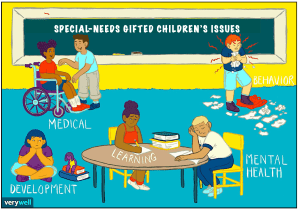
 Being Unusually ‘Gifted’ Can Take A Severe Psychological & Emotional Toll On Children

Gifted & Talented (G&Ts) by BEHAVIORAL STYLEs (cont)
Type III: The Under-grounders
Type IV: The At-Risk

Type V: The Double-Labeled
‘Double-Labeled’ (‘Twice Exceptional / Dual diagnosis’) – are kids whose giftedness is masked by a physical or emotional handicap, or by learning disabilities such as ADD & Dyslexia, none of which impact actual capacity to think, but only the style.

They’re sometimes mislabeled as “lazy,” since they perform well in one area but struggle in another. EXP: such a student might keep getting unbelievable high score in language arts, but with barely-competent abilities in math.

Since school systems focus on strengthening weaknesses rather than nurturing existing strengths, Type V’s rarely show special abilities at school. So they’re often not recognized as gifted until well into their academic careers – if at all.

Type Vs feel rejected, which shows up as disruptive behaviors & confusion about their inability to perform school tasks. With low self-esteem, stress leads to becoming discouraged, frustrated, isolated, & acting helpless.

Rather than admit they’re having a problem learning – they may claim that school work is boring or stupid. But while impatient & critical, they can be highly skilled at using the defense of intellectualization as a way to cope with their feeling of inadequacy.

At home of such children need advocacy, recognition for their abilities, & family activities to challenge them. Family counseling & medication may be needed.

TYPE VI: The Autonomous Learner
These are self-confident, independent children that are successful academically, motivated, goal-oriented & responsible. Unlike Type Is, these children have learned how to use the existing school system to get their needs met – based on a strong, positive self-concept.

They make up their own minds about how hard to work & what else they have planned. They’re well-respected by adults & peers, with a small social circle of friends. Often serving in some leadership role in school or their community, they still need a good coach at each level of development.

They accept themselves & are risk takers, which goes well with their independent & self-directed nature, willing to push boundaries in ways that “Type 1 – successful” gifted children are not.
They are also able to express their feelings, opinions & needs freely & appropriately.

Being creative thinkers, they look for opportunities to pursue their interests. EXP: If they’re interested in trains but their school doesn’t provide an outlet for this passion. they may look for summer programs or extracurricular opportunities to build train sets or visit stockyards.

This style of learning is not usually seen in young children, but parents may have an inkling of it by how they play. These G&Ts also need family support, advocacy, family activities & opportunities related to their interests. But they should also be allowed to have friends of all ages, with no time or space restrictions. (MORE….)

Child-MATURITY
Parents & teachers of the G&Ts often make the mistake of assuming that an exceptionally bright child is just as advanced emotionally. However, the reality is that their intellectual, physical, emotional & social abilities develop at different rates, & to different degrees. This uneven growth is called asynchronous development.

There are 2 broad categories  of emotional sensitivity & development:
☁︎ The young geniuses who are emotionally appropriate to their chronological age, but are wrongly considered immature because of their mental abilities. They may even sometimes throw tantrums when highly frustrated, a normal reaction for a G & T child. (Mistaken expectations“)
 AND
🤔 The G & Ts who are especially sensitive to their environment because of their giftedness – an intensified ability to respond to stimuli – called over-excitability (OE) – seen in 5 areas: emotional, imaginational, intellectual, psycho-motor & sensual .

NEXT: 

Gifted Children – Types (Part 2)

IT’S GREAT TO KNOW
the ways we’re unique

PREVIOUS: Gifted Children (Part 1)

SITEs: Intellectual Giftedness

Cartoons re. Gifted kids

CATEGORIES of ‘Gifted & Talented’ (G&T)
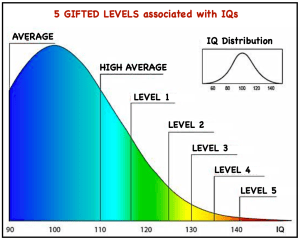
IQ LEVELS -cOne way of identifying the G&Ts is Dr Ruf’s’ Estimates of Levels of Gifted CHART (w/ info) ⬇️, using IQs as an indicator.

All gifted children are not affected by their special abilities in the same way.
Giftedness can be identified on the differences in intellectual abilities, talents, or interests  – rather than in terms of behavior, emotions or needs.
EXP of categories : artistically gifted, creatively gifted, intellectually gifted, learning disabled gifted….

Annemarie Roeper, 1982 noted that emotions cannot be treated separately from intellectual awareness or physical development – they intertwine & influence each other. She proposed 5 types of gifted children based strictly on the ways they cope with emotions – child/adult, perfectionist, self-critic, winner-of-the-competition, & well-integrated. She focused on how the gifted experience & express feelings, & the coping styles they develop.

🤓 However, the following overall distinctions were proposed by George Betts Maureen Neihart (1988).

G&Ts by BEHAVIORAL STYLE
TYPE I: The Successful – 90%
They are the traditional understanding of gifted children: they’re good at school – academically high achiever, becoming perfectionists,  tend to be structured thinkers & usually have a high self-concept.

Generally well-adjusted goal-setters, they do well on the SAT/ACT & score high on IQ tests. After figuring out what “sells” at home & at school, these kids conform to the rules, are obedient in class, do homework without a lot of prompting, & get good grades.

They’ve learned the system – keen to earn approval from all adults, so are usually well liked & included in social groups. Being dependent on the system to function, they lack autonomy, & so are less imaginative & creative – but they can perform music or produce art projects, without showing much interest in composition or abstract thinking.
Unfortunately, these children might face jealousy from some peers from being “teacher’s pet.”

• At home = they need independence, freedom of choice, time for personal interests, & opportunity for risk-taking experiences.  However, if they’re in an ‘average’ environment, gradually some Type Is will become bored, & then use the system to get by with as little effort as possible. They’ll go through the motions & end up coasting or under-achieving in both grade school & college.

Gifted young adults who may underachieve in college & later adulthood come from this group. They haven’t acquired skills, concepts or attitudes needed for life-long learning. They’re well adjusted to society, but not well prepared for the ever-changing challenges of life.

Type II: The Challenging
Challenging & creative students are generally the opposite of the “successful” ones. Many school systems fail to identify these kids as special, even though they’re ‘divergently gifted’ (multi-talented), therefore highly creative.

They may have extraordinary creative gifts as graphic & fine artists, composers, fashion designers, photographers,  writers …. But it’s this very disposition that put them at odds with a traditional school system.

As non-conformists, & can come across as obstinate, tactless, or sarcastic – which doesn’t go over well with the adults.
Not being ‘seen’, they become rebellious – questioning authority & the system, challenging teachers in class. They’re impatient, too direct & competitive, often leading to conflict.

🗯 Frustrated because school doesn’t acknowledge their natural talents & acquired skills, they struggle with low self-esteem. This group is at risk of dropping out & getting involved in unhealthy activities, such as drugs & delinquency.

• At home = they need acceptance, understanding & advocacy from parents. Also family activities & examples of positive behavior
• Socially = some may find themselves excluded as ‘weird’, while others will earn peer approval & friendship because of their creativity & sense of humor

NOTE: Gifted children types I & VI (Successful & Autonomous) are usually easy to recognize and deal with. Their achievements cannot go unnoticed.
BUT the other four types (Challenging, Under-grounders, Double-labeled & Dropouts) require special attention. They should be recognized as early as possible, so parents can find out what’s needed to help these children thrive.

NEXT: Gifted Children Learning styles 3 & 4

Gifted Children – LEARNING STYLES

 PREVIOUS : ACoAs & Listening #4

SITEsLIST of articles re. Learning Styles 

When Bright Kids Become Disillusioned

• How Being A Gifted Kid Affects You As An Adult

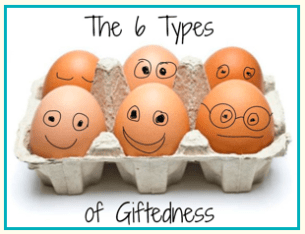
TYPES of GIFTEDNESS
More than three-fifths of a person’s learning style is biologically imposed (Restak 1979, Thies 1979). According to Joseph Renzulli: “Gifted behavior occurs when there is an interaction among 3 basic clusters of human traits:
• Above-average general &/or specific abilities
• High levels of task commitment (motivation)
• High levels of creativity 

EXP: Many gifted students find logical reasoning to be their preferred learning style, & for others linguistics may be (Language Arts & Math are not automatically synonymous – as if they’re gifted in one so they must be in the other)

👀 Visual learners learn best by comparing & contrasting modalities (a piece of lit to a video), or may do well in geometry…. Graphic organizers are a great resource for them

👩‍👩‍👦‍👦 Some enjoy working in groups where their leadership skills can be exposed and developed. Others prefer to work independently at their own pace
👍🏽 Some are hands-on kinesthetic learners – while others are auditory learners

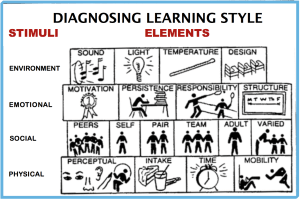
The most prominent unique personal characteristics of the G&T are: being Critical, Persistent & Independent of thought & judgement. Studies conclude that there are at least 18 areas of sensitivity. (CHART by Dunn & Price)

Also see posts: “Adult Learning styles

Existential – these thinkers are focused on issues too deep for other kids to understand, & may be prone to depression as they ponder the meaning of life. Careers involving philosophy & spirituality are a good fit

Kinesthetic – the kids who are highly skilled with their hands. As they develop control of their body, they may become hyperactive. Always on the move, these students must find physically active careers

Logical – those who excel in problem-solving & number manipulation. They may be easily frustrated with anything illogical. These students love to analyze everything, often becoming accountants or programmers

Verbal – masters of word manipulation, they can be quite persuasive. Their command of language gives then a love for storytelling, & a tendency to arguing. These students can have careers in marketing or politics

Visual – creating vivid mental pictures, these students thrive in the arts. Seeing the beauty in places where others may not, they can seem ‘overly’ emotional & dramatic. With imagination that never stops, these students make prime graphic designers.

In their BOOK “Teaching Gifted Students Through Independent Study,”  Johnsen & Goree recommend independent study as one of the most effective ways to differentiate and individualize (S & I) learning for the G&T, allowing those students to delve deeply into any topic of interest. (MORE..).

Rita Dunn, with colleagues, has done extensive research on all forms of learning styles. BOOK: How to Implement and Supervise a Learning Style Program, 1996
In Chp 1 Dunn writes that adolescents gifted in a particular area – athletics, dance, leadership, literature, music & math – have similar learning styles across 9 cultures.

Her work showed that most of those G&T students preferred to learn either by themselves or with an authoritative teacher, & only a few with classmates. Even in primary grades, gifted 1st & 2nd-graders got higher achievement & attitude test scores when allowed to learn in their preferred way. (See ‘Social’ in chart above).

Research also documented the influence of time-of-day energy patterns on achievement. Conventional school hours appear to be poorly time for the majority of G&T adolescents, because while a few learn well early in the morning, many more prefer late morning, afternoon, or evening for concentrating on challenging academic studies.

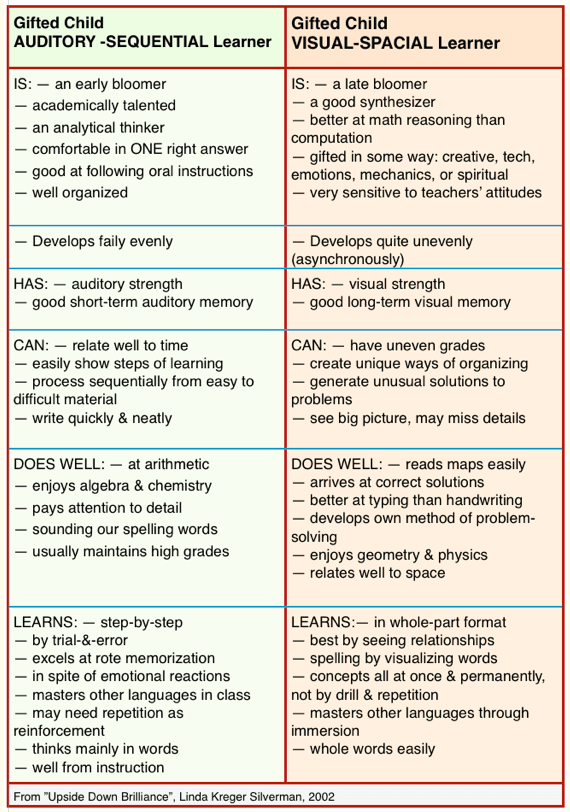
The Gifted Development Center, created by Dr. Linda Silverman 30 years ago, found two main learning profiles, based on brain hemisphere preference:
• Right side dominant are ‘Visual-Spatial’ Learners (VSL)
• Left side dominant are ‘Auditory-Sequential’ Learners (ASL) (MORE...)

Her validated research of children ages 9-13 showed that :
🌱 about 60% are mainly Visual-Spatial
🌱 33% are strongly Visual-Spatial
🌱 23% are strongly Auditory-Sequential
🌱 44% use both styles, with about 30% leaning toward VSL & 15% toward ASL.

QUIZ by Jade Ann Rivera, to help identify a child’s type + other info


ACoAs & LISTENING (Part 4)

PREVIOUS: Listening #3

POST : Use THINK instead of FEEL


3. (AWhen someone wants you to listen to them AND it’s a practical issue (lack of funds, health or relationship problems…..) (in Part 2)

#3 VARIATION (cont)
(
T) When someone wants you to listen to a problem AND asks you directly to tell them what to do

👄 💬 If you automatically respond by giving advice, you’re trying to think for them.

HARMFUL – ACoAs are notorious advice givers!
• we really believe someone wouldn’t be telling us their problem if they didn’t want a solution
• from earliest childhood, e’re trained to be Rescuers, & by golly we have to do our job, AND we feel guilty when we don’t!
• we can’t bear to see anyone suffer, because it touches on our own unprocessed pain, so we have to make them feel better – since we couldn’t heal our parents’ suffering

📣 IF you can’t be silent & just ‘be there’ because it’s getting you riled up, overwhelmed, grossed out, judgmental or scared — excuse yourself as soon as politely possible & work on which WIC button got pushed

HELPFUL
• RULE #1 (again) : Zip the Lip!
• IF you want to be helpful AND can do it from your Loving Parent &/or Healthy Adult (the UNIT)

— then ASK respectful Qs – but only to find out what the other person:
– really needs (may be hidden to them at the moment)
– is thinking : if they have some distorted, confused beliefs you can carefully point out, or help them uncover & clarify their ideas

– is missing : what don’t they know, & are they open to new info which they can use to help themselves/
🤫 They may just need to say it out loud, to come to their own conclusion or make a firm choice between various options that suit them

4. FINALLY
NOT everything you’re asked to listen to will be about distress, or a problem.
When someone wants to share a joy, success, good ‘luck’ …. anything great & exciting that’s happened to them AND you ignore them, give them a little dig, or find some other way of diminishing their joy – you’re ‘abandoningthem by acting like your Bad Parent.
These reactions are from envy / jealousy.

HARMFUL
ACoAs don’t have permission to take care of ourselves, which makes us afraid to take healthy Risks. It prevents many of us from following our dreams & talents. Often the successes we do have are at things that are not our desires (family expectations or demands), OR not our first choice, rather than going for the things that we were born to do!

ALL envy/ jealousy is about feeling powerless to get OUR needs met.Screen Shot 2015-06-18 at 8.02.04 PM
So we’re angry & resentful when others have happy moments & positive outcomes – whether we wanted their specific ‘thing’ or not.

• ENVY is between 2 people : “I envy your beautiful long hair, your education, how comfortable you are with yourself….
• JEALOUSY is between you and 2 or more others (3 +) : “I’m jealous that you have a happy family, a great boss, lots of friends….”

HELPFUL
The more we have our own needs & dreams fulfilled, the easier it is to be generous – genuinely happy for others who are also doing well. In fact it will make us feel good to be with others who are happy, so we can have fun & share with them, on equal terms.
*            *              *              *            *           *           *             *
IMP – You DON’T have to be available to listen, IF :
• you don’t have the time, desire or capacityScreen Shot 2016-06-19 at 5.22.11 AM
• the other person is using you to dump on, rather than sharing their process.

If you’ve heard the same problem, complaint & rant on for years! – without any real changes in the person, you know you’re wasting your time.
They’re responsible for their own growth, so if that’s missing, you’re being used. Endless listening is co-dependence, even if you call it loyalty.

It’s OK to decline to listen — on a particular day, or because you’ve not able at the moment, or not at all, because you’ve had enough!
😡 If they react badly (angry, whining, chasing you down…) – that just validates your decision!

NEXT: Gifted Children #1

ACoAs & LISTENING (Part 3)

listening to herYOU MEAN I HAVE TO
be happy for someone else?

PREVIOUS:  ACoAs & Listening (#2)

SITE: The SKILL of LISTENING  ** w/ EXP (Center for Parenting Education)

REVIEW posts : “Healthy Helping

See ACRONYM page for abbrev.

QUOTE: “We have two ears and one mouth so that we can listen”~ Epictetus 

REMINDER: Accurate & compassionate listening means we don’t try to make the other person a carbon copy of us. Even if we strongly identify, listening is about THEM – where they’re at, what they’re feeling & thinking. Don’t talk about yourself too much. You are the listen-er, they are the listen-ee.

3. (AWhen someone wants you to listen to them AND it’s a practical issue (lack of funds, health or relationship problems…..) (in Part 2)

#3 VARIATION (re. actions)
(A) When someone wants you to listen to them AND asks you directly to tell them what to do
a. Naturally if you are sought out as a professional (doctor, decorator, coach, teacher, lawyer…) you’re paid to give your expert opinion & advice.
— However, for psychologists, psychotherapists…  the rules are different. The goal is more about mirroring, giving feedback (true listening), providing the client with options & helping them find what’s right for themselves.

b.
For the rest of us who are not being paid, teach or heal, there are options.
• ASK if they want ‘advice’ OR information – not the same thing!

Advice is telling someone what you think they should do, be, feel, think based on yourself, not who they are! No matter how right or helpful the info is, it’s not listening.

Information is giving knowledge they may not have, including options, without an emotional valence attached. They can use it or not, as they wish We often tell people to DO things they’re already tried. Don’t waste their time or yours! Good listening is hard for ACoAs, but worth the effort!

i. When you know the listen-ee well, you probably know —
if they already know what to do – but in this case refuse. Don’t push
that they may know, but really do need some help implementing a solution.
Suggest someone else who is qualifies & willing, or if it doesn’t harm you, you can offer, but think twice before you do

— that they really don’t know. Then you can decide IF you want to give them info, or suggest where they can get it (on Google, from Al-Anon or AA,  some books you recommend….)

ii. If it’s someone you just met or don’t know well, start by asking some pertinent questions —
— What do they WANT from you? What are they really asking for & how much? See posts “Healthy Helping”. If you can get that far with them, the conversation may take a different turn than how it started

— What have they done about their problem / situation so far? & how have those things turned out? This saves time & energy suggesting things they’ve already covered.
• If they’ve tried a number of things which have all been disappointing, there may be absolutely nothing you can contribute. OR they didn’t try something useful because they didn’t know about it – so you can offer it

• IF their response to any suggestions is always a version of “Yes but… that won’t work / I can’t because….” then either you’re asking the wrong questions or they’re playing the “Yes, But” game from Games People Play, by Eric Berne.

In the latter case they don’t actually want an answer, they want to be parented AND be contrary, which is a child’s way of saying “You can’t control me.” It may be a version of “Come here-Go away“(posts).

With such a person, only try 2-3 times, then shut up. 😑

NEXT: What just Happened? – #1

ACoAs & LISTENING (Part 2)

Screen Shot 2016-06-19 at 5.12.58 AMI FEEL SO POWERLESS
if I don’t DO something to help!

PREVIOUS: ACoAs & Listening (#1)

POSTS: Anxiety & T.E.A

Turkish
proverb: “If Speaking is Silver, then LISTENING is GOLD”


LISTENING ‘situations’
(cont)
1. (E) When someone wants you to listen to them AND….

2. (E) When someone wants you to listen to them AND they’re expressing intense emotions (sadness, anger, fear…) 

BUT their emotional state sounds ‘crazy, irrational, ‘out of proportion’ to the current situation, remember: “If it’s Hysterical, it’s Historical”. It usually means their WIC is in the foreground, who is expressing intense old pain – accumulated from childhood trauma.

It’s not your job to parent them & you’re not their therapist. Here too – trying to make them feel better can be heard by them as denying their experience!
CAVEAT:  If you’re listening to someone deep into the emotion of self-hate, there’s very little you can do to make a difference in that moment.

DO NOT try to talk someone out of Self-Hate. It’s futile. Their WIC has completely regressed into a familiar childhood state & locked in for the time being.
Because S-H is about denying the pain of abandonment & trying to avoid feeling vulnerable, while having a little control over their sense of hopelessness (S-H gives a false sense of power) – they’re not going to come out of it right away.

OPTIONS
◆ You could say: “Wow,_____, I hear that you’re really beating yourself up mercilessly. Why is that?”
◆ You can also ask: “What’s happened recently that hurt you or disappointed you so much?”
If you think they’ll understand, you can gently suggest they’re feeling some deep childhood abandonment
◆ If appropriate, you could add your own reaction: “Your self-hate is really painful for me to hear. It’s like watching someone I care about cut themselves or shoot heroin!”
Yes, that’s how devastating S-H is!
💝   💘   💔
3. (AWhen someone wants you to listen to them AND it’s a practical issue (lack of funds, health or relationship problems…..)

AND you insist on offering a way for them to solve their problem (actions)
you’ve actually failed them, strange as it may seem, because…..
….. when you do for them what they can AND need to do for themselves, you contribute to their sense of inadequacy & fear of taking appropriate risks.
And they can do things for themselves. As adults, they’re not helpless. Maybe discouraged & faltering, but not helpless. Maybe all they need is information – but it has to be something they can apply for themselves.
(Review posts: “Rescuing – False helping” and “Healthy Helping“)

HARMFUL
• ACoAs would rather do for others that themselves. It’s our training & a great distraction from taking care of ourselves- which we don’t want to do.Screen Shot 2016-06-19 at 5.18.42 AM

• IRONY: we use a great deal of intelligence, creativity, money, time – even wisdom – on someone else, BUT genuinely believe we don’t know how to handle our own problems! How is that possible, when we just used all those skills for others?

• REALITY: We use up a lot of energy trying to save someone else, while silently expecting, even demanding, that someone else do the same for us! WE too want to be taken care of, even though we too have the ability to care for ourselves.

HELPFUL
• Rule #1, again – zip the lip!
• Often people just need a non-judgmental sounding board – to hear themselves think.  By running it past a good listener, they can hear the problem for what it is, maybe even find their own answersScreen Shot 2016-06-19 at 5.14.43 AM

• You can ASK if they need practical suggestions, but only give it IF….
…. they say yes & they seem willing to do for themselves (not just trying to be taken care of, or need to be oppositional)
…. you actually know, maybe from experience, what you’re talking about
• You need to CHECK what they….
…. want to do, in the near future
…. have already done, but for some reason didn’t work or didn’t help!

NEXT: ACoAs & Listening (Part 3)

ACoAs & LISTENING (Part 1)

 I’M GOOD A LISTENER, BUT….
… I have to make them feel better!

PREVIOUS: Healthy Opposites #3

POSTS: How ACoAs Abandon Others


LISTENING
can be passive or active, but basically – the less said the better!
Wanting to be listened to is not always asked for directly. When someone starts talking & then keeps going & going – they want to be heard.

• The following 3 examples cover T.E.A. In each case, if the WIC or PP are the ones listening, then what we think are ‘helping’ responses will actually be our own narcissism – the compulsion to tell them what WE would do or say – but is actually NOT about the other person & so not useful. Don’t get in the way of someone else’s process!

LISTENING ‘situations’ 

1. (E) When someone wants you to listen to them, AND they’re having intense emotions (sadness, anger, fear…),

🔓AND you tell them they shouldn’t feel that way – “Don’t be upset”
💚OR automatically tell them how to fix their problem – “You can….”

👣👣 then you’re trampling on their right to feel & express their emotions without interference.
EXP: After my fire, when I told people how sad I was that both my cats were killed by the smoke, some people said: “Well then get new cats”!

HARMFUL
ACoAs who react from their WIC to another person’s emotional expression will over-identify with their distress. Since we didn’t get the support as kids that we needed, we project that on to others, & decide (usually unawares) that we’ll never be like our parents – to leave someone in the lurch. We compulsively have to ‘help’.

PROBLEM with this WIC-logic (T)
When we were originally abandoned, we were very young! But the people we’re usually trying to rescue to now are adults who have many resources & capacities no child can possibly have. So they don’t need us the way we needed someone to soothe us when we were in pain as kids. (See posts: “Rescuing – False helping” and “Healthy Helping“)
ALSO, we’re not their parent, no matter how immaturely they may act!

🖤 Negating a person’s emotions or trying to make them ‘feel better’ wastes everyone’s time because,
• the listen-ee may just shut down & not be able to continue, OR
• they’ll waste a lot of energy convincing you how & why they feel that way
HELPFUL
Rule #1 : YES, zip the lip!
OR if you can’t :  ASK them what they’re feeling – emotionally.
Don’t settle for HEAD answers. Ask what they’re feeling emotionally vs. what are they’re thinking. Anything more than one word (E) is a thought (T). (“Feelings Aren’t Facts”)

If they’re not sure, maybe you can help them identify the words, such as fear, self-hate, frustration OR excitement, joy, love… If you also aren’t clear about what they may be experiencing, be quiet.

• If you’re in the ‘mood’ to respond to their comments, always start by validating whatever emotions they can verbalize. It doesn’t mean that you identify with the feelings or the situation, nor is that necessary. You can say brief, comforting things like:

“Wow, that’s tough, I know what you mean, Sorry to hear that, I’ve been there too….”
Screen Shot 2016-06-19 at 5.06.00 AM“Sound like you’re in a lot of pain, That must really make you angry. Ouch!”.
But, DO NOT assume you’re sure you know how someone feels. If they disagree with your opinion, drop it.

A POSSIBILITY – with their permission
If you know them well, have experienced something similar AND you feel like it – you could help them figure out what’s behind their big emotions: old beliefs, the WIC over-reacting, family patters, current similarity to childhood experiences….
Then if they’re willing & able to go deep, the solution to their problem may be obvious to them without any more help from you.

NEXT: ACoAs & Listening (Part 2)

“ACTIONS – Healthy OPPOSITES” (Part 4)

PREVIOUS: Healthy Opposites #3

SITES:  Positive Responses to Events 
Self-Esteem // UNIT 
33 Things I’ve Learned 

A. UNHEALTHY Patterns
B. UNHEALTHY Opposites

C. HEALTHY Opposites (cont.)
Healthy functioning goes against all our Toxic Rules, & disobeying them feels like we’re betraying the family. What we in fact must do is to become totally, unequivocally loyal to ourselves, since we didn’t get nourished correctly from the beginning. Our ONLY job is to heal the Wounded Child & bring out the best of our Natural Child

EXP: Imagine you’re a highly trained plumber with a fully stocked tool bag. It may be worn & dirty, but has always been available & made your work possible. You’ve been using those tools for a long time, replacing old parts, stopping drips & duck taping leaky pipes, hoping to avoid a flood. You’ve been on the job so long you can’t imagine doing anything else!

• Then one day you’re told the old-style plumbing is being replaced with an all new infrastructure & your specific skills are not needed anymore! You can throw away that raggedy tool bag & carry an elegant briefcase with fewer but more refined new instruments! You’re shocked, even devastated.

You know how to use the old instruments – what are you going to do with a briefcase? You don’t know how to read the new rules & or how to implement them. What are you going to do without having cracked pipes to tinker with?? Who are you going to be now!!??

Shifting from Negative to Positive ways of living is done thru Process,
— another one of those things ACoAs hate! and we need practical examples of correct thinking & acting

When our Inner Child is on the same page as the Healthy Adult /Parent (‘Unit’) about some specific issue in our life (ending a bad relationship, pursuing a healthy dream….), then resistance is eliminated, & we’re able to take the actions we want, the ones that are best for us. With time the new actions become the new norm!

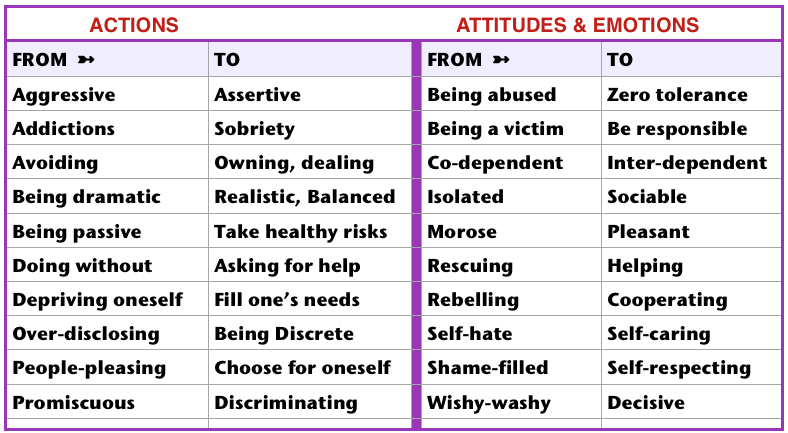
From NEGATIVE to POSITIVE Opposite  (from #1 to #2 on chart):oppositesREVIEW – it helps to remember that:
• Most people in the world are damaged. It’s the younger, damaged part of us making these negative choices – by training, to be loyal to our family & prevent punishment. This is normal & understandable.

Without healing everyone is run alternately by 2 Ego States: the ‘Bad’ voice (Introject) & the Wounded Child.
Many people have a somewhat functioning Adult – “somewhat” because is includes CDs.
But rarely do we meet someone with a Loving Parent voice. Without the L.P. it’s hard for anyone to make long-lasting improvements

• While many of us across the country & the world legitimately have limited options for help & support where we physically are located, now we have many new possibilities via the internet & books that can improve our lives

• To shift into Positive Opposites, ACoAs need 2 new ego states to work as the ‘Unit’: the Healthy Adult that deals with facts, & the L.P. in charge of nurturing & guidance. The Unit must take over the responsibility of running our lives, & care for our wounded part – away from the ‘bad voice’ that beats us up & holds us back

✶ As Healthy Adults, we can choose what actually works & what doesn’t – in the present – rather than what we learned originally.
Using T.E.A. (thoughts, emotions & actions) our goal in Recovery is to:
• notice that our Es are, & as much as possible, manage them in safe ways
• keep track of our Ts, re-enforcing the realistic results& healthy ones, while changing the toxic beliefs – or at least not obeying them!

• observe our As, especially the ones that are self-defeating, noticing their practical & emotional consequence, so that we WANT to change them – and re-enforce the good ones, no matter how small!

RESULTS of Positive Opposite actions:
❇️ Over time, taking Positive Opposite actions add up, giving us a sense of worth,  permission to be our True Self, be part of the human race & actually enjoy life!

NEXT: ACoAs & Listening, #1