PERSONAL POWER : Individual ➖(Part 1a)


PREVIOUSLY : Power – 3 Directions

POSTs: Narcissist’s FEARS


NOTE: Personal Power relates to 2 different spheres of life:
a. A person’s psychological well-being, or lack of, POS & NEG
b. One form of influence in business.
These 2 posts deal with the first kind (a).  (b) will come in later  posts dealing with various types of power in business.

At its best, Personal Power (PP) is used to control our own states & actions.
However, PP can easily be misused, certainly against others in one’s daily life (at home, school, works….) by wounded people.

Surprising to some, PP can also be used inwardly – passively to keep oneself stuck, or actively to harm oneself in PMES ways. The power of self-destruction is a real. A person who functions from this power will go out of their way to implode & disrupt any positive qualities they have.

1. NEGATIVE PERSONAL POWER (PP)
This term may seem like an oxymoron (self-contradictory) – we would say ‘you either have power or you don’t’. However, psychologically unhealthy adults who function from the position of Victim – compulsively, persistently behave in self-defeating ways.

The consequences are almost alway bad, but they don’t seem to learn that “doing the same thing over & over hoping for a different
outcome” (the definition of insanity) will always lead to hopelessness.

This takes great deal of determination, using the energy of negative power to persist in self-harm. It can be seen in the 3 roles of the “codependent triangle“, where the damaged person cycles through them in reaction to PPT (people, places & things) which cause them stress.

a. INTERNAL negative power
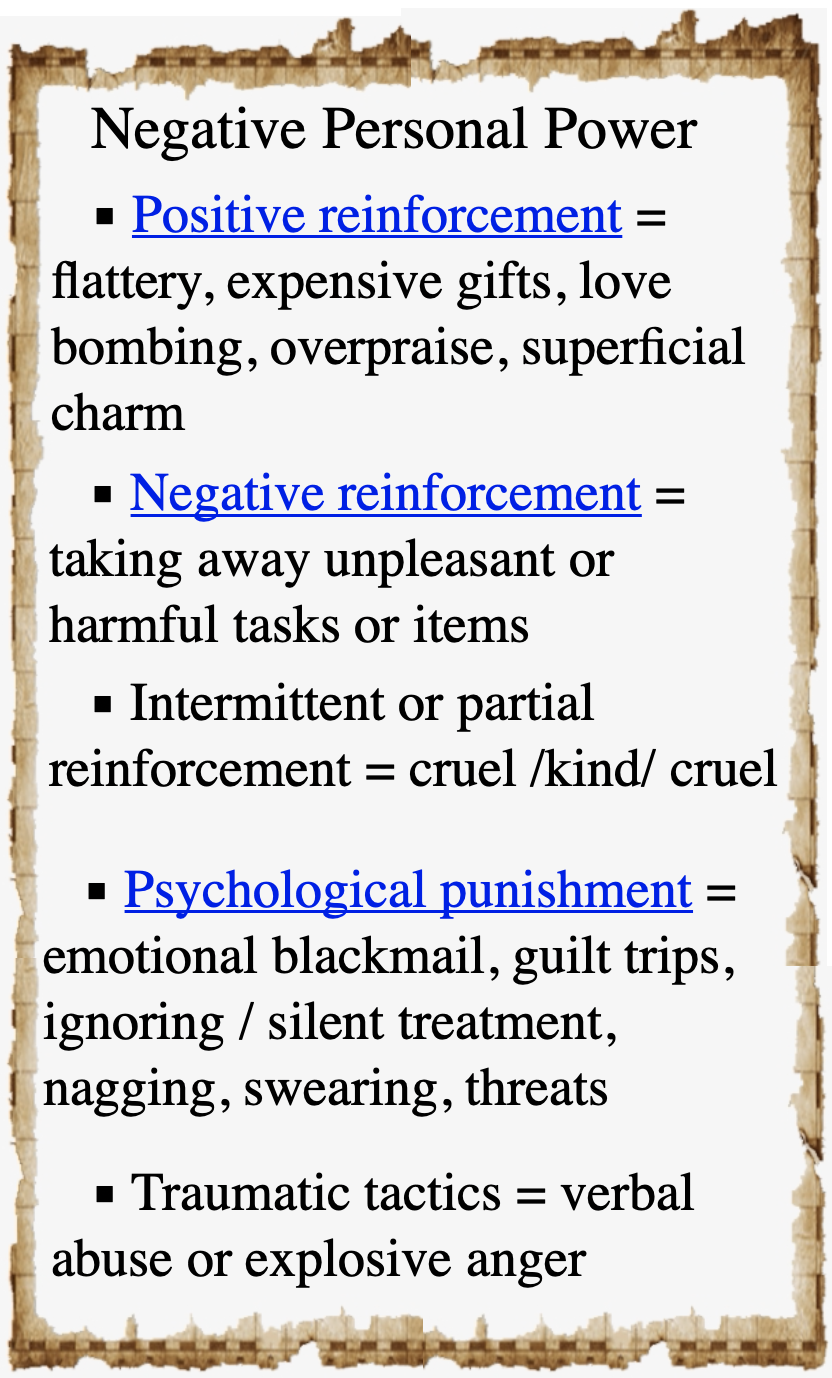
While these people see themselves as Victim, the effect of their  harmful attitudes & actions put them in the role of indirect Perpetrator, by triggering anxiety, guilt & anger in others around them. Blatantly self-destructive Victims, such as chronic addicts or those who threaten suicide – are especially effective at generating fear in their loved ones. This is indeed power

Negative PP can be in the form of accusations, blame, envy & jealousy, only caring about what others think about us, ‘falling apart’, fear of rejection or confrontation, putting others’ needs ahead of our own, verbal attacks, tantrums….. (Review the original Laundry List).

Another way NP is expressed by the Victim is a form of passive-aggression, acted out as incompetence, mental & emotional instability, procrastination….. The power is in the suppressed rage which leaks out in all parts of their life. Although different from overtly destructive power plays, their subtler mind games are just as destructive.

Internal NP can dominate & destroy the life of entire families. It’s a type of terrorism, which includes scapegoating, where the Perpetrator (covert abuser) will pick on one person to be “accountable” for the misery & unhappiness of others. Review all the ways Covert Narcissists cause harm, especially to children.

b. EXTERNAL negative power – based in anxiety, & rage – is expressed by toxic people by aggressive actions of coercive control, domination & force. They consistently misuse PP – deliberately playing on other’s fears, needs & lack – to gain & maintain power.  
The personality structure of overt power-mongers is made up of underlying emotional weaknesses, including arrogance, rage-aholism, narcissism, paranoia, extreme vanity, sociopathy & other personality disorders….
Devoid of empathy for Self & others, they hide behind an authoritarian-parent style of being ‘all-knowing’, judgmental & always right.

OVERTs compulsively need to deny feeling vulnerable from real or perceived inadequacies (S-H). So having control over others can be addictive, because it produces a sense of elation (highs), & diminishes a sense of insecurity (lows).

Even deeper, destructive people suppress acknowledging the reality of their eventual death. Denying any form of powerlessness, their endless hunger to be special & invulnerable to all harm (typical of NPDs). creates a fantasy of being immune to non-existence. Assuming they’re exempt from natural forces supports their vanity, superiority & the ‘right’ to lord it over others.

Because self-delusion never succeeds in eliminating their underlying fear of death, excessive need for power (++nPOW) becomes increasingly compelling, leading to disastrous outcomes, from creating criminal or addict children to crimes against humanity.

NEXT : Positive Personal Power
POWER – 3 Directions, Authority


PREVIOUS : P TYPES

BOOK :”Whistleblowers: Broken Lives and Organizational Power” by C. Fred Alford


3 DIRECTIONS of Power
Everything we do as humans can be seen as a status game — exercises in raising & lowering our own status & that of those around us, which can also be seen in one of 3 types of power within groups.
1. Power-from-WITHIN (power TO self) : healthiest – a result of self-realization, sustaining our life. It’s empowering & underpins self-confidence & spiritual faith.
These people see all humans & the world as = living beings who are dynamic, integrated; individualistic, artistic
Motivation – creativity, empowerment.
BASEs: Nutrient, Competitive (Over & To)
EXP: sitting up straight & forward may be a physical way to raise your status

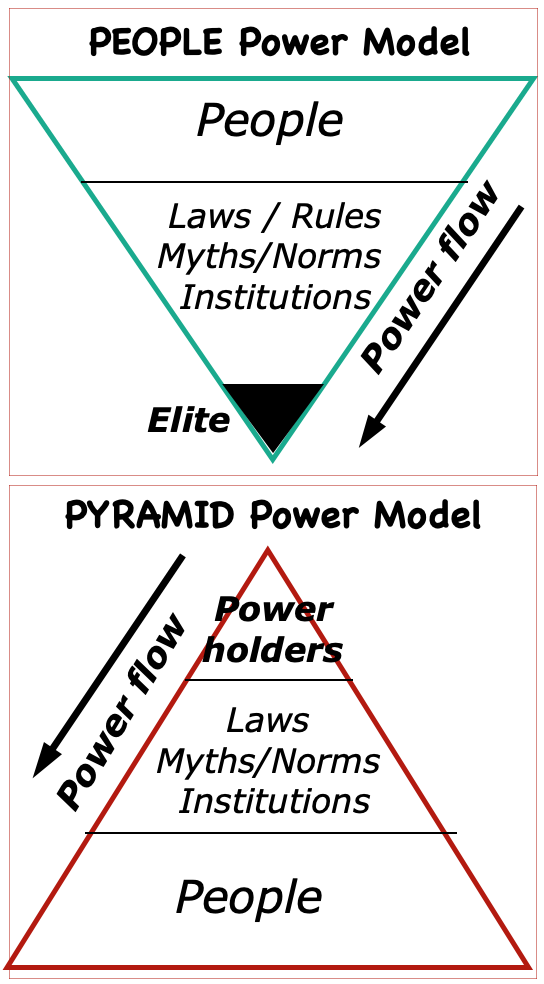
🪐 Socially & politically, power can flow from one of 2 sources, either from ‘the
People’ or from the ‘Elite’, shown as People Power or Pyramid Power

2. Power-WITH (others) : it bridges the value system of P-from-Within and P-Over, representing social & psychological integration, “the whole is greater than the sum”. Such people see the world as a pattern of relationships, valuing all beings & persons. Their interest is in how that pattern can be molded, shapes & shifted – for the better.
Motivation – equality of & respect for all.
BASEs : Integrative, Ideological (soft, implicit power)
EXP: Ask a colleague for their opinion can equalize their status

🌹People-Power Model : This type holds that –
• P ultimately rests in the hands of the  public masses (they’re the top)
• the P-holders’ influence depends on the mass public’s cooperation
• the strategy of creating change from people-movements by ‘leading the leaders”

Re. VIOLENCE – there are also 3 types:
✴︎ Direct – physical actions
✴︎ Structural – built into the fabric of the prevailing governing system (only 10% is visible)
✴︎ Cultural – parts of a culture that legitimize violence, making it an acceptable way to deal with conflict, supporting a few to have a sense of superiority over the majority (More….)

Non-violent social change is the ideal use of People-P, based on universal principles which unify, allowing everyone to participate, using education, persuasion, social movements….

3. Power-OVER (others): domination & control over others & things. These people sees humans & the world as = objects, made up of separate, isolated parts with no inherent worth.
Motivation – fear. BASE – Coercive
EXP: Talking over someone is a verbal way of lowering their status

🧔🏻Pyramid-Power Model : It holds that –
• society is organized in the form of a hierarchical pyramid, with P-holders (elite) at the top & the powerless masses at the bottom
• P flows down from the elite to the masses
• social change can only be achieved by appealing to & persuading the elite to change their views.
🦾
Together, Power & Authority are the 2 capacities of effective power that underpin social interactions.

AUTHORITY – is derived from one’s position, not from themselves, even if they have personal traits that also make them powerful. So a person can be given authority while having very little personal power, although this placement is not beneficial to an organization

Authority is easily lost. An organization can delete someone’s authority by removing everything that gave them formal power over others, by firing them or with a demotion (moving a manager to a position with the same pay level but taking away their leadership functions).
However a few power positions are institutionalized & very difficult to change, such as the British monarchy or a U.S. Supreme Court Justice.

POWER – is mainly the product of positive personal traits, but can also can be learned. EXP: The more knowledge a person has in their field, the more power they have. Having power also depends on how others view you. If they don’t consider you powerful, then you’re not (in your specific environment).

Power can be lost. Because it’s built on expertise & experience, making critical errors, especially in politics or business, can make a powerful person lose credibility. And while it doesn’t require a good personality, it helps, so bad personal behavior or treatment of co-workers can also strip someone of influence.

NEXT : Power Characteristics (Part 3)

POWER – Types


PREVIOUS :  P Dynamics


⬅️ “Dynamics of Power
∼ Evangeline Bradley


ACoAs : It can be helpful to look at all the ways Power can be & is used, so we can have an accurate perspective, be able to correctly identify who we’re dealing with, & make informed choices.

Everyone’s first encounter with power is in the family. Our experience left a very bad taste in the ‘mouth’, leaving us with fear & rage at all ‘authority’ figures, because the original ones misused their power, & -now- we think we don’t have any! Not true!
🌈
POWER (P) itself is not evil – only some of the actions that result. Like any form of energy, it’s not the action of changing another person’s attitudes or behavior, only the potential to do so.

The proper use of power is the ability to get things done safely & respectfully, such as positively affect the outcome of a social interaction, rather than ‘lording’ it over others.

Power can be an effective tool in coordinating & promoting harmonious relationships, solving conflicts, & enhancing performance. It’s not only needed to get certain direct results, but also to form negative decisions or non-decisions.

“The use of influence is not automatically a negative. Like any strong force – from powerful medicine to nuclear power – it is the morality-motive behind the desire to harness it that makes all the difference.” R.L. Dilenscheider, 1990 (“Power and influence: Mastering the art of Persuasion“)

Some TYPES
• CONTROL P : the ability to achieve something. To persuade, manipulate, coerce OR work together to achieve a goal, adapt, prevent injury….
EXP: Acquire the knowledge to name or define events, people, pattern, things

• EMOTIONAL P : Power-related feelings signal basic survival needs — who is a threat, who is an ally, who can be counted on, and who is in the way.

• FRAMING  P : the stories ‘explaining’ why things are the way they are, which can control or direct the outcomes of social-change- efforts (homelessness….), If limited or one-sided, will drive responses in a skewed direction

• LANGUAGE P : Research identifies several features, such as –
– Powerful talk makes speakers seem confident & knowledgeable
– Powerless talk suggests the speaker is unsure, tentative & submissive

• MANIFEST P : having the intention of using power, or actually use it – when A wants something from B
vs.
• LATENT P : the ability to exercise power but not use it, perhaps not even consider its use. Qs:
= Does person B behave differently because they’re anticipating what A could do?
Yesoften to please or protect oneself

= Does the power-holder’s (A) intention matter in an interaction?
No, yet there can be an unintended effect – if A’s very presence causes a change in B’s attitude & actions

• POWERLESSNESS P – resistance to act in ways not desired, such as delay tactics in biz / law / politics…, or sullen pouting / door-slamming / tears by adolescents…..
OR as sacrifice, such as ignoring personal “status” (boss, star, leader….) to belong to a group, or giving up some personal desires to be a good parent

• STRUCTURAL P : the ability of a person / group to shape their social environment, to set the agenda, & determine rules of the game
EXP: “Living next to the United States is a little like sleeping with an elephant. You always wonder if they will roll over on you.” ∼ Pierre Elliott Trudeau

GROUP Dynamics 
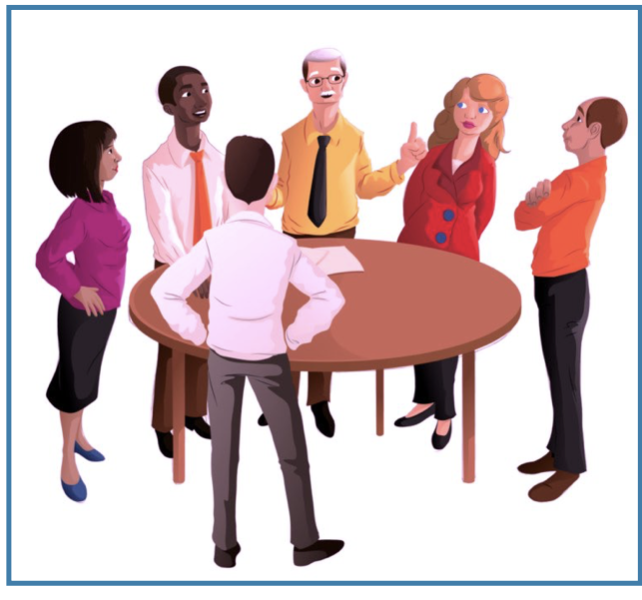
Family therapist David Kantor lists 4 power-dynamic interactions seen in business meetings (& other groups) :
a. Move – to initiate  //   b. Follow – someone else’s move
c. Oppose  – disagree with, or correct another’s move
d. Bystand (positive) – notice when the group gets stuck, name it & make a helpful suggestion for moving forward.

A successful group or family unit uses all four in complementary, positive interactions.
And one way to assess how ‘well’ a group is doing is noticing the pattern of their conversations – how they talk to each other.

Unhealthy groups include the dysfunctional bystander, (lack of moral courage). EXP: Enabling addicts & narcissist, knowing about abuse, watching a crime take place…. & choosing to not intervene.

NEXT: Personal Power (+ / -)

POWER – Dynamics


PREVIOUS : Human POWER MOTIVE

SITE :
How to Successfully Navigate Power Dynamics at Work

⌛️ Power Dynamics History – from 5th cent BC to 2019 (scroll way down)


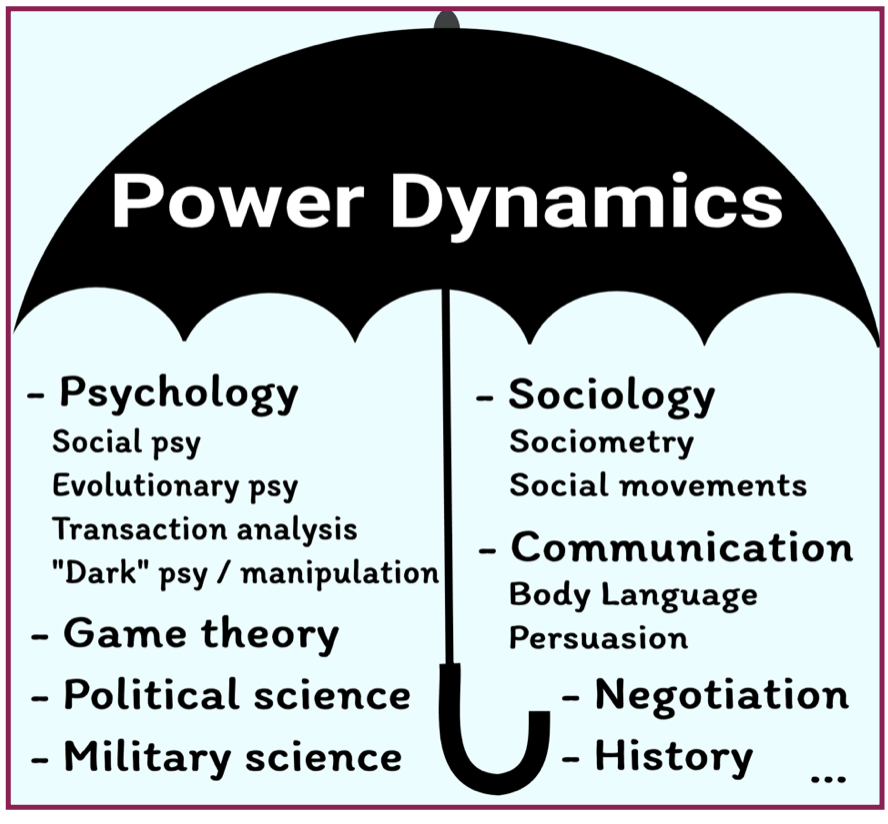
POWER DYNAMICS (PDs) – is the science of power negotiation between individuals or in groups – as a branch of social skills & life strategies. It’s the study of the unwritten rules people use to engage & interact with each other.  It includes :
♝ cooperation among individuals to reach goals
♝ forming & acquiring rank-titles within structured hierarchies
♝ negotiating conflicting interests
♝ use of strategies to reach an end or goal
♝ use of influence, persuasion, & manipulation

If Power is defined as “the ability to achieve predefined goals” then power, in & of itself, is neutral, neither good nor bad. It’s all about how it’s used. Unfortunately, this discipline still has a negative connotation, because power-hungry, unscrupulous individuals are drawn to mis-applying PDs.
However, PDs can also be used for personal self-defense. When strategies for individual success are expressed ethically, they add great value to the people around us & to society as a whole.

Power Dynamics are seen IN many areas of human socialization, so managing its complexity is essential to achieving our goals
Relationships
❧ PDs are present in & crucial to all relationships, healthy & unhealthy. Along with having Personal Power, understanding & mastering the various forms & appropriate uses of PDs supports positive ones.

One of clearest signs that a partner is potentially abusive or already toxic is the one who focuses mostly or solely on having ALL the power within the intimate pairing.
Ignorance of PDs allows abuse to develop & persist. So living as if they don’t matter is naive. And dangerous.

Dating
PDs are part of mating negotiations, & the strategies to gain sexual access. Single people complain about not finding a good mate, but the real issue is not knowing the rules of the game.

EXP: Historically, men have gained power from sex with multiple partners, but women have not. B genders have converging & diverging interests, which vary depending on
where they’re at in the process.

Social environments
Proper use of PDs are needed to be socially successful, because:
• people respect others they consider to have ‘high power’
• one needs to know how to be persuasive
• ignorance of social PDs leaves one vulnerable to being manipulated or ignored.
RULE : Don’t go through life as a ‘dumb’ lamb, pretending there are no wolves. It’s OK to keep being a friendly lamb – but use PDs as healthy  protection.

Business
Workplaces everywhere are hotbeds of politics & (hidden) Machiavellian power moves – because they tend to have built-in contradictions.
On the surface, a company’s values usually stress teamwork, & the “whole” over the individual.
But underneath, there are many diverging & conflicting interests at all power levels that get in the way of cooperation. (PD : Hidden Element in Meetings)

Leadership
How PDs are used differentiate great leaders from poor ones. The poor ones rely only on formal authority (power OVER), while better ones gather power by their people-skills, making others want to follow them (power WITH).
Great leaders can achieve social status within groups even if they have no rank or formal power over others. If they also get a title, it’s an additional ‘legal’ recognition of their already existing influence.

Social Sciences
As important as PDs are, for self-development & personal success, there is no recognized branch in the social sciences. Yet PDs are embedded in the very fabric of most recognized university courses, & so can be considered scientific, since many contribute research & papers to our understanding of PD.
EXP:
‣ Political science – the end game of top power-players is to run things, & running countries is the apex
‣ Game theory & economics – which provide insight into the exchange & transactions of human relations
‣ History – which shows which strategies people developed to acquire & maintain power, or which ones failed. (Scroll to the list ).
(Modified from : “Power Dynamics: What Is It, How it Affects You“)


NEXT : Power TYPES

The Human POWER MOTIVE


PREVIOUS : 
Narcissist

SITE : “The Basics of Power(includes several studies)


POWER (P) is fundamental to human social life
The study of Influence & Power is likely as old as human history. “To a greater degree than most of us realize, we are the products of power,”  Toffler (1990).
Success, defeat & conflict have given rise to the desire & search for it. Some psychoanalysts call this normal, saying that power can actually build a person’s identity, under certain circumstances. (Zalesnik 1989)
Others doctors believe that power-seeking is not conducive to psychological development. This can be shown in Eve’s greed for illegal knowledge & power, which made her vulnerable to the  manipulation of the powerful & devious Nāḥāš (Hebrew for ‘snake’), leading to the downfall of all humanity. (Genesis 3)

GENERAL : The human Power Motive is the desire of one person to have an impact on the behavior or emotions of another individual or group, &/or being concerned about one’s own prestige & reputation. This broad definition includes a whole family of overlapping concepts :  ✦ authority, aggression, coercion, control, dominance, influence, inspiration, leadership & nurturance – combined into the “need for power” = nPow

nPow is different from other power-related psychological concepts. It is not :
✦ Beliefs about P (Authoritarian, Machiavellian)
✦ having the Skills to get or use P (rules, maneuvers)
✦ natural Traits (dominance or surgency ….)
✦ occupying P Positions (teacher, CEO, minister)
✦ P Styles (5 -10 categories)
✦ Sense of having P (locus of control, reinforcement)

nPow is an inborn basic component of one’s personality, & some people have a greater need or capacity for it than others. Research suggests nPow is embedded in certain physical processes, hormones, & mechanisms.
Power-driven people show greater sympathetic nervous system arousal when under stress & threat (reactiveness).

Without proper self-care & the ability to self-regulate (powerlessness), constant triggering can lead to lowered immune system efficiency, potentially causing frequent infectious or auto-immune diseases. Over-reactivity is also related to cardiovascular problems  & higher blood pressure.

In David McClelland’s book “The Achieving Society”, nPow explains some people’s push to always be in charge.
But he also identifies 2 other main psychological motives :
👥 nAffil = Affiliation – a person’s need to feel a sense of involvement & belonging within a social group, &
✍️ nAch = the “need for achievement”, higher in people who have an internal locus of control & so are more in charge of their actions. (MORE…..)

Each of us has these 3 in some proportion, but with a stronger preference for one.
McClelland lists 2 kinds of nPow (business, politics, church….) :
🔻SOCIAL – (for control) the ability to exert dominance, influence or control over the actions of others. These people only function for their own benefit, to prevent everyone else from achieving their P.
🔺PERSONAL (for connection) – being in charge of one’s own states & behaviors. These people don’t chase approval or recognition, rather wanting agreement & compliance. The desire is to achieve goals for the greater good, through positive or negative sanctions.

nPow can be seen in career choices –  modified by social class, responsibility, or extraversion – in all 4 PMES categories :
Physical : Coaches, Trainers // Mental : Teachers / Professors, Politicos // Emotional : Psychologists, Therapists // Spiritual : Religious ministers, healers….

Compared to people with high nAffil or nAch, those with high nPow scores prefer to go after & hold a position where they run everything (people-places-things). And if their “responsibility quotient” is low, they’ll be more argumentative, take big risks & engage in conspicuous consumption. At work they’re pushier in group discussions, & get very frustrated when not in charge of everything.

SIDE NOTE: nPow & nAch are often related – the greater the power motive, the greater the need for achievement. And this combination does not have to be immediately visible. Since P is about influence, it can be achieved indirectly.
EXP: ▪︎ Privately expending a great deal of time & effort writing one or more books – which become widely read & having a great effect by being helpful
▪︎ Working for years quietly creating a new invention, medicine, or other product to broad benefit (influence)….

IMP: The fear of expressing Personal Power in one’s life because of emotional / psychological wounding does not indicate the strength of a person’s native nPow, only the limitation of its use & full expression.

NEXT: ACoA Powerlessness, #1

BIRTH ORDER Characteristics (Part 2)

PREVIOUS : Birth Orders (Part 1)

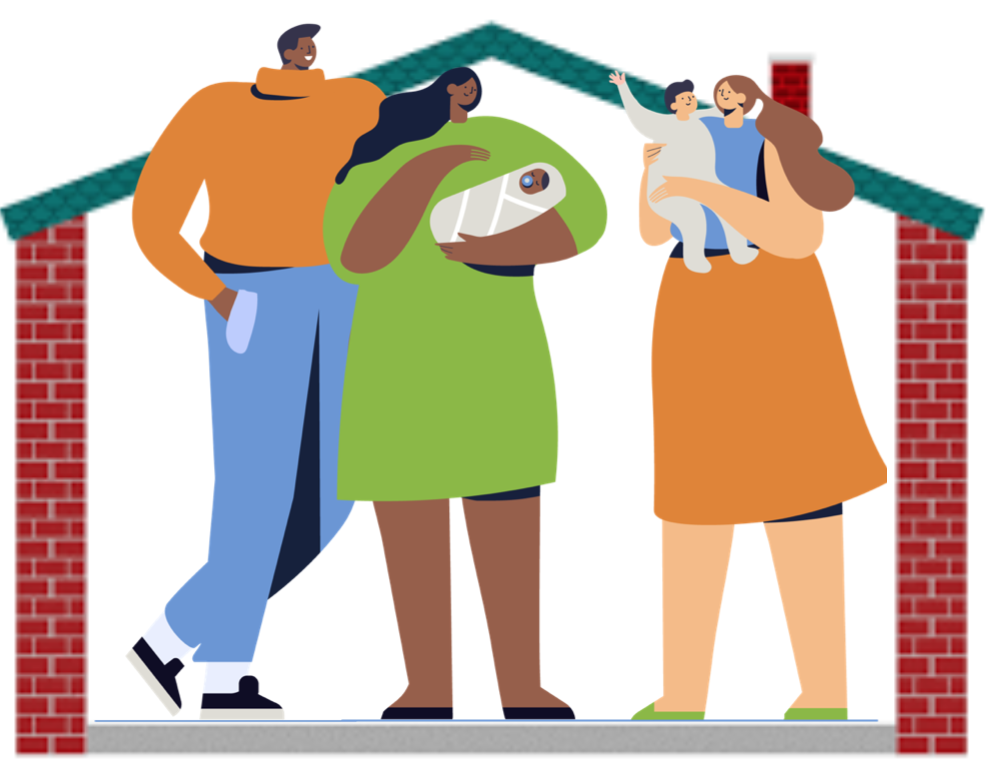
⬆️ ARTWORK at Anna Goodson Illustration Agency

SITE : BIRTH ORDER TRAITFLosCuLous (Personal story)

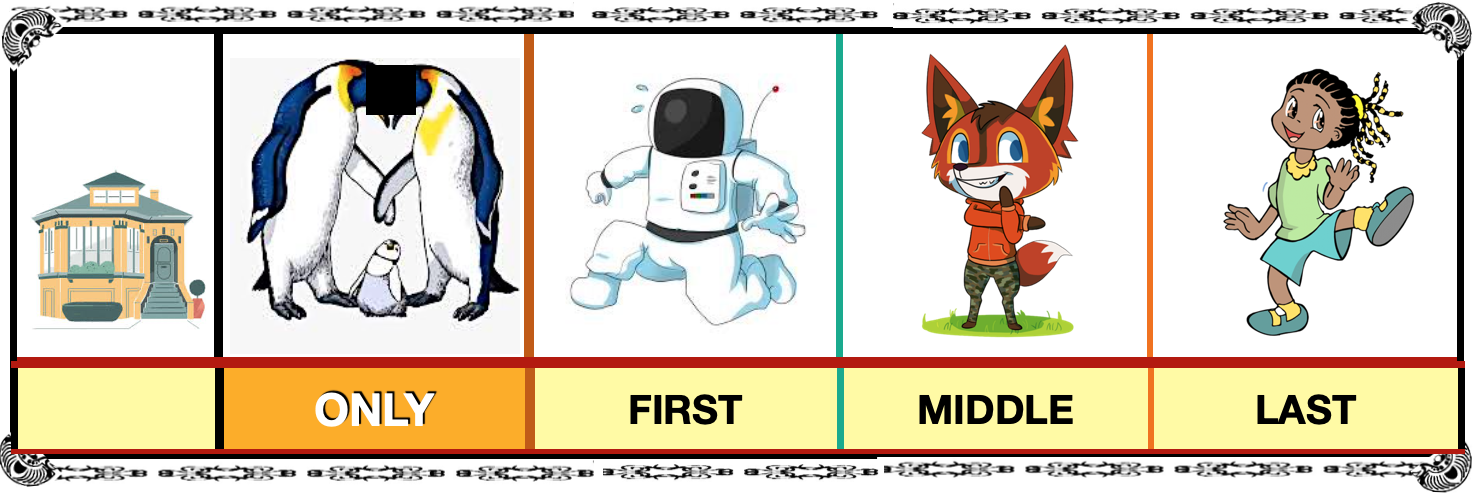
For “ONLY CHILD” – see Part 1

INFO: Several studies show that First-borns & Only children usually reach higher educational goals, gain greater prestige & acquire more net worth, while Middle children are likely to struggle a bit more.

EXP: “As a result of a stricter upbringing, First-borns tend to be more extroverted & confident, Second-borns more rebellious & open to new experiences, & the Youngest is usually the most creative, & more often manipulative to get their way.”

Obviously, predicting personality based on birth order is not straightforward. There are many other factors that will determine how much it can affect personality.
EXP: Adoption / 
Blended families / Gender / How many children in the family / Mental or Physical disability / Multiples (twins or triplets) / Spacing (1, 6, 9 year separation….)

The following are the broad basics, but do apply more than not. «

«
re. ELDEST ACoA : Usually cast as HERO / caretaker, they often have to take care of a drunk or NPD parent &/or younger sibs – cooking, cleaning, babysitting…. but also emotional needs of the adults. This is more likely if it’s a girl or a ‘sensitive’ boy, nor necessarily gay.
But if there are several children & there’s a boy as second or third, he may be designated family Hero-rescuer, but more likely outside the home, by accomplishing something they can point to (military, academic, sports, professional) – to prove the family’s not as dysfunctional as they really are.

NOTE: When there’s 6 years or more before the next child arrives, the First becomes a version of an Only, which effects their overall attitude to life. It also makes it potentially very hard for them to deal with being dethroned.
According to Adler, this makes them more neurotic & may even contribute to substance abuse.
Parental ‘compensation’ is to make the First be the baby’s parent-substitute – an unfair & heavy responsibility for a youngster of 7 or 8, especially when punished for lapses in attention or not ‘always knowing’ what to do.
«

«
re.  Middle ACoA : SCAPEGOAT – the second child who identifies with the drunk or crazy one, but is actually trying to take the focus off that parent(s) by being an even bigger troublemaker, sometimes with suicide attempts. But the ‘acting out’ (getting into trouble) is also a way for this child to express their own pain.

LOST CHILD ACoA – Especially if there are several kids, one of the Middlers is likely to be the invisible one, like the nerd hiding in their room or staying after school in the library. They’re silent, lost in their own inner world, although it can lead to some very creative ideas. (Middle Child Overview – 21 traits)
«

«
re. Youngest ACoA : Often the MASCOT, the entertainer who tries to lighten the heaviness of the family drama & depression. They may be used that way by the family, but then not taken seriously – for their own needs & pain. (See post on ROLES)


CHARACTER TRAITS
Generally, adults will have some characteristics from more than one column. Don’t assume you need to have all per your type.
However, as children, when one leaves home – usually the eldest &/or the Hero (for college, marriage, military), roles tend to get re-shuffled, & one will take over as Hero – to keep the family going – since the dysfunctional parents aren’t doing such a great
«

«
Research from Gronqvist & Ockert (2017, Sweden) focused on males, starting from the result of a standardized psych evaluation. They were interested in how birth order may influence skills developed in childhood, & professional decisions made later on.

EXP: LATER-borns are more likely to be self-employed.
FIRST-borns tend to be in occupations with the highest need for the “BIG 5” Personality Traits, such as CEOs, managers, legislators, & senior government officials. (Applies to both genders). (MORE…)

Studies of CEOs show that Firsts tend to run companies conservatively – improving things by streamlining product lines, simplifying distribution routes, making sure the trains run on time…..
LAST-borns are more likely to blow up the tracks & buy new trains – entirely reinventing a company, rather than just reforming or improving it.
«

«

NEXT : POWER

BIRTH ORDER Characteristics (Part 1)

PREVIOUS : Self-Parenting BOOKS

SITEs:Birth Order Theory : Insight into your personality’
vs.”Birth Order may Not Shape Personality after all

The Relationship between Birth Order, Personality & Career choices” ∼ Colleen Collins

POST: Toxic ROLES (#3) scroll to “As an only child”

⚙️ Viennese psychological Alfred Adler (early 1900s) believed social & community aspects of a person’s life were just as important as internal thoughts & emotions. His Birth Order Theory grew out of this perspective – how family environment shaped a child’s beliefs & behavior.

In “Why Firstborns Rule the World & Last Borns Want to Change It” Michael Grose says that “A child’s position in the family impacts their personality, behavior, learning & ultimately, their earning power.”
“Most people have an intuitive knowledge that birth order somehow has an impact on development, but underestimate how far-reaching & significant that impact is.”

There’s quite a divide among researchers about the validity of Birth Oder Impact. Some dismiss it entirely, while others are convinced it plays a crucial role. Researchers at the U of Leipzig & Johannes Gutenberg U (in Germany) studied more than 20,000 adults from the USA, UK & Germany. In this study, they compared siblings within families using the order of their birth.

INFO: The scientists found that older children generally show higher performance on intelligence tests. More than half of all Nobel Prize winners & U.S. presidents were Firsts. However, the study showed no birth-order effects on emotional stability & imagination.

ANOTHER German study reported that “the effect on intellect persisted after controlling for IQ scores, indicating that there is a genuine birth-order effect on ‘brains’ that goes beyond objectively measured intelligence, & can be observed in adults.”

Researchers suggest that the Youngests, like J.S.Bach & Mozart, were 50% more likely to have careers in classical music, possibly for their “sensitive & idealistic personality traits.”
And a study on Onlys concluded they’re more likely to become artists due to their “perfectionist & mature personality traits.”  Different genres & styles.

PARENTS unconsciously feel they better understand the child with the same birth order position as themself (a little narcissism??) – which the child can find annoying. They may also have a soft spot for the child whose birth order matches that of their own favorite sibling.

Adoptees – It will depend on the age of adoption. If adopted as babies, they’re assimilate into the birth order already set in family. EXP: In situations where the parents have tried a long time but haven’t conceived, or lost some, they adopt – so the baby is an Only. Then suddenly the mother does get pregnant & the adoptee becomes a First (Oldest).
If the adoptee is older (not an infant), then they’ll have the birth order of their foster home or previous family.

Culture. EXP: In some traditions, even if a boy is born after 4 girls, he may still be treated as the oldest.

Twins. Most twins get special attention from parents, so experts say birth-order rules don’t automatically apply – but may, especially if fraternal.

Birth order & HEALTH – Studies suggest if you’re the eldest, you’re more likely to have a lower birth weight than your siblings. Later-borns have an increased risk of hospitalization due to avoidable accidents, which could  be due to a lack of parental attention in a large family. Younger siblings may struggle with mental health during puberty & young adulthood, & are more likely to be admitted to hospital for problems related to alcohol abuse.
IN DYSFUNCTIONAL FAMILIES children are slotted into a ROLE, usually by birth-order, sometimes by gender. The main Toxic Roles are Hero, Scapegoat, Lost Child & Mascot.

re. ONLY children : If an ACoA was an ONLY who had to deal with adults who were drunk, raging, ranting for hours, uninvolved & distant or just plain missing – the child ended up filling all the Toxic family Roles.
This usually has a long-term effect, such as being the caretaker Hero throughout adulthood. But during a particularly stressful event – these CoAs may cycle thru all 4 Roles in rapid succession.
This can make the child (& later as adult) seem like they’re ‘crazy’, switching from one mode to another, (placating, raging, silent, humorous, withdrawn…. ). But NO – they’re just trying to cope with the impossible – & having to do so way beyond their capacity!

NEXT: Birth Order – Part 2

BOOKS: Self-Parenting


2022 HAPPY NEW YEAR! to all my readers.

THANK YOU!


LATEST Self-parenting work book (2021)

Text COPIED from Amazon.com

The Solution in the Adult Children of Alcoholics / Dysfunctional Families (ACA and ACoA) program is to become your own loving parent. The Loving Parent Guidebook explores, in practical terms, how to build this healing resource into your life.

The book provides guidance on creating the conditions to reclaim your inner child and reparent yourself with gentleness, humor, love, and respect. You can apply everything you learn in this guidebook to parenting, interacting with children, and interacting with adults. When you become a friend to yourself, you’re naturally a friend to others.

The book is structured to help you access the love inside you and grow the awareness and skills you need to become your own loving parent:

  • In Chapters 1-9, Laying a Foundation for Reparenting, you will awaken your loving parent and identify and connect with your inner family.
  • Chapters 10-16, Deepening Your Reparenting Skills, help you deepen your reparenting skills to protect, nurture, support, and guide your inner family.
  • In Chapters 17-21, Nurturing a Loving Inner Home, you’ll connect more deeply with your inner family to build a loving inner home.
  • Chapter 22, Reparenting as a Way of Life, concludes the book with an example of how to approach reparenting as a way of life.

This guide includes many fellowship shares about reparenting and inner child work. To help you integrate reparenting into your daily life, the guide also includes:

  • Sample loving parent messages.
  • Exercises, questions for reflection, and guided practices.
  • Images by The Loving Parent Guidebook artist team that you can color.
  • The book is a guide for meetings, study groups, and/or one-on-one with a fellow traveler/sponsor.

Bonus Resources Page: https://adultchildren.org/literature/loving-parent-guidebook/

Corrections announcement: The LPG Subcommittee discovered some errors after the guidebook went to print. For example, Appendix D lists “respected” as a feeling, but it should be deleted. Please visit the LPG Bonus Resources page for additional corrections.

Narcissists’ GROWTH Goals (#3)

PREVIOUS: Growth Goals, #2b

SITE: Narcissistic Personality Disorder Treatment & Management


NOTE: Most mental health conditions are treated with a combination of therapy & medication.
But personality disorders, including NPD, do not respond to medication. If drugs are prescribed, they’re used to treat symptoms of co-occurring disorders such as depression, anxiety, OCD, ADD…

IN-PATIENT THERAPY
While outpatient therapy can be effective as a long-term option, NPD sufferers new to recovery should start treatment in a residential mental health treatment facility. It offers enormous hope for improvement to anyone who’s finally had the courage to admit having problems they can’t solve on their own.

It’s often said that recovery rates for NPD are low. But inpatient treatment is effective because sufferers are in a calm, non-judgmental environment where they’re not distracted by outside stressors.
They also receive appropriate treatment for symptoms of any co-occurring emotional, behavioral &/or health conditions, such as substance use disorders – 40.6%, anxiety – 40%, other mood disorders 28.6%…..

✳️ ALL therapies for NPD work toward modifying unhealthy thoughts & actions – to replace them with saner, more effective ones. The main differences are in treatment styles.

OUT-PATIENT THERAPIES
🌱Cognitive Behavioral Therapy (CBT)
New skills are practiced with the therapist. The N will also have homework, to use the changes between sessions.
Techniques : cognitive restructuring, guided discovery & questioning, journaling, scheduling positive activities & situation exposure

🌱Dialectical Behavior Therapy (DBT)
This is a form of CBT with a focus on: distress tolerance, emotion regulation, relationship skills & mindfulness.
It includes individual &/or group sessions where the N can learn & practice new coping strategies. (Mainly for BPD, but also applied to NPD)

🌱Eye movement Desensitization & Reprocessing (EMDR therapy )
A step-by-step process divided into 8 distinct phases. Throughout, the therapist directs eye movements to divert attention from old beliefs & experiences, lessening the impact of traumatic memories & emotional triggers

🌱Family therapy
Narcissistic behavior severely impacts families, so involving loved ones in the Recovery process can help NPD sufferers understand the true ramifications of
their self-centered behavior

🌱 Gestalt therapy
Using Field-theory exercises helps clients see what’s really going on right now, rather than what they assume is happening based on past experience. Clients are encouraged to re-enact those, identifying blocks to true self-awareness which cause them distress

🌱Group Therapy
The goal is to help NPD sufferers lean to treat others in more appropriate ways. It provides an opportunity for them to see how others experience them, & how various behaviors impact others.

🌱Mentalization-based Therapy (MBT)
This focuses on improving clients’ ability to become internally self-reflective, as well as pay attention to the ideas & emotions of others. They learn about the intent behind other people’s behavior, & work on thinking things through before reacting. Then they may connect emotions to behavior patterns. (Mainly for BPD, but also applied to NPD)

🌱Meta-cognitive Inter-personal Therapy (MIT)
A step-by-step treatment designed to:
‣ dismantle N processes by looking at problems in the N’s own life
‣ see their maladaptive patterns in relationships
‣ diminish old behaviors, & build adaptive ones
The therapist will be looking for barriers to therapy effectiveness, & work to help improve them (Book)

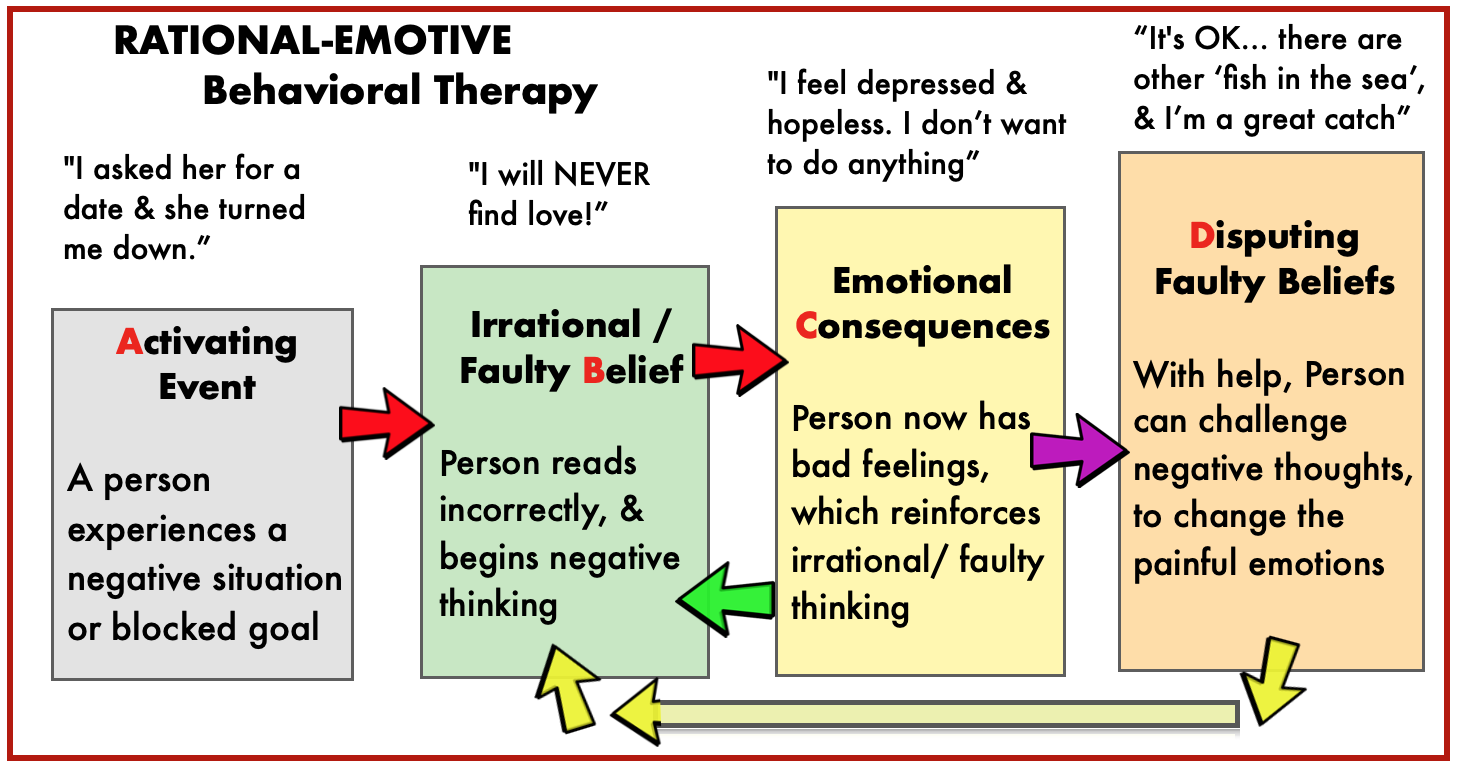
🌱Ration-Emotive Behavioral Therapy (REBT)
A practical, action-oriented approach for dealing with emotional, cognitive and behavioral problems, to improve personal growth & psychological wellbeing

🌱Psychoanalysis (Psychotherapy)
This is the original ‘talk therapy’. In one-on-one sessions, clients explore the reasons behind their emotions & actions. As they start to understand their past – current emotions & actions become clearer, so clients can manage them better, & then change the way they react

🌱Schema therapy
This is a newer approach shown to be beneficial in treating Ns, an integrative approach combining parts of Psychotherapy & CBT. The aim is to help clients identify & understand unhelpful coping mechanisms formed from early childhood experiences.
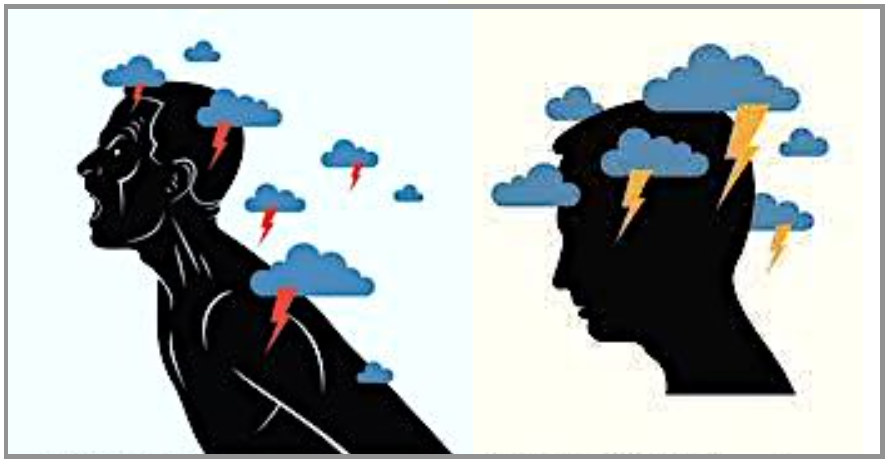
Once maladaptive schemas are uncovered, clients can learn to modify them

🌱Transference-focused psychotherapy (TFP)
In this work, clients redirect some desires for or intense emotions about
another person on to the therapist. This may make it easier to talk things through, as the therapist helps them gain insights.
Clients can identify self-destructive ideas & patterns of interaction – as they come up during a session, rather than only focusing on outside events.

NEXT:

Narcissists’ GROWTH Goals (#2b)

PREVIOUS: Narc – Growth GOALS (#2a)

SITE: SCHEMA Therapy  to treat narcissism


10 Stages of Therapy for NPD (cont)
4: Create New Coping Mechanisms
5: Form New Habits


6: Impact on Other People
Most of the time, N-clients can’t seriously consider how they affect other people until they’ve developed better coping strategies. Otherwise they’ll feel too much shame.
How well they understand themselves & form new action-habits will create more realistic (normal size) pride. This lessens the incentive to be grandiose, & increases ability to tolerate the idea that : their life may improve if they also considered other people’s needs. This is not yet emotional empathy, since they’re still looking at everything through the self-benefit lens.

7: Focus on Childhood Pain
Having gone thru previous stages (back & forth), clients are calmer & their life is generally less frantic. They’ve learned what life’s situations trigger over-reactions in them, & have developed more productive ways of coping.

As some of their defenses against shame are lessened, the focus is more on painful traumas from the past. If some healing occurs, they may form moments of emotional empathy for themselves as a child.
This can develop into the ability to form a stable, realistic image of themselves (Whole Object-Relations), which then help them deal with others more realistically, not splitting them into all-good or all-bad.

8: Update the Inner Voice
To develop emotional empathy for others, NPDs need to have (at least) some compassion for themselves. More would help.
Typically, people update their apps, cell phones, computers….  but most of us still run our life based on corrupted inner “software” that was programmed into us as a very young child.

Early on, the therapist can explains how children automatically internalize their version of :
– how their caregivers saw them
– their caregivers’ ideas about right & wrong, and
– their ideas about what deserves praise & blame.
Everyone can benefit from examining how their Inner Guiding Voice talks to them. ASK : ➡️

Now clients start noticing the tone & content of their inner voice, & realize that how they speak to themselves can be greatly improved. Then they can explore what those changes sound like. Sometimes all that’s needed is a firm “Stop that!” when the voice is mean & undermining

Clients can practice responding internally with a variety of positive statements they find acceptable. This process requires a willingness to challenge or inhibit the toxic voice. Naturally, this will take focused awareness, vigilance & many repetitions.

Note: We can tell how harsh someone is toward themselves by listening to how they talk to others. Outer harshness is in direct proportion to Inner harshness. Blaming & judging others redirects the nasty inner critic —> outward, temporarily buying the N some inner quiet, but at other people’s expense.

9: Empathy for Other People
Once the N accepts their pain & gets some control over the negative Introject’s voice, they can start noticing who other people really are. But it’s still mainly from their own point of view. Tentative, fledgling empathy will be based on the other person :
— being no emotional threat to the narcissist
— reminding them of themselves (symbiosis)
— being / having been traumatized in similar ways to the N’s experience

10: Authenticity
The therapist’s consistent, non-judgmental, compassionate interest in them allows the N’s defenses to become less rigid, improving client-therapist relationship.
Little by little they come to trust that they can be authentic in sessions – because the therapist has seen their ‘worst’ side & nothing terrible happened to either one.

As healing continues, the N can take baby steps forward by trying to be more ‘real’ with others as well. If this works, reliance on the old “false self” defenses lessens —> which leads to becoming more comfortable in their skin —-> to being more spontaneous —> to feeling better overall.

Because therapy with NPDs is complex, involving many stages, it takes a long time – there’s a lot of ground to cover. Sadly, most don’t want to do all of this work, or just can’t.
However, those who do keep plugging away at the growth-process eventually improve, at least somewhat. How much depends on sticking to it year after year, encouraged by tangible improvements in their life – internally & externally.
(Article based on a Quora post, 6/28/19).

NEXT: Narcissists’ GROWTH Goals (#3)