Psychological DISORDERS – PDs (Part 4b)

TRYING TO BE SOCIAL
is such hard work!

PREVIOUS: Disorders #4a

SITE: ‘Somatization’ & Psych terms used as swear words

HUMOR: 35 Undiagnosed Medical Conditions of Disney Characters 

1. NORMAL // 2. NEUROSES

3. PERSONALITY DISORDERS (PDs) (cont)
PDs describe types of ‘damage’ in adults who have long-standing problems in forming deep, meaningful, positive relationships with others. These people often show unusual, rigid or extreme patterns of thought, emotional reactions, &/or impulsive behavior, which consistently lead to problems for themself & others
● The brain uses Self-concept as a guide for interpreting the world. People with this diagnosis have a wounded core identity. How dysfunctional they are depends on how intensely they act in self-defeating ways.  
= At one extreme – some PD people assume they’re invulnerable & have a right to feel superior. They’re insulated in their carefully built shell of defenses, and flatly deny having a wounded core

= However, most feel empty, bad, ‘not right’ in their basic sense of Self.  Their sense of badness has a physical quality – as if it’s in their very bones or cells. They they truly believe it they’re not, & say there’s never been a time when they felt OK.
Transactional Analysis theory explains that this sense of wrongness comes from their WIC’s child parts (C1 or C0) – the most vulnerable aspect of personality. So this feeling is ego-syntonic – it ‘makes sense’ to them on a gut level, with no inner conflict, as there is with neurotics. So the damage started very early, likely at birth (Co).

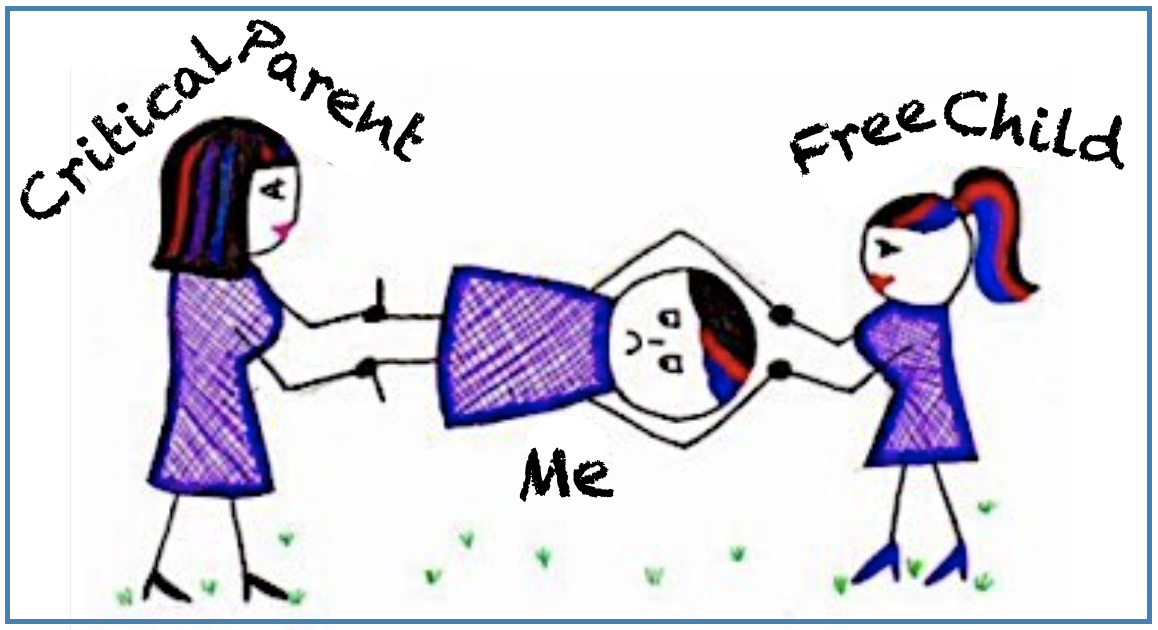
Using the Gestalt technique, if we visualize putting a person’s Adult & Parents voices in 2 opposite chairs, & imagine the Inner Child between them, we ask the person “How do you feel about your IC?” Most people will have a fairly positive reaction.
In contrast, many PDs will say they hate their child – that it’s ugly, dirty, disgusting, full of needs ….. expressing their ingrained sense of worthlessness (typical of many ACoAs!).

💚 SIDEBAR: There is now a “Grand Unified Theory” of psychology (GUT) the relationship between psychology & neuroscience …..which clearly defines how the field relates to other disciplines (biology & sociology….) . It’s made up of :
1) the Tree of Knowledge System // 2) the Justification Hypothesis
3) the Influence Matrix  // 4) Behavioral Investment Theory (MORE….)  

Relational INFLUENCE Matrix (IM)
It maps how people represent themself in relation to others. It grew out of the Behavioral Investment Theory of social motivational & emotional processes, based on Attachment Theory.  The Matrix makes 2 main points:
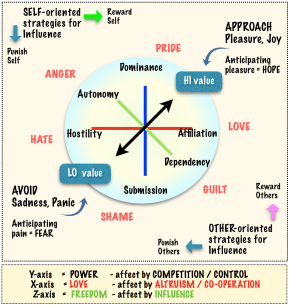
a. Humans are motivated by the need to be loved, admired & respected
b. They are equally driven by the need to avoid loss – being rejected, criticized or ostracized
(Freud’s Pleasure-Pain principal)

The green boxes at the BLACK axis points show that people have a mental/ emotional picture of how valuable different types of relationships are, & tend to approach or avoid them accordingly.
💗 EXP: Having ‘HI relational value’ can come from accomplishing 
something really hard that other people admire or love you for.

✥ Personality Disorder Star (these 2 CHARTS)
Karen Horney’s 3 main NEEDS – ways of relating to others – exactly parallel the IM dimensions (above) : Power is used to move against, Love for moving toward & Freedom for moving away – separate pathways to deciding relational value

HOWEVER – People with PDs consistently act in ways that reduce the relational value of themself & others – their self-defeating behavior causing everyone so much distress.
EXP: PDs are grouped by the direction of MOVEMENT  –
• Against = Narcissistic – hyper-competitive, constantly act superior to others (Steve Jobs)
• Away = Schizoid – deep detachment, without emotional connection & responsiveness
• Toward = Dependent – desperate fear of abandonment, they submit to the will of others to avoid rejection, & a need to caretake then

This star shows how certain PDs are the opposites of other negative personality characteristics.
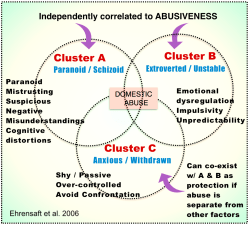
Cluster A people are extreme on the need for Freedom dimension
Cluster B people are mainly selfish, competitive, manipulative & controlling
Cluster C people (especially Avoidant & Dependent PDs) are deeply concerned with affiliation – come here or go away – at any cost

NOTE that only 6 out of the 10 PDs are represented. The others tend to be combinations.
EXP: Borderlines (BPD) fluctuate between strong displays of dependency/ neediness followed by extreme displays of reactive hostility – described in”I hate you, don’t leave me” by Kreitman & Straus. They are less rigid than most PDs, with a weak or fragmented identity, & strong need for all 3 (power, love & freedom), covering a basically insecure Self (LO relational value).
«

«
NEXT: Personality Disorders (Part 4c)

Psychological DISORDERS – PDs (Part 4a)

I CAN’T HELP IT if I’m afraid of everything!

PREVIOUS: Psych Disorders (#3c)

POSTs: EGO States – summary

SITE: Re. PSYCH terms used as swear words

HUMOR: Hollywood PDs, as “Cars in the parking lot”


1. NORMAL  // 2. NEUROSES

3. PERSONALITY DISORDERS (PDs)
They are a group of 10 PMES mental/emotional illnesses,
consisting of  internal maladaptive – thinking (Ts), experiencing (Es) & behavior (As) – that deviate from norms & expectations of the person’s culture. These PDs make it very hard for the sufferers to accurately understand or relate to other people & situations.

PDs are pervasive & inflexible (unlike neuroses), have an onset in adolescence or early adulthood, are stable over time (consistent, persistent), & lead to emotional distress & impaired ‘normal’ functioning. Skodol, 2005 :
— PDs are about 15% of the US population, 10% worldwide
— They are usually chronic, & difficult to treat
— A person can be diagnosed with more than one PD, usually from the same cluster.
— Identifying a person’s specific PD (Axis I of the DSM) can help clinicians evaluate the risk of suicide & other psychological problems (any on Axis II) often accompanying PDs

This category fits into the hierarchy of mental states – Highest to Lowest functioning:
1. Healthy —-> 2. Neurotics —-> 3. Personality Disordered (PD)—-> 4. Sociopaths/Psychopaths —-> 5. Psychotics (who are not at all in reality)

●  All human traits range from
healthy & adaptive <—> to unhealthy & maladaptive.
PDs fall into the orange & red sectors, because the dysfunction affects
every part of a person’s life, usually as a result of an ongoing traumatic childhood. PDs tends to severely limit success in school, relationships, social encounters, work.

OVERVIEW – Main Symptoms of PDs
a. Distorted thinking patterns (CDs)
b. Over / under – regulated impulse control
• Odd / eccentric behavior patterns
• In some cases, periods of losing contact with reality (dissociations)
c. Interpersonal difficulties
• Avoid other people, feel empty & emotionally disconnected
• Trouble sustaining stable/close relationships (partners, children, professional helpers)

d. Problematic emotional responses
•  Overwhelmed by distress, anxiety, anger & worthlessness
• Trouble managing uncomfortable/painful emotions, especially without self-harming – use self-cutting, promiscuity, belligerent, withholding, chemical abuse… in order to ‘cope’ – but rarely harm others physically. Exceptions : bullying people,  torturing animals

CLUSTERSCHART
Based on similarities, PDs are grouped into:
A3 “odd, eccentric” types: social awkwardness & withdrawal (MORE….) .  Dominated by distorted thinking, & extremes, they go:
— from eccentricity to fantasy
— from lonely to schizoid hiding
— from distorted thinking to delusion to paranoia
— from projective identification to projecting guilt on to others…..
Paranoid (2%) “The world is hostile, so don’t trust anyone, & deal with people by being angry & attacking.”
Schizoid – “The world is scary so I withdraw from it (people), & don’t show any emotion or other needs/feelings”
Schizotypal – “The world is too scary, so I withdraw from it (people), & being a bit crazy, I don’t think clearly”

B4 “dramatic, emotional, erratic” types
UNDER- controlled: People in this cluster share the pattern of little or no impulse control & have trouble emotionally regulating themself. This can include failure to plan ahead, or to consider the long-term consequences of their actions. At the extreme they can end up getting into trouble (like breaking the law), & hurting others.

Antisocial (3%) “You can’t trust anyone & life’s unfair, so I take advantage of people & do whatever I like”
Borderline (1-2%) “Relationships & life are very unreliable, so I frantically do anything to keep people around”
Histrionic (2-3%) “I must be the center of attention, so I will be dramatic, flirtatious & highly emotional”
Narcissistic (1%) “I’ve always been told that I’m very important & the best, so I agree & act that way”

C 3 “anxious, fearful” types  
OVER- controlled: This group shares a pattern of social inhibition, a deep sense of inadequacy, & hyper-sensitivity to other people’s negative opinions. They’re afraid to try new things lest they embarrass themself, & get ridiculed or outright rejected. They hold back around others, so can come across as uptight & snobbish. They lack spontaneity, since every action must be considered for its potential to cause themself emotional pain

Avoidant (1-10%) Life is scary & rejecting, so I feel worthless & withdraw ”
Dependent (0.5%) “I’m worthless & can’t cope with life, so I cling to others & do what they tell me”
Obsessive/compulsive (1-8%?) “Everything around me is chaotic, so I have to be in control of myself & everything in my life, by being orderly & perfectionistic (MORE….)

Other PDs not in DSM IV
Cyclothymic: Mood swings from Hi to Lo, with evenness in between – not as extreme as Manic-Depression
Masochistic (self-defeating): A need to fail, deliberately putting obstacles in ones own way to cause themself
frustration, grief, setbacks & suffering

Passive-aggressive: See POSTS
<— Sadistic: Derive pleasure from harming or humiliating others, using aggressive, cruel, demeaning & manipulative behavior

NEXT: Personality Disorders (Part 4b)

Psychological DISORDERS – Neuroses (3c)


MY CHARACTER DEFECTS
are just twisted versions of the True me!

PREVIOUS: Disorders #3b


1. HEALTHY


2. NEUROSES
 – Different  Perspective (cont) a. Enneagram  //  b. Trauma

c. Transactional Analysis  – The IMPASSE
Def : 
A road or passage having no exit, as a cul-de-sac
A situation so difficult that no progress can be made. Deadlock/stalemate

In psychological terms, impasses are formed at Type 1, 2 & 3 developmental stages in childhood ⬇️, when script-decisions are made. Scripts – our unconscious plan for life /internal ‘story’ – are usually based on unmet needs & abuse.
This causes inner conflicts between one’s Parent & Child ego states, & usually experienced by the child first as a personal failure – an internalized sense of inadequacy. Scripts are presented by, repeated & reinforced by parents, wider family & society —

— in some cases positive, but most often harmful. (Gouldings’ 12 script themes – similar to ACoA Toxic Rules)   ✥ This shows the power & active participation of children in their own development.

As adults, we all carry a representation (model) of the world & ourself – where we belong, how we fit in, our work & how we do it, & where we’re headed. If the source of this model comes from a dysfunctional family, it will always fall short of dynamic, ever-changing reality, limiting our S & I growth.  An impasse (being stuck in some area of life) indicates a need for change in order to move forward.
✺ The different intensities of psychological disorders represent various stages & intensities of impasse. (MORE...)

CHART : 3 developmental stages of conflicts between inner Parent (P) & Child (C)
✓ 3rd degree impasse (Po-Co: Birth to 6 months, pre-verbal, even pre-natal)

These earliest conflicts come from the type of connection between mother & child, depending on how they relate day after day. Conflicts will be around the issue of survival, between: abandonment & engulfment, destroying or being destroyed, worth & worthlessness….

EXPIf the mother has an unhealed WIC – stuck in her own impasse – her wounds get communicated to the baby, day after day. If she is insensitive, controlling or brutal – the effect on the baby is predictable.
However – much more difficult to identify later on –  is if h
er grown up Adult & Parent parts are used to activate, even improve her parenting style, but without Recovery her behavior won’t have any affect on her little C1 ego state. No matter how she tries to cover it up, her deepest damage will unconsciously keep re-traumatizing the baby. 

A depressed or angry mother can ‘responsibly’ feed & look after her baby son every day, but he knows / senses his mother is emotionally bereft. He intuits (or is told) that he needs to take care of her – all focus must be on her instead of his own feelings & needs – OR ELSE she may somehow leave (die). So he feels unworthy to be taken care of & worthless for not being able to help her, which causes intense anxiety. So he slowly develops defensive patterns like people-pleasing / isolation / addictions…., which form his False Self.

As an adult,
this earliest impasse continues as deep-seated conflicts in PMES forms such as muscle tension, psychosomatic complaints, immune disorders…. & expressed verbally in symbolic images, such as “I feel as if I’m in a fog, lost, cold & alone, there’s a wall up between me & everyone else” …. 

 ✓ 2 degree impasse (P1-C1:  6 mths – 6 yrs)
Made up of Injunctions (authoritative parental orders) carried by the child’s feelings /emotions. They become internalized, often through non-verbal comman
ds, at a time when the child has only a basic grasp of language. Script-decisions made are basic theme about the child’s identity, such as: “Who am I? // Am I important? // Don’t grow up // Don’t feel”…..
Later on, it’s much harder to remember how these issues developed, so the person usually doesn’t know they’re stuck back there

1 degree impasse (P2-C2 : 6+ yrs old, when they can understand language)
The struggle here is between what the child should & should not do, what behaviors are socially acceptable or not. Internalized verbal
instructions (counter-injunctions) will be things like: “Please others // Always try hard // Be a good boy or good girl // Never get angry”….. These are more accessible to awareness, so later on it’s easier to remember who gave them & in what form. (More….  in ‘Ego States’ posts).

BREAKING the Impasse – options
When the Bad Parent is so strong that it keeps the messages in place, the person gives in & continues to live by the original ‘rules’, keeping the Healthy Child bound.
HOWEVER –
a. When the person’s Wounded Child refuses to go along with its Bad Parent’s messages & is finally allowed to get angry, it liberates the Healthy / Free Child
b. The Bad Parent’s injunctions are agreed with, but the Healthy Child’s needs are ‘redefined’, often in humorous terms. Then both sides win.
EXP = Parent voice: “You’re crazy”  Child: “I may be crazy, but I’m never boring!”:)

NEXT: Disorders #4a

Psychological DISORDERS – Neuroses (Part 3b)

I’M ALWAYS ANXIOUS
when I  have to travel

PREVIOUS: Disorders #3a

BOOK:Neurosis & Treatment: A Holistic Theory. – A. Angyal


2. NEUROSES (cont.)

Neurotic Disorders
Agoraphobia w/ panic – believing some environment to be unsafe with no easy or possible escape, so needing to stay hidden indoors
 • Conversion (hysteria) – very distressing neurological symptoms (numbness, blindness, paralysis, fits) without a well-established organic cause, traced back to a psychological trigger
Depersonalization – feeling disconnected or estranged from one’s Self – as an outside observer of ones thoughts or actions

Dissociative (DDNOS) – chronic & recurrent identity disturbance due to prolonged & intense brainwashing (coercive persuasion) – which disrupts normal functioning of consciousness, memory or perception of the environment
Generalized anxiety (GAD) – the “worry cycle”, being concerned about getting through the day, but with no apparent or current problem

Hypochondriasis – excessive worry about having a serious illness, despite the absence of any actual medical diagnosis / proof
Neurasthenia (from stress &/or isolation) – a mechanical weakness of the nerves, with symptoms of anxiety, depressed mood, fatigue, headache, heart palpitations, high blood pressure & neuralgia

Neurotic Depression – same mental & physical problems as depression, with less severe but longer-lasting symptoms
Obsessive-compulsive – the need to repeatedly check things, perform certain routines (“rituals”), or having recurring unwanted thoughts, which control behavior
Phobic state – an irrational fear of a place or situation that makes one feel powerless & out of control (no choice)
Panic (without agoraphobia) – sudden periods of intense fear that may include palpitations, sweating, shaking, shortness of breath, numbness, or a feeling that something really bad is going to happen

• Post-Traumatic – caused by experiencing a single or prolonged traumatic events, & includes physical flashbacks, nightmares, & intrusive memories
Social anxiety – significant amount of fear in one or more social situations, causing considerable distress & impaired ability to function in at least some parts of daily life
Somatization – multiple clinically significant repeated physical complaints, representing emotional pain

A Different Perspective (non-traditional, non-medical)
a.  Students of the Enneagram start with each Type’s distortion or flaw, seen as a positive characteristic which has been bent away from True Center – because of wounding experiences. This is similar to the ancient Greek notion of sin or fault as hamartia = ‘missing the mark’. If you aim at a target with a bent gun barrel or crooked arrow, you’ll miss the target.

Starting in childhood, when we need the most nurturing & encouragement, our vulnerability can  turn our innate strengths into weaknesses, but ONLY —
— IF our values are attacked, discounted, made fun of or in any way violated, so we feel threatened & scared
— IF our strengths are challenged, distrusted, dismissed or questioned, so we can become anxious, guilty, ashamed & angry

Inner Child work is about uncovering & healing the wounds / vulnerabilities created when growing up. It’s discovering where our Healthy IC is, & where the WIC is hiding, how, where & from what, and what it really needs. By knowing our specific sensitivities, our EnneaType can be used as a guide to growth. (MORE….)
FLAW                                                    GIFT
#1 – Criticism /Resentment         == Serene / Good
#2 – Pride / Flattery                      == Humble / Loving
#3 – Deceit / Vanity                      == Authentic / Effective
#4 – Envy / Moody                        == Emotionally balanced,  Creative
#5 – Avarice / Stingy                     ==  Unattached / Wise
#6 – Fear / Cowardice                   == Courageous /Loyal
#7 – Gluttony / Avoidance           == Sober / Joyful
#8 – Lust  / Vengeance                 == Subtle / Protective
#9 – Sloth  / Withdrawal              == Engaged / Peaceful

(MORE ….  ➕ what each EnneaType really wants)
BOOK: “The Positive Enneagram“, Susan Rhodes

b. SIMILARLY – Andras Angyal (1965), a neo-psychoanalytic therapist, wrote:  “The real traumatizing factors are those which prevent the person from expressing these basic tendencies. In neurotic development there are always a number of unfortunate circumstances which instill a self-derogatory feeling in the child ……”  (MORE – excellent)
However –
✳️ “The person’s essentially healthy features exist not beside but within the neurosis. Each neurotic manifestation is a distorted expression of an individually shaped healthy trend. (p.228).
The distortion must be clearly seen & acknowledged, but the healthy core will be found within the distortion itself. So, when a person learns that the neurosis is an exaggerated version of health, they can feel less shame, & be more hopeful.”
• In other words – trace the neurosis back to it’s original strength & focus on expressing that instead.

NEXT: Disorders #3c

Psychological DISORDERS – Neuroses (Part 3a)

I’M NOT AS MESSED UP 
as some people I know!

PREVIOUS: Disorders #2b

SITEs: “Why being neurotic could actually be a good thing”

⬅”THERAPY SESSION” by DMT


1. HEALTHY

2. NEUROSES – now called “depressive or anxiety disorders”, are a group of mental dysfunctions which do not interfere with a person’s ability to think rationally or function day-to-day, but definitely cause distressing anxiety.
PSYCHOLOGICAL
Freud said they’re a result of an extremely painful experience earlier in life, which was never processed consciously (rape, witnessing a traumatic death, attacked by a person or animal….)
Jung added they’re caused by a conflict between conscious concerns (like obligations) & unconscious content (unacceptable thoughts, wishes, emotions….)

Trait Neuroticism (TN) one of the 5 personality components of O.C.E.A.N. All vertebrate animals – including humans – have a “negative affect system” to avoid dangerous or punishing situations. TN includes individual differences in sensitivity & activity of this system, ie. how painful someone’s emotions are & what kind of responses they have to upsets (affect=emotion)

People tend to be more sensitive, so are high in TN & more likely to develop depression & anxiety, especially when exposed to ongoing stressful living conditions without having the skills to process their distress in a safe, validating interpersonal environment. They can either avoid the disturbing person /situation, or shutdown from frustrated needs & losses. AND they can either turn their pain in on themselves, or turn it on other (S-H or attack).

Karen Horney in “Our Inner Conflicts” said neurotic needs move us:
Toward others: who look for affirmation & acceptance from others – needy, clingy, looking for approval & love
Away: those who are hostile & antisocial – aloof, cold & indifferent
Against: those who are hostile, with a need to control others – difficult, domineering & unkind

❎ MEDICAL / SOCIAL
• Scientific studies show a correlation between neuroticism and a specific human gene with its corresponding allele pair. These cell components help to control the amount of serotonin released into the body, which when delivered unevenly, will continue to stimulate surrounding nerve cells, causing neurotic symptoms (anxiety)

• Not surprisingly – a 1998 study of over 9,500 UK residents found a higher number of neurotic disorders among poorer people. It’s possible that genetic factors predispose an individual to anxiety & neurosis, with outside factors triggering the symptoms.(MORE….)

IMP: Neurotics have a consolidated identity (not fragmented – being mostly in touch with reality), are well aware that something’s wrong (unlike PDs & psychotics), & can use ‘normal’ defenses (like CDs).

• With neuroses (n.), only a part of the personality is effected.  A person confronted with their feared issue (big dogs, snakes, airplanes, clowns, public speaking, visiting family….) will inevitably have an intense desire to avoid it. But their way of dealing with it is self-defeating, because it prevents the person from meeting their long-term needs (feeling safe) & goals (achievements).

✰ The main symptom is excessive anxiety, along with one or more physical issues not based on illness (tight muscles, palpitation, headaches, sleeplessness…..), & may include anger & irritability, co-dependence, compulsive self-defeating behavior, low self-esteem, obsessive harmful thoughts & perfectionism.

Re. traumatic events – without psychological & spiritual help at the time of the originating stressor (rape, severe accident, death of parent, best friend, classmate….), the unconscious suppresses unbearable emotions, & sometimes even the memory of the event. Whether the person remember or not, their nervous system continue to experiences it as it did originally, becoming an ‘invisible injury. This makes dealing with their specific fear very difficult, while others parts of their life function relatively well. (MORE…..)

Neurotic reactions can show up in one or more areas :
♟ Beliefs: (‘verbal cognitions’), intensely protected rigid beliefs about ourself in the world, developed to justify actions & reactions
♟ Defenses: trying to manage the tension between conflicting internal goals, & filter unacceptable ‘stuff ‘ out of full consciousness, but doing so at significant cost
♟ Emotions: generally either over-regulated (suppressed & not expressed) or under-regulated (hyper-sensitive & over-expressed)
♟ Habits: automatic or ritualized patterns of visible actions used to calm anxiety & provide a (false) sense of security
♟ Relationships: developed rigid styles of dealing with others, & can have extreme reactions when not getting the connection they want/need

NEXT: Psych Disorders #3b

Psychological DISORDERS – ACoAs (Part 2b)

I ENVY OTHERS WHO
easily know how to function

PREVIOUS: Disorders #2a

SITEs : • Help with Organizing your mind

Psychological Disorders:  PowerPoints with Video Links & Lecture Notes
(To purchase. For teachers)

⬅️ IMAGE  : Truman College Wellness Center
UNHEALTHY
Psychiatrist Otto Kernberg (Object Relations Theory) wrote that someone is mentally healthy if they have a well-organized personality, which functions reasonably well because their reality testing is mostly intact. Such people have an integrated sense of Self, with an accurate Self-to-Other concept. This helps to hold opposite feelings about someone – at the same time – without changing one’s realistic opinion of them. (not B or W) . Everyone is experienced as a ‘whole’ entity, with both positive & negative qualities.
NOTE: This does not mean we like everyone!

Using the criterion of personality organization, Dr. Kernberg marked 3 degrees of dysfunctional severity: Neurotic, Borderline & Psychotic states. The more mentally & emotionally disorganized, the worse the person’s functioning. To evaluate, ASK :
1) Is my reality-testing intact? (Explanations)
2) Do I have an integrated sense of self & others?
3) What is the maturity level of my defenses?

ACoAs fall into any one of the Mental Health Levels, depending on the individual’s native personality, the amount of trauma suffered, social environment & spiritual beliefs.  However, all are wounded in some form. Unrecovered, most of us think that our usual way of being is our actual personality (who we were born as) because it’s how we’ve been since childhood.
But anyone growing up in a very damaging family forms a False Self as protection, which combines PP & WIC, & houses the different disorders. Because of living thru’ years of trauma, many ACoAs have a fragmented sense of Self  (not about multiple personality or schizophrenic dissociation).

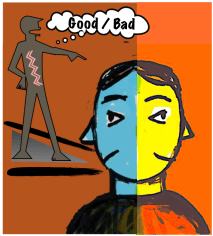
Our wounded mind stores separate split-off images of ourself & others as being either all bad or all good at any given moment, based on a current event. So, when someone we think we know well and rely on to feel safe is sometimes nice to us & then turns on us at other times (parents, a mate, best friend….), we’re shocked & confused.
When that happens, the WIC actually thinks they’ve now become a totally different person – rather than realizing we’re dealing with one being who’s showing different aspects of their (perhaps unhealthy) personality.

▪️Most of the time it’s actually our internal experience of someone that has changed – in response to their current behavior or mood. This is a reflection of our own B & W thinking, usually believing ourself to be ‘all bad’ & others as ‘all good’. So when they become the ‘bad one’, we get scared. The WIC doesn’t realize that it’s normal to have inconsistencies & accept that the person is still the same, but complex. This distortion prevents us from holding a consistent sense of Self & others across time & in a variety of situations.

EXP: If you smile & are friendly to me, you are a totally good person – in that moment – who I like & feel safe with. If at some other time you hurt my feelings or ignore me, you are then a totally bad person – in that moment – so I absolutely don’t feel safe with you, and blame myself for what happened.

😟 As a way of coping, the brain compartmentalizes traumatic experiences to keep us from feeling too much pain (physical &/or emotional) – creating a dissociation, spacing out. A part of our attention is missing, so we don’t recognize what we’re feeling, not noticing or hearing things around us, or that’s right in front of us all the time.
What’s missing is a connection to some or all of our emotions.

NOTE:  ACoAs can develop mental health by getting the right help & consistency using all the tools available throughout life. With FoO work, most can improve if not totally heal, but not all wounded people are willing to go thru the process needed to Recover.

(CHAT BOT – talk to computer re. moods (Woebot on Facebook Messenger)
«

«
NEXT: Disorders #3a

Psychological DISORDER – Normal (Part 2a)

GETTING TO BE A HAPPY SENIOR
took a lot of effort & help!

PREVIOUS: Disorders #1

HUMORPsych Disorders of Winnie the Pooh Characters

1. HEALTHY (NORMAL) cont.
Theresa Lowry-Lehnen, Health Psychology lecturer, said:
“Emotional stability refers to the level of control a person has over their own emotions. A healthy personality does not have unreasonable & unwanted negative thoughts & feelings towards others, nor indulges in self-loathing. They can be spontaneous but not impulsive, can make rational, well-judged decisions, & are able to protect their health, self-esteem & well-being – despite any problems in their life.”

TOOLs that improve Mental Health
• Value yourself     – • Take care of your body (food, rest, exercise, sleep…)
• Learn how to deal with stress     – • Quiet your mind  – • Practice gratitude
• Surround yourself with good (healthy) people
• Set realistic goals   – • Look for ways to change routines (travel, learn….)
• Express kindness to some else (but NOT at your one expense!)
• Practice saying NO!   – • Get help when you need it!    (MORE ideas….)

DEFENSES
Our coping mechanisms develop organically in response to frustrating, difficult & painful situations / experiences. They function like a human firewall, a psychological immune system needed to defend against hurtful & abusive relationships, while hopefully allowing healthy / nurturing relationships to pass thru’ the protective walls. (Posts: Boundaries .… weak, rigid, healthy)

At their best:
Defenses are important to know about because they strongly influence how easily people can form & maintain healthy relationships, while being able to reject unhealthy relationships. Knowing when to be defensive & when not to be – is key for health.
We need them to keep us safe from people who mess with us, but also need to be able to relax & let the wall open up, to keep the capacity for innocence, availability & healthy connections. (Posts: Trust …. over. under, healthy)

At worst: Defenses are harmful & debilitating when they turn into psychological armor solidified into stone or iron, not allowing trust & spontaneous interactions with positive PPT (people, places, things) in our life.

 MATURE Defenses (Healthy)
Altruism = You feel true pleasure from helping other people, & if you couldn’t, you’d sense something’s missing in your life & feel sad or get depressed
Anticipation = When you know you’ll be faced with a challenging situation, you try to plan ahead so you won’t be overwhelmed
Distraction = When something upsetting happens or has already happened, consciously decide to put off negative thoughts (which add anxiety) by temporarily focusing your attention on something less threatening
Humor (not humiliating, mean, sarcastic….) = You look for the funny side of situations, even when they’re stressful or potentially upsetting (watch a comedy show on TV)
Identification (healthy version) = When in new or scary situation, you temporarily use a characteristic – that you don’t automatically / naturally have – of an admired & respected person  (“What would ____ do or say right now?”)
EXP from the Enneagram :  Picking up positive qualities of the Number at the end of your type’s “Security Point” arrow (direction of growth)

Introjection (healthy version) = You admit not having a skill or trait that you value – so you copy examples from the environment & with practice – make them part of yourself
Sublimation = when you’re feeling anxious, you do something constructive that soothe you ,such as cooking, reading, woodworking….
Suppression – When bothered by something or someone, you keep the lid on your thoughts & emotions, if letting them show would interfere with your goals or well-being

HERITABILITY = is a statistic which assesses the amount of variation in the population one can attribute to the likelihood of inheriting a trait by genetic variation. While it’s a population-wide statistic, it can be informative on an individual level.
— If heritability is 1.0, all is genetic – offspring are a direct combination of their parents
— If heritability is ~0.0, then there’s no correlation between parents & offspring.

EXP: the heritability of height is ~0.90 in the Western world. (More….)
See Survey CHART  re.Genetic influence on human psychological Traits – which can give a rough sense of the “pull” that biological inheritance will have on an individual. Biology may not be destiny, but it is definitely probability.

Some Behavioral Traits w/ HIGH Heritability
• Aggressiveness,  Strong avoidance, Impulsivity, Reward-dependent
• Altruism, Empathy, Nurturance, Well-being, Persistence (or stubbornness)
• Assertiveness, Leadership, Constraint (non-impulsive)
• Sociability, Social closeness, Traditionalism, Physicality  (More….)

Article: “All Human Behavioral Traits are Heritable” from studies in BioDiversity

NEXT: Psych Disorders – ACoAs  (#2b)

Psychological DISORDERS – Intro (Part 1)

I’M NOT CRAZY – just a little ‘off’!

PREVIOUS: Communication (#6)

POSTs: Principles of Character 1 & 2

SITEs: STARLINGonline educational videos, community support, & tools  -to improve mental health
🌱  7  vitamin supplements that improve mental health


LEVELS of Mental Health, from highest to lowest functioning :  1.Healthy ——> 2.Neurotic ——> 3.Personality Disordered ——> 4.Sociopathic/Psychopathic ——> 5.Psychotic (deranged)


DEFINITIONS

✦ PERSONALITY
:
A pattern of relatively permanent traits & unique characteristics that give both consistency & individuality to a person’s behavior.
✦ TRAITS contribute to individual differences in behavior, consistently over time, & across a variety of situations.
✦ CHARACTERISTICS are unique qualities of a person that include temperament, physique & intelligence.

BEFORE looking at the various degrees of psychological disorders, we need a look at what mental health is – to use as a comparison. One way to identify it is :
O.C.E.A.N. traits: Openness to experience, Conscientiousness, Extroversion, Agreeableness, & Neuroticism
⬆️ It’s also called the BIG FIVE, (CHART) dimensions of character which represent the main qualities shaping our social interactions. Extensive research shows they have biological origins & are remarkably universal.
One study that looked at people from more than 50 countries found that these 5 traits accurately described personality from Germany to China. (Descriptions). Traits are rated on a scale from strongest  to weakest. (People at the extremes)

Thomas Fuchs (U. of Heidelbergs) : Narrative Identity** is a person’s combined personal past, present & future. Understanding that makes it possible to observe contradictory aspects & tendencies found in oneself & others —> & mentally integrate them into a consistent, inclusive picture about Self or ‘Other”.
**Narrative Identity = forming a sense of oneself from a combination of all life’s experiences into an internalized, evolving story of the Self that provides them with a feeling of unity & purpose

INTERESTING : people with long-term, stable mental health seem to be in the minority.  Several long-term studies – in the US, Switzerland & New Zealand – (covering a 27 yrs, with people ages 11 to 38) found that up to 83% of participants developed mental disorders sometime during those ages.

Re. the continually health people: while having loving, drama-free childhoods helped, these people were (born) naturally up-beat (emotionally not moody), had lots of friends & had superior self-control.
As adults, they reported more education, better jobs, higher-quality relationships & more satisfaction with their lives. Also, in New Zealand, the healthiest Kiwis had fewer first- & second-degree relatives with mental disorders. (More….)

1. HEALTHY  (NORMAL)
Basically – mental health is about knowing who you are – the very essence of you (not just your damage expressed as self-hate) but rather the person you were born as, called the True Self, found in the Natural Child.
IT IS:
• being comfortable in your own skin, even when things aren’t going well or you’re experiencing great difficulties (More….)
• being curious about yourself, other people & the world, always looking for new ways to grow & stay interested in life
• having access to all emotions (not all at once ):), knowing how to comfort yourself when in any kind of pain, AND being able to enjoy all the good things about yourself & your life

• knowing what your talents are & using them  to your best ability, learning what you don’t know & using all your imagination to express your ideas
• having strong, clear boundaries (not walls) so you can have safe relationships which can be loving, interesting &/or fun

• knowing what your limitations are, based on your natural personality, you experiences & your age. Accepting that you are imperfect & not all-powerful, both as a human being & as your unique self. It’s ACCEPTING this & being OK with it

💕 Healthier people can tolerate a wider, deeper range of emotion, so don’t have a compulsive need for distractions (alcohol, sugar, internet surfing, sex, doing / doing….). Being more honestly self-aware allows them to feel:
😟 the pain of their own human failings, limitations & eventual mortality, and
😍 the beauty of everyday living – precious moments with loved ones, appreciating delicate flowers, a kind word from someone, time spent with a pet or listening to favorite music….
‼as well as the high points, like weddings, births, promotions, personal milestones, artistic accomplishments….(SITE: Children’s Mental Health 2–8)

NEXT: Personality Disorders (Part 2a)

COMMUNICATION Categories – Ways (Part 6)

NOBODY SEEMS
to be listening to me!

PREVIOUS: Comm categories #5


CATEGORIZING Communication (Comm) cont.
7a. Re. Mechanical Networks  /// 7b. Re. Human Networks  

8. Re. WAYS to ENGAGE in communication
Level 1: Messages into the Ether
Snail mail, email & texting have some things in common. They’re sent out, & a response can sometimes take days or weeks. Since they’re not conversational (back & forth) there can be a high level of misunderstanding, possibly leading to hurt feelings, even fights.

Level 2: Back & forth Messaging
It’s conversational, but still done remotely (IM, text….). Such exchanges are more casual & direct, so confusion is less likely, since one or both can catch distortions or misses with each reply.
However, its bite-size style means it’s not well-suited to discussing complex issues.

Level 3: A Verbal Dialogue
Here participants get to express their opinions directly, plus adding a whole layer of implied info via Para-language. These can hint at excitement, pleasure, peacefulness OR annoyance, frustration, stress…. that are harder to detect in writing. A drawback is that they often require scheduling, but sometimes things need to be cleared up quickly via phone.

Level 4: In-Person Spontaneous Discussion
When something important comes up unexpectedly, we might decide to get together with the others person. Spontaneous discussions can be effective for problem-solving, getting an immediate need met or making a plan. Benefits come from adding a new level of mutual understanding & co-operation. But it doesn’t always work – discomfort with spontaneity, lack of privacy, the other person being too busy or not in the mood…. can get in the way.

Level 5: In-Person Scheduled Discussion
What makes this level special is the mutual agreement to set time aside.
Planning doedn’t have to make the meeting Formal, but gives both parties time to think about the topic. Successful & dynamic interactions (Zoom, Skype, FaceTime… OR office conference, private dinner….) come from combining self-awareness, non-verbal intelligence & privacy, to ensure comfort & trust. (From )

VALUE: Observing admired leaders, we can see that good comm. judgment is very important to their success.
EXP:  knowing what
can be done at Level 2, versus what must be done at Level 5 – & doing it – is a sign of sound leadership instinct, as well as knowing what to expect in personal relationships.

9. Re. PMES Categories
✒︎SOCIAL
: Talking about anything of mutual interest – world news, sports, weather…. It’s superficial but truly useful, allowing us to function among acquaintances & strangers without burdening them with TMI about our life.  It also helps determine whether someone is neutral, a potential friend or enemy

✒︎MENTAL: Talking about facts, helpful tips, ideas, non-controversial beliefs, plans & strategies, as in professional conversations. Unfortunately, some people go out of their way to be the ‘best’ at it, so that no one is smarter, wittier or more knowledgeable, & they never have to be wrong.

The distance between the first two levels is relatively short. Polite conversation can turn into a mentally stimulating one very quickly & then collapse back into small talk or none at all – without discomfort. Except for conversations with a controlling know-it-all, these two levels are safe.

✒︎EMOTIONAL: Here talk is about aspirations, fears, wants, needs & joys. Sometimes eyes well up, lips quiver, & the voice chokes. Other times those same eyes light up, heart pounds & words flow with joy, or fail from awe.

• The distance between #1 & 2 AND #3 is rather wide, because #3 requires intimacy, transparency, trust & vulnerability. Most of us are afraid of being wrong or looking foolish, & absolutely terrified of rejection.
Participating at this level opens us to possible rejection, hurt & being scarred. Over-all, this level is easier for women to navigate, partly because expressing emotions is more socially acceptable, & because a portion of women’s Corpus Callosum is thicker than men’s, perhaps allowing more access across the hemispheres emotions to be verbalized  (MORE….)

✒︎SPIRITUAL. This is the hardest to identify & describe, not only because our culture is so secular, but because few people are willing to drop down into the level of faith – for themselves – much less to speak of it to others.
It melts away push-pull, give-take win-lose, me-you. There are no distortions from emotional mental or social games, allowing for the highest level of resonance, creating an energetic embrace that sustains & heals.

‼️ Understanding all these forms of comm allows us to identify & then choose which is most appropriate for any given situation.
It can be too easy to go down the path of least resistance, but that can get us into trouble, so it’s important to be more thoughtful about how & when we communicate.
It’s better to do it the right way – focusing on our goals & using whichever level will help us get there.

NEXT: Psych Disorders #1

COMMUNICATION Categories – Informal (Part 5)


IT HELPS TO KNOW
what the rules are

PREVIOUS: Comm. #4

SITE: “….How Relationships influence Behavior”

⬅️”BUSINESS MEETING
designed & created by DMT


CATEGORIES of Communication
(Comm) cont…
5. Who / 6. Structure / 7a. Mechanical Networks

7b. Re. HUMAN Networks  (biz, academia, military, even family)
The form of an organization’s comm. networks dictates the method & speed that ideas flow between managers & employees (parents & children). Flow efficiency can be checked by looking at : Nature of task, Leader emergence, Group satisfaction, & Speed of work

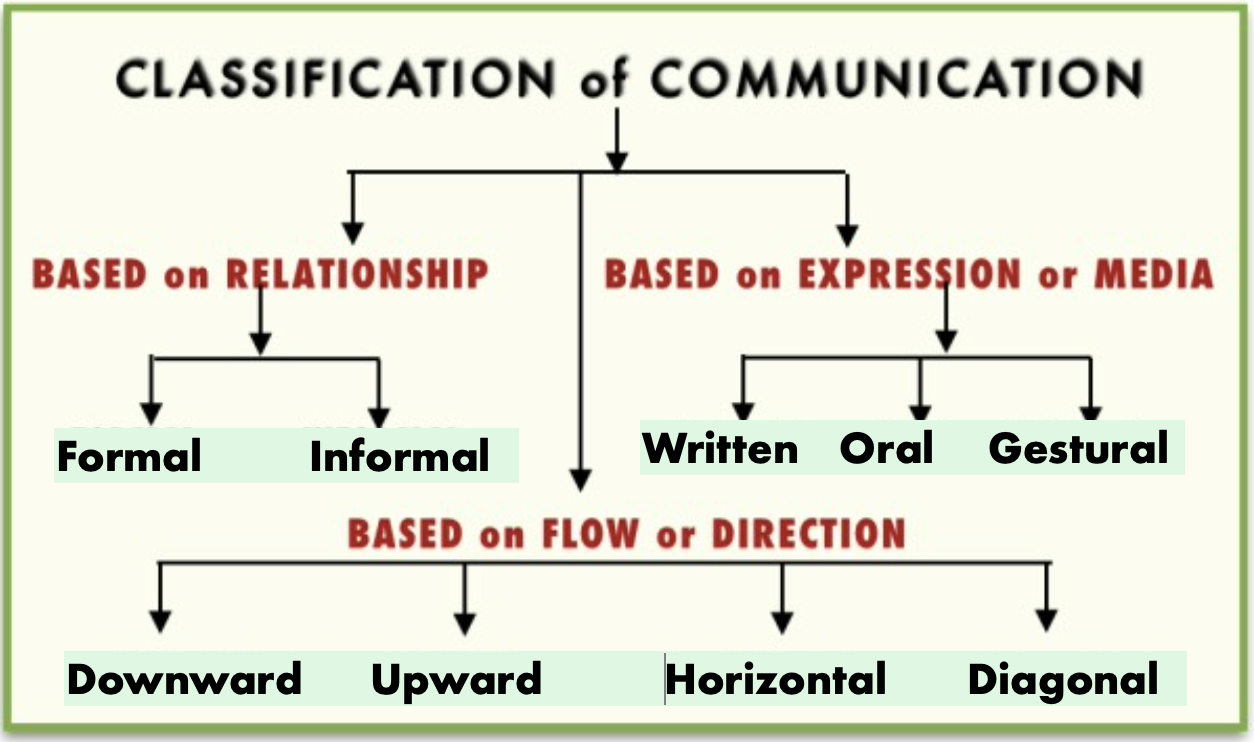
a. MEDIA – Written, oral & gestural. see Part 2

b. DIRECTION
• Vertical comm. – Info is passed between different levels of organizational hierarchy. Orders move down from the top through a formal chain of command, to the person or group who will carry them out. Responses (obedience) & collected info (research….) flow up to the top for review & decision-making

• Horizontal (lateral) Comm. is between any two parts of the organization at the same level – between 2 people, divisions or departments – allowing a greater degree of informality. The purpose is to co-ordinate the activities of the various ‘units’

• Diagonal – Sharing info among different structural levels. This term was introduced to capture the new comm. challenges associated with new organizational forms, such as matrix & project-based businesses.
EXP: It’s when higher level management works with a lower level to tell them about a change in work/ goal objectives (we’re going to grandma’s instead of the mall)

c. RELATIONSHIP (channel)
i. FORMAL Networks
➤ CENTRALIZED
This is when one group member has access to more comm. channels than any other, & so tends to use more info than others in that group, sent out to others based on status & hierarchy.  (Older sibling to younger)
EXP: The boss needs to deal with any negative grapevine comm., or employees will believe the rumors to be fact

• Wheel  – most centralized form, where all info flows from the leader, & other members have little or no comm. link with each other. Here, the boss deliberately controls comm., making sure their wishes reach everyone

• Chain (scalar): People comm. in a set sequence, via the line of command….. proceeding from A to B, B to C ….. or in reverse. This type is slow but carries the most authentic communication

➤ DECENTRALIZED
Here all group members have access to the same number of channels. Info is comm. by any person on the hierarchy scale & can be accessed by other employees. Research shows that decentralized networks or organizations perform better, & have more satisfied members (regular family group ‘conferences’)

• Circle – Here the info is shared equally among all members. Each person gives & receives info from two or more others in the network

• Star – Comm. revolve around a central point. Each person in the outer branches of the star passes on a message to a central authority, who then distributes it to the other participants. A must for groups to promote teamwork, but can limit or inhibit ease of comm. between members

• Inverted “V” – Here subordinates are allowed to comm. with their immediate superior, as well as with that boss’s boss – but it’s effectiveness is limited

• Common (Free-flow / All-channel)the most decentralized, where everyone is connected to each other, so info can flow freely from anywhere in the organization (a commune?)

ii. INFORMAL
Usually deals with interpersonal, horizontal comm. Traditionally it was considered a potential hindrance to effective performance, but that’s no longer true. However, leaders of modern organizations see it as an important way to ensure effective conduct in employees

Informal comm. is via the grapevine, represented by sociograms. These are important since they’re a large part of daily comm. Friendship, usage & efficiency are 3 important parts :

• Single strand
Info flows from one person to the next, until it reaches everyone ….. but generally a less reliable or accurate way to pass on the message. However, it can effectively for urgent / emergency news

• Gossip Chain
There’s usually a central person who looks for, finds & then passes on info to all other members directly (water cooler, lunchtime…..), often used when the topic is not job-related

• Probability Chain
Info passes randomly from persons to persons – when it’s interesting but not important

• Cluster Chain
The most common type – where a person who is the source of a message passes info to a pre-selected group, out of which a few individuals repeat it to other selected groups – until the whole network is covered, like a telephone tree.

NEXT: Comm #6