GREIF – & CHILDREN

PREVIOUS : GRIEF – Gender differences

SITE : Grief & Bereavement — scroll TO “How children and teenagers view death”


BOOK :Grief Journal for Kids – guided prompts….


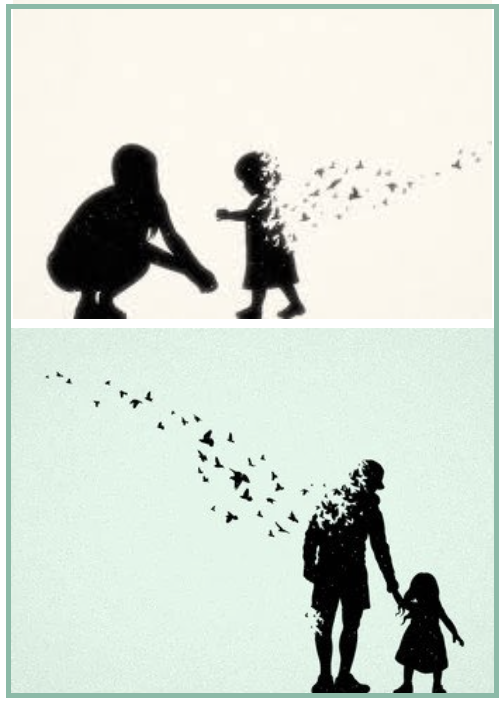
Grief is universal. If a child can react to separation with fear & tears – temporary or permanent –  then they have the capacity to grieve. While there are some similarities to adult grief, there are also some distinctions, such as the child’s age & development, which will affect how they understand & respond to death.

Pre-schoolers/young children : Between ages 2-4, children usually think that death is temporary & reversible. They may ask, “When will mom come back?” even after you’ve told the child that “mom’s gone for ever “.  It is also very common for grieving children this age to seriously regress to an earlier developmental stage (toilet-training, language, &/or clinging behavior).

School-age: Between ages 5-8 children are tend more toward guilt & magical thinking. They may say : “It’s my fault this happened.” Or think of death as a person (the boogeyman), so their dreams & fears will reflect this.
Between 9-12 they start to understand that death is permanent, the way adults do, but may want more details about what happened.  They may ask : “What happened to Grandpa? And then what?” At this age children are more likely express grief physically, such as complain of headaches & stomachaches. They may also revert to more clinging behavior, &/or have outbursts of anger.
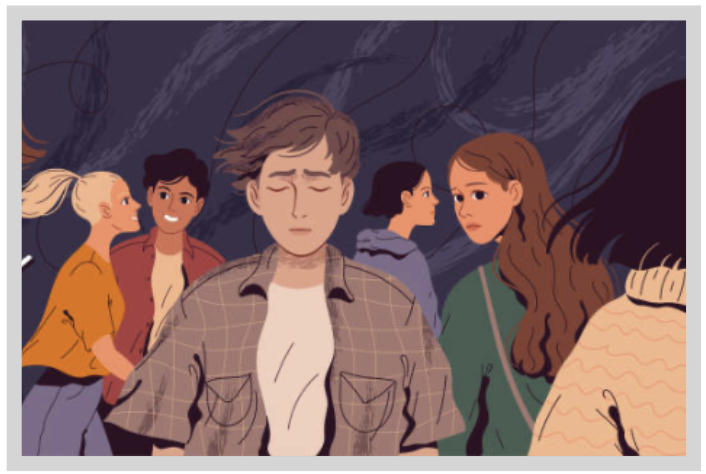
Adolescents: Teens between 13-18 tend to realize that death is  permanent & universal, so it can happen to anyone – like you & me.  After a death, teens may feel a need to connect with family, as well as to keep their independence, which can be confusing & may lead to friction in the family.
As part of these experiences they’ll start forming opinions about morality, the world, & their role in life, which may be the same or different from the family & the person who died.

Parents & Caregivers : Get help if the child….
⚙︎ …. never talks about the person who died, or they leave the room when the deceased’s name is mentioned
⚙︎ ….. ‘s aggression becomes destructive, especially if this is new or unusual behavior
⚙︎ …… develops persisting anxiety, any talk of suicide, &/or starts abusing substances.

One of the strongest predictors of how well a child will cope with a severe loss is how well their parent(s) is functioning after a death of their loved one.  ADULT : Ask & get support for yourself. Asking becomes a model for the children to copy, to show that it’s okay to reach out for help, one of the most important coping tools. See hospice resources. 
TIPS to help your child
☆ Accept their way of expressing their emotions, as well as setting appropriate boundaries for behavior
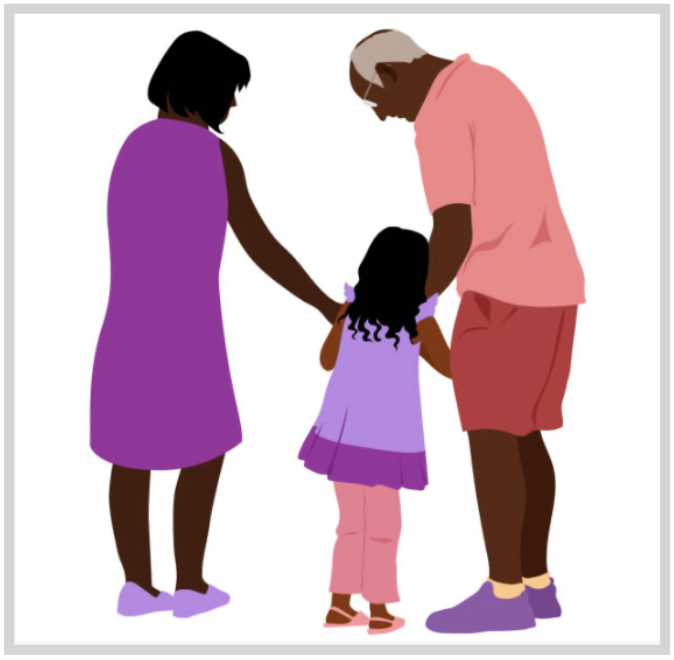
☆ Allow & encourage them to keep their rightful place in the family – still being a child
☆ Allow them to honor & remember the person who died. Memories are important & powerful. Don’t avoid them.

☆ Become a listener. ☆ Remind the child that it’s courageous to let themself grieve

☆ Children need outlets to release energy. Pay attention to how they behave when playing – understand that it’s one way to share their grief with the adults

☆ Communicate with the adults in the child’s life (teachers, coaches….) so they can be part of the support system

☆ Keep routines & structure in the child’s life as normal as possible. The rules for conduct should stay the same – but realistic

☆ Know you won’t have all the answers. Saying “I don’t know” OR “What do you think?” are honest & powerful responses.
Listening to their answer will help you know what information they need to feel comforted & safer

☆ Let the child choose whether they want to participate in the funeral & burial functions. If yes, prepare them by explaining what to expect & will see at the funeral. EXP : photos, the coffin, crying adults, reminiscing about the deceased….

☆ Understand that grief expressions can vary, even within a family.  One child may show a lot of emotion. Another may want to do something in memory of the person who died….

☆Give clear explanations, without euphemisms such as “lost, passed away, sleeping”….. Being direct means using the words:  dead, died, death & dying. It’s more honest.

NEXT : GRIEF – Helping to heal

GRIEF – GENDER DIFFRENCES

PREVIOUS :  GRIEF — Extended Cycles (#2)

SITE: “AI Uncovers Hidden Differences between Male and Female Brain Structures

☼  Dementia’s Gender Differences Revealed

BOOK :Grieving Beyond Gender – Understanding Diverse Grieving Styles

POSTs : ☼ Male vs Female Brain (1- 5)
Money Madness & Gender Diff (1 & 2)

re. BOUNDARIES (scroll)


When considering gender differences in grief
expression, it’s important to note that not all men will automatically express the male model nor all women the female model – either gender can display characteristics of -or- act from of the opposite style.
Since there’s no right way to grieve, neither style is better.  What is noticeable is that people tend to grieve in a the way they deal with life in general – based on their personality, family & culture.

However you grieve – it will impact your needs, wants & expectations, so a deeper understanding can support your healing & acceptance. Either type will benefit from reaching out for help, rather than trying to work through grief alone. (LISTs from various sources)

Interestingly, research shows women tend to be more sympathetic toward grievers in general, but neither gender is more sympathetic toward grieving female than to grieving males.

MASCULINE type is characterized by suppressing feelings & refusing to express emotional distress. This in no way implies that men are without deep emotion – they are just as physically & psychologically capable. But without processing the grief, they reject a critical part of their personal history.
SITE : “How Men Grieve

THEY are more likely:
▶︎ Controlled: to keep emotions tamped down, are less likely to cry, & try to ‘get rid of” the pain quickly.  They don’t want to look weak to others & vulnerability can be socially dangerous, so don’t use conversation to process their loss

▶︎ Practical : focus is on “fixing it”, relying on their own resources & problem solving, rather than turning to other people & resources

▶︎ Guilt – feel they should have been able to save a spouse or parent from an illness or trajedy, or protect their child from death.

Men try to cope – THEY :
☆ Activities : may try to re-connect with mate & other family by doing things together, or hanging out more with ‘the guys’

☆ Family needs : will take on more responsibility if there has been a child’s death, such as paying bills, planing the funeral, doing more household chores, staying home more…

☆ Isolating : tend to avoid anything too personal with others for fear of showing their pain, & may get angry if not left to grieve on their own. Also may spend longer hours at work to escape the sorrow in the family

☆ Projects & tasks : may distract themself or find release by exercising, doing physical labor, working in the yard, building something, & take on more jobs to increase family’s economic security

FEMININE ways are more about sharing feeling openly –  reaching out for support & talking through the grief. This processing helps women deal with grief more effectively – not with less pain but be able to cope better in the long run. Common reactions :
► Connecting = believe that talking helps the healing process –  rather than focusing on fixing it or problem solving. They share their emotions with friends & loved ones, & when possible with a counselor &/or support group – to feel their way through the grief, which also helps to deepen their perspective about the death & their life afterward.

► Isolated = may feel alone when other family members have trouble sharing their sadness, & become angry or resentful when others cannot join them in working through their grief.

Women cope BY :
☆ Telling their story : repeat the experience of loss over & over to help process their feelings, which can help them come to terms with the harsh reality, understand their emotions about it, and feel heard & supported.
This can include reaching out to their social networks or creating new ones, to find others who can understand their loss.

☆Remembrances : may focused on continually thinking about the loved one, create a shrine, have a memorial event to celebrate the loss, or set up a foundation to help others

☆ Reviewing : part of processing is to think back over their relationships. If they’re having trouble working through grief – even with help – it may be that they’re holding blame toward diseased parents, against themself for a bad relationship with their dead partner or spouse, or because of deeper feelings of disloyalty-guilt about trying to move on

☆ Writing :  may express grief through writing it out in daily journaling, especially in the early day & weeks. Also reading other people’s experiences, that helps reduce the feelings of isolation.
(The Memory of You, Mom – a guided journal)

NEXT : GRIEF – Children

GRIEF – Extended CYCLE (#2)

PREVIOUS: Grief- Extended Cycle (#1)

POST : Accepting Emotions


Grief  Cycle (cont)
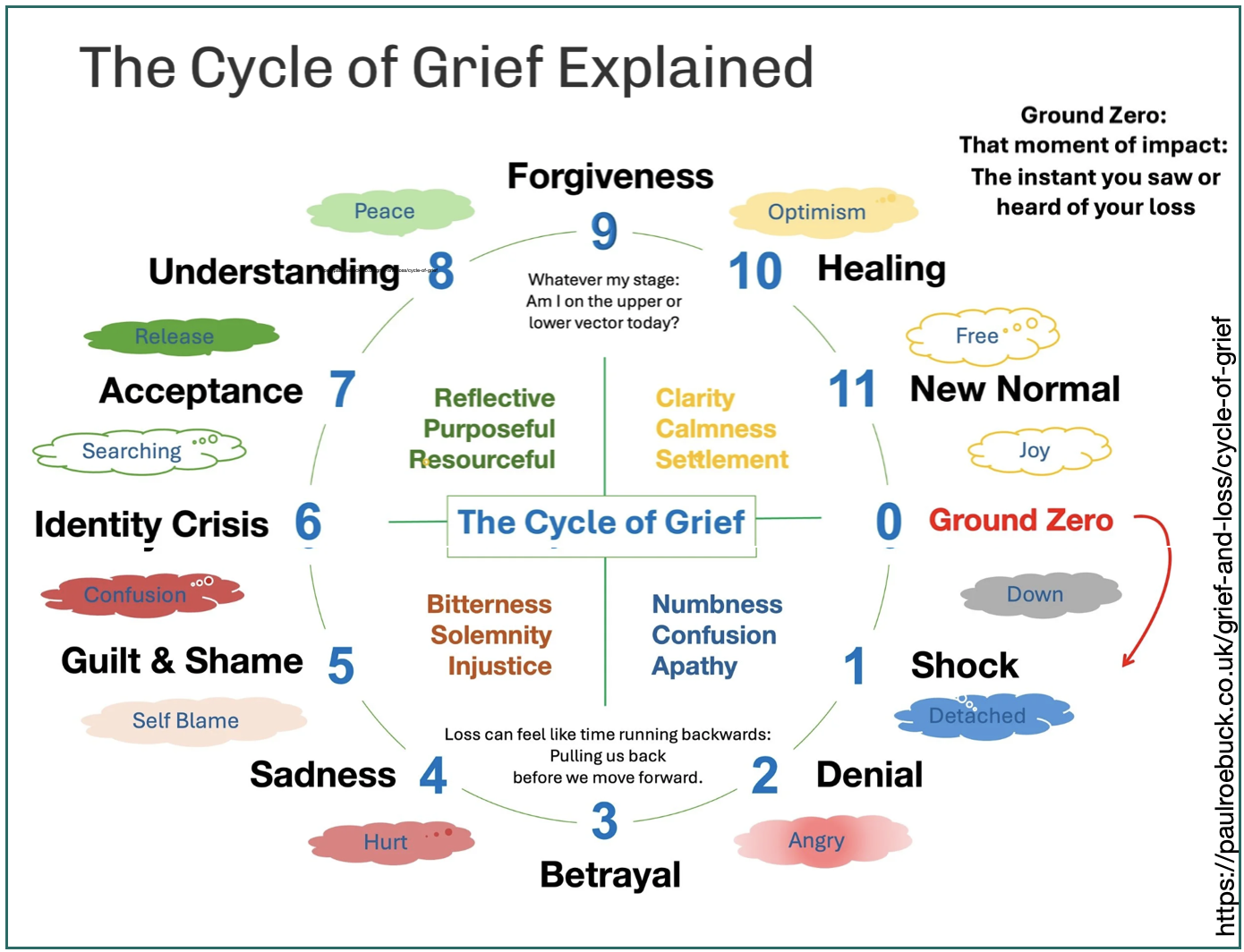
1 – Shock // 2. Denial // 3. Betrayal // 4, Sadness

5. Guilt and Shamethe ‘shoulds’ are a major part of grief. You’re weeks or months into the cycle, & may still blame yourself for what you could have done differently. You think : “I should have visited more. // I should have called them. I should have made more time….”
 Shame often follows guilt, shrinking your world : “What did I do wrong? I must deserve this.” You feel small, withdraw, stop socializing, avoid people because you feel unworthy of happiness. The tumble down to loneliness, guilt & isolation can be quite rough, almost making those lows look restful compared to what it took to get there.

Loneliness & isolation can breed depression. We can make matters worse for ourself if we intentionally shut out the rest of the world.
But time alone & loneliness are not the same. Solitude is needed to think things through, regroup, reflect & recharge.  Some isolation can also be a protection against having to put on a mask to act as if you’re doing better than you actually are.

💔 6. Identity Crisis – the lowest point. Loss has changed everything – birthdays, Christmases, routines…. It all feels sooo different. “Who am I without them?” For a while, you don’t have the energy to be concerned about the discrepancy between who you knew yourself to be & who this stranger in the mirror is now.

Disorganization – is part of the mental fog & lack of clarity during the depression of grief. You’re not sure what day of the week it is, whether you took a shower or ate lunch….
Panic can set in when this disconnect is noticed. “What if I never go back to who I was? ” Panic that things will always be this disjointed & hard to understand, and about what your future might hold. 

7. Understanding – the slow process of meaning-making:
“At least we had time together // At least they weren’t in pain. Maybe we’ll be together again one day.”

It’s easy to stay stuck at rock bottom, convinced there’s no way ahead, so the shift from Identity Crisis → Understanding is the hardest part of the cycle. Support from friends, family, or therapy is crucial here. This is where you start to accept the reality of the loss,  letting go of the relationship at a deep level.

At the same time – we believe we can bear a crisis more easily if there’s some purpose in suffering.  But we have to discover the **treasures hidden in it on our own, rather than having others point them out, or they’ll just be empty platitudes. (**prove your core strength, miracles in disastrous situations, good triumphing over evil, redemption,….)

8. Acceptance is not about forgetting or moving on. It’s the deeper realization that they are gone, and I am still here. You begin to adjust. Your sense of them moves from the present to the past, in memory. (More in future posts)

9. Forgiveness is about letting go of blame. It releases the emotional weight of grief.  At this point, you’ve moved past the denial, guilt & anger, & not hurting as badly as before.
❤️‍🩹 Forgive yourself (for what you should have done). Forgive them (for leaving you). Forgive doctors, other people, & circumstances that might have played a role.

10. Healing – You start to rebuild, As the heaviness lifts, life feels possible again. Fear can also get in your way here, but for a different reason – fear of letting yourself love again, so you may put off a new love relationship or have another child – to prevent the pain of future loss.  Even so, the healing gives resilience new energy & you start to re-engage as much as you can. 

The is key is learning to love yourself enough to create a joyful life. The audio program “nurturing your inner child” can help prepare you for optimistic transitions.

11.  The New Normal – Life after grief includes spiritual awareness. You incorporate a sense of stability, clarity, & peace. Death is a part of life, & we need a spiritual belief system that provides resilience, allowing us to be at peace with this reality.

NEXT : GRIEF – Gender Differences

GRIEF – Extended CYCLE (#1)

PREVIOUS : GRIEF – Debunking ‘ Stages’

POST :  Accessing Emotions

SITE : BOOK: “Loss and Growth: The Grief Spiral – Transformative Bereavement” [Kindle]   Elissa Bishop-Becker M.Ed. LPC NCC


↗️  Grief
is a cycle we revisit throughout our life. We grieve many things, even missing a bus. It can happen on 2 levels:
✑ Macro – Deep, long-term grief, such as losing someone we loved dearly, that’s not over when the funeral ends.
✑ Micro  – Daily, moment-to-moment experiences (see grief INTRO – Secondary and TYPES).

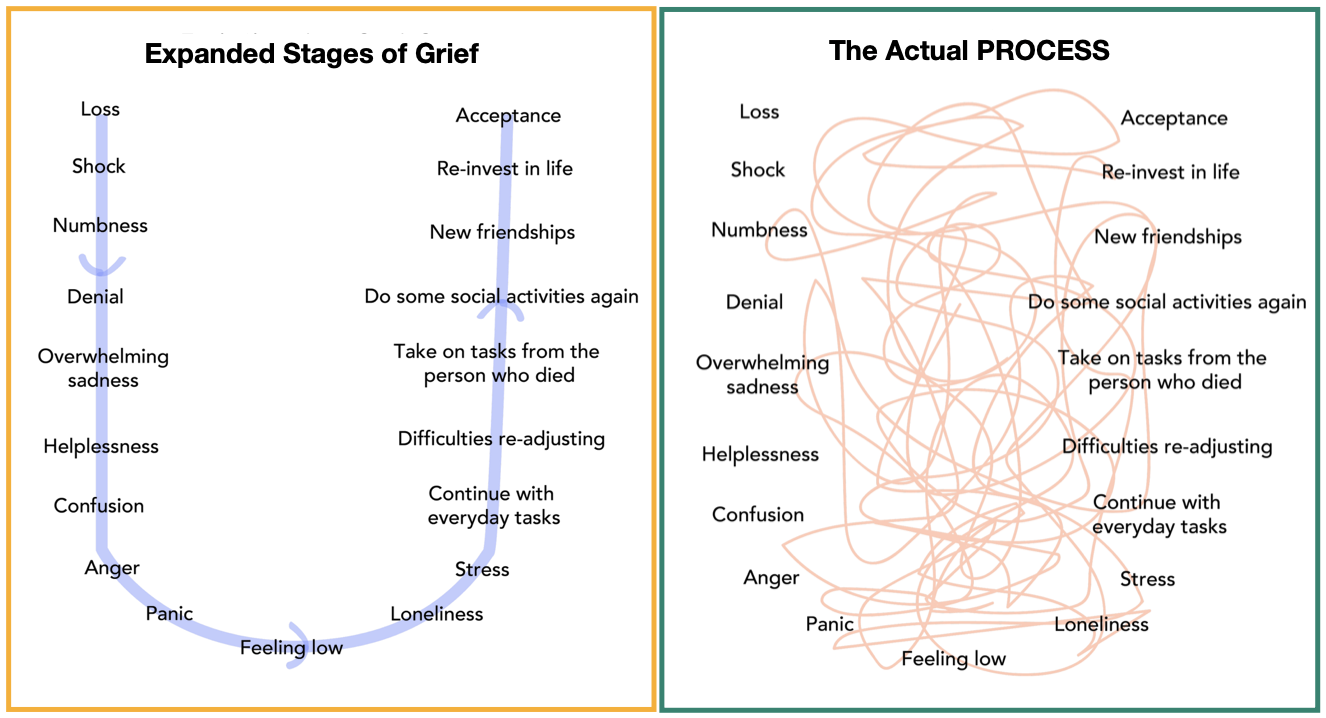
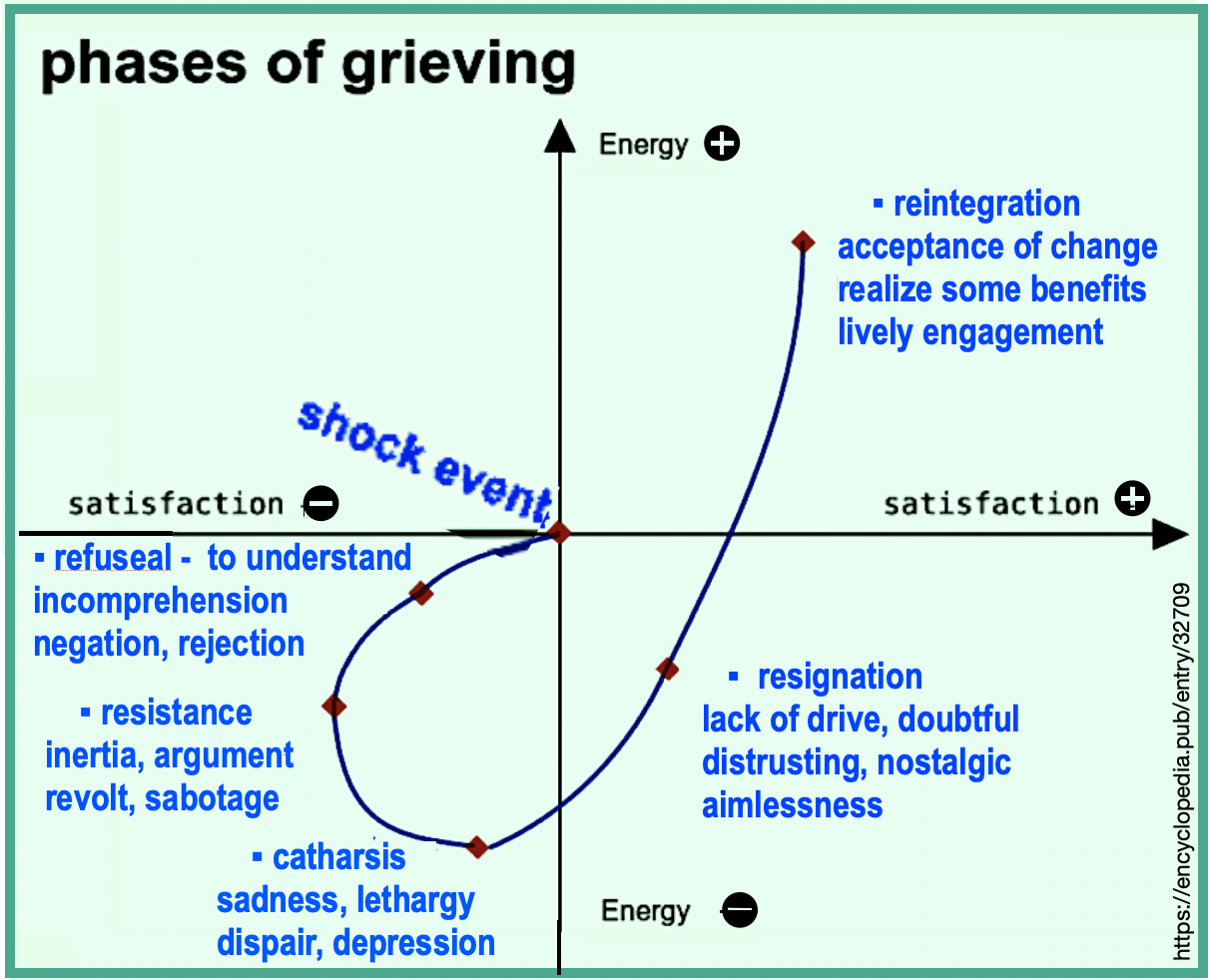
Grieving isn’t linear. We don’t move cleanly from Shock → Denial → Betrayal…. Instead, we oscillate between emotions, sometimes experiencing multiple stages at once. Do not judge yourself or allow others to – you have the right to fully grieve & in your own time. You may not get over your loss, but you will survive it.

3. Betrayal = the reaction to being left behind, often turning into anger – a much stronger part of grief – especially when the death is by violence, or of ones child.
The anger could be at the person who died. You think : “You shouldn’t have died. You should have taken better care of yourself. If you hadn’t smoked, you’d still be here….”  

You may also feel betrayed by the injustice of what happened, by God for letting it happen, or by yourself for being powerless : “If I’d been a better partner, they wouldn’t have left me…. If I’d forced them to go to the doctor sooner, they wouldn’t have died. OR if the doctors had done more..…”

Emotional Outbursts – Often with trauma there is hyper-vigilance, so grievers can be easily triggered. The fight-flight instinct is revved up, looking for impending dangers all the time, causing disproportionate reactions to ‘normal’ situations. Increased levels of cortisol in this escalated state of vigilance puts a lot of wear & tear on body & mind. 

4. Sadness = oftenest emotional throughout the cycle. While many painful grief-emotions can be relieved in church & therapy, sadness cannot.  It’s not just about crying – it’s the deep, melancholy oboe, a constant companion when everything is harder.  Even on “good” days it’s in the background, its volume rising & falling, depending on how much attention we give it.
Yet sadness plays an essential role, forcing us to regroup – physically, cognitively, emotionally, socially & spiritually (PMES). It instinctively makes us turn inward & slow down, as if our soul says “Time out. I need to acknowledge what’s happened & consider what I want to do next – just for today.”
««
NEXT : GRIEF – Extended Cycle (#2)

GRIEF – ORIGINAL Stages & DEBUNKING

PREVIOUS : GRIEF & the Body, #2

SITE : Types of Psychological Theories (many)


STAGES
One of the most commonly known & accepted psychological concepts is that grief proceeds in stages. This isthe work of Elisabeth Kubler-Ross, the Swiss-American psychiatrist & death-&-dying expert.  She helped soften some of the stigma of grieving, making it a little more acceptable to talk about & get support for loss.

Actually, Kubler-Ross originally develop the stages to describe the process patients go through as they come to terms with having a terminal illnesses. The 5 stages— denial, anger, bargaining, depression, & acceptance — were only later applied to grieving friends & family who seemed to undergo a similar process after the loss of their loved ones.

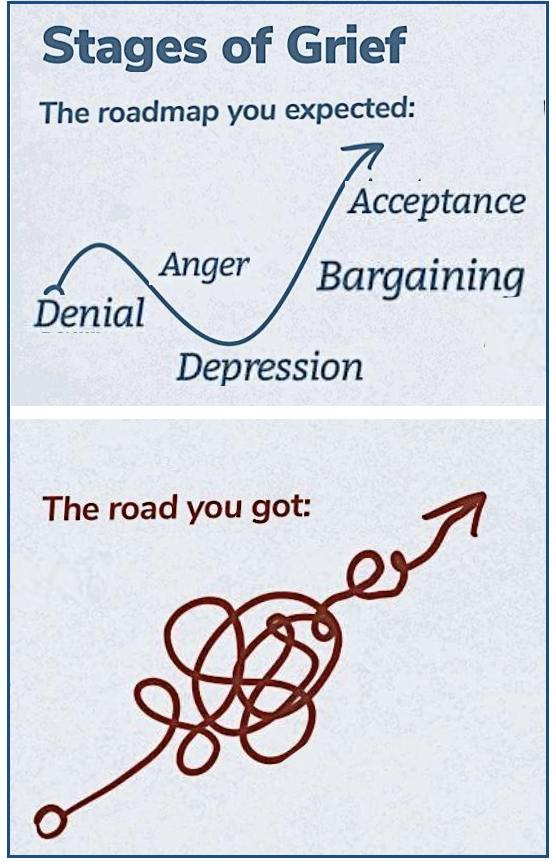
NOTE: While individually each emotion or attitude in the Stages has validity & worth paying attention to in our life – the issue here is the misuse of the series – the expectation that humans should proceed in a specific & required sequence of mourning.

REALITY : There’s no research evidence that = most people = most of the time go through = most of the stages in order, no matter how much people want to create simple, bullet-point guidelines for the human response to loss. Even so, the urge seems irresistible – to compress the complexities of life into neat, tidy boxes.

Why stages? Humans are pattern-seeking, storytelling beings trying to make sense of a confusing & unpredictable world, by imposing order on chaos, inject predictability into uncertainty, & optimism over despair.
The importance of storytelling is a focus of Cognitive Psychology & ‘narrative psychotherapy,’ helping clients change negative self-talk (‘look at all I’ve suffered’) ——> into positives (‘I not only survived but triumphed’).  So,  what’s wrong with stages?

🔻 In developmental psychology, the idea of predictable life stages (‘Passage Theories’ – see AI def) disappeared with changing social & economic conditions. They were developed from a time when most people marched through life with total inevitability : marry at an early age —-> then have children when young—-> then work, work, work —-> then maybe have a midlife crisis —-> then retire —-> then die.  

🔻 Rigid theories impose psychological pressure by creating unrealistic expectations about what & how you should be “feeling”-  in a predictable direction (sad ——> happy), AND guilt that you should be farther along in your grief journey.  ★ Stay away from any psychotherapy or post-trauma interventions based on ‘inevitable’ stages. A particular procedure may be true for a particular griever, but it’s not universal.

🔻 A little Denial is Normal.  This may sound odd, given that it’s always considered inherently harmful. Research now tells us that it’s not automatically bad.  Denial is healthy in moderate amounts, the brain’s way of providing “denial breaks” so we don’t get too great a dose of grief before we’re ready. It lets us relax, regroup, & get ready for the pain we’ll inevitably face.
Being forced to confront harsh grief-related emotions all at once can be cruel, even psychologically dangerous.

🔻 Grief can Shake our Faith. Faith isn’t just about religion. We believe in many things – in ourself, in others, & in the future. When someone dies, our faith in these things takes a hit. We’re sure we’ll ever be the same again, & neither will the whole world – since it so badly let us down!

Most people believe “What comes around goes around,” so if we’re consistently good, we’ll be rewarded with good things. This is a “comfort-fantasy”, which is rudely challenged by the loss of a loved one, leaving us feeling guilty & punished for somehow not ‘living right’. Actually, life is rarely fair, so people do not always get what they deserve – good or bad.

🔻 The Grieving process does not always lead to ‘total’ Acceptance. Most people never stop missing their departed loved ones, but some losses are so unacceptable that the person is crushed for the rest of their life.
EXP : 2 famous fathers who were never the same after the death of their son — Aristotle Onassis (Alexander), & Dean Martin (Dean Paul). Or a UK man, after his father’s death.
NOTE – many other men & women have lost a son or daughter, but no matter how great the pain, they were not permanently devastated.     See SITE : Effects of Losing a Child

NEXT : Grief – EXTENDED Cycle, #1

GRIEF & COLORS (#2)

PREVIOUS : GRIEF — Colors (#1)

SITE : “The COLOR of GRIEF“(celebrity CHEF)

BOOKs :”Colors of Grief ” – Poems
International Handbook of Art Therapy…..” 


COLOR PSYCHOLOGY in Daily Life enhances well-being:
✧ Colorful Self-Expression : Whether through art, fashion, or personal spaces, let your color choices reflect your unique personality & emotions.
✧ Home Decor : Choose colors that align with the atmosphere you want to create. Relaxation = calming blues & greens in your bedroom. Energy & Creativity = add pops of vibrant colors like orange & purple in your workspace
✧ Mindful of Color Choices in your daily surroundings, from the paint on the walls to the artwork you display. Consider the emotional & psychological effects these colors may have on your well-being
✧ Wardrobe Choices : Dress in colors that are comfortable & help you feel confident – to have a positive effect on your mood. Experiment with different shades to match your age, environment & the current emotional state you’re in.

In Psychological Terms – All colors of the rainbow convey grief’s complexity & can be used to gradually move you toward integration :
▪︎ Blue channels feelings of sadness that lessen but still linger
▪︎ Green reveals the first buds of new growth & life’s meaning
▪︎ Indigo represents honoring the memory of the loved one,  as a reminder that reconnect us to them
▪︎ Orange embodies the frustrations of having to live a ‘new’ way
▪︎ Red represents swirling anger, guilt & agitation
▪︎ Violet & magenta hold the mysteries of why loss occurs, & what dreams can hold
▪︎ Yellow illuminates dawning hope & optimism

GRIEF’s many shades evolve slowly, without a set sequence or time frame, its color palette as varied as human experience itself. Exploring them lets us see into our personal emotional landscape, knowing that some days being easier than others.

Grief is not mono-chromatic, it’s multi-dimensional.  Though it may start with darker tones like gray & black, it will gradually incorporate lighter hues like green, yellow, & glimpses of the rainbow. The breadth of options shows the depth of our relationships with the lost one, & the deepest feelings are in technicolor. Colors are the energy-levels we carry in our body & spirit, to help re-assemble the broken pieces of this life we’ve been given.

Grievers can use color to encourage healing by incorporating it into their environment & clothing (but not red or black) :
❥ Blue: to promote calm & tranquility, & soothe emotional pain
❥ Green: for renewal & growth, encourages healing & hope
❥ Yellow: warmth & positivity, uplifts the spirit in hard times
❥ Purple: for spirituality & introspection, aids emotional processing
❥ White:  for purity & peace, for a sense of comfort & clarity
❥ Pink: for love & compassion, fostering self-care & emotional support.

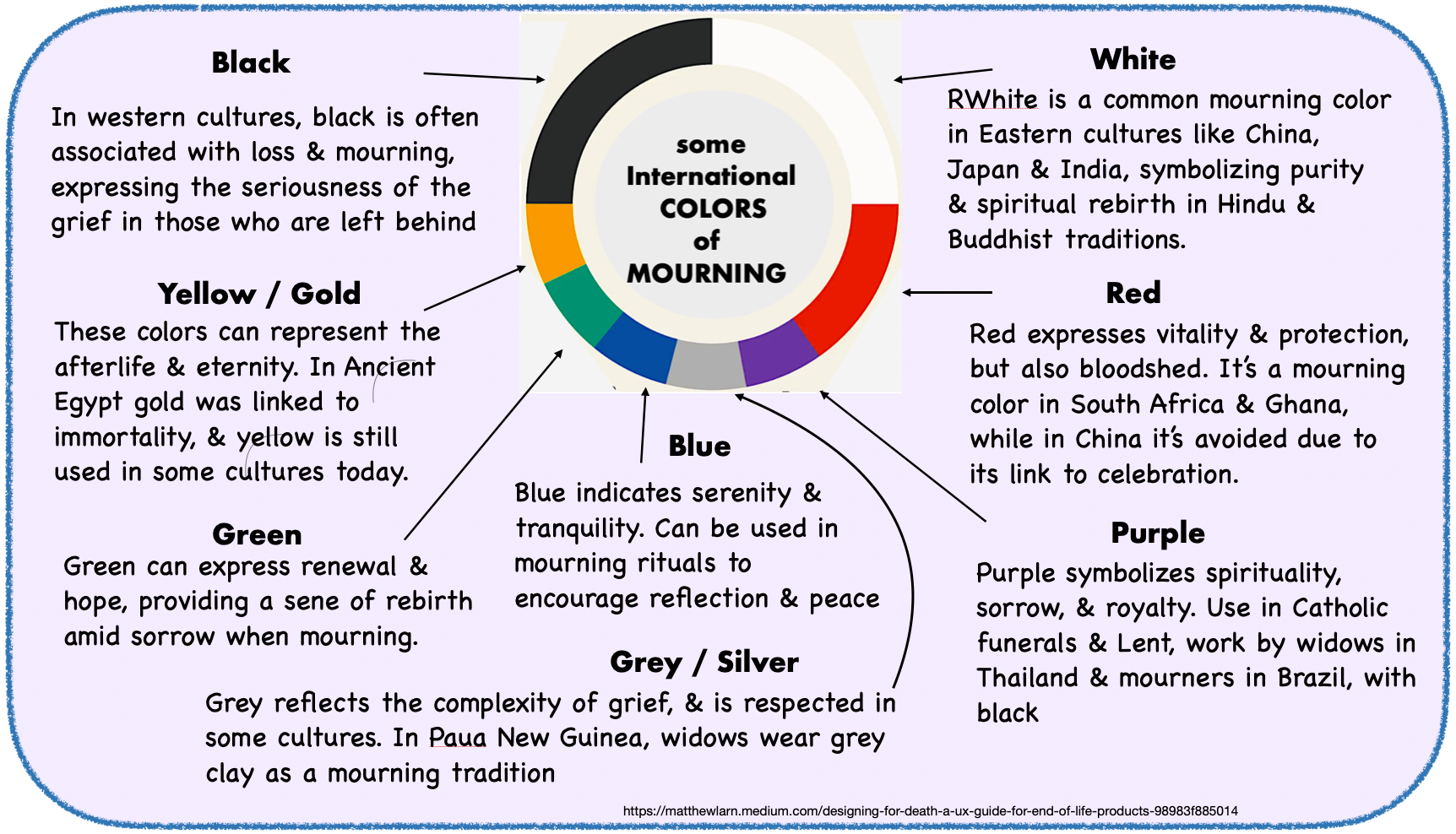
MORE generally, we can choose comforting colors to wear or surround ourself with that are typical in the WEST during grief – no matter how long that is :

❀ Black = Traditionally associated with mourning & loss, especially at funerals, for solemnity & reflecting on the deceased
❀ Soft Blues = Evokes tranquility, helping to soothe emotions
❀ Dark Blue = Represents depth, conveying a sense of calm
OR
❀ Deep Purple = Linked to mourning, for dignity & respect
❀ Gray = A neutral color that reflects sadness without being too stark – can give a sense of quiet in chaotic times
❀ White = Provides a sense of peaceful solitude
OR
Muted Earth Tones = Browns & greens connect to nature, & can offer grounding & stability
Soft Pastels = Light colors – pale rose & lavenders – a gentle presence without being overwhelming

✹ Avoid
Bright Colors, as other mourners or relatives may consider them disrespectful.
However, Although religion & tradition are still important there’s been a change toward personalized funerals as a celebration of life.  The deceased may have wished their mourners to wear brights, or the family may request participants to wear a specific color or ribbon in support of a charity. See: ” What to wear to a funeral guide.”

COLORS not to wear at a wake, memorial or funeral
Bright Reds = In 90% of Western cultures, red symbolizes passion, danger, or celebration – the opposite of mourning.
Neon or Electric Brights = these trigger physical alertness – exactly what grieving brains do not need.
Shiny Metallics = they reflect light 3–5x more than matte fabrics –  making the wearer the literal “center of attention” when the focus should be on the casket or family. (MORE….)

GRIEF – Original Debunked