

I GUESS THIS IS 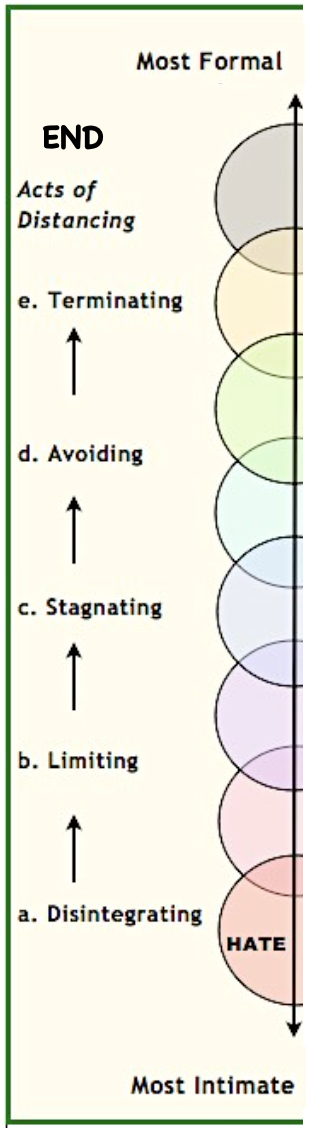 GOODBYE : (How could this happen to me!?)
PREVIOUS: Leaving (#1)
▼ ACTS OF DISTANCING ▼ (cont)
5. DIFFERENTIATING
4. LIMITING
3. STAGNATING
Normal: They’re still together, but with a feeling of being stuck & not knowing how to make it better or how to get out. There’s not enough meaning or nourishment to keep it alive, but being in a long-term or committed relationship makes it harder to consider leaving.
They feel disconnected & depressed/ but stay together to avoid the pain of separation
Some form of talk is needed, but if either hints at starting an unpleasant conversation, they’ll find a way to prevent it so they don’t have to invest any feelings
 • They have little to say to each other, are bored with the same old stories, don’t want any confrontation, & won’t talk about the relationship because it feels pointless
“Do you want to watch that program?” <> “No, but you go ahead” , “I don’t want to hear that again” <> “I know, you’re not interested in what I have to say!”
• One or both may be experiencing personal problems & possibly blame the other, rather than facing their own issues. But when people are no longer getting their needs met from their partner, they shut down the lines of communication & turn elsewhere
• People can start punishing each other for their own disappointment & loneliness: “Well, she/he hasn’t helped me in a long time, so I’m not doing this for her/him”
– may be the kind of thinking behind further withdrawal.
💔
2. AVOIDING
Normal: Now these 2 people who have been in a committed relationship, no longer see themselves in the dyad. They’ve withdrawn their emotions & are ‘spending‘ them elsewhere. Deep emotional distance is an indicator that the union is no longer salvageable. Each person knows in their mind & heart they’ve detached, & need to protect themself
• They reorganize their lives to avoid being together & may even verbalize it: “I don’t want to talk to ____”.
 It can also show up by sleeping in separate beds or rooms, & one or both looking for a new place to live
• People not living together will avoid calls, emails & texts.
“Leave me a message & I’ll get back to you” , “I’m really busy, so I’m sure you’ll understand if we don’t get together this week”
Usually there’s less fighting, but what’s left may be sniping, sarcasm, put-downs. Otherwise, communication is only about practical necessities, if at all
💔
1. TERMINATING (Final)
Normal: This stage can be done rather quickly or be dragged out for years.
• It’s the actual physical leaving of the relationship, with a little or a lot of psychological finality. If both parties can accept this, it makes it much easier to move on.
“I can’t do this any more. This is the end for me.” <> “Yeah, sure, whatever  you say.”
• When one partner has come to their ending point, it’s important & respectful (be ‘clean‘) to actually tell the other person. This is more likely with a longer-term connection. Often with less developed ties, one person just stops taking calls, emails…..
• Verbal messages are used to prepare for the end by only using ‘I’ or ‘me’ statements, & meant to create finality & permanent distance “This relationship isn’t working for me anymore” , “Please don’t call me again” .
• It’s not uncommon for one or both people to have another relationship, job, even a new city… waiting in the wings, even if the new ‘love’ is temporary, to get them thru the transition.
✶ Leaving may actually be a benefit to both, even if it hurts. They may need the relationship to end so they can continue their career, their personal growth or to start a more suitable lifestyle.
♥ ♥ ♥
NEXT: “Trying to Leave you” (Part 2) – Clingers
 HEAL & GROW for ACoAs