ACoAs MANIPULATING Self & Others (Part 4a)

re-frameMPREVIOUS: Manipulation #3c

SITE: Response Options to a Controlling/ Manipulative Person

See ACRONYM page for abbrev.


RE-CAP – Manipulation (M) is the resort of :

a. the legitimately powerless (consider Children, Women, Poor & homeless, the Chronically ill, Minorities….), usually in small ways

b. anyone who internally believes themselves to have no options (the Learned Helplessness of ACoAs, addicts, victims….) BUT who actually do have the capacity to empower themselves – with the right help & persistent work in Recovery

c. AND, ironically, high achievers who’ve clawed their way into positions allowing them to be high-level manipulators, usually on a large-scale.

MOTIVATION: By definition, such people shouldn’t need to manipulate – their whole life is about getting exactly what they want, BUT at any cost.
These externally powerful bosses, politicians, parents, church leaders, salespeople…. have to be one-up, using every dirty trick in the book

This tells us that the seemingly ‘lucky ones’we envy also grew up in very damaging circumstancsuperiorityes, leaving them with a great need to compensate. Hidden under many layers of intelligence, determination & deviousness, they do not feel OK ‘just as they are’, with both strengths & limitations, so they rarely let their vulnerability show, even to themselves
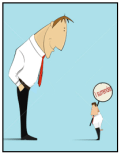
They’ve suppressed the awareness of their basic needs (safety, unconditional love & acceptance, mirroring, help….. AND having emotions!), which they consciously consider as weaknesses.
Instead they settle for being feared, having power of others, looking good on the outside, & accumulating as much money & ‘stuff’ as they can manage.

So like the rest of us, whatever childhood needs were punished or neglected – will become the focus of their life’s activities, & how those are expressed will depend on their individual native personality, combined with the social environment of their upbringing.

M. RE-FRAMED
a. In order to change the need to manipulate, we need to start by identifying our specific ways of ‘getting over’, looking at the harm they do when used, & their long-term effects

b. Instead of simply considering Manipulation as an evil thing (motivation ideasbad, arrogant, narcissistic), we need to also understand it as a defensive maneuver. It’s used by the WIC in an attempt to provide for itself what our family & community should have but didn’t.
We began using it to survive as kids, & we’ve continued it as adults, fed by toxic family messages & bad examples.

c. On the surface this character defect is made up of conscious or unconscious BEHAVIORS, but to get anywhere we need to focus on MOTIVATION, rather than on visible actions.
Motivation is goal-oriented energy which moves us to action, using mental focus & physical exertion to reach specific outcomes.

Motivation Types
1. PRIMARY / basic = unlearned & common to both animals and humans (food & shelter, sex, fear & aggression, avoidance of pain….)
or SECONDARY / learned = which can differ from person to person (need for achievement, need for power….)type of motives

2. EXTRINSIC M.= when somebody else tries to make you do something
or INTRINSIC M. = when you want to do something

3. PULLING M. = external goals that influence how we act in order to achieve them
or PUSHING M. = internal changes (emotions, beliefs, hunger, illness….) that trigger a specific desire to act

4. POSITIVE M. = having the desire and the willingness to get or achieve something good
or NEGATIVE M. = to avoid undesirable or threatening situations

As for all human being, our primary motivation is survival – in any way possible. And for ACoAs – the over-riding need is for SAFETY – by avoiding possible abandonment & punishment (which feel like the same thing!)

SAFETY, BELONGING & MATTERING are essential to good brainbelonging functioning, allowing us to live well:
• the greater the feeling of safety, both emotional & physical, the more easily we can take appropriate risks
• the greater the feeling of connection with others, the more we can feel we’re in this together & belong
• the greater the feeling that we personally matter, that we can make a difference, & are contributing to the greater good, the greater the success in all parts of life (MORE….)
SO, since our upbringing did not provide us with these 3 fundamental needs – manipulation is the way we think we’ll be safe. Unfortunately it doesn’t work!

Motivation: The Why’s of Behavior(7 theories)
Study of Motivation”(Scroll down)

NEXT: Manipulation #4b

Double BINDS – Re-Framing (Part 7)

sharng food
I CAN SEE THIS ‘MESS’
in a whole new light! 

PREVIOUS: Double Binds (Part 6b)


RE-FRAMING (NLP)
• A frame is the focus of attention we give to something (DBs #4a & b).
❖ Re-Framing (R-F) assigns another meaning to any upsetting situation, which helps us identify, interpret & respond to it in new ways.
It’s a powerful tool for solving problems based on assumptions that insure stuck-ness. (See ‘AGREEMENT Frame’)

• Dealing with DBs requires making cognitive leaps by using a broader perspective, by putting toxic communications into a larger context. While re-framing by itself seldom resolves a problem, it offers a way to “softening it” so a solution can be uncovered that’s acceptable, if not always always liked.

Re-framing asks “How can I think about or respond to this differently?”
This shift leads to self-empowerment, which leads to higher functioning & satisfaction, taking us from no-win to no-lose. (MORE…)

ACoAs are used to feeling trapped (‘Learned Helplessness’), but eventually in Recovery we can come to value the inherent freedom of dealing with OR resolving DBs. (also: Seligman – slideshare ). While we originally experienced DBs as a horrible trap, we can now see them as opportunities to choose what works for us.

As adults we have access to many different feelings (Es) & perspectives (Ts) to life’s events – like how each of us grieves a death differently, or how we show love. This means we can’t be “wrong” when expressing our True Self.
★ Damage is the same for everyone, but our essence is specific to us, so we can learn about & pursue our own style! (Grieving & DBs)

TYPES of Re-Framing
🧩 Context
Figuring out where a ‘problem situation’ or reaction would fit better – the context most appropriate for it, that would make it useful, an asset or skill
EXP: Dancing in the isles in a conservative church / synagogue / mosque would be severely frowned on, but not at a Pentecostal or African-American Baptist church!
🧩Content
Shifting the focus, either to a different part of the problem, & asking: “What else could this mean?”
OR seeing that the same situation can have a variety of meanings – good, bad or different

EXP: Someone was frowning ‘at me’. Were they annoyed with me? OR maybe they were :
• worried about a loved one
• thinking about a problem to solve
• looking at someone/ thing past my shoulder that upset them….—> none of which had anything to do with me!

🧩Value
Changing the meaning of a word or term, often done in marketing, where the same product is given a totally new purpose, a different use &/or presented to new markets.
It can also be the way a phrase is accented, as in the picture
EXP: Many pre-Christmas retailers will say they’ll help you “Pay less” with special deals, but the Berlin lingerie store Blush recommends a ‘smaller’ holiday gift: “Make your loved ones happy with less!”

DB QUESTIONS
Sooner or later we may run into someone who loves to ask unfair or impossible DB Qs – the kind that try to force the answer the (S) wants, no matter which way you answer.
Unless we can step outside the Bind, we’ll be in a catch-22 – angry & possibly humiliated.
These Qs are usually made up of 2 parts: Reference to a ‘bad’ thing or an assumed action PLUS the issue of frequency (★ MORE…. )

The S starts with an accusation OR assumption about you, then asks if you’re ‘still at it’ or ‘will be doing it’.
By framing the Q as closed, you’re expected to only give a Yes/No or other one-word answer, without a chance to address the actual topic
EXP: “Are still lying? / Have you stopped beating your wife? / When do you want to help us? / How much money can you contribute?”….

RE-FRAMING: The only sane & self-respecting way to handle this kind of verbal trickery is to treat it as if you heard an open question, so that you respond to the underlying assumption rather than the closed question.
EXP: “What makes you think I’m a liar? / I’ve never beaten my wife & never will / I don’t have time in my schedule to help / I’ve already contribute all I can”…. (Open vs Closed Qs)

NEXT: DBs – Part 8a

TRAITS of VICTIMS (Part 1)

MY POWER IS EATEN AWAY
by the bugs in my head!

PREVIOUS: Dealing with Abusers  – #3

QUOTE: “Some people wonder why others often fail to treat them with respect — not realizing they’ve signaled that it’s not necessary to treat them with respect.”  ― Nathaniel Branden, Six Pillars of Self-Esteem

V= Victim // P= Perpetrator (abuser)

VICTIMS – There are 2 broad categories :
Voluntary (for a principle or religious belief, in war, to save a loved one….)
Involuntary – anyone who suffers continual harm from another – as a child, as an invalid or the elderly, & not by choice.

Involuntary V. Sub-types 
a. Passive – most common
• Internal : depressed, hopeless, lonely, needy, self-hating, unhappy
• External : easily react to being baited, easily hurt, try to placate or be overly helpful, not able to use humor to diffuse conflict, justify themself,  few or no friends, socially awkward (no matter how intelligent)

b. Provocative – rarer (will have some, but usually not all these traits)
Attitude: resists rules, no patience for delay
Behavioral : fights back & keeps at it, but always loses with frustration & upset
Emotional : easily angered, frustrated, irritable, in great distress, over-sensitive
Internal : immature, impulsive, restless – but gifted!
Physical : may have learning disability (ADD, dyslexia, autism …)
Social : misreads social cues, poor interactive skills, reacts aggressively to authority, teases others & doesn’t know when to stop &
• can be very annoying or irritating , & so will be easily avoided. Gives off the unconscious message “Kick Me” (see Games PeoplePlay – Eric Berne)

Vs are ABUSED by Being:
• emotionally tortured, & mentally disorientedvictim
• ridiculed, punked or teased, the continual target of someone’s anger
•  punished for the errors or stupidity of others
• tricked, swindled, manipulated or taken advantage of
Being:
• the focus of unrealistic & excessive expectations
• physically neglected or injured
• subjected to attacks, oppression, hardship & other mistreatment.

• As a result of long-term abuse, usually started in childhood, a person will continue the original Victim role. It’s the feeling of helplessness, being passive in the face of current or future ill-treatment or misfortune – called “learned helplessness” —> see Artwork #3victim

• Vs who need to be in a relationship – at all costs – will gravitate to some type of abuser. They may be of either gender, high or low functioning, underprivileged or highly accomplished.
EXP: Many famous & talented men & women have been victims of domestic violence, such as Carol Channing, Whitney Houston, Tina Turner, Reba McEntire, Madonna…. AND Phil Harman, Kelsey Grammer, Abraham Lincoln, Stephen Hawking (by his wives), Bill Clinton (in childhood)….
We know from reports that some stayed with their Perps long-term, (Ms. Channing, Pres. Lincoln…) while others got themself out. Some chose better the next time, & some repeated the harmful pattern – as in the list below. (the Men….) (the Women….)

BTW (in our culture)  • Generally, men do need & want relationships, but tend to get their basic sense of identity from work & career, academic achievement, athletic success &/or material gain. So their vulnerably to bullying is more likely to come from outside the home.
• Women tend to base their whole identity on the number, quality & intensity of their personal relationships.
Because of that, they’re more vulnerable & more likely to be abused by ‘loved ones’. The need to be a ‘good’ daughter, wife, mother, friend, co-worker…. makes them willing to do just about anything to maintain those connections, often to their detriment.

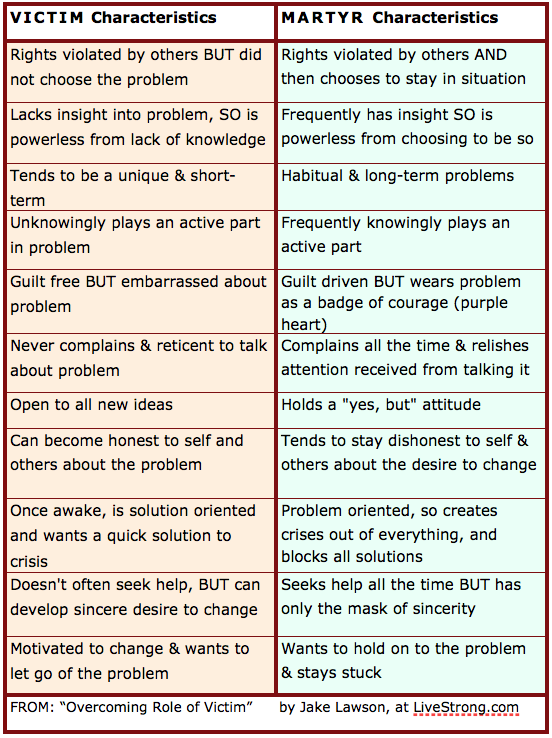
MARTYR vs VICTIM  : This distinction is naturally about ‘functioning’ adults, who make conscious or unconscious choices regarding a bad situation they find themself in. The difference between the two is that Martyrs are self-aware (sort of) & Vs are in denial – at least to start with.
«

«
NEXT: Traits of Victims – (Part 2)

What is EMOTIONAL Abuse? (Part 3)

YOU NEVER ADMIT
what’s really going on!

PREVIOUS: What is E. A.? (#2)

SEE ACRONYM Page for abbrev.


P. = Perpetrator / V. = Victim
TYPES of EMOTIONAL ABUSE (E.A.) 

ASSERTIVE = standing up for ones rights without intent to harm.
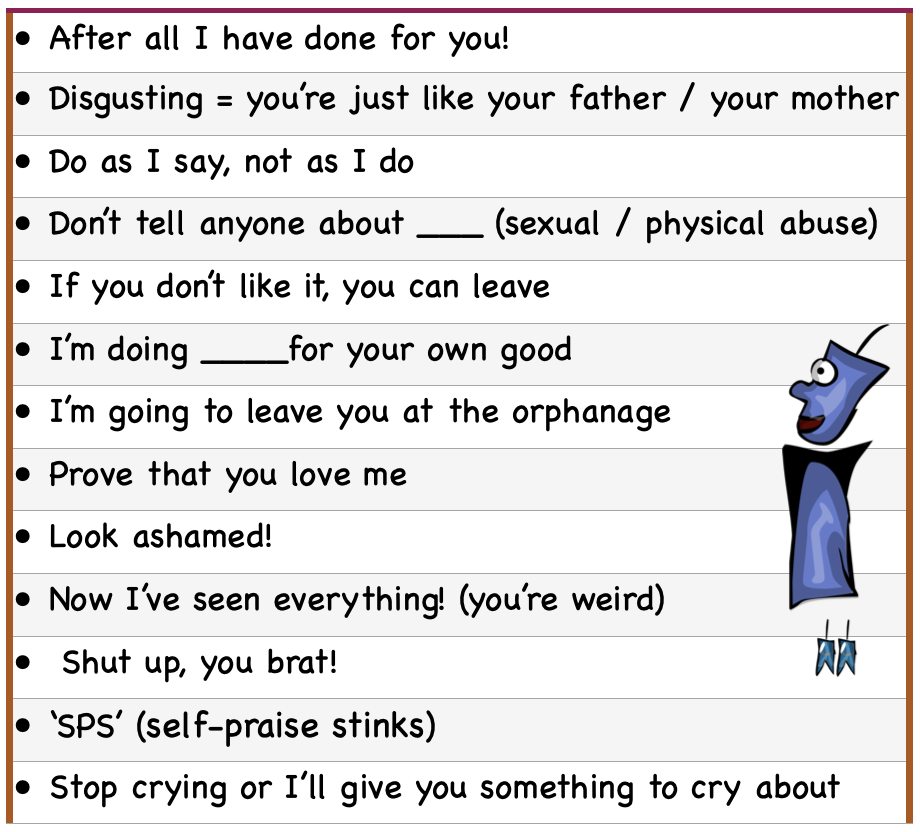
Statements we may have heard growing up
VS
AGGRESSIVE  = deliberately trying to hurt someone, at any level (PMES). The receiver of the aggression may not be the actual target, like kicking the dog when you’re mad at your boss

EMOTIONALLY HARMFUL statements we may have heard growing up ALSO, they tell outright lies about us, and love to recount to everyone -sensitive, shameful or embarrassing stories about us
Naturally, this list is only a fraction of what damaging family & other adults are capable of – a guide to help us think about what we may still be ignoring from the past OR still putting up with, maybe without realizing. (Journaling POSTS – “Writing for Personal Growth“)

TYPES of EMOTIONAL ABUSE (E.A.)
✔️ Direct & obvious
Perps usually have an angry, attacking attitude. THEY :
• make you one-down to them by judging & invalidating you, undermining the equality & autonomy essential for healthy adult relationships
• use accusations, blaming, labeling, name-calling, ordering around
• use one-up parent-to-child communications, infantilizing you

✔️ Dominating
INDIRECT -They
• railroad discussions, talk over you, won’t give you room to respond…. so you don’t have time to identify what’s wrong with what they’re saying or doing
• if verbally clever, they’ll make their point seem perfectly logical even though they’re twisting everything in their favor, using CDs
DIRECT – They
• give away or throw your things out without discussion or permission
• smash, throw, deface or cut up personal or household items

• want to control your every action, to have their own way – and will resort to threats & verbal attacks to get it

✔️ Emotional Blackmail – they
scared• draw you in by being nice, then unpredictably say something cruel, or push you away, act disgusted
• play on your compassion, values, guilt, shame, limitations or other “hot buttons” to get what they want
• threaten to end the relationship, to totally reject or abandon you, ignore or use other fear tactics, unless you give in

✔️ Indirect – they
• are often disguised as “helping”- BUT it’s actually criticizing – ‘fixing you’, giving unsolicited advise, analyzing you, questioning your tastes & decisions
•  use the implied judgmental tone of “I know best” – to belittle, control, or demean, rather than support your growth & development

✔️ Threaten
• to leave, any time they don’t like something – but doesn’t go
• to take the kids, the car, the house…  • to stop paying for important necessities  • to get you fired  &/or ruin you reputation using lies
• to hit or do other harm (your kids), but don’t follow thru
• to commit suicide (& it will be your fault), but never do

✔️ Verbal assaults – theyScreen Shot 2015-07-15 at 2.51.42 PM

• berate, belittle, criticize, name call
• blow your flaws out of proportion, harping on them
• constantly blame, use sarcasm & humiliation
• make fun of you, any time, & in front of others
• scream, threaten you physically

NEXT: EMOTIONAL Abuse? (Part 4)