Anger – Triggers (Part 3)

angry robot

TOO MANY THINGS
can go wrong every day!

PREVIOUS: Anger Triggers  #2

SITE:Anger: Moodjuice Self-help guide


MORE Anger Triggers, set off by OTHER people or circumstances
🚹 Noise • construction work, babies crying, dogs barking
🚹 Overload when too many stressors happen at the same time, so our coping capacity is exhausted (caregivers, working mothers….)

🚹 Pet Peeves lazy, sloppy, dirty, chaotic people or places
• violation of personal rules/ values
• social irregularities, political issues
🚹 Powerlessness
• not able to fix or change someone/ thing that hurts us (so we don’t have to leave)

🚹 Stealing • lover or mate taking $$ or other things / ID theft / break-ins / business frauds
🚹 Stupidity rules that make no sense
• not having or not using common sense
• government incompetence or deliberate harm
• favorite sports teams losing
🚹 Unfairness
• discrimination because of age, race, religion, gender, looks….
🚹 Unreliability
• broken promises, lateness, lies, repeated cancellations
• being let down when needing someone specific (disappointments)

STUFFING triggered EMOTIONS
Life is made up of energy ebb & flow, expressed, contained or withheld.
We take in – food, love, nature, beauty, affection….
We let out – art, exercise, emotions, sex, sports, talk…
…. a cycle of building & discharging vibrations, which only stops at death

🔻 Relaxed muscles are in low energy, but also anything that’s a road block keeps us tense
🔺 High energy that’s not moving tightens the muscles. People who are very afraid – will unconsciously hold their breath, so their lungs are always over-inflated, making them sigh a lot

When energy gets either too high or too low, people get more & more anxious. Then they try to find ways to dampen it or pump it up (over-eating, compulsive sex, fighting, smoking, drinking….)

• Our society (& unhealthy families) tell us what we’re allowed to express emotionally, & to ‘control’ how much to let out. We’ve been taught to be afraid of showing anger, loneliness, fear, mourning, insecurity – even too much joy or excitement (except @ sports or concerts)….. told to “calm down” & contain emotions rather than letting them out in healthy ways.

The energy of each unexpressed emotion gets stuffed into an imaginary POT. One way to tell how full it is – is by noticing the tension in our muscles – tight jaw or shoulders, having IBS, overall stiffness….

⬅️ Al Turtle’s CHARTS start by assigning each ‘provoking’ external event as 5 units, with a corresponding emotional response of 5 units, & then going up from there: trigger 50 = response 50, 500 = 500….
He calculates that by the time we’re age 20 most of us have at least 35,000 units of backed up energy in our body, which can use up tp 20 to 80% of our calorie intake – just to keep it all inside the POT.

No wonder we’re tired – suppressing emotions takes a great deal of effort, piling up until we implode (depression) or explode (rage)

Re. Anger – usually the amount of anger felt is in proportion to the provocation (trigger), so the larger the input (stressor), the larger the output (emotional intensity).
A child will explode as much as it needs to, then it’s over, & they stops. This is normal.
But adults have learned to cut too many of their feelings off. Then we end up with a very full POT,& it doesn’t take much of an external trigger (5 to 10 units worth) to set off a very big response (100 -1,000 units)! So a little thing that would “justify” a little anger often results in a huge amount of expressed rage.

RELIEF – The ONLY thing that relieves suppressed emotional energy is venting it appropriately – as a way of ‘completing’ / ending the emotion – so it does’t hang around. Nothing else works.

Regularly emptying the POT  – a little at a time, in small doses – actually gives us more energy because we’re releasing the tremendous effort needed to hold it in.
Many of us are not aware of how hard we’re working to sit on emotions, because consistently tight muscles become numb after a while. That’s why doing emotional-release body work is so important as part of Recovery.
SITE : Polyvagal Theory, a Ladder of  Nervous States the mammalian autonomic nervous system provides the neurophysiological substrates for adaptive behavioral strategies.

BOOK: “The Body Keeps the Score” ˜~Bessel van der Kolk, M.D. (Overview & chapter summaries)

NEXT: Anger & ACoAs,  #1

Anger – Triggers (Part 2)

many triggers I CAN ONLY COPE WITH
but so much stress!

PREVIOUS: Anger Triggers (#1)

SITE:Aggressive Driving & Road Rage
Anger Worksheets – Checklists


1. Internal (in Part 1)

2. EXTERNAL Triggers
Triggers are all the PPT that make us uncomfortable – causing emotional distress of some sort.
Anger is only one response to negative external experiences. The most common is fear, in the form of dread or anxiety. It can also be sadness, frustration, feeling abandoned…..
The defenses that have helped us survive can also cause intense painful reactions – when it seems that someone’s not respecting or valuing what makes us special

We get triggered when the brain thinks we will be or have been deprived of a positive need that’s important to us. Then we quickly rationalize & justify our anger or fear-behaviors so we don’t look so bad. (see LIST of NEEDS). Of course, when we can access the Healthy Adult voice we can catch the over-reaction, giving us time to discover if the threat is real or not.

REMINDER – While there are ‘universal’ things that annoy most of us, it’s important to figure out what our particular buttons are, so we can deal with them differently or at least better – mainly for our own benefit
(see post re. Damaged Needs)
ALSO – there are situations which legitimately SHOULD make us angry – such as physical, mental & emotional boundary violations & abuses

BUT, much of the time our anger stems from our harmful past :
• things family, school, church…. did to us when we coulSTRESS listdn’t stand up for ourselves (“If it’s hysterical, it’s historical”)
• AND, our reactions are based on what we were / were not allowed, as well as watching how adults dealt with their anger, hurt, frustration….

STRESSORS predispose us to anger, & the amount of stress we’re under at a given moment determines if we ‘let fly’, & to what extent
The following Anger Triggers come from other people or circumstance. They may not all apply to you, so focus on the ones that do, & go back to Part 1 to see what might be under your anger/rage.

🚹 Abuses = all PMES forms (“Emotional Abuse”)
🚹 ‘Bad’ parents = drunk, controlling, insensitive, manipulative, mentally ill, narcissistic, negative, unavailable, unreliable…..

🚹 Betrayal  • a cheating spouse
• anyone going behind your back to cause you problems
• someone passing on private info to others / using it against you
• ‘friends’ spreading malicious gossip
• taking credit for your ideas or work
🚹 Boundary invasions • someone going thru your stuff
• being woken prematurely (in the middle of a REM cycle)
• continual / repeated loud noises, music, neighbors
• telemarketers / tv ads / popups

🚹 Breakage / breakdowns
• equipment failure (esp. when most needed)
• tech complications or malfunctions
• destruction of a favorite or prized object/possession
🚹 Concerns
 worrying about family members (health, finances….)
• wondering what might have happened to them
• not able to help someone in trouble (powerless)
• worry about possible injury to self or a loved one / health problems

🚹 Communication problems
• being put on hold – especially for a long time
• dealing with incompetent “customer service” calls
• not heard, words twisted, ideas misunderstood or used against you
• given the wrong instruction or info (esp. when important)
🚹 Delays / Interruptions
• obstacle to reaching goals (the closer to an important goal when interrupted – the greater our anger)
• prevented from completing any ongoing task, especially if meaningful
• interference with planned fun / entertaining activities
• long lines, slow service
• waiting for something you badly want right now

🚹 Disrespected / Embarrassed / Humiliated / Shamed
• being treated as unimportant, invisible, stupid….
• not obeyed when you’re in authority (parent, boss….)
• belittled, called on the carpet…. especially in front of others
• being with someone who acts badly, as a reflection on you

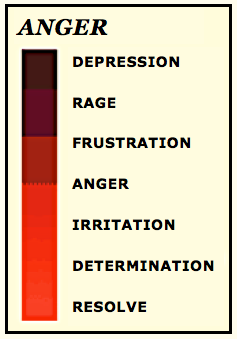
Anger- red range 🚹 History • annoying or painful behavior someone repeats & repeats – even when asked many times to stop. Over time will accumulate frustration & then become anger
🚹 Lack of consideration
• often texting when with you, anywhere
• loud cell conversations in enclosed spaces
• talking at movies, concerts….
🚹 Losses • of illusions or of hope
• of a relationship, job, home, health…..
• death of a loved one, friend, pet…

CHART ↗️  : Anger colors + 8 other Emos  

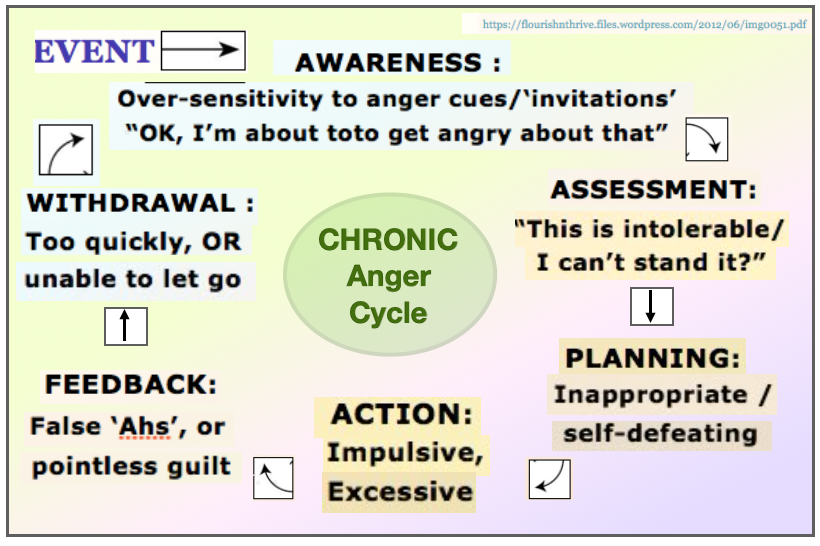
⬇️ ANOTHER look at the Anger Cycle comes from Ronald Potter-Efron’s best-seller “Angry All the Time” – Normal vs Chronic anger


ALSO: See an expanded behavior cycle – applied to anger & other dysfunctional patterns (from “Anger management for Kids”)
NOTE: This site includes other links, which may help ACoAs teach our Wounded Inner Child how to deal with our anger.

NEXT: Anger triggers (#3)

Anger – TRIGGERS (Part 1)

THERE’S NO END OF THINGS
that can set me off!

PREVIOUS: Negative Uses (#2)

SITE: Anger TRIGGERS Qs

Series of POSTs : “What Just Happened? – Noticing painful events”


WHAT GETS US MAD?

a Trigger + our point of view about it + our personal temperament = anger (but not always or for everyone)
Our Anger reaction to PPT is usually a combination of internal & external factors. Sometimes external events that bother us are actually positive or neutral, but because of internal damage (WIC & PP) we automatically get angry.  EXP – for ACoAs:
√ being accused wrongly enrages us
√ being accused rightly terrifies us (then we get angry or defensive)

• While there are legitimate reasons for reacting, under the anger are ‘sensitive’ emotions we may not want to admit to, such as loneliness, need, loss, abandonment pain, fear, sadness….. making us feel too vulnerable.

Everyone has some triggers, based on our personality & childhood experiences. Anyone interested in personal growth needs to identify their specific buttons, to better manage verbal & physical responses. (Iceberg)

1. INTERNAL Triggers
a. EMOTIONALLY , the Big-3 inevitable triggers – are:
HURT – to our feelings, our integrity, an important loss, an insult to anyone / anything we love…..
• SCARED – Physical or emotional danger
EXP: Man on bike with little son on the back almost gets side-swiped by a bus pulling to the curb, making him yell & hit the bus with his fist as he turns that same corner
FRUSTRATED – whenever someone /thing blocks us from reaching a goal (big or small), especially if it’s very important to us, or if it’s been for a long time

b.  Our own PERSONALITY – as mentioned elsewhere, genetics plays a part in our temperament. Some are more easily revved up when something goes wrong for them. (Enneagram 8s, certain astrological  ‘Squares’, or positions such as Mars in Scorp……)

c.  EXPECTATIONS – too High or unrealistic (re. others)
When held as demands, they usually create a lack of frustration-tolerance, leading to inappropriate anger-expressions, including :
√ a deeply rooted belief that our circumstances & people ‘have to / need to’ be exactly as we want
√ a tendency to lecture people on how they ‘should’ / ‘should not’ behave (MORE….)

d.  DISTORTIONS – cognitive (CDs) & Toxic Beliefs S-H
such as : awfulizing, blaming, discomfort-intolerance, mind-reading, filtering, perfectionism….. At best they will lead to disappointment & frustration, at worst to Self-Hate & rage.
False beliefs cause anxiety, & sometimes aggression, in an effort to ward off perceived threats to our well-being OR self-image

CDs cause us to misinterpret facts, events, or other people’s actions as threats to achieving our goals, or as attacks on our dignity, rules or property. This ends in wrong conclusions, leading to harmful reactions (DRAWING)

e. IMPULSIVENESS (poor emotional control)
While some of us are naturally more ‘sensitive’ than others, impulsive reactions can usually be traced back to our WIC, filled with anxiety from past trauma. The more anxiety, the more easily stress gets expressed as bursts of anger.
Some only let it out around people we’re close too, others only toward strangers. But instantaneous over-reactions tell us the Amygdala is in charge, not the Cortex. That’s why it’s considered psychologically immature.

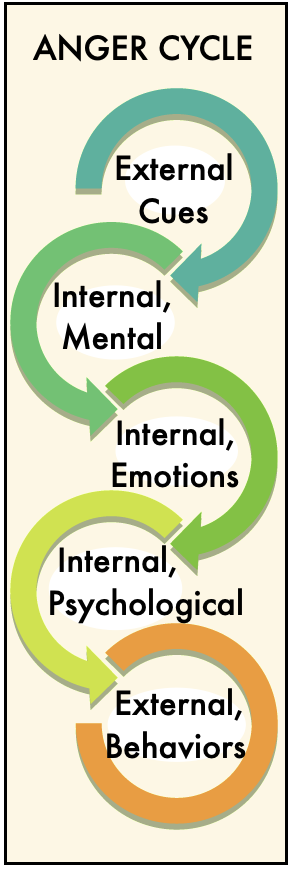
🔥ANGER CYCLEunhealthy responses to events which hurt, frustrate of scare us :
1. Trigger – by a loss, words, actions or anything that will set off anger
2. Internal Reaction – pain, letting us know that something’s ‘wrong’

3. Intensification –  a chemical flush released in the brain, which dramatically increases heart rate & breathing.
This can give a volatile person an excuse to justify how they’re feeling, but most of the time the anger is from distorted thinking.

4. External Barrier Break – some obvious signs of anger can be clearly seen by others, such as crying, angry gestures, shouting verbal threats….
5. Explosive Peak – a verbally &/or physically violent expression of anger. Dangerous to others, but also to ourself – by saying or doing things we may not really mean but will get us in trouble

6. Exhaustion & Withdrawal – when the anger / rage had died down or dissipated, then intense self-judgment follows
7. Final Stage
a. Remorse & Apology : with some people – when they realize they’ve over-reacted – will admit their error & apologize
OR
b. Intense Justification : others (especially narcissists) will not admit they’ve done/said anything wrong, & find a ‘good’ reason for their behavior, including blaming others for causing their upset

REPEAT the above pattern – Whether one is a chronic or occasional rager, without Pattern Correction, this cycle will continue.  (From DAMBREAKER)
(⬆️ Anger Cycle chart from extensive ClinMed article)

NEXT: Anger triggers (Part 2)