ACoAs: Getting to our EMOTIONS – Over (Part 1)

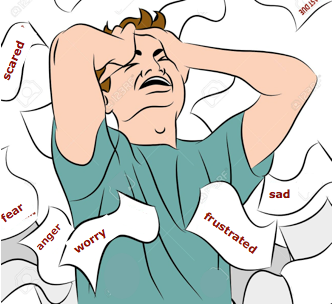
too many Es HELP, I’M overwhelmed –
I can’t cope with all these feeling!

PREVIOUS: ‘Under-Feeling’ (review)

SITE: “Handling emotional overwhelm


1. IN THE PRESENT
– emotional intensity comes from the Wounded Inner Child (WIC), who had to stuff & store all the hurt no one helped us process in childhood, day after day, year after year! “If it’s hysterical it’s historical”,

• Our self-hate, guilt & shame add to the mountain of misery we already carry, as well as staying with emotionally unavailable &/or outright abusive people.
Yet we stubbornly resist doing emotion-release work because we say we don’t want to feel the WIC’s pain – while we’re creating more pain with our damage!  Over-Feelers (O-Fs ) are already suffering! Why not clean it out & be done?

• Being swamped with old pain (and new) blocks our ability to have pleasure! We know we’re not happy but are so used to misery, we believe we’ll never be free. “Does a fish know it’s wet?” Unexpressed grief & rage keeps us stuck obeying our Toxic Rules.

• ACoAs need permission and courage to express distressing Es. Also, learn how to handle them appropriately whenever they surface, expressing them in the right places & in safe ways.

• One reason O-Fs are afraid of letting out intense rage & terror is because we honestly don’t want to hurt others. But sometimes, when our huge abandonment button gets pushed, our Inner Sadist (I.S.) raises it’s head, & we can’t stop ourself from saying & doing cruel things.  Afterward we feel guilty, ashamed & remorseful.  So O-Fs try to push big Es down too – just not as successfully as U-Fs.Screen Shot 2015-07-11 at 4.14.10 AM

IMP: If you’re over-sensitive (O-F) AND see it as a character defect – brainwashed to believe that by dysfunctional parents because everything seems to upset you, consider this:
• You were born with an very active limbic system (brain-seat of Es)
• It’s like having hyper-sensitive pale skin. If you’re out in the sun too long – without protection – you’ll get burned

• So too, an emotional ‘sensitive’ will have intense reactions to being burned by years of emotional abuse & neglect as a child – without the internal protection of an adult brain, & externally without safe adults to protect our little body & heart!   NOTE: It’s not the sensitivity but an abusive childhood that’s at fault!

2. OVER-FEELING (O-F)
a. Damage
O-Fs have a hard time holding in Es when hurt, so growing up we were scolded, punished, made fun of & misunderstood – everywhere.
We cried too much, were depressed, felt suicidal, threw tantrums, were clingy or rude, withdrawn or flamboyant…. The more we expressed our pain, the more we were abused, so the more pain we had to endure. AND – the more we showed distress at being abused – the more we were punished for it! Vicious cycle.

EXP: Jinny was a bright, intuitive & hyper-sensitive teenager. Not only had she been emotionally & mentally stressed since birth, but then hormones kicked in. Her ACoA parents had no clue how to deal with her – the narcissistic mother wanted her to ‘shape up’ & the depressed father identified with her but was powerless himself. One evening, in the kitchen, yet another insensitive comment from her mother set Jinny off & she began sobbing.

— Her father came in & told her to stop, which made she cry harder – so he slapped her.  His reason: “You were hysterical & I was trying to snap you out of it”.  It’s something he had once read, so thought he was being ‘helpful’! UGH!
Jinny was devastated by his betrayal – as he was ‘the kind one’.  She knew she was not hysterical & could think quite clearly!  Not everyone can “walk & talk & chew bubble gum” but she could, yet her father never bothered to find out who she really was!
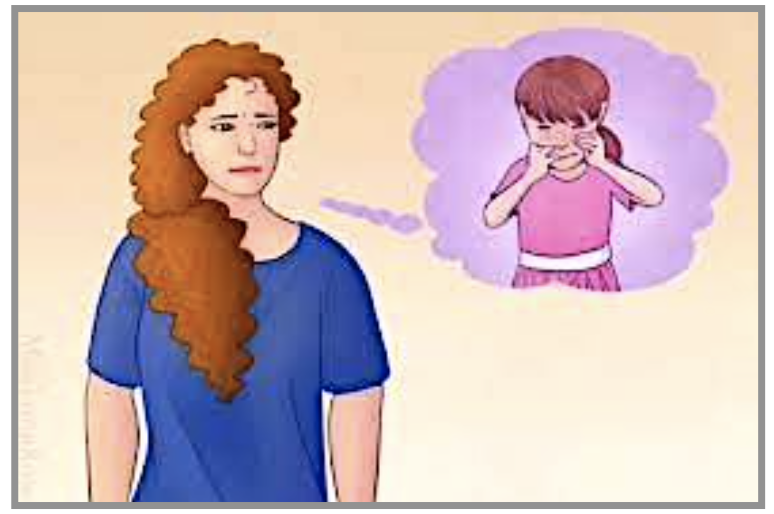
• As a result of our experiences, O-Fs often hate having emotions but can’t suppress them, so we despise them as ‘weakness’!
Growing up we were rarely if ever comforted, left desperately alone with our pain – profoundly terrifying for any child.  Combining no empathy with being penalized for expressing legitimate suffering = taught us to loath being Sensitive.

• This enormous backlog makes un-healed ACoAs very touchy & easy to flare up. One O-F woman in early Recovery expressed it as : I’m an emotional hemophiliac – touch me & I bleed”!

NEXT:  Over-Feelers – #2
ACoAs & Boundary INVASIONS (Part 2)

no limits

PREVIOUS: B. INVASIONS (#1)

ARTICLES: ‘Sexual Abuse / Trauma’
The Incestuous Family” – Roles re sexual abuse


BOUNDARY INVASIONS  
(cont)
2. MENTAL Coercion

3. Family SYMBIOSIS

a. Insecure parents :
push for an ‘us against the world’ attitude, hoping to increase family solidarity, powered by denial of dysfunction, & an unbearable threat to their sense of identity
can be over-protective.  On the surface it may look like love, but they’re only trying to keep us attached by dis-empowering us
📲 The underlying message is that we’re incompetent, weak & have to be afraid of everything

• may attribute the wrong motive to other kids or adults’ unpleasant/ abusive treatment of us, no matter what we actually did (cause trouble or not, be friendly or withdrawn….)
When we complained about the bullies, Mother may say: “Those kids are just jealous of you because you’re so much better than everyone else in the class”, which becomes the twisted thought “The boss doesn’t like me because I’m smarter than her”…. distortion

b. Distortions
 CDs cause many problems for children. IT :
• gave us a distorted view of how the world works, making it hard for us later on to take responsibility for our motives & action
• prevented us from – becoming fully socialize, taking normal risks & learning about the many options available in life
• severely increased our inappropriate school / social behavior, making it easy to be a target for bullying, insuring distance from peers, & forced to stay dependent on the family

Familiar phrases: Blood is thicker than water Never air our dirty laundry in public  ~  No one else will love you like we do
~ You’ll never make it on your own so we’ve got to stick together ~ We’re better than ‘those’ people
OR a childhood taunt:  “You have a face only a mother could love, & she died”!

c. Family Insularity is an attempt to feel safe BUT built on fear-based rules that inevitably lead to constriction, intolerance & an inability to collaborate / cooperate well with others.
Ironically it also creates isolation, scapegoating, unhealthy alliances & splits inside the family, which then get repeated in adulthood.
EXP: A  part of the dysfunctional family mobile, being trapped in a toxic ROLE, (Scapegoat. Lost Child….) had “negative benefits.” It seemed useful by ‘protecting’ a parent from their emotional problems, the consequences of their addictions, & whitewashing outright abuses.
As adults we look for the same kind of payoff when playing out our Role in the larger world (protecting a mate, boss….), which doesn’t work now either, only reinforcing our sense of being a failure.

4. Parental NARCISSISM (N)
a. Boundary invasions
• Ns require that everyone be their carbon copy, with no room for children to develop their individuality
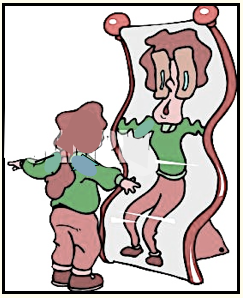
• children need mirroring (reflecting back who the other person be like meis, without adding anything of oneself), but Ns can’t do that since they’re only projecting themself on to the child

Narcissists don’t recognize there are such things as Bs, that others are separate & not extensions of themselves. People either exist to meet their needs or may as well not exist at all. Anyone who provides narcissistic ‘supply’ will be treated as if they’re part of the controller, who demands the victim live up to their expectations (think: spider & fly).

• Some N. phrases:
“What’s yours is mine & what’s mine is nobody’s business”
“Do as I say – not as I do”, “Put a sweater on, I’m cold”
“No son of mine is ever going to…..”
“This is the thanks I get – after all I’ve done for you”
“Do that in the morning when you’re fresh” said by a mother always raring to go at 6 am, to her child who was born a dyed-in-the-wool night person!
Watch ‘Angry-martyr Narcissist” on YouTube

b. Role Ambiguity
Parental N. spawns much identity confusion. Since only their needs count, the children take on a parent role – “I am them”, & many a parent acts like a needy kid – “They are me”.

Family members aren’t sure who’s in or out of the clan, who’s performing what tasks or legitimate roles : Dad acts like a ‘girl’ , Sis is the ‘mom’, little Brother is the family shrink…..

Al-anon IMAGE: A co-dependent decides to kill himself by jumping off the roof of a tall building.  As he’s falling, someone else’s life flashes before his eyes!

NOTE: If you have firm boundaries in the face of a narcissist, the relationship won’t usually last! Good – better for you!

NEXT: B. Invasions (Part 3)

ACoAs & Boundary Distortion (Part 3)

I GOTTA GET OUT’a HERE –but I’m stuck in YOUR mud!

PREVIOUS: B Distortion (#2)


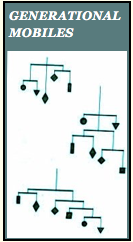
The Family MOBILE
• All of us grew up as part of a larger generational inter-connected mobile – even if we were cut off from actually spending time with various relatives.
A mobile is a collection of objects that is in constant motion within a framework. A family is the most complicated, ever-changing one that exists, made up of human personalities.

The stability of a mobile depends on all the parts being in balance, in a specific relationship to all other parts.  But balanced does not automatically mMobiles-aquean it’s beautiful, safe from falling apart, nor having lots room to move.

IN unhealthy families, everything may look fine on the outside, but the mobile is barely holding together, or is so rigid it can’t move at all.  In the ARTICLE : “My 10-year-old says no one cares about him, and talks of suicide – the mother is shocked because she thinks everything is fine!

EXP Addicts upset a mobile’s very delicate symmetry. Their unpredictability, violence, contempt & self-focus distorts much of the family’s interaction. To keep the mobile’s skewed ‘balance’ other members try to adapt by:
— absorbing the addicts anger, & suppressing their own
— denying the effect of the addict’s behavior on everyone in the family
— avoiding the addict, while trying to cover up the dis-ease to outsiders
—> forcing each one to become progressively more skewed to make up for the addict’s constant disruptions, causing long-term damaged & being co-dependently trapped in that state.

• Dysfunctional families are always crammed full of confusion & chaos. But there are also rules that must be followed to keep the mobile from totally collapsing.
a. Equilibrium
On the one hand, no matter how distorted the mobile, each person has a part to play in keeping the status quo, called homeostasis. And just like an inanimate mobile returns to its normal state after being shaken up, so do families.
So if the addict goes into treatment to get clean & sober, their return to the family is often met with great resistance – & anger. They’ve changed too much – the role they originally played isn’t available, undermining the shape of the familiar structure, sending the whole setup tilting uncomfortably off its normal axis.

• If it’s the father – the most common way to regain the old balance is for the spouse, & even the kids – to manipulate the recovering person back into their original role by sabotaging their growth & getting them to drink or use again

• A better way would be to form a new mobile. But this is much harder, met with a lot of anger & may never work : every member of the family – still living at home – would have to face their own damage & make serious changes

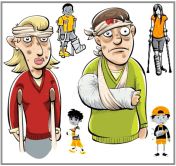
EXP: Picture a broken arm that was never set professionally – it ‘heals’ crookedly & is only partially useful. To make it fully functional again it will have to be re-broken & set, then patiently wait for it to heal, maybe needing rehab & re-learning how to use it correctly!
It’s scary, painful & tedious. Broken lives & broken families are like that too, so people would rather keep to the twisted well-known ways than having to fix the problem in Recovery

b. Fragility
On the other hand, we learn how precarious the dysfunctional mobile actually is. Because members of a wounded family are bound by symbiotic needs rather than healthy egos – with self-hate, fear of abandonment & distorted boundaries – there’s little room for ‘error’ in the system (newness, difficulties, unexpected changes, expansion…). This mobile, with all its convoluted problems, has been jury-fragle castlerigged, held together by Toxic Rules & Toxic Roles.

• While it appears solid & inflexible / rigid, it’s actually too fragile to withstand any major shift, such as one person becoming sober or another going into Al-Anon / ACoA Recovery.
Unless other members are also willing to grow & be supportive, like at least one of the adults doing some deep soul-searching…. the family unit will fall apart. This is particularly threatening when there are small children, so members will do almost anything to keep the (sick) status quo.

NEXT: DETACHING w/ Boundaries, #1

Loneliness in RECOVERY (Part 2)

separation I’M NOT  LONELY AS OFTEN
now that I have myself!

PREVIOUS: Recovery Loneliness (#1)

SITE: Stop being Lonely in Recovery

The middle A : ACCEPTANCE  (PART 3)
Recovery (Rec) Loneliness is part of the process, so it’s normal & to be expected
(cont.):

4. Accept temporary Rec. loneliness of……
….. re-evaluating all our relationships. At first we just become aware of the problem, slowly we consider leaving the most blatantly inappropriate / abusive people, then eventually catch the more subtle ways people are harmful, unavailable or just plain unsuitable for us, no matter how good they look ‘on paper’leaving

….. realizing that actual ‘leaving’ comes in stages too. Some people just drift away, some we have to have a talk with, some will not accept the loss & pursue us.
And then there are the relationships we’ll keep falling back into – even when we know they’re not healthy for us, because the WIC is not ready to let go of them, so we’re conflicted. When the kid is sick & tired of being sick & tired (being on the same page as the UNIT) – we move on, with little or no regret!

5. Accept temporary Rec. loneliness of……
….. an increasing Awareness (the first A):
• of anyone one who is not ‘all there‘, We may live them & they may not be a bad person BUT they’re shut down, distracted, narcissistic, not available – fir us. We are truly alone with such people & we don’t like that anymore! (YEAH!)
• that we get confused when someone tries to ‘help’ us, yet we still feel angry, alone, lonely, misunderstood.
Screen Shot 2015-07-12 at 7.57.56 PM— Sometimes this is because the WIC is still not allowed to be helped by anyone, BUT more often
– we’re legitimately picking up that the solicitousness to help is tainted, because they’re controlling, narcissistic, people-pleasing or a rescuer.
We come to realize that it’s being offered for their benefit not ours. That leaves us alone – again!

• that in early Recovery we tend to idealize NEW support people or groups who are genuinely helpful, kind & gentle. This is the WIC experiencing them as the Good Parent, rather than just healthier peers. As long as we idealize anyone – we will be let down & disappointed when they don’t / can’t live up to our fantasies.

✶✶ However, for those of us with parents still alive – a very important & powerful Recovery experience is when we finally ‘get it’ that being with our unhealed family IS being mentally & emotionally alone – no matter how well behaved they may be with us in the present.
It’s not just our imagination or some flaw in us. It’s that they haven’t done the ‘work’ & are still shut down, still ‘active’, still self-centered…. so our connection is superficial. We want more, but they’re simply not available.dumping everone

a. Too fast – re letting go
When we first truly see of how unhealthy / harmful many of our long-term relationships are, some of us will want to get rid of everyone right away, & may start dumping our whole phone book.

If the phone list is very recent, that may be appropriate. But it doesn’t make sense to compulsively throw the baby out with the bath water.  Ending all old relationships at once – if at all – will be too jarring, leaving us bereft of any connections before we can replace them with more loving ones.

b. Too slowly : At the other extreme are those of us who procrastinate, taking too long to separate, especially those long-term relationships that were once important to us. We’re afraid of —
— being disloyal (even tho they are not worthy of it)
— hurting their feelings (even tho they rarely considered ours)
— losing some fun, good things about them
— the loss of our illusions about how badly they treat us, even tho we’ve always really known there was something wrong, but couldn’t admit it. It’s scary to realize how off our thinking has been.

NEXT: Recovery Loneliness – Part 3