ACoAs: Lack of TRUST (Part 1)

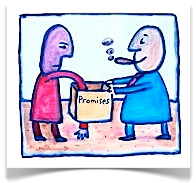
con man
WHO CAN I DEPEND ON?
for sure NOT my family!

PREVIOUS:
 Early Trust Betrayal

REVIEW post: ‘Parents Blaming us


LIFE STAGES Erik Erikson, a German psychoanalyst heavily influenced by Freud, developed a psycho-social theory of personality development, which included the impact of external factors (parents & society) ON our:
• ego identity (the self)
• personal identity (what distinguishes one person from another)
• social/cultural identity (social roles we might play)

Erikson’s theory says every person must pass through a series of inter-related stages over the entire life cycle —>   AGES:
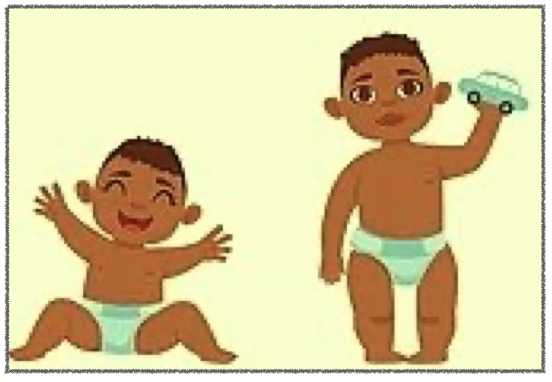
1. Infant   (Hope) – Basic Trust vs. Mistrust 
Birth to 18 mths
2. Toddler  (Will)    – Autonomy vs. Shame
18 mths to 3 yrs (MORE….)

IN Infancy (Stage 1) the main emphasis is on parental ability to nurture & care for the child, especially using visual contact & touch, so that :
• in a safe environment the child will develop confidence, optimism, security & trust
• in an unsafe home, they’ll develop insecurity, worthlessness & general mistrust of the world

In an episode of LIE TO ME, (TV series, Fall 2010), Dr. Lightman says:
“The way to make a disturbed personality is: Constant Criticism & Lack of Affection – it works every time” !

DEF. of Legitimate Trust
Re. OURSELVES 
• be able to rely on our own observations, judgement & intuition
• when exposing vulnerabilities to someone, assume they won’t take advantage of or abuse our openness, but know we can’t control their reactions
• have confidence placed in us by someone else, & accepting the obligation that entails
Re. OTHERS
• identify how someone is going to act (predictably good or bad) & gauge our probable losses & gains. It’s based on what we already know about them, using their past performance as a guide
• have a firm belief in the integrity, ability or character of a person or thing, from our own experience, or based on accepting the opinion of a highly reliable source
• Hope: to be able to rely on something or someone in the future / to expect a specific outcome with assurance

NOTE
• The Healthy Adult ego state knows no one can be perfectly dependable, & that the wish for it isn’t possible – so we wouldn’t expect it.
Secretly demanding others to be absolutely 100% ‘safe’ (before we can trust) is UNrealistic,  which makes us vulnerable to always getting disappointed, leaving us in the same old place – convinced that ‘no one’ is trustworthy

• There are legitimate reasons to not trust certain kinds of people – especially the not-so-obvious narcissists! – which we definitely need to acknowledge, & then stay away from.
Past experiences with them should not be ignored, especially as we become sure of our ‘evidence’.

EXERCISE : Keep a log for a month (or as long as needed) of each time you feel unsafe with someone, & see what patterns show up. Then take a small, definite action to change the situation or your part in the relationship

unsafeMISUNDERSTOOD
ACoAs often say : ‘I can’t trust anyone’ –  the focus being on people outside of ourself. This is B & W thinking & not totally accurate. Although it[s true that our parents were not safe, most of us do have/ or have had a few people throughout our life who have proven themselves trustworthy (even if not perfectly!).
❇️ Instead – trusting needs to be focused internally – on our own intelligence.

MAIN reasons we say this ⬆️ – is that unhealed ACoAs :
a. haven’t learned to trust our own observations, experience, & intuition!
b. keep picking & staying with toxic people, & keep getting burned. Strange that we’re surprised each time!
c. want / expect / demand the assurance that whatever or whoever we put our trust in will never ever let us down, disappoint, abandon or hurt us!

This demand is:
• B & W ‘all or nothing’ thinking (a CD) – typical of children & thdemanginge emotional immature

• the position of the WIC, who wants everyone to be the good parent we never had, so we don’t have to grow up & take care of ourselves
• an expression of co-dependence – being focused on others, outside of ourselves, instead of internally listening to what we know to be true

NEXT: ACoA Lack of Trust (Part 2)
ADULT Play – Benefits (Part 2)

family benefits
PREVIOUS: Adult Play (Part 1)

SITE: “The Power of Play” (long article)

QUOTE: “We do not stop playing because we grow old, we grow old because we stop playing”  – George Bernard Shaw


BENEFITS  of PLAY  (cont)
1. MENTAL //  2. PHYSICAL (Part 1)

3. EMOTIONAL / PSYCHOLOGICAL /SOCIAL Benefits
a. Reduces Struggle, Conflict & Worry – Because play includes using ones imagination & ability to fantasize, it acts as an antidote to violent tendencies, & so is a powerful catalyst for positive socialization.
Play provides us with an opportunity to choose alternatives to struggle, conflict & worry – that are healthier, more positive, promoting a sense of belonging & connection to other people.

Alice Miller points out that people neglected & abused in childhood were often deprived of developing an inner fantasy life – missing the ability to process rage & frustration in their internal world. They become lost in fear, anger & obsessive worry, making them more likely to become violent toward others, even to the point of murder

b. Mutual play heals emotional wounds  Screen Shot 2015-09-16 at 11.44.59 PM
Vigorous play triggers endorphins that lift spirits & provide distractions from pain, fear, stress…
When done with others, whether friends or strangers, it helps us connect in delightful & meaningful ways that minimize loneliness

• Regular play can also heal hurt feelings, anger & disagreements. Studies show that emotionally insecure people slowly replace negative beliefs & actions with positive ones by living with a secure partner.
Emotionally safe relationships heal, & create emotional resilience

c. Provides ‘role relief’ – This is not about the ACoA Toxic Roles but rather the normal set of roles adults take on, such as worker, boss, spouse, parent, sibling, adult-child….
Play allows us to guard against ‘role fatigue (burnout).  Taking the time to balance between roles helps to foster self-expression by using different parts of our personality, & makes room to practice new kinds of activities. Getting stuck in one role, such as ‘mom’ or ‘worker’ can reduce spontaneity & aliveness

d. Gives Opportunities to Take Risks  Successful, happy people know the difference between safe & unsafe risk, and take healthy risks in small doses. We can choose to risk something important to achieve a goal of benefit.

We also need to manage incoming risk as an essential part of a full, healthy life. PLAY lets us experiment, explore & take risks with ideas & activities without worrying about consequences that could happen in “real life,” & teaches us that our fear-based ideas are not always true.

e. Brings joy into our life – A basic reasons for playing is simply the sheer joy of it, a happy state of being. So playing as often as possible can preserve & nourish our own hearts & that of our community. It creates laughter, & a feeling of inner peace, encouraging emotional resiliency

4. SPIRITUAL  
❖ Sense of Lightness – Keep in mind we’re made up of Physical, Mental, Emotional & Spiritual (PMES) components.play is spiritual
The spiritual benefits of play are not easy to verbalize, since people have different meanings for this aspect of life.  But it’s a very important part of our personal well-being, & our right to develop a healthy Self.

In childhood we start to give meaning to our life through story-making & playing out various possible scenarios. As adults the ability to play & be active in things that suit our True Self – strongly promote a sound lifestyle

• Being absorbed in fun activities & caught up in the moment —> eliminates self-consciousness. Infused with pleasure, we delight in the sheer “lightness of being”, stimulating creativity.
Spiritual benefits can mean
 we : love being alive, have a positive attitude, being the best we can, having a deeper understanding of the world & its possibilities
Spiritual benefits include: refreshing & recharging, restoring optimism, changing perspective, renewing our ability to do the work of the world

environment play❖ Enhances our Humanity – Play can have value on a broad scale – an important expression of our humanity, both imitating & advancing our progress.
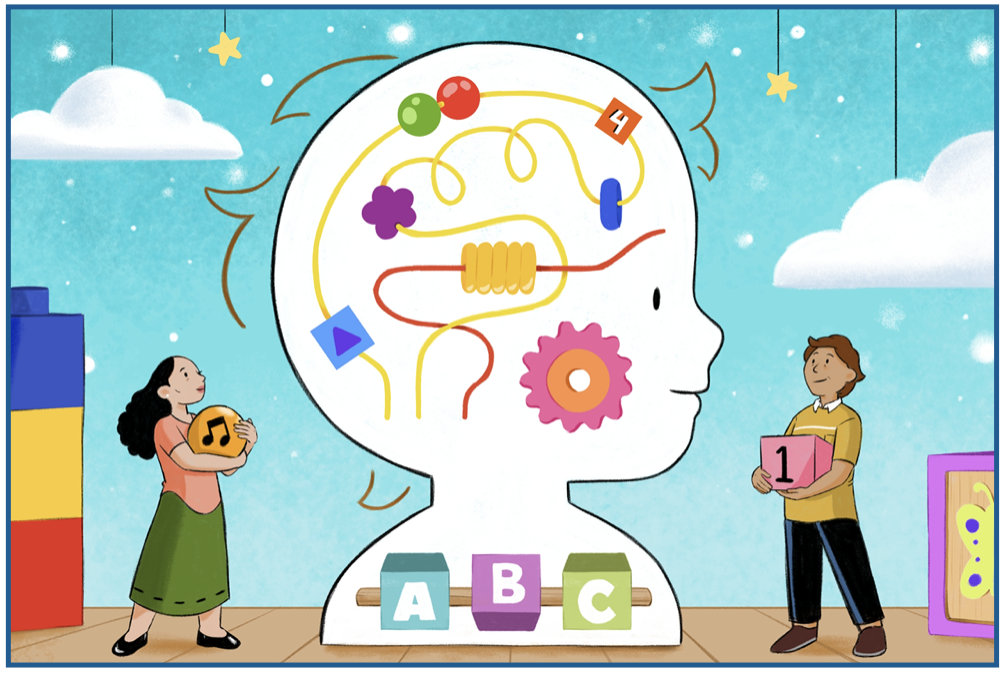
Play appears to allow the brain to exercise its flexibility = maintaining & renewing neural connections that embody the human potential to adapt, & meet many environmental conditions.

❖ Preserves the physical world – Recreation & leisure can protect the environment, as it gives us a reason to keep our surroundings clean and beautiful, which promotes a healthier planet.

NEXT: Early Trust Betrayal (Part 1)

ADULT Play – Benefits (Part 1)

beach funPREVIOUS: Adults – the NEED for Play

BOOK: “Play: How it Shapes the Brain,  Brown, S. (2009)

QUOTE: “It is utterly false & cruelly arbitrary to put all the play and learning into childhood, all the work into middle age, and all the regrets into old age. ~ Margaret Mead

BENEFITS 
Playing is not only as an activity but also a state of mind which makes life enjoyable, whether we’re participating or just watching. It’s a form of release which allows us to connect with our Healthy Inner Child & the HIC of others.
Shortages of the following benefits of Play predict possible health problems & emotional fragility

1. MENTAL
“I see Play as a way for women & men to establish mental balance, & embrace a healthy form of comfort” ˜∼ Jennifer Louden, Women’s Lifestyle expert
PLAY :
a. is a doorway to learning – a hands-on, minds-on learning process. The components of play are the same as those of learning :
– curiosity, discovery, games, novelty, pretense, risk-taking, social etiquette, trial and error, & other increasingly complex adaptive activities
play & learn
Play makes it fun to learn  perseverance – the rewards for mastering a new game shows us that it’s worth sticking to something – a necessary trait for healthy adulthood.
>> Perseverance & violence are rarely found together

b. inspires us to Think DifferentlyWalt Disney was dedicated to play, & his willingness to buck conventional wisdom changed the world of entertainment. He didn’t let criticism get in the way of his child-like imagination.

An Apple Computers ad: “Here’s To The Crazy Ones. The misfits. The rebels. The trouble-makers. The round pegs in the square holes. The ones who see things differently.
They’re not fond of rules & have no respect for the status-quo. You can quote them, disagree with them, glorify, or vilify them. About the only thing you can’t do is ignore them.
Because they change things. They push the human race forward. And while some may see them as the crazy ones, we see genius. Because the people who are crazy enough to think they can change the world – are the ones who DO !”

We’re always creating our experiences in life, so why not have some fun & develop a thirst for curiosity, like Leonardo DaVinci. The renewed sense of imagination could be endless!

c. Reduces Risk of Alzheimer’s & Dementia – according to various studies – challenging your mind with mentally stimulating leisure activities is great for your brain’s health (board games, cards, crossword puzzles, reading, playing musical instruments, writing, slow walking….)senior fun

Apparently these activities trigger chemical stimulation, resulting in an increased ability to learn, & possibly the ability to deal with or compensate for physical changes linked with dementia. (CHART….)

Play takes the mind off stressors, giving the body a chance to restore itself. Seniors who participated in activities they enjoyed, once a week for about 20-years, reduced the risk of dementia by 7% or more.

2. PHYSICAL
❖ Reduces Stress & Enhances Energy Levels – Too much stress increases chemicals such as cortisol & nor-epinephrine, which disrupt the immune system, making us feel edgy, hostile, and can lead to heart disease.
Dr. Blair Justice, Psych professor at Texas U. says: “Playtime is also essential to help adults relieve stress. You don’t have time to make yourself sick”.

• Body Movement is most often associated with PLAY, for children & adults  :
> exercise – releases sugars & fats into the bloodstream, while stimulating endorphins. It’s great for heart health, reduces hypertension & cholesterol, improves neurological & spinal problems, burns off stress-related hormones & improves sleep excercise

> sports – When we jump on or over stuff, play football, dance, run…. we receive the pure pleasure of feeling our bodies move & work. Dr. Stewart Brown defines it as “the spontaneous desire to release ourself from gravity”

> entertainment, which is fun & soothes tensions.  An online survey by RealNetworks, Inc., a ‘casual games’ developer, found: 53% play for stress relief
64% play games as a way to unwind & relax
42% believe game play is a way to keep their mind sharp
75% of responding parents see educational benefits for their kids

Less stress + more play (in the right proportion) increases longevity.

NEXT: Benefits of Play (Part 2)

ADULTs – NEED for Play

fun sailing

TAKING THE TIME TO PLAY
is needed by all adults

PREVIOUS: Play Experts (#2)

SITE: Fun & Importance of Play”

QUOTE: “Surround yourself with people who take their work seriously, but not themselves, who work hard & play hard.”  ~ Gen. C Powell

PLAYING def : “Most importantly, the activity should not have an obvious function in the context in which it is observed – meaning that it has no clear goal.”  Scientific American

Animals and Humans
Jacob L. Moreno 1889-1974), the father of Psychodrama, wanted to be remembered for bringing laughter into psychiatry. He said that happy people tend to play a variety of roles allowing for rest, relief & rejuvenation, which increases spontaneity & creativity.
If “the un-examined life is not worth living” (Socrates), then “the un-lived life is not worth examining!” (Zerka Moreno, psychodramatist)

• Humans become more successful adults when they had the freedom to play as children. “Welcome to Your Child’s Brain…” tells us that play activates our brain’s reward circuitry, but not its negative stress response – so it encourages attention & action (“How does the brain develop?”) , (“This is your child’s brain on Play“)

🔔 Through play we learn to :
Analyze, Evaluate, Hypothesize, form and substantiate Opinions, Question, Predict & Persist through adversity.

• Play is widespread among all non-humans, beyond the familiar cases of mammals & birds, to vertebrates, even invertebrates, from lizards to squid. Play helps all species learn adaptive behaviors that increase their chance of survival, & provides :
> a safe way to release aggressions
> time to learn adult behaviors

INDICATIONS of animal play – IT:
1.  has no immediate survival purpose – voluntary & seems to be done for its own sake (pleasure)
2. resembles a serious behavior, like hunting or escaping, but by young animals, & is awkward, exaggerated or modified
3. is usually seen when an animal is not under stress or doesn’t have something more ‘important’ to do (eating, sleeping or mating)

TRUE STORY, from Stuart Brown, pres. of the Nat. Institute for Play:
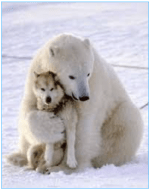
In a Northern freezing wasteland of snow & ice, a polar bear stalks a line of sled dogs. The bear picks out the last in the line & begins a predatory stalk towards her.
Onlooking breeders & trappers watch in horror as death slinks towards one of their prized dogs, & no one has a gun to defend her. The doomed dog turns & bows before the bear.

But this is no bow of submission. She raises her rear high in the air, face smiling, tail wagging in a “play bow.” The bear rears up on hind legs & pauses in slight confusion, then bows down & begins to play with her.
They enjoy a raucous romp in the snow, tumbling, nipping, yelping & chasing, before the bear finally gets exhausted & leaves. The bear comes back every day for two weeks to see the dog AND play!

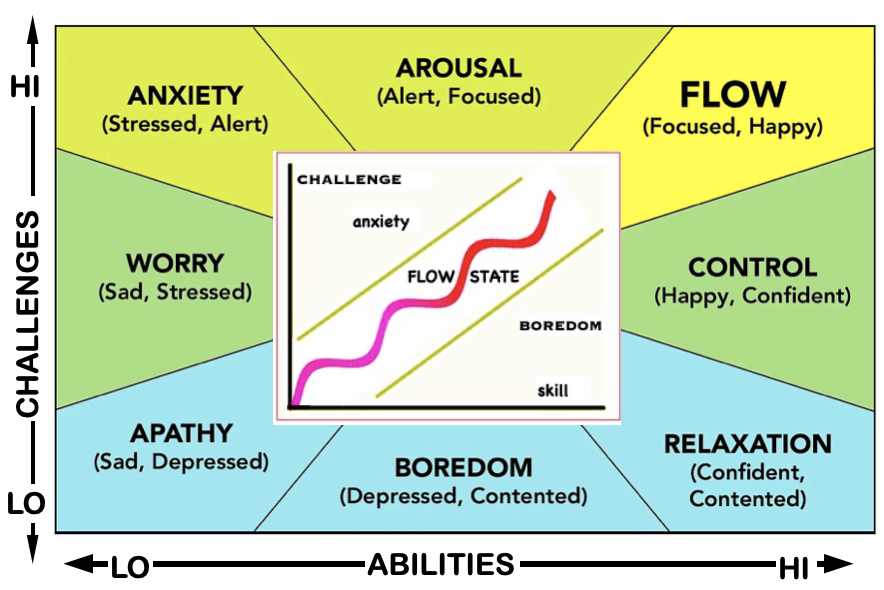
Play, creativity & flow.  Psychiatrist / author Mihaly Csikszentmihalyi coined the idea of “flow state” (in the zone), having studied play extensively, searching for things that contribute to a life worth living

He explained that to be in flow, PLAY has to have just the right balance of difficulty & ‘solvabity’. If the game is too hard or too easy it loses its sense of pleasure. All participants, regardless of age or ability, must feel challenged but not overwhelmed

• Having at least one activity we do regularly just for fun is important for our ‘happiness quotient’. When we get really engrossed in an enjoyable activity, it puts our brain in a near-meditative state

It can sharpen many skills, express creativity, help solve big problems, or just blow off steam. Sometimes the best way to learn a complicated subject is to play with it. ALSO – physical play delays mental decline in old age.

FLOW STATE provides:
> Clarity – great inner sharpness & a built-in understanding of things
> Confidence – not feeling anxious or bored, having an built-in sense that the activity is do-able & that your skills are up to the task

> Delight – a sense of bliss & positive detachment from everyday reality
> Involvement – complete focus & concentration, due to innate curiosity or to good skill-training
> Motivation – intrinsic understanding about what needs to be done, & a desire to keep the momentum of play going
> Serenity – sense of peace & absence of worries about oneself
> Timeliness – thorough focus on the present, & lack of attention to the passage of time

NEXT: Adult Play Benefits (Part 1)

PLAY-ing EXPERTS (Part 2)

wise owl - 2
FUN WISE OWL SAYS:
“Play help us be the best we can be!”

PREVIOUS: PLAY-ing EXPERTS (Part 1)

QUOTE:  If you want creative workers, give them enough time to play. ~ Actor John Cleese

 MORE Play EXPERTS
Piaget (1962)
wrote that children learn primarily by doing, & that Play is the main way they take in their surroundings, absorb it into their thinking about the world, & use it as psychic nourishment. It’s what Maria Montessori called the “absorbent mind of the child”: they soak up their environment, and by taking it in, they become it.

Karen Hutchison is a play advocate and expert, teaching at Rowan University, & the U.S. delegate for the International Play Association’s “Right To Play Award” in 2012.
She’s concerned that in recent years Play is under attack. It’s being curtailed in the U.S. by parents trying to protect their kids from harm or over-scheduling their ‘free time’, while schools are cutting recess for economic reasons. Since the 1970s, kids have lost, on average, 9 hours of free playtime a week!
She messy playcommented: “True play is unstructured. It’s messy & it’s child-initiated. Not allowing them to go onto the playground to get scraped knees & even broken arms – is doing more harm, by preventing them from learning what they can or can’t do. Experience is the best teacher. That’s what play is all about.” (MORE….)

Gary Chickanthropologist at Pennsylvania State U, focused his studies on the non‐Western cross‐cultural validity of the concept of leisure (Article)

Johan Huizinga
, the Dutch historian, cultural theorist & professor, wrote in “Playing Man” (1938) that Play is an important component of culture & society. The book lists general RULES:
> Play is free, & is in fact, freedom
> Play is not ‘ordinary’ nor ‘real life’, separate in both location
> Play creates order, absolute & supreme order, demands order
> Play is not connected to material interest, & no profit is gained from it.play circle

Huizinga considered it to be a most basic human function, calling it the ‘magic circle’ of human activity that permeats all cultures from the beginning, expressed in creative language.
“Play is older than culture, for culture always presupposes human society, & animals have not waited for man to teach them their playing.”  One of the most important characteristics of play is that it’s fun.

• He noted that Play “absorbs the participant intensely & utterly…. proceeds within its own proper boundaries of time & space, according to fixed rules, in an orderly manner. Both free & structured play are meant to promote adaptive social behaviors & enjoyment, even though many adults consider the ‘loose’ type (unstructured) a waste of time.
It promotes the formation of social groupings that tend to surround themselves with secrecy & stress the difference from the common world by disguise or other means.”

Carl Jung, Swiss psychiatrist & one-time student of Freud, felt that access to the unconscious archetypal energies could provide the blueprint for profound change, when allowed to surface (conscious ego).
“The creation of something new is not accomplished by the intellect but by the play instinct, acting from inner necessity. The creative mind plays with the objects it loves….. Without this ‘playing with fantasy’ no creative work has ever yet come to birth. The debt we owe to the play of the imagination is incalculable.”sand play

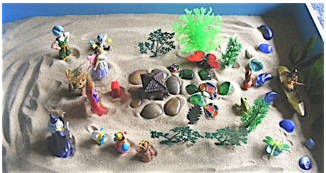
• An extension of his work is SAND PLAY, originally developed by Margaret Lowenfeld in the 1930’s. It’s a self-directed learning & therapeutic tool that emphasizes nonverbal, symbolic work in sand, similar to dreamwork, believed to tap into very deep levels of consciousness that helps heal and enlighten

Frank Salamone is a prolific anthropologist & writer. His book Society, Culture, Leisure and Play: An Anthropological Reference” (2000) is a collection of 42 articles about the many facets of leisure, taken from his almost 30 years experience in the field, ranging from adornment to weaving, with considerable depth about music and the other arts.

NEXT: PLAY-ing EXPERTS (Part 3)

PLAY-ing EXPERTS (Part 1)

clever owlCLEVER WISE OWL SAYS:

“It’s good for us to play

PREVIOUS: Childhood Play – Stages (#2)

ARTICLE: “The Importance of Play


ACoAs: Some of us may still think this topic is frivolous, not to be taken seriously. We seem to be even more afflicted than most people with the ‘Adult Syndrome’ – which is not seeing ‘nearby objects of amusement’, oblivious to the possibilities of joy

In fact, each of us DO have the ability to draw on a happiness & sense of humor that comes from inside. But we’ve been so conditioned to work hard, to suffer & shut up about it! that we can’t imagine ‘letting go’. It makes us uncomfortable, squirming in our seats.
You can’t ask us to just sit around & relax, do nothing, & try to have fun. For some that’s pure sacrilege, for others blatant disobedience

SO – it might helpful to read what some of the many students of Human Nature have to say about Play.

“Free play”, the purest form, is what kids are designed to do – imaginative, independent, self-motivated & unstructured – where children initiate their own games, & even invent their own procedures.

Free play is critical for “becoming socially adept – allowing children to develop competence, exercise self-control, follow rules, form interests, learn to –animal play–> get along with others, make decisions, make friends, regulate their emotions & solve problems” – without being traumatized! WOW.

Research into animal behavior confirms Play’s benefits, establishing its developmental importance : Playing & being playful provide animals & humans with skills that help them survive & reproduce

EXP: According to the AMA, when adults take a vacation from work, even a 4-day weekend, we’re more inventive, productive & healthier (fewer sick days) when we return
> And, a study led by Princeton researcher Alan Krueger found that people are at their happiest when involved in leisure activities

• There are many books, articles & whole organizations focused on PLAY, such as —> The American Journal of Play, The National Institute for Play, the National Museum of Play, the National Toy Hall of Fame, The Strong (educational institution studying play, in upstate NY), the Brian Sutton-Smith Library and Archives of Play, the International Play Association, the International Center for the History of Electronic Games…..

Some EXPERTS
Many of the most prominent researchers in the field of psychology (Freud, Jung, Piaget, W. James, Lev Vygotsky….) considered Play an intrinsic part of being Human, & had strong views on how important it is to child development.Freud
Freud regarded play as the way children accomplish their first great cultural & psychological achievements – noting how well & easily it allows them to express their thoughts & emotions

This is true even for an infant who may ‘only’ be returning its mother’s smile, called Attunement Play. He believed that young children could be unaware of or overwhelmed by their emotions, except by acting them out in play-fantasy.
> Other psychoanalysts noticed how children use play to work through & master quite complicated psychological problems of their experiences, which led to Play Therapy.

Dr. Stuart Brown, psychiatrist, in the late 1960s, was assigned to evaluate Charles Whitman of the U of Texas Tower massacre, & later interviewed 26 convicted Texas murderers for a small pilot study.

He discovered that most of the killers, including Whitman, shared two abuse/no playthings in common : they were from abusive families, and they never played as kids.

Since then he’s talked extensively to almost 6,000 people about their childhood, & again found “that a lack of opportunities for unstructured, imaginative play can keep children from growing into happy, well-adjusted adults.”  At age 76 he’s still hooked on playing. (TED Talk)
Research by Jenkins & Astington, 2000 / Leslie, 1987 / Singer & Singer, 1990 & 2005 – showed that make-believe (Pretend) play is closely related to the “Theory of Mind”. This important concept has to do with an awareness that one’s thoughts may differ from those of other people, and that each of us is capable of a variety of perspectives.

NEXT: Play-ing Experts (#2)

Childhood PLAY – STAGES (Part 2)

jump rope 

I WANT TO PLAY WITH MOM & DAD
but not too much!

PREVIOUS: Children & Play (Part 1)

SITE: Ages & Stages of Child Development 


DEVELOPMENTAL STAGES of Play in Early Childhood
(cont.)
4. Parallel P  (Part 1)

5. Associative P.
This is when children start to see the value in playing with others, but test their boundaries. They don’t ignore their own interests, with a mild attempt to control who can & can’t be in the group. They’re involved with what others are doing – all play the same games, talk about what they’re doing, borrow & lend play things, follow each other with trains or wagons…. without assigning tasks & materials, or choosing a goal. They may alternate playing with others & then on their own

SKILLS which help build friendships:frindship play
• Cooperation (if we work together we can make our city even better!)
• Language development (what to say to get their messages across)
• Problem solving (how can we make this city bigger?)
• Socialization (what should we build now?)

3 – 4 yrs. old: They play cooperatively together, taking turns with other children. Show more reasoning skills & ask Qs re. ‘why’ and ‘how’.
Recognize shapes, letters, colors, & can solve jigsaw puzzles by combining thinking by trial and error. Play imaginatively (play house, dress-up //  make sandcastles, collect rocks…).

6. Cooperative Play
When children focus on a joint effort rather than on themselves, bringing together all of the social skills they’ve been working on, and putting them into action. Play is organized to:
–> make a tangible object, reach a competitive goal, dramatize situations of adult & group life, or play formal games.
At this level there’s usually one clear leader, play is structured, & they work together toward a common goal. This can cause conflicts, but also can be resolved quickly

Co-op Play allows mastery of important new social skills:
Obeying rules: Most want very much to win, even if it means cheating
Negotiating: Must learn to give as well as take, to compromise on what they want – all of which is hard to acceptsharing when you’re the ‘center of the universe’

Sharing: When little ones want something, the thought of giving it up to someone else is almost unbearable. It’s made harder by the confusing use of  ‘share’ – some things you’ll get back (a toy) some things you won’t (a cookie)
Taking turns: their desires are urgent & immediate. – “I want it NOW.” Delaying gratification is required, & being able to imagine what it’s like being the other children. Empathy already learned (hopefully at home) & during parallel play will help

> This stage may be seen in younger pre-schoolers as well, if they have older siblings or are around a lot of other children
• 4 – 6 yrs. old : They plays cooperatively, take turns & may enjoy table-top games. Start to understand & use symbols (for writing & reading).
Are better able to reason & figure out their experiences. Start to understand simple rules in games
6 – 8 yrs. old : They like to play with children of their own gender. Enjoy playing co-operative games in small groups a& making up their own games with rules, but usually don’t cope well with losing

ACoA INVENTORY re. Play Stages
IMP: Always start from the position that you are not deficient, even if the WIC doesn’t believe it, yet – but rather how you were raised.

Using Part 1 & 2, WRITE what you can about your play history. Keeping in mind the limitations & stressors of your childhood  :
• List what you did get to do – at each stage – what parts you missed out on, how each one turned out and what affect that had on you – emotionally.
• Given your present-day patterns, are you struggling with one or more of the stages?
• Identify if & how you’ve added healthy playing to your life in the course of Recovery (review the DEF of Play).

NEXT: STAGES (Part 2)

Childhood PLAY – STAGES (Part 1)

tea with bear EACH STYLE IS IMPORTANT –
I’ll have to try them all out!

PREVIOUS: Play  FORMS (Part 3)

BOOK “Play, Stress, and the Learning Brain


DEVELOPMENTAL STAGES
of Play (P) in Early Childhood
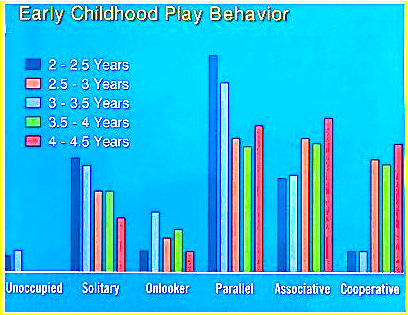
Mildren Parten (1932) proposed that children progress through SIX social levels of play, each one more complex & requiring more social skills to be able to interact successfully with their peer group.
Normal progression is from solitary >> to comfortable social interaction, as the child grows physically & psychologically

KEEP IN MIND: Types of play
Except for the infant, the stages are fluid, & can show up at different ages, depending on the personality & circumstances of each child.  — > CHART

1. Unoccupied Behavior
Babies mainly look at anything that catches their eye, including watching adults closely.
If nothing exciting is happening they’ll play with their own body, & later will get on & off chairs, stand around, follow an adult, or sit in one spot & observe. In spite of appearances, this is early play, setting the stage for future play exploration

Birth-6 months: Babies explore by putting things in their mouth & touching things with hands. They’ll play alone with toys, such as rattles & shakers or banging things with both hands
6-12 months: They look at & imitate adults, copy their actions – such as dropping things. Continue playing with toys alone, explore things with mouth & hands. Like simple games (peek-a-boo….)

2. Onlooker Behavio 
This is when children definitely spend most of their time watching others at play rather than other exciting things in the environment. They’ll stay near enough to maybe talk to other players, ask questions or give suggestions, but not participate.
Toddlers learn how to act when they’re ready to join in the fun. Watching the big kids play is a great way to learn the politics of the playground (no stealing shovels!)

12-18 months: They start playing with grown-ups & notice other children. Learn through trial & error, such as banging 2 objects & finding out the sounds they make. Repeat actions they enjoyed. Play & ‘talk’ alone.
> 2 & 3 yr olds in solitary play are learning how to keep themselves entertained, eventually setting the path for being self-sufficientlone play

3. Solitary Play
When children play independently, with toys that are different from those used by others who are within speaking distance. They make no effort to get closer, content to pursue their own activity without referring to what anyone else is doing. They’re still too self-oriented, don’t yet have much of a vocabulary, or may be shy, & are too interested in exploring the world around them to play socially

1.5 – 2 yrs old : Like to play with adults as well as alone.
Look at other children playing but don’t join in. Copy them and adults. Continue to explore things with mouth, and learn by trial and error. Like repetitive actions, such as putting objects in and out of boxes, and scribbling on many pages

4. Parallel P 
This is when children play independently but alongside other kids, with toys that are like the others but used in their own style, and don’t try to influence or modify what nearby children are doing.
They are in fact learning quite a bit from each other, because even though they don’t seem parallel playto be paying attention, they often mimic the other’s behavior. It’s an important bridge to later stages of play

1.5 – 2.5 yrs old: They show interest in what’s happening by pointing or squealing, but may prefer to do it from the safety of a caregiver’s lap
2.5 – 3 yrs old : They start to play near other children, & while not acknowledging each other, are happy to play separately side by side.  They continue copying them & adults.
Begin to show some reasoning skills, & using symbols in play (a stick becomes a sword). Much of the play is ‘imaginative’ (scolding toys). Still learning by trial and error.

NEXT: Childhood Play STAGES (Part 2)

Childhood PLAY – FORMS (Part 3)

kids playing

THERE are ALWAYS MORE
ways to play!

PREVIOUS:
Childhood Play- #2


FORMS of Childhood PLAY (cont)
2. Emotional
3. Mental

4. SOCIAL
Social P: a key part of fun activities, from the simplest romp or wrestling of young animals to the most humorous, complex banter of close adult friends.
The more children play with others – the easier they can move thru different social stages. How engaged they are & good at interacting with other children – can be observed, validated or corrected as needed.  Activities listed in Part 1

• Interacting in play-settings teaches children social rules, principles & standards…. such as give & take, reciprocity, cooperation & sharing.
Playing with others who are at different social stages also helps develop moral reasoning, to form a mature sense of their own values.play rules

Rule-governed P: by age 5-6, children like pretending, & playing formal games that have rules.  Piaget suggested this shows they’re about to shift into the next stage of mental & practical functioning, which requires an understanding of guidelines.
EXP: Follow the Leader, Red Rover, Simon Says, baseball and soccer….

Most children progress from a self-centered view of the world to understanding the importance of social agreements which includes rules – that the ‘game of life’ has laws we all must follow to function productively

Competitive P: a variation of all games, where children compete as well as co-operate (follow the rules), take turns & work as a team (Chutes and Ladders, Little League….). This can be a lot of fun if the child wins, but they’ll need help dealing with losing
Recapitulative P : allows the child to explore ancestry, history, rituals, stories, rhymes, fire/light & darkness. Enables them to access Playing from earlier human eras

Transformative P (integrative): With many new experiences & a great variety of infcreate newo, children learn that imagination can improve & go beyond the ordinary in life, & what’s known so far in the world (mulling over a problem, daydreaming…..)
This can form the seeds of new ideas & create a higher state of knowledge, like Einstein seeing himself happily riding on a sunbeam at the speed of light
Brain imaging technology tells us : Play + Science = Transformation

👥    👥  👥
Early GENDER DIFFERENCES 
Culture – In some, boys are separated from girls at a very early age. In others, there’s little concern for gender segregation, so in nursery school they play in same-sex groups (Western Europe) (Fagot, 1994)

Family / culture – Parents treat boys & girls differently, based on society’s norms. Also, they respond according to how much they like each child – because of the child’s personality & how similar they are to each parent (narcissism)

Nature – Gender preferences in types of play can be seen at about age 2 – by their ownboys & girls choice.
Male & female brains are wired differently in significant ways, which show up right from the start
EXP of how nature effects a child’s perceptions: By age 4 children can tell the difference between the sexes but don’t yet know that gender is a constant
BOYS
• are hard-wired for spatial-mechanical play, so need more physical space & will may ‘bounce off walls’ when confined
• don’t hear as well as girls, so may need adults to speak up or tap an arm to get their attention. When an instruction is ignored, they can be asked to repeat it back to the adult
• need time to finish an activity before moving on to the next
• mock fighting is natural at this stage, an early form of male bonding
GIRLS
• usually gravitate to dolls, stuffed animals & art materials. Higher levels of oxytocin encourage girls to love & care for their dolls, which boys only see as inanimate objects to be thrown around
• verbal skills develop early, boys later
• tend to use all their senses, while boys rely mainly on visual cues
• may ‘flirt’ with dad – showing love for Father, & a healthy identification with Mother.

BRAIN SEX: The Real Difference Between Men and Women” Anne Moir & David Jessel, PhD:

NEXT: Childhood Play – STAGES – #1

Childhood PLAY – FORMS (Part 2)

play formsI HAVE LOTS OF OPTIONS
for playing with my fiends               

PREVIOUS: Childhood Play – Forms, #1

SITEs Science & Human Play

Child Development Theories


FORMS of PLAY in Childhood
(cont.)
1. Physical

2. EMOTIONAL / Psychological
Attunement Play (P) – is when a connection is being formed between newborn & mother, as she makes faces & funny noises, tickles, rubs, sings….. AND as the infant makes eye contact with mother, causing a mutual surge of joy.
This can be seen on EEGs…: the right cerebral cortex, which organizes emotional control, is “attuned” in both mother & infant

Quiet P – activities useful when the child is tired or needs ‘down time’ but not sleep. Can often be conducted in one place, such as looking at books, working with blocks, coloring, finger painting, using play dough…..

Constructive P – psychologically, the child is able to form something new from available materials, which gives them a sense of accomplishment & empowerment – that they can be in control of or have an effect on their environmentparasail

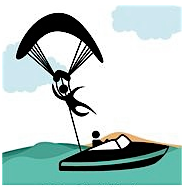
Deep P – allows the child to face risky or even potentially life-threatening experiences, to develop survival skills & conquer fear (rock-climbing, para-sailing, jumping from a platform in a harness, zip- lining….)

Symbolic P – allows the child to be in control, gradually exploring & increasing its understanding without the risk of being out of their depth (educational video games, virtual driving practice, ‘scuba diving’ in a pool or shallow pond….)

3. MENTAL  / Artistic
Imaginative, Fantasy or Socio-dramatic Play – ‘rearranging’ reality as the child pictures it, where conventional rules that govern the physical world do not apply.
Somewhere in the preschool years, children begin using make-believe to invent scenes & act them out – “dress-up, doctor, restaurant, princess, pirate…”. In early ages they usually play alone, with dolls & may have imaginary companions, but sometimes with adults.
Later they incorporate other children. pretend play(See Social Play”) Creative Play allows for new responses, transforming information, becoming aware of new connections, & an element of surprise

First Pretend Play:  Typically 15 – 21 mths.
It’s when children use a toy copy of an object or person & treat it the way they would the real thing . Piaget believed this kind of play was an important indicator of a child’s capacity to use symbols. For a boy, perhaps a train – be the conductor, for a girl usually a doll – pretend-feed with spoon…).

Substitute Pretend P:  Between ages 2-3 children start using objects to stand for something altogether different, such as a carrot-&-stick as imaginary a violin-&-bow.
This type of P. is key for innovation, creativity & nourishing the spirit. In a risk-free environment, as children grow, there will be many opportunities to practice developing needed abilities

However, deprivation & trauma inhibit or prevent learning many of the following ‘normal’ skills:
• able to practice using coping tools, which come from trying out new roles & possible situations
• learn to take turns, co-operate, share
• develop abstract & flexible thinking, to understand & use amounts, numbers, place, symbols, time…. (essential knowledge in an ever-more technological society)

• experiment with language, use new words or word-combinations to express ideas, concepts, dreams, emotions & histories
• stretch the imagination to create ideas & stories beyond the here-&-now
• form a sense of how others think (learning patterns, not mind-reading)
• learn how to function in the greater community, which helps to understand & trust others

Communication P – children who are comfortable manipulating objects & materials also become good at manipulating language, ideas & concepts. They Play using words, puns, debates, jokes, poetry, nuances.  ALSO with gestures, mime, making fun of, play acting, singing…..

Narrative P – storytelling is how most kids love to learn, & is considered the unit of human understanding, so it’s important to healthy early development.
It teaches about other places & societies, develops the intellect, makes sense of the world & one’s particular place in it, passing on tradition while indirectly teaching social mores & values.

NEXT: Child Play FORMS – #3