DIFFICULT People – Types (Part 1)

PREVIOUS: Difficult People – Intro

SITE:  Humans are naturally Selfish

LOOKING at YOURSELF – just for a minute 😊
If we consider someone to be difficult – it may be that:
💧 our 2 personalities clash – which we can’t change or fix. It just is.
💧 we can be the difficult one, rubbing others the wrong way
💧 we misunderstand the other person’s behavior or group’s goal
💧 they are indeed difficult, but trigger an old unhealed issue in us

Since everyone brings preconceived ideas & attitudes to every situation, we tend to interpret observations of & interactions with others thru our personal lens – ‘glasses’ that are not always wiped clean. AND, much of the time we have no idea what’s really behind someone’s ‘weird’ style, yet we unconsciously fill in the blanks with wrong assumptions about them

Being disruptive in whatever environment they’re in, Difficult People (D.P.) push buttons in others – especially those who have to deal with them for a long time. It’s very wearing.
But what upsets you may only be irritating or neutral to ‘the next guy’.

So it’s truly empowering to figure out & deal with what sets us off, those buttons our family installed & are now stuck in the WIC. Fortunately we can understand the root cause of our reactions to D.P., instead of being confused, & feeling tapped by them.
It’s a 2-parter:
• identify your strengths, skills & preferences, as well as the old wounds that get triggered
• learn about each D.P. type & their antidotes
EXP of buttons: Being accused wrongly, treated as unimportant or invisible, having your ideas or work usurped by someone else, talked to as if you’re stupid or incompetent, trying to control you….

ASK yourself :
• What emotional tornado does this D.P. set off in me? (terror, rage, desperation….)
• What do I do in reaction? (fight, isolate, rat on them…..)
• In general, how do others handle my carrying on or withdrawing?
• How does my D.P. deal with my reactions ? (be hurt, justify, make fun)
Am I the difficult person triggering others to react badly?
• Do I just keep reacting to the D.P. in my life, OR am I diligently working to find better ways to manage myself & others?
👞 💼 👡 👜

Some TYPES
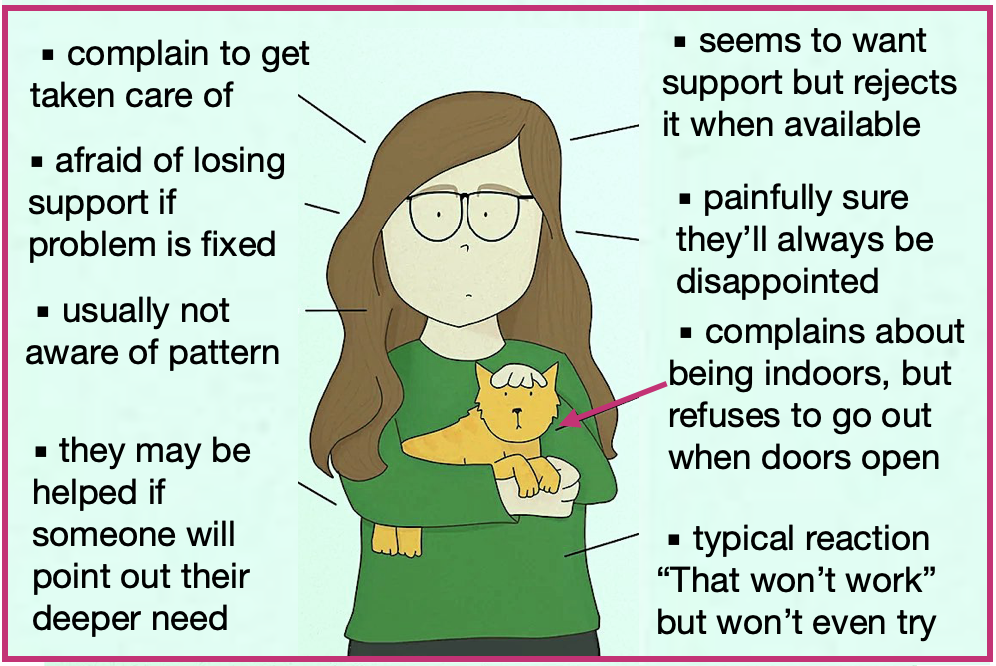
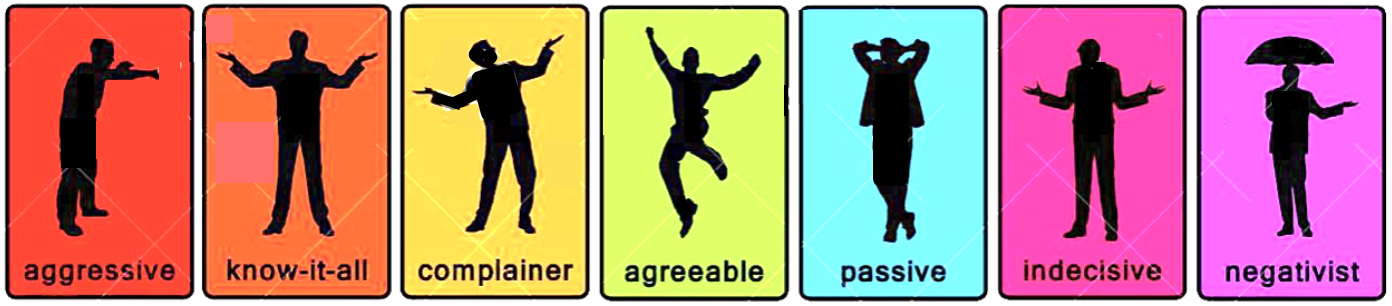
• Complainers : fearful, with little faith in themself or others, they assume the whole world is hostile. They’ll make a general complaint about something & then walk away without being specific. Nothing ever works out for them, & their constant discouragement can make others feel despairing too
VARIATION : Help-Rejecting ↗️

• Controllers / Dictators : they’re compulsive micro-managers, acting like they know best how to do – everything. They don’t want anyone to be different – it’s their way or the highway. They have a “pervasive pattern of grandiosity,” & can be vindictive when challenged

• Cranky : easily irritated about even the smallest frustration, indirect anger at the world for not automatically providing their needs. For some it’s deliberate, to help them get their way. For others, crankiness is a true reflection of being needy

• Critics : they find fault with everything & everyone, but are not interested in solving problems or improve situations. They won’t lift a finger to help, but are the first to point one  

• Grenades : after a brief period of calm, the grenade explodes into unfocused ranting & raving about things that have nothing to do with present circumstances – but you never know when they’ll blow

• Know-it-alls: they’re very knowledgeable & competent, but give long monologues with detailed, arrogant arguments to bolster their opinions. Their goal is to eliminate any opposition by finding flaws or weaknesses that will discredit other points of view

• Liars : most people lie a little, sometimes. But compulsive liars embellish or make up reality even when it’s just not necessary. They think it’s the only way to protect their vulnerable under-belly.  It insures that they’re unreliable, frustrating any kind of closeness.

NEXT: More Types #2

DIFFICULT People – Intro

PREVIOUS: PARENTING Introvert Children

SITEs:  How to Tell if You Are Self Absorbed


General CHARACTERISTICS


As ACoAs, when young
– we had no choice but to become enmeshed with our specific set of Difficult People, brainwashed into accepting their messages without objection and to ignore the damage it did to us. We were at their mercy, & rarely if ever did we get help to cope with them, or learn how to protect ourself in healthy ways.

So, it’s imperative to identify & acknowledge what & who we have to deal with, instead of questioning our observation of dysfunction, or denying them completely.

Difficult people (D.P.) are manipulative, controlling & bratty – with most people, most of the time – who function from defenses developed in response to their damaging background. Internally conflicted, their patterns are usually unconscious. Dedicated D.P. don’t like it when they can’t play out their shtick (pattern), or are called out on their negativity. When they don’t get what they want from one person or environment, they move on to the next innocent sucker.

DON’T IGNORE the red flags:
a. They rarely have empathy for others, &
b. Are always angry OR always miserable
While most people have one or more of the following characteristics – some of the time, in some circumstances – negative personality traits & attitudes of D. P. are entrenched, in the form of personality disorders (More….)

1. It’s all about them = Narcissistically opinionated, they always need to be the center of attention. Dramatic & fueled by reactions from others – their life is like a soap opera. Asking “How are you?” will open a can of worms, & a story can turn into a novel

2. They’re Victims = They’ve never gotten over childhood & marital trauma – stuck in the past, telling & re-telling stories of pain, failures & guilt. They’ll reel you in by using illnesses, family & tragedy – as a manipulation to make you feel sorry for them

3. They never do a favor without collecting = They’re always scheming to get something for nothing – self-serving, with no shame or compassion. If they do you a favor – you’re going to pay for it, big time. They’ll keep reminding you of what they did & what you owe, even though you’ve also helped them in the past. But admitting that you have -would not serve their interest

4. They’re oblivious = They have no idea what’s going on in reality – living in a world only they understand. They’re not dreamers & trailblazers, but rather in deep denial – undependable & irresponsible. They’re so vague it’s hard to have a serious conversation with them

5. They blame, gossip & whine = If they’re gossiping with you about others, they’ll do the same about you. They blame others for their troubles & whine to get attention. They complain about everyone – to you – but put on a big smile for the ones they just trashed.  (modified from Adorablequotes4u.com)

They’re some combination of :  • arrogant • disrespectful  • negative  • passive-aggressive  • pot-stirring  • selfish  • unmotivated & lazy • disregarding common decency or rules  • not responsible for their behavior

More SIGNS of a Toxic Person (the more of these, the more toxic)
NOTE – not all toxic people are obvious in how they treat others – like the bullies & tanks do. Some do it by withholding or being sneaky, but all have a harmful effect on others: Only what they think, feel & want matters . THEY :
• are critical, controlling & never consider anyone else’s (your) needs
• act like they’re fabulous & never make mistakes (perfect)
• dominate conversations, & leave no room for you
THEY
• drag up your past & use it against you, & won’t let you be different from them
• leave you feeling guilty & ashamed about who you are
• leave you wounded = feeling battered, bruised & torn apart
THEY
• make fun of even the smallest actual or imagined flaw in you
• spread gloom, & keep disappointing you
• violate your boundaries, & never respect a ‘no
AND
• The angry ones don’t care about your feelings & like to see you suffer
• When you’re around them you have to walk on eggshells
• Nothing you say or do is ever good enough for them
You end up ‘checking out’ &/or ignore your own values

NEXT: Difficult types #1

MBTI : PARENTING Your ‘I’ Child – DOs & Don’ts

PREVIOUS: Introvert CHILD

SITEs : How to Raise an Introverted Child” 

• “So Your Child is an Introvert”

15 ways to better parent your Introvert

Mistakes parents make with an introvert child

3 MBTI MOMS – & their gemstones)
PARENTS

to DO: Some time each day should set aside time for the child to not have to deal with anyone else or have to interact at all.
They don’t like small talk (especially with strangers). This isn’t shyness.
It means they:
1) want to skip meaningless chit-chat & stick to the important stuff
2) like to form a safe connection first – to trust that they’ll be listened to, understood, & taken seriously. This cautiousness is too often mis-interpreted, but is actually appropriate if the adults aren’t safe

DON’T insist that the child must talk as soon as you notice a problem or stressful situation. They won’t be able to clarify their thoughts until they’ve had time to sort thru what’s bothering them, maybe during a quiet car ride, or an hour climbing trees. Only then is it OK to ask something like – “How was your day at school?”

PARENTS
to DO: If you want your child to form a valuable connection with anyone new, start by being their ‘bridge’ instead of pushing them together & expecting things to take off ‘naturally’. That only works with Es, & even then not always. Then if the child is allowed time & space to feel safe, they’ll be more willing to connect
DON’T: Announce your I child as being shy (a form of shaming), or make them ‘perform’ small talk, which would be fake & create stress

• Because they process thoughts & emotions internally, it can be hard for parents to know what their I is feeling. Is take in stimuli, hold them & toss them around for a while to decide what they think, how they feel & if they want to respond to it all. When too much emotional turmoil builds up, & the child feels flooded, it can erupt as a ‘random’ or mis-directed outburst

• Comparing: the E child takes in stimuli, turning the energy right back out at the world. A disagreement with a friend? Loud angry words go ‘right back at’cha’. An exciting ride at the fair? Boisterous chatter, laughter, shouting. Enjoying a great movie? Exited reactions & commentary throughout. NOT like an I.

PARENTS
to DO: Make the effort to learn what your child is thinking & feeling. To help them communicate – when they’re ready – give them outlets like journaling, art projects or lots of time for free play with stories, imaginary characters or toys (pounding nails into a block of wood…). It’s also important to give them several possible words to choose from.

DON’T: Assume that because they’re is not having an outburst that they’re “fine.”! Tantrums are simply the last straw for an I. If that does happen, be totally accepting & available to listen thoughtfully. If they’re having trouble finding words, see if they’ll draw what’s going on, show it with dolls, toy soldiers, or make up a song, a rhyme…..

• They prefer single play dates to play groups, which is a balance against their need to be alone. One-on-one encounters allow kids to get to know each other more easily, & more deeply, which Is crave. This is generally true for most children, but imperative for inner-oriented ones.

PARENTS
to DO: Help your I child develop a few close friendships rather than a variety of ‘light’ ones. Keep birthday parties small & intimate.
DON’T: Equate happiness with being a social butterfly. The more people they have to deal with, the thinner they have to spread themselves. That makes it harder to enjoy time with others, or to process it all.

• They enjoy activities that let their minds wander. Any opportunity to think, pretend, get creative, solve problems, day-dream or otherwise stay in their head is welcome & beneficial. Great introvert activities:
— biking, climbing trees, fishing, gardening, hiking, jumping rope, learning an instrument, on a swing, painting, play dough, puzzles, construction, playing catch, reading, skating, sketching, swimming, writing….

PARENTS
to DO: Support & encourage your child’s natural interests. Notice anything they want to do or know about – if it’s safe & healthy!
DON’T: Force them to participate in group activities you think will ‘improve’ social skills or teamwork. While group sports do have a lot of value, not participating isn’t a negative. There are many other ways for children to assert talents, learn new skills, & develop strengths.
«


«
NEXT: Introvert child

MBTI : INTROVERT Children

PREVIOUS:
Introvert Growth, #3

SITEs: Why introverted kids are awesome

MBTI16 Types of MOMS


TELL your INTROVERT CHILD their special ways are normal:
❇️ You know yourself
Because you like to spend time alone & enjoy your own thoughts, you know a lot about yourself, & how different things can make you feel. Figuring out who you are & what matters to you is a great way to use all you traits to help you grow & develop your talents

❇️ You’re a talented problem solver
You have larger, thicker gray matter in your prefrontal cortex than your extroverted peers – that command center in your brain responsible for complex problem solving, information processing & decision-making.  Your brain is literally built to ponder. So when facing a challenge, you thrive on brain-power to work out solutions.

❇️ You’re careful & discriminating
Sometimes it pays to take risks, but you know it’s smart to ‘look before you leap’ into something. In fact, because information takes a longer journey through an introvert’s brain – than Extroverts – it’s normal for you to hang back a little & study new situations before deciding to participate, which gives you the chance to make better choices

❇️ You have amazing ideas
Taking the time to be quiet & listen to your inner voice, you end up with lots of interesting ideas that can eventually turn into great discoveries, products & careers. Like Bill Gates, J.K.Rowling, Emma Watson, Rosa Parks, Christina Aguilera…. Keep listening to yourself, and keep thinking!

❇️ You’re observant
You like to think about all kinds of things, which includes noticing & investigating what’s going on around you. Introverts think everything through thoroughly, creating pictures in their mind, which helps them vividly remember events & details. This makes you awesome at recalling your own stories & other people’s as well

❇️ You’re reliable
Chances are, even if they don’t always show it, the adults in your life know you’re dependable, which intuitively gives them confidence in you. They value & depend on you for being trustworthy. Being organized makes it easier to keeping your promises & plans, especially since you think carefully about your actions before you do something

❇️ You’re a great reader & writer
It’s natural for Introverts (Is) to love reading – as part of their quiet, alone time. And the more you read, the better you can write. Reading gives you inspiration for ideas & a better use of language, which you can show off in your imaginative & well-thought-out writing.

Being forced to write fast or in a short time is not your thing – you like to have space to think about the plot, the characters, locations & problems in the story you have to iron out. Isaac Asimov, author of ‘I, Robot ‘ once said, “Writing to me is simply thinking through my fingers.”

❇️ You make a great leader
This one may surprise you – you have wonderful leadership qualities which you can develop as you mature. Introverts project calmness in times of crises, think before they speak, & ask great questions – all the marks of an effective leader & doer

❇️ You’re peaceful
Introverts are rarely bullies, because they’d rather figure out how to explain their point of view than pick a fight. Because you have a calming effect on others, you can usually solve conflicts by talking it out, rather than getting physical. That doesn’t mean you don’t get excited or angry sometimes, but you don’t get crazy, especially in tough situations

❇️ You’re fair
You are a terrific listener, & want to hear everyone’s point of view before deciding what you think about a situation. People love to have a friend who will carefully evaluate what they’re saying & give fair opinions. You’re great at paying attention with your whole brain, not just the ears

❇️ You have deep friendships
You may feel overwhelmed or tired at a big, noisy party, but you love spending time with very close friends. Because you care deeply, are loyal, & have great ideas – you making close, even lifelong friends. This is one of the great rewards of introversion. (Song...)

NEXT: Parenting your Introvert child

GROWTH for INTROVERTS (Part 3)

PREVIOUS: Growth #2
SITEs: 56 Best Jobs for Introverts, by sub-type

BOOKs: The Highly Sensitive Person ~ Elaine Aron
The Biological Basis of Personality ~Hans J. Eysenck

HELPFUL SUGGESTIONS (cont.)
9. Go BEYOND your Comfort Zone

10. Identify your Cognitive DISTORTIONS (CDs)
Is are just as susceptible to distorted thinking as Es, which has nothing to do with temperament. If you’re prone to being emotionally flooded because of CDs, such as B & W thinking, personalizing, catastrophizing, over-generalizing…..you can be held back in life.
🔆 Learn about them, notice when they crop us, & then correct them, a little at a time.

11. Identify your EMOTIONS
Is need time to process emotions privately, but also to share them with someone who’s trustworthy.  To reduce denial, learn to identify Emotions so you know what you’re feeling. Give yourself permission to experience them all, without judgment, finding healthy ways to handle them internally & then express them safely.

• You can have a wide range of emotions – not just the ‘acceptable’ ones – without violating your values, & continue pursuing your goals (actions), no matter what your emotions are. Being able to manage them well can make it easier to deal with difficult relationship, or to work things out when others disappoint or act out on you

12. KNOW your I variation
Introverts (& Es too) come in different ‘natural flavors’ ➡️, and each types has its own 4 MBTI level combination formed into a STACK, showing different proportions & orders of preference ↙️
EXP: The order of preference for an ISTJ in their ‘stack’ is based on the 2 middle levels (ST), from strongest to least ‘natural’ (More….)
And be sure you know the difference between I-ness & insecurity – so you’ll feel better about yourself. Confident people are : comfortable with their traits & abilities, are not afraid to admit limitations & know they’re generally liked by others – which has nothing to do with being E or I.

14. Practice SMALL TALK
Is often think that small talk is stupid & incredibly useless, even tiring. Their mind & emotions work differently than Es, preferring to stick to ‘big’ concepts & ideas. That’s okay, but ⭐︎ small talk is an important part of greasing the wheels of social interactions.
Most people are not ready or willing to ‘go deep’ at first or second contact – which is appropriate. It takes time to get to know others, & that means sharing ‘light’ interests first – to find compatibilities, & where you’re human like everyone else. If you do get along with someone, then you can try having the kind of conversations you enjoy.

13. PLAN ahead to rest after an event
Too often, Is get sucked in to over-doing at social events, to please family & friends – who are mostly Es!
OR – you may have done too many things while on vacation, or spent long hours on a business trip.

In the after-math of exhaustion on these occasion – you may decide to stay home in future.
Instead, it would be better to not limit your opportunities.  Set a preferred time-limit on group activities. Let people know what you need – & stick to it.
If you think they’ll be hurt or judge you for leaving early, explain what it means to be an I, & then take care of yourself.
Always PLAN ahead for down-time after each event to recharge your batteries.

15. QUALITY vs Quantity
Es tend to judge Is by the number of friends they have, but Is truly prefer spending quality time with only 1 or 2 close ones. Their friendships have a different flavor than that of most Es.
Uninformed people try to push Is into getting “out there more”, which adds to the unfair treatment & pain similar to what they grew up with. If you feel okay with the number of friends you have, ignore well-meaning people who think they’re being helpful.  There’s no right or wrong – only individual preferences.

16. Take time to RECOVER from disappointments
All of life includes setbacks from time to time, & this includes the path to success. When things don’t work out as expected or how you’d like, as a positive Introvert you can be fair & patient with yourself.
▪︎ First take the time to get over the frustration, anger & sadness.
▪︎ Then assess what happened – what’s your responsibility & what’s not, without self-recrimination.
👏🏼 Then – keep going !

NEXT: Introvert Children

GROWTH for INTROVERTS (Part 2)

PREVIOUS: Growth #1

SITE: 6 Things Every Extrovert Secretly Has To Deal With,

An Extrovert’s Lament, An Introvert’s Response’ ~ Sophia Dembling
•  7 things Introverts should know about Extroverts’ & vice-versa


HELPFUL SUGGESTIONS (cont.)
5. Accept unpleasant but constructive FEEDBACK
No matter which MBTI type you are, it’s not healthy to absorb everyone else’s arbitrary reactions, since most have noting to do with you & some are just mean. However, very sensitive people with lower self-esteem are afraid to hear anything other than positive comments, limiting their growth options.

Even so, if you have good friends, & they accept you fully, they can be the safest people to help identify any problems they see in your thinking or actions, & offer solutions. They want you to be the best you can, so evaluate their info, & if it suits you – use it to your benefit

6. Adopt a “GROWTH Mindset”
It’s the positive belief that you can get better at your chosen activities, rather than that your abilities are limited & ‘fixed’. EXP : “I can get better at networking.”
There’s lots of research that shows people with a growth mindset are more successful. Recognize you don’t always need to be outstanding at everything, only use the knowledge you already have & persevere. REPEAT : “I know what I know – but can’t know everything” & remember – “Progress not Perfection”! (More….)

ASK an Extrovert to explain how their world works. Understanding Es can allow you to interact with them better (when it’s important to you) – even though it’s not always your preferred type to spend time with.

EXP
: Extroverts reach out to the world & look for feedback. Is appreciate positive comments on a blog or FB, but trying to make the connection themself feels exhausting, so they don’t usually bother. Work on developing personal strategies that don’t tax you, but allow for positive relationships

7. Be OPEN to other people’s ideas
Is have a very active internal world, with some great ideas. Since you’re already busy processing a lot, getting external ones (especially unsolicited) may be way too much, which can make you cranky.
By knowing & accepting the need to limit your energy drain, you can pay attention when feeling put-upon, & set a boundary by waiting until you feel OK before responding.
You can always explain your style, so you can still listen to others (which Is are good at anyway), but only when you’re ready. You never know – their comments & insights may be useful, or at least interesting

8. Find ways to FUNCTION well in the world that doesn’t require acting like an E.
You can collaborate with a few others in ways that don’t over-stimulate you. Take your time to reflect & digest, accepting your need to mull things over for a long while, before taking action. Understand yourself well enough so you know when it’s best to go with your natural tendency, & times when it benefits you to (temporarily) override it.

EXP: DO something you’ve been wanting to for a while, rather than thinking some more about it. Procrastination may be insecurity, or worry about future performance & social pressures that can come with success. Instead of obsessing about potential problems, consider all the possibly wonderful outcomes.
It’ll turn out well enough if you just “Do it, but do it gently”. (Review  info re.“BISin Part 1)

9. Go BEYOND your Comfort Zone
Naturally, you’ll be able to connect with others more easily when doing something you enjoy. However, Is are often criticized for sticking to ‘boring’ activities (lectures, book groups, quiet dinners….). While these are actually great ways to meet like-minded people, it’s okay to go a little out of your comfort zone, by trying different ways to interact, as well as other kinds of events. (MBTI groups at MeetUp.com, & others)

In any large group where you don’t know everyone, your natural tendency is to hang back & just listen, rather than including yourself in conversations. BUT you have a lot to say. Take a small risk & add something you know about, or ask an interested question. You may connect with someone as interesting as yourself!

NEXT: Growth #3

GROWTH for INTROVERTS (Part 1)

PREVIOUS: INFJ

SITEs: MBTI Types as animals, some famous people, + Cognitive Functions

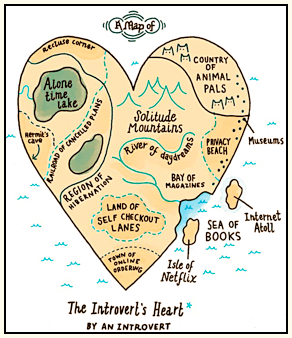
Life of an Introvert – illustrated (heart map)

Are an E or an I?


I-ness = Introversion

HELPFUL SUGGESTIONS (modified from Dr Alice Boyes)
1. Get to know your BIS (Behavioral Inhibition System)
BIS is a brain-based system that prevents a person from moving forward when they have competing needs (achieve success while avoiding all negative outcomes), or conflicting motivations (pleasing a parent vs. pleasing oneself).

• People with a strong BIS tend to be highly anxious – worried about real or potential ‘punishment’ – which can include negative responses (criticism) or something positive taken away (loss of solitude)…… When faced with an internal dilemma, a strong ‘stop’ signal will kick in, OR they may start & then stop – unable to finish.

• Introverts (Is) with a particularly sensitive BIS can benefit from staying alert for punishment signals from others (being judged, ignored, disappointed….) & fend them off before getting run over by their BIS.
🔅 Look for & accept rewarding opportunities in your daily life (complements, encouragement, praise, a raise…..) & learn to get as much of them as possible. (See post “Resilience – Traits : Positivity ratio” – scroll down)

2. Accept & appreciate your TEMPERAMENT
DEF: Personality is the whole being, & Temperament is the basic force that drives a person to behave in certain ways, unique to them.

Introversion is neither a virtue nor flaw – just a natural part of ones personality. Many Is grew up being shamed by family & peers for being ‘different’, leaving them feeling ashamed for being ‘less-than’.  That belief can now be corrected. (CHART….) — (also the Temp. Blends)

EXP: It’s normal for Is to be cautious about starting new relationships.
BUT, if you’re also brain-wired or been trained from childhood – to assume negatives first – it’ll slow connections down even more.
🔆 Work on looking for positive opportunities & risk reaching out once you’ve spent a little time observing how someone talks & acts. Trust your instincts.

EXP: It’s normal for Is to be focus inward – on being creative, paying attention to details & knowing things in depth.
BUT if you are also highly ambitious with a strong independent streak, you can become an entrepreneur, create a new product, fight inequality or ‘city hall’….
🔆 Identify long-term interests & passions, pursue them & self-correct when necessary. Explain your temperament when you need to, so others can understand your responses. (9 childhood aspects of temperament – some relating to I-ness)

3. Accept being “SLOW to WARM”
✒︎ This is part of your temperament style, expressed as:
✧ a little suspicious of new people, getting to know them rather than automatically trusting
✧ standing back to get a read on social situations before participating
✧ your warmth & friendliness are mainly for people you know & trust

✒︎ Identify anything that over-stimulates you. Once you know what drains you, avoid or minimize exposure, or find ways to work around them. EXP :
• Being in a huge store with too many options (‘Bed, Bath & Beyond‘)
• Forced to go in & out of social mode too often (work projects vs meetings)
• Noisy family gatherings….
• Interrupted to make a decision when trying to concentrate
• Severely irritated by loud commercials, street noises….
• Stadiums or concert halls full of screaming, clapping extroverts
• Too many emails, social media posts…..
• Too many people on the sidewalk you’re trying to navigate

Learning physiological & emotional self-regulation strategies will help you recover faster after being with stressful people or environments. (Resilience posts) // (14 Stress relief tips)

4. Accept ‘NO-REWARD’ Outcomes
These can be things like any delay that require patience.   Sometimes it’s about getting no response at all – to a text, a call, a biz proposal …..
⭐︎ Understand that : not getting what you want – right away, or at all – is not punishment, so do NOT take them as personal rejections.
Other people may be away, busy, ignorant or just jerks. And in business, some people or groups won’t know how to or can’t use what you’re offering
Remember that ‘Delay is OK” & “Man’s rejection is God’s protection”
(Tips for Not Personalizing Rejection)

NEXT: I Growth (#2)

MBTI Type – INFJ

 PREVIOUS: INFP


The INTROVERTS

👠 👠 👠

INFJThe PROTECTOR/ Confidant / Counselor
Introvert-iNtuitive-Feeling-Judging

❤︎ Most Contemplative, reflective
(1.5% world-wide) (1.3% ♂︎  // 1.6% ♀︎)  Perfectionistic humanitarian // Muse

NATURAL: An inspiration to others
GOAL: to Analyze.

INFJs are sensitive, original & quietly forceful, more likely to be individualistic rather than a leader or follower. They’re able to develop a clear vision of how to best serve the common good, then are organized and decisive in how they choose to implement this vision, tending to stick to things until they’re done.

They’re conscientious, with a well-developed value systems which they’re strictly committed to, & are well-respected for their perseverance in doing the right thing.

They’re curious to understand other people’s motives, & generally have great insight about them.They look for meaning in the connections between people, ideas & things.  INFJs are idealistic, wanting to inspiring others, who often try to find a shared vision for everyone & come up with new ways to achieve the vision.  (More…)

They’re : anxious, compassionate, complicated, creative, empathetic, idealistic, introspective, an eloquent speaker/ writer, quietly caring, paradoxical, patient, sensitive, a visionary, understanding
«

«
Hidden side : While their NF ‘righteousness’ usually compels them to be open & honest, they can be surprisingly clever & manipulative, from a knack for knowing what people want (& don’t want) to hear. They’re masters at keeping their friends close & enemies closer.

They’re the most cerebral of the Feeling types. So while many INFJs are spiritual, their aptitude for coming to conclusions with little or no evidence doesn’t come from any mystical source. Instead it’s from a constant but unconscious analysis of tiny details that most others completely miss, & which they themselves have trouble explaining

• Life’s Purpose : To guide those who are lost.
• Their Law : You shall always listen to my advice.
• They Comfort others by saying: It’s not your fault, you don’t deserve to feel this way.

• They Say :  These rules don’t benefit me, so I’m making up my own. I want to see my ideas be accepted & applied.  ….it’s fine.
Catchphrase : Do unto others as you would have them do unto you

Communication : Advice – We don’t need to talk about every emotion.
They won’t start the conversation. They’ll just watch you, from afar

Weaknesses : Extremely private, over-doing sensory activities, convinced they’re right even when evidence proves otherwise, too quiet
Manipulate : Secretly meddle in your affairs because they know what’s best for you – more than you do

Paradoxes : Confident AND overbearing. Help everyone else BUT can’t help themselves. Strong BUT fragile
Value: soul mates       • Fear : of being hated

Judge people by: their selfishness
Are Judged for : making others feel that their emotions are invalid

Become STRESSED from situations shown in illustration.  They either go all adrenaline rush or total paralysis

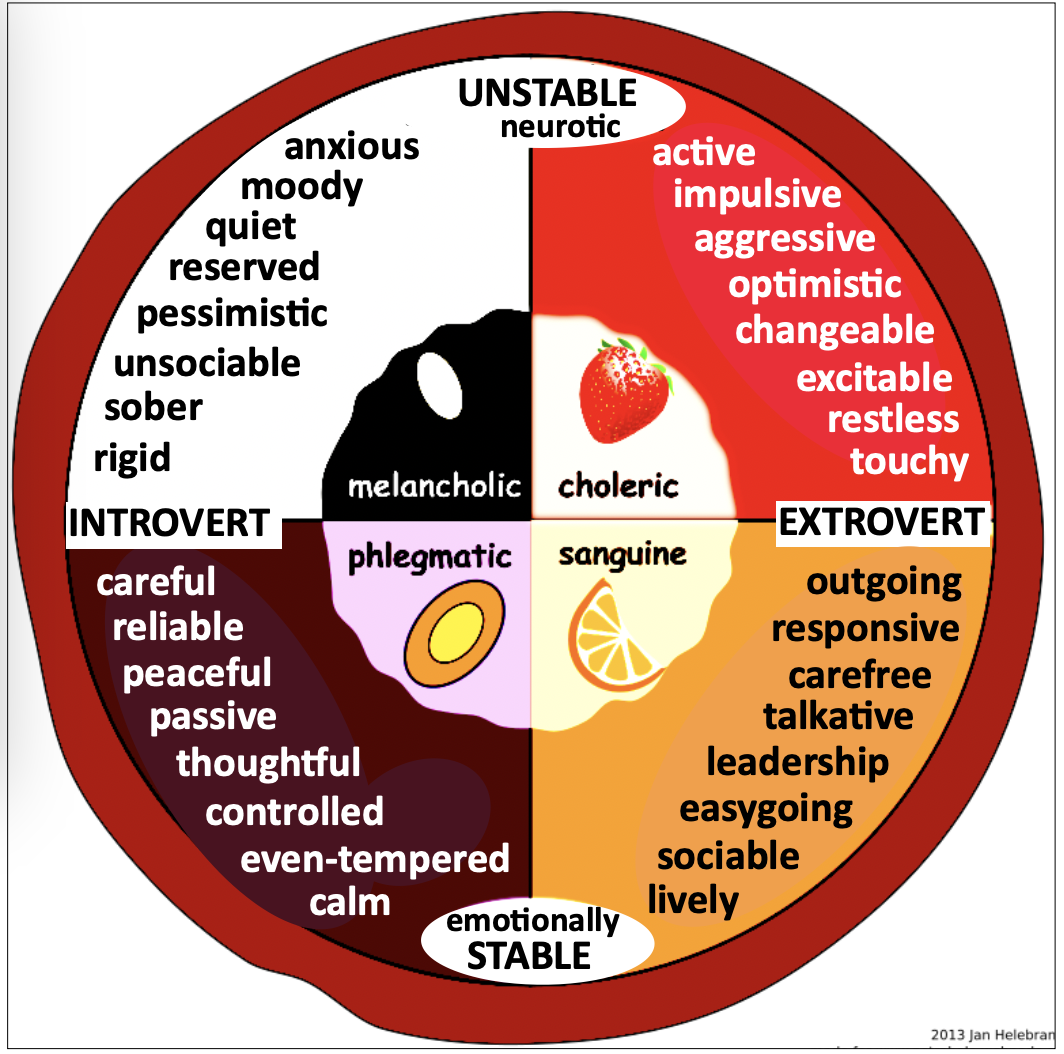
Under stress (Melancholy-Phlegmatic) INFJs tend to withdraw from reality into a fantasy world, which gradually gains importance as they become dissatisfied with their real life & the people in it.
While fulfilling the demands of their outer commitments, they’re secretly critical, & that their imaginary world & its characters are more important than anything real.

In these circumstances they’ll feel physically stressed & intensely angry, with an obsessive focus on certain details & a tendency to over-indulge.

They can end up living almost exclusively in their imagination, resist reality with a defensive attitude, feeling like a misfit. They’ll spend enormous amounts of time falling into their deepest hidden fantasies & emotions. In this state, they might be attracted to seriously defective people & environments which they’re convinced will truly understand & appreciate them

Hate : asking for help because it make them feel like they’re burdening others, anyone intentionally limited,  being forced, being misunderstood, being so effected by someone flirting with them, going to funerals, pretentious people, surrounded by conflict, unfairness

Don’t argue with an INFJ while they’re holding : a grudge
Never : antagonize them       • Never tell them : “You’ll never do anything meaningful with your life”

GROWTH
Advice : What you think is good for someone isn’t necessarily what they actually need.

INFJs may come across as too individualistic (“different”), private or mysterious, doing their thinking in a vacuum, which results in unrealistic ideas that are hard to verbalize

INFJs can best help themself by finding a way to bring their artistic vision & intuitive insights to light. By learning to express their rich imagination in a way that others can understand & appreciate, they become psychologically liberated, as well as integrated into the world. Artistic pursuits bring a great benefit to INFJs, offering an appropriate outlet for their deep emotions

INFJ Relationships
YOU : have a gift to intuitively understand human relationships & complex meanings, as well as emphatically understanding partner’s emotions. Others see you as mysterious since you tend to share your internal intuitions only with those you truly trust.
👥 Your relationship superpower is Sensitivity.

Thrive in any place that is: complex & intellectually challenging

• As a friend, you’re always the one reading a book, or listening to everyone’s problems, the one who needs a week ahead of a hang-out to mentally prepare – & then spend all the ‘fun’ time discussing the Universe & meaning of life

Annoyed when: someone acts like you emotions are invalid

INFJ Parent / child of INFJ parent, INFJ child  (ALSO….)

Still single because : you’re tailor-made for the ‘friend-zone’
Unhealthy behavior : stalking your S.O.’s social media at 3am

Show interest by: hiding it – they won’t know & never will!
Show love : empathize, are understanding, offer emotional & moral support

• You want to hear : I’m here for you
• You’re attractive/sexy because : being naturally refined & elegant, you have a peaceful presence, mysterious & wise. People want to get into your head & know what you know

• You should date : someone who cares about you as much as you care about them, will never take you for granted, lets you be yourself even if they don’t get you completely, who you can trust, & will never intentionally hurt you

To attract you : they need to be one big walking paradox. They should look deep into your eyes & say “I need you” to help figure themself out (Your turn-on)

• Some famous INFJ: Shirley Temple Black, Martin Luther King, Jr, Nelson Mandela, Tom Selleck, Billy Crystal, Mark Harmon

NEXT: Introvert Growth #1

MBTI Type – INFP

PREVIOUS: INTJ

SITE:  Many fun lists of ‘names’ for the 16 types  ++ other info


The INTROVERTS

👠 👠 👠

INFP – The HEALER / Clarifier / Harmonizer
Introvert-iNtuitive-Feeling-Perceiving

❤︎ Most Idealistic
(4.4% world-wide) (4.1% ♂︎ //  4.6% ♀︎) The Angsty poet

NATURAL: Performing noble service to aid society
GOAL: to Dream.

INFPs are reflective & idealistic, interested in serving humanity, with a well-developed, strongly-held value system which they strive to live up to. They’re adaptable & laid-back unless those values are threatened.

Being highly intuitive about people, they enjoy helping others’ inner development to reach their full potential, & are extremely loyal to people who are important to them.
Mentally quick, able to see possibilities, they like coming up with creative solutions to problems. Usually excellent writers.

Their polite, reserved exterior can make them hard to know – at first. However they do enjoy conversation, taking particular delight in the unusual. When in a sociable mood, their humor & charm shine through. Disposed to like people & avoid conflict, they tend to make pleasant company. (More….)

They’re : contained, creative, flexible, full of wonder, have strong personal values, imaginative, intense, non-directive, opinionated, quirky, reflective, reserved with people, seek inner order & peace.
«

«
Hidden side : Often regarded as frivolous daydreamers, they can be shockingly practical, seeing the value of using time & resources wisely. So they have no time for anything that’s irrelevant to their causes, projects or ideals. In a society where E-J behavior is the norm, INFPs (I-P) are just as busy & functional, but their motivation is internal, & projects are usually personal, not social.


They’re not as pleasant as most sites claim. Many INFPs are harshly judgmental towards people & things they experience as violating their values. Though they usually don’t say anything, they’ll easily ignore anyone who doesn’t meet their standards – without giving it a second thought or consider the real reasons others have for their position.

• Life’s Purpose : Heal those who are hurting
• Their Law : You shall always love yourself
• They Comfort others by saying: You’ve got so much potential, just keep your head up!

• They Say : I’m completely unaware that rules exist, & (I’m worried about) don’t know why everyone seems so stressed. Why can’t everyone just get along??!!
Catchphrase : It’s better to travel hopefully than to arrive

Communication : Advice – Stop talking about bumblebee-super-cumberwho…..
They probably won’t start a conversation unless you share their interest – or, unless they’re sure you want to talk to them specifically

Weaknesses : Can’t decide what they want, too idealistic, loss of confidence, martyr attitude
Manipulate : show high moral standards & act proudly victimized

Paradoxes : Detached dreamer AND hyper-emotional. Tons of dreams BUT no practical realization, timid BUT brave
Value: Ideals      • Fear : of a life without harmony

Judge people by: their values
Are Judged for : seeming to be fake

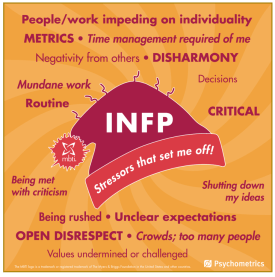
Become STRESSED from situations shown in illustration. They diligently ignore a problem until it’s too big to manage

Under stress (pure Sanguine or Supine) INFPs usually dislike conflict & trend to be passive-aggressive when experiencing frustration or dissatisfaction. They’re deeply dedicated to being their ‘true self’, in the extreme, avoiding anyone or anything that doesn’t fit in with their inner value system, becoming intolerant a& hard to please.

In these circumstances they’ll be cynical, depressed, aggressive & prone to acute self-doubt. As stress increases, they can get extremely whimsical & stubborn, insisting on acting on feelings, while ignoring the logical implications & consequences of their actions. Also, they’re inclined to use their self-focus as a standard for all relationships & situations in their lives, sticking only to what reinforces their self-image, & reject everything else

Hate : asking for help because they want to do it their way, being left by a loved one, conflict, debates that don’t include social justice, feeling invalidated, feeling overwhelmed, having to be too logical & objective, lack of imagination, sneaky-amoral-manipulative thinking,  stereotypes

Don’t argue with an INFP while they’re holding : you hostage
Never :  trap them   • Never tell them : “What you just said doesn’t matter”

GROWTH
Advice : Just act on your passion – nothing’s an excuse unless you make it so.

INFPs may struggle to speak up in meetings, leading others to assume they don’t care or have nothing to contribute, which makes it hard to convince others of the value of their ideas.

INFPs can help themselves by accepting they don’t need to resist or fight reality to fulfill their unique vision. Instead, it’s better to accept things as they really are & take advantage of opportunities to build the life they dream of. They need to learn to see all the possibilities without trying to filter them as right or wrong – living in reality instead of trying to change it or ignore it.

INFP Relationships
YOU : tends to be selective & reserved about sharing your deepest feelings & values, which can sometimes make you hard to understand. You’re seen by family & friends as sensitive and introspective.
👥 Your relationship superpower is Support.

Thrive in any environment that is: deeply romantic & intimate

• As a friend, you’re the super quiet one in a group, but crazy. Have 1 or 2 good friends, always deep & introspective, who’ll listen to someone all day or all night. And when you do give advice, it’s totally on point, like you’re channeling the other person’s inner self

Annoyed with: anyone you think is a fake

INFP Parent / child of INFP parent, INFP child   (ALSO….)

Still single because : you’re the ‘friend’ type
Unhealthy behavior : say ‘I love you’ on the first date

Show interest : You’re so confusing & slow, that by the time they figure you like them out, you’ll like someone else
Show love by : coordinate their needs, offer analysis, advice & help

• You want to hear : I believe in you
• You’re attractive/sexy because : you’re full of romance, feel so deeply & passionately. You seem so vulnerable, off in a dream world, & people wish they could be there with you

• You should date : someone who keeps you grounded, shows you reality, can be your anchor, is completely dependable, can protect you if needed, but also show how to protect yourself, help you modify expectations, & always works to impress you

To attract you : they have to act like they have a deep broody secret they’re too guarded to let out. Then you won’t eat or sleep until you’ve gotten thru their wall (Your turn-on)

• Some famous  INFP: Helen Keller, Carl Rogers, Dick Clark, Neil Diamond, James Taylor, JFK, Lisa Kudrow, Scott Bakula

NEXT: INFJ

MBTI Type – INTJ

PREVIOUS: INTP


The INTROVERTS

👠 👠 👠

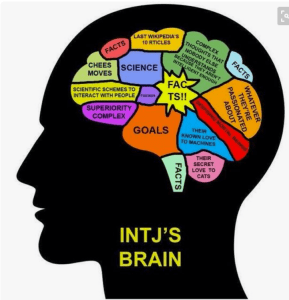
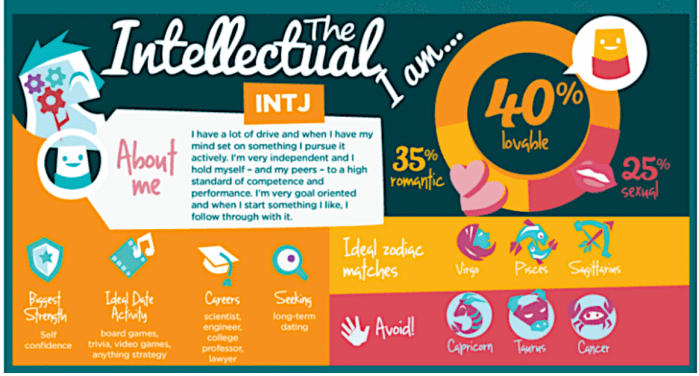
INTJThe SCIENTIST / Strategist / Mastermind
Introvert-iNtuitive-Thinking-Judginging

🛠 Most Independent
( 2.1% world-wide) (3.3% ♂︎ //  0.8% ♀︎)  The Badass mastermind // Iconoclast

NATURAL: Everything has room for improvement
GOAL: to Criticize.

INTJs are independent, determined & competent. They’re natural leaders, although usually keep to the background until they see a real need to take over, but also will follow someone if they trust their authority. They place a high value on knowledge & structure, & when committed, are capable of organizing a job & carrying it through to the end.  They have very high standards for their own performance, & that of others.

Original thinkers, they’re often able to define a compelling, long-range vision, & are driven to gather meaning from their ideas, coming up with innovative solutions to complex problems. Their analytical mind can easily see patterns in external events & then explain them thoroughly, coupled with an exceptional ability to turn theories into solid plans of action.

INTJs spend a lot of time inside their own mind, usually with little interest in other people’s thoughts or feelings, quick to express judgments. With very evolved intuitions, they’re often convinced they’re right about things. (More…)

They’re : analytical, calculated, caring, driven, efficient, knowledgeable, innovative, need to be competent, need things ‘my way’, skeptical, straightforward, strategic, theoretical,  seeing world as a chessboard
«

«•
Hidden side : They fiercely believe in free will, but aren’t stubborn. If they learn the value of something they previously resisted, they can do a complete 180 – quite often – because of their tendency to analyze things for a long time. They’re more aesthetically oriented than other Thinking types, & can be quite whimsical, though it may not always show

While they can seem cold, they’ll quickly defrost for a cause or something they relate to. They can be quite compassionate to people & things that are misunderstood, urging others to look beyond biases at facts & circumstances. While their thinking is very independent, they usually don’t mind (even prefer) helping & being helped, because of their keen understanding of everyone’s limitations

• Life’s Purpose : To be objective in a sea of subjectivity.
• Their Law : You shall always be like Newton.
• They Comfort others by saying: Are those….tears? Holy moly!

• They Say : I’ve found all the inconsistencies in the rules, so I consider them void. I look to the future rather than the past. …. just Stop.
Catchphrase : Hope for the best & prepare for the worst

Communication : Advice – Stop talking about being the smartest. They won’t start a conversation, & may ‘look’ angry. They’re probably not, but still…. approach with caution.

Weaknesses : Can be arrogant, extreme anger, misanthropy, too apathetic toward others
Manipulate : Never have time for anything because they’re always ‘busy’ with work (by their definition).  Can’t argue with them because they’re ‘always right’

Paradoxes : Visionary AND arrogant. Everything planned BUT nothing solidified. Confident BUT insecure
Value: Vision           • Fear : of losing their skill

Judge people by: their competence
Are Judged for : being an idiot

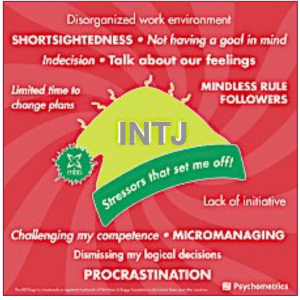
STRESSED by situations in illustration. They design a universal procedure that will solve their problem for all time

Under stress (Melancholy-Choleric) INTJs live too much in their mind, mostly disregarding physical & emotional needs. Therefore, love & romantic relationships can take them by surprise, the intensity of their own emotions being what causes them distress.
They may feel out of control, restless & tormented, so respond to these emotions by dismissing them, turning them into abstract theoretical principles that don’t connect to objective reality

In these circumstances they can feel physically stressed & intensely angry, with an obsessive focus on certain details, & a tendency to over-indulge. Idealizing their own complex concepts & ideas, they fail to recognize the importance of relationships with peers, managing to isolate themself from their emotional & physical self, as well as the world around them. They become ‘misunderstood’ loners, cryptic & enigmatic to everyone else.

Hate : asking for help because it make them feel incompetent, being injured or diseased, being ordered around, feeling stupid, flippant attitude, ignorance, overly-dramatic people, misinformation, subjectivity, someone who keeps making ridiculous jokes while the INTJ is trying to be serious

Don’t argue with an INTJ while they’re holding : all the cards
Never : control them     • Never tell them : “You’re not as smart as you think you are”

GROWTH
Advice : Occasionally take time off from work to explore new things

When it comes to emotional satisfaction, INTJs simply are out of their element. They can come across as cold and distant when focusing on the task at hand, & miss recognizing or appreciating the contributions of others.  They can find it hard to engage in social conversations, & tend to too reserved, not giving as much praise or intimate support as those around them would like

INTJs need to organize their esoteric perceptions and highly intuitive mental constructs, by applying some form of general logic to them so they’re understandable to others. They need to become more grounded in reality by also appreciating & giving proper importance to material practicality

INTJ Relationships
YOU : take commitments very seriously, prepared to dedicate substantial energy & time into a relationship to make it work. Instead of falling head over heels, you first look for the qualities you admire. Embracing conflict instead of avoiding it, you can easily move on from a breakup.
👥  Your relationship superpower is Healthy Confrontation.

Thrive in any environment that is : stable & intellectual (What you needscroll down)

As a friend, you’re the MENSA one who sometimes rubs it in everyone’s face, but because you’re so fascinating – they don’t mind.  The sarcastic one who’s quiet, & occasionally gives  death glares

Annoyed with: anyone who’s an idiot

INTJ Parent / child of INTJ parent, INTJ child    (ALSO…)

Still single because : you’re arrogant and socially inept
Unhealthy behavior : plan your wedding on the first date

Show interest by : being stalkerish
Show love : are affectionate, giving time, advice, analysis….

• You want to hear : I’m in awe of you
• You’re attractive/sexy because : you’re observant, meticulous, work hard & play harder. You seem both fully present & other-worldly, so people find your mysterious, detached & intriguing

• You should date : someone very smart who can force you to live in the moment, can make you accept your emotions without trying to ‘understand’ them, can help you experience passion without logic but will listen to your logic-rants without falling asleep

To attract you : they need to present you with a completely new way of thinking about something you’d already decided on. It’ll shake your foundation but win your admiration (Your turn-on)

• Some famous INTJ : Chevy Chase, Raymond Burr, Richard Gere, Hillary Clinton, Michelle Obama, Rudy Giuliani, Stephen Hawking, Ayn Rand, Isaac Asimov, Al Gore, Bill Gates

NEXT: INFP