ATTACHMENT : Healthy-er PARENTING (2a)

PREVIOUS : Unhealthy Parents

SITE: 23 Parenting Philosophies ….

4 POSTs : Parenting Styles”

PARENTING TIPS
Creating a healthy attachment in your children starts with understanding & facing how your own early attachment affects your current reactions to life, & correcting any problems. Do what’s best for your child, both with practical decisions & emotional ones.

❣️Let go of how your child “should” be & accept the child you have
❣️Develop compassion in the family by acknowledging & valuing the differences in personalities & preferences

❣️Give you kids the language of emotions by actively talking about how about how you, they & others are feeling. When reading a book with them, stop to reflect on how the characters might be feeling

❣️ Teach them from your experiences, & set a life example by being their role model
❣️You need to play multiple roles – parent, friend, mentor, counselor, friend, play companion….  to stay in tune with your child❣️Make sure that you correctly evaluate your decisions – so your children can trust you for all their needs & worries,  & feel safe to open up it you without hesitation
❣️Don’t let the differences between you & your spouse affect the bond with your child, as it can leave a bad impression on his / her emotional life

❣️ Realize that no one is perfect, so there’s always room for improvement. And with advancement in technologies, you need to keep up to date

❣️ Don’t hamper their private space & privacy. Even if they are children, they have their own life. It’s good to know what they’re doing, but it’s not advised to  constantly interfere

❣️Hold family meetings where each member can share what they think about what’s been happening, about upcoming plans, family schedules, major changes, painful events…..

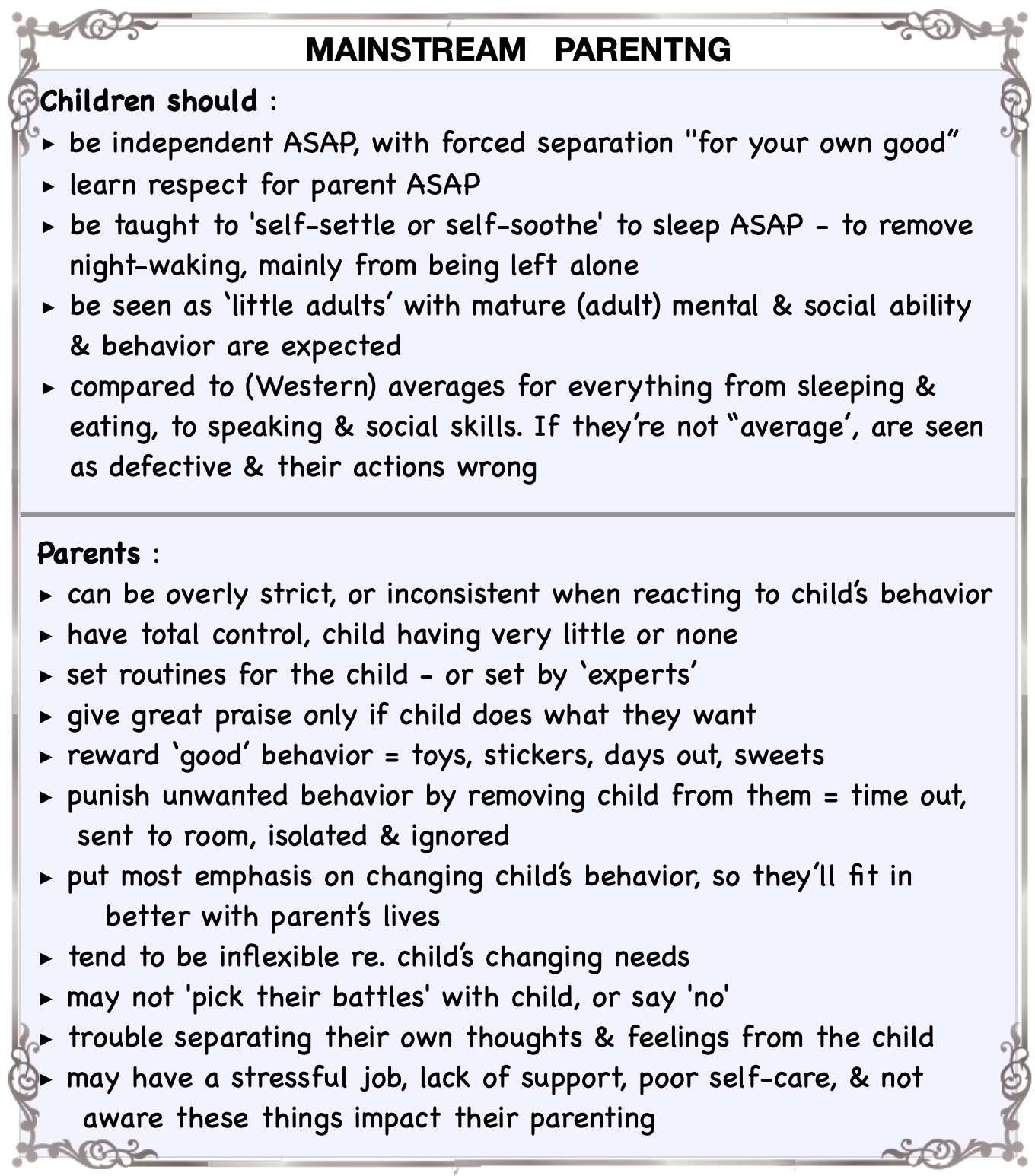
MAINSTREAM parents believe that children have the same capability for self control as adults – but without the same rights. To get children to behave the way they want, these parents use control & intimidation through punishments, spanking & yelling.  In this atmosphere, the complaint child will try to follow instructions slavishly, or another will become rebellious & eventually cut connections, directly or indirectly.

SITE: “Why Mainstream Parenting Risks Breaking our Children’s Spirit”
«
«
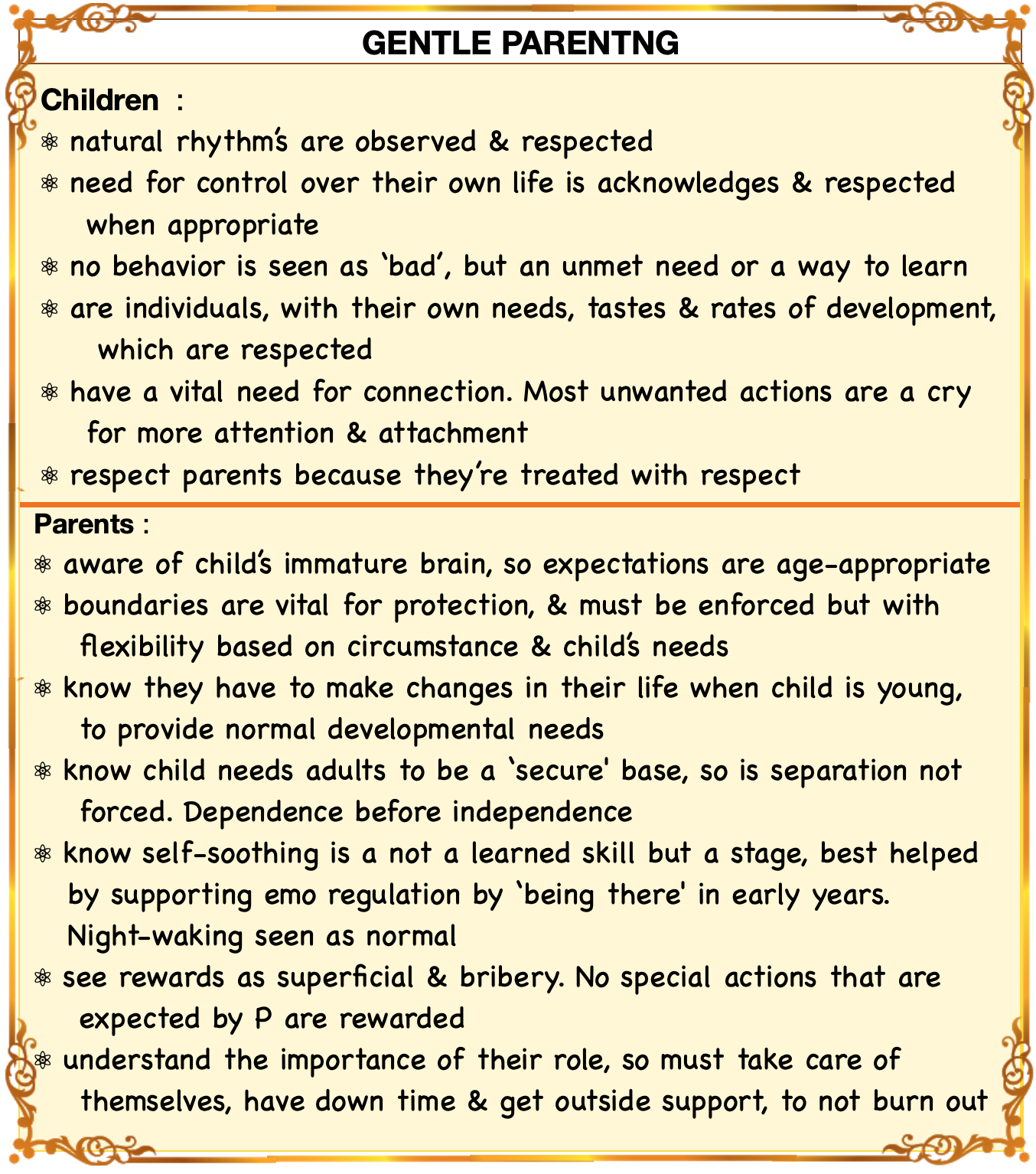
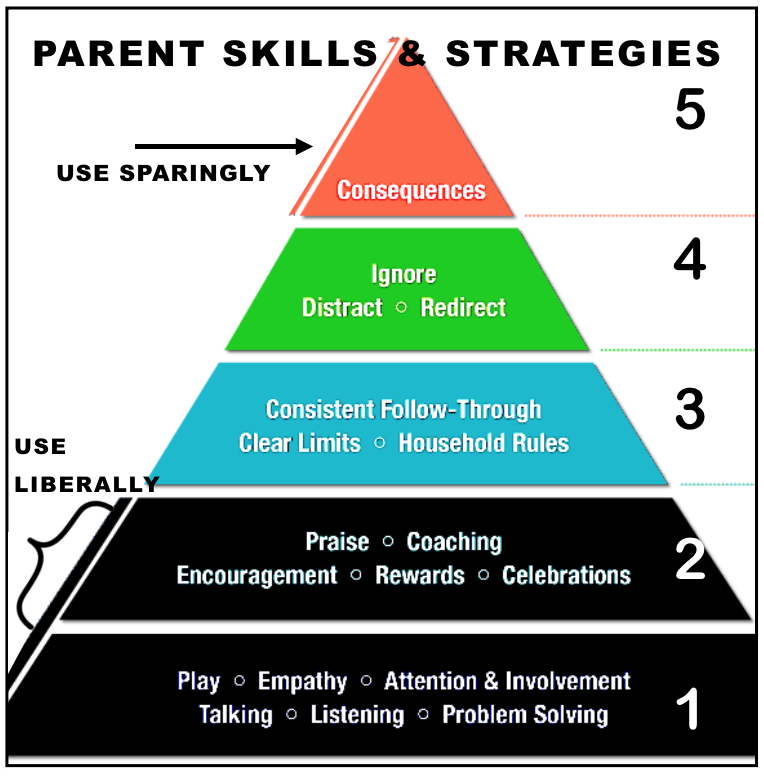
GENTLE Parenting is an evidence-based approach to raising happy, confident children – composed of Boundaries, Empathy, Respect & Understanding, It encourages the family to work together to teach the children to express their thoughts & emotions – in socially acceptable, age-appropriate ways. 

It focuses on developing positive qualities by being attuned & compassionate —-> while providing age-appropriate discipline, enforcing healthy standards & rules that will carry them thru life. Gentle parents behave around their children as a model for what they expect from the young ones. (Posts : “Personal Power ++


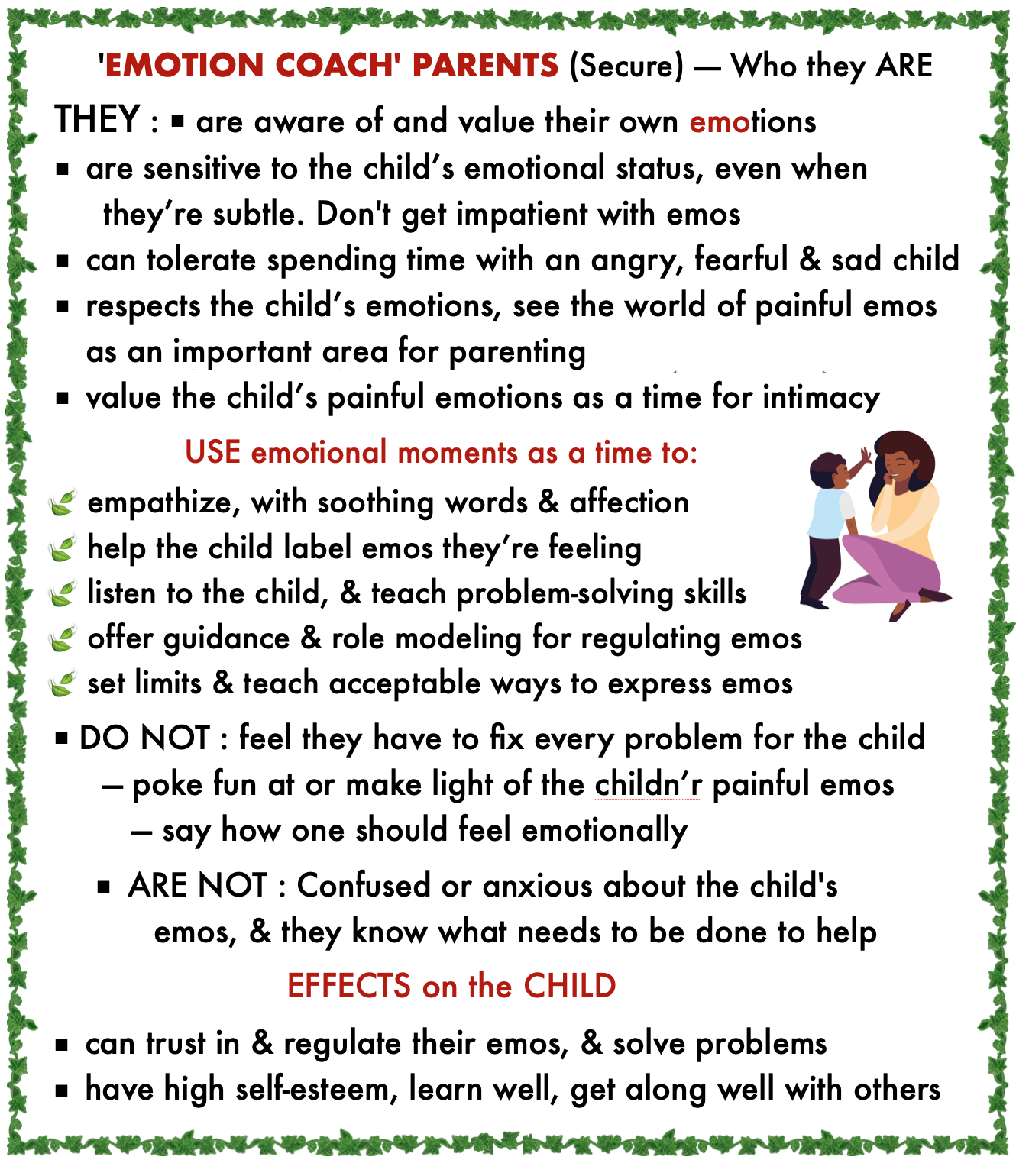
SECURE parenting style – includes emotional warmth, sensitivity, acceptance & their inter-personal accessibility. It paves the way for the child’s independence & secure adult relationships.
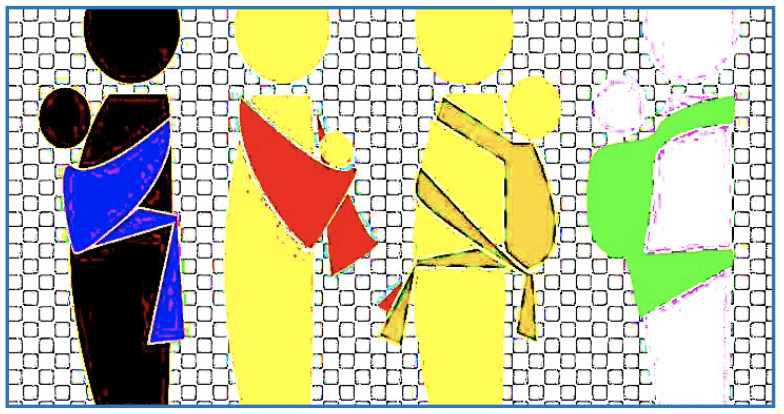
a. Attachment Parenting – promotes the bond between parent & baby through immediate bonding at birth (skin-to-skin for the first hour of life before any other medical procedures), breastfeeding, baby-wearing, co-sleeping (or another form), avoiding “training” baby, responding to their needs quickly…..

b. Gentle Parenting – is a long-term approach, intentionally looking towards the entire future of the child’s life, not just trying to make them more “tolerable” who doesn’t cry, complain, disobey…
T
he main emphasis is on kindness & respect, along with discipline strategies which consider & honor the child’s feelings. It does not endorse spanking, time out, rewards…. since these practices are considered unkind, disrespectful, & will not benefit the child in the long run.


🔺Don’t fulfill all their demands. Let them earn self-esteem once they’re able to do some things for themself. That way they can appreciate your sacrifices, & learn the value of money & hard work

🔺To love is to set free. You can guide them to the right path but do not control their footsteps. You can help, but let them choose for themself.

NEXT : P-C SECURE

ATTACHMENT : Parent-Child INFO (#1b)

PREVIOUS: Parent-Child Attachment – #1b

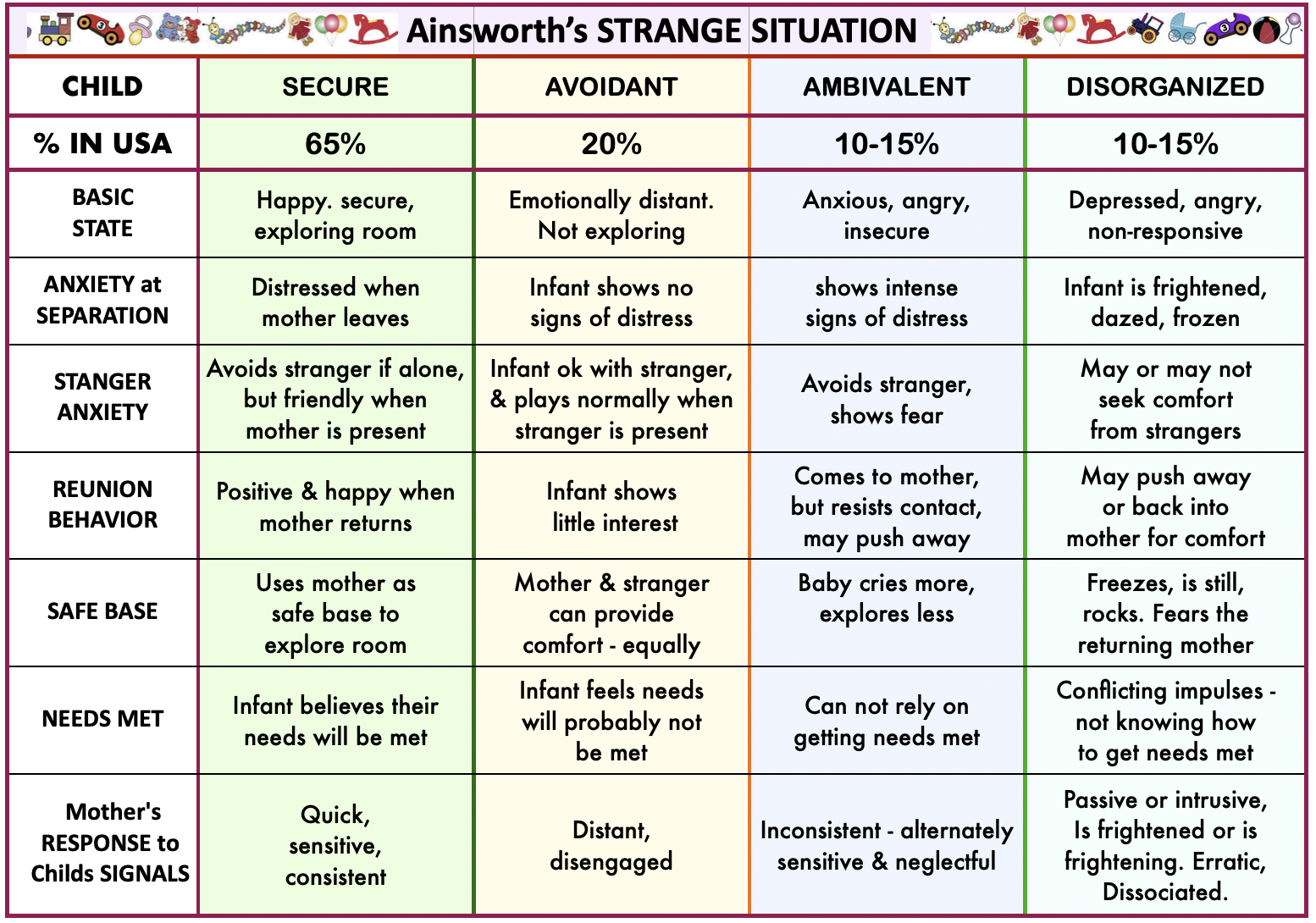
REMINDER  Based on the “Strange Situation”
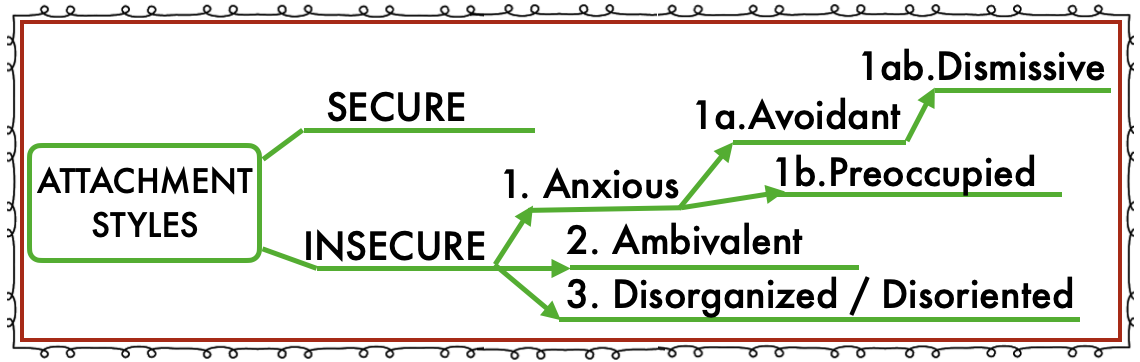
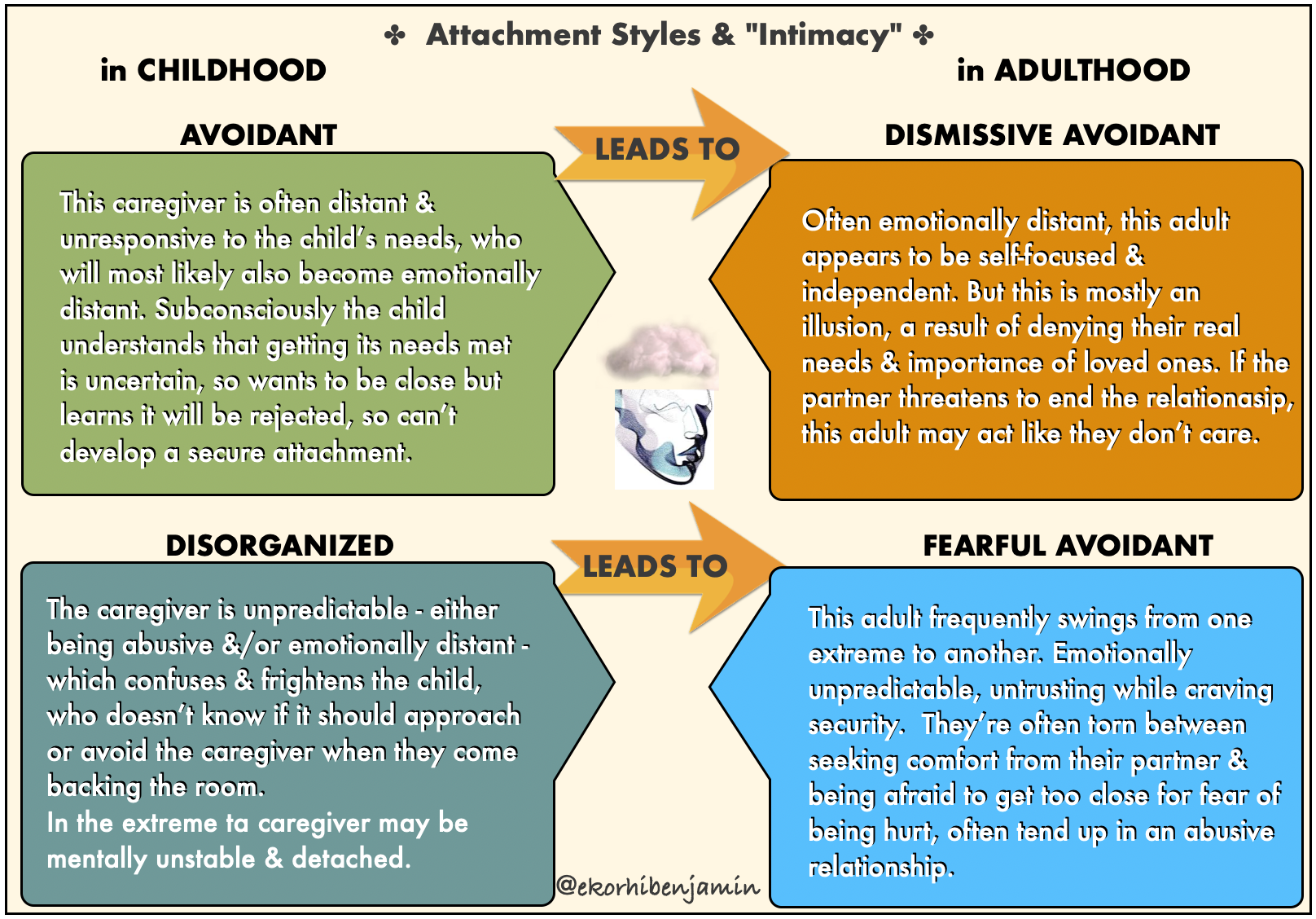
🔹AVOIDANT child –
distracted by the environment & doesn’t want mother when she comes back <—-> becomes DISMISSING adult – who doesn’t open up emotionally to partner, & prefers to be on their own

🔸 AMBIVALENT (resistant) child –
who doesn’t interact with the environment much, & is very upset when mother leaves
<—-> becomes PREOCCUPIED adult – always afraid of rejection, obsessive about needing closeness
«
♥️ ATTUNEMENT vs DELAY in the Early Years
In his work with mothers & infants, John Bowlby challenged the idea of a ‘perfect mother’.  While a mother needs to be emotionally available to her infant, with two-way communication being built up —–> an equally important part of her role is to allow the infant to experience tolerable frustrations.

This can lead to a healthy development of independence & sense of Self. Bowlby said that a mother was not doing the best for her child if her aim was to immediately alleviate all distress, discomfort & frustration.  (Winnicott, 1965).

♥️ MOTHER – CHILD interactions

«
♥️ INDEPENDENCE through SCAFFOLDING
For a slightly older child = when an age-appropriate task gets tough, he/she will pleadingly ask you the parent / caretaker, melting your heart in a second – moving you to do the task for them.
No matter what prompted you to do that, the result is – the child’s independence is hampered.

The best way to handle the situation is through scaffolding. Provide just enough support for the child to complete the task on their own.
GIVE clear directions, reduce confusion, understand “zone of proximal development”**, and encourage the child to finish.
Soon they’ll develop the pleasure of doing the activity, not just focusing on results.
** “…. the space between what a learner can do without assistance & what they can do with adult guidance or in collaboration with more capable peers”
This lays the foundation for strong social & emotional skills that will serve them for the rest of life. An independently functioning child is also more stable in groups, interacting well with peers – because of a high level of confidence.
«
♥️ DISTURBATION of Attachment

«
♥️ GOOD vs BAD PARENT

«
♥️ Maternal COMMENTS
A UK study was made to test the links between attuned & non-attuned comments made by mothers – to see the effect on their infants’ mental states.  In a study of 206 mothers with their infants, these two types of comments showed marked differences on attachment security. (York U. Meins et al., 2012, ).

RESULTS :
☀︎ attuned comments = secure infant attachment
☀︎non-attuned comments = less secure attachment.
And a very high proportions of non-attuned expressions predict Resistant attachment, more than Avoidant.
«
♥️ Infant Attachment and SECURE BASE Provision
The Secure Base model is drawn from attachment theory, adapted to include an additional element, ‘family membership’, for children who are separated from their birth families. It provides a way for the infant to learn about a caregiver’s availability to serve as a secure base  — both when it needs comforting AND when it’s focused on exploring
(See Att. Dysfunctions #3 post)

«
The 5 dimensions of caregiving ⬆️ are each associated with a corresponding developmental benefit for the child. When the dimensions overlap & combine they create a secure base.
EXP:  A caregiver playing with a child in a focused, child-led way will be doing so with Sensitivity & Acceptance —> as well as demonstrating availability & promoting co-operation.

Both Sensitivity & Secure Base Provision (SBP) look at how caregivers perceive, interpret & appropriately respond to infant signals, Also, in both important infant signals occur at each end of the attachment-exploration continuum.
But SBP looks only at certain key infant signals & specific caregiver responses. It also focuses much less on prompt responses and more on crying resolution  – the ratio of infant crying episodes that end in chest-to-chest soothing until the infant is fully calmed, regardless of promptness. (MORE…..explanation)
«
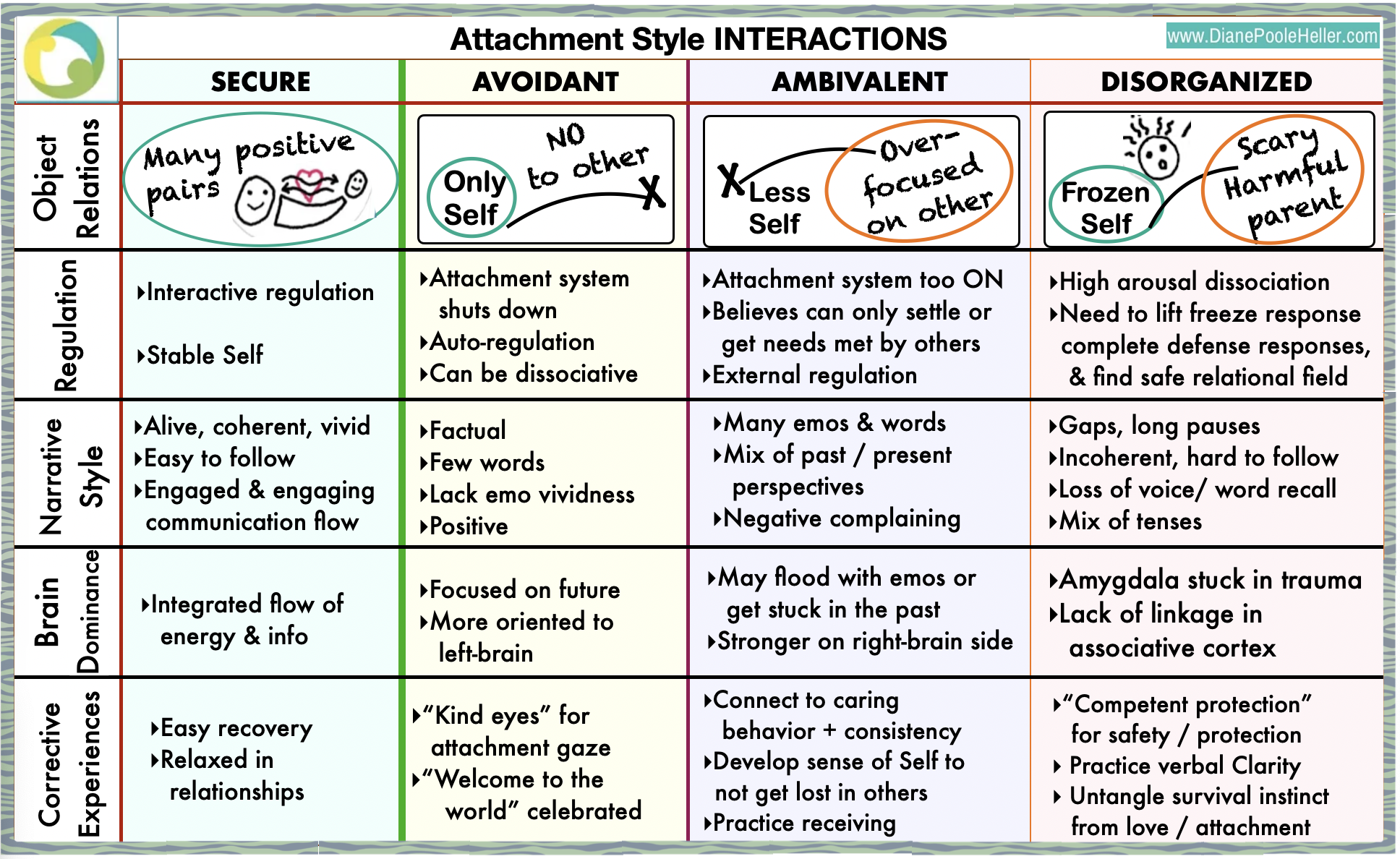
♥️ OBJECT RELATIONS

«
♥️ CHANGING Parent-Child Relationship
In a large national study of Canadian families, interviews revealed that typically warm relationships between parents & preschoolers changed (diminished) as children became older. (Statistics Canada, 1999)
«
♥️ INTER-RELATING

«
NEXT : Healthy-er PARENTS

ATTACHMENT : Parent-Child INFO (#1a)

PREVIOUS:
SECURE Att. #2
SITEs :  “Children’s early social & emotional experiences matter”

◆  Parent-child Interactions Affect Social & Emotional  Development 


SOURCE of SECURE Attachment

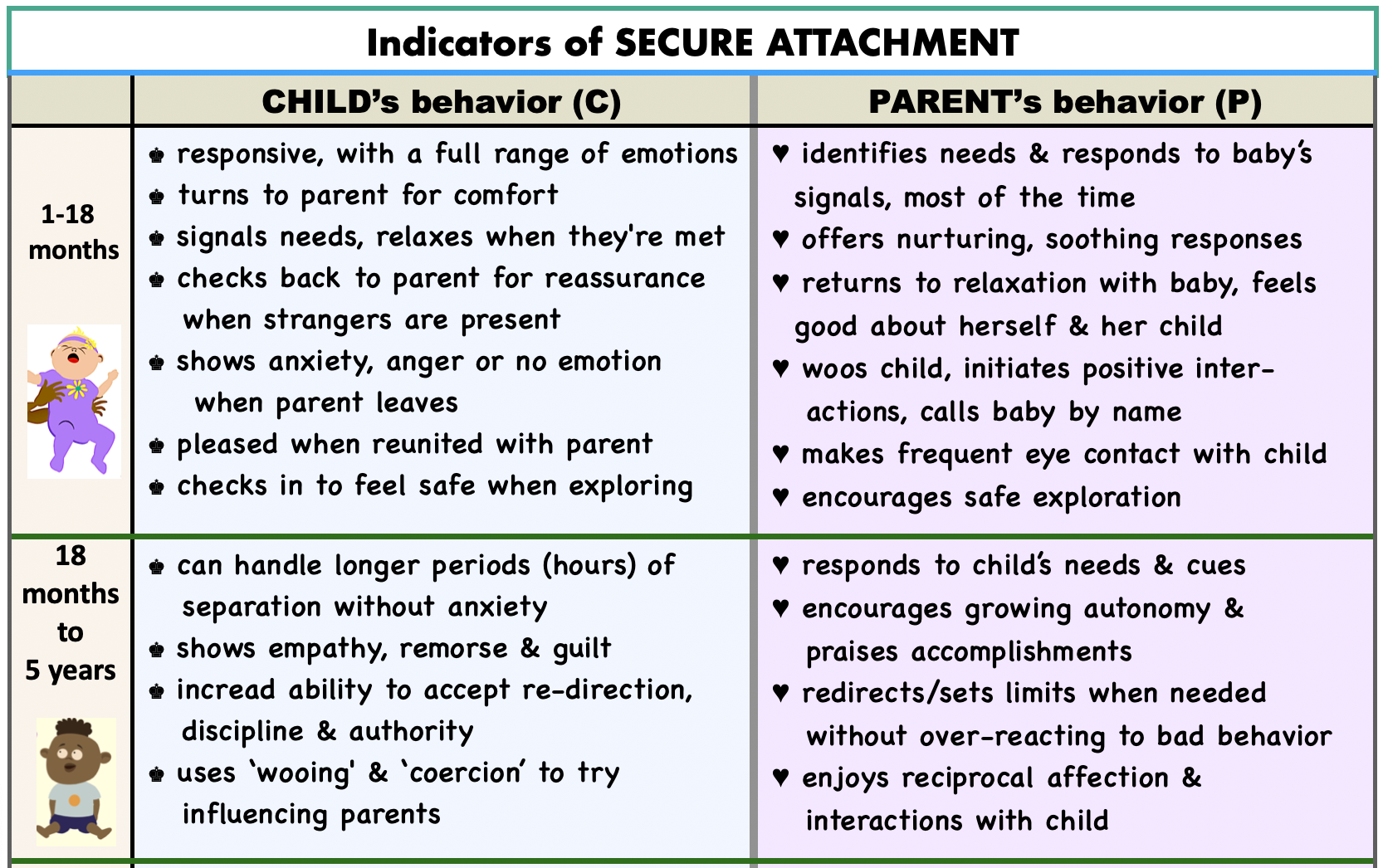
A strong Secure attachment bond develops when mom synchronizes with her baby from the very beginning – by regularly being sensitive to her baby’s need-signals & providing comfort & quiet. (See charts at bottom of post)

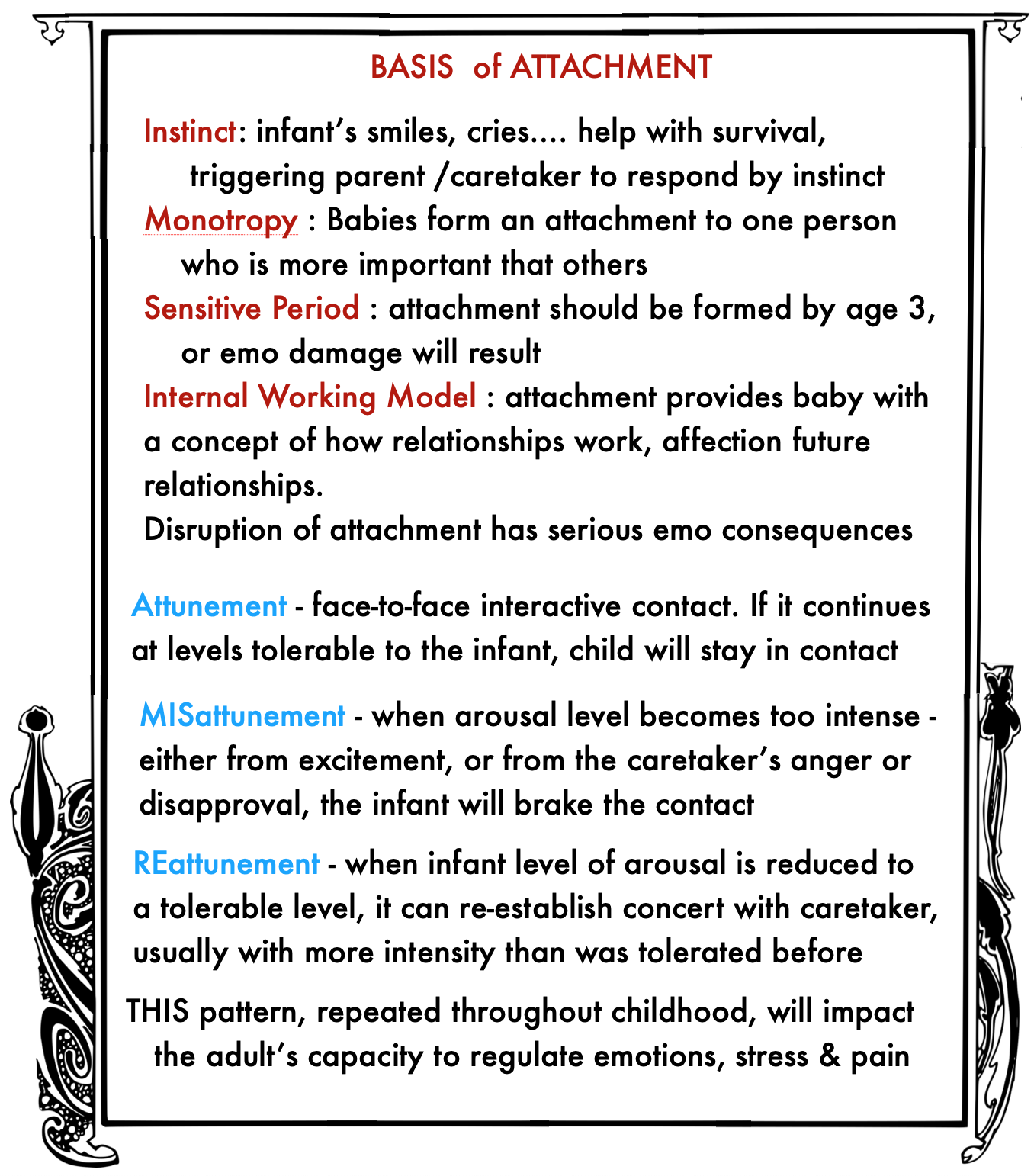
Synchronization involves reciprocated mother-child rhythms, matching their mental states & energy levels, alternating between periods of arousal & rest. Attunement is expressed through facial expressions, tone of voice, body gestures, & eye contact.

Healthy mothers synchronize to baby, while unhealthy mothers insist on getting baby synchronized to her own needs. The mother who de-synchronizes with her child seriously damages her child’s attachment circuit.

In a stable, loving home, the child intuitively knows it can use the caregiver as a safe base for exploration. Baby shows appropriate distress when the adult leaves, & is comforted when mom returns, which allows it to feel safe enough to then return to exploring its immediate environment. It may be comforted by a stranger, but shows a clear preference for the parent.

NOTE : There’s NO such thing as perfect parenting!
John Bowlby coined the term ‘good-enough mother’ who allows just the right amount of delay in meeting an infant’s needs  —-> to encourage both tolerance of waiting AND confidence in ultimate satisfaction – not as deprivation or from neglect!
Studies confirmed his work,  that – to have a positive impact on a baby – caregivers need only ‘get it right’ 50% of the time when responding to the child’s need for attachment. (Lehigh U. in PA, USA 2019)
Because children don’t have fully a developed persona, skills & self-esteem, it is important that the adults in their world actively work to increase their confidence. When kids feel valued, loved, heard, and respected, a positive identity develops based on being treated this way. Most children basically want to have a place in the world, and in the lives of those they love.

⬆️ The STRANGE SITUATION (SS) “Normal”
Psychologist Mary Ainsworth (1978) created an experiment in 5 stages to assess the quality of an infant’s attachment to their mother, designed to present children with an unfamiliar, but not overwhelmingly frightening experience
«

«
DEVELOPMENTAL STAGES
In a longitudinal study with 60 infants, researchers Schaffer & Emerson (Glasgow, Scotland) analyzed the types of attachment-relationships infants formed.
Children were observed every 4 weeks in their first 12 months, then again at 18 months.

In NORMAL Circumstances :
1) Asocial stage – usually the first 6 weeks after birth. Newborns tend not to discriminate between people, but do have a preference for humans over non-humans.
The infant’s signals, such as crying or fussing, naturally attract the attention of a caregiver, & the baby’s positive responses encourage the adults to stay close

NOTE : Baby’s EYES & Attachment –  Newborns can focus their eyes 7-12 in., just the right distance to make eye contact with mom when being held. This is a basic form of communication for attachment. The infant gazes into mother’s eyesreceiving powerful messages about her emotions & involvement, which influences the baby’s feelings of safety & security…..

2) Indiscriminate stage – from 6 weeks to 6 months. Infants are able to develop trust that the caregiver will respond to their needs. While they still accept care from others, they start distinguishing between familiar & unfamiliar people, responding more positively to the main one, & don’t yet show an aversion to strangers.

3) Specific Attachment– from 7 to 11 months. Babies show a strong attachment & preference for one specific adult & have separation anxiety when apart from this person (usually a parent). Babies also begin to have a fear of strangers at this stage.

4) Multiple Attachments – from around 10-11 months babies are already forming strong emotional bonds with other caregivers, showing an increased interest in father, older siblings, grandparents, friends, & other familiar adults.
«

«
NEXT
: Parent-child Att. #2

SECURE Attachment Style (Part 2)
PREVIOUS : Secure #1

SITE : Cartoon Videos from Circle of Security International


CHARACTERISTICS (cont)

♥️ “SECURES” – Socially THEY

= expect to be loved, trusting that support will be available. They form attachment-bonds more readily, are more successful at making friends & picking appropriate partners with longer & happier marriages

= have appropriate independent & dependent responses & inter- actions in relationships, neither desperately seeking nor avoiding connections

= are comfortable with closeness. Want the person they care about to be integrated into their life, with an exchange of family & friends on both sides – if possible
THEY
= love unconditionally & empathize completely. When the partner becomes part of their inner circle, they’re treated with love & respect (like “royalty”)

= freely & clearly communicate feelings to their partner. If they say something insensitive or harsh when under stress, they own it & apologize as soon as possible

= know their taste & will be clear – showing interest if interested, or decline to continue if not

= they tell their partner what they want, AND freely offer what they have to give, once a relationship is stable
THEY
= can speak freely about feelings & old experiences (memories), clearly explaining how they feel now or felt in the past 

= value their partner understanding who they are & accepting how they became that way 

= are confident in their positive beliefs about themself & others, therefore secure in their ability to bringing value to the relationship

= are appropriately concerned for their partner’s well-being, responsive to others’ needs – expecting others to be that way in
return

= enjoy sex, tending to view sex & emotional intimacy as one, not   needing to create distance by separating the two. They don’t misuse sex as an addiction to suppress emotions

= prefer sexual activity in a committed romantic relationship. Enjoy touching to express closeness, & positive sexual experimentingSECURES – DO NOT:
= have the fears & preoccupations (obsessions) of the other types
= numb out their emotional pain.
= afraid to ask for the truth, even when that truth might hurt. It’s the power of vulnerability

= play psychological games – withhold or manipulate to get what they want – because they want closeness & believe others want the same
DO NOT:
= get overwhelmed by a fear of being slighted (like Anxious) nor fear of engulfment (like Avoidants), so don’t struggle with envy or jealousy

= try to keep others from knowing them, nor live a compartmentalized life where others are not welcome in some settings (family, work, relaxation….)

= put up barriers or constantly talk of “boundaries” as a way to distance themself emotionally. “Secure” don’t mean ‘cool’
DO NOT:
= pile up secret stores of resentments their SO (significant other) will never be told about directly

= hold grudges—someone who is honestly angry at you for a good reason communicates their distress in a healthy way

NOTEIf the secure adults had an unhappy upbringing, they now understand the effect those painful experiences have had on them. They’ve also given up the ROLE of victim, having worked through enough of the trauma to speak about it without crashing

re. being with or being a secure partner – one great thing is that they have the power to lift up someone with an anxious or avoidant style to develop personal satisfaction & smoother inter-relating

♥️ How did some people become “Secures”?
= some children not born with a naturally secure disposition, achieve it by the attention of responsive but not overbearing parents within a relatively happy, stable family

BUT, with a less-than-ideal early life , some
= seem to be naturally resilient, & will find enough other nurturing role-models to overcome bad parenting

 = yet others grow into an adult Secure – out of an unsafe beginning – through therapy, along with Secure friends & a stable significant relationship with a Secure partner  (More….)

TEENS : those who can talk coherently & thoughtfully about their experiences with their parents —
= are better able to handle conflicts with both parents
= are more assertive, but also able to ‘hear’ their parents’ point of view
= less likely to act out dysfunctional, critical anger
= make an easier transition to college
= have fewer one-night stands, with more positive emotions during sexual activity

NEXT : Parent-Child, Part 1

SECURE Attachment Style (Part 1)
PREVIOUS : INTRO, #4

SECURE Attachment
The concept of a “secure base” is central to attachment theory, the bedrock for emotional & physical health, crucial to a child’s successful development 

All children form some kind of attachment relationship to primary caregivers –  the 4 major types being Secure, Insecure-avoidant, Insecure-resistant & Insecure-disorganized)

Secure attachment has lasting impacts on an individual. Such children have a consistent, loving relationship with parents – giving the confidence to explore & interact with the world as they grow. They feel protected by their caregivers, & know they can depend on the adults returning – if they leave briefly.

ADVANTAGES to being Secure
❦ Admit when in distress, able to be vulnerable even IF in a high-powered position
❦ Have high self-esteem & few inner doubts
❦ Less likely to be a bitter cynic & more an enlightened work-colleague
❦ Regard others as trustworthy & reliable until proven otherwise
❦ Remember parents as warm, available & affectionate
❦ Actively work on & enjoy intimate relationships

CHARACTERISTICS of secure people

PSYCHOLOGICALLYTHEY
= understand what makes themself & others tick, with a sense of why their parents behaved as they did

= are better at recognizing their own inner conflicts, knowing when they’re off centre. & generally know what to do about it

= take responsibility for their strengths & limitations, & work at improving themselves, with persistence & gentleness

= are comfortable being alone & enjoy their own company, whether “married”or not. Also strongly goal-oriented when on their own
THEY
= are good at “self-regulation”, including identifying & maintaining healthy boundaries between self & others

= have a sense of personal empowerment rather than helplessness – resilience in the face of adversity, with a high tolerance of short-term ambiguity & frustration

= are optimistic & hopeful – knowing their life’s purpose, & believe in their ability to solve problems or overcome obstacles

= are adaptable & flexible in all life situations, including conflict
THEY
= know they can be themself, safe to disclose their thoughts & feelings to ‘close ones’, without fear of rejection

= feel worthwhile even when rejected by someone, & so are not as hurt by others’ moods & negative comments or actions

= assume other people have good intentions, so are likely to forgive them when they’re hurtful

►EMOTIONALLY – THEY
=
 can roam the emotional world freely, & help others with strength & empathy, from confidence in their own worth

= are willing to explore the emotionally close relationships, not afraid of being ‘seen’, finding it easy to enjoy closeness, physical & emotional, without putting up walls

= freely express both pleasurable & painful emotions, part of any relationship, & the courage to experience heartbreak – called emotional intelligence

= can pick up on other people’s feelings, attuned to others’ emotions & attitudes, making them better parents, partners, friends & employees

= are quick to forgive others – letting them know when they made a mistake, but not holding it against the

= tend to show anger more easily toward others, but quickly recover their calm 

MENTALLYTHEY
= are mentally flexible, & not threatened by criticism. So they’re
willing to reconsider their way of interacting, & if necessary, revise beliefs & action-strategies.

= know that things will be okay again during challenging times

= are effective communicators, & expect others to understand what they hear, & be responsive.

= are great conflict busters. During a fight they don’t need to act defensively, nor injure or punish an adversary or partner, which prevents the situation from escalating

= when there’s conflict in goals or plans, they make an effort to understand another’s point of view, & find a compromise that satisfies both parties

► WORKING – THEY
= have higher incomes, on average
= have higher job satisfaction, less likely to burn out
= have better physical & mental health, less symptoms of illness
= less likely to put off or have trouble with their tasks, less fear of failure or rejection

= use their ability to reflect on their own (& others’) inner emotional states to be better leaders, being more successful in a group work environment

= pick up on attitudes & needs of staff, & so are able to respond appropriately, both verbally & nonverbally. Feel heard, employees  have a greater sense that such team leaders can be relied on.

= tend to be well-liked by colleagues because they’re friendly & outgoing, and generally likable. Because the feel secure, the, comfortable with themself & others.
SEE Posts on Positive Leadership

NEXT : Secure #2

ATTACHMENT – INTRO (Part 4)

PREVIOUS : Attachment Theory #3

SITE : ATT style QUIZ (short)

DURABILITY
Psychoanalyst John Bowlby believed that “ATT behavior characterizes human beings from the cradle to the grave” (1979),  & that it’s instinctive in infants. His main research goal was to describe & explain how children become emotionally attached to their primary caregivers, & are emotionally distressed when separated from them.
ATT behaviors are activated by any situation which seems to threaten the achievement of proximity (staying physically near the parent/ main caretaker).

Based on Bowlby & M’s work (1965 thru 1988), the most common opinion is that a person’s ATT style formed in childhood will be maintained throughout life.
More recent theorists disagree – indicating that ATT bonds are flexible, that dynamic changes can & do occur, & on a quite short time scale.

Research shows that not all children who experience inadequate & abusive parenting go on to develop an insecure attachment style, just as not all children who receive emotionally attuned, available, or responsive care-taking automatically develop a secure attachment style. 

PERSPECTIVES
🔅Organizational : 
“Early experiences should be construed not as determinants of development, but rather as setting the stage for optimal psychological functioning” (see here). So while childhood may create a specific ATT type, later events & environment will determine whether the early patterns will remain in place or change.

🔅Differentiation of ATT representations : This suggests that over a person’s life span, rather than updating existent representations (changing our image of the original caretakers), new ones are created (added) when we bond with other people

🔅Socialization–selection asymmetries : Att bonds & representations are more or less stable at different stages of life, with more stability during adulthood – compared to adolescence – & for more established relationships, as with one’s parents. (see here).

A Minneapolis U. 30 yr. longitudinal study found that :
Of the participants who had experienced significant loss or stress, 44% changed attachment categories from infancy to early adulthood, versus only 22% who had not experienced negative life events.  (MORE….)

So, as adults, forming positive new relationships can create improved changes in the “working model” of the Self & Others. Such improved experiences can help some people override the traumatic influence of their first 6 years with family, indicating that ATT styles may not be set in stone. While there are no guarantees, both risk & protective factors have a major impact.

The good news is, it’s never too late to develop a secure attachment. The style you developed as a child based on your
relationship with a parent or early caretaker doesn’t have to define your ways of relating to those you love in your adult life.

By identifying your original ATT style, you can see ways you defend yourself from getting close enough to suitable people who you can become emotionally connected to, and then work toward developing an “earned secure attachment.”

One essential way to do this is by “making sense” of your story. The key to making the shift is to write a coherent narrative of your childhood experiences. That kind of inventory actually rewire your brain, which helps cultivate more security within yourself & so in your relationships.

NEXT : SECURE ATT, #1

ATTACHMENT – INTRO (Part 3)

PREVIOUS : INTRO #2

Internal WORKING MODELS (IWM)
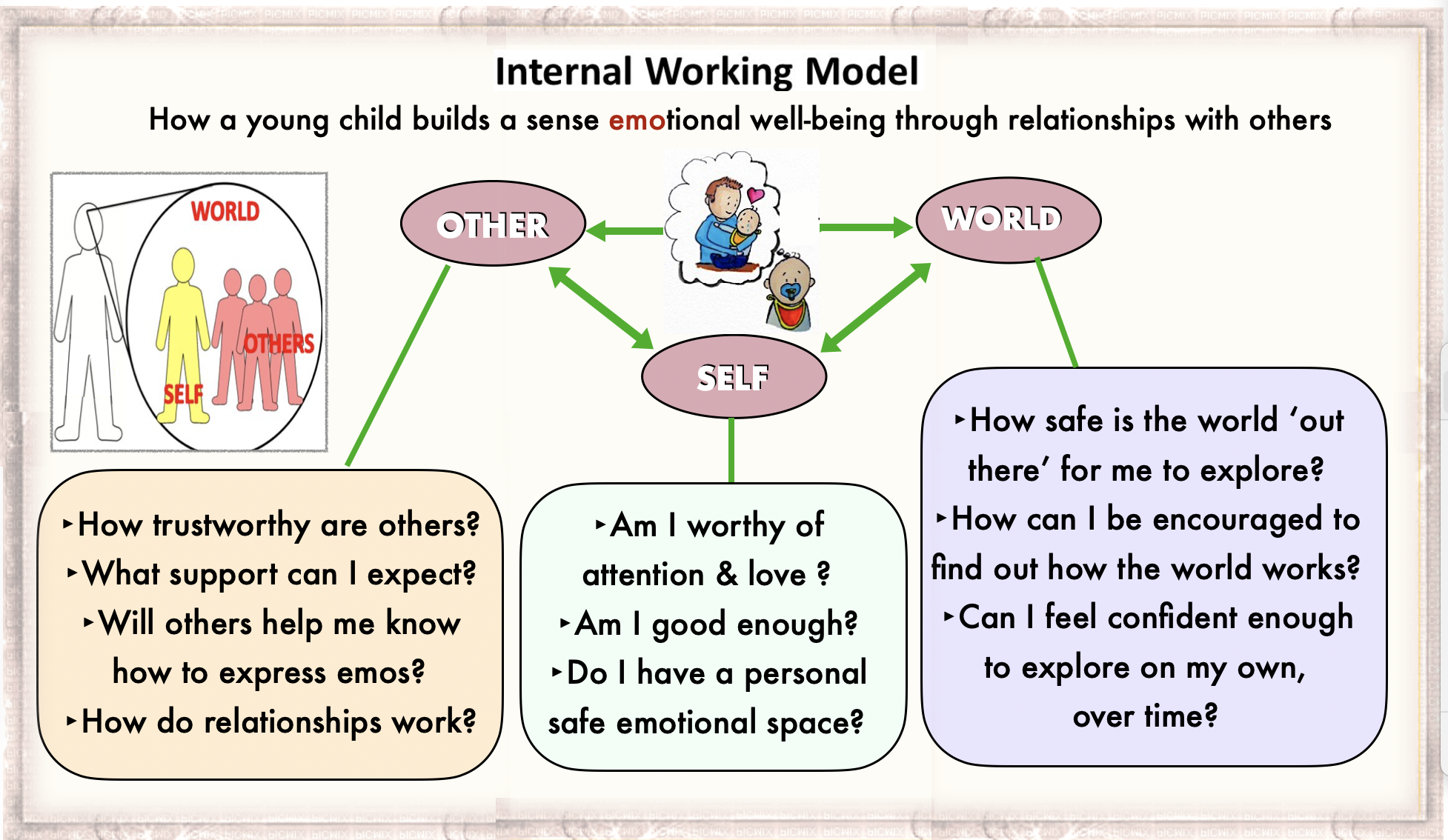
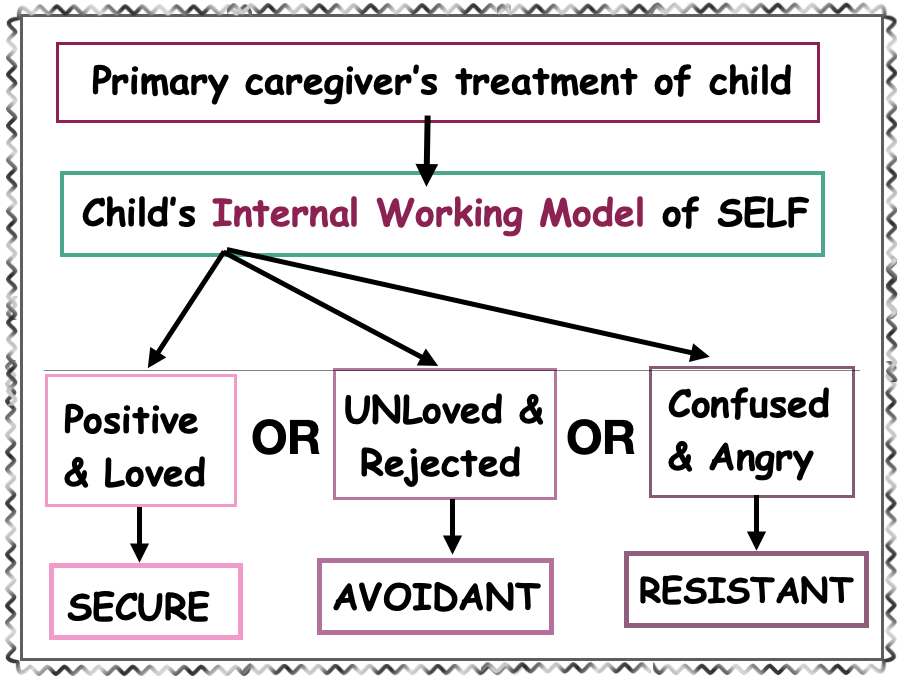
Over time, children internalize their specific attachment style as a base to form a prototype for later relationships outside the family. This is made up of a set of archetypes of Self & Others, an automatic process of creating cognitive schemas (mental pictures).

IWMs are a key component of a person’s earliest development, because those schemas become an inner guidance system for future behavior. (as SBS = secure base scripts)
They govern the way each child interprets & responds to the caregiver’s behavior, as an expectation of care, which is then used to make decisions about & plans for ways to interact with others.

EXP: As an adult, it’s used to decide whether to approach or withdraw from a situation, as well as for voluntary emotion- & distress-regulation strategies

IWMs influence a person’s emotions, general behavior, interaction with others, & assumptions about how others will treat them in relationships. For most, IWMs operate unconsciously, guiding our attention & actions in social situations.

IWMs are dynamic, so can be modified under some conditions, but tend to remain stable over time, based on the quality of the original parent-child relationship.
🌗  This is why Recovery from an unhealthy or traumatic childhood takes so much time & effort!

RESEARCH  
Studies validate the reality of universal human social needs. In the UK, after World War II, the unmet needs of homeless & orphaned children created great distress for the British. To deal with this, relief organizations addressed the problem with the help of attachment theory, based on Maslow & Bowlby’s developmental psychology work.

At the time, the focus was mainly on maternal deprivation & the corresponding loss of the child’s essential / primal needs. Attachment theory has since been extended to explain nearly all the human needs in Maslow’s hierarchy, from basic physical needs & mating -to- group membership & justice.

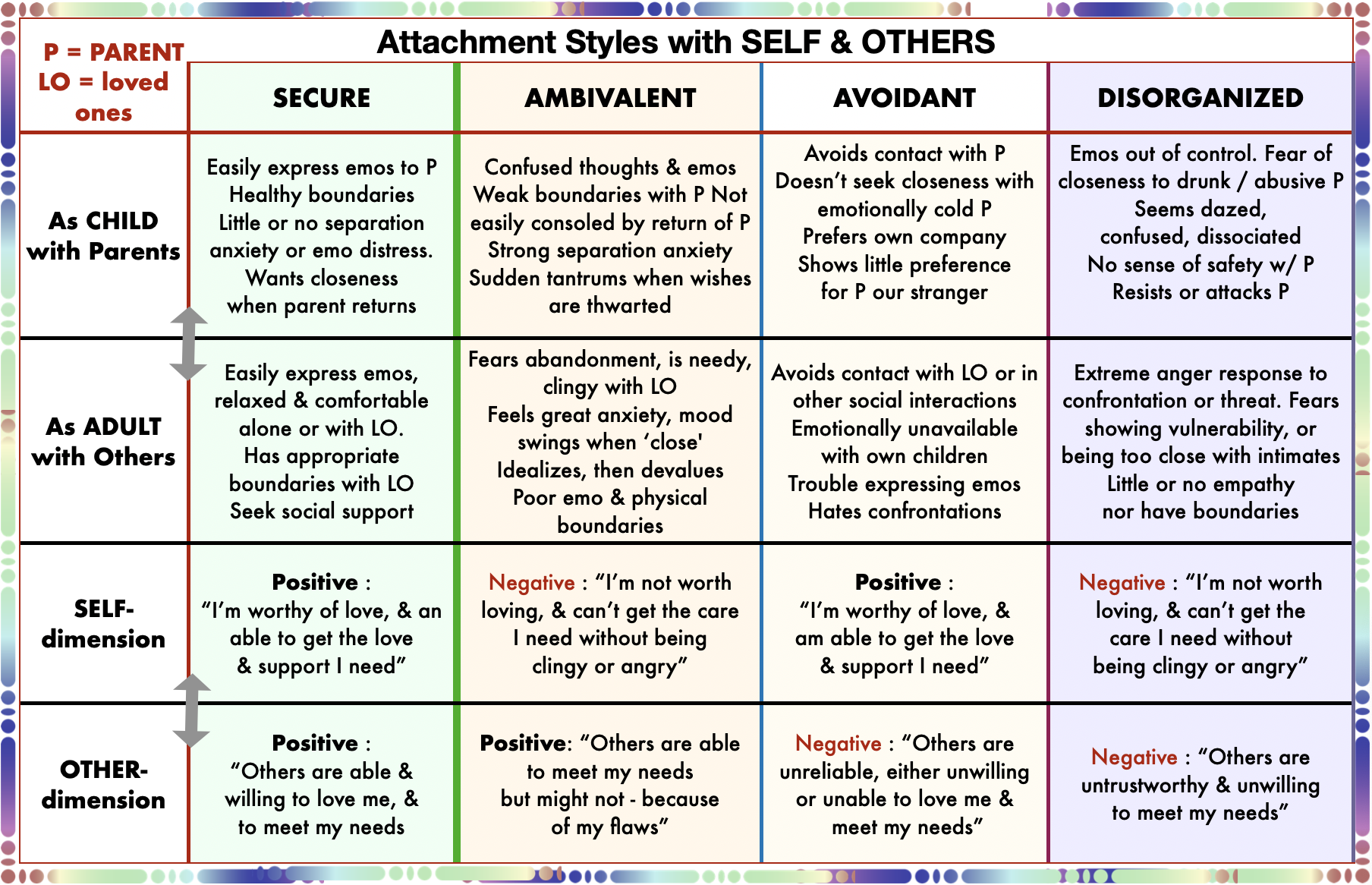
The theory indicates that attachment Security or Insecurity are connected with specific images & beliefs about the Self & Others.
♝ Security is usually related to positive Self- & Other-models
♝ Avoidance comes from an overly positive Self- but negative Other- view
♝ Anxiety is linked to a more ambivalent Self- & Other opinion

Based on a person’s childhood experiences, R. C. Fraley, (2002) adults pay particular attention to experiences & information that fit their internal expectation about how the world works, referred to as the Confirmation bias.
CONCLUSIONS
Both insecure styles (Avoidance & Anxiety) interfere with rational thinking & reality evaluation of people / places / things (PPT) – which would normally regulate emotion as part of a person’s positive functioning. Interestingly, they seem to have opposite effects on how life is understood ⇓

🔹 Avoidance is linked to a general decrease of emotional reactions, especially re. incoming positive social info (good news is not comforting!)

🔹 Anxiety includes a general increase in emotional reactions, especially in the case of incoming negative social information (bad news is very triggering)
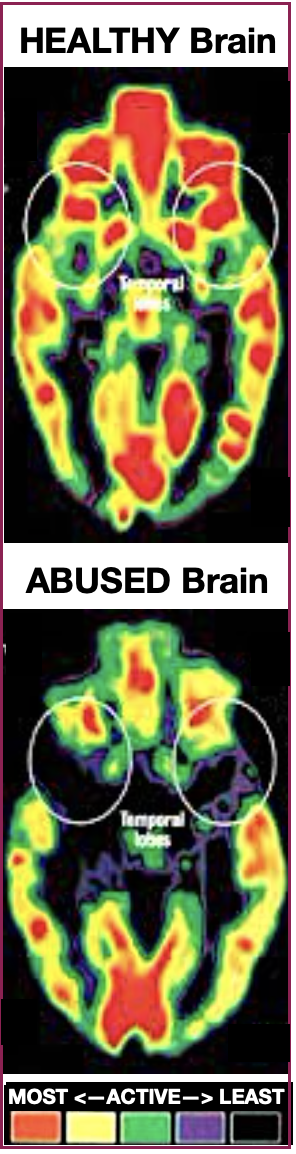
➡️  IMAGES from “Early Attachment Relationships & Their Impact on the Brain’s Wiring
ALSO :
Two studies used a brief adjective checklist (strong, safe, cruel, stupid….) to measure attachment. Data revealed that participants with a more negative self-image showed — ⇓

🔸 increased brain activity >thinking< during either positive or negative adjective evaluation about the Self (“I’m strong OR I’m unattractive”) (pleased OR upset)

🔸 but decreased brain activity >stop thinking< when hearing negative adjective about a close ‘other’ (“Mom is selfish / My kids are aggravating”).  (More….)

re. TEENS (More….)
Normally, as a teen grows, they can better cope with incongruent (unclear or negative) reaction to themself in social situations.

For Anxiety attachment, the observed effects were similar to age-related brain activation –  increased brain activity (being upset) when dealing with incongruent social feedback or conflict.

However, Avoidance attachment influences brain activity opposite to “normal” development, causing a stronger focus on congruent (clear & positive) social feedback, AND ignoring anything unpleasant – which is less psychologically mature.

‘High’ Avoidance seems to make a person unable to notice or deal with variations in social interactions.
EXP : Avoidant teens will gravitate to friends & locations which totally agree with their own attitude & point of view.
NOTE : Avoidant Attachment does not always mean physical isolation, but rather emotional withholding.

NEXT: INTRO – #4

ATTACHMENT – INTRO (Part 2)

 PREVIOUS :
Attachment Theory #1

SITE : QUIZ – re.  Love & Attachment 


T.E.A.

The three emotion (E) regulation & coping strategies >>problem, emotion & avoidance -focused << are the source of many interesting cognitive (T) & behavioral (A) outcomes discovered in people with different attachment styles.

Different patterns in children’s attachment styles or orientations in adults —> reflect different ways of regulating affect (observable manifestations of emotion), particularly the way painful emotions in especially challenging or threatening situations are controlled or dampened.

◎ More Securely attached adults usually experience more intense & mildly pleasant emotions in romantic relationships, fewer intense & mildly uncomfortable emotions ……
◉ ……. whereas the reverse is true of the more insecurely attached.
In one study students classified as insecure (anxious-avoidant or anxious-resistant) were rated by teachers as less socially competent during early elementary school.

⁍ Similarly, teens rated as insecurely attached were seen to have lower social competence when interacting with their same-sex friends at age 16…..

⁍ …… which in turn predicts both feeling & expressing unhappy / painful emotions in romantic relationships when in their early 20s.

THEORIES
Conceptual Models  = WHO qualifies as an ATT figure
▪︎ Monotropy – that the main ATT figure (usually the mother) has an exclusive impact on children’s personality development

▪︎ Hierarchy – Adds that relationships with subsidiary ATT figures (like the father) may also contribute, although to a lesser extent. However, since the 1960s fathers‘ contribution to child development is increasingly recognized

▪︎ Independence – all ATT relationships are assumed to be equally important
▪︎ Integration – the quality of all ATT relationships, taken together as a whole, is what optimally predicts children’s developmental outcomes

🚼 Sensitivity Hypothesis = HOW is ATT transmitted from from one generation to the next?
Theory : the assumption is that once a certain attachment style has been formed in early life, it remains relatively stable throughout, & is then transmitted from one generation to the next. The main variable of this transmission emphasizes parental / maternal sensitivity.

However, the amount of variance evident in families indicates there are many other variables moderate it, called the ‘transmission gap’

🚼 Competence Hypothesis = Secure is good, Insecure is bad
Theory : an early Secure attachment is a prerequisite for healthy emotional & social development, necessary to become a competent child, adolescent & adult.

Competence includes the ability to understand & regulate the expression of emotions – individually & in response to others. It’s associated with better well-being, life satisfaction & higher self-esteem, & can ease cognitive tasks.

However, starting life with an insecure ATT can represent a risk factor for developing mental health, it’s no longer assumed to inevitably produce negative outcomes.

🚼 Universality Hypothesis = built on 3 assertions that :
— healthy attachment is facilitated through parental sensitivity
— secure attachment is normative
— healthy attachment leads to longitudinal competence.

Critics argue that contemporary attachment theory privileges a conception of child-rearing that is fundamentally based on family structures & societal conditions that ignore the cultural practices of most of the non-Western world.

🚼 Cross-cultural similarities vs differences = Theories have mainly been tested on people from western, educated, industrialized, rich & democratic societies – in short, “WIERD”(rare) cultures (scroll down).
However, now there are many implications of cross-cultural differences in ATT on various levels, having to do with moral judgments about good & bad parenting.  EXP: a comparison of US versus Japanese values. Rothbaum et al

EXP: A study done in the slums of Nairobi, Kenya (pub 2021) of 2,400 households with children under 5. Researchers evaluated caregiver-child relationships in the routine home visits, using an adapted version of the Ainsworth “Strange Situation”.
RESULTS  : Of the 2,560 children studied from July to December 2010, 2,391 (90.2%) were assessed as having a secure attachment with a parent or other caregiver, while only 259 (9.8%) were assessed as being at risk for having an insecure attachment.

NEXT : Attachment – INTRO #3

ATTACHMENT – INTRO (Part 1)

PREVIOUS : Enneagram WINGS (Types 8, 9)

SITEs:  ☼ History of Attachment Theory
☼ “What is Somatic Experiencing ?

ATTACHMENT THEORY can be considered a variation of Object Relations Theory. It tries to understand & clarify people’s emotional connections throughout their lives, first with parents & then with everyone else. Attachment styles may vary & change over time, but we all have a tendency to favor the ‘original’ one.

When positive : the basic idea is that the primary caregiver (an emotionally healthy mother) who is available & responsive to an infant’s needs – allows the child to develop a sense of security. Because she’s dependable, the child will feel safe, & so is comfortable to explore the world.

Attachment styles don’t develop overnight. A few really positive or negative interactions with parent(s) / primary caregiver(s) are unlikely to have a permanent impact.
▪︎ Rather – it’s by repetitive interactions – either frustrating or rewarding – that attachment styles take shape.
In addition to parental behavior, a child’s inborn temperament plays an important role in creating that bond.

According to attachment theory, formative relationships serve as a psychological foundation of personality, from which we develop —
‣ an understanding of how relationships work
‣ what to expect from other people
‣ how safe or “secure” we feel in any relationship

«
Our style can be thought of as the “lens” through which we see ourselves with others. If it’s blurry or cracked, we’ll experience inter-personal interactions -at best- as slightly ‘off’, -at worst- as very distorted.

Children have a built-in drive to seek proximity in order to bond with a primary caretaker (usually the mother). This is a highly adaptive survival strategy that ideally leads to the child’s ability to :
manage stress 
— explore the world without undue fear
— develop a coherent sense of Self in relation to others.
The child’s tie to the mother is called —> ‘attachment’, whereas the mother’s tie to her child is called —-> the ‘care-giving bond’.

Developmental psychologist Mary Ainsworth defined ‘normal’ attachment as “An affectional tie that one person or animal forms between themself & another specific one – that binds them together in physical space, & endures over time.”
It involves a desire for regular contact with that person, & produces distress when separated from them.

3 Key Propositions of SECURE attachment (Bowlby)
First When children are raised with the confidence that their primary caregiver will be available to them – they’re less likely to experience fear throughout their life – than those who are raised without such conviction.

Secondly – this confidence is forged during a critical period of development – throughout infancy, childhood & adolescence. The expectations formed in those years tend to remain relatively unchanged for the rest of the person’s life

Finally – these expectations are a direct result of the child’s experiences. Their assumption is that caregivers will continue to be responsive to their needs, because those people (parents….) have been responsive in the past.

4 Distinguishing characteristics of attachment:
Proximity Maintenance – The desire to be near the people we’re attached to
Safe Haven – Returning to the attachment figure for comfort & safety in the face of a fear or threat
Secure Base – The attachment figure acts as a base of security from which the child can explore the surrounding environment
Separation Distress – Anxiety that occurs in the absence of the attachment figure

As seen in the chart at the top :
Q : What causes differences in styles?
ANS : A combination of inborn differences in the infant, & how they respond to a variety of parental treatment over time

SECURE infants are more likely to have parents who are consistently, appropriately able to attend the child’s needs
EXPs: Feed infant when hungry, rather than on a set schedule
– Cuddle baby at times other than when feeding or changing

INSECURELY attached – results from the mother (or other caretaker) being less sensitive, less responsive &/or inconsistent
EXPs: Feed infant only when convenient for parent
– Sometimes ignore baby’s cry of hunger
– Avoid physical contact with baby as much as possible, or only to harm it (slap, shake, yell at….)


NEXT : Attachment INTRO #2

ACoAs – fear of EMPTY TIME

PREVIOUS : Enneagram WINGS Types 8, 9

SITE: ☼ “Weekend anxiety: Are you dreading time off?

 ☼ 7 Exercises to Heal You Inner Child


✳️ ISSUE
:  many ACoAs notice that when there is no action-goal in sight – the WIC gets panicked. This blank-time can be early mornings, evenings after work, but more likely non-workdays, usually weekends. (POSTS :  ACoAs & TIME )

We don’t know what to do with free time.  We may sleep too much, or
— wander around the apartment / house empty-minded
— endlessly obsess about something trivial or worrisome
— find some activity to distract (internet / social media / movies….)
— act out some addiction (shop, overeat, sleep around….)

If someone asks us “What do you want to do with this open time?” The most often response is “I don’t know.” This is in spite of the fact that on other occasions we’ve said – “I’d like to learn a language / go to the gym / take a walk / read some books / practice my guitar…..”

Yet when we have the time – we don’t. We waste many precious hours not really accomplishing anything worthwhile, which includes putting off things we say we want to do. AND then we give ourself a hard time about procrastinating – again!

🚼 REASONS
1. Lack of “Identity”
Many ACoA say “I don’t know who I am”, this in spite of the fact that we may have actual tangible accomplishments. Again, this plaint is the WIC’s very real feeling-sense – when looking inside all we see is either a ‘monster’ or a blanks. (Post: “Abandonment pain“). 

This comes from : a lack of legitimate mirroring (parents reflecting back to us who we are) so we can’t see ourself,
AND not having our human needs & personality needs identified, much less allowed to express & have provided

2. Fear of painful emotions
We bring with us into adulthood an enormous backlog of unresolved childhood pain. When things are too quiet – we may feel – which we don’t know how to cope with. (Posts : “What about Emotions?”)
And vagueness about taking actions includes trying to escape a deep inner loneliness which is not about being physically by ourself, since we can also feel disconnected & isolated in groups.

Rather, it’s the WIC’s aloneness we still carry – from the trauma of our parents not being able to connect to us/ with us in PMES ways, no matter how it seemed on the surface. They ignored & invalidated our emotions, punished us when we expressed any (excited, loving, hurt, angry….), and didn’t comforted us when we were in pain.

So now we’re terrified of experiencing any emotion, assuming all are ‘heavy’. We miss out on the pleasurable & joyful ones we can have from  finding & expressing our True Self  (Posts : “Being Confident“)

3. Lack of self-motivation
The ability to determine our own actions is based on having a fundamental sense of who we are (point 1), what our needs (point 2) & our rights are.

No matter how talented & accomplished many of us are, unrecovered ACoA are almost totally driven by external requirements, while still thinking we’re frauds!

This means we can & will do what is required or demanded of us from others – whether family, friends, work or religious community. (Posts: Co-dependence)
SO – when there’s nothing or no one else who needs our attention – we don’t know what to do. Like a stalled car, we’re going nowhere!

4. Wrong choices
It’s true that over the years we’ve accumulated a personal history of dysfunctional decisions that have turned out badly – because they were based on our S-H. & obeying the Toxic family Rules.

Without FoO work, we still don’t know how to pick any better, as long as our weak decision-making style is run by the PigParent & the WIC. We’re afraid to make yet another mistake, so are paralyzed.

5. Perfectionism
Our WIC (listing to the PP) is convinced that whatever we do must be done exactly right! It’s the WIC’s uncontested belief, & this supposed requirement leaves us feeling overwhelmed, beyond our ability. So there doesn’t seem to be any point in even trying.

ERROR: In some “recovery” setting there’s a phrase that many people use – “I don’t have to be perfect” – thinking they’re relieving the pressure.

Q : What’s wrong with this statement? Why is the soooo harmful?
ANS: It implies that you could be perfect – if you just wanted to. WRONG, wrong, wrong! NO ONE is!
The belief in perfection prevents us from taking actions we’re very capable of.

❤️ To counter perfectionism, we must develop & apply the UNIT every day – by unconditionally loving our WIC, consistently disobeying the Toxic Rules, and actively providing our needs – to the best of our ability. (Posts : “Set goals to meet needs“)

NEXT : Attachment, Intro #1