ANXIOUS-AVOIDANT Attachment (#1)

PREVIOUS : Anxious Preoccupied, #2

SITEs :
Yes it’s your Parents Fault” & Commentary

Attachment AVOIDANCE & the Brain 

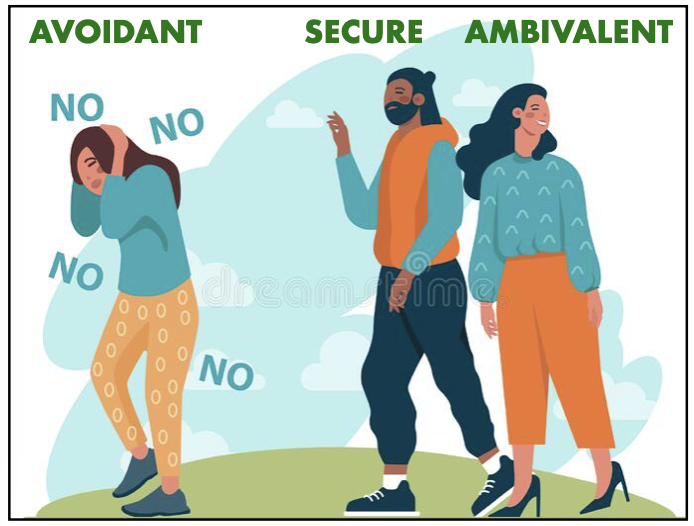
🖤 ME-no / YOU-no
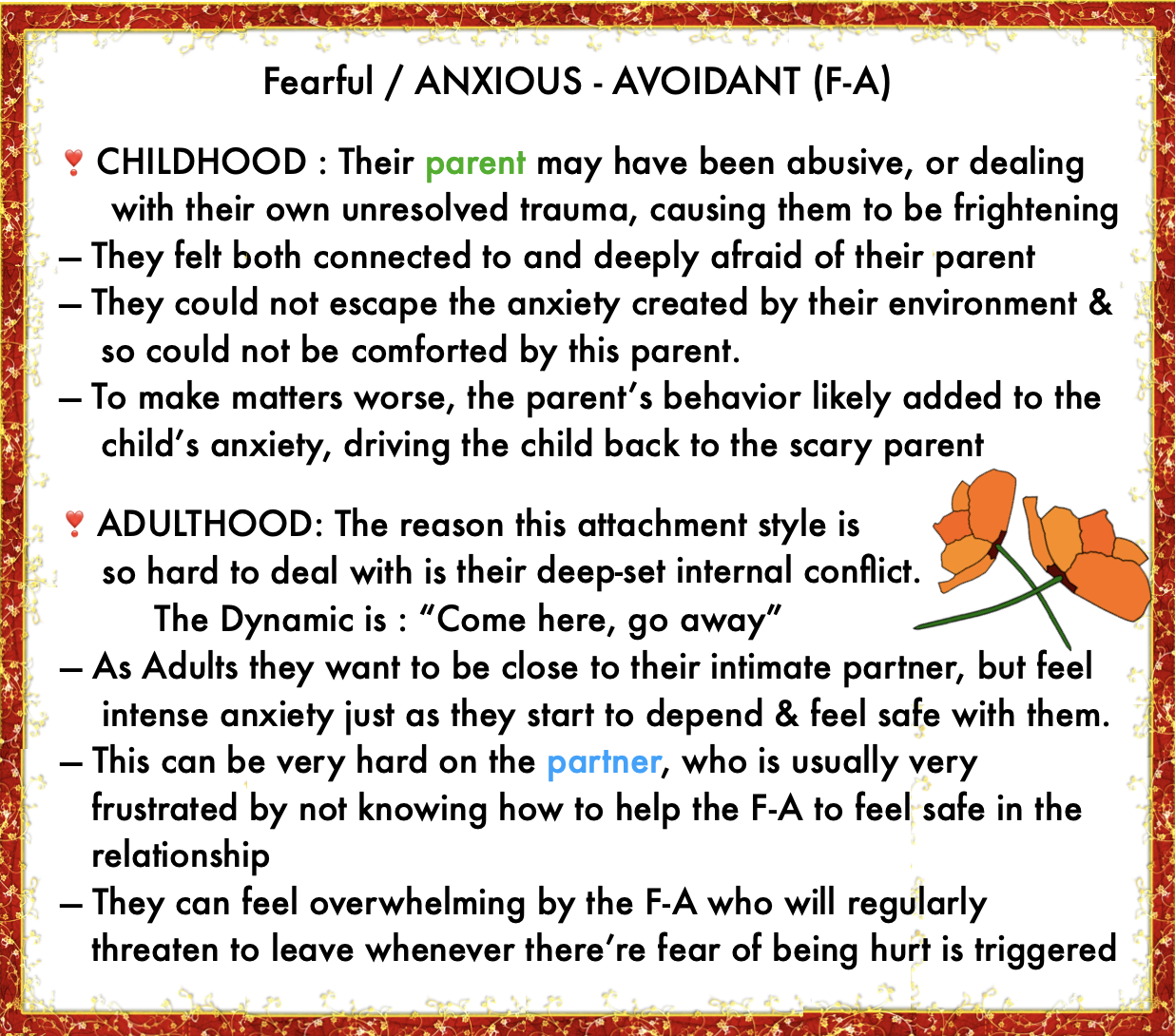
This style may be one of the hardest to understand – confusing to both sufferers & observers. While these types have a strong desire to protect themself by avoiding relationships, they still having a strong desire to be in one. They’re torn between the fear of being too close to and of being too far from others.
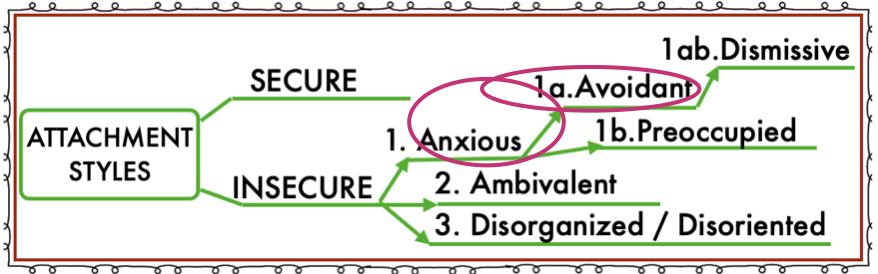
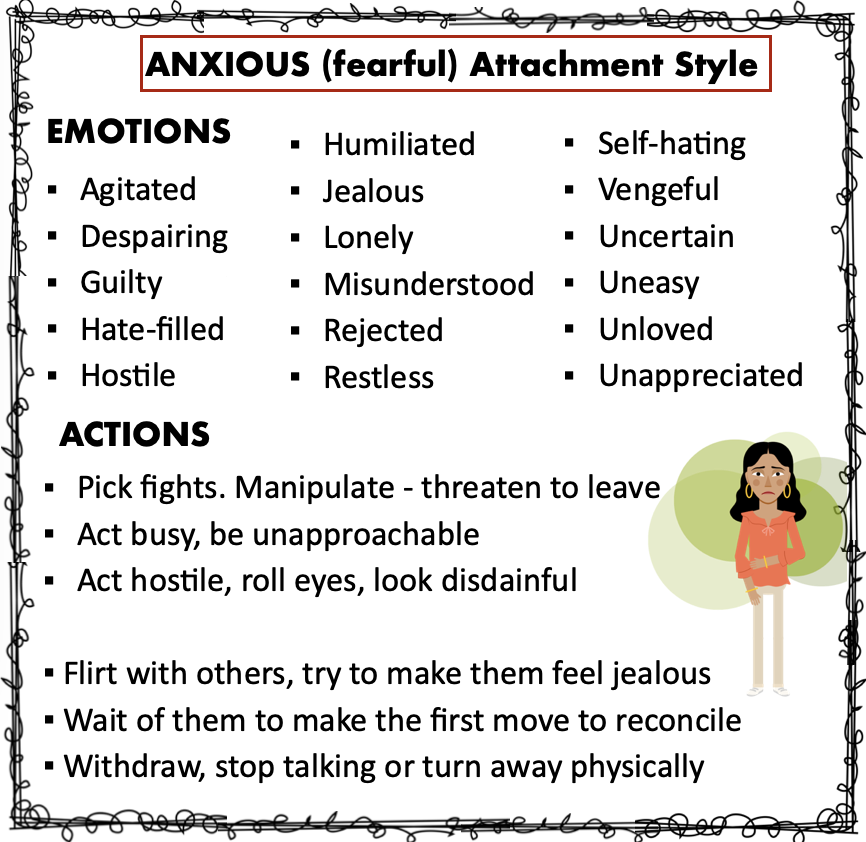
People with the Anxious (fearful) AVOIDANT style have a negative views both of themselves and of others➖/➖ .
They feel unworthy & undeserving of love, but also believe it’s not safe to give their love & trust to others — because they’re convinced everyone will always hurt or reject them.

Their moods are confused & unpredictable. While they desperately try to suppress all emotions, the pain of loneliness & fear of abandonment leaves them overwhelmed, often experiencing emotional storms.  (Post : “ACoAs & Boundaries #4 ↙️ )

The need to connect is real but it feels terrifying because they’re convinced they will always be rejected or inevitably lose the one they care about. To protect themself they settle for avoiding close involvement with others. The tragedy for them – without Recovery – is that the person they want to go to for safety is the same person who will be unsafe.

If they do find themself in a relationship, they’ll cling to their partner when feeling rejected, then feel trapped when they get closer.
Result : Their relationship timing is usually off since they don’t have a workable strategy for getting their needs met from others.

a. Avoiders are most likely find themself in rocky, dramatic or physically abusive relationships, with many highs & lows, swinging between fear of punishment and the struggle to feel connected & secure.

b. On the other hand, without Recovery, Avoiders haven’t developed the armor of high self-esteem that would allow them to function well whenever they happen to be without an attachment.
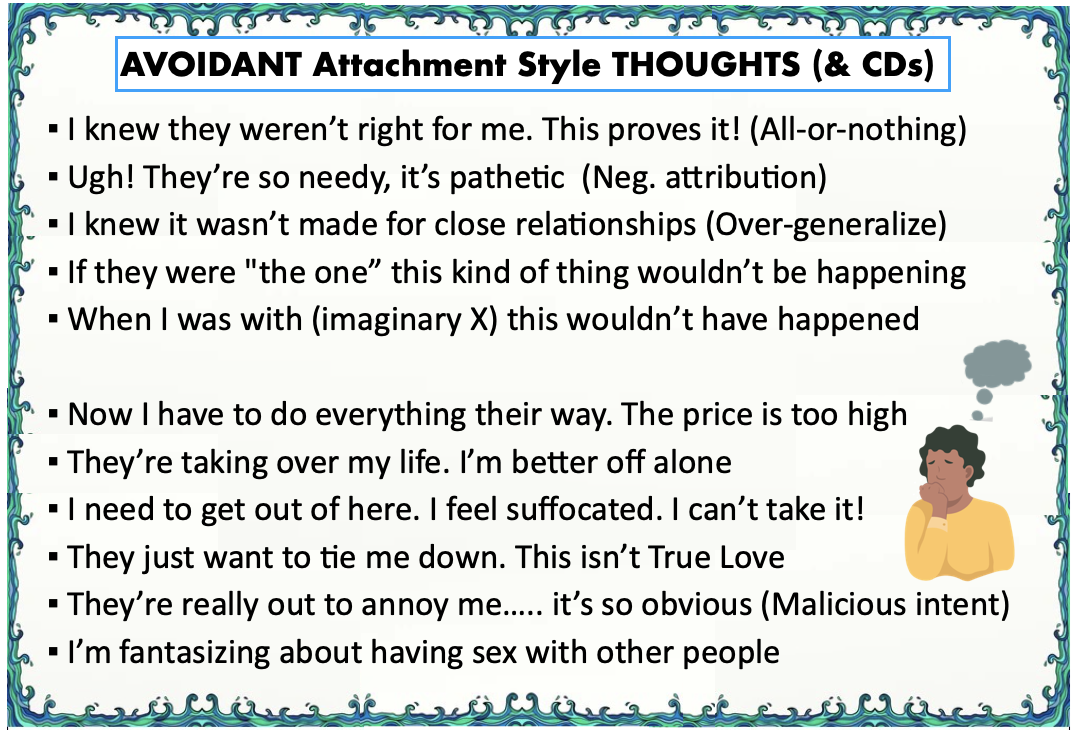
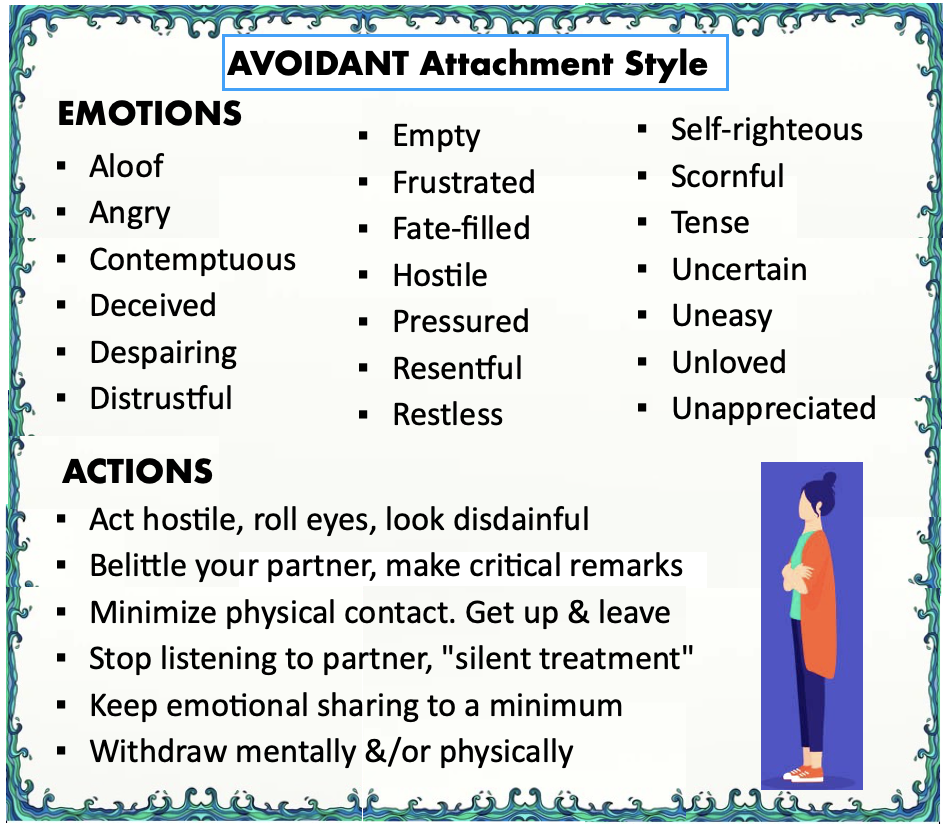
 
Avoidants can cause a lot of problems in a relationship, most likely when paired with a Secure or Anxious-Preoccupied partner – which is especially draining emotionally for the Anxious one.

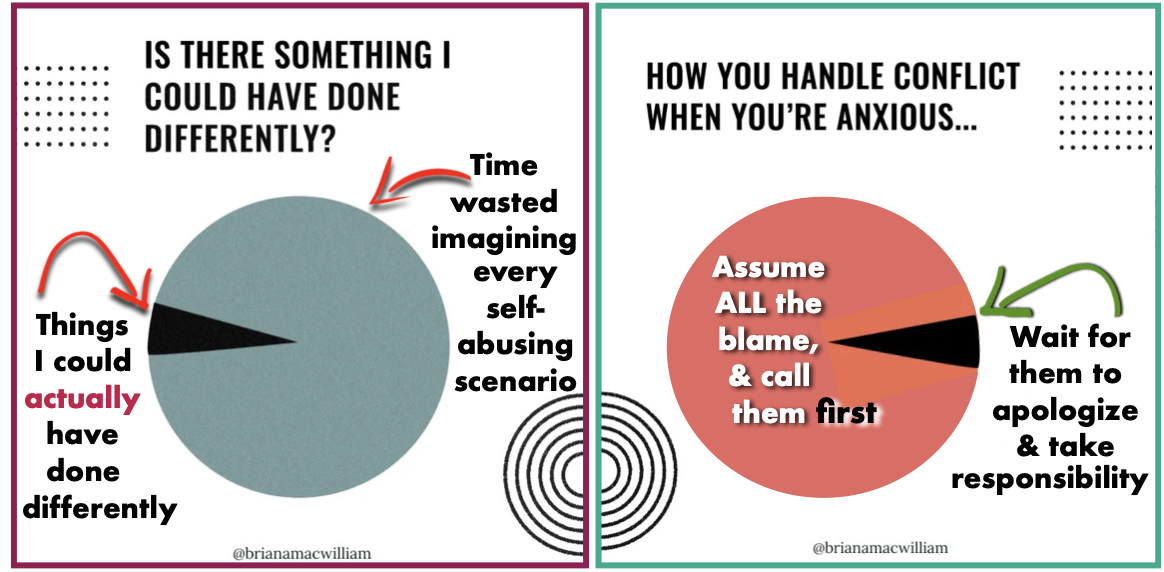
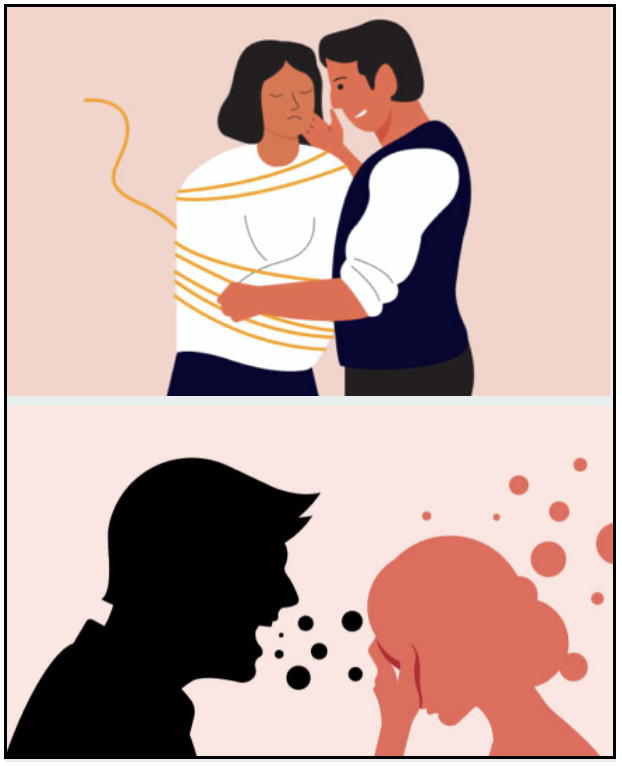
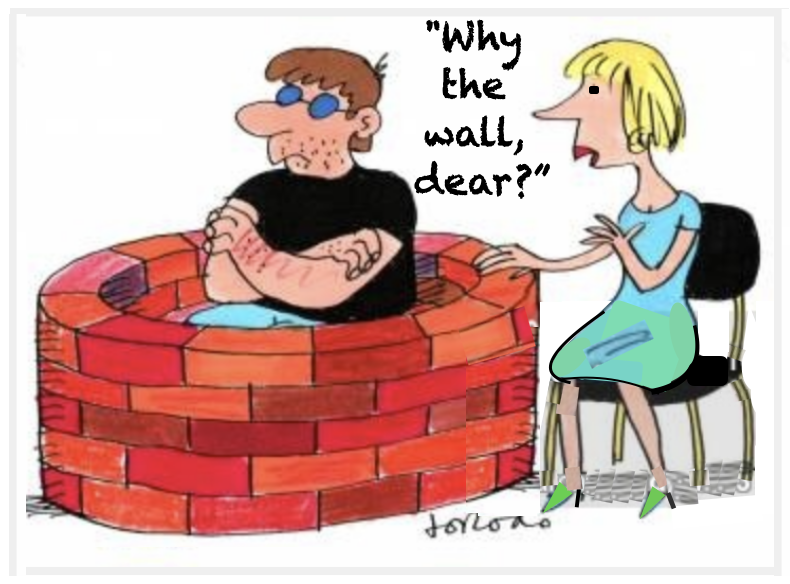
Vicious Circle : ✤ When the Avoidant physically withdraws & is emotionally distant – it triggers the Anxious-Preoccupied partner, who feels insecure & so tries to draw the other person ‘back in’

✤ This makes the Avoidant pull away, because they feel pressured
✤ As the Preoccupied continues to try closing the gap, the Avoidant grows more distant, feeling suffocated
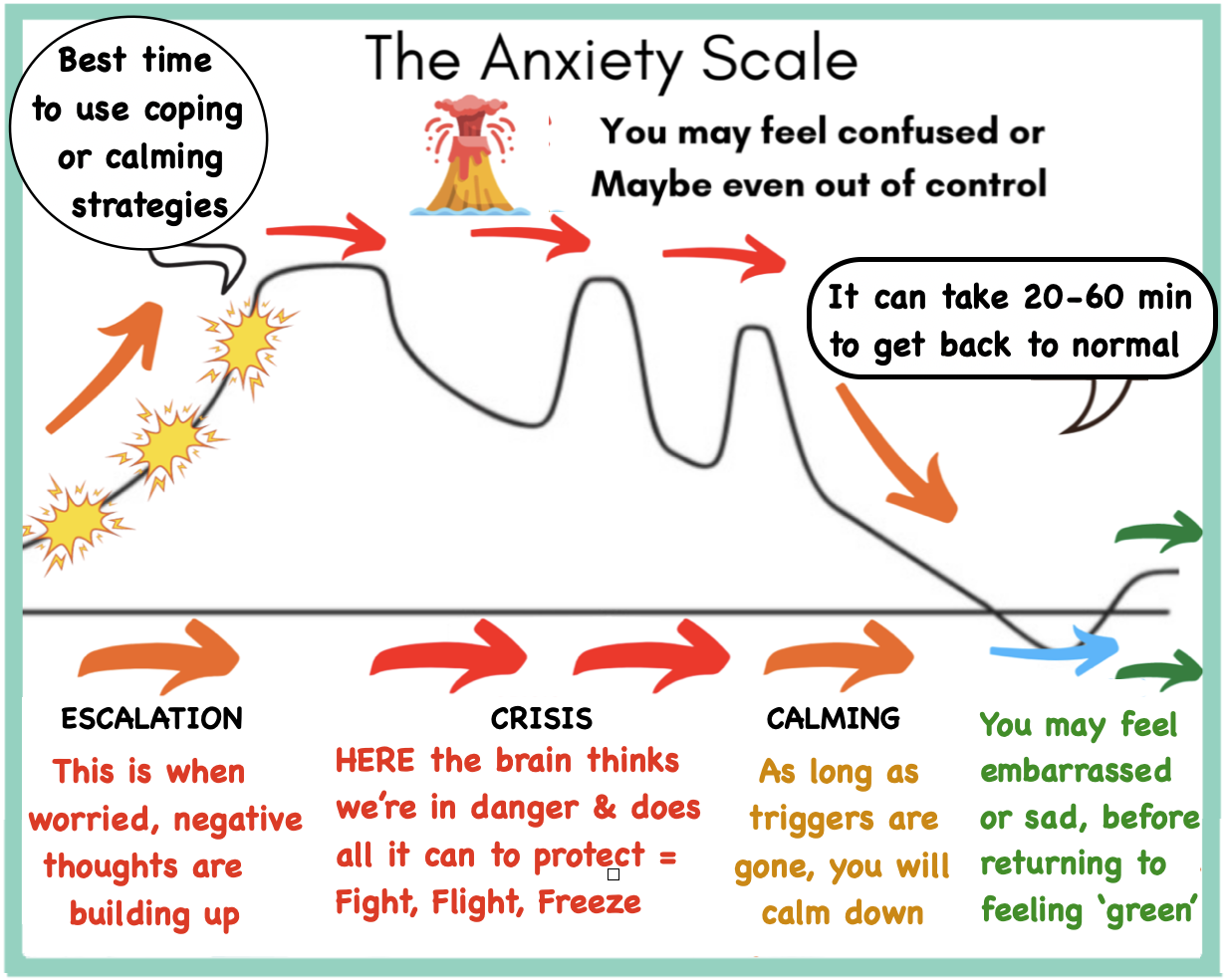
✤ This can easily turn the Preoccupied’s fear into rage, which leads them to act out with some extreme behaviors (yelling, berating, accusing, jealousy, sulking….), making things worse.

✤ After the dust settled down, the Preoccupied will feel intense shame & regret, remembering what they like about their partner
✤ However, the Preoccupied’s over-reactions push the Avoidant away even more, who focuses on their partner’s negative traits -which keep repeating.
Hopefully, becoming aware of this pattern can help both people want to get help to change, & so reduce their conflicts.
«
 «
NEXT: AVOIDANT Style #2
ANXIOUS-PREOCCUPIED Attachment (#2)

PREVIOUS : Anxious-PREOCCUPIED (#1) 


When triggered,
AS a Preoccupied 
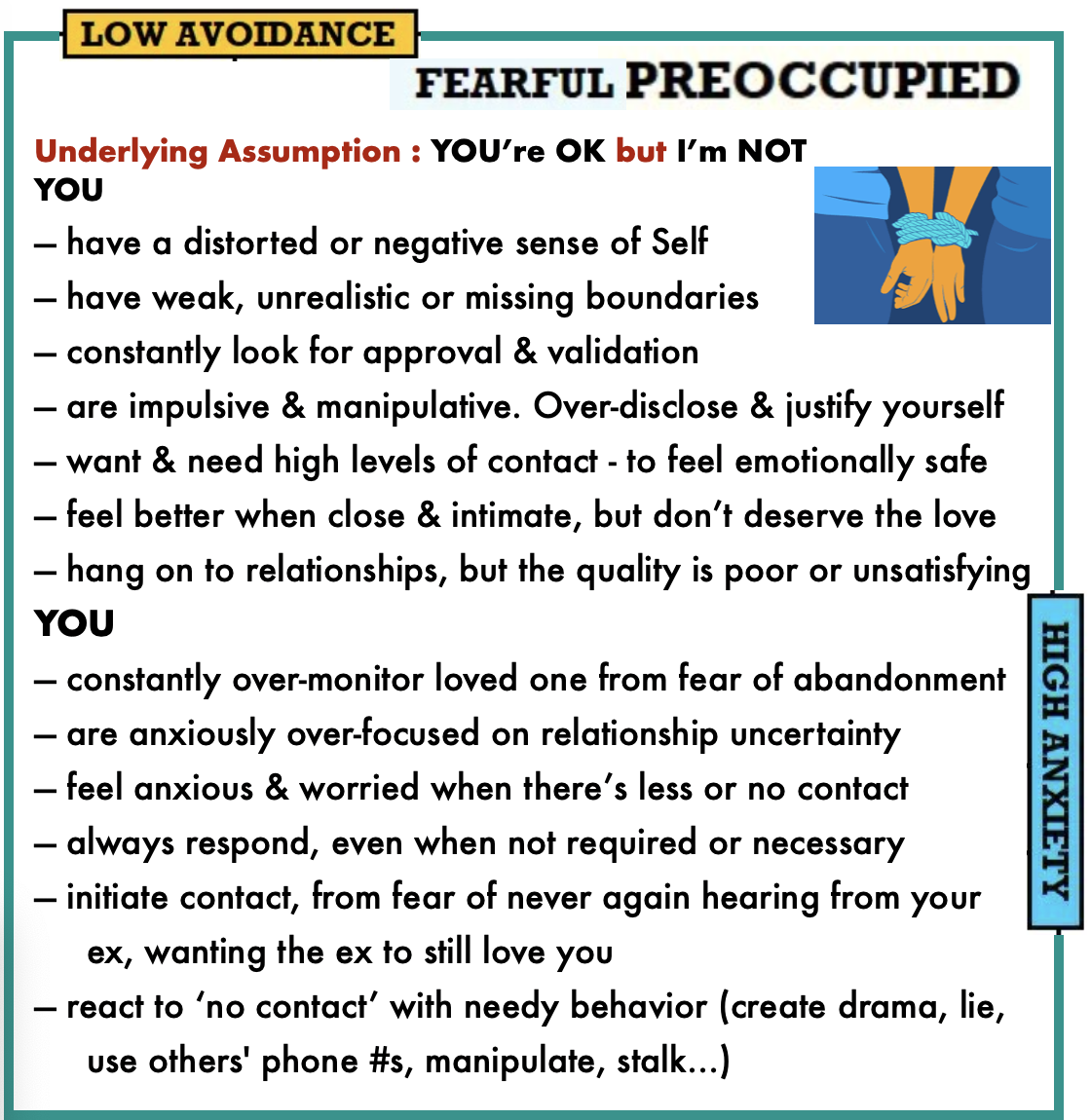
you’re always obsessed with how to keep or re-establish closeness with your partner. The pain of anxiety only goes away when they’re with you.
YOU:
♦︎ are so mentally focused on your mate that you have trouble concentrating on other things
♦︎ only remember your partner’s good qualities, ignoring all the ways they hurt you
♦︎ put them on a pedestal, under-estimating your talents & abilities, while over-estimating theirs
YOU
♦︎ believe this is your only chance for love, thinking :
⚆ “I’m compatible with so few people – what are the chances I’ll find another person who’ll want me ? “
⚆ “It takes years to meet someone new.  If I let go of this one I’ll end up alone.”

♦︎ believe that – even though you’re persistently unhappy, you’d better not break up, because :
 ⚆ I know “They can change.”
⚆ “If they leave me, they’ll the a great person—for someone else.
⚆ “All couples have problems, so it’s to be expected & I just have to live with it”

«
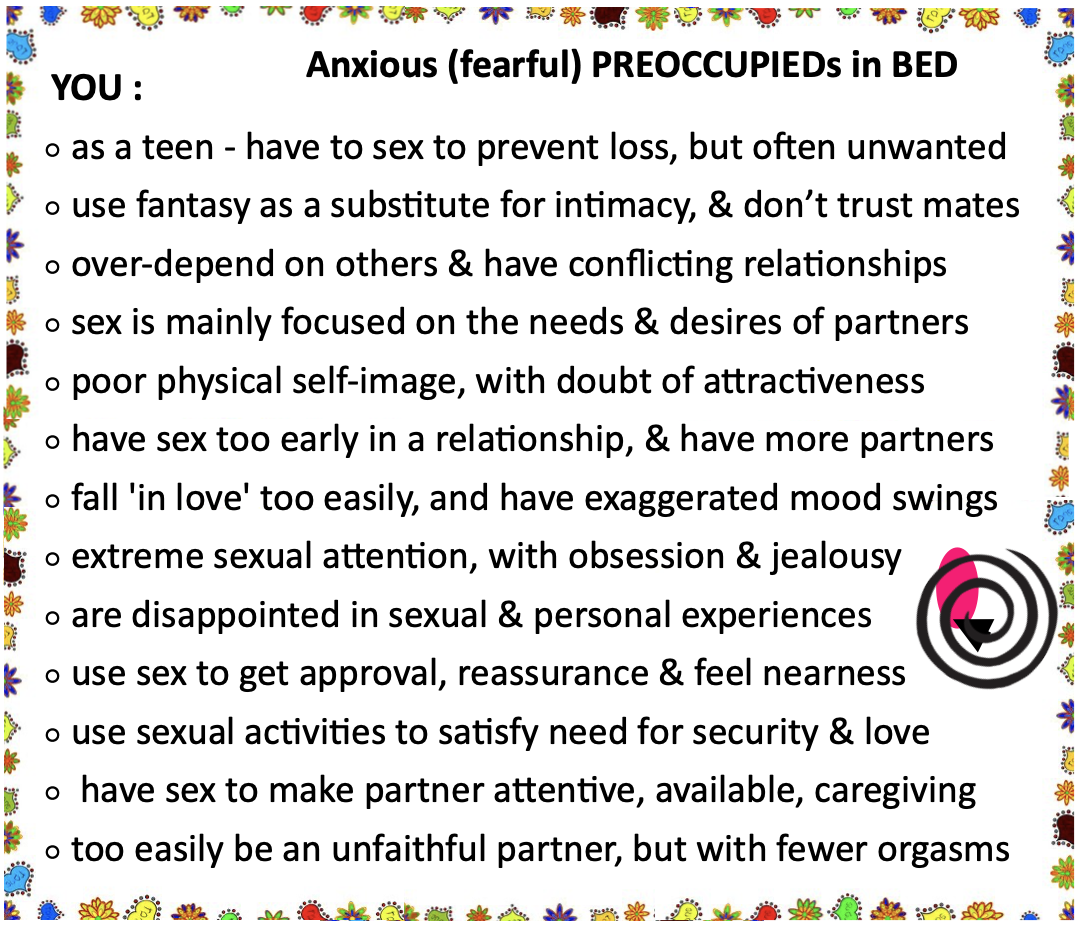
Anxious-PREOCCUPIEDs & SEX
The bond
we develop with our main caregiver in childhood may condition our sexual desire,  & then how we’ve learned to relate to each other influences how we behave sexually.
Interesting : Findings in a study of 100 Saudi couples suggested that people with lower avoidant scores (anxious-preoccupied) had higher sexual desire, and those women reported higher sexual satisfaction when their partner’s level of sexual desire was higher than their own. (culturally based?)

Red flag : when sex becomes necessary to fix emotional issues –  our old abandonment trauma. Sexual behavior of Preoccupieds is driven by trying to make up for the a deep lack of love & security – rather than from a place of empowerment.
They use sex  :  = for approval, closeness & reassurance
= to temporarily soothe loneliness & to feel ‘wanted’
= as manipulation, to make the partner available, get their attention & be taken care of (as replacement mother)
= to fill an inner emptiness because of missing the True Self.

Preoccupieds have porous boundaries, so sex is more oriented towards the needs & desires of the partner, rather than their own. Avoiding their own preferences can result in lower free-flowing passion but increased desire, as sex is less about pleasure & intimacy, & more about forcing contact.

Because their focus is on ‘the other’ – and choosing other unhealthy attachment styles – Preoccupies feel under-appreciated & misunderstood by their lovers, or generally unsatisfied with the way they’re treated.
This comes from the fantasy/ illusion that the partner should :
🔎 already know what the anxious one needs without having to be asked for it – the same way an infant needs to be provided for before they can talk!
🖇️ reciprocate-in-kind all the affection, attention & love which the anxious one showers on them (in gratitude?) – a tit-for-tat game rather than given from generosity

When a Preoccupied’s hopes/ expectations / demands are not met, their rejection-terror can show up as obsession & being emotionally labile (rapid, exaggerated changes in mood). Even the most minor unavailability from the partner can cause extreme jealousy, distrust & displays of anger.

For ex-partners – when your relationship ends with an anxious person, it often leaves bitterness & resentment in them. So it’s not likely you can ‘just be friends’ after you’ve been sexually involved with them.
««
Sexual Addiction
DEF :
compulsive behaviors such as constantly looking for new sexual partners & frequent sexual activity, use of pornography & compulsive masturbation.
Cognitive & emotional symptoms include obsessive thoughts of sex, feeling guilty about excessive sexual behavior, & desire to escape from or suppress unpleasant emotions…..

One study-results indicated that people with a high rate of sexual compulsivity are looking for sexual activity without emotional involvement. They’re more likely to have an Avoidant or Anxious attachment style, with trouble forming Secure attachments as adults.

Another study chose gender-balanced sample (53 men, 51 women) who responded to measures of sex addiction, adverse childhood experience, adult attachment, narcissism, self-compassion, and motivation.
Anxious attachment types showed a strong connection between adverse childhood experiences and/OR narcissism and sex addiction. Being Self-compassionate did not correlate.

Note: despite having many lovers, anxious individuals are more likely to use condoms during sex, perhaps because of being more careful & fearful in general..

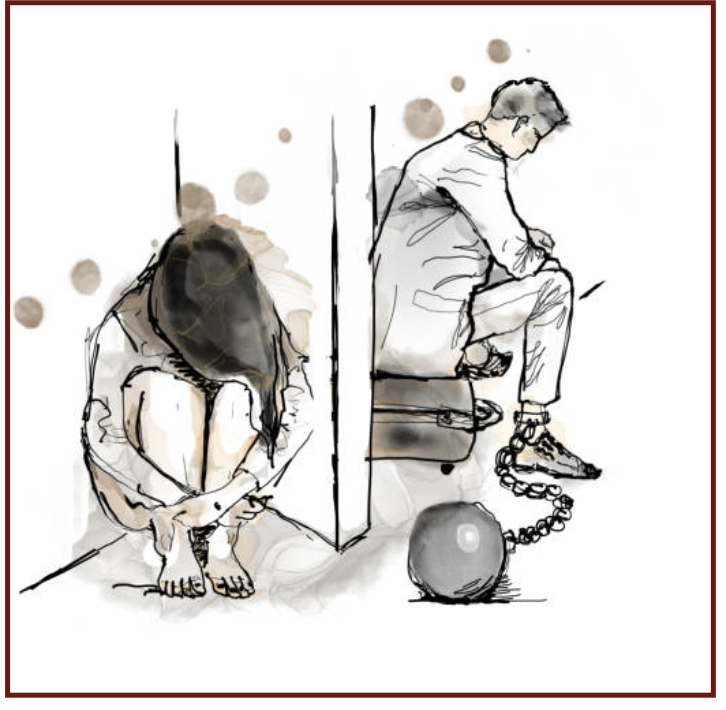
IMAGE ↗️ re. PARTNERS of Sex Addicts 
Partners often experience Complex Betrayal Trauma  from being in a long-term relationship with someone who is sexually addicted. The Complex is made of up three overwhelming, traumatic experiences all meeting together in a perfect storm, which intersect with & overlap.
«
NEXT : Anxious-Avoidant #1

ANXIOUS-PREOCCUPIED Attachment (#1)


PREVIOUS : Attachment – DYSFUNCTIONS #3

💚 ME-no / YOU-yes
This is the most common ACoA attachment style, and directly explains co-dependence in relationships . This is the second largest attachment type group, at about 20% of the population.

People with Anxious (fearful) PREOCCUPIED style (APAS) have a totally
🔻negative ➖ view of themselves = undervaluing, &
🔺positive ➕  view of others = overvaluing .

Sadly, because of feeling unworthy, they’re convinced that no one cares about them as much as they care about others.    Seeing others as better than themself, they’ll go above & beyond to hang on ‘special’ people in their lives, trying to keep the partner happy & avoiding conflicts.   They can be loving, forgiving, loyal & thoughtful, BUT not be able to accept genuine kindness & help in return.

CAUSEs of Anxious Preoccupied Attachment Style
a. Growing up with parents who could not provide stable or consistent support, (engaged & responsive to the infant’x needs, then unavailable or distracted) —>  it’s likely the chid will develop ‘uncertainty anxiety’ about whether its needs will be met or not . 

b. Conversely, with an overly-protective parent who catastrophized every minor frustration, inconvenience or disappointment – this child may also develop APAS = because it never feels safe, & is worried even in mildly uncomfortable situations, much less real problems.

As children, Preoccupieds often had to be responsible for their parents’ emotions, rather than the other way around. They obsessively (hopelessly) tied to please their parents, leaving them angry  & disappointed.

Later, this early inconsistent relationships & lack of boundaries results in adult confusion about what our emotions & perceptions are – vs – those of others.

As preoccupied children grow up, they’re often too self-absorbed to quietly listen to emotional messages sent by others, & likely to be unreliable partners in games or at work. EXP : In one study – preoccupied students – enmeshed, angry & incoherent when talking about their parents – “were seen by their peers as anxious, self-absorbed & ruminative (obsessive)”.

Not yet able to get a grip on what happened to them, Preoccupies’ memories of their early life come out in a confused stammer. so the trauma isn’t integrate it into an understandable picture that that could set them free.
Still so psychologically enmeshed with their parents, their infantile emotional flooding bewilders them & keeps them in dysfunctional patterns.

SITE: 10 causes of developing APAS in childhood

CHARACTERISTICS
At an extreme, especially when with either a Secure or a Dismissive partner, APAS’s constant demands for attention (too needy) makes them “high maintenance”, which can drive others away.
 YOU :
❥ have a low avoidance threshold (always be with someone, so date a lot), but at the same time have high social anxiety 
❥ tend to idealize other people, & are desperate to form a fantasy bond
❥ are too concerned with what others think about you,  creating a dependence on their acceptance to feel OK
YOU
❥ are overly-involved & clingy when in relationships (symbiosis & co-dependence, people-pleasing)
❥ compulsively reach out to others to fulfill your needs, expecting a partner to rescue or complete you
tend to fall head over heels in love with a new romantic interest – too fast – because of emotional hunger
YOU
❥ have a distorted view of reality : convinced that to be close to someone & get your needs met, you have to be with that person all the time to get constant reassurance, BUT——>
<—— because of self-hate & fear of abandonment, you choose someone who is isolated & hard to connect with

❥ find it hard to identify & stick to boundaries, seeing any space between you two as a threat, assuming it means your partner no longer wants you, which can trigger panic & anger

❥ interpret the partner’s (normal & appropriate) independent actions as proof of your abandonment anxiety, which is fueled by your self-hate. You then use guilt, controlling behavior, or other manipulative tactics to keep them close.

EXP :If the partner socializes with friends, you’ll think, “See? He /She doesn’t really love me. This means they’re going to leave me. I was right not to trust them” …..

SUMMARY

NEXT: Anxious-Avoidant Style #2

Attachment DYSFUNCTIONS (#3)

PREVIOUS :
Attachment Dysfunctions (#2)


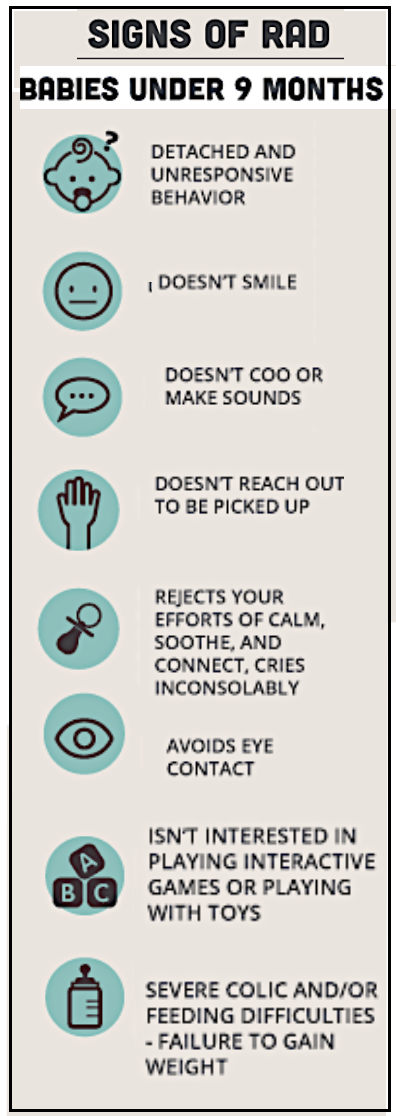
NOTE: According to the DSM-5, RAD & DSED are two childhood socially disabling attachment disorders – resulting from childhood trauma,. RAD is not a form of Disorganized attachment, which is caused by confusing caregiver mistreatment & can lead to oppositional defiant disorder (ODD).

The critical period for damaged development is in the first 6 months of life, up to age 5, but there is growing evidence that RAD & DSED symptoms may persist into adolescence & early adulthood.

♠️ RAD = Reactive Attachment Disorder
RAD is considered a rare (1-2%) & lifelong condition that results from non-attachment in very early childhood – caused by insufficient care, such as social neglect, a deprived or limited opportunity to form stable  attachments to caregivers.

RAD children may have experienced a  a traumatic birth, sudden separation from mother or continual PMES abuse. Most grew up in shelters, orphanages, foster homes, a war zone…. receiving little 1-on-1 attention.

Since these children didn’t have the opportunity to experience comfort from others, they don’t usually feel pleasurable emotions, but more likely are irritable & unhappy even during normal activities with adults. Tend not to be interested in playing interactive games in groups.

As young children they’re prone to tantrums or uncontrollable crying, & spend time alone trying to comfort themself (rocking, head butting, thumb sucking….).
Other symptoms – THEY :
► seem to have an under-developed conscience – stealing, lying, often disobedient, & don’t express guilt or remorse after behaving badly
► may have abnormal speech patterns & persist in asking nonsense questions or have unusual arguments with others

► can be preoccupied with fire, blood or gore, & be cruel to animals or siblings (More…. extensive lists)

♣️ DSED = Disinhibited Social Engagement Disorder
This disorder is another face of damaged Attachment, rather than a behavioral problem – from various forms of neglect, most prominently Emotional.
It’s described as the child’s inappropriate, overfamiliar & indiscriminate social interactions with strangers, preoccupied with getting their attention despite the presence of their family/parents.

Common ground with RAD & DSED is that both groups find it very hard to form emotionally meaningful bonds with anyone, although acting from opposite extremes, which makes it hard to have nurturing long-term relationships.
While similar abnormal upbringing will produce either inhibited (RAD) or disinhibited (DSED) styles, studies suggested that abuse & neglect was far more prominent & severe in cases of DSED.

Not all these children were raised outside the family. Many grew up with parents who were severely narcissistic, mentally ill, alcoholic, obsessive-compulsive, too preoccupied with their mate, covertly suicidal….
It left a gaping emotional hole that desperately needs to be filled – anyway possible – & these children use their persona of being very friendly & outgoing as ‘bait’. 

DSED children act in abnormal ways – for their age. They :
◆ often wander away from mom in social settings out of not feeling bonded to her, loneliness, social curiosity ….
◆ will hold hands, hug or sit on the lap of a new person without an invitation
◆ can easily leave with a stranger, even without being seduced or manipulated

Signs of DSED in young children can show up as trouble thinking rationally (living in fantasy, dissociated, smiling when describing painful events….), & in adolescence as poor social skills.
♦️ Obvious DSED behaviors may or may not persist into adulthood, but even if those ‘calms down’, there can be residual patterns, such as over-disclosure, idealizing desired friends & lovers, weak boundaries…...
«

«
LINK between Attachment Types & Childhood TRAUMA
Study by Atilgan Erozkan, Mugla Sıtkı Kocman U, Turkey

Results provide more verification of typical developmental disturbances seen from research in other parts of the world (US, Italy, UK, Poland, Australia ….)
🔻 Secure attachment is inhibited by growing up with physical, emotional & sexual abuse, along with physical & emotional neglect.
🔻 Fearful, Preoccupied & Dismissing attachment styles are predictable results from harmful parenting.

FROM a Study in Texas 
To assess childhood mistreatment found in a community sample of 676 active drug users, Medrano, Hatch, Zule, and Desmond (2002) found that :
— 53% of women and 23% of men were sexually abused
— 53% of women and 43% of men were physically abused
— 58% of women and 39% of men were emotionally abused
— 52% of women and 50% of men were physically neglected
— 65% of women and 52% of men were emotionally neglected.

NEXT : PREOCCUPIED Style (#1)

Attachment DYSFUNCTIONS (#2)

PREVIOUS : Attachment DYSFUNCTIONS (#1)


PERSONALITY DISORDERS & Attachment
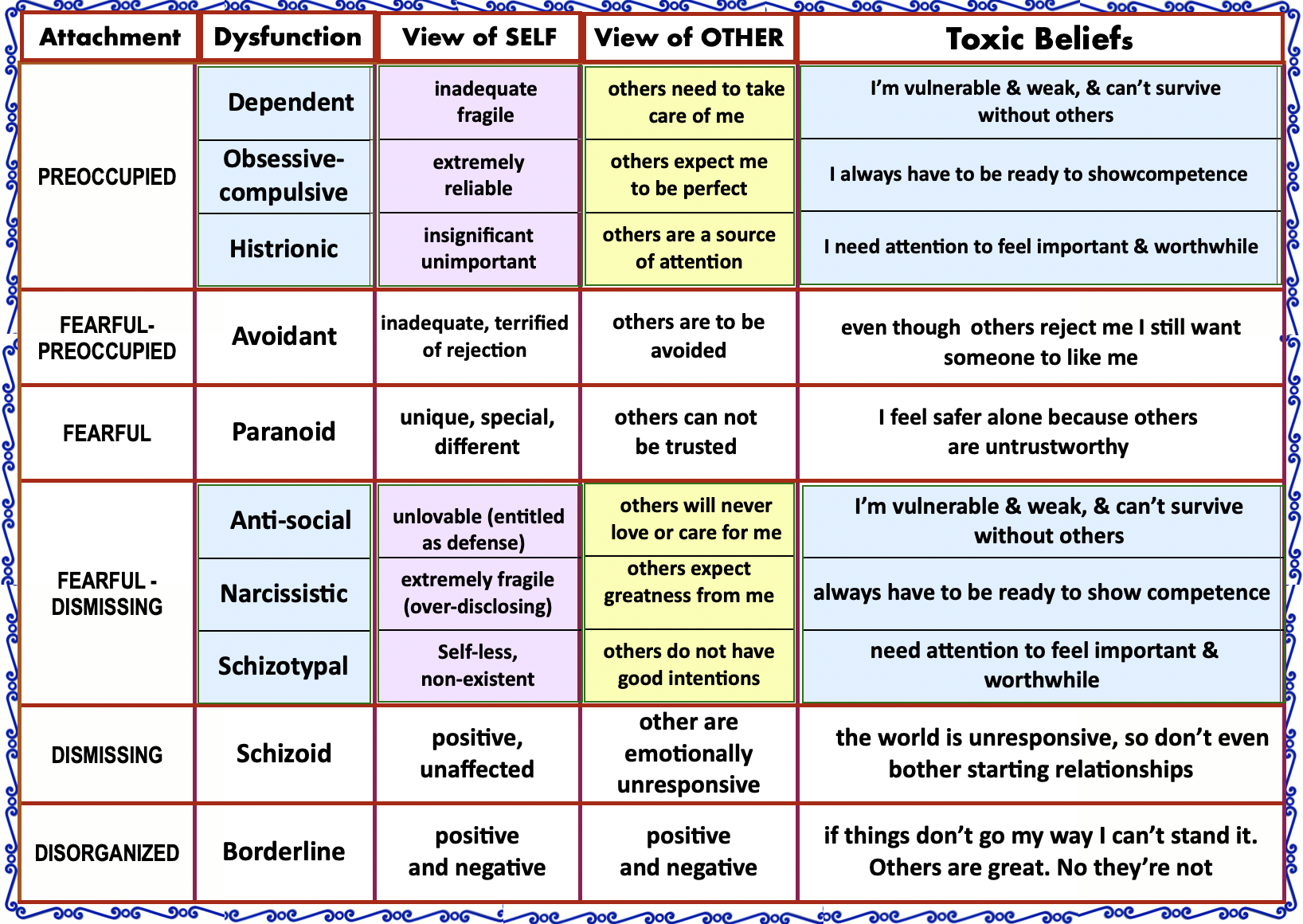
☂︎ Adults with a Preoccupied style, being anxious & more reactive to rejection, are prone to avoidant, borderline & dependent & histrionic PDs (personality disorders).

Based on a history of inconsistent parental support – they feel unsafe & wary, likely to be over-sensitized to possible environmental threats & therefore easily stressed.

☻ Conversely,
the hypo-activation of Dismissing attachment (desensitized) is associated with antisocial, narcissistic, paranoid & schizoid PDs.
Chronically lacking support from original attachment figures, Dismissives habitually deny or dismiss environmental threats, & have less ability to experience hard emotions or admit a need for connections.

☁︎ Most likely to have personality disorders, such as BPD,  are the Unresolved/ Disorganized individuals – the adult analog of disorganized/ disoriented infants – with abusive parents who had their own unresolved losses or abuse experiences. (MORE….)


«
ALCOHOLISM as an Attachment Disorder (POSTs….)
A study from Poland with 94 addicts & 94 non-addicts (pub 2014) showed that people with alcohol dependence significantly differ from non-alcoholics in terms of attachment style.
 
The ‘users’ had lower scores for Secure attachment, snd
higher scores for the Insecure types :
anxious-ambivalent & avoidant style – indicating mistrust in interpersonal relationships,  &
anxiety corresponding to fear of rejection & avoidance referring to avoidance of intimacy

This follows other studies which concluded that 66 to 95% of the alcoholics observed were identified as Insecure attached, while only 6 to 40% were Secure.  (See details & statistics….)

There is ample evidence that higher rates of substance dependence is found among emotionally wounded adults. Many alcoholics say they feel a “Hole in the Soul”, that something’s missing in their make up. Actually – all addictive behavior is an expression of the False Self, underpinned by Anxious attachment.

It’s about not having a clear sense of a positive identity. This ‘hole” is not a personality defect, but rather a lack of a safe Introject = feeling unloved by family. It comes with distorted thinking (S-H / CDs) & an inability to cope with overwhelming emotions accumulated from painful & dangerous childhood experiences.

Studies also note that addicts avoid being vulnerable, & are terrified of intimacy, more likely to show distrust & fear in relationships with loved ones.
Interestingly, the brain’s “love chemical” oxytocin – known for its role in bonding – is negatively linked to Insecure attachment, which affects all other neuro-chemicals involved in addiction.  Oxytocin is severely reduced by chronic alcohol use & stress reactions caused by fear-based attachment styles, which reduces the other chemicals as well.
😣 Active alcoholics try to replace them at the bottom of a bottle.  (Article : “Oxytocin could help treat alcohol addiction“)

Researchers from Hamburg, Germany (pub 2019) studied people with substance use disorders (SUDs).
Based on attachment theory, substance abuse can be considered “self-medication”, an attempt to compensate for missing Secure attachment strategies.
Longitudinal studies show that Insecure attachment is a risk factor for SUD, and continued substance abuse impairs the ability to form close relationships – which are needed to form Secure connections.

They also noted different patterns of attachment in different groups of users, suggesting different developmental pathways. EXP: — heroin addicts more often were Fearful–avoidant
— alcohol abusers could be more than one type
— SUD & insecure attachment was more strongly linked during adolescence than in adulthood
— Disorganized Attached people are at the highest risk for developing SUD (MORE….)
«

«
DOMESTIC VIOLENCE
Approximately 1 in 4 (24.3%) women have experienced severe physical violence by an intimate male partner. Compared to intimate partner violence (IPV) toward men, women experience more severe injuries & longer lasting symptoms such as PTSD, depression, & anxiety.  (Black, 2011)

In a study of 132 male partner abusers in Texas Researchers Lawson & Brossart (pub 2013) examined whether hostile dominant interpersonal problems (HDIP) plus antisocial & borderline features —> had an effect on the connection between anxiety or avoidance attachment styles and intimate partner violence (IPV).

They conducted a two path analysis, with Avoidant and Anxious attachment styles as predictors……. Both hypotheses were supported, but the Avoidant model provided the stronger evidence……. It showed that abusive partner men with predominantly avoidant attachment are most like to deal with domestic conflicts (HDIP) in coercive, controlling, & vengeful ways, using physical aggression toward a partner……
NOTE : In this study, the 2 PDs ⬇️ did not correlate with domestic violence.
«

«
NEXT : Attachment DYSFUNCTIONS (#2)

Attachment DYSFUNCTIONS (#1)

PREVIOUS :
Parent-Child – Insecure (4b)

⬅️ BOOK from Amazon UK

POST : Psychological Disorders (#2a):


Numerous studies have found that attachment anxiety & emotional dysregulation (out of control) are positively correlated (directly connected), which can contribute to maladaptive behaviors, such as  — various addictions, problem internet use, eating disorders, depression…..

Attachment disorder in adults usually starts in childhood, with symptoms that show up between 9 months & 5 years old.  Untreated they can affect everything from a person’s self-esteem to satisfaction in relationships. In fact, without available, consistent & responsive parenting, most children are vulnerable to developing attachment disorders.

When the primary attachment figure (Mom / caretaker) is unresponsive but also physically present, the distress that first makes a child hunger to connect slowly turns into doubting the possibility of attachment.  SO then secondary strategies are developed. EITHER:

👁️‍🗨️ Hyper-activation – If mom is sometimes responsive but unreliable, the child intensifies its efforts to force love & support from her

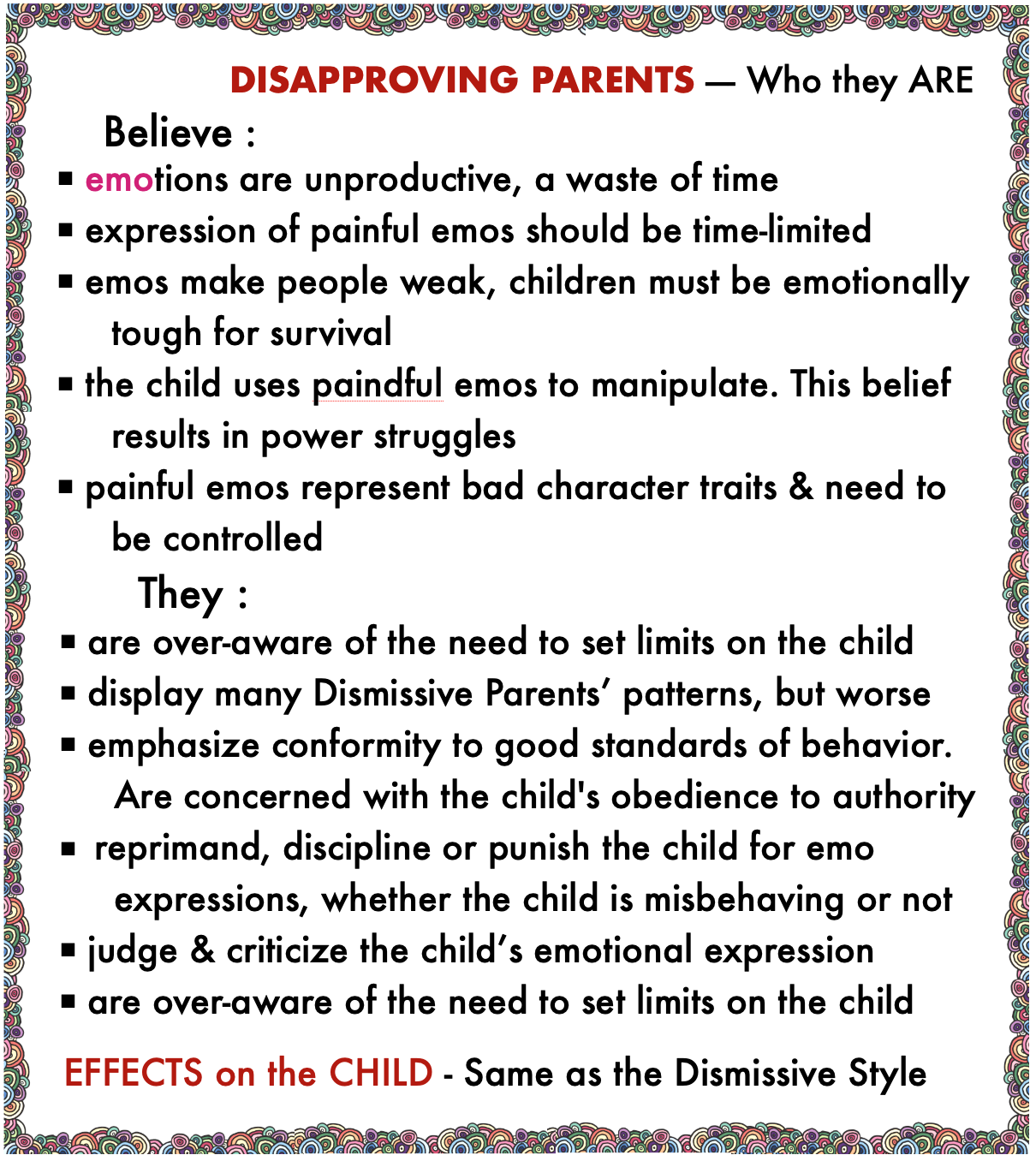
🔘 De-activation – In  this cases, mom disapproves of & punishes closeness, as well as any expressions of dependence & vulnerability. Need for closeness is suppressed, & the child tries to cope with dangers alone.

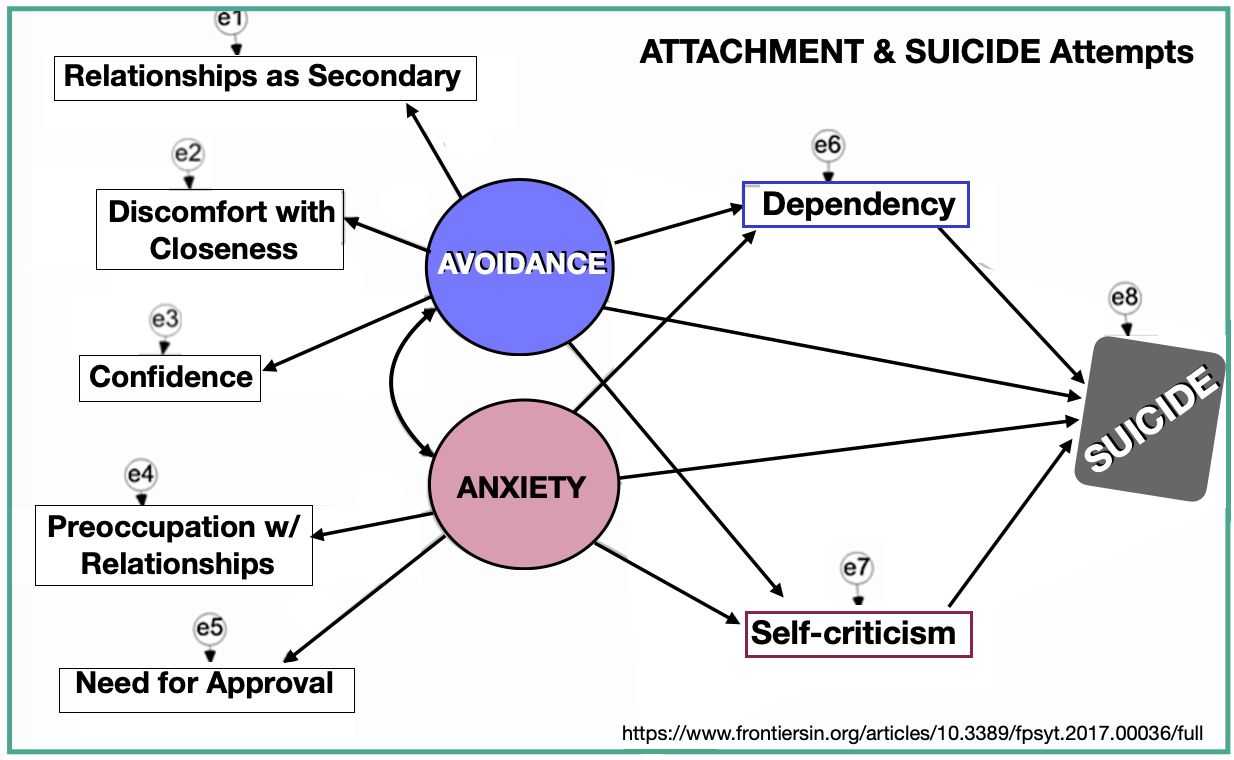
DEPRESSION & SUICIDE attempts based on Attachment deficits from RESEARCH studies in Italy (pub 2017).

MATURE personality is formed by an interweaving of two developmental goals, extended throughout life. In successful growth, individuals usually place more of an emphasis on one of these dimensions without ignoring the other :
a.Interpersonal relatedness (attachment, intimacy) —> which involves forming the capacity for mature, intimate, reciprocal & mutually satisfactory relationships
AND
b. Self-definition (identity, autonomy, achievement) —> which is about developing a realistic, differentiated & integrated identity of the Self (S & I).

Eearly disruption of the development process can result in a rigid, one-sided preoccupation with one style at the expense of the other. And the research suggests that the 2 main weaknesses resulting from an insecure attachment in childhood  — > Dependency OR Self-criticism <— create vulnerability to depression & suicidality in adolescents.

🔶  Normal : When Interpersonal Relatedness (a) is the choice, the focus is on a desire for harmonious, supportive & reciprocal relationships.
☀︎ Unhealthy : an over-emphasis on the need for connection is the basis of a pathological pattern labeled Dependent.  Such people are obsessed with and worried about having closeness, connections & bonding. They’re especially sensitive to separation, loss & abandonment – becoming depressed, feeling helpless & empty.

🔷 Normal : For those who emphasize Self-definition (b), the focus is mainly on individuation, achievements, & identity formation.
☀︎Unhealthy : an over-emphasis on this style is the basis of a pathological attitude labeled Self-criticism.
Especially concerned with perfectionism, these people obsess about experiences they identify as personal failures, leading to shame. 

Such highly self-critical types feel guilt & self-blame when they can’t reach their impossible standards, & are particularly prone to depression as a result of those ‘fat;ures’. They have a stronger suicidal intent (i.e., greater wish to die).   (Read whole study, URL above.)
«
 

«
ALSO, suicide gestures differ in the 2 groups, although the risk of suicide is similar for both.
Violato & Arato showed that Preoccupied and Disorganized attachment types were associated with suicidal behavior among adolescents in psychiatric treatment.
Also, Preoccupied and Dismissing attachment predicted suicidality among undergraduates with a history of suicide ideation or attempts

🔸 Dependents generally tend to act with impulsive gestures & attempts. Patients in the study likely made the suicide attempt as a response to an interpersonal stressor, their intention being to let someone / anyone know how distressed they were.

Researchers noted that adult participants with high Dependency scores used methods that made rescue more likely. Since developing Dependency is meant to ensure others’ availability & validation, dying would be the ultimate form of cutting close emotional ties, which they’re terrified of.

🔹 Self-critical types are generally less impulsive, more likely to plan acts of self-harm These patients’s suicide attempt was made in response to a personal or professional failure, their intention being to escape from the discrepancy between the actual event & their expectations. On the whole their attempt was rated as more lethal than the more dependent patients – ie. having a greater wish to die.
«

«
NEXT : Attachment DYSFUNCTIONS (#2)

ATTACHMENT : Parent-Child (#4b) INsecure

PREVIOUS : Parent-Child ATT, #2

SITEs: “Neurobiology of Attachment to Nurturing & Abusive Caregivers  (Scientific)  ✅ “Infant Attachment: What We Know Now

NOTE:
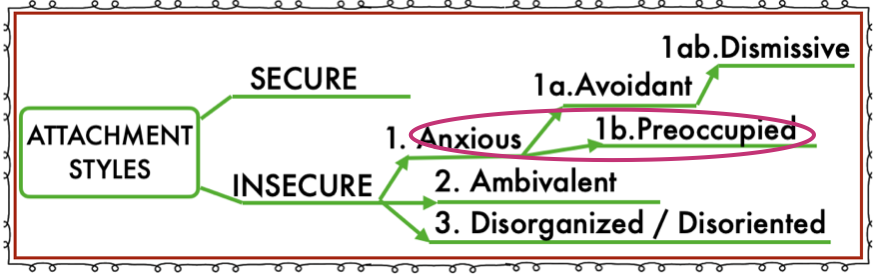
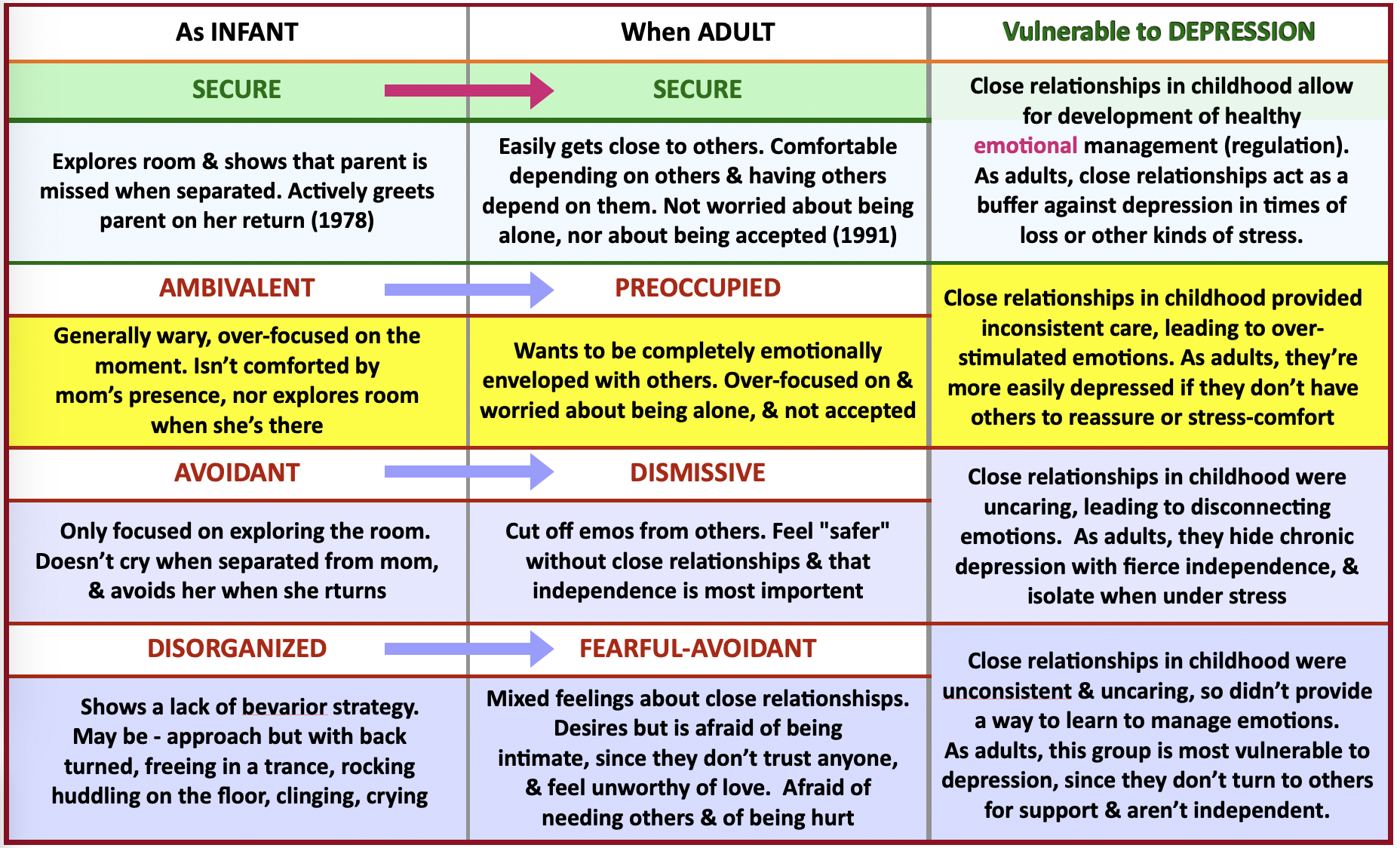
AMBIVALENT child will become PREOCCUPIED adult
AVOIDANT child will become DISMISSING adult

INSECURE Attachment develops when the mother continually FAILS to recognize when the child’s “attachment light” is on (arms reaching out, eye contact, crying, climbing on her, tugging….), OR deliberately ignores the signals . This is inevitably absorbed by the baby as a personal rejection.  

🖤 The mother who de-synchronizes with her child = produces serious damage to her child’s mental & emotional attachment circuitry.
This is PMES neglect, which creates immense distress in the child, the awful disconnect  emptiness is experienced as a “death”, forcing it ro make an intense effort to avoid the feeling of terror. Sadly, the “death state” corresponds to “rest states”, so the child avoids rest at all cost. – This is a common issue for ACoAs ! (See Parent-Child Part 2b Secure, scroll to Joy-building = mother signaling rest-time)

As time goes on, the agonizing pain of mis-aligned attachment is then covered up & disregarded as much as possible – with addictions & emotional dissociation. (Ignore it & it’ll go away or Run to keep ahead of the pain).
The insecurity caused by maternal rejection will continue to haunt the child into adulthood, going unchecked without Recovery & FoO work, so anything that resembles rest or relaxation will be avoided. (See “Toxic Rules“).


«
♨️ When
there is physical &/or emotional neglect, the baby will develop an insecure attachment (Avoidant, Anxious, or Disorganized). These styles are associated with persistent low self-esteem & relationship troubles – with a lack of trust, reluctance to commit, & all-encompassing fear of abandonment.

🚼 Avoidant-Insecure attachment (20-30% in low-risk ‘normal’ groups).  In the home, these parents were emotionally non-perceptive, unresponsive, unavailable & rejecting.

In the Strange Situation (SS – see Part 1), the mother was not available to the infants as a secure base from which it could explore its environment. When the mother started to leave the room, the infant might move toward her, but often did not. When she returned, the infant acted like she was not even there & just continued playing.

Some of these parents were responsive in non-emotional interactions, but very dismissive when the infant was emotionally needy, frustrated, or angry.  As a result, these babies often became clingy, demanding, & expressed random aggression.

√ The internal working model is likely, “Mom does not respond to my emotions, especially when I’m upset or angry, so I’ll shut down & try to become independent (not need her).”

The infants then protects itself from this ongoing terrifying environment by dissociating internally from their normal, legitimate need for connection, & generally repressing their emotions = a “de-activating” strategy.

🚼 Anxious-Ambivalent (insecure) attachment (5-15% of low risk samples)
In these homes, the mother was inconsistently available for the infant, & when she was paying some attention – she was often pre-occupied – so her responses to the infant were un-attuned or mis-aligned.

In the ‘SS’, while playing – the insecure infants were more alert to where the mother was. They were very upset when she left the room, immediately went to her when she came back, & became very clingy.
On reunion these children alternated between outbursts of anger & going limp, but either way they were not soothed by the presence of the mother, even if she seemed caring & emotionally available.

These infants respond with an “over-activated” attachment need, being the most anxious, needy & demanding at home.

√ The likely internal working model here is “Even if mom is available physically, she’s not warm & soothing.”

🚼 Disorganized-Insecure attachment (20-40% in non-clinical populations. And up to 80% from abusive homes)
These children often suffered physical &/or sexual abuse, with parents who were psychologically disturbed, &/or substance abusers. Inconsistent caregiving (come here-go away) became alternately a source of comfort & of fear

In the ‘SS’ scenario, these infants felt disoriented when the mother left the room. In response, they were not soothed even if they made physical contact when she returned .  The child’s behaviors were a confused mix – moving towards her, then away OR freezing & going into a corner

√ The inner working model is that the “supposed” source of soothing is also the source of danger – “fright without solution” – leaving the child’s mental & emotional state & behavior very confused.


NEXT : ATT

ATTACHMENT : Unhealthy PARENTING (#4a)

PREVIOUS : Parent-Child Types #2

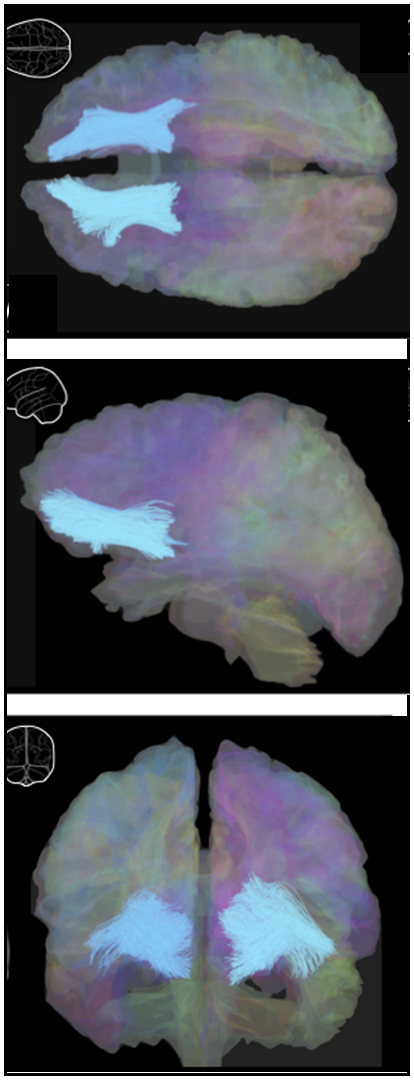
SITE : ⬆️ “…Neuro-anatomical model of human Attachment

➡️ BRAIN IMAGING show some effects of early life adversity (ELA) re. white matter alterations. Nearly 40% of children in the US endure multiple forms of abuse & other stressors….

BAD PARENTING – see details for each

⬇️ 👥
💧 Uninvolved or Absent Parent or Poor Role Model

While an unavailable parent leaves a void about all the things a child needs for healthy development, a poor role model fills it with bad information to copy. Either way, the child will likely have immense hardships ahead on life’s journey.

💧 Lack of Respect for Feelings, Opinions, or Choices
Not respecting for your child’s feelings, opinions, or choices shows you have no faith in your child or their growing process. It is a selfish error. It says that their evolving ideas are not worth the time & effort to express them. This will create deep-seated issues that will be woven throughout the child’s life.

Children can only learn to express themself & find out who they are – by trial & error. So patient guidance can help them excel .  This will create deep-seated issues that may weave throughout the child’s life

⬇️ 👥
💧 Lack of Support, Encouragement, or Praise
This involves things like – not helping the child with homework, not encouraging them when they feel insecure, or not giving them praise when they’ve made an accomplishment. It may not seem like a big deal to a parent, but the negative baggage it creates for the child is significant.Belittling, Comparing, Criticizing, Demeaning, or Shaming
These cruel communications are used to push the child into conforming, behaving, or producing as the parent wishes.

Children listen. They follow their role models. Even the slightest murmur that diminishes a child’s identity or efforts can be detrimental, especially for a sensitive child.
˚
⬇️ 👥
💧  Over – or- Under-Reprimanding
Either styles is equally damaging, & they’ll carry these patterns into adulthood.Excessive scolding for making a mistake or poor judgment call is to signal that the child is only identified by the mistakes they make.
Under-reprimanding tells the child that their mistakes or poor judgment has no consequences, & so can go without guidance, direction, or correction.

💧 Publicly Shame or Discipline
Any open display of correcting a child in front of others is never a healthy option. It creates a victim mentality, making them vulnerable to being gullied, both as a child & later in adulthood.  Making the child a public scapegoat could eventually cost your child its life.
˚⬇️ 👥
💧 Lack of Rules, Structure, or Real Consequences
These adults are too lazy to enforce them, are too busy, or they simply have no interest in making the effort. Having little or no structure is chaotic, & is as bad as having overly complicated rules.

💧 Don’t Teach Respect for People or Animals
These adults are either not caring at all, or their own sense of entitlement is passed on to their kids.
EXP: loud, unruly, boundary-less kids running around a restaurant screaming & touching things they shouldn’t
˚
⬇️ 👥
💧 Physical, Emotional, or Psychological Abuses
No child should have to suffer through any kind of abuse. Unfortunately some forms are so subtle or passive that parents may not realize they are perpetrating it.
Long-term effects are often recycled, transferring the pain onto others who enter the child’s life

💧 Withholding Affection, Food, or Medical Care
This is only ever legitimate if a licensed medical doctor has ordered a temporary hold for medical reasons. Even with a ‘good’ reason, this can result in the child feeling they have to must go into survival mode to take care of themself.

Withholding affection is never legitimate or acceptable.

NEXT : Parent-Child INSECURE

ATTACHMENT : Parent-Child (#3) Temperament

PREVIOUS : ATT Adult-Child #1

SITE : “How to Understand Your Child’s Temperament

MAIN FACTORS for identifying different temperaments – HOW :
💠 strongly children react to people & events
💠 easily children approach new people or new situations
💠 well children can control their attention, emotions & behavior.

Temperament DIMENSIONS (Kristal, 2005)
☀︎ Activity – is a child’s general level of motor activity when awake & asleep
☀︎ Adaptability – how easily a child adjusts to changes & transitions

☀︎ Approach/withdrawal – the child’s initial response to new places, situations, or things
☀︎ Distractibility – the ease with which the child’s attention can be diverted by a variety of external stimuli, or conversely its level of concentration or focus.

☀︎ Intensity – the strength of the child’s expressive-reactions, such as happy, sad, angry….
☀︎ Mood – the basic quality of emotional state – more positive (happy, cheerful) or more negative (cranky or serious).

☀︎ Persistence – “stick-to-itiveness”, the ability to continue an activity when it’s difficult, or when faced with obstacles

☀︎ Rhythmicity – determines the predictability of bodily functions such as appetite, sleep/wake cycle & and elimination patterns
☀︎ Sensory threshold – the level of stimulation necessary to produce a response (See each one expanded)

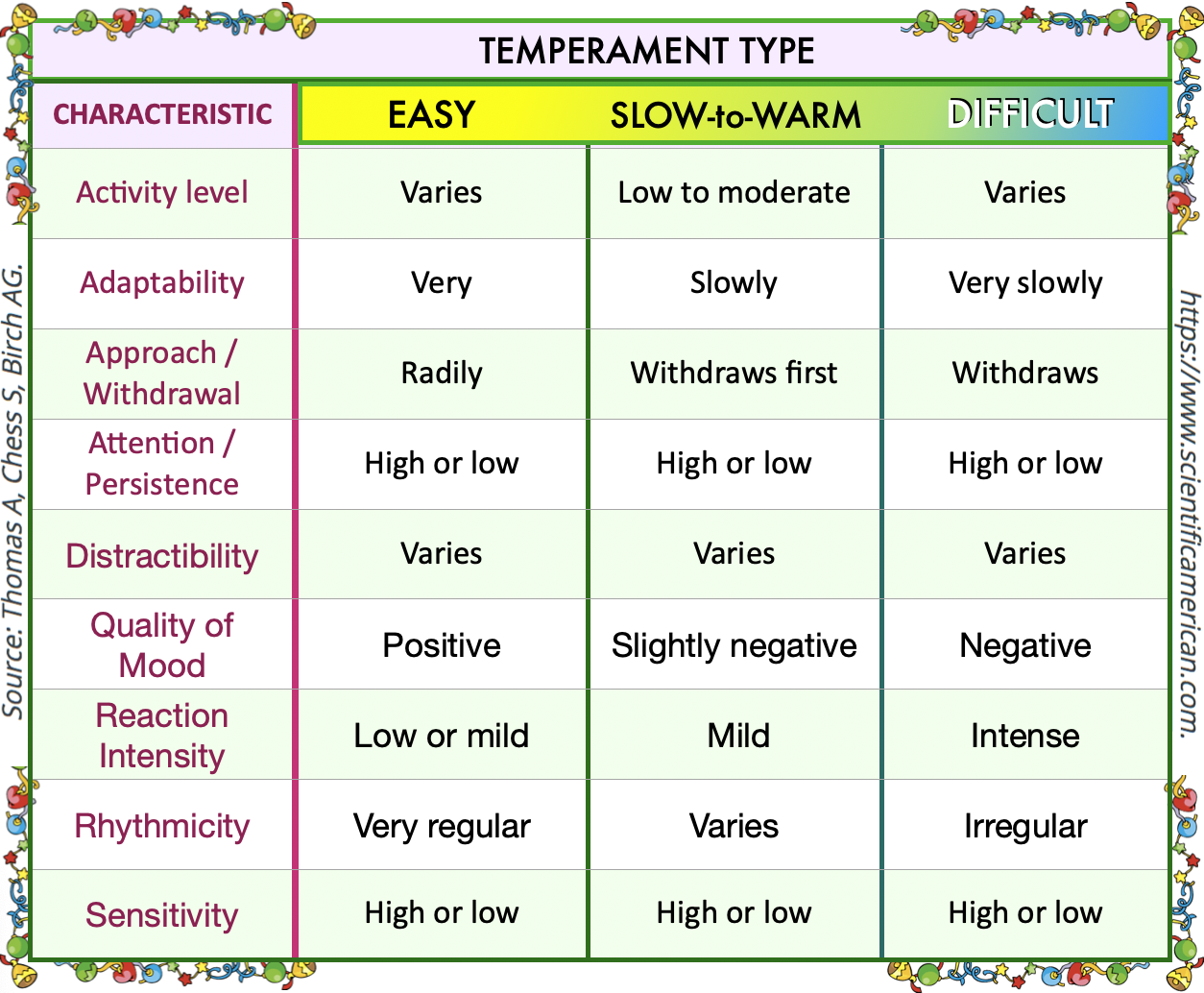
Thomas & Chess also described 3 constellations of a child’s temperament that influence parent-child relationships & family life. (Also research at UCLA, Keogh, 2003).
♟ EASY – children are typically adaptable, mild or moderate in activity & intensity, positive in mood, & interested in new experiences.

♟ DIFFICULT – children tend to be intense, have low adaptability, & negative mood

♟ SLOW-to-WARM-UP — children upset by change, are generally ally-reluctant & withdrawn in new situations, shy with new people – although given time they adapt well

Children who are slow to adjust, ‘naturally’ shy or irritable – are likely to experience conflict with parents, & so receive less acceptance or encouragement which can make the child feel inadequate & unworthy.

If your child is highly active & so is the mothers, that’s a great match!  However, if she is a withdrawn type who likes to limit new experiences, but baby loves stimulation, they may end up with a conflict – if mom is not willing to adapt yourself a little.
However, the influence of children’s temperament or other attributes may be mitigated if parents adjust their caregiving behaviors to better fit the needs of the particular child.

How temperament influences family life (See ALSO…..)
Individual differences in temperament & behavior styles affect how family members interact. The ‘mix’ between them has a strong effect on family life, sometimes leading to positive interactions, sometimes to frustrations & then to conflicts

“Goodness of fit” refers to the matched or mismatched temperaments between a child & various family members.
EXP: A certain reaction – such as high activity, intensity & persistence – may be tolerated & valued in boys but not in girls.
Conversely, shyness & sensitivity may be viewed as acceptable in girls, but not in boys.

CHILDREN – Some adapt quickly & easily to family daily routines & get along well with siblings.
Others, especially highly active, intense or“prickly” ones have a harder time adjusting to everyday routines & expectations, so interactions with family members often lead to friction & upset. 

EXP: an impulsive child can bother an older sibling trying to finish a school project, or a distractible child, low in persistence, can frustrate parents’ efforts to get them to do homework or a household chore.

PARENTS also differ in temperament. Some are quick-reacting & intense, while others are quiet & slow to respond. Some are flexible & ‘fair’, others are rigid & perfectionistic.

AND they differ in the expectations they have about their children’s behavior, & how they view & tolerate differences in temperaments. If disruptive behavior is labeled as deliberate, parents are more likely to be irritated & angry, & easily responding with verbal & physical abuse.

EXP : A high-activity, intense child may upset & irritate a quiet, slow-paced, reflective parent.
An active, quick-responding parent may be impatient with a slow-to-warm-up child, who the parent may consider as lazy or indifferent. Or, sparks may fly when both parent & child are intense & quick reacting.

REFRAMING :  A parent’s response is affected by how they interpret the child’s behavior. When seen as temperament-related rather willful misbehavior, they can reduce their negative reactions.

EXP: The parent might see an active, energetic, approaching child who is into everything as “exuberant,” rather than as “hyper” & intrusive.
OR – see a shy & slow-to-warm-up child as “sensitive” & thoughtful, rather than as unfriendly or unmotivated. (From : Greatschools.org)

NEXT : ATT

ATTACHMENT : Parent-Child (#2b) Secure

PREVIOUS : ATTACHMENT – Parent – Child (#1)

SITE:  “Emotionally Intelligent Parenting”


🚼 Secure attachment
  – 55-65% of ‘normals’ (non-clinical) samples.
In the home, these parents could understand / intuit the infant’s personality, & were able to accept & be available to provide baby’s physical & emotional needs

In the Strange Situation test (SS, see Info 1a) , the infants used the mom as a secure base from which to explore, very aware when she left the room, & protested the ‘loss’. When mother returned, the infant went straight to her to be held, was easily reassured, & then quickly returned to play.
In the home, these parents could understand / intuit the infant’s personality, & were able to accept & be available to provide baby’s physical & emotional needs.

√ The internal working model of these infants (mental image) incorporated these experiences. They assume they’ll be seen & heard, & helped t0 regulate their emotions, so they can safely explore their environment.

The 4 S’s of Secure Attachment
Children whose emotional & physical needs are consistently acknowledged & responded to appropriately – are most likely to form secure attachments, allowing them to become more resilient  & competent adults. When frightened, they’re comfortable seeking reassurance from safe caregivers.

1. SAFE
These parents provide the child with the sense that home is a haven, & make a commitment to not be a source of fear . This includes actively re-connecting after disagreements or an anger-flare up, & apologizing when the adult is mistaken or wrong.
Later on, being ‘safe’-as-kids means these Secures find it easier to openly express their emotions & needs, having developed trust in inter-personal relationships.

2. SEEN / KNOWN
“Seen” children know they’re acknowledged, because patents take the time to learn who they are & make an effort to understand when they’re going through something.

As adults, ‘seen’-as-kids people are more likely to form emotionally secure relationships. They feel comfortable being genuine, intimate, & vulnerable. Are less likely to develop codependence or anxious attachment style.

3. SOOTHED / COMFORTED
Soothed’ children are comforted at all times, not just when emotionally upset or  under stress. Caregivers help the child develop healthy coping strategies needed for the challenging times. The 5 main elements for this are “PEACE” : Presence /  Engagement /  Affection /  Calm /  Empathy
‘Soothed’-as-kids people become emotionally intelligent adults, who are better prepared to get thru difficult life-situations, can adapt to change, stay grounded, & offer support to others.

4. SECURE
These parents
cultivats security & trust with the child by consistently providing the other 3 S’s 🔼.
The Secure child can let their guard down, make mistakes, & voice opinions – without fear of punishment or rejection.  They’re encouraged to not be afraid of their emotions, by identifying, valuing & dealing with them, as well as as recognizing those in others.

“Secure”-as-kids people find it easy to appropriately trust others & be trustworthy themselves, being open & having empathy

Secure bonds provide an infant with a solid foundation to experience a wide range of motions = from most uncomfortable or painful and most comfortable & joyful ones. All states are important for the infant to safely experience them thru the mother’s capacity to ‘hold space’ for them – by her inner safely & personal strength. Gradually this allows the child to carry that ability internally, & so comfortably experience bonds with others.

Shared attunement is the alignment of emotional & mental states between mother & child, through facial expressions, tone of voice, body gestures, & eye contact.

Joy Building — Joy is produced when mom’s face lights up, expressing I’m delighted to be with you!   Joyful exchanges establish a secure bond with baby that will travel a lifetime.

❇️ As the child is ‘full enough’ of joy, mother will look aside. Breaking eye contact stops right hemispheric communication & says, ‘let’s rest!’ Healthy mothering understands the legitimate need for rest, & will respect the requirement. (See Parent-Child Part 4b Insecure, re “rest=death”)  SITE :  “How to really Rest

✳️ VALUED
Feeling valued needs to start in infancy, to develop healthy self-esteem. Loving parents repeatedly show their joy about who the child is rather than what the child does – on Being rather than Doing, but also express delight to the child about almost everything it does.  (POSTs : “Being Loved“)

VALUING children requires : (MORE on each)
🧡 Boundaries – for structure & control to know limits & feel safe
💛 Companionship – time spent alone with child builds closeness
💚 Conversation – for their sense of maturity & trust to ask for help
❤️ Expressed Love – they need to know they’re loved unconditionally
🤍 Respect –
appreciating the child’s mind, that they ‘make sense’
💜 Track record –
adults need to be consistent & dependable.
«

«
NEXT : Parent-Child ATT #3