Their ATTITUDE Inventory (5 of 5)

inventory  

FWHUH!
Glad it’s finally done

PREVIOUS: THEIR Attitude Inventory (4 of 5)


FYI:
This INTRO is repeated for all 5 posts in this series, but with different topics

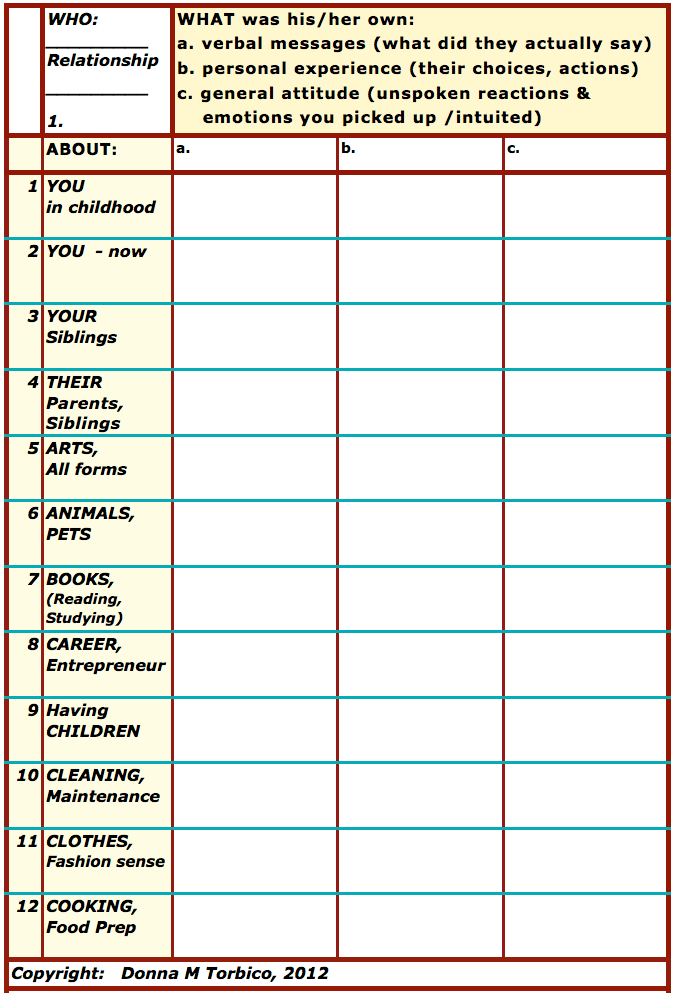
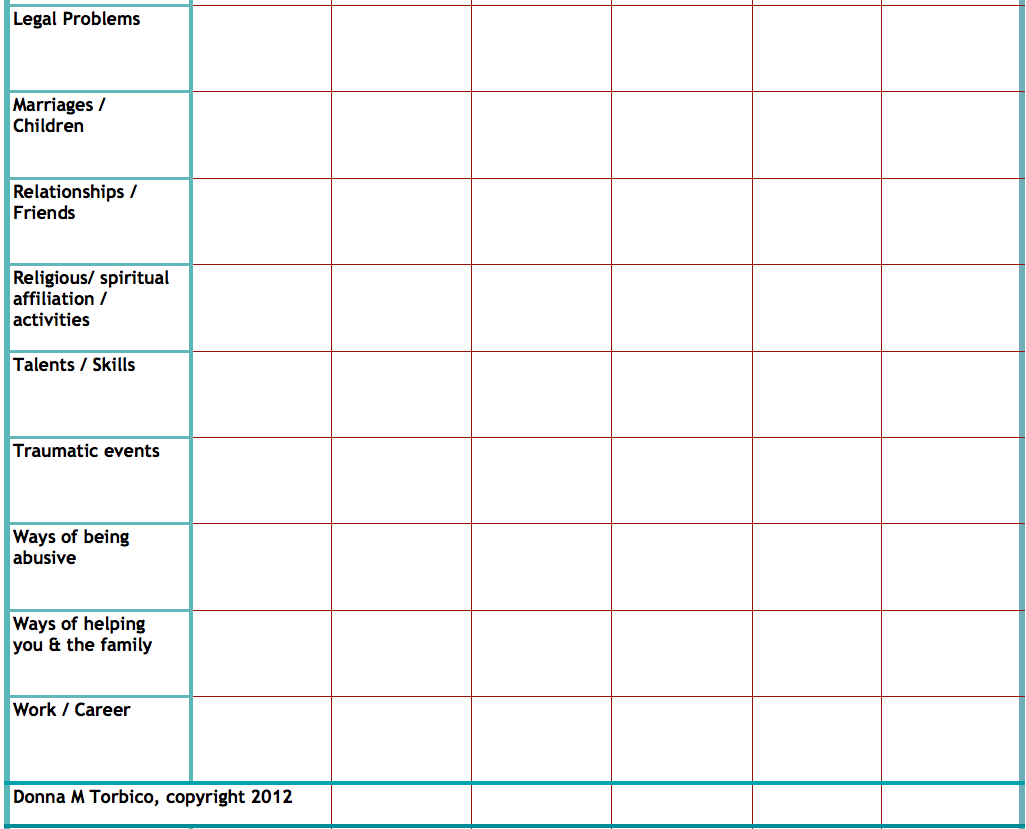
THIS CHART is much more specific & includes listing many of the statements family & others made to us (or we overheard, often) that have become our Toxic Beliefs.
List the people you want to ‘learn’ about.  To start, you can pick ONE you think you know more about & see how far you get.  Of course you can use this chart any way that suits the way YOU process info, so experiment.

* TAKE YOUR TIME. You may feel even more overwhelmed than with the previous chart (there are 62 possible topics altogether). There’s no rush – if you push it you’ll be more likely to give up or to miss important details.

** Naturally you won’t be able to fill in every category for every person. but if you make a separate page for each topic, you can play around by filling in anything that comes to you right away. If you can only write one line per category, start there. Fill in more info at any time later. That can encourage you to work on the rest.  PROGRESS not PERFECTION!

REMINDER: Not surprisingly, many of us don’t remember what
we heard, felt or experienced as kids – mainly we blanked out from fear, but our unconscious remembers.
As you proceed you might be surprised at how much you DO know, and at what will ‘be revealed’ about yourself as you go thru this exercise.  Siblings, other family members & friends or old notebook/ diaries / photo albums – may be helpful.

NOTICE that for each topic you’re asked to consider 3 aspects:
a. Verbal messages: What did this person actually say about the issue? If we pay attention to the way we talk to ourselves – & others – especially when we’re frustrated or angry – we can hear ‘them’ coming out of our mouth.
Also, if someone you’re inventorying is still alive, you can get it from the ‘horse’s mouth’. Without being confrontational or angry, just slip some questions into your conversation & you may get lots of material for your writing. Even what they leave out is very informative!

b. Personal experiences: this is usually the easier one to remember – what  actions did they take about each issue – what did they go thru? Lots of jobs, kinds of relationships, the many ways they did something stupid / abusive / self-destructive / OR helpful / kind / amusing ….. especially any repeated patterns

c. General Attitudes: This may be the hardest because you are the repository of their unspoken, disowned parts! But there are things you’ve always known about them (or at least suspected) that you may not want to admit. Remind yourself – “I know what I know”. You’re NOT crazy – kids are very intuitive & absorb everything!

Suggested PROCEDURE:
More than likely you’ll be doing this on some kind of device.  Make a separate page for each topic & perhaps each subheading
• OR you can use a loose-leaf notebook, & maybe 3 different color pens
• Take as much room for each a. b. & c. as needed, filling in first the things you’re sure or have an idea about – in NO particular order!

• Include all positive & negative points, to get a rounded picture
• Skip any topics that don’t apply to a specific person or that you simply don’t know about, & include more later
• Add any topics not listed which applies to a specific person
PS: If a topic specifically impacted you – growing up – you can make a separate column / page to comment

NEXT: Unrealistic Expectations – OVER – #1

THEM Inv 5

Their ATTITUDE Inventory (4 of 5)

inventory
I DON’T KNOW HOW MUCH MORE
of this I can take!

PREVIOUS: THEIR Attitude Inventory (3 of 5)


FYI: This INTRO will be repeated for all 5 posts in this series, but with different topics

THIS CHART is much more specific & includes listing many of the statements family & others made to us (or we overheard, often) that have become our Toxic Beliefs. More issues in the next post.
List the people you want to ‘learn’ about.  To start, you can pick ONE you think you know more about & see how far you get.  Of course you can use this chart any way that suits the way YOU process info, so experiment.

* TAKE YOUR TIME. You may feel even more overwhelmed than with the previous chart (there are 62 possible topics altogether). There’s no rush – if you push it you’ll be more likely to give up or to miss important details.

** Naturally you won’t be able to fill in every category for every person. but if you make a separate page for each topic, you can play around by filling in anything that comes to you right away. If you can only write one line per category, start there. Fill in more info at any time later. That can encourage you to work on the rest.  PROGRESS not PERFECTION!

REMINDER: Not surprisingly, many of us don’t remember what
we heard, felt or experienced as kids – mainly we blanked out from fear, but our unconscious remembers.
As you proceed you might be surprised at how much you DO know, and at what will ‘be revealed’ about yourself as you go thru this exercise.  Siblings, other family members & friends or old notebook/ diaries / photo albums – may be helpful.

NOTICE that for each topic you’re asked to consider 3 aspects:
a. Verbal messages: What did this person actually say about the issue? If we pay attention to the way we talk to ourselves – & others – especially when we’re frustrated or angry – we can hear ‘them’ coming out of our mouth.
Also, if someone you’re inventorying is still alive, you can get it from the ‘horse’s mouth’. Without being confrontational or angry, just slip some questions into your conversation & you may get lots of material for your writing. Even what they leave out is very informative!

b. Personal experiences: this is usually the easier one to remember – what  actions did they take about each issue – what did they go thru? Lots of jobs, kinds of relationships, the many ways they did something stupid / abusive / self-destructive / OR helpful / kind / amusing ….. especially any repeated patterns

c. General Attitudes: This may be the hardest because you are the repository of their unspoken, disowned parts! But there are things you’ve always known about them (or at least suspected) that you may not want to admit. Remind yourself – “I know what I know”. You’re NOT crazy – kids are very intuitive & absorb everything!

Suggested PROCEDURE:
More than likely you’ll be doing this on some kind of device.  Make a separate page for each topic & perhaps each subheading
• OR you can use a loose-leaf notebook, & maybe 3 different color pens
• Take as much room for each a. b. & c. as needed, filling in first the things you’re sure or have an idea about – in NO particular order!

• Include all positive & negative points, to get a rounded picture
• Skip any topics that don’t apply to a specific person or that you simply don’t know about, & include more later
• Add any topics not listed which applies to a specific person
PS: If a topic specifically impacted you – growing up – you can make a separate column / page to comment

NEXT: Attitude Inv. (5 of 5)

THEM Inv 4

Their ATTITUDE Inventory (3 of 5)

inventory 3 

THIS IS HARD WORK
but I’m learning a lot

PREVIOUS: THEIR Attitude Inventory (2 of 5)

See ACRONYM page for abbrev.


FYI: This INTRO will be repeated for all 5 posts in this series, but with different topics

THIS CHART is much more specific & includes listing many of the statements family & others made to us (or we overheard, often) that have become our Toxic Beliefs. More issues in the next 2 posts.
List the people you want to ‘learn’ about.  To start, you can pick ONE you think you know more about & see how far you get.  Of course you can use this chart any way that suits the way YOU process info, so experiment.

* TAKE YOUR TIME. You may feel even more overwhelmed than with the previous chart (there are 62 possible topics altogether). There’s no rush – if you push it you’ll be more likely to give up or to miss important details.

** Naturally you won’t be able to fill in every category for every person. but if you make a separate page for each topic, you can play around by filling in anything that comes to you right away. If you can only write one line per category, start there. Fill in more info at any time later. That can encourage you to work on the rest.  PROGRESS not PERFECTION!

REMINDER: Not surprisingly, many of us don’t remember what
we heard, felt or experienced as kids – mainly we blanked out from fear, but our unconscious remembers.
As you proceed you might be surprised at how much you DO know, and at what will ‘be revealed’ about yourself as you go thru this exercise.  Siblings, other family members & friends or old notebook/ diaries / photo albums – may be helpful.

NOTICE that for each topic you’re asked to consider 3 aspects:
a. Verbal messages: What did this person actually say about the issue? If we pay attention to the way we talk to ourselves – & others – especially when we’re frustrated or angry – we can hear ‘them’ coming out of our mouth.
Also, if someone you’re inventorying is still alive, you can get it from the ‘horse’s mouth’. Without being confrontational or angry, just slip some questions into your conversation & you may get lots of material for your writing. Even what they leave out is very informative!

b. Personal experiences: this is usually the easier one to remember – what  actions did they take about each issue – what did they go thru? Lots of jobs, kinds of relationships, the many ways they did something stupid / abusive / self-destructive / OR helpful / kind / amusing ….. especially any repeated patterns

c. General Attitudes: This may be the hardest because you are the repository of their unspoken, disowned parts! But there are things you’ve always known about them (or at least suspected) that you may not want to admit. Remind yourself – “I know what I know”. You’re NOT crazy – kids are very intuitive & absorb everything!

Suggested PROCEDURE:
More than likely you’ll be doing this on some kind of device.  Make a separate page for each topic & perhaps each subheading
• OR you can use a loose-leaf notebook, & maybe 3 different color pens
• Take as much room for each a. b. & c. as needed, filling in first the things you’re sure or have an idea about – in NO particular order!

• Include all positive & negative points, to get a rounded picture
• Skip any topics that don’t apply to a specific person or that you simply don’t know about, & include more later
• Add any topics not listed which applies to a specific person
PS: If a topic specifically impacted you – growing up – you can make a separate column / page to comment

NEXT: Attitude Inv. (4 of 5)
THEM Inv 3

Their ATTITUDE Inventory (2 of 5)

inventory 2 

I NEVER WANTED TO BE
just like them – but I am, sort of!

PREVIOUS: THEIR Attitude Inventory (1 of 5)


FYI: This INTRO is being repeated for all 5 posts in this series, but with different topics

THIS CHART is much more specific & includes listing many of the statements family & others made to us (or we overheard, often) that have become our Toxic Beliefs. More issues in the next 3 posts.
List the people you want to ‘learn’ about.  To start, you can pick ONE you think you know more about & see how far you get.  Of course you can use this chart any way that suits the way YOU process info, so experiment.

* TAKE YOUR TIME. You may feel even more overwhelmed than with the previous chart (there are 62 possible topics altogether). There’s no rush – if you push it you’ll be more likely to give up or to miss important details.

** Naturally you won’t be able to fill in every category for every person. but if you make a separate page for each topic, you can play around by filling in anything that comes to you right away. If you can only write one line per category, start there. Fill in more info at any time later. That can encourage you to work on the rest.  PROGRESS not PERFECTION!

REMINDER: Not surprisingly, many of us don’t remember what
we heard, felt or experienced as kids – mainly we blanked out from fear, but our unconscious remembers.
As you proceed you might be surprised at how much you DO know, and at what will ‘be revealed’ about yourself as you go thru this exercise.  Siblings, other family members & friends or old notebook/ diaries / photo albums – may be helpful.

NOTICE that for each topic you’re asked to consider 3 aspects:
a. Verbal messages: What did this person actually say about the issue? If we pay attention to the way we talk to ourselves – & others – especially when we’re frustrated or angry – we can hear ‘them’ coming out of our mouth.
Also, if someone you’re inventorying is still alive, you can get it from the ‘horse’s mouth’. Without being confrontational or angry, just slip some questions into your conversation & you may get lots of material for your writing. Even what they leave out is very informative!

b. Personal experiences: this is usually the easier one to remember – what  actions did they take about each issue – what did they go thru? Lots of jobs, kinds of relationships, the many ways they did something stupid / abusive / self-destructive / OR helpful / kind / amusing ….. especially any repeated patterns

c. General Attitudes: This may be the hardest because you are the repository of their unspoken, disowned parts! But there are things you’ve always known about them (or at least suspected) that you may not want to admit. Remind yourself – “I know what I know”. You’re NOT crazy – kids are very intuitive & absorb everything!

Suggested PROCEDURE:
More than likely you’ll be doing this on some kind of device.  Make a separate page for each topic & perhaps each subheading
• OR you can use a loose-leaf notebook, & maybe 3 different color pens
• Take as much room for each a. b. & c. as needed, filling in first the things you’re sure or have an idea about – in NO particular order!

• Include all positive & negative points, to get a rounded picture
• Skip any topics that don’t apply to a specific person or that you simply don’t know about, & include more later
• Add any topics not listed which applies to a specific person
PS: If a topic specifically impacted you – growing up – you can make a separate column / page to comment

NEXT: Attitude Inv. (3 of 5)

THEM Inv 2

Their ATTITUDE Inventory (#1 of 5)

writng inventory 

TAKING THEIR INVENTORY
helps me know what I absorbed!

PREVIOUS: 2011 Blog Stats

See ACRONYM Page for abbrev.


FYI: This INTRO will be repeated for all 5 posts in the series, but with additional topics
THIS CHART is much more specific & includes listing many of the statements family & others made to us (or we overheard, often) that have become our Toxic Beliefs. More issues in the next 4 posts.
List the people you want to ‘learn’ about.  To start, you can pick ONE you think you know more about & see how far you get.  Of course you can use this chart any way that suits the way YOU process info, so experiment.

* TAKE YOUR TIME. You may feel even more overwhelmed than with the previous chart (there are 62 possible topics altogether). There’s no rush – if you push it you’ll be more likely to give up or to miss important details.

** Naturally you won’t be able to fill in every category for every person. but if you make a separate page for each topic, you can play around by filling in anything that comes to you right away. If you can only write one line per category, start there. Fill in more info at any time later. That can encourage you to work on the rest.  PROGRESS not PERFECTION!

REMINDER: Not surprisingly, many of us don’t remember whatchildhood memories
we heard, felt or experienced as kids – mainly we blanked out from fear, but our unconscious remembers.
As you proceed you might be surprised at how much you DO know, and at what will ‘be revealed’ about yourself as you go thru this exercise.  Siblings, other family members & friends or old notebook/ diaries / photo albums – may be helpful.

NOTICE that for each topic you’re asked to consider 3 aspects:
a. Verbal messages: What did this person actually say about the issue? If we pay attention to the way we talk to ourselves – & others – especially when we’re frustrated or angry – we can hear ‘them’ coming out of our mouth.
Also, if someone you’re inventorying is still alive, you can get it from the ‘horse’s mouth’. Without being confrontational or angry, just slip some questions into your conversation & you may get lots of material for your writing. Even what they leave out is very informative!

b. Personal experiences: this is usually the easier one to remember – what  actions did they take about each issue – what did they go thru? Lots of jobs, kinds of relationships, the many ways they did something stupid / abusive / self-destructive / OR helpful / kind / amusing ….. especially any repeated patterns

c. General Attitudes: This may be the hardest because you are the repository of their unspoken, disowned parts! But there are things you’ve always known about them (or at least suspected) that you may not want to admit. Remind yourself – “I know what I know”. You’re NOT crazy – kids are very intuitive & absorb everything!

Suggested PROCEDURE:
More than likely you’ll be doing this on some kind of device.  Make a separate page for each topic & perhaps each subheading
• OR you can use a loose-leaf notebook, & maybe 3 different color pens
• Take as much room for each a. b. & c. as needed, filling in first the things you’re sure or have an idea about – in NO particular order!

• Include all positive & negative points, to get a rounded picture
• Skip any topics that don’t apply to a specific person or that you simply don’t know about, & include more later
• Add any topics not listed which applies to a specific person
PS: If a topic specifically impacted you – growing up – you can make a separate column / page to comment

NEXT: Attitude Inv. (2 of 5)

THEM Inv 1

Family INVENTORY – Looks

looks inv.
OH NO, THE OLDER I GET  –
the more I look like him / her! EEK!

PREVIOUS: Family Inventory – Overview

See ACRONYM Page for abbrev.

This series of Inventory Qs (© Donna M Torbico, 1995) is specific to the topic of LOOKS, but can be modified to cover almost any other topic you want to evaluate: Food, Money, Sex, Work, House, Religion, Personal & family name, Ethnic / cultural / country background…..

APPEARANCE
Every aspect of our family made a deep impact on us, consciously or not. Since everyone is affected by & often judged by our appearance, we want to look at this aspect first.  It has a direct bearing on how we feel about our own looks – did we grow up proud or ashamed of it?

EXP: A very well known passionate Bible teacher who speaks in public all over the world – is not what most people would call ‘pretty’. She mentioned once that someone unkindly told her she had a “great face for radio”!

At the other extreme, millions of people follow, even adore, famous people who are gorgeous, & imagine / assume they’re also wonderful people. Not so! Many are addicts, cheaters, batters, sexual predators….
OR: Think “Father Knows Best”‘s Robert Young who presented as squeaky clean (in the days before the net & social media) but in real life was an active alcoholic…..

Describe each Q** in as much detail as you can remember, as if telling someone who has never seen them.  If you can’t think of much, start anywhere & then go on to the next point. Leave room for adding to it as memories come up.
If you need help, ASK anyone who also was part of OR knew your family members – what they can contribute
**DO a separate list for each parent & sibling, & any other relative who had an influence on you

1. In your opinion:
• what did each of them look like?
• how have they changed over the years?
• do you/ did you like their looks or not?
• how did their looks affect you?
• did other people have reactions to their looks or to any changes in them – from age, sickness, accidents….?
• who do you most look like & how do you feel about that?

2. What was their opinion:
• of their looks?
• of your? (list their comments)
• how did you feel about that?
— did anyone in the family favor your looks or someone else’s?
— what about others in the family?

3. Is there a pattern to the physical type they preferred or disliked? (gender, color, size…) – even if it now seems shallow or cruel
• What did you think of that?
• Did it affect you in any way?
• Did it have anything to do with ethnic background?

4. How did they dress?
• has it changed over the year? How?
• what aspect of grooming was most important to them?
• if it has changed, what life situations might have contributed to it?
• what was the difference in their choice of clothes at home vs going out?
• did they ever embarrass you by the way they dressed? When & how often? (Drunk?)Screen Shot 2015-08-10 at 3.07.52 AM

5.  How would you describe their style (if not already done so above)?
• frumpy, elegant, sloppy, careful, conservative, hippy, modern…..
• did other people (neighbors, school, church…) comment on their way of dressing?
• how did you feel about their style?
• what other people said?

6. Who chose your clothes & accessories?
• how did you feel about their choices?
• OR did you have to do it alone – when you were way too young?
• what emotions & thoughts did that cause?
• if an adult chose, at what age did that change?
• were your clothes hand-me-downs?
• what effect did that have on your self-esteem & social acceptability?

7. What was their attitude about personal hygiene?
• about themselves?
• about you?
• what effect did this have on you?shows

8. What were their favorite OR hated scent, color, fabric, era…. ?
• were any of these imposed on you?
• how did that affect you?

Add other thoughts relevant to your experience on this topic.

NEXT: OUR Time-Line Inventory

Family Inventory OVERVIEW

inventory writing
THIS IS SUCH A BIG JOB!
so I have to take it a little at a time

PREVIOUS: Inventories – beginning (#3)

BOOK: GENOGRAMS in Family Assessment” by M. McGoldrick & R. Gerson (Another type of Inventory)

REVIEW the relevant “What To Do” section of “Our TIME LINE Inventory” post for suggestions about how to use this chart

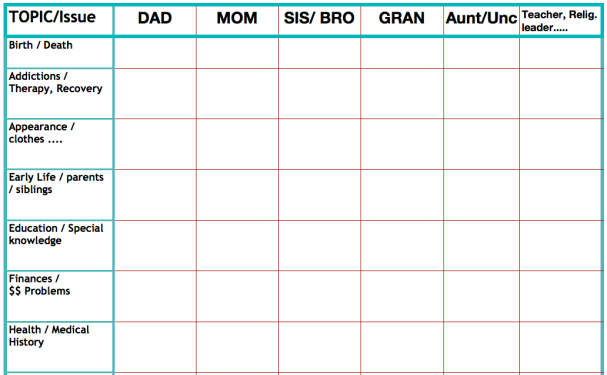
THIS CHART is for the basic facts of each person’s life. Adapt it to fit the number of people in your family members & for others important people from your childhood.
You can add (or subtract) any topic not listed which you feel is relevant to each person you’re writing about. Following posts will cover attitudes & positions in greater detail.
REMEMBER to include any good or beneficial features each person had, when filling in the boxes.

PROCEDURE:
• This design is just a way to get you started. Naturally you’ll need to make a lot more room for each category than is shown here
• You could use a pencil making it easier to add & subtract info, or try different colored pens for each person, to keep them clearly separate

• Try a very big sheet of light-colored wrapping paper to draw up your version. Or take a separate page for each person in a notebook, even for each column
• Add rows with other headings or separate the ones given. Again, don’t worry if you don’t don’t know what to put in some boxes.  Do as much as you can – jump around as ideas & memories come to you.  Go back & fill in as “more is revealed”.
MAKE IT OUR OWN.

AGAIN: DOING THIS on PAPER INSTEAD of ONLINE is BETTER for your BRAIN.
MY Fam Inv a

my-fam-inv-b

NEXT: Family Inventory – LOOKS

ACoAs: EDUCATION Inventory (#2)


SOMETIMES A TEACHERS HELPED
to counter the loneliness & abuse

PREVIOUS: ACoA Ed Inv. (#1)

See ACRONYM Page for abbrev.


NOTE: There might be some overlaps with Qs from Part 1. You can skip those, of maybe here where in a different context, or you’ll remember something else.
TEACHERS

• how did you get along with teachers? Anyone special or especially helpful?
• how were you treated / what was their attitude toward you?
• did you ever get in trouble with school authorities? If yes, when & what for? What was the outcome?
• did you use drugs &/or alcohol connected to school  (events, people…)? What happened, & what was the effect on you?

PEERS
• How were you treated by other kids?  How did that feel?scjoolmates
• If you were not accepted by your peer, what do you think made you different from them?
• Did you have any friends? Who, how many & in what grades?
A BFF or best bud? For how long? What happened to the friendship?
• If you were popular, when, where & why do you think you were?
• If that changed at any point, what happened that caused a shift?
• What did you do, (if anything) or not do, to protect yourself from other kids?
• Did anyone help you with your social problems in school?

COLLEGE
• how many colleges did you attend? What type? (local, vocational, under-grad, grad….)
• who decided where? Why?
• how was the money put together for your schooling?  Did you have to pay it off? Is it done or ongoing?
• where did you live then? What were the circumstances? Did this help or hurt you?college
• what were your majors & minors? Who picked that?
• did you change majors? Why? Which one did you prefer?
• did you finish college? If not, why? Do you want to go back & finish?
• if you go back to school, what would you take? Finish or add to an old major, or take something different?

GRADUATIONS
List all the graduations & special ceremonies you we part of at all your schools
• were any family members there? How did they behave? What did they say about these events?
• who else attended in your honor?
• were there any celebrations?
• did you enjoy these occasions? (aside from any family drama)graduation
• were there any graduations or ceremonies at your school that you missed? Why?
• were there any you didn’t want to go to? Why? How do you feel about that now?

PS: What about school Reunions, for any level? Have you gone? If not why? If yes how did they turn out?

EVALUATION
• looking back, what have you learned about your attitudes toward
— schools & education             —  peers & teachers
— your intelligence, talents, study habits, accomplishments
• have these attitudes changed any since you’ve been in Recovery?
• have you seen improvements in the past few months or years?

✶ DOING WELL in life, with or without a formal education, implies not only native ability but also having certain skills, such the ability to understand, absorb & retain complex informbrainsation.
In school it required concentration, comprehension, following instructions, memorizing, speaking….  many of which you probably did NOT get from your dysfunctional home!
You managed to survive the system & even excel, in spite of all the stress you went thru, so give yourself a lot of credit & give your Inner Kid a BIG HUG.
You can learn, no matter what you heard at home or anywhere else. You survived a lot of hard times. You ARE smart! You survived them, didn’t you?

If you have a 12-Step Sponsor, therapist or appropriate friend, you can share what you’ve written to get positive feedback!

NEXT: Family inventory Overview

ACoAs – EDUCATION Inventory (Part 1)

school, schmoolSCHOOL, SCHMOOL!
What was it all for??

PREVIOUS: Time-Line Inventory

REVIEW post : “Family Inventory – Overview


TRAUMATIC EXPERIENCE in SCHOOL?
Whether because of moving, bullying, learning disabilities….  it can be cathartic to do this writing, surprising you about how much pain is still hiding under your mental carpet. This is one way to start cleaning out more of the sludge clogging our mental & emotional arteries – that keep up stuck.

IMP: Moving often meant new schools, which meant being the ‘new’ kid each time. In most cases this was a cause for peer-abuse. The more schools – the more pain! 

EXPERIENCE
a. Some ACoAs only went to 2-3 schools throughout our educational life
b. Others of us moved a great deal & so changed schools often
c. Some have had little formal education, but have learned a great deal on our own, by life experience, reading, unofficial classes….
SITUATIONS
✒︎ some of us did very well & gained a measure of self-esteem & positive feedback away from home
BUT we were abused / ostracized by other students for being smarter, favored by a teacher, getting awards, the child of someone ‘Special’, of a different religion….

✒︎ for some it was a relief to away from the chaos & neglect of the home, but for
others it was more of the same – being teased, ignored, deliberately abused….the scream

✒︎for some, we didn’t do so well, not because we were stupid (mentally limited) but because:
✐ it was too hard to concentrate, worrying about the bad things that did happen or could happen at home while we were away
✐ of having to hide physical &/or sexual abuse from everyone
✐ of ADD, illness or other personal difficulties
✐ bullied, made fun of… for being different in some way
✐ we didn’t fit in to the social setting of the school
✐ missed school because of illness – ours or family member
✐ moved often & got out of synch with class level….

The QUESTIONS — Use this as a FACTUAL inventory, at first, so you don’t get too overwhelmed. You can add emotions later, or on a separate sheet

SCHOOLS: • how were they paid for?
• every school you went to (Kindergarten thru college)
• dates, location, names — if possible, or approximately
• was there tuition & other costs?

To be more specific: use a separate page for each of your school years & at the top include the year, your age, the grade & school location.  It’s ok if you don’t know or remember – you may eventually, someone else may give you some info or you’ll leave it blank.  Fill in as much of the following as you can for each year.

FAMILY:last-minute
• what was each parent’s attitude toward school & education?
• what messages did they give you about it?
• how did your home life affect your homework?
• did your parents help with or hinder your schoolwork?
• did you get the clothes, books & other equipment you needed? If not, what happened?
• were they proud of your progress & achievements? Indifferent? Disappointed? How did that feel?

YOU:
For the grammar school years, do the best you can & ask others for info :  • which subjects did you take?
• did you like or dislike these classes? Why? The subjects you remember most easily tell you how you felt about them

• were there special assignments you did better in? worse? What were the teachers’ reactions?school bag
• were you in any clubs, special groups, cliques?
• were you a loner, disliked, ignored, teased, tortured OR liked, popular…

• were you alert, falling asleep, sick, out a lot? visible or invisible in class?
• did you play sports (group or individual)? Was it a positive or negative experience?

NEXT: School Inventory (Part 2)

ACoAs: Our TIME-LINE Inventory

inventory


IT’S INTERESTING TO SEE
my life all laid out so clearly

PREVIOUS: Family Inventory – General

See ACRONYM Page for abbrev.


CHOICES:

Family Inventory charts are next. If you want to start with a Personal Inventory (or have already done one, try c.), here are a few options:

Al-anon “ 12 STEP Workbook ” (as an adult) and12 Steps of Adult Children” (about you & family in childhood)

These 2 books can be done together – one Step at a time – of course! & share each one with a sponsor or therapist. You may need some suggestions on how to answer the various ones, since it’s hard to see oneself. Do not rush, but do it.

If you just want to do a character Self-Evaluation, you can do:
a. the 4th Step of the 12 Step Program: “Made a fearless moral inventory of ourselves”. Most newcomers just write everything they think is wrong with them (personality defects) & all the wrong things they’ve done (bad actions). Actually it’s supposed to include our strengths, skills & gifts, but ACoAs rarely think to do that.
• This can be done with an outline such as the AA version at “Step12.com
• or done ‘freehand’, as things come to you. Then later you can categorize them for clarity.

b. AL-ANON‘sThe Blueprint for Progress” booklet & online

c.  The TIME LINE Inventory (DMT 1986)
This chart may seem sketchy, but can be quite powerful. Because it’s so visual & simple it’s hard to miss the obvious – trauma & repetitions of trauma. You may:
•  find yourself reluctant to start , OR you may fill in some & then drop it. This is most likely because it’s painful & you’re shying away from facing the pain – doing it alone can be hard
•  If you do continue, be sure you have a good support system in place ahead of time when you need encouragement if the emotions that surface come up too strongly. Don’t give up!
WHAT TO DO
•   Tape together as many sheets of paper as needed (20-30…)
•   OR use a roll of sturdy white paper
•   OR a loose leaf notebook with unlined paper
❇️ Doing this online is not as effective, since you can’t see it all at one time. Plus – the physical act of writing is good for stimulating the brain

Draw a horizontal line about 2/3 of the way down, all the way across. At far left put the year of your birth & then mark off every 2 or 3 years with the date and your age, all the way to the present. Leave more space between later 2/3-yr. periods than early ones

Above the horizontal line add slanted lines as they fit your life experiences & briefly write on each one a major event: illness, moves, school, graduations, special events, travel, hospitalizations, awards, relationships, work, physical abuse…. It’s OK if you don’t know the exact date or yr, especially from your early life. Put in everything you can think of, even if dates are approximate. ASK the Inner Child for memories (or reliable relatives)
(USE PENCIL to make changes or corrections)

Below the line write in any event that happened to another person close to you which had an impact on your life: birth of siblings, divorces, illness, deaths, their loss of jobs….

Start anywhere in your lifetime, filling in the things you remember most easily, & then go back & fill in earlier events as you think of them. Ask siblings, aunts…. or anyone who knew you then, who can give you some history you forgot or difind the patterndn’t know. Do the best you can.

👀 When you’ve filled in as much as you can (you can add things at any time) you’re going to be looking for :
•   the recurring pattern of your early experiences
•   how you’ve copied them as an adult
•   what had the most impact on you
•   what did you just realize for the first time now
•   what are you clearer about, that you sort of knew, but hadn’t solidified

IMP: Take your time. Allow yourself to feel all your emotions – sadness, anger, frustration, loss…. Bookend this exercise with someone your trust, & review it with a therapist, sponsor or sibling, if possible.

NEXT: OUR Education Inventory – #1