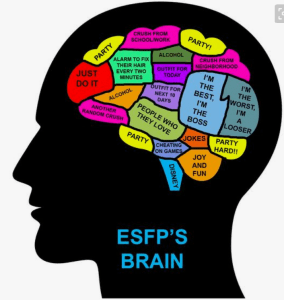
MBTI – Introvert vs Extrovert ANATOMY (Part 1)


PREVIOUS
: Brains Overview

SITEs: Surprising things re our BRAIN 


Interesting:
Studies show that the average distribution of extrovert factors varies around the world.
EXP: people in Europe & the US score higher as Es than people from Asia

Es = Extroverts   //  Is = Introverts

1. NERVOUS SYSTEM (NS): The 2 branches (central, peripheral) produce the body’s involuntary functions – what’s normally not under our conscious control (circulation, breathing, temperature control, digestion).

a. Sympathetic NS response (Dopamine) = Fight or flight.
It produces a thoracolumbar outflow, from neurons starting in the thoracic & cervical areas of the spinal cord, mobilizing physical activities needed to deal with stress, potential /imagined threat, or actual /imminent danger (increased energy & cardiac output, dilating bronchial passages….)

b. Parasympathetic NS (Acetylcholine) = Rest & digest.
It produces a ’cranio-sacral’ outflow from neurons starting in the brain & lowest area of the spinal cord – responsible for the body’s ability to recuperate & return to a balanced state (homeostasis – conserves energy, increases intestinal & glandular activity)

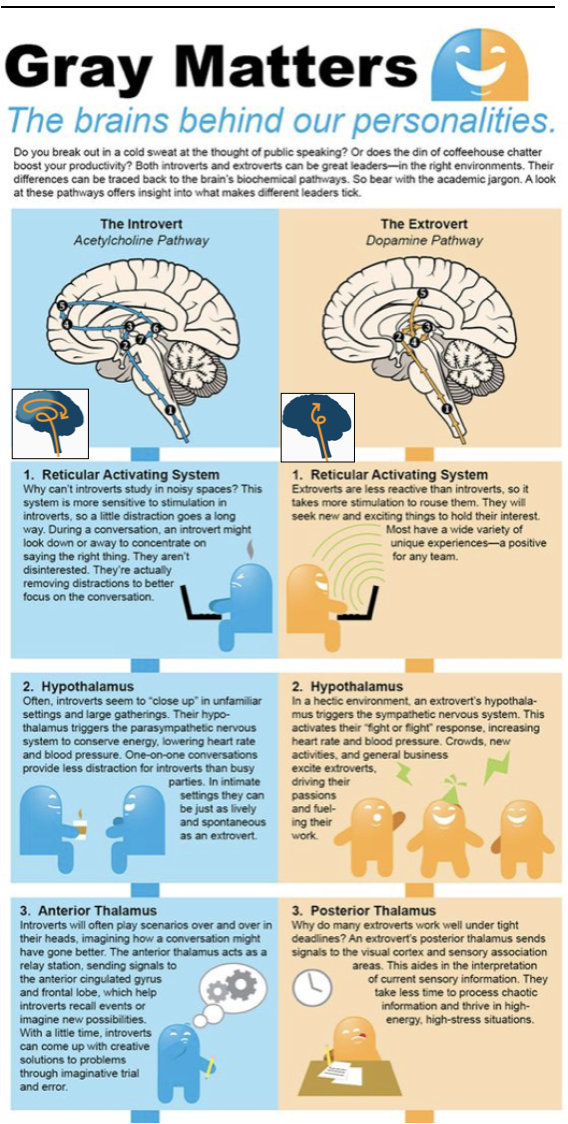
Reminder: The RAS (reticular activating system) is at the top of the spinal cord – in the brain stem – essential to our alert conscious state. It determines the general level of arousal – indicating where someone fits on the extroversion-introversion continuum.
Broadly, the RAS in Is has a higher alert setting, making them much more aroused to start with, so need less input from the outside than Es do.

👩🏽 🧓🏼 2. FACES
Event-related potentials
(ERPs) are very small voltages generated from all brain structures in response to specific sensory, mental or motor events. (MORE…..)

Brain Fingerprinting is a new computer-based way to measure electrical brain waves reacting to words, phrases & pictures. It uses EEGs to identify the ERP known as P30o (P3) , a non-invasive way to evaluate brain functioning. This specific waveform is considered an indicator of human attention, i.e. how fast the brain notices that something has changed. It’s a reaction to decision-making, when doing certain tasks, or by a sudden change in the environment.   ( Dr. Lawrence Farwell)

One study was designed to see if Es are more sensitive than Is to stimuli in social situations (faces). Electrodes covering the parietal lobe of 28 subjects scanned for P3 waves.
Subjects were shown a series of male faces, & then every so often a female face. They were also shown pictures of purple flowers interspersed with yellow ones.

Those who had previously scored high for extroversion showed a greater P3 response to human faces, but no correlating reaction to flowers. It suggests that faces, & people in general, have more meaning to Es, which encourages them to be more interested in socializing.
Conversely, Introverts – shown the same series of images – had about the same level of P3 responses to both faces & flowers, suggesting their brains react to people about the same as to inanimate objects.

Another study focused on how the brain reacts to happy faces.
Research has shown that the amygdala ‘lights up’ in response to socially & emotionally meaningful images, & consistently so in reaction to fearful faces – compared to neutral ones.

But amygdala results in people looking at pleasant / happy faces was inconsistent. To account for that, Stanford scientists started by testing subjects on the Big 5 O.C.E.A.N. traits, specifically for Extroversion & Neuroticism, & then showed student volunteers pictures of fearful & happy faces, using brain scans.
FYI: Right amygdala generates ‘negative’ emotions like fear & sadness.
Left
amygdala can create both pleasant emotions, like happiness – & unpleasant ones.
FINDINGS
• The amygdala in people with high extroversion scores was “turned on” more by happy facial expressions, & more than to all the other ‘Big 5’ traits, but not significantly to other expressions, such as fear, sadness or anger.
It indicates why more-outgoing people find social situations pleasurable.

• Volunteers with test scores slanted towards Neuroticism (tendency to anxiety, worry or insecurity) had no significant amygdala reactions to any of the emotional expressions. This suggest why up-beat interactions are neutral or unfulfilling for Is – but not WHY some amygdalas under-react.

Reminder: Is are by definition not neurotic, but because of their normal inward-focus, when they are ‘wounded’, some are said to suffer from ‘extreme introversion’ (severe shyness or social phobia) – debilitating conditions preventing them from forming meaningful relationships.

NEXT: E vs I Anatomy #2
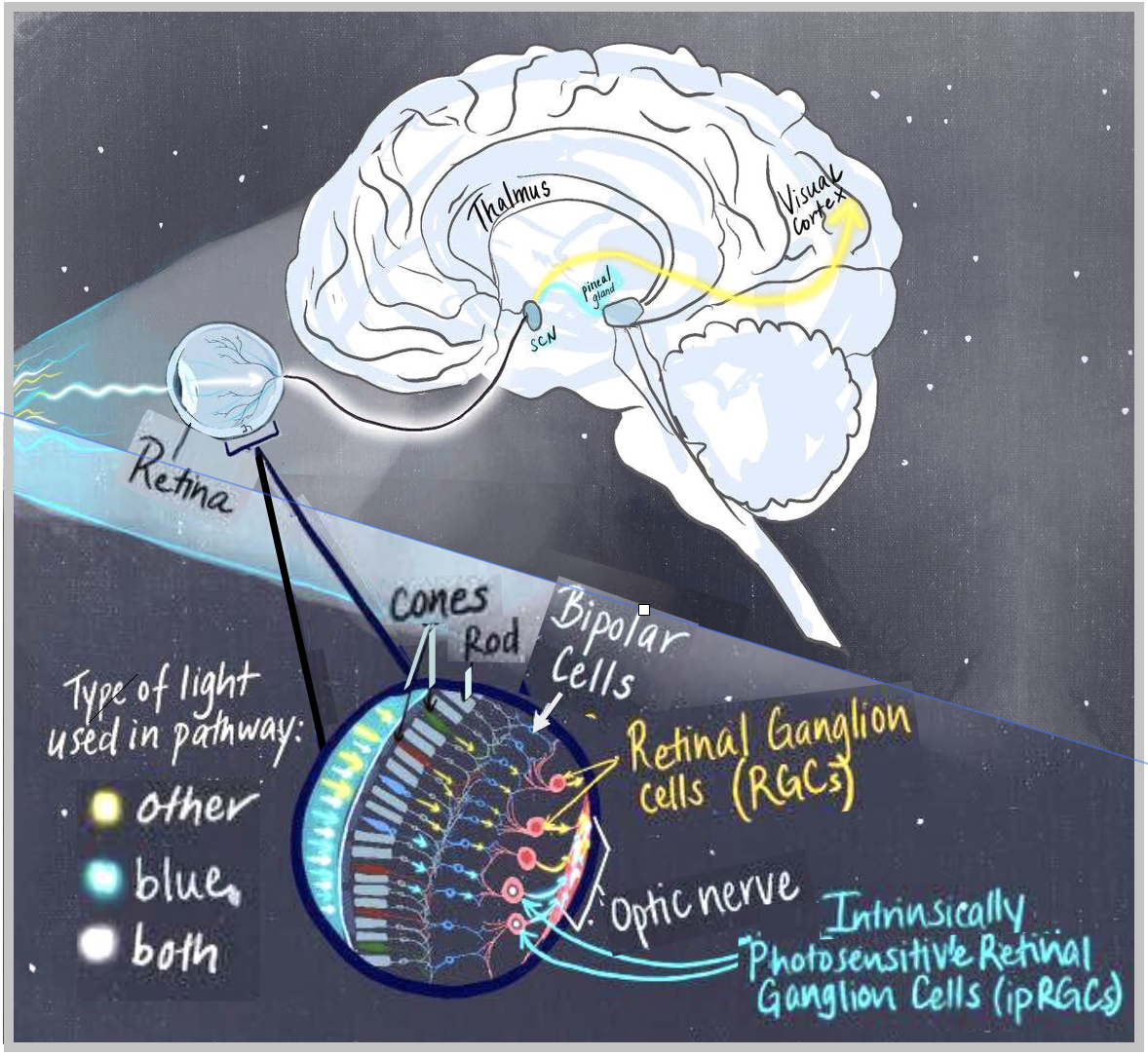
MBTI: E vs. I Brains – OVERVIEW


PREVIOUS: E vs I brains #2

SITE: ‘The Brain that changes itself” – Norman Daidge, M.D.


The Brains Behind ‘Grey Matters’   ↗️ Grey Matters Columbia University (CU), a joint Barnard and Columbia literary journal that premiered in spring 2021, seeks to make neuroscience more accessible to the public. #


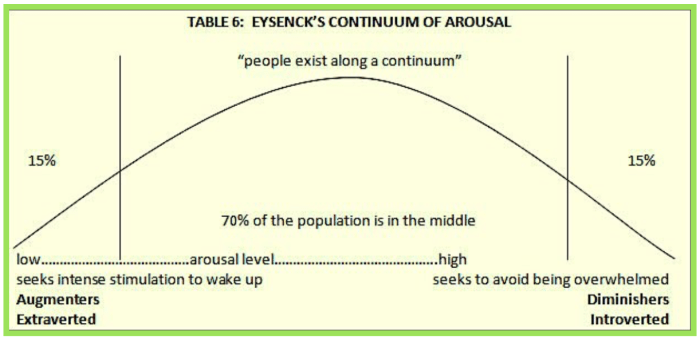
Introverts & Extroverts have different levels of arousal – meaning the extent to which our minds & bodies are alert & responsive to stimulation

«
Es have a lower basic rate of arousal. They need to work harder to be up to the same ‘normal’ state that Is might reach quite easily, because Is‘ rate of arousal is much higher.
«

«
Hedonic tone
⬆️ is the degree of pleasantness or unpleasantness associated with a given subject, state or circumstance. Also known as positive or negative valence.

NEXT : E / I  ANATOMY, #1

MBTI – Introvert vs Extrovert BRAINS (Part 2)

PREVIOUS: E vs I brains #1

SITE: Surprising Brain facts

Es = Extroverts   //   Is = Introverts

FACTORS re. Biological Differences between I & E brains (cont.)
2. BRAIN QUADRANTS // 3. BLOOD FLOW – Front vs Back

4. Blood Flow & NEURO-TRANSMITTERS
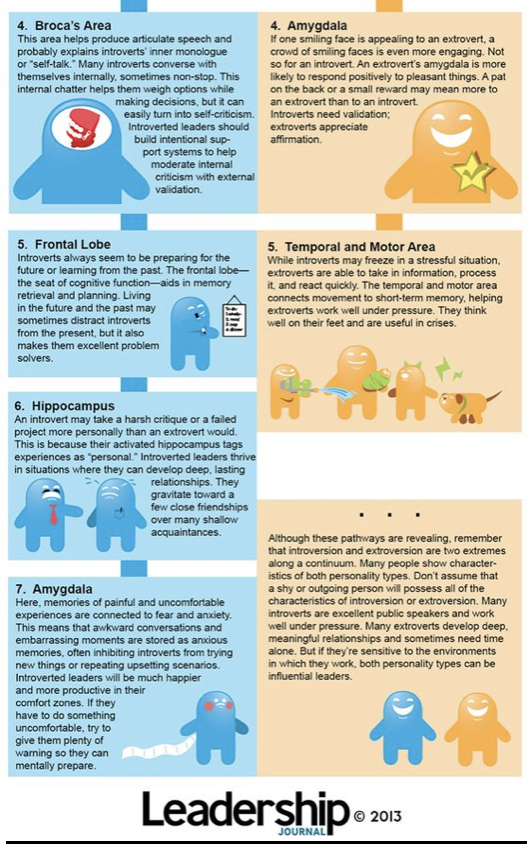
Blood of Es & Is brains travel on different pathways in response to a wide variety of stimulation. Each style uses a completely different neurotransmitter, which take a different amount of stops in the brain along the way to processing ideas, info, experiences, interactions….. These chemicals direct where the blood goes, & regulate how much of it flows to various centers, influencing what parts of the Central Nervous System (CNS) are turned ON.
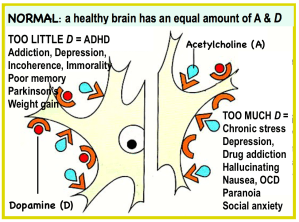
✳ Extroversion is linked with energy-spending dopamine/ adrenaline, while Introversion is linked with energy-preserving acetylcholine.

Energizing: Dopamine (D) is the ‘activating’ transmitter which produces good feelings that come from social interaction, physical activities & passion. The D-system affects how we learn & respond to novelty. Setting off an external response, it motivates us to go after situations that are rewarding.

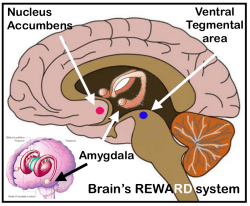
The amygdala & nucleus accumbens (which encode new motor skills) are important components of the brain’s D-reward activation, responsible for processing emotional stimuli, & giving Es a rush when trying something highly exciting. And D’s sidekick Adrenalin makes more D when released from the sympathetic nervous system, needed for fight or flight reactions when we’re faced with real or assumed danger.

Calming: Acetylcholine (A) is the ‘inhibiting’ transmitter that also helps us feel good, but as a relaxing influence. When set off, it activates the parasympathetic nervous system, along with  the hypothalamus, providing an internal response that lets us slow down, to maintain or safeguard energy. A is like D’s alter ego, creating a sense of satisfaction & contentment, & plays a role in dreaming & imagination.

Acetylcholine fuels our ability to think deeply, reflect & focus for long periods of time on one thing. It rewards mental concentration by giving hits of ‘happiness’ – but not the charge of glucose & oxygen needed for physical energy.

Extroverts & D
 Research has shown that Es have more Dopamine receptors in their brains (than Is), so they need much more of this chemical to fill all those ‘slots’. More activity means producing more D, with then pushes Es to continue social interaction, activity & excitement.
Interesting: People born with a longer D-receptor gene are more likely to become thrill-seekers & adrenaline junkies – if stressed for too long.
Introverts & D
Is
 have fewer receptors in the same area that generates D, the substantia nigraso they need a very specific limited level of dopamine, but a greater amount of acetylcholine – to be comfortable. A normal amount for Es will easily be too much for Is, which can eventually lead to agitation, depression, or mental illness if Is don’t get enough stress-relief.

5. CIRCUITS
Both styles
respond to incoming info from activities picked up by the spinal column (SCS). From there, the I’s brain-path accesses memories or information. Es brain-path mainly accesses sensory info.

➡️ For E’s – when activities stimulate their brain, a Dopamine-response is trigger . The pathway makes a 5-stop circuit (shorter & less complicated) which runs through areas where taste, touch, visual & auditory sensory processing take place.

#2. Data from the RAS goes to the Hypothalamus (thirst/ appetite / temp) switching on the ‘Full Throttle’ system
#3. a relay station amplifying the stimuli
#4. the emotional center – & Es is associated with actions, the motor area being lit up
#5. connects movements to—> short-term memory access, to—> the center for learning, as well as processing sensory & emotional stimuli

↗️  For Is, activities trigger Acetylcholine, needed to balance out any potential or actual overwhelm. It makes a 7-stop loop traveling through areas of the brain dealing with info, meaning, planning, remembering & problem solving. This uses 40% more energy than the extrovert-dopamine circuit. 
#1. Stimuli enter the RAS at the top of the brain stem –  less active in Is
#2. data is interpreted & the brain placed in ‘Throttle down’ mode
#3. is the relay station turning sensory signals down
#4. where speech & activates self-talk is planned
#5. selects, plans & chooses ideas or actions. Forms expectations & evaluates outcomes
#6. is for environmental awareness & info sent to long-term memory
#7. the emotional center where feelings are attached to thoughts

⬅ In high activity situations, the 2 styles are opposite, because different brain areas are activated.

NEXT: E & I body parts

ACoAs: PATIENCE vs Co-dependent Waiting (Part 2)

PREVIOUS: Co-dep vs Patience #1

SITE: How to cope with waiting for news

QUOTE: “Good character is not formed in a week or a month.  It is created little by little, day by day, by protracted patience” – Heraclitus of Ephesus

PASSIVE PATIENCE (cont.)

Co-dep also shows up as IMPATIENCE, annoyance, intolerance, worry, fear & distrust
• It’s demanding what we want, right now (instant gratification), because any delay in getting a need or a desire met is taken by the WIC as a definite “NO – you can’t ever have it, so shut up & go away!” from the PP (Negative Introject)

• It’s rushing relationships, to get that feeling of instant attachment, which is actually symbiosis. It’s an attempt to compensate for present-day fear of Abandonment pain, to make up for not having had that bond as an infant with mom, when it should have occurred

• It’s impulsively rushing into situations without considering whether they’re right for us, or what the consequences will be – to ourself or others
• It’s pushing our way ahead of others (selfish entitlement) – the unconscious fear of being left behind – while consciously assuming it’s ‘our right’, but is actually childish narcissism
<ADD YOUR OWN kinds of unhealthy co-dep ‘patience’ & impatience>

Fortunately, Recovery gives us an out – a way to identify our damage so we can separate & strip it away from the Real us that’s hidden under all the defenses, separating the Toxic Rules from our Rights. As adults we have very real options, if we’re willing to risk leaving our attachment to the dysfunction.
REMEMBER: We’re damaged (wounded), not defective!

🦋 🐯 🦆 🐳 🦒 🐇

HEALTHY PATIENCE
This kind is an ACTIVE response to reality (personal & environmental)
Just like ‘Acceptance‘ does NOT mean giving up or giving in, Patience does NOT mean letting the world trample us.
Nor does it mean ‘taking the moral high ground’ as some spiritual superiority, nor a punishment from the ‘universe’
• It does not imply the hopelessness of being forced to endure suffering & deprivation
• It does not mean being passive, of not taking appropriate actions when necessary to accomplish something, especially if it’s something only we can do. (Posts: Healthy Actions // What to do when confused // Why are you stuck?)

It DOES mean being emotionally mature. This allows us to tolerate delayed gratification, which can only come from lowering the WIC’s intense anxiety. Healthy patience is active in the sense that we choose to wait for a desired outcome, while at the same time actively continuing to live our life the best way we can – every day.

Real patience :
• requires knowing the difference between Rescuing & Healthy Helping, because it takes patience to sit with our own discomfort of not jumping in to someone else’s problems. Knowing the rules for Helping is important.
But we can also tell what’s healthy by feeling physically stressed or relaxed, & by our emotions: Rescuing / people-pleasing is driven by anxiety, a compulsion to compensate for something broken in us. SO —
• Before a situation (a communication, an event….)  we can obsess & worry OR – be excited about ‘doing / reacting’, which comes from a false sense of connection, & temporary relief of abandonment fear.
Afterward – we can feel drained – from overdoing, disappointed if we didn’t get what we wanted in return, & then angry. Here the actions are ALL about us, the WIC trying to cover up S.H.

True Helping is done from an inner sense of calm & confidencebefore taking action a choice that comes from the Healthy Adult’s enjoyment of sharing our personal talents, knowledge & experience. And we feel pleased, satisfied & comfortable, even uplifted – afterward. We benefit, & not just about ourself.

NEXT: Co-dep vs. Patience #3

MBTI Type – ENFJ


PREVIOUS: ENTJ

SITE: Extra info per type experts don’t tell us


EXTROVERTS (EX)


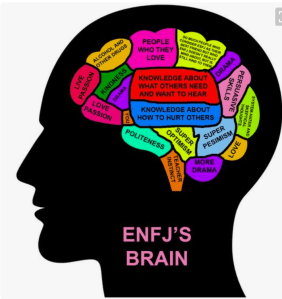
ENFJ – The GIVER / Teacher / Advocate / Protagonist
E-Intuition-Feeling-Judging

Most PERSUASIVE – “Personal cheerleader”
• 1.6% males, 3.3% females

NATURAL
GOAL: To express. 
ENFJs have excellent people skills, believing in ‘people possibilities’ – with a real concern for how others think & feel.  Preferring to ignore unpleasantness, they see everything from the human angle, instead of through impersonal analysis. Interested in being of service, they tend to place the needs of others over their own.

Popular, sensitive & loyal, they’re responsive to both praise & criticism. Externally focused, they usually don’t want to be alone, & so can neglect their need for down-time, although when on their own they may fall into negativity. However, they can also feel lonely when around others, because of hiding parts of themself.

As leaders, they’re very effective at managing people, moderating group discussions, building consensus & being an inspiration. They see the potential in everyone, interested in helping others reach it. Highly responsible, they can get the most out of teams by working closely with them, & by making decisions that respect & take into account the values of others.

They’re : charismatic, collaborative, compassionate, driven, empathetic, idealistic, manipulative, passionate, supportive, talkative, warm.  And they don’t all want to interfere in your life. (More…)

Hidden Side
ENFJs tend to suffer from a poorer self-image than most E–Js. While their genuine concern for people is in their nature, over-focusing on others can be mislabeled as responsibility when it’s actually used to avoid dealing with their own problems.
Coupling a hyper-altruistic tendency with a weaker Si (their Stack’s Tertiary Sensing function) can make a mess of their life, but because their Fe (Primary Feeling function) is image-focused, they tend to be very good at hiding it. And they’re easily prone to vices / addictions, contrary to their goody-2-shoes image painted by most MBTI profiles.

Life’s Purpose: Bring love where there is hate
• Their Law: You shall always fulfill your dreams
• They Comfort others by saying: What’s wrong? Tell me everything – I’m here for you

• They Say: Rules are great – they help us be better people. I am loyal to anyone or anything I respect & admire. Do unto others as you would have them do unto you.
• Communication:  They’ll definitely start the conversation, & probably guide it too.  They’re warm & encouraging, but can be a bit overbearing. They should stop saying YES.

Weaknesses:  Fluctuating self-esteem, overly idealistic, struggle to make tough decisions, too sensitive, too selfless
Manipulate: Keep on smiling while ‘handling’ others to do what they want them to think/do/feel – but not to worry, it’s “for the greater good”  🦊
Paradoxes: Totally caring for others, yet their own feelings are more important than anyone else’s. Altruistic and intrusive.
Judge people: by their selfishness  • Fear: not able to help
• Are Judged for: not seengi other people’s point of view

Become STRESSED from situations shown in the illustration.
ENFJs are likely to be disappointed by relationships they worked so hard to build. They stop being enthusiastic & passionate about those around them, then feel guilty about it. Believing they’re letting their loved ones down, as well as losing themselves, they take over all responsibility, trying to use logic to solve problems.

They obsess about not being seen as empathetic & loving. Highly sensitive to rejection & criticism, they work hard to keep up appearances, while deep inside they feel depressed & joyless.

If the stress continues or increases, ENFJs become pessimistic, rigid, & insensitive. Obsessed with escaping their guilt, they impulsively, inappropriately vent bottled-up emotions. Some may even abandon their loved ones or communities altogether, in search of a more inspiring environment.

• Hate: Anyone being closed-off. Being cheated on or abandoned. Cruelty, disharmony, unfairness & people being socially marginalized. Someone being really mean, & the ENFJ realizing they don’t have a sad back-story as an excuse. Asking for Help, because they think they’ll be a burden

Don’t argue with ENFJs when they’re holding: A conversation
• Never antagonize them.   • Never tell them: Your friendship means nothing to me

GROWTH
Advice:
Don’t assume you know someone well when trying to help.
ENFJs talk a lot, & may be discouraged if they don’t get a lot of feedback from others. They also expect everyone else to give as much to tasks as they do, but may overlook logical, factual realities when making decisions.

They find conflict & lack of consensus hard to deal with, so take on the burden of being responsible for others’ success or failure, which gets to be too much. They must work at letting go of control & guilt – permanently, especially when they can’t save someone – which is not the ENFJ’s fault. It’s best if they focus on themself, since they already have all the intuition & info needed for personal growth.

ENFJs can reduce stress by cultivating their own identity apart from society’s expectations & predefined roles. By exploring & loving their own interests & potential, they become less concerned with public approval. Then they’ll be able to appreciate their considerable talents & gifts, & be open to a wider mix of people & experiences (More….) 

ENFJ Relationships
You quickly understand the emotions of others & focus on encouraging their growth. Partners & friends will see you as gracious, expressive & congenial.

• Thrive in any situation that: Encourages mutual personal growth (More...)
• As a Friend, you’re the one who’s never available because you’re busy talking to everyone else & doing favors for them

Annoyed when: someone can’t see your point of view

ENFJ Parent, child of ENFJ, ENFJ child

• Still single because: playing the mentor has taken all the mystery out of you
• Unhealthy behavior: Stalk your S.O.’s ex on social media at 3a.m.
Show interest by: Trying to be ‘perfect’ for them
Show Love: Give time & affection, want to process emotions, explore & grow –  together
• You want to hear: I’m with you

• You’re attractive/sexy because: you have a warm & uplifting spirit – you can’t be missed. Like the sun, you radiate certainty in yourself & your devotion to those you love make you incredibly you incredibly attractive

• You should DATE someone who : can make you feel loved & cared for, who can take charge if necessary, & surprise you with romantic gestures.

• To attract you someone needs to : act like the bad boy/girl, but show glimpses of deep emotions. Who’ll make a great effort to figure you out & bring out the best in you.  (More….re. Turn-ons)

• Some Famous ENFJs : Barack Obama, Ronald Regan, Oprah, Diane Sawyer, Dick Van Dyke, King David (Bible), Andy Griffith, Ross Perot, Michael Jordan

NEXT: Co-dep vs Patience

MBTI Type – ENFP


PREVIOUS: ENTJs

SITE: ‘Styles of Worshippreferences by MBTI dichotomy categories

BOOK:Personality type in Congregations


EXTROVERTS (EX)

ENFP – The INSPIRER / Motivator / Cause promoter  E-Intuition-Feeling-Perceiving

Most OPTIMISTIC –  “Happy procrastinator”
• 9.7% females 6.4% males

NATURAL
GOAL: To create. ENFPs are warm, enthusiastic, bright & full of potential.  They’re imaginative, consider life as full of possibilities, excited by new ideas.
Their energy is stimulated by new people & experiences. The life of the party, they have great people skills – wanting harmony with others, & have a need to live by their inner values.

They’re open-minded & flexible, with a broad range of interests, & do well at whatever interests them. They quickly see connections between information & events, able to move forward with confidence based on what they see.  Going quickly from one project to another, they’re willing to consider almost any possibility, often developing multiple solutions to a problem. They’re better at starting than finishing, bored with details.

They’re: creative, energetic, enthusiastic, expressive, friendly, gentle, idealistic, innovative, quirky, people-oriented, scattered, thoughtful, upbeat. And they’re not all bubbly klutzes.

Hidden Side
They may be Es, but not typically outgoing because their Fi (Introverted Feeling – in their stack) prevents them from wanting to over-extend themself emotionally. Their extroversion shows up more in exploring various interests, by gathering external info, & interpreting it by figuring out how different pieces connect. While they almost always have an unconventional senses of humor, they’re not necessarily ‘goofballs’  – because  they take their moral causes, values & social relationships very seriously.  This intensity can be seen any time these topics are brought to the ENFP’s attention. (much MORE re. stacks in future posts)

Life’s Purpose: Inspire those who have given up
• Their Law: You shall always follow your heart
• They Comfort others by saying: Everything’s going to be alright!

• They Say: Oops – I didn’t realize there were rules :). Laughter is the best medicine. Chill! I have a wide range of feelings & many are intense.
• Communication: Will start the conversation & likely direct it. They know what they want to talk about – probably something fun.
They should stop talking about how offended they are.

Weaknesses: Easily stressed, highly emotional, not practical, overly independent, over-think things, too talkative, trouble focusing
Manipulate: They use their ‘gift of gab’ negatively, justify ‘handling’ others emotionally as just being charming, but it’s ok ? because they’re ‘being authentic’

Paradoxes: Incredibly open-minded & totally stubborn. Lively & lonely.
Judge people : by their values  • Fear: Being ignored
• Are Judged for : thinking everyone hates them

Become STRESSED from situations shown in the illustration.
ENFPs in distress will feel overloaded & overwhelmed by too much to do – heart rate going over 9000 rpm! They believe they’re trying to help others by making their lives better, but feel their efforts are unappreciated, & that there are always more expectations or demands on them. Then they become overly-emotional, too worried, withdrawn & have tunnel-vision. In such cases, ENFPs are likely to start shirking all responsibilities, forgetting appointments, being late for deadlines…..

They see other people’s annoyance with ENFP’s unpredictability as a lack of consideration & respect for the ENFP’s rights & priorities. They want to be free to respond to possibilities as they occur, & to change their mind whenever they want. Requests or previous commitments that don’t support their present agenda are felt as unreasonable & limiting, so will be ignored.

• Hate: Being inauthentic & anyone questioning it. Feeling bored or betrayed. Being made to do something simple for hours by a tough authority figure. Their ideas being stolen. Subjective logic & unchallenged beliefs.  Asking for Help, because they’d rather do it their own way

Don’t argue with ENFPs when they’re holding: Their temper
• Never rein them in.   • Never tell them: You’re boring & unoriginal

GROWTH
Advice:
There’s a line between being charming & emotionally manipulative.
They’re lighting in a bottle, full of inspiration, humor & unfettered ideas – but risk burning out from over-committing or following every possibility.

They can have trouble determining priorities, not good at follow-through on decisions or projects. So each time they have a great idea, it would help to immediately break out a pros & cons list, & be as realistic as possible. No matter how strongly they feel about it, it’s best to weigh the consequences of their actions honestly & logically, because others are counting on them.

ENFPs need to find what will really fulfill them – long term – instead of what’s attractive at the moment. By working to achieve their true ideals & values, they can build a consistent lifestyle that fits who they are, not just as a temporary escape from feeling trapped by life. (LARGE CHART)

ENFP Relationships
You‘re keenly perceptive about people, with a wide range of feelings & as well as intense emotions. Your partners & friends will see you as versatile & enthusiastic

• Thrive in any situations that are:  passionate & growth oriented (More…)
As a Friend, you’re the gorgeous one who makes sure everyone is having a good time
• Annoyed when: someone thinks you hate them

ENFP Parent, Child of ENFP, ENFP child

• Still single because: you’re too ‘flaky’ to be taken seriously
• Unhealthy behavior: Communicate only with emojis to avoid intimacy

Show interest : Can’t stop smiling (more than usual)
Show Love: You cheer them up, boost their confidence, help brighten their outlook on life
• You want to hear: I feel you

• You’re attractive/sexy because : you radiate charm & positivity. A youthful need for adventure & possibilities are contagious, making you magnetic & sensational
<—-  Why these 2 types are compatible

• You should DATE someone who: will beat you at your own game & keep your interested. Someone you can depend on, but doesn’t give in when you’re in a mood to be demanding. Someone who can bring excitement, but show you that relaxing can also be fun.

• To attract you someone needs to: flirt with you once & then act completely uninterested. You love a challenge!

• Some Famous ENFPs: Carol Burnett, Dom Deloiuse, Buster Keaton, Regis Philbin, Hayden, Mark Twain, Dr. Seuss, Robin Williams

NEXT:  ENFJ

MBTI Type – ENTJ


PREVIOUS: ENTP

SITE: How to attract each MBTI type


EXTROVERTS (EX)


ENTJ – The EXECUTIVE / Chief / Mobilizer
E-Intuitive-Feeling-Judging

Most COMMANDING  – “World Dominator”
2.7% males, 0.9% females

NATURAL
GOAL: To strategize.  
ENTJs are assertive, decisive, outspoken & straightforward. They’re driven to be in charge, readily stepping into leadership roles, & express their ideas forcefully. They value knowledge & competence, with little patience for inefficiency or disorganization. Intelligent & well-informed, they usually excel at public speaking.

They’re career-focused, & live in a world of possibilities, viewing problems as challenges to overcome.  Excellent at understanding difficult organizational problems, they can create solid solutions.  Because they see the big picture & think strategically about the future, they can efficiently mobilize people & resources to meet long-term goals.
Although not naturally tuned into others’ feelings, they can a have strong sentimental streaks.

They’re: authoritative, calculated, challenging, efficient, intense, questioning, strong, strategic, structured.  But not all are bossy & narcissists.

«
Hidden Side : They’re usually not Machiavellian. Their strong sense of individualism often extends to others, making them respectful of others’ uniqueness – using their brave, outspoken nature to amplify the voices of others who may be unheard. They’re often the ‘bully’s bully’ – if they see someone being picking on who can’t fight back, you can bet they won’t hesitate to put that offender in their place. They may seem tireless & unsinkable, but when they don’t live up to their own standards, they’ll temporarily withdraw from their efforts to regroup

Life’s Purpose: Thrive in the impossible
• Their Law: You shall always obey my orders!
• They Comfort others by saying : You don’t have to be sad – we’ll get ice cream or something

• They Say: I make the rules. I’m in charge here! You can’t make an omelet without breaking eggs. I can be tough when the situation calls for it
Communication:  They’ll start the conversation if you catch their eye, but you may be doing something they don’t like, so be prepared to run.  They should stop talking about world domination.

Weaknesses:  Arrogant, cold, controlling, dominant, impatient, intolerant, ruthless, stubborn, deny & mishandle emotions
Manipulate: Make others seem less-than with their holier-than-thou attitude, & treating everyone like pawns in their personal life-game

Paradoxes: Leader & stubborn. They’re good at organizing others, & their plan is always better than yours.
Judge people : by their competence  • Fear: Of intimacy
• Are Judged for : not being competent at ‘doing’ life

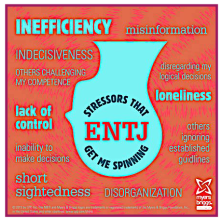
Become STRESSED from situations shown in the illustration.
ENTJs believe the source of their distress is totally outside themself, so they’re quick to blames others for their problems. They see people as needy & illogical, & systems or organizations as inefficient & hindering. They think everything & everyone is holding them back, afraid of being crushed underfoot, so they feel compelled to take matters into their own hands & set things right.

This makes them controlling, stubborn & insensitive to the delicate human element – which includes people’s emotions, ideals & limitations. Feeling increasingly stuck in a frustrating situation, ENTJs will feel out of control & act on gut impulses – such as physical & verbal violence, manipulation, sexual addiction….

• Hate: Being wrong, close-mindedness, failure, immaturity, not being listened to, people who are ignorant or won’t work together, having to handle something with kid gloves. Someone getting into a position of power over them who is really dumb. Asking for Help, because they’d rather do it their own way

Don’t argue with ENTJs when they’re holding: you in high respect
• Never ignore them. • Never tell them: I want you to redo everything – this just isn’t good enough.

GROWTH
Advice:
There is more to ‘stupid people’ than you think.
ENTJs live in the dog-eat-dog world (often of their own choosing), driving themselves strongly, so they unfairly expect the same from others, intimidate people with their take-charge attitude.
They often overlook the contributions of others, ignoring the emotional needs of the people who implement their plans. To soften their harshness, they need to cultivate a confidant or small group of trusted supporters.
Also, playing games in their personal life is a waste of precious time. Finding the right mate may not be easy, but worth the effort. Until then, it would benefit them to get involved in something altruistic or ‘spiritual’ – to cultivate empathy & patience.

ENTJs need to accept that life’s imperfections & everyone’s subjective experiences (emotions) – are normal & natural. Logic is not the answer to everything, so insisting on it only creates an irrational, distorted worldview, causing frustration & disappointment.

ENTJ Relationships (More….)
You enjoy & are energized by stimulating interactions with people. You’re seen by your partners & friends as decisive & fair

• Thrive in any situation that : has shared long-term goals (More…)
• As a Friend, you’re the who’s always commenting on everything that everyone does  • Annoyed when: someone’s not very good ‘at life’

ENTJ parent, child of ENTJ, ENTJ child

• Still single because: you’re too busy building your empire
• Unhealthy behavior: plant a keylogger to track your lover’s texts

Show interest by : Being hyper-critical 😦  (cleverness??)
Show Love : You give time & attention, offer advice & help, help them plan
• You want to hear: I’ll follow you

• You’re attractive/sexy because: you’re usually charismatic, calculating & confident in thought & deed – knowing what you’re doing, & pursue goals without second-guessing yourself. It makes others feel safe.

• You should DATE someone who : you can take care of & teach them how to be more practical. But also someone who can keep your ego in check, who helps you get in touch with a wider variety of emotions, & can teach you to be more sensitive to other people’s feelings.

• To attract you, someone needs to : have a strong character but not stronger than you. Who will assure you that being with them is a low-risk investment that will yield a sizable emotional return.

• Some Famous ENTJs: Presidents FDR & Nixon. Al Gore, Margaret Thatcher.  Harrison Ford, Steve Jobs, Dave Letterman, Whoopi Goldberg, Sigourney Weaver

NEXT: ENFP

MBTI Type – ENTP


PREVIOUS: ESFJ

SITE: ‘How each type handles feeling Ashamed’


EXTROVERTS (EX)

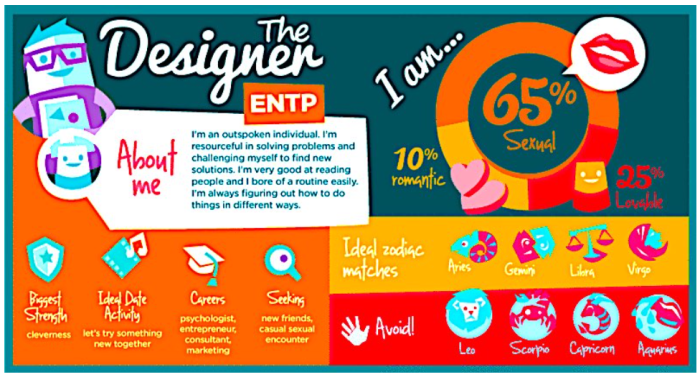
ENTP – The VISIONARY / Originator /Debater
E-Intuitive-Feeling-Perceiving

Most INVENTIVE  – “Explosions maker ”
• 2.4% females, 4.0% of males

NATURAL
GOAL: To invent.  
ENTP’s are ‘idea people’ – resourceful & mentally quick, good at many things – upbeat visionaries who value knowledge, understanding & possibilities. They can solve problems creatively & in unusual ways, because they see connections & patterns, able to spot & capitalize on new opportunities.

They enjoy developing strategies, but are more interested in generating ideas & options than specific actions. They get excited about new ideas & projects, but tend to neglect mundane parts of life – bored by routine

They like people, & make interesting company, good at reading others, intuitively understanding them & situations. Generally alert, outspoken & assertive, they may be into one-up-manship – fluent conversationalists who enjoy debating issues & lively verbal sparring.

They’re: charming, eccentric, flexible, given to brinkmanship & testing limits, ingenious, innovative, theoretical, undisciplined. They enjoy arguing both sides, loving challenges. And not all want to debate every single thing. (More… )

Hidden Side
ENTPs are probably the least self-aware of all iN types. They seem ‘non-committal’ to people who don’t know them, because they’re already so committed to someone or something that it keeps them from sticking with a new possibility long enough to get anything from it.  A bit like a fish struggling to get away, only to be reeled back in over & over, not realizing it’s attached to a hook. Also, contrary to popular belief, they’re not reckless, even when involved in what seems like reckless activities, since they’re extremely cautious in how they go about it

• Life’s Purpose: Find what’s possible in what seems impossible
• Their Law: You shall always order pizza with double cheese
• They Comfort others by saying: Come on – there’s got to be something that’ll cheer you up!?

• They Say: I’ve figured out that these rules aren’t doing their job – let me explain…. I value adaptability & innovation. All’s fair in love & war – fight me!
Communication: They’ll start the conversation & probably end it if they don’t like the way its going.  They should stop talking too much.

Weaknesses:  Don’t like practical things, hard to focus, insensitive, intolerant, very argumentative, too uncommitted, too unrealistic
Manipulate: Always have a backup of convincing bull— when they’re called out on their convincing drivel.

Paradoxes: Eccentric & narcissistic. Everything planned & nothing solidified.
Judge people: by their ‘smarts’.   • Fear: Not understanding things
• Are Judged for : making others feel stupid

Become STRESSED from situations shown in the illustration.
ENTPs become so focus on possibilities/options, they don’t DO anything. They can get flighty, over-concerned with personal freedom & how other people’s wishes might threaten it. They act impulsively, rationalizing their whims & inability to stick to a project or commitment by saying they’re avoiding entrapment

As internal pressure increases, ENTPs tend to go against or ignore rules, assuming these don’t apply to them. At the same time they unconsciously rely on others to provide them with stability & to do the chores they hate.

Interpreting others’ dissatisfaction with them as manipulation, they reject any responsibility, being intolerant & unpredictable. They’ll only do as they please, refusing to limit their options or follow through with obligations.

• Hate: Growing old. Hiding their power level, ignorance, objective morality, not being listened to, rules. Being written off for being too unorthodox. Anyone being very controlling, ignorant or close-minded. Asking for Help, because they’d rather do it their own way

Don’t argue with ENTPs when they’re holding: back their thoughts
• Never dismiss them.  • Never tell them: You shouldn’t always give your opinion, because you’re usually wrong

GROWTH
Advice:
Just because you can get away with it doesn’t mean you should.
They’re visionaries, but tend to avoid making decisions, & can get excited about grand impractical ideas, not do-able because of limited time or resources.  They challenge others & their ideas too much. They have a way of bringing others in on their vision, but that are unpredictable & unstable.

ENTPs are like a living tornado. While it may be in their nature, everyone they’ve left behind in the wreckage of their adventures – could use an apology.  If unwilling to apologize, the ENTP should find ways to clean up their mess with people in their life now by being counted on 100% from now on, & showing appreciation.

ENTPs can change dysfunctional patterns by assuming responsibility for the situations they create & for how they treat people they deal with. By acknowledging their importance in the larger scheme of life, they become more focused & self-disciplined, able to inspire others & offer consistent, trustworthy leadership.

ENTP Relationships
You enjoy a good debate, your conversational style can be challenging as well as stimulating. Your partners & friends will see you as energetic & lively, & independent

• Thrive in any situations that are: Dynamic & constantly evolving (More…)
• As a Friend, you’re the one who has a new hobby or interest every week
• Annoyed when: someone tries to makes you feel stupid

ENTP parent, child of ENTP, ENTP child 

Still single because: you consider trolling a form of flirting
• Unhealthy behavior: Only express emotions through memes, (indirectly)

Show interest: try to ‘prove’ you importance by arrogance & arguing
Show Love: You’re attentive to their needs, motivate with fun ideas & activities
• You want to hear: I disagree with you

• You’re attractive/sexy because: you’re charismatic, novel & witty – a flame people are drawn to. You’re usually smooth, knowing how to persuade. & your sharp, piercing humor is a big draw.

• You should DATE someone who : can stand up to your strong will, who has their own clear sense of purpose so you can’t overshadow them. Someone who is always willing to grow, & wants to grow with you.

• To attract you someone needs to : be able to challenge your ‘logic’ & not fall for your manipulative tactics

• Some Famous ENTPs: Alexander the Great, Presidents – Thomas Jefferson, Teddy Roosevelt. Julia Child, Rachel Ray, Alfred Hitchcock, George Carlin, Céline Dion, Tom Hanks

NEXT: ENTJ

MBTI Type – ESFJ


PREVIOUS: ESFP

SITE: How each MBTI type shows affection


The EXTROVERTS (EX)

ESFJ – The CAREGIVER / Supporter / Provider/ Consul
E-Sensing-Feeling-Judging

Most HARMONIOUS  – “Popular friend”
• 7.5% males, 16.9% females

NATURAL
GOAL
: Harmony, Cooperation = best accomplished when everyone follows the same set of rules. . ESFJs are generally popular, sociable & outgoing. For example, in High School, they take the spotlight & set the tone, such as cheerleaders & quarterbacks, who help lead their teams to victory & fame. Later in life, ESFJs continue to enjoy supporting friends & loved ones, organizing social gatherings & doing their best to make sure everyone’s happy.

Their clear set of values are related to the external world (family & community) rather than about their inner self. Feeling a strong sense of responsibility & duty, they value tradition & security, with a desire for things to be pleasant.

With a strong wish to be liked, they tend to put the needs of others before their own. They’re interested in being of service, but need positive reinforcement to feel good about themself. They’re conscientious, good-hearted, cooperative & supportive. Gifted at making others feel good about themself, they understand what people need & to be appreciated for their contributions to society.

Re. projects & plans, they take time to collect necessary facts to help them make decisions, & enjoy creating effective procedures. Are extremely organized, with a well-developed sense of space & function.

They’re: Accomplished host/hostess, dedicated, empathetic, friendly, gracious, respectful, shallow. They live to please. And not all are gossipy. (More…)

Hidden Side
Usually kind-hearted & well-intended, ESFJs are not warm & fuzzy – because they try to ‘love’ people before they see if they actually like them. Of all the ESxx types, they’re the biggest nerds, & gravitate to Enlightenment Era ideals. They can also be great pranksters, because they’re clever & love to get reactions from people.
«
Life’s Purpose: Bringing together those who are apart
• Their Law: “You shall always take care of your friends
• They Comfort others by saying: I’m here to help you feel better, so let’s get started

• They Say: I’m loyal to people, institutions & causes I believe in. We’re all fiends here – there’s safety in numbers. I’ve bent over backwards to fulfill all the rules.
• Communication: They’re so friendly & inviting – like a mom-friend – that people love talking with them.  They should stop talking about their sorority or fraternity

Weaknesses: Inflexible, sometimes too needy, reluctant to innovate or improvise, take things too seriously, think they always know what’s right, too selfless, vulnerable to criticism, worried about their social status
Manipulate: To make themselves ‘interesting’, they gossip about the back-story of people they don’t know

Paradoxes: (Un-developed ESFP) Friendly & ‘difficult’. Take ‘5 minutes’ to gather everyone – for a ‘1 minute’ group project
Judge other people: about their selfishness  • Fear: Of isolation
Are judged for: caring too much what others think

Become STRESSED from situations shown in the illustration.
Under stress ESFJs usually keep their inner conflicts & upset out of public view. They’re terrified of being judged or criticized by others, but can be highly intolerant of others’ behaviors they judge as inappropriate. When they feel used & unappreciated, their resentment leads them to rash, thoughtless actions that can damage the very relationships they care so much about.

As frustration increases, they complain, manipulate & go behind people’s backs to make decisions for them – that benefit themselves much more than for the other. They rationalize their insensitive behavior by being convinced their actions are the right ones for solving problems.

• Hate: Being disliked. Insensitivity. Know-it-alls. Lack of community. Selfishness. Anyone who hurts other. People who don’t listen. Asking for Help, because they think they’ll burden others. Someone suggesting a lot or ridiculous ‘novel’ ideas – that obviously won’t work – while the ESFJ is trying to make a plan.

Don’t argue with ESFJs when they’re holding: a Frying pan
• Never: Abandon them.  • Never tell them: This is all your fault

GROWTH
• Advice: 
Remember that what you say about others reflects on who you are.
While ESFJs are good at making friends & being popular, unfortunately many are also prone to gossiping.  When making decisions, they can be overly influenced by what they think others want, & so can have trouble adjusting plans when faced with unexpected changes or opportunities.

They risk being too accepting of -or- deferential to those in charge.
ESFJs can help themselves by accepting that they can be loved for who they are, rather than what they do for others, & that they don’t have to fulfill everyone else’s wishes. They need to define who they are & what they want, apart from how others see them or want them to be.

ESFJ Relationships (More)
Because you‘re highly attuned to your partners’ emotional needs & concerns, mates & friends see you as responsive & persuasive

Thrive in any situations that are: old-fashion-romantic (More…)
• As a Friend, you’re the one who can be counted on for advice on almost everything.
• Annoyed when: someone won’t go anywhere with you

 ESFJ Parent, child of ESFJ, & ESFJ child

Still single because: You’re still in love with your ex
• Unhealthy behavior: Over-react when your S.O. forgets your anniversary

• Show interest by: Bragging
• Show Love:
You lessen their stress, motivating with affectionate pep talks
• You want to hear: I need you

• You’re attractive/sexy because you’re: warm & generous, have a need for beauty & harmony, creating a haven of light & love, which are sensual & very desirable.

• You should DATE someone who: CAN live without you but doesn’t want to. Who makes you feel appreciated because you care. Who doesn’t NEED you, so you can focus on our own needs as well.

• To attract you, someone has to: Be popular in their circle of friends, so they can tell everyone you sometimes forget lunch or the need for sleep. Then everyone will be desperate to be the one who’s taking care of you. 

• Some Famous ESFJs: Pres. Bill Clinton, Prince William, Martha Stewart, Barbara Walters, Sally Field, Mary Tyler Moore, Terry Bradshaw, Dr. McCoy of Star Trek

NEXT: ENTPs

MBTI Type – ESFP


PREVIOUS: ESTJ

SITE:  R & L brain horse types

“Horsenalities” – using Types to identify horse temperaments


The EXTROVERTS (EX)

ESFP – The PERFORMER / Entertainer / Demonstrator / Dynamo
Extrovert-Sensing-Feeling-Perceiving

Most GREGARIOUS  – “Dramatic spotlight” • 10.1% females, 6.9% males

NATURAL
GOAL: To conquer. 
ESFPs are Active Types who live in a world of possibilities, drawn to new experiences, since they view the world as a stage.  They’re playful & love being the center of attention. Excellent team players, they’re focused on completing tasks with the most fun & least discord. Traditional schoolwork can be hard, since they don’t like theory or impersonal analysis, but will do well when a subject interests them, or when they see its practical relevance.

ESFPs love to talk to people & about people (endlessly), & are some of the most colorful storytellers. But annoyingly they can jump from thought to thought in mid-sentence. And they love anything / everything new.

They’re also interested in being of service, great at working together with others to get things done, making things more pleasurable for others by their own enjoyment. They have well-developed common sense & practicality (S). They’re often in the role of peacemaker because of their warm, sympathetic & tactful nature (F). Rarely following convention, they find creative ways to help, being especially good at mobilizing people in crises. (More….)

• They’re : accepting, colorful, daring, generous, optimistic, persuasive, reckless, sociable, spontaneous, theatrical.  But not all like to perform.
They – cut thru red tape, share readily, juggle many projects, love surprises«

Hidden side
Of all the Feeling types, ESFPs often have the most trouble dealing with emotions – not good at facing their own psychological issues because they tend to minimize problems. However, their Feeling side does shows up – in their genuineness – not playing games with others’ feelings or pretending to be someone they’re not, in order to be liked. Their natural confidence is usually enough to win friends & influence people.

Life’s Purpose: Making lively that which has become dull
• Their Law: “You shall always have fun
• They Comfort others by saying: I hear there’s a really good karaoke bar in town

• They Say: I enjoy the good things in life – physical comfort & happy times.  Seize the day. Is there a fine for breaking the rules? OK I’ll pay that. SURE, but I can’t physically calm down right now!
• Communication: They’ll talk to anyone & everyone, as long as they feel the other person isn’t too intimidating to approach.
They should stop talking about partying.

Weaknesses: Arrogant, conflict-averse, easily bored, impatient, poor long-term planners, over-sensitive
Manipulate: Everything has to be about having fun. Just went bankrupt? Not to worry – let’s go out, get drunk, find some ‘entertainment’….

Paradoxes: (Un-developed ESFP) Exciting & visionless. In tune with their environment, & oblivious to what’s really going on
Judge people: by their own values   • Fear: Not being appreciate
Are Judged for: needing too much attention

Become STRESSED from situations shown in the illustration.
Under stress, ESFPs need space to figure things out. They’ll get overwhelmed by ‘downer’ thoughts & projecting negative outcomes. First they’re likely to feel depressed & disinterested, with diminished physical & emotional energy. Then become self-absorbed & indifferent to other’s needs, finally leaving their current situation altogether in search of a whole new alternative.
As psychological pressure increases, ESFPs can lose their individuality by acting flighty & superficial, wanting instant gratification, & ignoring the consequences of their actions. Others will see their unpredictability, as they indiscriminately go for what’s popular or try to fit into their environment, which damages their credibility.

 Hate: Boundariesbeing judged, co-dependent or lonely, lack of excitement. Not being able to express themself. People asking them “But, why?” to everything they say. Anyone talking about their life in great detail – or worse, drone on & on about it at a social gathering where the ESFP just wants to relax.
Asking for help because it makes them think they won’t be able to learn it

Don’t argue with ESFPs when they’re :  holding a Celebration
• Never: Belittle them  • Never tell them: I don’t like you

GROWTH
Advice: Don’t fall for sweet words. Look for ‘right’ actions.
ESFPs are the life of the party, but need to find healthier ways to have fun. It’s important to say ‘no’ to pointless experiences, make wiser choices & try not to jump in impulsively, or they’ll likely to being taken advantage of. It’s best to stick to those who really care about them, whether they’re feeling happy or sad.

ESFPs can get easily distracted, not always finishing what they start & so have trouble meeting deadlines. It will help if they focus on a purpose that satisfies their inner values, figuring out their own priorities & what really matters to them, ignoring current trends.

ESFP Relationships (More….)
You love life, enjoying food & clothes, animals & human companionship. Partners & friends see you as supportive, fun-loving & spontaneous

Thrive in any situations that are: exciting & exploring (More…)
• As a Friend, you’re the one who gets excited by everyone & everything.
• Annoyed when : someone’s a total buzzkill

ESFP parent, child of  ESFP, ESFP child

Still single because: it’s what you want to be
Unhealthy behavior: Keep complaining “You don’t love me!”

Show interest by: Making a complete fool of yourself – but in a cute way
Show love: You listening to them warmly, paying attention to practical needs
• You want to hear: I notice you

• You’re attractive/sexy because you’re : radiant, glowing with vivacity, with an added earthy ‘I know what I’m doing’ vibe. Your inner strength & pure willpower are very attractive & admirable

• You should DATE someone who : can handle your spontaneity & let you be yourself, but can keep you in line. Who can help you take things more seriously & organize your sometime messy life

• To attract you, someone needs to : look good, make it clear they’re available & then wait a while. Your natural ‘people curiosity’ will eventually drive you to go after them

• Some Famous ESFPs: Adele, Arsenio Hall, Deepak Chopra, Goldie Hawn, Janie Foxx, Marilyn Monroe, Tony Robbins, Stephen Spielberg

NEXT: ENTJ