Re. ACRONYMS

me typing

 PREVIOUS:
Multiple Intelligences – Spiritual, Part 6


Dear Readers,

Thank you for your interest in this blog & your continued support.

From time to time I have received objections to my use of acronyms & abbrev.

I would like to offer some thoughts about it:

✤ In the past 10+ years I have written & published over 1,350 posts! I have also written many more that are in the pipeline

✤ Each series of posts (by topic) takes many, many hours, & often weeks, to put together. With my readers always in mind, I go over each one 5-10 times to insure they are clear, logical & the best I can do. It’s inevitable that occasionally I’ll miss something, but Perfection is never a goal!

✤ For each individual post much time is spent researching relevant articles, (listed near the top of the page & throughout), as added-value to the topic. This includes noting references to info from other sourcesdoing researchscreen-shot-2017-02-07-at-5-10-52-pm

✤ I also take hours & hours to comb thru images to add flavor & clarity to each post. In many cases, when I can’t find what I want, I take yet more time to combine up to 6 images into the scene that fits the text

✤ I have rewritten many old posts correcting or revising when necessary, & breaking up the earliest ones that were originally too long

✤ I recently revised all the ‘sitemap‘ lists by year (2010-2016) to group topics together that were written at very different times, which also means going thru over 500 of the posts to re-set all their pub dates, as well as all the relevant links to other posts!

✤ Sitting at the computer for hours & hours & hours to do this work is my great love, but I’m a senior (now 77) w/ Fibromyalgia & other physical issues, making the task quite tiring. So I try to find ways to make my life a little easier, which includes a few shortcuts

NOTE: This is not the only place you’ll find such shortcuts, used mainly with phrases that are often repeated, as in my posts.
You may have seen scientific, medical & other type of articles which use acronyms, as well as in AL-Anon (ODAT, ACA, HP….), & psychology (PTSD, MBTI, NLP, MMPI….), medicine (MRI, EKG, CAT scan…..), in everyday life  (BLT, FYI, ASAP, VIP….)

MY REQUEST:willingness??
Since I have put so much effort & care into this work, would you be willing to put a little extra effort in as well – to learn the acronyms?

Of course, it’s fine if this doesn’t work for you.

Thank you,
Donna Marie

MBTI – e & i INTUITION Style (2a)


PREVIOUS: e & i Sensing, 1b

SITEs: Ns are smarter than Ss – includes IQs of famous people, & functions by %

iN-P : Catalyst + Change
iN-J : Visionary+Independent
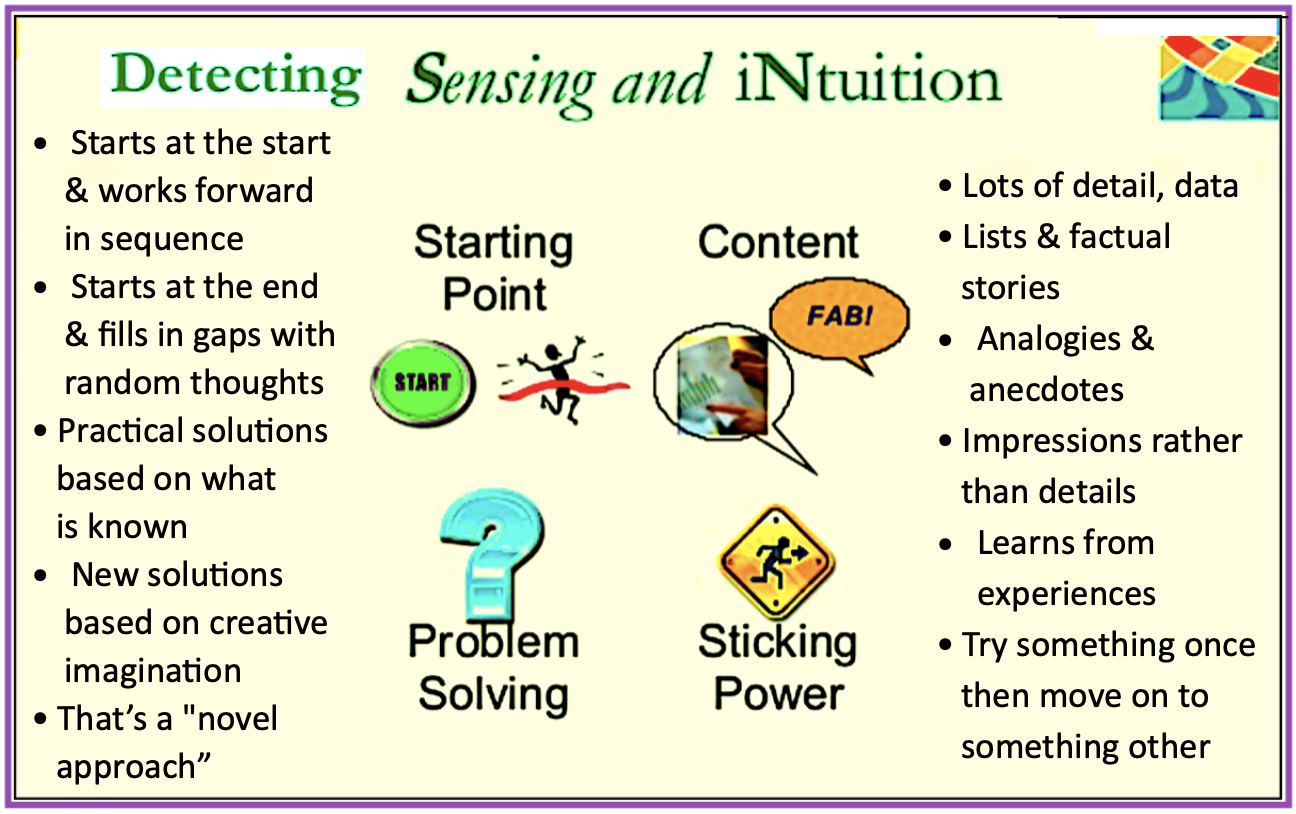
iNe : Detective Patterns
iNi : Existenial Intel.

Inner dichotomy STACK Preferences (cont.)

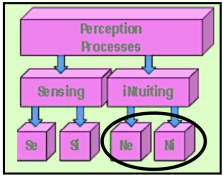
A PERCEIVING Function
N = INTUITION (Wisdom)
N-types need to think things through.  They gathers data through the world of ideas. Info is stored in abstract form, as concepts instead of details. Ninterprets the meaning behind info received. EXP: Determines the meaning behind the movie Inception.

Ne – Extroverted INTUITION, directed outwards
As DOM : ENFP & ENTP  // As AUX: INTP & INFP
Nicknames: Exploration, Pattern Recognition of the Actual Present

Spot by:  Seeing Possibilities & connections in the external world.
Trusts flashes from the unconscious, which can then be shared with others

Q: “What could this be or is connected to?”
Potential STRENGTH: innovative, visionary
Potential WEAKNESS: indecisive, jumps from thought to thought

Basic Desire: See all possibilities, make cross-disciplinary connections

Ne perspective: Exploration, Possibilities – “What will happen 20 years from now?”.  Ne is about exploring the world of ideas, in multiplies possibilities & theories. Looks for what can be gathered from info & then expands on it in the environment. Wonders ‘what could be’, SO – determines that the movie Inception has many possible, unknown meanings.

• Ne Dom types experience bursts of high energy, followed by periods of being reclusive
• Ne Dom types bore quickly, & almost always have a new project in the works
THEY:
• are quick-witted, gaining energy by debating ideas, & enjoy discussing possibilities most of all
• want to explore every side of a given situation, & are more likely to play ‘devil’s advocate’ than other types
• tend to jump from topic to topic with ease & enthusiasm, but can directly contradict themselves multiple times while speaking
• enjoy using metaphors to explain things – which are prone to becoming more & more complex as they go along, which they love.
• These types usually advocate keeping options open, exploring all possibilities, & taking an unconventional approach to solving problems.

=========================

Ni – Introverted INTUITION, inner directed
As DOM: INTJ & INFJ  //  As AUX: ENTJ & ENFJ
Nicknames: Perspectives , Recognition about Future

Spot by: Having a Singular goal, inner vision. Looks at consistency of ideas & thoughts, with an internal framework.
Trusts flashes from the unconscious, which may be hard for others to understand.

Q: “What is or will be under the surface?”
Potential STRENGTH: perceptive, understanding
Potential WEAKNESS: stubborn about beliefs, but won’t back the up

Basic Desire: See & understand deep truths

Ni perspective: Future, Perspective – “Something’s going to happen tomorrow”.
Ni is about converging a large body of info into insights, answers & theories. It synthesizes internal concepts to predict possibilities, tying unrelated stored info to create new ideas. A way to determine ‘what will be’, SO – determines that the movie Inception has only one possible, known meaning

IMAGE: Like a weather-forecasting stone, able to feel things & then tell what’s about to happen
GIFT: Insight, foresight – able to perceive upcoming changes
Physically
: As Dom – distant eyes, late or awkward smile. Draws on entire mind to foresee

• Everything an Ni Dom type does is deliberate. One can get the sense they’ve carefully (but covertly) planned out their actions & words
• Ni dominant types usually pause to fully take in and consider what you have said in conversation before replying.
• Ni dominant types often give off a stoic or “Zen” vibe.

THEY:
• may ask a lot of questions in conversation, which tend to be open-ended I.e. “Can you tell me more about that,” As opposed to, “When did that happen?”
• prefer sticking to one topic at a time, but feel the need to ‘explain around’ it if they can’t get their point across concisely
• may also return to a topic of conversation weeks later, having processed & analyzed what you’ve said more fully
• enjoy talking about future possibilities in a linear fashion, & seem to have a lot of ‘epiphanies’ or ‘realizations.’
• These types usually advocate thinking through options carefully, optimizing experiences, always keeping long-term objectives in mind.

NEXT: Thinking

MBTI – STACKS Basics (Part 1)

PREVIOUS: PYRAMID USES –  MISC.

SITEs: • MBTI links  // MBTI’s 4 dichotomies explained 
How each MBTI type Processes Their Own & Others’ Emotions


STACKS
: our ORDERS of PREFERENCE
Once we identify & appreciate our personal Type, we can go deeper into understanding our personality. 
The MBTI is not about knowledge, skills or abilities. Neither does knowing our type (ISFJ, ENTP….) force us to rigidly limit our options. We all have the ability to be flexible to choose & change behavior patterns that are immature or self-defeating, even while our underlying preferences remain the same.

To increase our self-awareness & flexibility, & to better appreciate how others are similar or different from ourselves, the MBTI provides a way to specify the mental faculties which help us make sense of the world.
They’re based on our type, but use only the 2 middle dichotomies, also called Cognitive Functions, which are the ‘heart’ of this typing system.

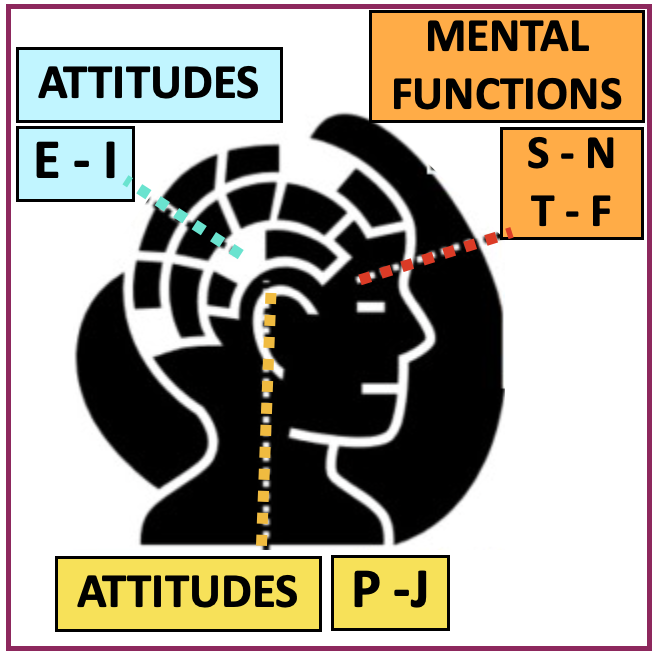
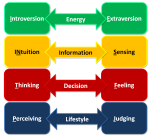
These show how we gather info (S=Sensing <—-> N-Intuition) & make decisions (F-feeling <—–> T-thinking), becoming 8 possibilities:
Extroverted functions (e) : Se, Ne, Te, Fe and
✥ Introverted functions (i) : Si, Ni, Ti, Fi
– combining into 16 STACKS –
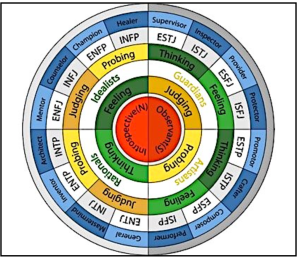
 the 4 dichotomies in specific order for each of the 16 MBTI types.  EXP: Small chart ↗️ shows the Stack for all INTJ people

✳ Our strongest preference is called Primary or Dominant, the next is Auxiliary, then Tertiary & lastly Inferior (weakest). Each Personality Type is referred to by its top two choices. Introverted functions are the ones we use internally, & the extroverted ones are used to interact with the world around us. (Formula for creating stacks and chart of all stacks – in #3c)

PURPOSE: Even though we only have 2 of the 4 choices in our Type (2 center letters), every stack will include all 4, indicating our thought process – NOT our behavior. It tells us the order of our mind’s/ brain’s thinking-steps: how we think, what we think of first, how we solve problems…. The same functions will show up differently in each Type, even the same Type, depending on their orientation (e/i, and j/p)

The order of their importance to us (our stack) comes from our genetic makeup, so it won’t change what it is throughout our life. But how it’s used & to what extent – can be modified or improved if necessary, by ironing out any inherent kinks.
Over the course of our life, different preferences may rise to the top & be used more often, as well as more easily – called Type Development.
EXP: Sometimes a Primary Thinker may decide things using their feelings, a Primary Feeler may make decisions logically, Ps can be very structured, & Js might go with the flow…..

✥ The 2 functions for gathering information (2nd dichotomy) – used to Perceive / see (p) things – are EITHER:
• Sensing (pS), looking for details & current realities
-OR-
• Intuition (pN), seeing patterns, underlying meaning & future possibilities

✥ The 2 for organizing info & making decisions (3rd dichotomy) – used to Judge (j) / evaluate things – are EITHER:
• Thinking (jT), deciding based on principles, systems & logical consequences -OR-
• Feeling (jF), deciding based on harmony, values & consequences to people (MORE re J vs P).

This table shows the distribution of cognitive functions between the genders in a theoretical population of 1 million….. it shows that the most common Perceiving functions are Si & Se, and the most common Js are Fe, Fi & Te.
This jibes with official statistics which identify SPs (Sensing Perceivers) SJs (Sensing Judgers) as the most common types. (in the USA ?)

Knowing our Cognitive Stack can help us TO:
• Explore ways to better develop our career, create or enhance our leadership style, & improve our communicate skills
• Appreciate diversity in working styles, & to understand organizational & team culture – which can improve working relationships
• Develop strategies to solve problems & resolve conflict
• Manage difficult or stressful changes, & understand stress reactions

NEXT: MBTI Stacks basics #2

MASLOW – Transcendence, Level #8 (Part 1)


PREVIOUS: Additional Levels

POSTs: ‘Spiritual Resilience – 1 & 2′


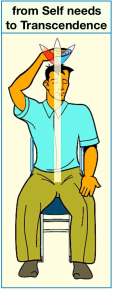
TRANSCENDENCE – Level #8
DEF:
To rise above or go beyond the limits of a situation
▪︎ To triumph over negative or restrictive aspects of something
▪︎ A state of being or existence above & beyond material experience

Most Self-actualization traits involve making everyday life more enjoyable.
Self transcendence (SC),
on the other hand, is not about competing with others for basic (B) needs, but a personal journey of self-discovery. It requires personal effort – the willingness to change – with an awareness that succeeding is a combination of the personal “little I” & the bigger, universal “I”. Mystical experience is a particularly advanced state of self-transcendence, in which the sense of a separate self is temporarily abandoned altogether

As one of the developers of Humanistic Psychology, Maslow had an extremely positive view of humanity – valuing man’s goodness, dignity & intelligence. Spirituality is then mainly about personal development, connecting with other people & the world of nature.

Maslow’s systematic works, like The Psychology of Being, didn’t focus on the treatment of various pathologies (as Freud did), but rather on understanding & defining humans in their optimal state, especially regarding ‘peak’ experiences & self-fulfillment. Ordinary human unhappiness was ‘too easy’ to find. He wanted to encourage the healthy core of people achieve self-actualization, with which the highest spiritual good is realized.

“The fully developed (& very fortunate) human being, working under the best conditions, tends to be motivated by values which transcend his Self…. My satisfaction with achieving or allowing justice…. is equally outside & inside: therefore, it has transcended the geographical limitations of the self.” (1969)

Maslow believed striving for these highest needs is instinctive – beyond self-interest, considering wider holistic principles for the greater good, in service to others, & the pursuit of causes bigger than any individual

He thought Transcenders would be highly religious – regardless of which type, indicating his theory had a broad social application: “Culture is absolutely needed for their actualization, but it can also fail to actualize them, & indeed this is just what most known cultures actually seem to do, & have done throughout history.”

He pointed out that, if successful, self-trancenders often crave peak experiences. Beyond the routine of fulfilling deprivation (D) needs (#1-6), some people have extraordinary deep moments of understanding, love, even rapture, making then feel more alive, whole & empowered, yet a part of the world. They’re more aware of goodness, harmony, justice, truth….

Peaks are exciting & elaborate situations which become the most important things in their lives – the most precious & validating – their high spots. It could explain why some people gravitate to jobs such as policeman or firefighter, putting their lives at risk for others. (“PEAK” in biz)

Maslow believed such states are mostly emotional & temporary but not always flukes – there are people who can access them easily. He also thought that some self-trancenders may be saddened by realizing that others don’t have such hight moments. While he said that mature people (self-actualized) are most likely to have peak experiences, he felt everyone had the potential.

From Students’ Peak Experiences (1985), James Polyson found that most :
— occurred during athletic, artistic, religious or nature experiences
— during intimate moments with a friend or family member….
— when students achieved an important personal or collective goal….
— overcame some adversity or danger — or by helping someone in need

💙 However, Maslow eventually noted that with age, the intensity of the highs gives way to a gentler, more lasting state of quiet between the “orgasmic peaks of the mystic gone wild”. This he called high plateau experiences (more mental), which can be cultivated through conscious, diligent effort.

At the end of his life he cautioned against the ‘‘Big-Bang’’ theory of self-actualization, recognizing the need to value ‘patience for the awesome elements in ordinary existence’, combining miraculous & normal consciousness (Maslow, 1970), a state said to be the true & final goal of the mystic’s endeavors

“With today’s ‘fast food spirituality’ there is a pressing need to understand both the positive & negative poles of self-transcendence. Ferrer (2002) points out that Western transpersonal psychology’s emphasis on experiential processes & peak states…. have often neglected the proper preparations, maturity, & ethical scaffolding long-standing spiritual traditions usually provide” (Nicole Gruel, AU)

NEXT: Transcendence  #2

Use ‘THINK’ instead of ‘Feel’ (Part 2)

PREVIOUS: SAY Think, not Feel #1

27 POSTS: “Emotions….” (in 2011 + Jan 2012) – in case you  mistakenly think Emotions are being minimized 😱


THINKING
The human brain is built for language – mainly on the Left side – the mental tool that allows us to formulate ideas, & the cognitive rules for linking them together. Being able to think clearly & accurately needs a healthy, well developed top part of the brain.
The frontal lobe, particularly the prefrontal cortex, the area furthest forward – is involved in sophisticated inter-personal thinking skills. Both left & right sides are used for interactive social competence, & the mental skills needed for our emotional well-being.

USING Accurate LANGUAGE accurately
For members of 12-Step Programs or faithful practitioners of a spiritual path,  Spiritual Principles tell us to be honorable in all our ways – as much as humanly possible. One of those ideals is to be Trustworthy, & one way to do that is to be sure we “Say what you mean & mean what you say – but don’t say it mean.”

This allows others to depend on us, without being co-dependent, as long as we’re speaking from our Truth. To do that implies that WE:
• have internal permission to find out who we are, a day at a time
• are capable of & willing to be honest with ourself about what we truly think & feel, AND can tell them apart
•  have the right kind of language to figure those out, & then express them

Mental vagueness makes knowing that impossible, & inaccurate speech creates misunderstanding, so we stay isolated, & hurt others.
Instead, we need the right kind of info about such things as :
HOW TO
⚬ deal with disagreements & conflict
communicate emotions
⚬ develop healthy boundaries, to know when to talk or not
⚬ distinguish between rescuing & helping
⚬ say things from the Adult ego state instead of from the WIC or PP
⚬  talk to ourself with kindness & patience
KNOW :
⚬ what level of communication we’re dealing with ↗
⚬ who we’re talking to (sick family, loving mate, dumb boss….)
⚬ what’s appropriate to say in various situations, like when it’s ok to get personal, & when we’re over-sharing

🌟 GROWTH
Consciously, consistently practice saying “I THINK…..” instead of “I feel…” will greatly help to figure who WE are, contribute to our ‘sanity’ & improve our connection with others. Only use FEEL if deliberately meaning to refer to body sensations or emotions.

The easiest way to know the difference:
❇  Sensations & Emotions are ONE WORD each, as many as we are experiencing at the time: “I feel tired & achy, but relieved & happy / I feel hungry but I’m too excited to eat / I’m so jumpy – I can’t relax…..”

✳ Thoughts are always MORE than one word (any sentence). “I think it’s time to ask for a raise / How long do you think it’ll take? / I think you’re a pain-in-the–!”…..

NOTE: Thoughts —-> lead to —-> emotions (Es), but we rarely actually say the Es in conversation. “I feel like you don’t like me” does not actually state any emotion, although it’s implied .
💡 More accurately : “I’m angry / sad / frustrated / lonely / afraid…. because it seems (I think / observe) that you don’t like me”

And we don’t have to be limited to the word ‘think / thought’. Here are others that fall into the M category of PMES, ( Mental = cognitive)

• “I assume you know what you’re doing”
• “I believe it’s time to end this affair”
• “I concluded she was angry at me”
• “They didn’t consider that a legitimate option”
• “I’m convinced my neighbor is spying on me!”
• “I figure they’re going to be half an hour late as usual”
• “I gathered this is your favorite restaurant”
• “I can’t imagine anyone being willing to help me”
• “I know now that I can trust you”

• “Did you notice the way she were looking at you?”
• “I observe that he never finishes anything”
• “I can’t stop obsessing about that mistake I made”
• “I’m projecting that no one at the party will like me”
• “Don’t even speculate about that!”
• “He suspected them of lying to the cops”
• “Did you think I was insulting you?”
• “I keep wondering how soon I can leave – politely!”
• “Did you understand that lecture?”

NOTICE – they’re all sentences without any E words

EXERCISE: Write out (T) how you’d (incorrectly) say any of these sentences using “I feel that…. / I feel like….” EXP: “I feel like I can trust you now”

Regularly including one of these THINKING words ⬆ in your sentences – instead of FEEL –  is a hard habit to break, but well worth the effort!

«
PS:
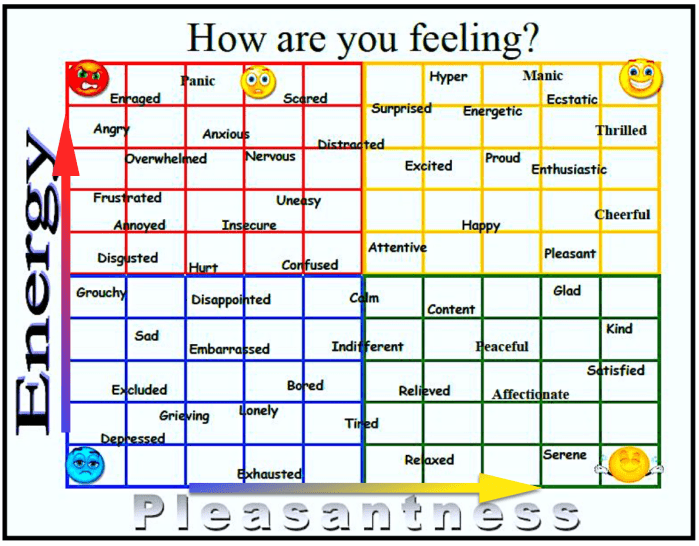
This Chart identifies a wide range of Es, in 4 groupings. See how many you are aware of throughout your day. Stay aware for how they’re not thoughts.

NEXT:  Al-anon Step 10, #1

ACoAs: PATIENCE vs Co-dependent Waiting (Part 3)


PREVIOUS:
Co-dep vs Patience #2

POST:  S & I: Healthy….(Part 3) Process, point #3.


HEALTHY PATIENCE (cont.)

Real patience :
is based on selfTRUST, an aspect of the True Self , rather than trusting others – too little or too much. This trust is the result of taking care of our needs & knowing what our destiny/ bliss/ passion’ is. It’s being willing to keep working toward them no matter how long it takes or how hard the path is to get there, believing we can last out the tough times.  This minimizes or eliminates envy & jealousy – because we have the right & power to provide for ourselves, so that needing to be Patient is not so frustrating

• requires a decent handle on boundaries, having learned what’s ‘my stuff’ vs. what’s yours – which can only come from knowing oneself well (inventories, Meetings, therapy, dreams, healthy adult mirroring….). Then patience is waiting to see what others can or are willing to do for themselves

• is working toward appropriate (do-able) goals, step by step, knowing it takes time to accomplish something worthwhile, knowing that some things take longer than others. (College was 4 yrs, meeting husband-to-be took going to singles dances for 7 yrs, Recovery – ongoing for the last 40 yrs!)

Real patience :
• comes from using our intuition, intelligence & experience to know when to “hold ’em & when to fold ’em” – letting things develop naturally
— Sometimes we just need to wait for a better (human) time, for a more appropriate location or person, for more emotional healing, for H.P.’s timing
— Sometimes we need to admit when something we want is not healthy, & let go of the original desire/demand, OR know when something is simply not possible – the way we want it – & then look for alternatives or change the goal

• is having realistic expectations – knowing how things actually work in the real world. This includes accepting that most setbacks are temporary.
EXPs: starting an online biz can take 3-5 years to become profitable
— calling a company for help or info usually takes 3-5 calls – long waits, no help, calling back, going thru several people – before getting THE answer or appointment
— having to wait for a physical injury to heal completely
— waiting in a line of any kind, a time to multi-task (context-switching, #3)……

• knowing what triggers our impatience – old childhood buttons from things that were done to us over & over – & still bother us, a lot!  Patience is a virtue because it requires self-control, so we don’t ruin things for others by anxiety & selfishness

It means accepting that we:
• can’t force an issue or project to go faster than possible – called process.   Planning, evaluation & measurement all take time
• don’t expect mates, children friends…. to be in the same place we are at the moment. Instead, we can continue our own life based on the principles of the Program (like Step 12, attraction not promotion) – allowing others their own timing
• not demand to be heard or understood in all situations & by everybody (stores, banks, service people…. loved ones…..)

BENEFITS
🍀 Reduces stress, minimizing anger & overwhelm
🍀 Develops understanding & compassion for others because we know what it takes to deal with life’s ups & downs
🍀 We make better decisions, avoiding as many mistakes, by taking the time to assess each situation, see the big picture, weigh the pros & cons, then choose the best option at the time

With patient, persistent effort, using everything in our Recovery tool box, we can apply the Serenity Prayer correctly & wrap ourself in love-energy as we wait for good things to come – while enjoying what we already have!

NEXT: MBTI – Introvert vs Extrovert BRAINS

MBTI Type – ESTP


PREVIOUS: Introverts vs Extroverts

SITEEach MBTI type as enemy


The EXTROVERTS (EX)

ESTP – ENTREPRENEUR / Doer / Persuader
Ex-Sensing-Thinking-Perceiving

Most FUN  – “Adrenalin junkie”   • 3.0% females, 5.6% males

NATURAL
GOAL: To win. 
ESTPs are adaptable & action-oriented, who like to take a practical approach to problem-solving that will produce immediate results.  They apply common sense & experience to problems, quickly analyzing what’s wrong, & then fixing it, often in an inventive or resourceful way. Living in the here-and-now, they’re risk-takers who live fast-paced, traveling the world. They tend to be bored by abstract theories, impatient with long explanations, & learn best by doing. 

They have great people-skills – friendly, outgoing straight-shooters, & extremely loyal to their peers. Are good at picking up on little clues about others’ personalities & feelings, & can motivate people by bringing energy into situations. They’re not usually respectful of laws & rules if those get in the way of accomplishing a goal. ESTPs leap before they look, fixing their mistakes as they go rather than being idle, but do prepare contingencies & escape clauses.

ESTPs are: charming, confident, crude, fearless, logical, spontaneous, trustworthy, unconventional. And not all are obsessed with sex. 
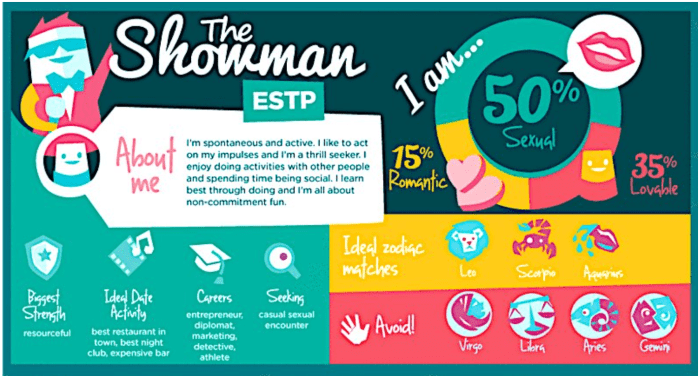
HIDDEN side
Surprising to some, ESTPs value book-smarts & often enjoy conversing with Rational types. They may not grasp ‘heady’ concepts as easily (nor apply them responsibly), but they find philosophical topics stimulating – just another piece of equipment in life’s big playground. While they’re naturally persuasive, they’re not usually interested in corporate & political arenas where they could thrive. Ladder-climbing in organizations doesn’t appeal to them – in fact, many ESTPs cringe at the very idea, so they rarely pursue those career tracks.

Life’s Purpose:  DOing when others don’t
• Their Law: “You shall always live in the moment!”
• They Comfort others by saying: “Alright…..So you’re sad. Why is that?”

• They say: I get more from first-hand experience than from study. Rules are made to be broken – so watch me break them! Life’s either a daring adventure or nothing at all
Communication: They’ll talk whether someone likes it or not – look out world! They should stop talking about ‘nothing’.

• Weaknesses:
Defiant, insensitive, impulsive, impatient, misses big picture, risk-prone, unstructured, contradicting themself
Manipulate: Frustrate others because – one day they’re hung-ho about a life-changing project or promise, then lose interest the next day

• Paradoxes: (Un-developed ESTP) Know they shouldn’t, & do it anyway. Bold & undependable. Think they’re funny, but only to those who are similar
Judge people : on their ‘smarts’  • Fear: Of commitment
Are Judged for: not taking life seriously

Become STRESSED from situations shown in the illustration.
Under stress they act first, figure things out later. They deal with problems & frustrations by going after more & more external stimulation & adventure (similar to EnneaType 7s). When disappointed or restless, they think it’s time to re-create their (lagging or previous) successful public persona. They either find a new audience to charm, or resort to some grand gesture to reinforce their image & make them feel desirable/popular again (Ennea #3)
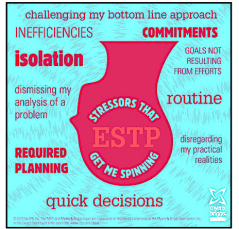
However, internally they suffer from a deep sense of emptiness, so intimacy becomes almost impossible, as they get increasingly detached from true emotional connections. As stress mounts, they get more agitated, chronically anxious, distracted & paranoid, but overactive, frivolous & too concerned with people’s opinions of them.

• Hate: Authority.Asking for help – it makes them feel stupid. Limits. Conventional or monotonous situations. Over-sensitive people. Constantly being asked ‘how they feel’ about things. Forced to ‘tone it down’. Stupid people. When someone wants a heart-to-heart talk just as the ESTP is ready to go out for some fun

• Don’t argue with ESTPs when they’re : holding the door open for you
• Never: Dominate them.  • Never tell them: Nothing you do is very impressive

GROWTH
Advice: Keep your promises, or don’t make them at all.
ESTPs tend to have trouble managing their time, so they can lose interest in long, complex projects. Being so focused on immediate problems will lead to ignoring long-term ongoing issues. They live for excitement!, being the life of the party, thriving on adrenaline!  However, periodically taking some time to shut out the world – & writing down all their adventures – could help to create much-needed balance.

ESTP Relationships (More….) 
Many ESTPs are uncomfortable focusing on, exploring & talking about relationships. They need to take time to consider their true priorities, & to realize the effect their choices have on others around them. When they take responsibility for their actions & acknowledge their importance in a larger context, they become more stable, reliable, & emotionally honest.

You truly love life, immersing yourself in it. Partners & friends experience you as adventurous but also pragmatic
• Thrive in any situations that are: fun & easy-going (More….)
• As a Friend, you’re the one obsessed with that‘ thing’, & will. not. stop. talking. about it!
• Annoyed when: someone never wants to go outside

ESTP parent, & child of ESTP, ESTP child

Still single because: it’s your choice
• Unhealthy behavior: Cheating

Show interest by: Being awkward
Show love: You’re attentive to their comfort, will motivate & boost their courage
• You want to hear: I’m excited with you

• You’re attractive/sexy because: Something about your down-to-earth, hands-on style is tantalizing – you ooze ‘tactile’. It’s hard to resist your passion & will-power
You should DATE someone who : won’t take your occasional stream of b.s. Who’s intelligent & can stand up to your know-it-all attitude. Who can keep you from taking too many risks, but lets you be yourself, & can also keep you excited

• To attract you (men?), someone needs to: Act sweet, wide-eyed, impressed with everything you do. Your ego will respond well to their fuel.

FAMOUS ESTPs: Donald Trump, cowboy Roy Rodgers, actors Eddie Murphy, Madonna, Bruce Willis, Biblical Jacob (OT) & Peter (NT) (More….)

NEXT: ESTJ

Myers-Briggs INTRO – charts (Part 1b)


PREVIOUS: MBTI Intro #1a

SITEs : INFJoe Cartoons

• Each TYPE’s Striving Style 
What makes an extrovert?

REMINDER: When people consistently differ from each other in how they see & interact with the world (different MBTI types), it’s only reasonable that they’ll differ in their interests, reactions, values, motivations & skills.

Our TYPE is Innate, Observable
It can be Influenced
It is not a box, not an excuse
It indicates Preferences, Not skills
It is a life-long Journey
🌈
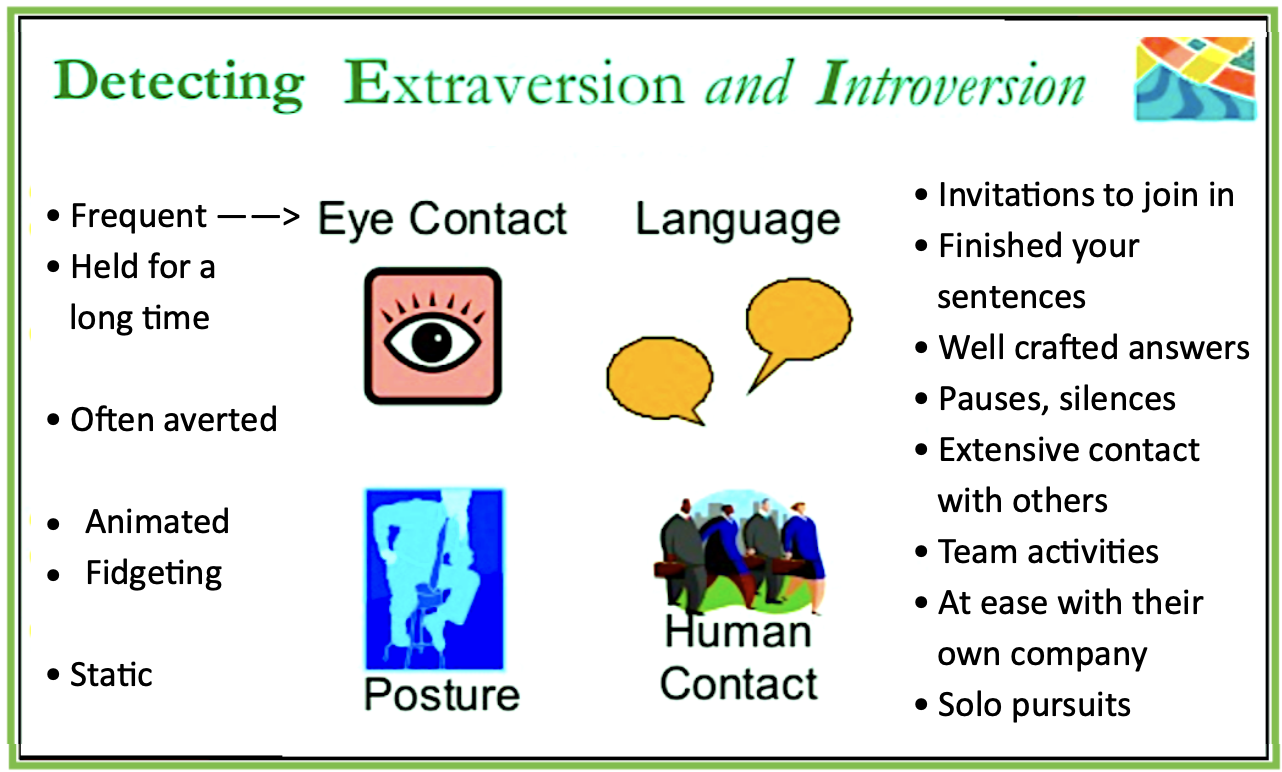
Detecting  PREFERENCES
Level 1
E
= ‘I have to experience life to understand it’
Work:
Stop by to see me. Communication: Talk it out
I = ‘I have to understand life to experience it’
Work:
Do not disturb. Communication: Thinking it thru
«

Level 2
S = ‘I need to work thru a problem to see a result’
Fun:
This was great for the price. Communication: Specifics
N = ‘I see results/solutions to problems at the beginning’
Fun:
This just gave me a great new idea! Communication: Big picture
«

Level 3
T
= ‘I can be insensitive’.  Work :
She has good credentials. 
Communication:
Logical implication
F = ‘I can be too sensitive’. Boss re. candidate: I like him. 
Communication:
Impact on people
«

Level 4
J
= ‘I run my life.  Work:
Glad this is done’
Communication:
Joy of closure
P = ‘I live my life’. Work: I have plenty of time
Communication:
Joy of process
«

«
From SLIDE SHOW
👨🏻‍🏫   re. WORK — The middle two letters of our specific type are the best predictor of career choice. (
ST, SF, NT, NF )
When we’re in the wrong job for our type the job is harder to do, & makes us feel like a failure. Being in the appropriate job/career guarantees success, even when there are things we may not like about it, or if it takes time & effort to ‘get it right’! (More….)
NUANCES (facets)
TEST : The official MBTI typing instrument is made up of 93 questions. It provides the test-taker with the 4-letter code we’re most familiar with (ISFP, ENFJ….), which stays with us throughout life.
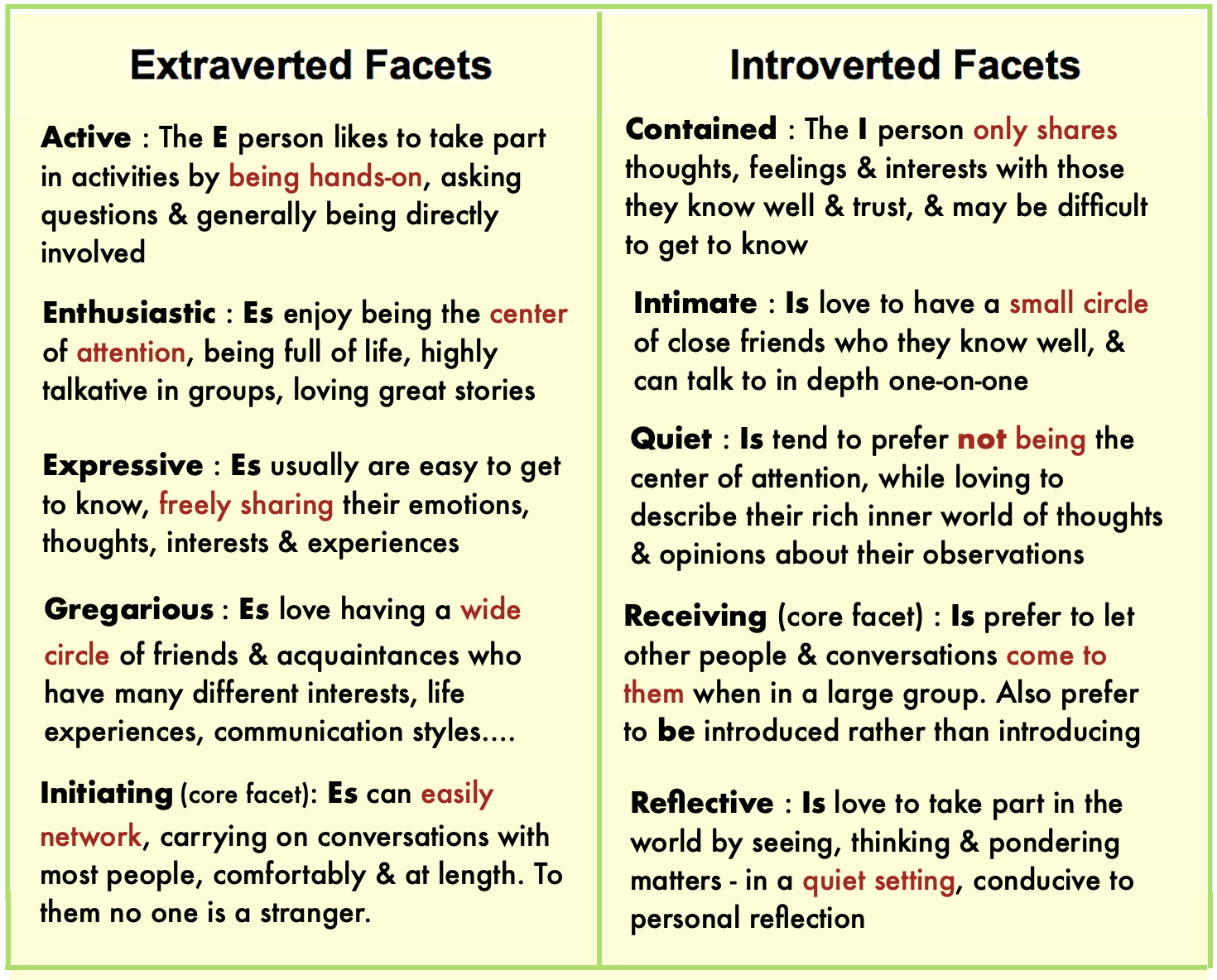
It also identifies where we fall on a continuum of 20 sets of nuances ⬇️, 5 per preference. Using our specific facets puts us in a mid-zone within our type, & allows us to say that — how we act depends on the situation!

EXP: We’re not all typical : some Thinkers are wired to respond with some aspects of Feeling in special circumstances. Some Judgers can be casual when feeling safe (as a P), some Introverts will be gregarious in certain situations (as an E). ….
➤ These possibilities don’t show up in short-form questionnaires

The following CHARTS identify the 40 possible aspects that make up all expressions of personality type, including the out-of-preference/ atypical ones.
Each of us is a unique mixture of our Type’s 20 nuances. It all comes down to brain plumbing.  (more re. Brain in future posts). So, an ESTJ would have 5 Extrovert, 5 Sensate, 5 Thinking & 5 Judging possibilities
EXP:
• You may identify as an Introvert (I), your innate preference, which includes facets normally seen in Is, & some that are outside your type. This means an Introvert could have 4 (I) nuances & 1 usually preferred by Es.

CAVEAT: Popular on-line tests are weak or useless because they condense the # of Qs from the official / correct questionnaire, & also change some of the wording. This leads to homogenizing the outcome. Some people will fit the ‘box’ built into these tests, while others will be slightly off from their pre-set ‘norm’, making the conclusions unreliable. The missing “extra” Qs in the original/ official test, which may seem repetitious, are needed to capture those important nuances of personality type & cognitive function.

ORIENTATION Nuances

COGNITIVE Nuances

  «
MBTE types & D.I.S.C.
(Dominance, Influence, Steadiness, Conscientiousness)


«
NEXT : MBTI INTRO – 2a

Myers-Briggs INTRO (Part 1a)

I‘VE ALWAYS WONDERED why I do things!

PREVIOUS: Psychological Disorders #6

SITEs: M-B: Does it pay to know your type? (includes some MBTI history)
• The Dynamic Basis for Type 

ORIGIN: MBTI is a personality inventory used by psychologists, as well as a tool for self-discovery, made up of 4 dichotomies (8 opposing functions). In yr. 2000, an estimated two million people took the test, making it the most frequently used inventory available. First introduced in 1942, it was the work of mother & daughter Katharine C. Myers Briggs and Isabel Briggs.

It’s based on Carl Jung’s theory of types, outlined in his 1921 work Psychological Types, which said that human behavior follows from an inborn Extroverted (E) or Introverted (I) way of being energized & of interacting with the world. This became the 1st level. (MBTI History….)

*** Jung also identified 2 basic functions of Consciousness
💚 Perceiving: Making decisions – either by Thinking or Feeling (T/F).

👁 Judging: Absorbing info – either by Sensing or Intuition (S/N)

S-N & T-F became levels 2 & 3, which are the core of typing. (MORE….)

Is was Isobel Myers who later listed Judging & Perceiving as separate components, giving us the 4th level. Each preferred function is expressed consciously (T over F, E over I….), while its less desired opposite shows up as behaviors driven by repressed, unconscious parts of our personality (as character defects?) (MORE… )

TOO SIMPLE? At first glance, only looking at the 4 opposite categories (which are on a broad continuum), the MBTI may seem simplistic. BUT – there are many nuances derived from various sets of connections, yielding a valuable range of deeper & more detailed personality insights.

• PREFERENCES: Our ‘mental process’ comes from using MBTI’s 2 middle levels (S-N, T-F), to identify each type’s preferences, from most to least, which form Stacks. The strongest one has the most powerful influence on our personality growth. If allowed to develop naturally, we come to trust this favored style, the Dominant (ENFJ = Extroverted Feeling), & our second most preferred one becomes the Auxiliary (ENFJ = Introverted Thinking).  (More in future posts)

Type falsification: However, too often family, school & culture won’t let us develop on a natural path. EXP: A child who easily prefers the T function will try to make logical, objective decisions, but is made to feel guilty by an F-oriented family for not focusing enough on group harmony & other Feeler values.

So this child grows up devaluing their preferred dominant &/or auxiliary functions, having been pushed to develop other less-natural ones instead. Gradually they’ll ignore & then suppress the ability to trust their inborn decision-making process (T), or not notice & use important T info that could give them throughout life.

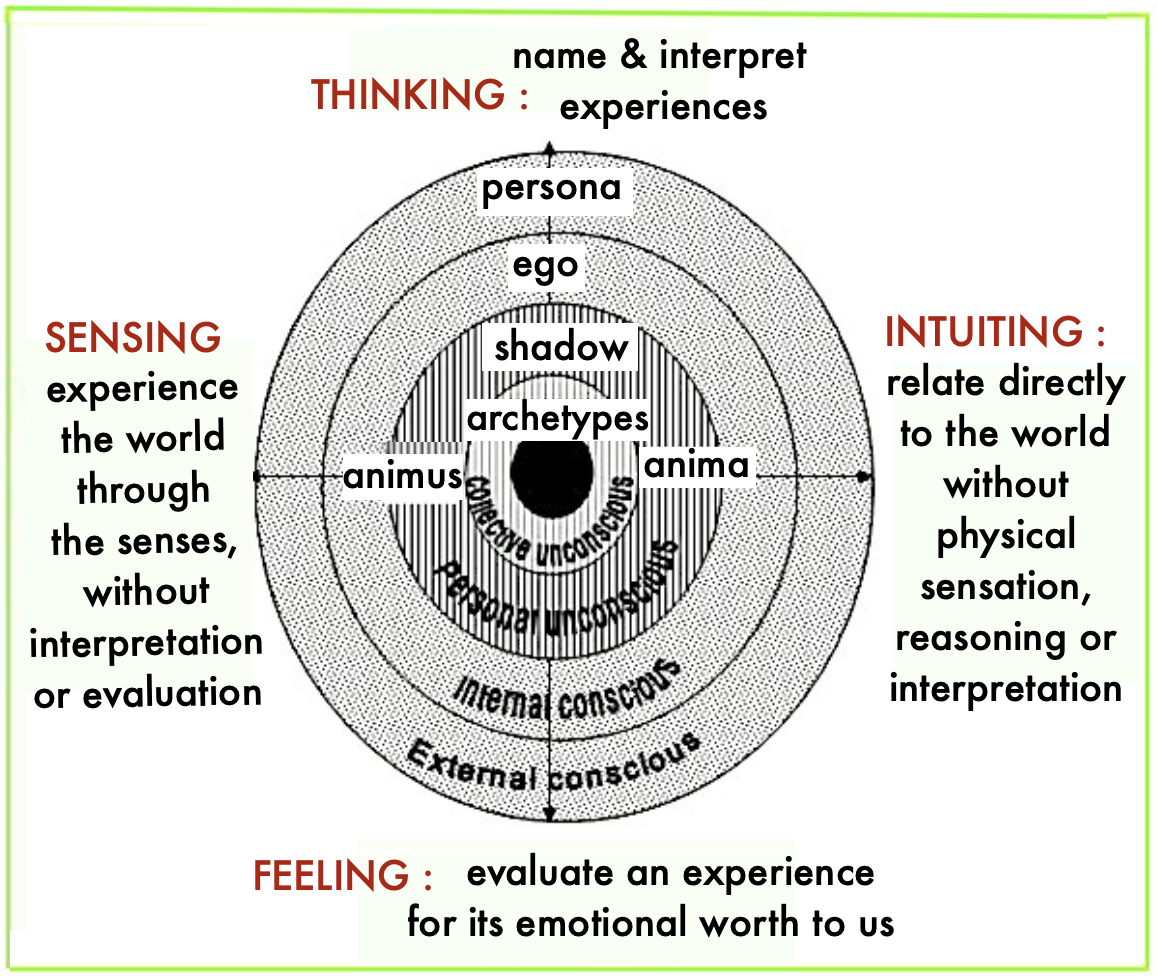
This CHART shows how Jung’s Psyche components generate the 4 functions – from a fascinating article of a Jungian analysis of Shakespeare’s ‘Macbeth’, which includes the False Self, a lack of S & I, the Shadow…..

JUNGIAN definitions
🔇 Introversion – A focus of the ego /conscious Self on ones internal world, which includes the collective unconscious & its archetypes. An orientation to life via “subjective psychic content”.

NOT
isolators, not intrinsically shy or withdrawn, Is are however more comfortable living within the ‘limits’ of their inner world of thoughts, feelings, fantasies & dreams. They don’t like crowds, noise & hub-hub, but can be very talkative & sociable on a one-to-one basis.

📣 Extraversion – A concentration of interest in external objects – whereby the ego/overall personality is mainly concerned with gaining enjoyment & satisfaction from what is outside the Self. Es greatly enjoy human interactions – being assertive, enthusiastic, gregarious & talkative.
NOT : automatically socially adept, easy with everyone or know what to say in very situation. Wounded extroverts are likely to sit on the sidelines & wait to be approached, or hide behind work, activities & authority roles.

🌓 🌗 AMBIVERT – for those of us who straddle the Type fence of choices .  Also see: “The Ambivert advantage”

👂🏾 If you want to know what an Extrovert is thinking, just listen.
👄 If you want to know what an Introvert is thinking, you have to ask them.
Read EXPLANATIONS

NEXT: M-B Intro #1b

Psychological DISORDERS – Psychopathy (Part 5c)

IT’S IMPERATIVE
I know what to look for!

PREVIOUS: Personality Disorders (Part 1)

SITE:  “Grey rocking – if you can’t go No-Contact” (re. NPDs)
* “Grey rock method of dealing with a Psychopath”


4. SOCIOPATHS & PSYCHOPATHS (cont)

4b. PSYCHOPATHS (cont)
(PS) ORIGINPsychopathy is generally considered a combination of genetic & chemical imbalances. Scans of PS brain show the section responsible for impulse control & emotions (compassion & remorse) is not developed.  So they lack the proper neurological framework to form a sense of ethics and morality.

PSs are born with cortical under-arousal, with temperament characteristics such as impulsiveness & fearlessness, leading to a lot of risky activities.
Also, t
hey don’t ‘get’ (internalize) social standards of behavior, making it impossible to function appropriately. They’re just as likely to hurt their family & friends as they are strangers (MORE….)
IMP: PSs are not ‘insane’, as in losing touch with reality, like in psychosis

(PS) EMOTIONS
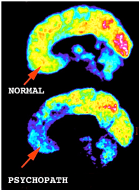
IMAGEs, side view —->  In the extreme, Cluster B  PD people suffer from a brain anomaly dramatically minimizing their clear-thinking ability & stunting the core personality. The anomaly is called Cave of septum pellucidum, causing the meso-temporal lobe to be diminished or starved. This scan shows reduced amounts of ‘grey areas’ in the prefrontal cortex & temporal poles, areas that normally play a vital role in expressing emotions & governing moral behavior.
<—- Top view : Affected people are not capable of awareness of consequences, guilt, genuine self-worth, self-consciousness, introspection … nor attachment to, empathy with, concern for, or even ‘like’ – much less genuine feelings of love – for anyone. Other people have no meaning for the PS except to be used for personal gain. And without a conscience, there’s nothing internal to stop them from doing horrendous things to others, & believing that it’s ok. (VIDEO of child psychopath)

(PS) SOCIAL
FROM ‘Ms No world Order‘ website: “They can be found in every culture, race & socio-economic levels. They thrive in a collective environment, & are common at the top of most power structures – corporate, government & religious. (Careers that attract PS ➡️ )

Psychopaths are manipulative & can easily gain people’s trust because they’ve learned to mimic emotion, & so appear “normal” to the unwary. They’re often educated & hold steady jobs. Some are so good at faking & conning that they can have families & other long-term relationships without those around them ever suspecting their true nature. (Dexter)

These are the people we most associate with aggressive, perverted, criminal, or amoral behavior, without empathy or remorse. They’re angry & deeply abnormal (unhealthy), who need to have control over others & cannot nor want to sense other people’s feelings, getting high off of their anti-social actions.(MORE….) CATEGORIES
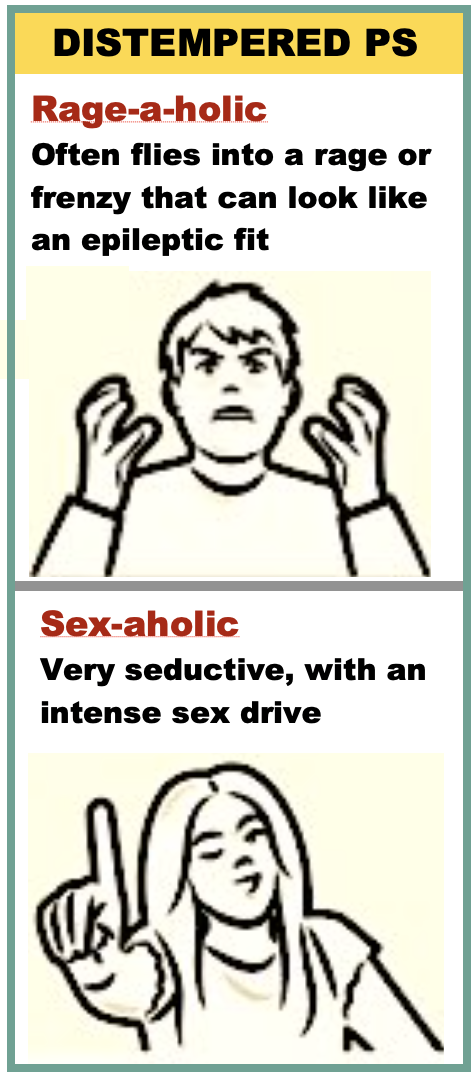
1. Distempered PS
Primary:  violent predators, don’t respond to punishment
Secondary: risk-takers, are violent, but fear getting caught
2. Charismatic PS
Primary : can live the ‘big lie’
Secondary : can tell the ‘small lie’ & live with it

TYPES
Abrasive – like to be different, can’t be trusted, will insult… to win an argument, always proud when they come out on top. They have no remorse – even for the greatest cruelty
Explosive – immediate & frequent access to their rage – taking it out on whoever is available. They can erupt unpredictably, & are savage when loosing control, taking down a victim before the person knows what just happened.

Malignant – driven by paranoia, but change their beliefs & pt. of view depending on how much they ‘like’ someone. Unlike other PSs, their methods are ineffective & backfire on themself. They’re been the victim of terrible abuse from others & so are terrified of everyone, which creates elaborate & horrendous revenge fantasies, which they obsess over but don’t do

• Malevolent
– cold-blooded & ruthless, paranoid &/or sadistic, they’re much more controlled than the Explosives. They’re terrified to feel positive emotion which they think will make them weak. AND they’re convinced that the purpose of tender emotions in others (love, kindness, sympathy…. ) are only expressed in order to manipulate the PS, another reason to hate feelings.
They love power & get off on mistreating others. If they don’t get what they want they’ll react with arrogance, contempt & cruelty, so this category includes many murderers & serial killers.

Tyrannical – cool, cunning & inherently violent, they’re turned on by the vulnerability of others. They’ll only target people to prey on who they sense will capitulate, & avoid resisters. Their victims must totally submit or join the PS as the weaker ‘partner’, delighting in their victim’s humiliation & intimidation. They relish the suffering of others, often keeping a token to relive an abusive experience.
Modified FROM Quantumcast – video


 NEXT: Personality Disorders (Part 3)