MBTI Type – INFJ

 PREVIOUS: INFP


The INTROVERTS

👠 👠 👠

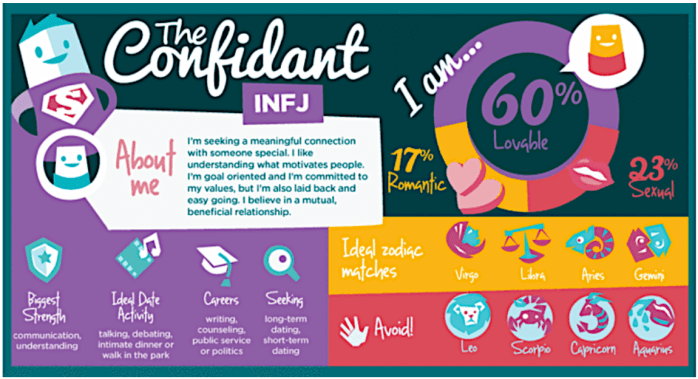
INFJThe PROTECTOR/ Confidant / Counselor
Introvert-iNtuitive-Feeling-Judging

❤︎ Most Contemplative, reflective
(1.5% world-wide) (1.3% ♂︎  // 1.6% ♀︎)  Perfectionistic humanitarian // Muse

NATURAL: An inspiration to others
GOAL: to Analyze.

INFJs are sensitive, original & quietly forceful, more likely to be individualistic rather than a leader or follower. They’re able to develop a clear vision of how to best serve the common good, then are organized and decisive in how they choose to implement this vision, tending to stick to things until they’re done.

They’re conscientious, with a well-developed value systems which they’re strictly committed to, & are well-respected for their perseverance in doing the right thing.

They’re curious to understand other people’s motives, & generally have great insight about them.They look for meaning in the connections between people, ideas & things.  INFJs are idealistic, wanting to inspiring others, who often try to find a shared vision for everyone & come up with new ways to achieve the vision.  (More…)

They’re : anxious, compassionate, complicated, creative, empathetic, idealistic, introspective, an eloquent speaker/ writer, quietly caring, paradoxical, patient, sensitive, a visionary, understanding
«
«
Hidden side : While their NF ‘righteousness’ usually compels them to be open & honest, they can be surprisingly clever & manipulative, from a knack for knowing what people want (& don’t want) to hear. They’re masters at keeping their friends close & enemies closer.

They’re the most cerebral of the Feeling types. So while many INFJs are spiritual, their aptitude for coming to conclusions with little or no evidence doesn’t come from any mystical source. Instead it’s from a constant but unconscious analysis of tiny details that most others completely miss, & which they themselves have trouble explaining

• Life’s Purpose : To guide those who are lost.
• Their Law : You shall always listen to my advice.
• They Comfort others by saying: It’s not your fault, you don’t deserve to feel this way.

• They Say :  These rules don’t benefit me, so I’m making up my own. I want to see my ideas be accepted & applied.  ….it’s fine.
Catchphrase : Do unto others as you would have them do unto you

Communication : Advice – We don’t need to talk about every emotion.
They won’t start the conversation. They’ll just watch you, from afar

Weaknesses : Extremely private, over-doing sensory activities, convinced they’re right even when evidence proves otherwise, too quiet
Manipulate : Secretly meddle in your affairs because they know what’s best for you – more than you do

Paradoxes : Confident AND overbearing. Help everyone else BUT can’t help themselves. Strong BUT fragile
Value: soul mates       • Fear : of being hated

Judge people by: their selfishness
Are Judged for : making others feel that their emotions are invalid

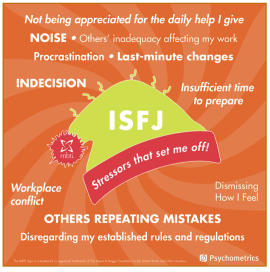
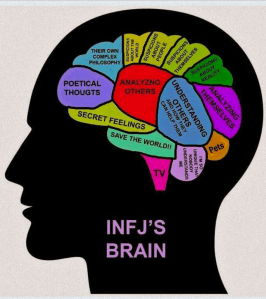
Become STRESSED from situations shown in illustration.  They either go all adrenaline rush or total paralysis

Under stress (Melancholy-Phlegmatic) INFJs tend to withdraw from reality into a fantasy world, which gradually gains importance as they become dissatisfied with their real life & the people in it.
While fulfilling the demands of their outer commitments, they’re secretly critical, & that their imaginary world & its characters are more important than anything real.

In these circumstances they’ll feel physically stressed & intensely angry, with an obsessive focus on certain details & a tendency to over-indulge.

They can end up living almost exclusively in their imagination, resist reality with a defensive attitude, feeling like a misfit. They’ll spend enormous amounts of time falling into their deepest hidden fantasies & emotions. In this state, they might be attracted to seriously defective people & environments which they’re convinced will truly understand & appreciate them

Hate : asking for help because it make them feel like they’re burdening others, anyone intentionally limited,  being forced, being misunderstood, being so effected by someone flirting with them, going to funerals, pretentious people, surrounded by conflict, unfairness

Don’t argue with an INFJ while they’re holding : a grudge
Never : antagonize them       • Never tell them : “You’ll never do anything meaningful with your life”

GROWTH
Advice : What you think is good for someone isn’t necessarily what they actually need.

INFJs may come across as too individualistic (“different”), private or mysterious, doing their thinking in a vacuum, which results in unrealistic ideas that are hard to verbalize

INFJs can best help themself by finding a way to bring their artistic vision & intuitive insights to light. By learning to express their rich imagination in a way that others can understand & appreciate, they become psychologically liberated, as well as integrated into the world. Artistic pursuits bring a great benefit to INFJs, offering an appropriate outlet for their deep emotions

INFJ Relationships
YOU : have a gift to intuitively understand human relationships & complex meanings, as well as emphatically understanding partner’s emotions. Others see you as mysterious since you tend to share your internal intuitions only with those you truly trust.
👥 Your relationship superpower is Sensitivity.

Thrive in any place that is: complex & intellectually challenging

• As a friend, you’re always the one reading a book, or listening to everyone’s problems, the one who needs a week ahead of a hang-out to mentally prepare – & then spend all the ‘fun’ time discussing the Universe & meaning of life

Annoyed when: someone acts like you emotions are invalid

INFJ Parent / child of INFJ parent, INFJ child  (ALSO….)

Still single because : you’re tailor-made for the ‘friend-zone’
Unhealthy behavior : stalking your S.O.’s social media at 3am

Show interest by: hiding it – they won’t know & never will!
Show love : empathize, are understanding, offer emotional & moral support

• You want to hear : I’m here for you
• You’re attractive/sexy because : being naturally refined & elegant, you have a peaceful presence, mysterious & wise. People want to get into your head & know what you know

• You should date : someone who cares about you as much as you care about them, will never take you for granted, lets you be yourself even if they don’t get you completely, who you can trust, & will never intentionally hurt you

To attract you : they need to be one big walking paradox. They should look deep into your eyes & say “I need you” to help figure themself out (Your turn-on)

• Some famous INFJ: Shirley Temple Black, Martin Luther King, Jr, Nelson Mandela, Tom Selleck, Billy Crystal, Mark Harmon

NEXT: Introvert Growth #1
MBTI Type – INFP

PREVIOUS: INTJ

SITE:  Many fun lists of ‘names’ for the 16 types  ++ other info


The INTROVERTS

👠 👠 👠

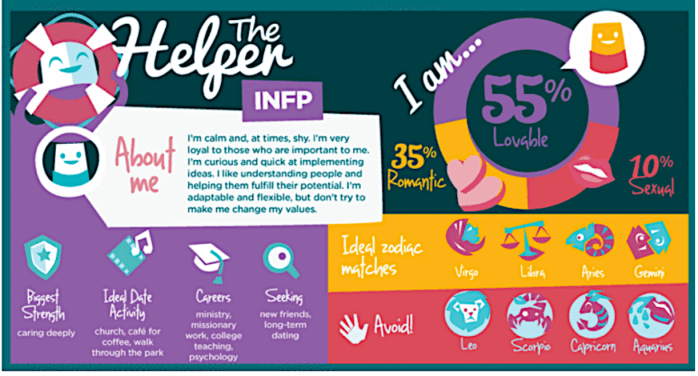
INFP – The HEALER / Clarifier / Harmonizer
Introvert-iNtuitive-Feeling-Perceiving

❤︎ Most Idealistic
(4.4% world-wide) (4.1% ♂︎ //  4.6% ♀︎) The Angsty poet

NATURAL: Performing noble service to aid society
GOAL: to Dream.

INFPs are reflective & idealistic, interested in serving humanity, with a well-developed, strongly-held value system which they strive to live up to. They’re adaptable & laid-back unless those values are threatened.

Being highly intuitive about people, they enjoy helping others’ inner development to reach their full potential, & are extremely loyal to people who are important to them.
Mentally quick, able to see possibilities, they like coming up with creative solutions to problems. Usually excellent writers.

Their polite, reserved exterior can make them hard to know – at first. However they do enjoy conversation, taking particular delight in the unusual. When in a sociable mood, their humor & charm shine through. Disposed to like people & avoid conflict, they tend to make pleasant company. (More….)

They’re : contained, creative, flexible, full of wonder, have strong personal values, imaginative, intense, non-directive, opinionated, quirky, reflective, reserved with people, seek inner order & peace.
«

«
Hidden side : Often regarded as frivolous daydreamers, they can be shockingly practical, seeing the value of using time & resources wisely. So they have no time for anything that’s irrelevant to their causes, projects or ideals. In a society where E-J behavior is the norm, INFPs (I-P) are just as busy & functional, but their motivation is internal, & projects are usually personal, not social.


They’re not as pleasant as most sites claim. Many INFPs are harshly judgmental towards people & things they experience as violating their values. Though they usually don’t say anything, they’ll easily ignore anyone who doesn’t meet their standards – without giving it a second thought or consider the real reasons others have for their position.

• Life’s Purpose : Heal those who are hurting
• Their Law : You shall always love yourself
• They Comfort others by saying: You’ve got so much potential, just keep your head up!

• They Say : I’m completely unaware that rules exist, & (I’m worried about) don’t know why everyone seems so stressed. Why can’t everyone just get along??!!
Catchphrase : It’s better to travel hopefully than to arrive

Communication : Advice – Stop talking about bumblebee-super-cumberwho…..
They probably won’t start a conversation unless you share their interest – or, unless they’re sure you want to talk to them specifically

Weaknesses : Can’t decide what they want, too idealistic, loss of confidence, martyr attitude
Manipulate : show high moral standards & act proudly victimized

Paradoxes : Detached dreamer AND hyper-emotional. Tons of dreams BUT no practical realization, timid BUT brave
Value: Ideals      • Fear : of a life without harmony

Judge people by: their values
Are Judged for : seeming to be fake

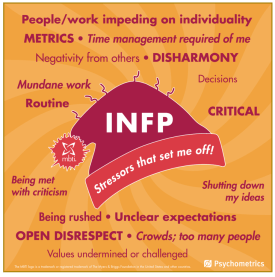
Become STRESSED from situations shown in illustration. They diligently ignore a problem until it’s too big to manage

Under stress (pure Sanguine or Supine) INFPs usually dislike conflict & trend to be passive-aggressive when experiencing frustration or dissatisfaction. They’re deeply dedicated to being their ‘true self’, in the extreme, avoiding anyone or anything that doesn’t fit in with their inner value system, becoming intolerant a& hard to please.

In these circumstances they’ll be cynical, depressed, aggressive & prone to acute self-doubt. As stress increases, they can get extremely whimsical & stubborn, insisting on acting on feelings, while ignoring the logical implications & consequences of their actions. Also, they’re inclined to use their self-focus as a standard for all relationships & situations in their lives, sticking only to what reinforces their self-image, & reject everything else

Hate : asking for help because they want to do it their way, being left by a loved one, conflict, debates that don’t include social justice, feeling invalidated, feeling overwhelmed, having to be too logical & objective, lack of imagination, sneaky-amoral-manipulative thinking,  stereotypes

Don’t argue with an INFP while they’re holding : you hostage
Never :  trap them   • Never tell them : “What you just said doesn’t matter”

GROWTH
Advice : Just act on your passion – nothing’s an excuse unless you make it so.

INFPs may struggle to speak up in meetings, leading others to assume they don’t care or have nothing to contribute, which makes it hard to convince others of the value of their ideas.

INFPs can help themselves by accepting they don’t need to resist or fight reality to fulfill their unique vision. Instead, it’s better to accept things as they really are & take advantage of opportunities to build the life they dream of. They need to learn to see all the possibilities without trying to filter them as right or wrong – living in reality instead of trying to change it or ignore it.

INFP Relationships
YOU : tends to be selective & reserved about sharing your deepest feelings & values, which can sometimes make you hard to understand. You’re seen by family & friends as sensitive and introspective.
👥 Your relationship superpower is Support.

Thrive in any environment that is: deeply romantic & intimate

• As a friend, you’re the super quiet one in a group, but crazy. Have 1 or 2 good friends, always deep & introspective, who’ll listen to someone all day or all night. And when you do give advice, it’s totally on point, like you’re channeling the other person’s inner self

Annoyed with: anyone you think is a fake

INFP Parent / child of INFP parent, INFP child   (ALSO….)

Still single because : you’re the ‘friend’ type
Unhealthy behavior : say ‘I love you’ on the first date

Show interest : You’re so confusing & slow, that by the time they figure you like them out, you’ll like someone else
Show love by : coordinate their needs, offer analysis, advice & help

• You want to hear : I believe in you
• You’re attractive/sexy because : you’re full of romance, feel so deeply & passionately. You seem so vulnerable, off in a dream world, & people wish they could be there with you

• You should date : someone who keeps you grounded, shows you reality, can be your anchor, is completely dependable, can protect you if needed, but also show how to protect yourself, help you modify expectations, & always works to impress you

To attract you : they have to act like they have a deep broody secret they’re too guarded to let out. Then you won’t eat or sleep until you’ve gotten thru their wall (Your turn-on)

• Some famous  INFP: Helen Keller, Carl Rogers, Dick Clark, Neil Diamond, James Taylor, JFK, Lisa Kudrow, Scott Bakula

NEXT: INFJ

MBTI Type – INTJ

PREVIOUS: INTP


The INTROVERTS

👠 👠 👠

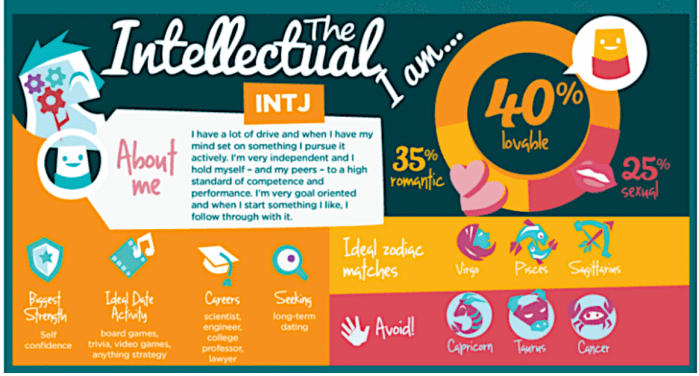
INTJThe SCIENTIST / Strategist / Mastermind
Introvert-iNtuitive-Thinking-Judginging

🛠 Most Independent
( 2.1% world-wide) (3.3% ♂︎ //  0.8% ♀︎)  The Badass mastermind // Iconoclast

NATURAL: Everything has room for improvement
GOAL: to Criticize.

INTJs are independent, determined & competent. They’re natural leaders, although usually keep to the background until they see a real need to take over, but also will follow someone if they trust their authority. They place a high value on knowledge & structure, & when committed, are capable of organizing a job & carrying it through to the end.  They have very high standards for their own performance, & that of others.

Original thinkers, they’re often able to define a compelling, long-range vision, & are driven to gather meaning from their ideas, coming up with innovative solutions to complex problems. Their analytical mind can easily see patterns in external events & then explain them thoroughly, coupled with an exceptional ability to turn theories into solid plans of action.

INTJs spend a lot of time inside their own mind, usually with little interest in other people’s thoughts or feelings, quick to express judgments. With very evolved intuitions, they’re often convinced they’re right about things. (More…)

They’re : analytical, calculated, caring, driven, efficient, knowledgeable, innovative, need to be competent, need things ‘my way’, skeptical, straightforward, strategic, theoretical,  seeing world as a chessboard
«

«•
Hidden side : They fiercely believe in free will, but aren’t stubborn. If they learn the value of something they previously resisted, they can do a complete 180 – quite often – because of their tendency to analyze things for a long time. They’re more aesthetically oriented than other Thinking types, & can be quite whimsical, though it may not always show

While they can seem cold, they’ll quickly defrost for a cause or something they relate to. They can be quite compassionate to people & things that are misunderstood, urging others to look beyond biases at facts & circumstances. While their thinking is very independent, they usually don’t mind (even prefer) helping & being helped, because of their keen understanding of everyone’s limitations

• Life’s Purpose : To be objective in a sea of subjectivity.
• Their Law : You shall always be like Newton.
• They Comfort others by saying: Are those….tears? Holy moly!

• They Say : I’ve found all the inconsistencies in the rules, so I consider them void. I look to the future rather than the past. …. just Stop.
Catchphrase : Hope for the best & prepare for the worst

Communication : Advice – Stop talking about being the smartest. They won’t start a conversation, & may ‘look’ angry. They’re probably not, but still…. approach with caution.

Weaknesses : Can be arrogant, extreme anger, misanthropy, too apathetic toward others
Manipulate : Never have time for anything because they’re always ‘busy’ with work (by their definition).  Can’t argue with them because they’re ‘always right’

Paradoxes : Visionary AND arrogant. Everything planned BUT nothing solidified. Confident BUT insecure
Value: Vision           • Fear : of losing their skill

Judge people by: their competence
Are Judged for : being an idiot

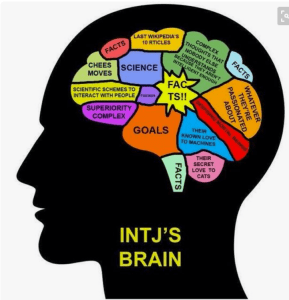
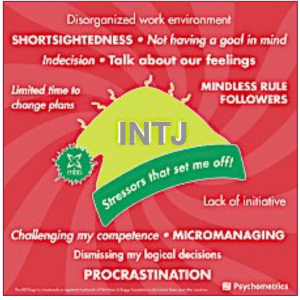
STRESSED by situations in illustration. They design a universal procedure that will solve their problem for all time

Under stress (Melancholy-Choleric) INTJs live too much in their mind, mostly disregarding physical & emotional needs. Therefore, love & romantic relationships can take them by surprise, the intensity of their own emotions being what causes them distress.
They may feel out of control, restless & tormented, so respond to these emotions by dismissing them, turning them into abstract theoretical principles that don’t connect to objective reality

In these circumstances they can feel physically stressed & intensely angry, with an obsessive focus on certain details, & a tendency to over-indulge. Idealizing their own complex concepts & ideas, they fail to recognize the importance of relationships with peers, managing to isolate themself from their emotional & physical self, as well as the world around them. They become ‘misunderstood’ loners, cryptic & enigmatic to everyone else.

Hate : asking for help because it make them feel incompetent, being injured or diseased, being ordered around, feeling stupid, flippant attitude, ignorance, overly-dramatic people, misinformation, subjectivity, someone who keeps making ridiculous jokes while the INTJ is trying to be serious

Don’t argue with an INTJ while they’re holding : all the cards
Never : control them     • Never tell them : “You’re not as smart as you think you are”

GROWTH
Advice : Occasionally take time off from work to explore new things

When it comes to emotional satisfaction, INTJs simply are out of their element. They can come across as cold and distant when focusing on the task at hand, & miss recognizing or appreciating the contributions of others.  They can find it hard to engage in social conversations, & tend to too reserved, not giving as much praise or intimate support as those around them would like

INTJs need to organize their esoteric perceptions and highly intuitive mental constructs, by applying some form of general logic to them so they’re understandable to others. They need to become more grounded in reality by also appreciating & giving proper importance to material practicality

INTJ Relationships
YOU : take commitments very seriously, prepared to dedicate substantial energy & time into a relationship to make it work. Instead of falling head over heels, you first look for the qualities you admire. Embracing conflict instead of avoiding it, you can easily move on from a breakup.
👥  Your relationship superpower is Healthy Confrontation.

Thrive in any environment that is : stable & intellectual (What you needscroll down)

As a friend, you’re the MENSA one who sometimes rubs it in everyone’s face, but because you’re so fascinating – they don’t mind.  The sarcastic one who’s quiet, & occasionally gives  death glares

Annoyed with: anyone who’s an idiot

INTJ Parent / child of INTJ parent, INTJ child    (ALSO…)

Still single because : you’re arrogant and socially inept
Unhealthy behavior : plan your wedding on the first date

Show interest by : being stalkerish
Show love : are affectionate, giving time, advice, analysis….

• You want to hear : I’m in awe of you
• You’re attractive/sexy because : you’re observant, meticulous, work hard & play harder. You seem both fully present & other-worldly, so people find your mysterious, detached & intriguing

• You should date : someone very smart who can force you to live in the moment, can make you accept your emotions without trying to ‘understand’ them, can help you experience passion without logic but will listen to your logic-rants without falling asleep

To attract you : they need to present you with a completely new way of thinking about something you’d already decided on. It’ll shake your foundation but win your admiration (Your turn-on)

• Some famous INTJ : Chevy Chase, Raymond Burr, Richard Gere, Hillary Clinton, Michelle Obama, Rudy Giuliani, Stephen Hawking, Ayn Rand, Isaac Asimov, Al Gore, Bill Gates

NEXT: INFP

MBTI Type – INTP

PREVIOUS: ISFJ

SITEs: I vs. E BRAINS & their different chemistry


The INTROVERTS

👠 👠 👠

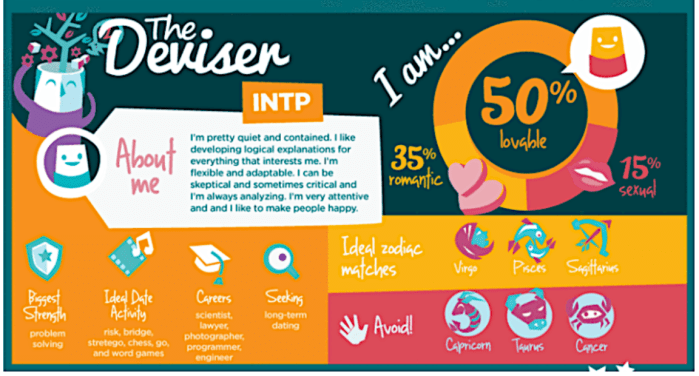
INTP – The THINKER / Engineer / Designer
Introvert-iNtuitive-Thinking-Perceiving

🛠 Most Conceptual
( 3.3% world-wide) (4.8% ♂︎ //  1.8% ♀︎) The Absentminded professor

NATURAL: A love of problem-solving
GOAL : to Research.

INTPs are original, logical & mentally creative, getting very excited about ideas & theories – valuing logic, knowledge & practical competence. They think strategically, able to build conceptual models to help understand complex problems.

They have an emotionally detached & mentally concise way of analyzing the world, & often figure out new or innovative approaches to problems. They’re exceptionally capable & driven to turn theories into useful, understandable procedures. They search for the universal law behind everything they see, trying to understand the unifying themes of life, in all its complexity.

They’re quiet, reserved, & can be hard to get to know well. They spend much of their time focused internally, are individualistic, uninterested in either leading or following others.  (More…)

They : challenge others to think, have a high need for competency, are calm, confident, detached, independent, ingenious, innovative, intellectual, logical, quirky, oblivious, skeptical, socially cautious
«

«
Hidden side : Their socially-awkward stereotype comes from over-thinking situations, rather than ‘keeping it simple’. They care a great deal about what others think of them & theirs. Out of all the NTs, they’re probably the best team players.

They’re not wishy-washy, just extremely skilled at picking their battles. They can argue a lot – for its own sake, but it wears them out more than they’ll let on. They may pretend not to care about gossip or “SAP” software, but secretly find it irresistible

• Life’s Purpose : To seek out that which is unknown.
• Their Law : You shall always procrastinate.
• They Comfort others by saying: Okay, okay… How can we fix this?

• They Say : I’ve found a way to bend every rule. I prize intelligence in myself & others. ….but….actually….uh….
Catchphrase : every Why has a Wherefore

Communication : Advice – Meowing doesn’t count as talking.
They might start a conversation, although if they’re busy with something, they may not notice others

Weaknesses : Second-guess themself, forget things, slowness, too often lost inside their own head
Manipulate : Can’t remember anything about anyone because all available space is filled with video-game lore

Paradoxes : Calculating AND uncaring. Brilliant with facts AND stupid about life. Smart BUT naive
Value: intellect          • Fear : of intimacy

Judge people by: their knowledge
Are Judged for : continually asking others why they’re upset

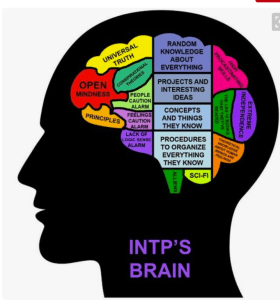
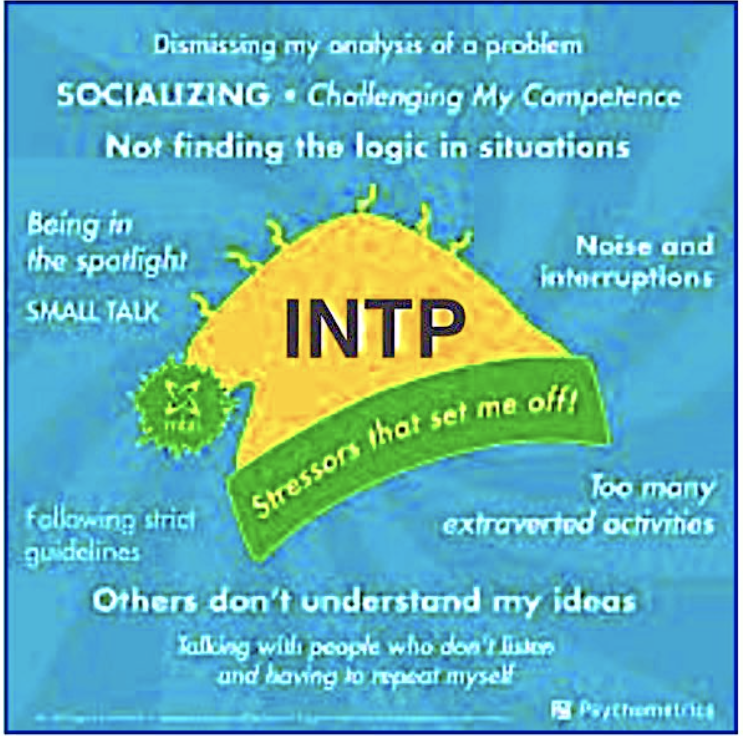
STRESSED by situations in illustration. They never do anything, in spite of understanding the situation.

Under stress  – INTPs are likely to be very critical of other’s expectations & demands, while at the same time unconsciously craving affection & appreciation.

Their thinking can get complicated & speculative, ignoring objective reality, & start living according to their own subjective interpretation of the facts. In extreme circumstances they’ll feel alienated, upset & prone to whingeing & hypersensitivity.

As frustration grows, INTPs may develop various phobias, worrying about their physical health & the effect their environment can have on it – masking unacknowledged emotional neediness. In this state, they might try to limit anything unfamiliar in their lives, as well as making a fuss around their theories & being oversensitive to other people’s attitudes & opinions of them

Hate : asking for help because it make them feel incompetent, being too emotional, falling thru the air (skydiving?), invalidating their ideas, lack of intelligence, overly serious people, someone  who’s offended by everything the INTP says, scientific stagnation

Don’t argue with an INTP while they’re holding : you accountable
Never : dismiss them
Never tell them : “Nothing you’ve made is special”

GROWTH
Advice
: Having many interest is no excuse for not mastering any

INTPs may struggle when working in teams, especially with others who they see as illogical or insufficiently task-focused. Ironically, they themselves may have no clear sense of direction, overlooking important facts or practical details.

INTPs may benefit from realizing that being impersonal & detached from their circumstances doesn’t mean they’re being objective or realistic. Everyone is dependent on others to a certain extent, & no one can have full control over their life all the time.
Realizing they’re part of a larger scheme of reality – where everything and everyone eventually interconnects – may help INTPs relax, to be open to new possibilities & relationships.

INTP Relationships
YOU : can be tolerant of a wide range of behavior but fail to consider how your style of expressing ideas can effect others. Family & friends   see you as someone who values autonomy & independence.
👥 Your relationship superpower is Bravery.

Thrive in any that are: honest & understanding

• As a friend, you never initiate hanging out but are totally available – as long as someone’s ready to talk science or conspiracy theories, the other sarcastic one (like INTJ) who doesn’t answer any Qs unless there about chemistry

Annoyed when: someone keeps asking you why you look so upset

INTP Parent / child of INTP parent, INTP child   (ALSO….)

Still single because : you prefer blow-up dolls
Unhealthy behavior : only express emotions in text

Show interest by : intense trolling
Show love : being considerate about their needs, offer advice & help

• You want to hear : I’ll leave you alone
• You’re attractive/sexy because : you’re low-key & dreamy, & something about you independence & aloofness is so intriguing that it makes others want to know what you’re thinking – about anything.

• You should date : someone who can can make you feel valued & smart, keep you grounded & teach you to live in the moment, can help you open up to & be OK with emotions, & keep you from using logic to ‘understand’ them

To attract you : they need to take the initiative, again & again, until you actually notice their existence. Then they have to try again.
(Your turn-on)

• Some famous INTPs : Einstein, Thomas Jefferson, Descartes, Darwin, Marie Curie, Jung, Socrates, Abraham Lincoln

NEXT: INTJ

MBTI Type – ISFJ

PREVIOUS: ISFP


INTROVERTS

👠 👠 👠

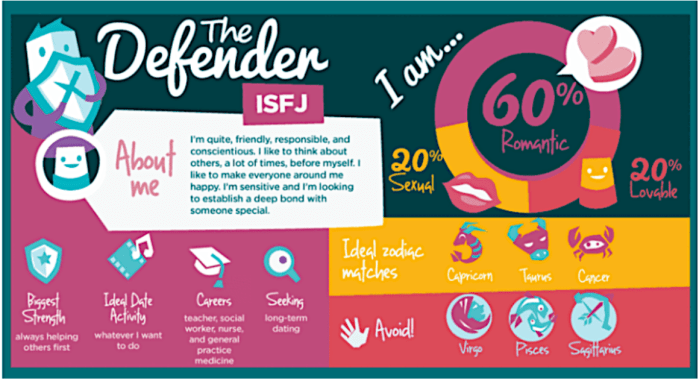
ISFJ – The SUPPORTER / Curator / Protector
Introvert-Sensing-Feeling-Judging

🌺 Most Loyal

(13.8% world-wide) (8.1% ♂︎ //  19.4% ♀︎) The Polite caretaker // Philanthropist

NATURAL: A high sense of duty
GOAL
: to Harmonize.

ISFJs are quiet, stable & practical, valuing security & traditions. Characteristically humble and unassuming, they rarely call attention to themself. Typically involved in social groups, but not wanting the spotlight, they’re more likely found behind the scenes, working diligently to fulfill their role.

With a rich inner world & keen observers of people, they’re highly attuned to the feelings of others. Being conscientious & committed to meeting their obligations, they tend to put the needs of others ahead of their own. They’re oriented to being in relationships, but can be reserved with new people, are compassionate listeners, and typically remember details about others. They often enjoy hearing the facts of someone’s life in the process of making a connection.

ISFJs have a well-developed sense of space & function, they’re patient people who apply common sense & experience to solving problems for others, usually very interested in finding ways to be of practical service. (More….)

They’re : accountable, can be shallow,  easy to collaborate with, dependable, easy to collaborate with, empathetic, friendly, grounded, patient, respectful, sacrifice readily, talkative, traditional, work behind the scenes, understanding, unique
«


 «
Hidden side : They’re more open-minded than they seem. While extremely cautious with strangers, they’re willing to try understanding others, regardless of differences.
They’re the most fantasy-prone of any Sensing type, with a love for lore & literary analysis – a way for them to keep in touch with traditions

They’re a lot more laid back than most profiles say, & some ISFJs have a tendency to give up on things they should keep at, while sticking to things they should give up on.
They take what they do very seriously, but also need a lot of downtime, being highly sensitive to sensory & social input

• Life’s Purpose : Help those who are helpless.
• Their Law : You shall always take care of your family.
• They Comfort others by saying: I’m really sorry. Is there anything I can do to make it better?

• They Say : These rules suck! Only a fool goes along with them! I’m very dependable. …. no, no, it’s okay.
Catchphrase : There’s no place like home

Communication : Advice – Stop talking about taking care of someone. They might talk to others, but they’re rather shy, so they have to be approached. It’s worth it.

Weaknesses : Take things too personally, being less efficient, too stressed /paranoid
Manipulated : they passive-aggressively guilt-trip you so you feel obligated to go along with their micro-managing

Paradoxes : Mostly consistent. Understanding AND lonely. Imaginative BUT grounded
Value: Safety            • Fear : of being dismissed

Judge people for: their selfishness
Are Judged for : belittling others’ emotions

STRESSED by situations in illustration.
They 🎤 announce : Move %*#-, get out of my way!

Under stress (Phlegmatic-Melancholy) ISFJs have the tendency to lose themself in emotional & moral commitments, seeing themself as indispensable to & an intrinsic part of the cause they’re identified with.
At this point they can become self-sacrificing martyrs whose only purpose is the happiness & well-fare of others. They can end up in bad relationships where they’re willingly being used & put in a service-oriented position

In extreme circumstances they’ll become accusatory & pessimistic, tending to think the worst & shut down.  As their stress increases they cling to others, trying to keep them attached by undermining their independence, while offering them unconditional care & support.
At the same time, ISFJs hide their own feelings & vulnerabilities, unconsciously building up more frustration. They can become intolerant about whatever doesn’t fit their view of life, rejecting reality, even fiction that doesn’t agree with their values of feelings & purpose.

Hate : an overly cocky bad-boy (who they eventually marry 🙀), asking for help because it make them feel like they’re burdening others, being chased, being misunderstood, inconsiderate people, not fitting in, not sharing, making tough decisions that affects others, pretentiousness & unfairness

Don’t argue with ISFJ while they’re keeping : a promise
Never : neglect them        • Never tell them : “I wish you wouldn’t talk to me or try to help me”

GROWTH
Advice : There’s a line between being nice & being a doormat.

ISFJs may be overly cautious, not always considering the logical consequences of their decisions. They can lack assertiveness, & risk basing decisions on what they think will please others.

ISFJs can benefit from learning to discover, understand & fulfill their own needs, the same way they do for others. They need to assess their opinions & goals against reality, & gauge the strength of their commitments, to keep themself balanced & reasonable.

ISFJ Relationships
YOU : are generally dependable, make a good ‘caretaker’, are committed to your partners, friend & groups you belong to. You honor commitments & like to preserve traditions.
👥  Your relationship superpower is Listening.

Thrive in any environment that is: stable & long-lasting

• As a friend, you’re the undying loyal one who’s like a good grandparent, the one who plans the party, is there, oversees it, talks to everyone, cleans up, goes home – & them obsesses about not having done it perfectly

Annoyed with: anyone who belittles your emotions

ISFJ Parent / child of ISFJ parent, ISFJ child  (ALSO….)

Still single because : you’re too much of a ‘safe’ option to others
Unhealthy behavior : giving a $100 1-week anniversary gift

Show interest by : lots of little looks & smiles
Show love by : taking care of practical needs, do little nice things to help

• You want to hear : I appreciate you
• You’re attractive/sexy because : you have a tender heart but also hidden strength. You radiate an intense love of sensuality, with that smitten smile & discreet charm, that makes others melt

• You should date : someone who can force you to relax & practice self-care, can teach you to worry less & go with the flow, who enjoys you taking care of them

To attract you : they need to act like a super-hero/heroin BUT who also needs you to take care of them. You’ll jump at the chance to nurture their reckless spirit (Your turn-on)

• Some famous ISFJ : Kristi Yamaguchi, Johnny Carson, Laura Bush, Kate Middleton, Rosa Parks, Princess Mary of Denmark, King George VI, Mother Teresa

NEXT: INTP

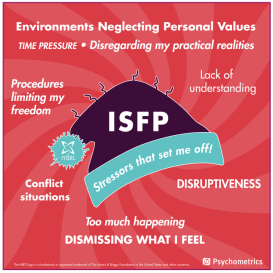
MBTI Type – ISFP

PREVIOUS: MBTI Types #1

SITEs“16 Types of Men


The INTROVERTS

👠 👠 👠

ISFP – The ARTIST / Producer / Composer

Introvert-iNtuitive-Feeling-Perceiving

🌺 Most Artistic
(8.8% world-wide) (8.5% ♂︎ // 2.4% ♀︎) The Observant artist // Creator

NATURAL : Sees much but shares little
GOAL: to Evaluate.

ISFPs are reserved, serious, sensitive & kind. Not liking conflict, they’re not likely to do things which will cause it. Not interested in leading or controlling others, they’re loyal and faithful, & enjoy being of practical help or service to others, as well as bringing people together, facilitating & encouraging their cooperation.

Others can see them as somewhat detached or analytical, as they’re interested in cause and effect, tending to organize facts using principles. They’re highly skilled with mechanical work & excel at finding solutions to practical problems.

They live in the present moment and enjoy their surroundings with cheerful, low-key enthusiasm, & may be interested in or talented in extreme sports.
With extremely well-developed senses & aesthetic appreciation for beauty, needing beauty in their surrounding, they’re likely to be original & creative.  (More…)

They’re : adaptable, colorful, considerate, cooperative, gentle, in touch with self & nature, love discovering, loyal, quiet, sensitive, self-pitying, spontaneous, strong-willed, team player, tolerant, warm, unassuming
«

«
Hidden side : They’re not snobs or hipsters. Well, not exactly. They know what they like, full stop. Whether their tastes are considered refined or eclectic by the rest of the world varies from ISFP to ISFP. They’re not that shy – many have an SP-typical brazen sense of humor, & they love to talk endlessly about their interests.
But they’re not as prone to jump at new opportunities or experiences as other ESPs – “I don’t know, it doesn’t sound like something I’d like” is a favorite phrase

• Life’s Purpose : Splash color on a grey world.
• Their Law : You shall always be creative.
• They Comfort others by saying: Don’t worry about it. Don’t worry about anything!

• They Say : I’m breaking all the rules, but it’s OK because I don’t think anyone noticed. I love having the freedom to do whatever I please. I don’t deserve this.
Catchphrase : A picture is worth a thousand words

Communication : Advice – Stop trying to say ‘in’ things to try fitting in – relax & use your tertiary Ni .
They’ll talk to anyone & everyone as long as they haven’t decided someone’s too intimidating to approach

Weaknesses : Too sensitive, depression, hopelessness, silence, too clingy
Manipulate : Scatter-brain, carefree hippies one minute, then in an obnoxious emotional turmoil the next

Paradoxes : Accepting AND fearful. Everyone should express themselves BUT not me! Idealistic BUT practical
Value: freedom                     • Fear : of conflict

Judge people by: their intelligence
Are Judged for : saying that something others created was ‘stupid’

STRESSED by situations shown in the illustration. Make list & lists & lists…

Under stress (Phlegmatic-Sanguine) ISFPs will put a lot of importance on their personal freedom, their choices, lifestyle & subjective view of life.
When feeling threatened by having to conform, & the prospect of giving up their ideals, they start rejecting other people’s help & advice, becoming increasingly defensive & dismissive.
They may resort to sarcasm, become cryptic or derogatory. Then they get cynical, depressed, aggressive, with acute self-doubt

As frustration grows, they tend to isolate to escape external influences, living on the edge of society, refuse to take any logical considerations into account, relying only on their creative emotions & peculiar worldview

Hate : an attractive person ignoring them, asking for help because they want to do it their way, being stifled artistically, being told how to live their life, falseness, lack of freedom, losing their teeth, meanness, rejection, people who hurt others

Don’t argue with ISFP while they’re holding : a baby
Never : betray them         • Never tell them : “I wish you wouldn’t talk about yourself so much”

GROWTH
Advice
: Figure out what your needs are, & be clear about them

Because they tend to be less assertive than some types, ISFPs may have less influence at work, & their concern for others could keep them from making tough choices. They sometimes put off making decisions in the hope that a better option will show up.

ISFPs need to find a way to bring their vision & gifts out into the open, usually by learning to express themself in a way that others can understand. By appreciating & accepting reality as it is, they can build a life that’s both authentic & appropriate.

ISFP Relationships
YOU : prize the freedom to follow your own path, enjoy having your own space & setting your own timetable, which you will also give you partners. You can be difficult to know well but do care deeply about others, which you show through actions rather than words.
👥 Your relationship superpower is Appreciation of Beauty.

Thrive in any environment that is : adventurous & lifelong

As a friend, you’re the hipster who listens to old music & goes to festivals, likes everything new way ahead of everyone else, & is all for wealth-distribution

Annoyed with: anyone who’s a total buzzkill

ISFP Parent / child of ISFP parent, ISFP child  (ALSO….)

Still single because : you’re not a musician or artist
Unhealthy behavior : debilitatingly jealous

Show interest by : blushing
Show love by: a spontaneous display of caring, taking care of their emotional needs

• You want to hear : I get you
• You’re attractive/sexy because : you have an earthy “I know what I’m doing” vibe with inner strength & willpower, but also glow with excitement & liveliness. These qualities are admired & attractive

• You should date : someone who supports you completely, as well as getting inside your head, can help you break out of your I shell & accepts your vulnerability

To attract you : they need to be playful & adventurous, & to take an interest in you, while giving space to figure out how you feel, & then go to you (Your turn-on)

• Some famous ISFP: Cher, Elizabeth Taylor, Barbra Streisand, Bob Dylan, Jimi Hendrix, Michael Jackson, Jackie O, Mozart

NEXT: ISFJ

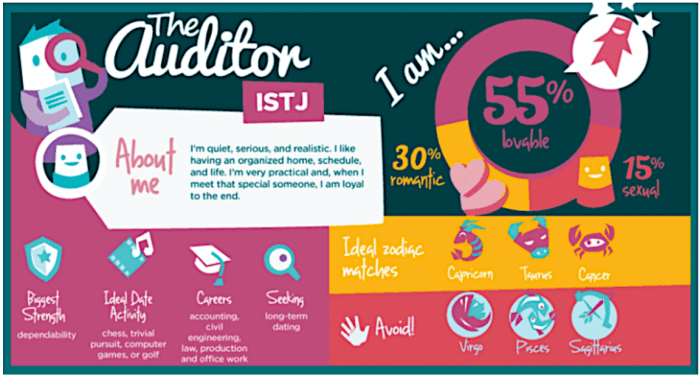
MBTI Type – ISTJ

PREVIOUS: ISTP


The INTROVERTS

👠 👠 👠

ISTJThe DUTY FULFILLER / Examiner / Inspector
Introverted-Sensing-Thinking-Judging

🔑 Most Responsible
/reliable

(11.6% world-wide) (16.4% ♂︎  // 6.9% ♀︎) The Rule lover // Enforcer

NATURAL – ‘Doing what should be done’
GOAL
: to Prepare.

ISTJs are quiet & serious, interested in security & peaceful living, usually supporting or promoting establishments, because they value traditions & loyalty.
Their successes come from thoroughness & dependability, with a seemingly endless capacity for improving anything that takes their interest, because they have the unusual combination of imagination & organization.

They can be hard on themselves & others on work projects, & anyone caught slacking will lose their respect. Although extremely dependable perfectionists, they don’t get trapped in it, because of the pragmatic rule: “Does it work?”

ISTJs take pleasure in making everything orderly & organized – in all parts of life. Practical, matter-of-fact & realistic, they’re known for having well-developed powers of concentration, who work steadily towards goals regardless of distractions. They decide logically what should be done & work toward it steadily. (More….)

They’re : conscientious, conventional, compulsive, command-ing, logical, need order, organized, realistic, reserved, practical, private, follow rules & regulations, supportive, systematic, thorough, traditional, trustworthy

«
Hidden side: They can be quite vulnerable, getting depressed & anxious when faced with a difficult decision – because of their strong sense of accountability.
At the same time, they’re sillier, softer & stranger than most profiles dare to mention, and more than ISTJs themselves realize. Some become so firmly set in their habits they may not notice how idiosyncratic they are. They can also have a knack for puns & poignant descriptions, though most people would never peg ISTJs as ‘poetic’.

• Life’s Purpose : To do what must be done.
• Their Law : You shall never be lazy.
• They Comfort others by saying: What the f– are feelings?

• They Say : I’ve completed everything according to the rules. When I give my word,  give my honor. WHAT are you doing?
Catchphrase : Do right & fear no man

Communication : Advice – Stop talking about the weather. They may be caught up with whatever they’re doing, but they’re available for a conversation when not busy. It’ll be fun.

Weaknesses : Tend to blame others, unusually impulsive, decreased efficiency, perfectionist
Manipulate : They have step by step instructions on how to judge & criticize you

Paradoxes : Dependable AND rigid. Need to obey authority AND need personal attention. Modest BUT proud, least weird of the types – making them a little weird

Value: dedication       • Fear : Not able to fulfill responsibilities
Judge people by: their competence
Are Judged for : not being dependable

STRESSED by situations in illustration. They’re cool-headed, but get hard like ice.

Under stress (Pure melancholy) ISTJs tend to see others as overly subjective & weak, which makes them think it’s time to take control & set things right. They can become domineering & uncompromising, assume their logic is the only valid standard, & try to impose it.
While they crave personal contact & affection, they won’t give in to their emotional side. They blame others for being corrupt, biased & disrespectful so that a self-righteous anger takes over.

Stress triggers can be things that challenge their natural preference for structure & logic. They can be accusatory & pessimistic, tending to withdraw & shut down. As the pressure becomes intolerable, psychological valves open to release frustration in inappropriate ways: bursts of anger, impulsive behaviors, excessive drinking or eating……

Hate : being nagged, being useless, under-performing, failing a test, letting others down, lack of honor, being misjudged, asking for help because it make them feel they’re burdening others, lack of leadership, someone behaving like Zooey Deschanel,

Don’t argue with ISTJ when they’re having : faith in you
Never : mislead them
Never tell them : “You didn’t even try”

GROWTH
Advice: You can’t fit others’ individual differences into a (your) mold

ISTJs can become set in their ways, seen as rigid & impersonal. Too easily judgmental, they need to pay close attention to their motivations & what they’re making judgments about. Because they tend to do so without enough information, it’s best to start by understanding what they’re criticizing, & only then form an opinion.

They can benefit from verbalizing their own views more often, but without too much detail, as well as being more aware of how people will feel in response.

Their greatest challenge has to do with being willing to change – finding the right balance between preserving what works, while being open to experimental or new ideas, where some will fail but others will reveal better ways of doing things. (More….)

ISTJ Relationships
YOU: are generally seen as someone who values traditions, is consistent & orderly. You develop strong loyalty in others & work hard to keep commitments.
👥 Your relationship superpower is Commitment.

Thrive in any environments that are: respectful and traditional

As a friend, others can trust you with their life. You’re the super organized one who always shows up early, & was the ‘smart one’ who answered all the Qs in class
Annoyed with: anyone who can’t be count on for anything

ISTJ Parent / child of ISTJ parent, ISTJ child  (ALSO…..)

Still single because : you’re uptight
Unhealthy behavior : taking the ‘shared-bathroom-schedule’ too seriously

Show interest by : ultra-intense eye contact
Show love by : handling problems or practical matters for you, offering you advice (un-asked for)

• You want to hear : I depend on you
• You’re attractive/sexy because : you have a natural rhythm & structure which many find desirable, are intense, with a strong will to follow your inner drummer which is admirable

• You should date : someone who can pull you out of your shell & force you to accept life’s messy bits, can teach you that taking risks & breaking rules can sometimes be fun

To attract you : be bubbly / charming enough to warm your heart, but flaky enough to imply they need your help (Your turn-on)

• Some famous ISTJs: Natalie Portman, Robert De Niro, Jackie Joyner-Kersee, George Washington, Queen Elizabeth II, George W. Bush

NEXT: ISFP

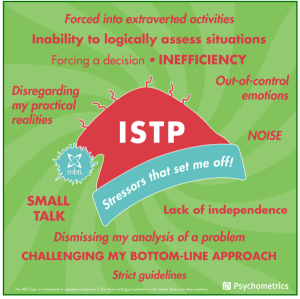
MBTI Type – ISTP

PREVIOUS: Al-anon Step 10, #2

SITE: 11 Talents Is Don’t Realize They Have


The INTROVERTS

👠 👠 👠

ISTPThe MECHANIC / Craftsman / Operator
Introvert-Sensing-Thinking-Perceiving
🔑 Most Pragmatic
(5.4% world-wide) (8.5% ♂︎ 2.4% ♀︎)  The Quiet explorer // Engineer

NATURAL – “Ready to try anything once.”
GOAL:
to Inspect.

ISTPs are quiet, reserved, uncomplicated in their desires. They can seem somewhat detached or analytical, but have a rich inner world of observations about people, & are extremely perceptive of other’s feelings. They’re kind, tolerant & flexible, usually putting the needs of others before their own, & can be interested in being of  service.

Conscientious, stable & practical, they value efficiency, security & traditions. They’re loyal to their peers & to their internal value systems, but not overly concerned with respecting laws & rules if those are in the way of getting something done.

ISTPs love learning, are excellent with mechanical things, & enjoy perfecting a craft by patiently applying their skills. Quiet observers until a problem appears, then act quickly to find workable solutions. They can remain calm while managing a crisis, easily deciding what needs to be done to solve the problem

They’re interested in cause & effect, will organize facts logically, & have a well-developed sense of space & function. Good at analyzing how things work, they can easily get through large amounts of data to get to the core of practical problems.

Usually interested in & talented at extreme sports. Risk-takers who live for the moment, they’re ready to try anything once. Well suited for an apocalyptic event, so without something exciting – they’ll make one up because they get bored

• They’re: adaptable, analytical, creative, energetic, fierce, great in a crisis, honest, independent, logical, rational, ready for anything, observant, physical, practical, seen as cool & aloof, spontaneous, technical, unemotional, unpretentious
«

«
Hidden side : Usually much more caring than most profiles give them credit for. They have a deep ‘brotherly-love’ nature, often using practical trouble-shooting skills to give loved ones & friends advice & help. While typically independent & solitary in pursuing hobbies, they’re not that aloof in social situations, with a knack for observational humor

• Life’s Purpose: To fix what’s broken
• Their Law : You shall always rebel
• They Comfort others by saying: What happened this time?

• They Say : Rules are important for others, & if I feel like it I might follow along.  I love sports & the outdoors. Can we do something ‘cool’ now?
Catchphrase : A bad workman blames his tools

Communication Advice – to Talk more…. and you’re OK.
They don’t want to talk to (almost) anyone so no one will know that they have better things to do – secretly

Weaknesses : Dislike commitment, psychologically isolated, over-emphasize logic, so focused on improving things they come off as unappreciative
Manipulate : Will be mindlessly passive unless you have mechanical parts they can fix, or you have to push them off a cliff for an adrenaline hit to get them going

Paradoxes : Calculating AND uncaring. Are for all systems BUT against social systems. Stubborn BUT easygoing
Value: friendship         • Fear : Lack of independence

Judge people by: their smarts
Are Judged for : not wanting to try anything new

STRESSED by situations in illustration ←

Under stress (Melancholy-Sanguine) ISTPs have a tendency to resist or reject any request or situation that doesn’t fit their basic views on life.

Afraid of being controlled by others, they protect their freedom by cutting out demanding people, & only hang out with those who have the same – usually antisocial – attitude.  In extreme cases they’ll feel alienated & upset, prone to complaining & hypersensitivity.

As pressure increases, they’re very likely to have a rebellious attitude against society & its organizational systems (government, political parties….), whose power they see as threatening their independence. By suspecting & blaming the system, they ‘leave’ reality & end up living as outcasts, ignoring common norms & values.

Hate :  —  asking for help because it make them think they won’t learn how to do it, anyone who won’t ‘get their hands dirty’
— being trapped, being told what to do,  disrespect, rigid structure,
— lack of privacy, loss of control, stupidity, when someone thinks they know what’s best for the ISTP then steps in to their life & does that very thing

Don’t argue with an ISTP when they’re holding : a knife
Never : use them    • Never tell them: “You’re actually awful at hobbies”

GROWTH:
Advice: Learn people-skills, because they’re useful & will get you places

ISTPs risk focusing so much on what needs to be done immediately that they miss the big picture. They don’t always follow through on projects that require working closely with others

ISTPs can avoid psychological breakdown by recognizing & valuing the human experience as a whole, regardless of personal differences. Accepting that human needs & aspirations are important & strikingly similar despite variety, they can use their practical skills to help society instead of trying to bring it down. (MORE….)

ISTP Relationships
YOU: are generally fair & tolerant of a wide range of behavior, but then surprise others by clearly objecting when logical principles are attacked. Being quiet & reserved – you can be a challenge to read.
👥 Your relationship superpower is Respect. 

Thrive in any environments that is: practical yet independent

• As a friend, you’re the sexy one who goes along with everything, seems to have your career all planned out, & always seems to know what’s wrong with your car or computer
Annoyed with : others who never want to try anything new

ISTP Parent / child of ISTP parent, ISTP child (ALSO....)

Still single because : you’re stuck in a Ti-Ni loop – re your stack (Ti-Se-Ni-Fe).
Unhealthy behavior : distant, emotionally unavailable

Show interest by : confronting someone directly
Show love by : acknowledging practical needs, sharing useful info

• You want to hear : It’s up to you
• You’re attractive/sexy because : you’re aloof, mysterious, broody, with a low-key humor, both an old soul & child-like – that’s intriguing & hard to miss

• You should date : someone who’ll give you space, but also force you to show more affection, who doesn’t let you push them away even tho’ you try, can force you out of your head & show you how to accept emotions

To attract you : they need to infiltrate your social circle, see you often but act nonchalant, & then offer sex (Your turn-on)

Some famous ISTPs: Keith Richards, Bruce Lee, Miles Davis, Tiger Woods, Katherine Hepburn, Clint Eastwood

NEXT: ISTJ

Al-Anon STEP 10 – Comments (Part 3)


PREVIOUS: 10th Step #2

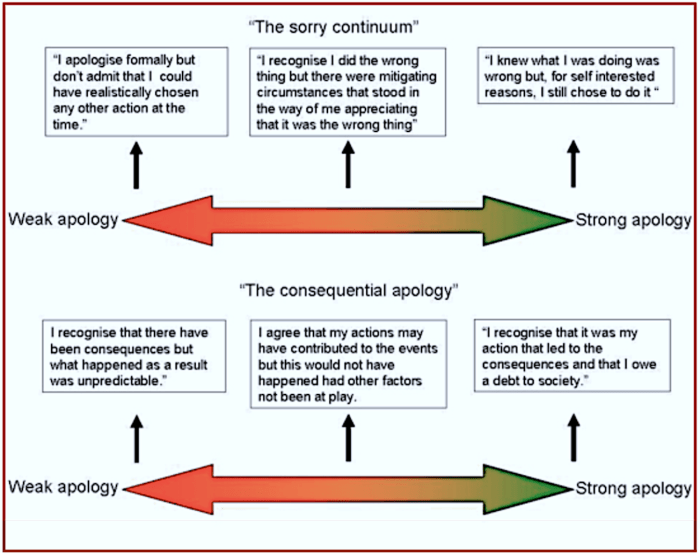
SITEs:  8 books for ACoA   ///   Apology GUIDE

AA / Al-Anon Step 10 : “Continued to take personal inventory & when we were wrong promptly admitted it.

1. Daily Inventory

2. AND WHEN WE’RE WRONG  (cont.)

🔻 Something that did not hurt or upset another, but which we are convinced did. Again, this is our narcissism – projecting how we’d feel if….. In fact, what we’re obsessing about may not have even registered, or if it did – it didn’t bother them.

So – ASK  “When I said/did ——, how did you feel?” (done right away, or at the next opportunity). Do not put your words in their mouth!
✔︎ If the other person was not upset, believe them & drop it!
THEN if you insist on explaining, justifying…. it’s not at all about making an amend to —-> the other person.
Instead – it’s all about you, trying to get them to make you feel better

✘ If it did bother them, then we can apologize, but not in a self-serving way by trying to justify our behavior!
However, sometimes BRIEFLY providing a legitimate context is helpful to the other person “I’m so sorry for ———, yesterday my mom was rushed to the hospital // I’d just had a chemo treatment…. // Sometime my brain-injury makes it hard to remember —– ” (Try not to use the word ‘but’ before the explanation!)

⚠️ Human mistakes  – not a tragedy. These can come from being tired, under great stress, over-doing or from ignorance. We need to have our own internal permission to be ‘normal’ (imperfect), to forgive ourself with kindness & then make any necessary corrections.
Most other people are not as upset about our errors as we are !

🔻 Things we said or did which actually hurt / harmed someone.
Sadly, the WIC still gets things backwards, as with the backwards Serenity Prayer.
We blame ourself for things that are not wrongs, while having great difficulty owning long-term defense mechanisms : superiority, lying, lateness, insensitivity, laziness, procrastination, S-H …..
Not noticing our unhealthy behavior is a lack of self-awareness – patterns we think “well, that’s just me” but are actually the False Self, & a deep-seated shame about our True-Self needs.

*    *    *    *    *    *
3. PROMPTLY ADMIT IT
a. Re. OURSELF –  The Program phrase “Let it begin with me” certainly applies here.
If we accurately identify a ‘failing’, we can promptly admit it to ourself – without shame or S-H.  Hard for many ACAs to do!

In Recovery we learn that character defects come from the wounded child &/or PP, so even with years of hard work they don’t go away fast or easily. We need to be KIND to ourselves, & patient with our process!
For in-depth info, read posts Outgrowing Co-dep Niceness #6a-7c”, re. Forgiving ourself.

b. Re. OTHERS – 9th Step procedure applies here too – read post “Outgrowing Co-dep Niceness #8a = Being forgiven by others”.

A sponsor may suggest that “promptly” means to act within 48 hours – not a week or a year.  But for many ACAs it can take hours or days before we realize we need to make an amend, or to take the time to overcome shame, or calm down from anger, & get some perspective.

REMEMBER that in some cases the other person may not accept the amends or want to talk to us at all. Sometimes it’s not safe or even possible to reach them.
Also – an abusive boss, a mentally ill family member, a manipulative narcissist, the passive-aggressive….. can easily use a sincere ‘amend’ against us, if not right away, then some later time when it suits them.
We do need to use discretion & be self-protective.

Not wanting to apologize may seem like PRIDE on the surface, but actually it’s:
a. being ASHAMED of not being perfect
b. something that was shamed / punished in our family growing up
To be able to apologize ‘easily’ we can not be choked with SHAME!

💠   💠    💠    💠
Read: ACoA 12 Steps

ACoA 10th Step: “We continued to take personal inventory & to love and approve of ourselves.”
• This is not arrogance or narcissism, but rather, self-care.
• It’s not about being at the extremes of either having to be “right” <—–> or of self-flagellation.
• AND keeping our side of the street clean does NOT mean staying with people who don’t want to be with us, who are subtly abusive or simply are incompatible!

By accepting ourself completely, we can slowly outgrow much of our damage, & uncover our True Self. This minimizes the amount & frequency of acting on character defects. It keeps us from isolating ourselves & judging everyone else.
“Admitting & Accepting” is the mental health of acknowledging our human-ness & the need to be part of the human race.

NEXT: MBTI Introverts

Al-Anon STEP 10 – Comments (Part 2)


PREVIOUS : 10th Step #1

SITE: 10th Step Worksheet 

A Study of Step 10 


AA/ Al-Anon Step 10 : “Continued to take personal inventory AND when we were wrong promptly admitted it.”

1. Daily INVENTORY (cont.)
✔︎ What were my thoughts today?
NOTE: This is NOT what you said out loud – only what was in your head.
Re: Yourself – most of this list will be the self-abusing thoughts from :
✧ the PP /Introject, in the ‘You‘ form (You should have know that), OR
✧ the WIC who believe the PP as Self-Hate, in the ‘I‘ form (I’m such a failure, I can’t ___, I’ll never___ )

Re. Others – If you’re angry at someone else, the thoughts will be harsh judgments & derogatory name calling
If you’re anxious, they’ll usually be thoughts of how to placate or avoid that person – mind-reading about what they think of you

These will all be in the form of obsessions – round & round – without asking yourself what childhood button was pushed, nor looking for a solution to the situation. (POSTS: “What just happened?”)

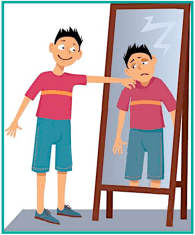
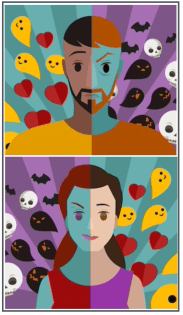
IMAGEs: they illustrate the positive & negative sides ⏬️ of our thoughts & Es, NOT as mental illness, but actually normal in all humans

POSITIVE: Identify all helpful, kind, adult, realistic, mentally healthy thinking (“What she said had nothing to do with who I am // I’ve just reached my limit // I need help with this // that was a good meeting”…. )

✯   ✯   ✯   ✯   ✯
2. AND WHEN WE’RE WRONG  (see posts on “Being right“)

What kind of wrong(s)? First we need to distinguish between defects of character, what’s our responsibility & what’s S-H.
a. DEFECTS (same as shortcomings) can be defined as “a fault or failure to meet a certain standard….” They are basically defense mechanisms (unhealthy patterns) that all of us develop in response to a painful childhood & outside traumas

** IMP: in 12-Step ‘work’, lists of defects always include emotions. This is WRONG! Emotions are never defects – only some thinking (CDs), AND some behavior patters (abusive actions) – which together are used to deny painful emotions.

b.  RESPONSIBILITY is simply a frank acknowledgement of what we think, do & feel – or not, without judgement or self-abuse.
We can still ‘feel bad’ about hurting someone & need to make it right if possible, but it does NOT cause shame or self-abuse

c.  SELF-HATE is blaming ourself for causing ANY hurt or fear we feel, & projecting abandonment, especially if someone ignored or harmed us, or if we’re not perfect!

We also need to Identify our rights, so we know what a wrong IS or is NOT. Just because someone doesn’t like what we say or do – does not mean it was ‘a wrong’! SO, look for:

🔻 Something that was NOT ‘a wrong’ at all, but actually:
✒︎ someone else made it sound like it was. This can be from :
⚬ projecting their own disowned defect
⚬ a way to deflect blame from themself
⚬ we having pushed one of their buttons
⚬ being caught in a defect of theirs (lie, error, abuse….) which they’re ashamed of

✒︎ someone hurt us & ⏫️ WE made it our fault – typical of codependents. We apologize in knee-jerk fashion, as if we caused the other person to say or do something inappropriate

✸ While this reaction is deeply ingrained in ACAs, it will most often show up when we’re around anyone who is oblivious to the effect of their actions, or who doesn’t care.
This is the WIC taking responsibility for someone else’s narcissism.
✧ It’s what we were trained to do by family & religion
✧ It’s carrying the guilt for them, since they won’t
✧ It’s as if we could teach them how to be responsible for their actions – like the alcoholic’s spouse who thinks they can ‘show’ the active drinker how to be moderate by example.

Also NOT ‘a wrong’ :
🔻 Something we were often punished for / made fun of…. as kids (family, school, religion…). It may have been normal child behaviors, or some inabilities, omissions, expressions of emotions….

This left us with a deep sense of Shame now re. expressing any imperfection which we then label as a character defect.
This emotion prevents us from thinking clearly, it silences us, makes us want to slink away, hide under the carpet, to die – the pain is so great, like a punch in the stomach!

NEXT: 10th Step, #3