PURPOSE of Emotions: COMMUNICATION (Part 2)

IT’S GOOD TO SHARE MY FEELINGS –
it keeps me connected

PREVIOUS: Purpose – COMMUNICATION, #1


1. SOCIAL NEEDS (cont)
a. BASICS
b. HOW & WHEN

c. EMOTIONS affect COMMUNICATION
• FACTS are a type of communication ‘channel’ for presenting ideas, plans & goal. Info stated clearly ensures that we’ll be correctly understood.
But communication also has an EMOTIONAL channel.  Es change people’s outlook on facts, so someone who’s sad tends to see problems as risks in the world, while a happy person mainly sees opportunities & potential rewards

• We signal our Es via verbal & nonverbal language (Emotions & the Body”posts). When there’s a difference between the 2, observers usually respond to the nonverbal portion. Es help us communicate with others:
∇ We can talk about a painful experience in a calm, rational ways – but show distress on our face or with body language – & we’ll get a response to the visual cues first
∇ If we look sad or hurt, someone may think we’re signaling for help, & an angry face will tend to keep others away.having an effect

Why we don’t Communicate Es:
Protecting Others: afraid we could hurt or upset someone
Social Expectations: which shape how we feel & express them
Social or Professional Roles: If it’s not appropriate, based on our role or position
Vulnerability: not wanting to give others info that could affect how they see us

• Being social creatures, clear expressions of emotion have an automatic effect on others, & healthy people are interested in the emotional state of those they care about.

When deeply into a certain mood, elated or depressed, others will be able to picked that up rather quickly.
Talking to someone who’s depressed can make us feel depressed too. When talking to someone who’s happy & confident we might notice that we feel good about ourself as well – but both are short-term

This inter-active response is especially obvious when someone famous & charismatic comes in to a room – everyone’s drawn to their emotional energy, even before the person says anything.
It’s also why we feel scared watching horror movies, seeing actors portraying fear through gestures & facial expressions

d. COMMUNICATION affects EMOTIONS
Every communication has an emotional context & sub-context, which can be used to create emotional responses in others.  News media, powerful speakers & successful advertisers embed key emotional phrases in their presentations, knowing it’s an effective way to manipulate their audience.

😗 But we also consciously let ourselves be moved by things we know are untrue – seen by how avidly we gobble up all kinds of fantasy media, because of the emotional impact it has on us. The best works of fiction not only communicate interesting ideas but also pull at our heart-strings

Communication is always wrapped in some Emotion :
• If you talk about your extensive accomplishments in a dull, flat voice, the audience will loose interest and not take you seriously
OR they may get worried, wondering what’s wrong with you, since you should be expressing joy, excitement & pride – not disinterest
• Conversely, an enthusiastic salesman can spin such a clever pack of lies that we end up longing for (& buying) their worthless products (as in late-night infomercials)!

The Right kind of communication has a direct & powerful effect
i. With ourselves
• dialoguing with the WIC in a loving way will often bring calmness
• writing in a journal can organizing our thoughts & get us in touch with hidden Es
• picture having a positive conversation with someone – to solve a dispute, apologize for a difficulty, to add something we forgot or neglected to say earlier….

ii. With Others
• when we’re troubled, talking to a sympathetic person who gets us can change our mood rather quickly – even when they don’t have much to say
• a nonverbal expressions of caring – a reassuring touch, a hug, holding hands – can make us feel so much better
• when sharing an important experience we may unexpectedly get choked up, adding weight to the topic
• expressing joyful Es to others can make them feel even deeper

NEXT: Purpose of Es – Awareness, #1

PURPOSE of Emotions: SURVIVAL

WE HAVE EMOTIONS FOR GOOD REASONS
– so now I welcome & work with them!

PREVIOUS: Repressing Emotions #2

Review post : “Getting to our Es – Under

PURPOSE
✥ Do you know what to say when you hear someone insist that emotions are a waste of time, unreliable, too much trouble? The next several posts will give important reasons – biological, personal & social – why we have them!

SOCIAL NEEDS
1. For SURVIVAL
• That’s the evolutionists’ answer. According to their theory, animals are aggressive & self-conscious (compared to rivers, mountains, plants….which have also survived) & humans are the most self-conscious, making us increasingly invested & crafty in our efforts to endure.
Over time we developed a wide range of Es & a complex rational thinking system, which allowed us to imagine our own past & future selves, giving us preeminence over fauna & flora. ‘”If you want to create a system that works hard to survive, make it be conscious and emotional. It will want to keep itself around!’”Es for survival

• Researchers believe that Emotion, rather than logic, is the driving force in the human brain. Studies show that Es are responsible for neural integration – linking various brain functions (talking to each other) by tying together physical, cognitive, sensory & social processes, keeping us sane, healthy & functioning effectively

• Robert Plutchik, of the Emotion Wheel, wrote that the purpose of emotions is to form behavioral interactions between a person & a stimulus – event, thing or another person – so that when Es are acted on (correctly, of course) it brings the person back to a state of equilibrium — feeling ok / safe
EXP: You’re in the woods & see a bear loping towards you. You’re very afraid. The fear makes you run away, so the emotion served to produce an action that saves your life. You’re then returned to a calm state (eventually).

2. For CONNECTION
• Humans are fundamentally social animals, needing to rely on each other for survival. So we not only have personal feelings, but also social Es deeply embedded in our nature for connection.  Es motivate & organize individual behavior & social interactions, as well as facilitate communication.  Social needs include acceptance, prestige & access to certain people, events or resources, & provide a mirror for our feelings, attitudes & realitybelonging

• Belonging to a group or community gives us a sense of identity.
Researchers found that people are happier when they’re with others rather than too much alone – & the “boost” is the same for Introverts & Extroverts (only the quantity & time amount differs).

✶ Loving relationships are important to our well-being & happiness because they’re comforting. It creates the psychological space & safety to explore & learn, which builds inner resources for those inevitable times of difficulty.
AND the positive effects are long-lasting. Strong emotional support also reduces immune system abnormalities that contribute to various stress-related disorders.

EXP: The success of the many 12-step Programs (AA, GA, OA / Al-anon, Gamanon, Oanon….). The Al-Anon closing says: “The welcome we give you may not show the warmth we have in our hearts for you. After a while, you’ll discover that though you may not like all of us, you’ll love us in a very special way—the same way we already love you.”

Emotions that serve social functions:
social EsGuilt (not the ACoA type) is legitimate when we’ve done something inappropriate or hurtful, that motivates us to make amends (AA’s 8th & 9th Step)
Responsibility (not co-dependence) to keep us from harming others, or to help where needed….
Altruism, going beyond passively ‘behaving’ oneself to not cause social problems, but rather to actively participate in groups & organizations that provide relief for the needy & suffering

3. For UNITY
• Because Emotions are universal, the ‘positive’ ones may help overcome prejudice & divisions. Tragically, even fatally, many cultural, religious & political beliefs separate us. But Es – such as empathy, cooperation, forgiveness & heroism – can help.
Unifying Emotions:
fun singingCaring: listening to concerns of others helps them feel understood & valued
Faith: a Spiritual belief providing wise rules (of right & wrong) can connect us to like-mined people
Music (& other art forms) emotionally link artists & a wide public
Laughter: a universal language that makes people feel good
Love: fostering acceptance, compassion, education, responsibility, understanding, & spiritual growth.

NEXT: For Communication, #1

REPRESSING Emotions (Part 1)

repress EsI HAD to SHUT OFF MY EMOTIONS –
so I wouldn’t go crazy!

PREVIOUS: ACoAs & Emotions #4

SITE: I Don’t Want to Talk About it: The Secret Legacy of Male Depression. by Terrance Real

Resistance to FEELING Emotions (Es)
• The source of personal power is Self-esteem – fueled & sustained by the emotion of unconditional Love – which allows us to feel Pease & Joy. But when we had to shut down our feelings because the pain was too much to handle, we also shut down the pleasurable ones!

Resistance to experiencing our emotions stifles the natural flow of life built into every human being. So it takes a lot of psychic effort to push down Es & keep them down – leaving very little energy left over to function, causing long-term Depression.
This is why ACoAs barely have any reserves to deal with unforeseen events in the present – so much of our effort is used up by our Shadow-storage of unwanted feelings & memories.

Repressed Es get trapped in various part of the physical body & in the layers of the energy body that radiate from our core. Such a backlog can cause holes in our spirit, leaking out vital power, which creates fatigue, vulnerability & low self-confidence!

• Emotions, as such, are never dangerous – only the suppressed ones that have piled up year after year, causing them to fester.
Our body wants to eject emotional poison the same way it does physical toxins. If we don’t allow this to happen they cause PMES damage. In the long run, releasing them voluntarily is best – so we don’t explode all over ourself & others. If we carelessly ‘dump’ our pain on others or act them out in a self-destructive ways, we end up feeling even worse about ourself (more S-H)

The BRAIN: our normal ability to repress emotions comes from 3 general areas : → the mammalian fore-brain, → the reptilian early brain, & → the mid-brain which connects the other two.
To function well we need the capacity to choose how we act on emotions (see posts on T.E.A. & Anxiety). But if our Recovery isn’t far along, sometimes we also need to disconnect, because the panful ones get so intense that our weak self-care gets even worse. SO — bain rooms
• When we want to remember something, we access the information stored in any one of the 3 parts ↑, altho what’s available varies according to which data bank is holding it
• When we want to forget something,, we disconnect the memory links between the fore-brain (thinking) & the other two – creating temporary amnesia (this is normal)

BTW, ACoAs are notorious for having a built-in forgetter as result of trauma, which sadly includes all the good things that happen to us day by day in the present!
The mid-brain, as the go-between, is responsible for keeping it all straight, & does so very well – especially if we live in a ‘civilized’ society.
EXP: Not letting ‘blind rage’ erupt in public prevents getting fired, thrown out & in some cases killed (road rage, gangs…).
Not acting on every sexual impulse will preserve our promise of fidelity to a mate, maintain the family’s integrity, eliminate STDs…..  & potentially prevent getting killed.

Are you emotionally repressed?
Def –  DENIAL is actually : “I don’t know that I don’t know some things about myself, or my family”

• If we wonder what Es we’re denying, there are many ways. We can always start by asking some basic Qs, like the obvious ones :
☞ “What emotions can I name? Which ones do I think I have felt ? (depression, rage, anxiety….?) What am I feeling right now?

From there we can go on to: “What Es am I not expressing?” & then to “If I knew what I was feeling, what might it / they be?”.
☞ If the answer is always the same “I don’t know” – it’s time for outside help (which we can all benefit from anyway), such as 12-Step meetings, therapy, reading, spiritual gatherings, healing groups …..
POST : Getting to your Es – Over & Under” has a list of tools

NEXT: Repressing Es = Part 2

ACoAs & Emotions (Part 3)

clean out old Es I JUST WANT TO BE HAPPY
but first I have to clean out the damage

PREVIOUS: ACoAs & Emotions #2

SITE: Help for Emotional Reactivity


WHY DO WE HATE having emotions so-o-o much? (cont)
b. OVER-REACTIONS 
(cont)
🦠 This is 
not self-indulgence or being manipulative, but rather:
1. Sensitivity = a person’s brain being wired to be intensely affected by  external cues, with nerve endings exposed & raw, causing out of control Es triggered by :
— the threat of or proof that a relationship is about to dissolve
— being told they can’t have something they badly want or are convinced they need
2
. Reactivity = having a reactive ‘higher baseline”, 0-20 vs a continual 80 out of 100 – so sadness is experienced as overwhelming despair, anger becomes rage….. and behavior is also intense & doesn’t fit the actual present situation
3. SLOW return to baseline = having a hard time calming down & staying upset longer than someone with a safer upbringing (an
emotion fires in the brain for around 12 sec. vs 20% longer)

EXP: You’re in the middle of working on a project & someone keeps trying to control how you’re doing it. You get angrier & angrier**, since you interpret their ‘directions’ as proof you’re not doing it right & so aren’t good enough – not just your work but as a person!
✶ This anger is caused by S-H.

ASK : “What does this reaction tell me about my damage?” – instead of just raging at the other person (in your head) & wanting to smash their face in
Ans: Some deep part still believes I’m so bad that I have to be perfect, to compensate, BUT since I can’t be, I hate you for exposing me, & it means I’ll never be loved!
not me• Yes, we are responsible for our behavior & attitudes.  But we also need to remember that HOW people treat us ALWAYS tells us about them. When their treatment is insensitive or mean it’s coming from their inner PP &/or WIC . Very few have a L.P. even when they have a functioning H.A. in the UNIT)

Their behavior tells us about their inner world, even if we made a mistake. So we don’t have to take responsibility for or try to fix our personality, only our actions – IF appropriate or possible!
In any case – OUR WIC desperately needs a hug & a mental course correction – modifying the CD of Perfectionism. If we do that every time – much of the anger will dissipate, even if the other person is still being a big pain!

CHECKLIST
ACoAs are often CONFUSED, because
• we combine Es with thoughts/ beliefs, usually Toxic one, because we use the word “feel” to mean both (“Use THINK instead of FEEL posts)

• of our conflicting Es: old vs. current, WIC vs Adult, PP vs Adult…
• mix up Es with normal human needs, which we’re deeply ashamed of
• don’t know our RIGHTS or what ‘normal’ is, much less have permission to act on them

1. Which Toxic Rule is in play? (all have turned into self-destructive toxic rules
behavior patterns, also called character defects)
Exp: “If I don’t like it, I have to stay” becomes passivity
2. Which of my WIC’s unmet needs am I re-experiencing?
Exp: Constantly ignored or punished for trying to get attention

3. What am I thinking about this situation?
Exp: “They’re never going to call / write back / I’m unlovable…..”
4. Which of my old buttons is getting activated? — an emotional sore spot from things your family & others consistently did to you &/or to each other – that hurt you  Exp: Being accused wrongly / being shushed

5. Which ego state is likely in charge at the moment (WIC or PP) ?
6. If I’m acting out, which parent am I copying & how?
7. What am I most afraid of in this situation? (FoA, punishment, isolation, not being heard…)
➼ Use the info in other posts to help you answer.

NEXT: ACoAs &  Emotions #4

ACoAs & Emotions (Part 2)

Screen Shot 2015-06-29 at 1.32.01 AMI CAN ALWAYS THINK of WHAT to SAY – after they walk away!

PREVIOUS: ACoAs & Emotions  (#1)


REMINDER: What they never told us was that 💗 it’s not intrinsically bad to have Emotions

WHY DO WE HATE having emotions so-o-o much? 
• we expect to be made fun of, ignored or physically punished for expressing them (“I’ll give you something to cry about!”)
• we were taught that Es are unacceptable (either specific ones or all), & we want to be ‘good’, obeying family rules as a sign of loyalty & love

• some ACoAs want to stay connected to a particular parent by copying their resistance or inability to feel
• others are determined to be the exact opposite of a dramatic or emotionally out-of-control parent

• we were never taught healthy ways to identify & deal with Es when they surfaced, so we’re convinced they’ll ‘drown’ us

• Unfortunately our culture reinforces the ‘don’t feel’ rule by telling us that:  — Es are not ‘rational’, so they can’t be relied on to tell us anything real or useful
— it’s not sophisticated, strong or admirable to be ‘emotional’ (to cry or get too upset, no matter how terrible the situation!)

• MOST of ALL – as kids we were never comforted when scared & hurt, & having no way to process our Es, over the years they accumulated in our unconscious, & now we’re terrified of opening ‘Pandora’s Box’

a. DELAYED Reactions
ACoAs are notoriously slow to catch on to how we feel emotionally – having a delayed reaction to all kinds of encounters & events, pleasurable or not. We may not realize them for a few days, weeks, even years! We do have emotions about most things, but we:too many Es
• learned early in life to deny them
• became so numb we don’t consciously know what they are
• have such negative beliefs about actually having Es
• are afraid to feel too much, because the WIC thinks it’ll kill us (or the ‘sensitive one in the family)
• never learned how to deal with uncomfortable or unacceptable Es

b. OVER / UNDER -Reactions
ACoAs IRONY: On the one hand we’re shut down, especially on those terrifying childhood Es. On the other hand we have intense emotional reactions (a melt down, blow up, fall apart, get suicidal…), to what people say or how they act to or around us.

These 2 extremes are inextricably linked:
• the more we have to sit on ALL painful Es, the more they get backed up & then Vesuvius blows
• since we’re not allowed to actually have Es, we can’t admit to having them (too ashamed), so we can’t really feel them. Then HOW can we possibly process the pain, anger, sadness, loneliness, terror….? to get them out, sharing them, get comfort & understanding???

REVIEW:
We hate being told we’re being too dramatic about something others think is minor or trivial, because we think that means:
• we don’t have a right to be upset
• we caused our own problem, & so deserve to be punished, belittled, not respected
• that the hurtful person or situation is being let off the hook,  so we’ll never get fairness or revenge!
NONE of those are the case.  Since “If it’s hysterical, it’s historical”, whenever our Es are out of proportion to an unpleasant current event, all we need to do is admit an unhealed wound is being triggered.

About Over-reacting (cont):
• Intense Es comes from the WIC, who thinks we’re still powerless to stop being controlled & abused
• Getting so upset by other people’s words & deeds means we’re still taking things personally

• It’s a clear indicator that a specific button is being pushed in us. This is useful info to cut thru denial & help with growth.
🙀 Intense emotions are the only proof we need about the abuse.
Knowing this – we can use the awareness to validate the kid’s pain, as we get another glimpse into past suffering, & stop blaming ourself for feeling loneliness & grief.

NEXT: ACoAs & Es (Part 3)

ACoAs & Emotions (Part 1)

acoa EsI DON’T WANT to FEEL ANYTHING – & you can’t make me!

PREVIOUS : EmotionIdentifying  (#2) Parrott’s Emotions List

REMINDER: See ACRONYM page for abbrev.

REVIEW: The Body & Emotions & Identifying Emotions


Those DREADED Emotions (Es) !
• ACoAs definitely believe all emotions are a bad thing. When asked what’s going on with us, or how we’re feeling, ACoAs usually fail to mention Es. We’ll talk around them, over & under, but never hit the bulls-eye.  We’re terrified of them like mice are afraid of cats.  We treat our Es as if they were a wild beast inside that has to be locked away in a deep dark dungeon.

• Then we wonder why we can’t get out of bed, always feel like the outsider, feel so alone, don’t get along with others, have panic attacks….. ⭐︎ Emotions that are ignored have sneaky ways of showing up in disguise. BUT those ways (listed throughout this blog) are the symptoms that provide vital information we can use to reverse-engineer events that distress us. Then we can make the necessary corrections

• Without enough healing, ACoAs are clearly not happy campers, having lived with depression most of their life – even if we don’t show it on the outside.  It’s not surprising, since our dysfunctional families indicated in thousands of direct & indirect ways that we should never object to being hurt by them, and then not express any pain from their abuse & neglect! (“Stop your whimpering. You’re such a baby. You’re just too sensitive!”). They didn’t give us much to be happy about, but they also didn’t want us to hold them accountable. So we learned: “DON’T FEEL”!healthy combo

IMP: What they never told us was that 💗 it’s not intrinsically bad to have Emotions but were simply unacceptable to them, because:
they didn’t experience love & nurturing, so could not give it to us
• they had no clue how to cope with their own problems, much less be there for us. The responsibility of parenting terrified them
AND
• if one or more parent had chronic mental or physical illness, or who were overly dramatic themselves, there was clearly no room for our needs or feelings
• never having dealt with their wounded Es as adults, they shoved them under the carpet & demanded we do the same.
🥺 An infant’s first ‘language’ is that of intense emotions. Only after that do they learn to use words! This combination would be a constant irritant to parents who already felt too much OR didn’t want to feel at all – our emotions & needs acting like sandpaper. They had to shut us up!
AND
• our needs as children enraged them because they wanted all the attention for themselves
• some parent & teachers delighted in hurting & humiliating us, & had no intention of giving us comfort or validation (did you catch one of them smirking when you cried?)
✶ One tender soul remembers her mother, the heartless narcissist, saying with a sneer: “I’m so glad I’m not sensitive like you & your father!”

muted EsAs a result:  
• many ACoAs have a limited range of Es they’re aware of – like only able to play 3 or 4 notes on a full piano keyboard – such as anger & disdain, fear & guilt, loneliness & desperation…. even tho’ there are many more available on both scales
• some have so many feelings that we can hardly breathe, acting them out all over the place or hiding under the covers as much as possible, always in ‘suffering mode’, which makes us wish we were like the other ones – numb (or dead)

• others of us have intense Es without consciously knowing it OR being able to identify them by name – not associating certain physical sensations with actual emotions, but tending to be cranky & exhausted.

NEXT: ACoAs & Emotions (Part 2)

IDENTIFYING Emotions (Part 2)


EENY MEENY MYNIE MOE – catch a feeling by it’s show!

PREVIOUS: Identifying Es (#1) – Plutchik’s Emotion Wheel

SEE post
: Getting to our Emotions – OVER


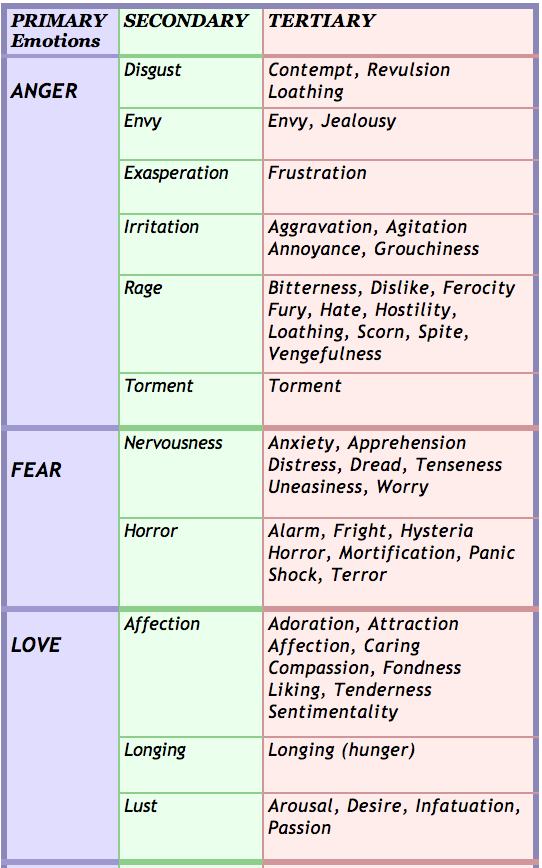
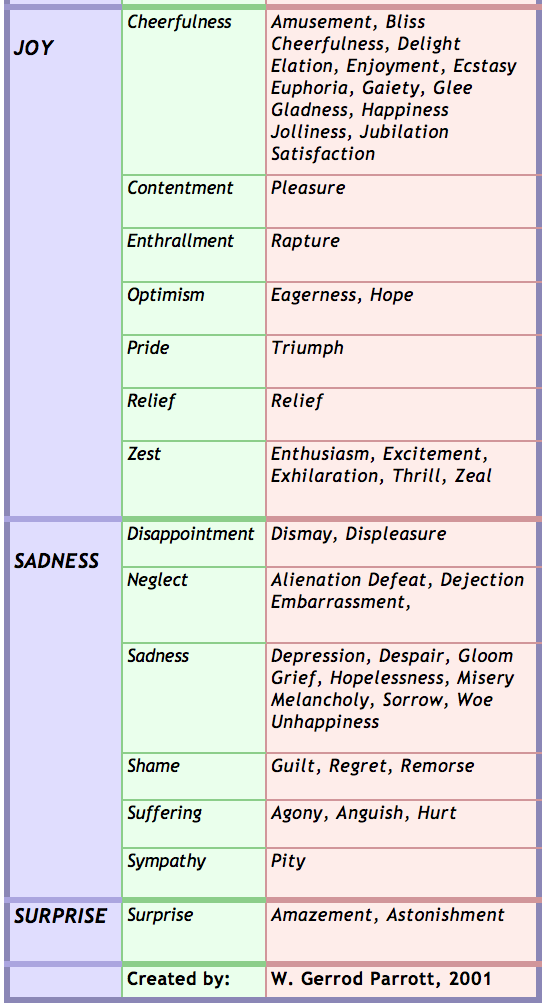
This CHART, by W. G. Parrott, is another way of grouping emotions – a general guide you can agree with in whole, in part or not at all. The more Es you can identify in yourself & others, the better. One reason I’ve added it is that it includes the Es of Shame & Guilt, which Plutchik does not.
«

«
NEXT : ACoAs & Emotions, #1

IDENTIFYING Emotions (Part 1)

emotions-poster-I HAVE TOO MANY FEELINGS –
I just can’t handle them

PREVIOUS: The Body & Emotions – #4

REVIEW: Getting to our Emotions – Under


CATEGORIES
Many psychologists & sociologists have created their own Primary Emotions list (90 so far), some of which are seen on the Changing Minds & Alley Dog sites.
One THEORY of Emotions
A variety of concepts try to explain the source of Emotions (Es), put forth by psychologists, sociologists, philosophers & scientist.
EXP: The James-Lange theory argues that an ‘event’ first causes physical arousal (body), which we then interpret (mind). Only after the interpretation do we experience emotions (body) related to the event.  However, if the physical ‘symptoms’ are not noticed or not given any thought about a specific event, then we don’t experience emotions

Here are some ways to think about this theory:
Expl: You’re walking down a dark alley late at night. You hear footsteps behind you. You start to shake, your heart beats faster & your breathing deepens. As you notice these body changes & decide this is telling you you’re in danger – then you feel fear

BUT
: Those same physical symptoms can also occur when you met your exciting new lover – & your interpretation (what you’re thinking) is that this is a very good thing – so you feel the emotions of excitement, joy & sexual desire!

No Reaction: If you just found out that you lost out on a job opportunity you interviewed for but weren’t crazy about getting – you don’t have a physical response & don’t give it a second thought – so you’re not upsetBIG Es

Suppressed Reaction: You’re having a very busy day, running around without a moment to think.  You pass by a major car accident on the street, with people screaming & bodies everywhere.  You don’t stop – you’re mind is on the next task & how late you are, so you’re too preoccupied to feel anything about the event you just saw

However – you did register fear, sorrow, revulsion…. at some physical level you weren’t aware of – so maybe late that nite you have a nightmare, or the next day you’re sluggish & cranky but don’t know why!

EMOTION WHEELs
Below is Robert Plutchik’s well-know chart, a 3-D model using the color spectrum to indicate adjacent & opposite Es, (Fear opposite Anger, Sadness between Surprise & Disgust …..) The vertical dimension represents intensity & the circles are degrees of similarity.

1. Fundamental – inner circle shows the most basic Es. They are the intensity of an infant’s feelings, whose brain pathways are not yet developed enough to experience a variety of emotional nuances
2. Secondary – each row out from there are milder versions of the core
3. Tertiary – in the white spaces, each E. is made up of the 2 adjacent secondary Es (Trust + Fear = Submission; Anticipation + Anger = Aggressiveness ….)

2nd CHART indicates triads – emotions formed by combining 3 primary emotions, leading to 24 dyads & 32 triads (MORE….— also several other theories of Es)

EXP: Fear opposite Anger in extremes
• Think of some people who always seem angry. They’re using that emotion to feel powerful while covering up how scared they are, unwilling to be vulnerable (they wouldn’t be if they had a strong identity, good boundaries & healthy self-esteem!).  They believe that feeling fear is a weakness & will do anything to avoid it
• Now notice people who usually present themselves as scared, delicate, easily hurt, a victim, isolating….. You can be sure that hidden underground is a lot of suppressed rage which they’ve been taught to deny & are terrified of in themself!

➼ Yes, anger AND fear can also mask sadness, loneliness, shame, guilt, hopelessness….. BUT we can actually see the difference when someone does FoO work & those extremes get evened out. The person is easier to be around since they live less in the painful Es, but can still respond with fear or anger when it’s appropriate, as well as have a wide variety of pleasurable feelings.


«
NEXT: Identifying Es #2 :
W. G. Parrott’s Emotion List

The BODY & Emotions (Part 3)

body Es 3

I TRY TO HIDE MY FEELINGS, but my body keeps giving me away

PREVIOUS: The BODY & Emotions – #2


SENSING Emotions
• Emotions (Es) represent a large part of our interchanges with others. If we leave out how we feel, or if we communicate them inadequately, we fail to get across an important chunk of what we mean.
NLP tells us that the Verbal part of Communication is only one aspect of the message we present, the others being our tone & body language. Words are important & have power – they can inspire or they can do great harm.  But it’s tonality & body language that convey emotions.

Even though there are still people who deny the value of having emotions, (& some still flatly deny that animals also have them!) – fortunately there are scientists who continue to gather data identifying brain structures associated with emotions & the ways we can use our senses. Maybe it will eventually convince the skeptics!

BLINDSIGHT is a term coined by researchers at Oxford in the UK, over 40 years ago – working with blind monkeys & then humans, in the process of testing their ability to sense their environment using parts of the brain other than eyes.

• In the TV series “Through the Wormhole” the episode Blind Sight’ (clips) shows a scientific study from the Netherlands about how Es travel from person to person, by picking up changes in faces. Dr. de Gelder’s subjects were stroke victims who can see with one eye but not the other.
They were shown pictures of people with neutral emotions – to their ‘good’ eye – at the same time that faces with a variety of emotions were shown to the blind eye.

• In every case, each time the unseeing eye was presented with people’s features that expressed emotions, the subjects automatically mimicked those exact expressions on their own face – without realizing it. When asked if they knew what emotion was on the screen, they all said they were just guessing.
Clearly they were using some other areas of the brain.  For an explanation see the whole program

• CAT Scans show our brains experience many complex interaction we don’t consciously realize & don’t make enough use of, which include the emotion centers of the brain.  It would benefit us as ACoAs to learn about these connections & realize they are legitimate parts of us – built into our biological system. We can then become more comfortable with our Es & use them to navigate the complexities of life – which is why we have them!

concave solar plexusHOLDING IN Es
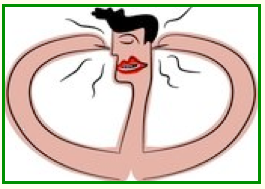
• How we carry our body can indicate how we’re feeling emotionally, not just at the moment, but habitually. We store un-processed stress in our body’s organs, muscles, chakras, meridians & electro-magnetic layers. Specific emotional residue of abuse AND negative beliefs are stored in various locations in theabused body.  (Anger in the liver, not being supported is in the lower back muscles, shame in the gut, fear in the heart or stomach….)

EXP:  Some people’s whole body center is visibly concave, as in these drawings. It shows they were severely & regularly abused in childhood, often continued in current toxic relationships.

☁︎ Their solar plexus has been emotionally punched (sometimes physically too) so often that their body is trying to pullback from future blows they know will come – or are still expecting, even long after the danger has passed.
There are also many abused people whose outward signs are much subtler, but the cues are there as well – to help us understand their behavior
➼ Generally, people who are confident & happy stand erect, head up, shoulders back, & walk with a sure but not arrogant gait. Depressed or self-hating people may stand with head down, slumped shoulders, slow or unsure walk…..  Changing how we hold our body can improve how we feel about ourselves.

Of course there are exceptions:
♿️ someone with a chronic physical illness or disability may move slowly, be hunched over, clumsy, needing a wheelchair. Yet they can be confident & emotionally balanced, with ups & downs, but not miserable,
☢️ while some who are deeply insecure may strut & seem ‘strong’ emotionally, only because they present a facade to compensate for being afraid, expressed as anger & inflated self-importance.

NEXT:  Emotions & the Body  (#4)

The BODY & Emotions (Part 2)

body Es 2OK, TELL ME ALL ABOUT IT.
Yeah, but you left out how you feel!

PREVIOUS: Emotions & the Body (#1)

SITEEmotions Are Physical 
INCLUDES “Signs You May Be Afraid of Your Emotions”

IMPRESSIONS
1. Showing strong Es in public too blatently is usually looked down on or made fun of – in the theater it’s called ‘chewing the scenery’ (think Captain Kirk) but is acceptable if we’re at a ballgame or rock concert. We remember how Jackie Kennedy was endlessly praised for her stoicism at JFK’s funeral.

2. On the other hand, when someone shows NO sign of emotion, it will be read by others as an indication that —
a. the topic is not important, as when :
= someone carries on about something too intellectually, or is just talking BS
OR
= talk in a monotone (flat affect), a neutral voice or with a smile about very painful events – the way many ACoAs do about their traumatic childhood, or newscasters reporting a tragedy.
The listener may just gloss over it or not actually ‘hear’ the info!

b. OR that they’re a ‘cold’ fish, heartless, even psychopathic, like if there’s no emotional reaction to the news of their child being horribly killed, or told they’ve lost everything in a disaster

c. BUT if someone doesn’t show any Es about an event or person –
it can imply that they disapprove of it / them, like when there’s complete silence from an audience toward a performance or a public figure, or we ignore a friend or spouse…..

REALITY
Regardless of the actual reason for a person not adding emotional subtext to their communication (from boredom, exhaustion, sickness, shock, shyness, shut down, terror….), the average observer is looking for some cue to the meaning (value & relevance) of what they’re hearing from or seeing in another person – which would help them know how they themself should feel & respond (If you don’t care then I won’t care either)
HOWEVER
Everyone does unconsciously telegraph their true feelings – even the reticent & the repressed – by micro-expressions of the face & throat muscles (as well as other physical signs like a clenched fist, leaning forward or back, slouching….).
Normally, both sender & receiver of these tiny movements are unaware of them, but astute observers can pick them up anyway & respond internally, if not outwardly. As in the “Lie to Me” TV series, anyone trained to carefully read them can identify what someone else is feeling / experiencing

ACoAs
1.
Toward ourself –  we were thoroughly trained to ignore our own   experiences (intuition, emotions & thinking), that we’ve suppressed (but NOT lost) the ability to know what we feel, becoming numb to this level of internal information, from both feelings & body sensations

2a. re.Others
• Because involuntary muscle contractions are such subtle cues to someone’s emotional state, and –
• we’ve just as thoroughly been taught to deny / ignore what we hear & see from others, unfortunately :
— we don’t even notice these interaction, BUT
— if we do pick up the cues from others (what they’re actually telling us about themselves), we don’t trust what we’ve seen, & then talk ourself out of the implications.
This is one reason we’re greatly handicapped in understanding & dealing with others.  Fortunately, we can change this!

2b. At the same time, as kids in a chaotic, abusive environment – we became overly focused on how the adults were feeling, in an understandable desire to protect ourself. Their every nuance became signals – are they going to beat me, fall asleep drunk, stay in bed depressed or “sick”, be in a rage & get ready for a fight…..
Our goal was to placate the monsters & stop the abuse. This never worked! to change them, so one conclusion was that we’re a failure at understating moods & ‘fixing  pain’.

SO NOW – it’s hard for us to evaluate :
• what someone is actually telling us. We easily misread their meaning or motives
• what we feel emotionally about their communication. We react from internal wounds instead of responding to present info
• how to respond appropriately, so our actions are too harsh or too weak

Because of our ‘limited vision’, when someone is verbally insensitive or mean, we don’t feel the emotional punch in the stomach until sometime later if at all, & then are more likely to feel scared, or maybe get angry but blame ourself!

NEXT: The Body & Emotions (Part 3)