LIARS & the BRAIN (Part 1)

PREVIOUS : How to LIE (Part 2)

SITEs : ✐ “Secrets of Body Language” documentary film

«
LYING & the BRAIN
The neocortex, made up of the Frontal & Temporal Lobes, is ‘intellectual’ (not emotional). When lying, a person’s activated frontal lobe is capable of dishonesty, & therefore involved in suppressing the truth, which makes it hard for others to know if you’re being lied to

The limbic system (emotions) compels a person to react subconsciously to situations, so their non-thinking reactions are very honest & can reveal a person’s true feelings, like a poker players ‘tell” when trying to hide a bluff. When it’s activated a person’s anxiety increases because of their deception.

When someone tells the truth, fewer brain cells are activated in the frontal lobes & limbic system, which which have to do with memory encoding & retrieval, needed to check whether the mental imagery used when communicating – is accurate .

🧠 The Nucleus Accumbens is considered the ‘pleasure dome’, known for its roles in pleasure, reward, & addiction. It allows us to perform 2 fundamental human activities – to survive & procreate. Activated neurons in this region release dopamine, a hormone that gives us the feeling of happiness &  satisfaction.

When we exploit these natural needs for selfish ends (over-eating, living in fantasies, chasing money & power….), the pleasure dome shrinks, not releasing dopamine, even when an original desire is fulfilled.

The resulting discontent propels us to keep  looking for ways to fulfill the craving for pleasure – choosing unhealthy activities – which often include manipulation & lying. EXP : Someone who lies, cheats or steals compulsively finds it ‘rewarding’ to deceive others.
But, like with any addiction, the moments of enjoyment are short-lived, inadequate & disappointing, so the person becomes a slave to repetition.

Much research has allowed neuro-psychologists to identify distinct area in brain when a person tells the truth vs when they’re lying, because different parts are used when deliberately telling a falsehood. Neuro-imaging studies in volunteer-participants showed activation patterns when they were asked to lie or tell the truth. Results : the ventro-lateral & dorso-lateral areas of the prefrontal cortex become more lit up when lying .

Also, if we think of the brain as a computer, Gray Matter is the hardware, & White Matter makes up the cables that connect the network & transmitting signals. 
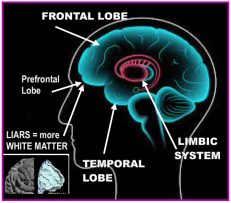
Interestingly, brain scans have revealed that the prefrontal cortexes in frequent liars are built differently from those in a typical brain. A 2005 study showed that in this region they had about 14% less gray cells -which play a role in impulse control. AND the scans showed they had 22% more “white matter” than average, allowing them to be better at manipulate information & words- so they can weave thoughts in ways others probably can’t.

Another study also found that compulsive liars have up to 26% more white matter in their prefrontal cortex, showing they’re better at making connections between various thoughts not based in reality.  EXP : an airplane mechanic might falsely combine ‘Me’ with ‘fighter pilot’.

While the key to success in both personal & professional relationships is the ability to communicate well, it’s not only the words used but the nonverbal cues or “body language” that speak the loudest. They include physical behavior, expressions & mannerisms that ‘speak silently’, often instinctive rather than conscious.

POLYGRAPH : the lie detector machine measures the activity in the limbic system, the anxiety felt by the subject (person being tested).
It can therefore be fooled if they’re usually calm (telling the truth) or are a Pathological Liar without a conscience -because they’re internally congruent (not in conflict) .
The information gathered by the machine is only 50 – 90% reliable, so polygraph test results are inadmissible in court, not being scientifically reliable enough when the stakes are so high.

NEXT : Liars & the BODY (Part 2)

DETECTING LIES (Part 3b)

PREVIOUS : DETECTING LIARS (#1)


HOW TO SPOT A LIAR (cont)
1. Reverse story
2. 
Answer delay


3. MISSING FEELINGS

In the interrogation literature, there’s a concept called “reality monitoring” –  how we store memories, compared to storing fiction.
◆ When recalling a true memory, we’ll refer to sensory details (how things looked, smelled….), as well as how we felt about a specific event – annoyed, bored, amused, uplifted…..

► On the other hand, when rattling off a made-up version, a liar is more likely to use “cognitive operations,” mental gymnastics that are literal, logical & matter-of-fact, without including emotions or body responses. (Post : “Repressing Es”)

EXP :  Suppose you’re talking about walking home from a movie. If it is a true memory, your may focus on the sound of the bus splashing a puddle or your annoyance at being wet. Truth-tellers tend to include sensory descriptions, liars do not.
If it’s made up, your version will sound more rational —  “It was raining, so I must have had my umbrella.”

4. HOLD your EVIDENCE
If you’re suspicious of someone, direct confrontation is one of the worst ways to get to the truth, as it gives your whole plan away. Don’t start by saying : “I know you did it!”
If you show your cards too soon, all they have to do is say No & you won’t know what’s real.
Also, experienced liars don’t show the usual signs – they don’t look stressed or make obvious mistakes.  With them, the best route is to sit back & wait, letting the liar sabotage themself.

According to the “Journal of Investigative Psychology & Defender Profiling” you should continue asking questions no matter what they say (unless you know you’ll be physically injured by them).
Just assume at first they’re telling the truth.
Eventually – if you keep pushing for more & more info about a situation, they’re going to run out of the prepared story & start contradicting themself.
IF you’re prepared – that’s the perfect time to spring the evidence   you have as proof of their lie.
In an intimate relationship, as soon as you flip the switch, they :
— may make elaborate excuses / justifications/ blame you
— act insulted, try to make you feel guilty for doubting them
— OR get very angry & verbally attack you
— OR laugh, make fun of you & walk away
— OR most often, the partner will just clam up.
RARELY – show signs of stress, stutter, crumbling the cool facade

5. ADD the UNEXPECTED
Whether trying to finagle the truth from a teenager or suspecting a friend of fabricating a story, catching someone in a lie takes some effort & knowhow.
When someone’s telling you a story you suspect is false, interrupt with weird questions as they talk. A good way to spot a liar is to throw them a curve ball in the middle of their story.
Scientific American looked at military interrogation tactics to see what works in everyday life, & found that posing left-field questions can trip up a liar.

Ask for random information  – something they weren’t expecting, & watch their reaction. Specifics are good – the more unrelated to the version they’re telling the better.
Example: If you think someone’s lying about having been to a movie theater, ask what the previews were, if a particular B-list actor was in the film….. (MORE …. )

A 2011 essay in the Journal of Applied Cognitive  Psychology – agrees that unexpected questions forces a liar to improvise, which can throw them off. It means having to make up something they didn’t have planned, so their initial story will fall apart as they make more & more mistakes. Most people caught in a lie will stumble or burble when put on the spot.

WITH FRIENDS
A 2012 study published in the Journal of the Human Factors & Ergonomics Society found that social behaviors change when a person is lying. They’re more uptight, even if everyone else is relaxed.
Truth-tellers tend to fall in sync with the people around them, easily making eye contact, laughing & mirroring the body language of their friends or partner.

CAVEAT: Tare care to not repeat a version of Othello’s error – Shakespeare’s tragic hero – who, after inaccurately accusing his wife of infidelity, mistakes her fear for signs that she’s lying —> & kills her!

NEXT : DETECTING LIARS (Part 3)

DETECTING LIES (Part 3a)

PREVIOUS : Types of LIARS (Part 2b)

3 POSTs :  “Why ACoAs Lie

SITE: Culture & Deception
(Can we tell ?)


NOTE for ACoAs
The following suggested tools are not only for law enforcement & legal uses.
WE grew up with blatant or subtle lies from family, school, news & social media …. SO we can too easily attach to mates, friends & groups who also control others, pushing their world view by cleverly concocted lies. Narcissist are particularly adept.

CATCHING a LIAR
“Americans consider themselves a “truth-default group, unconsciously assuming people are telling the truth.
HOWEVER – author Pamela Meyer, in her very popular TED Talk on Spotting a Liar, suggested that most people are on the receiving end of 10 – 200 lies every single day.  But it’s tricky to get lying just right, so it has to be done carefully & sparingly.
⁍ Too much, & no one trusts you
⁌ Too little, & you get laughed at, called “blunt,” or shunned as socially inappropriate. ”

1. STORIES in REVERSE
IF you want to check if someone is going to answer your Q honestly – & you know or suspect they tend not to :
a. Ask the same question 3x in different ways —-> to uncover their lie-pattern. The 1st time – you’re likely to get a well-planned answer – the details, the words they’re going to use…

b.
What happens when you ask again, in a different way?
IF they’re telling the truth, they may add some details or tell the story differently.
To spot a liar, be a good listener. Research found that liars often hesitate or don’t talk ‘smoothly’ because “they can’t draw on real memories, lack the imagination to make up a detailed, plausible story, or are afraid they’ll give themselves away.”  Since they only have one version about an event, they’ll rehash the same words, details, even the same phrases.

c. Ask a 3rd time – about details – the less important things in a situation.
◎ If they were at a restaurant, “what color were the chairs?”
◎ If they were staying with friends, “which bedroom did they sleep in? What did it look like? ”
Keep them talking & it gets even more obvious – the first version you heard is repeated – again.
SO ask them to tell their story in reverse.

By the ‘law of human behavior‘, when asked to tell the false story backwards, it’s much harder – if it’s a lie – as they try to imagine details in reverse. It increases the “cognitive load” exponentially. They get confused, talk slower, make more mistakes or leave out important derails, give contradictions.

Opposite – when you’re being told Truth, a ‘story’ is almost always easier to explain, even in reverse, actually uncovering new info or details missed before.

◘ KEEP them BUSY – a variation
The “cognitive load model” of deception says that “lying is multi-tasking, & therefore difficult. Liars must plan what they say, remember to play a role, & suppress the truth.” So, make it harder for them.
Professor Albert Vrij et.al. (Portsmouth, UK) suggests getting a known liar to focus part of their attention on some important concept or task, or sometime they love to do.
Then at the same time question them about a suspicious behavior, unhealthy plan, abusive comment (“Why did you….?”). If their brain is busy doing other things, they won’t have as much mental resources left over to lie, or at least, not as convincingly.   (MORE….)
EXP: ◎ If you suspect your partner of cheating, ask them questions while they’re driving. ◎ If you suspect your teen is using drugs, ask about it while getting them to do household chores…..

2. ANSWER DELAY
Normally, when someone asks a question you were not expecting, you pause, taking a second to think about your answer – honestly.
BUT practiced liars often jump the gun. They have something already prepared, always wanting to be a step ahead, so they’re anxious to get that lie out of their brain & into the world (on you).

When checking to see if someone is lying (you know they often are) –  listen for that little pause. If they skip it & answer right away, there’s a good chance they’ve planed their excuses / justifications / ‘false proofs’ – way in advance – just in case they get caught!

NEXT : DETECTING Liars, (#2)

REASONS we LIE – in Brief (#2b)

bPREVIOUS : Reasons we LIE – in Brief (#2)


33 REASONS (cont)

❥ Manipulate: An abusive person constantly lies in order to continue their manipulation – to keep the other on their power. If the truth came out, the victim might leave

❥ Maximize: At one extreme, some lies exaggerate the person’s feelings or situation, making things worse than they really are, for dramatic effect

❥ Minimize: With the opposite version, a person may minimize a situation by lying, trying to reduce the physical damage, emotional harm, or punishment that might otherwise occur

❥ Perception: Some people believe their own illusions. Their perception of reality is distorted enough, so they believe their ‘version’ is not a lie

❥ Procrastinate: Passive-aggressive avoidance of responsibilities is a way to procrastinate making decisions or taking a specific action. This lie is more subtle because they knows they should be doing something but are intentionally putting it off

❥ Protect: Some lies are done to protect others, such as taking on responsibility for things the person did not do or is not responsible for, in order to benefit someone else

❥ Suppress: Some lies are intentional – meant to cover up their  misbehavior or a problem they can’t cope with

❥ Superior: Those with larger-than-life egos put out big lies, to maintain superiority & make themself look better than everyone

❥ Sympathy: Similar to attention-seeking, a person who tries to get empathy from others will lying about a past or current event

❥Vindictive: Some people use lies to intentionally cause harm as a way of getting back at another person or group they feel harmed by.

🖤     🩶    🤎    💙  💔
FEELINGS : Many people lie, directly – or indirectly by omission, to hide their feelings and emotions. This may be a way to get along in most areas of our life (work, at parties, on the street) but sadly we also lie about ourself to people we’re supposed to be close to – family, mates, friends, adult-children….

Remember that what we normally mean by “feelings” are not emotions but rather some form of thinking : an opinion, a belief, an experience, a point of view….. none of which are either emotional feelings (sad / happy) or body feelings (tired /energized).

EXP: Whenever someone asks you : “How do you feel about that ?” almost everyone will start describing an event, a reaction…. not emotions. RULE : any response that’s more than one word is a thought – a mental expression!
That includes all lies, no matter how short.

We lie to avoid events & circumstances that make us anxious – like speaking up for our rights, or saying no to something we don’t like. We want to suppress emotions that come with them such as guilt, depression, sadness & anxiety.  So we lie because we don’t want to feel vulnerable.

Most people lie about their “feelings”, acting as if we don’t have many concerns, but we really do. This includes both our opinions (cognitive) or emotions (feeling).On the other hand, it’s important to have boundaries. It’s not appropriate or acceptable to expose ourself or to burden others with our personal difficulties. This RULE is: Do not justify yourself, but do not lie. No is a complete sentence !

INTELLIGENCE – Perhaps surprisingly, it turns out that  intelligent people lie more often than others. There are many studies proving that those with higher intelligence are good at deception. They also lie because of having better emotional intelligence.
Lies are the “Precursor of the previous lie”
There’s a maxim that : “A liar’s worst enemy is someone with a good memory….. You’ve got to create a hundred other lies to hide a single one.” That is accurate, because people can get even more involved in falsehoods to cover up the lies they’ve told in the past. Research has found evidence for a retrieval mechanism that helps us remember the lies we’ve already told – in response to re-encountering a question that one has lied about before.

❣️ Telling the truth is considered easier than maintaining a web of lies, because you don’t have to remember what you said previously, which can lead to more authentic, meaningful relationships.

NEXT :

REASONS we LIE – in Brief (#2a)

PREVIOUS : Type of Lies & Liars, #2

3 POSTS : “Why ACoAs Lie


The main reason people lie is low self-esteem. The person wants to impress, please, & tell others what you think they want to hear. If you often find yourself being deceptive with family & friends to sidestep volatile or painful subjects, you may need to strengthen your interpersonal skills, & in some cases, avoid the person instead of the issues.

33 REASONS

❥ Attention-seek: Some people lie just to get other people’s attention (HPDs & NPDs) . The irony is that most don’t know what to do with the attention when they do get it

❥ Avoid: Some lying is to avoid consequences of bad behavior, or get out of trouble if caught – especially true for children.
It many instead be a need to avoid embarrassment (reason for forgetting an appointment)

❥ Bored: Some people are ‘addicted’ to drama in their life. So they lie to stir it up & watch other people’s reactions

❥ Curiosity: Some people lie when wanting to poke their nose into things that are none of their business, without considering possible harm to self or others – a very childish behavior some don’t grow out of

❥ Covet: When a person is envious of what others have (& don’t know how to get what they want for themself !) they lie by pretending to be happy for someone else’s success or accomplishment

❥ Cover: Some people wear a social mask, pretending to be something they’re not.  To keep up appearances, they lie to hide revealing who they really are

❥ Control: For some, their whole life is trying to control everything & everyone – o they feel safer.  A web of lies are told to keep others in line with their one goals & desires

❥ Deny: Some are convinced they can ‘eliminate’ a person or situation (death of a child, fatal illness) by lying to themself & others to deny the reality, which may be deliberate or by omission

❥ Disappointment: A lie can be told to avoid disappointing another person or even themself, so eliminating their uncomfortable feelings (fear of rejection) justifies the deception

❥ Desire: Wanting to believe a lie someone tells them to be true (‘I love you’ from an abuser) has a deep need / desire to cling to their distorted misconception

❥ Elevate: A person who wants to lift themselves up to another person or group will lie about their high level of morality, strong work ethic, or perfectionistic standards

❥ Fun: Some people lie as their form of private entertainment, to feel superior (“I know something you don’t know”), because they like the power of manipulating others

Gains : The second most common motive for lying, in both children & adults, is to grab a reward not easy to get, or not legitimately available. (on a job application, for an inheritance)

❥Habit: Lying can become a very bas habit with lots of repetition over time, which can seem natural rather than an aberration

❥ Harm: A person determined to harm another person who is vulnerable will lie as a common tactic about who they are & what they’re doing. (abductions, molestation, narcissistic control)

❥ Hide: A person can lie to hide who they are, about what they’re doing or about someone else – to avoid accountability. This can be about their own addiction, their mate being phycaiuly abusive….

❥ Impress: As a way to try impressing others & to look better, a person will lie about who they are, what they’ve done, or where they’re going

❥ Indifference: A person can lie to another about some subject because they doesn’t care whether the listener believes them nor not, nor about any consequence of the lie, so won’t see anything wrong with their deception

❥ Intimidated: Sometimes a lie comes from being intimidated by others. This feeling of inferiority is so uncomfortable that they lie to cover it up (fawning)

❥ Lazy: On occasion, a lie boils down to a person being lazy & not wanting to do the work the promised to do or that was assigned to them, so they lie about the avoidance

NEXT : REASONS we LIE – in Brief (#2)

Type of LIES & LIARS (Part 1c)

PREVIOUS : Type of LIARS (2a)

SITE :  Pathological Liar vs. Straight Shooter
😏 Saying
: “Liar, liar, your pants are on fire”

“NORMAL ” vs. PATHOLOGICAL Lying (cont.)

◼️ Pathological
INTERESTING : Psychology & neuroscience provide clues to why some people lie up a storm, while others have trouble being dishonest or detecting dishonesty in others

😇 At one end of the spectrum are those rare individuals who can be described as “pathological truth-tellers.” They refuse to use socially convenient & appropriate fibs, but rather only speak the unvarnished, upsetting truth.
😝 This is a well-known pattern of some ACoAs –  blurting out whatever comes to their mind, (like a chid – “Look mommy, she so fat / he’s ugly….). Such unrecovered ‘normal’ ACoAs are desperately compensating for a severely dysfunctional upbringing, ✒︎ angrily insisting that everything be ‘fair’
✒︎ determined to tell whatever they observe, without boundaries
✒︎ getting back at family lying by outing them to the whole world
✒︎ not let anyone get away with any form of hypocrisy & deception

🧡 However, more commonly, it’s a well-known feature of people with high-functioning autism & Asperger’s Syndrome. Brain scans using fMRI show them to have less activity in areas of the “social brain“, so parts of the prefrontal cortex that should light up – don’t.”

They have a tendency to be very blunt & direct, honest to a fault. Also, they have trouble detecting falsity in other people’s words & actions, making them gullible, AND because they assume other people are as honest as they are, they’re vulnerable to anyone who looks to take advantage.
EXP: TV characters with Autism Spectrum Disorder.

😈 At the opposite extreme —> found in a portion of ‘normal’ people with long-term neglect & abuse, & ACoAs severely traumatized by years of physical & sexually torture.
“Pathological liars have a pattern of frequent, repeated & excessive lying, distinct from occasional dishonesty, with no apparent benefit or gain to them, which seems to defy logic.

What’s most puzzling is that it’s counterproductive. Spouting flagrant whoppers cause trouble in jobs, relationships, even with the law through self-incrimination! Stranger still, the blatantly falseness of their lies can easily be seen through. Not only is there no obvious personal benefit to the lies, but most of the time are easily disprovable.
Researchers speculate that pathological liars experience some sort psychological excitement from fooling others, an internal satisfaction that makes them keep it up, but it’s not known why, suggests Dr. Charles Dike at Yale U. & CT Valley Hospital.

Whether consciously or not – their lies may be triggered by a desire to avoid shame or conflict. It typically includes creating elaborate stories to impress others, & adding more lies when questioned. Pathological liars are characterized by 5 traits.
THEY:
🔻are great storytellers with vivid, dramatic, fantastic & detailed imagination
🔻 make lies convincing, since they’re natural performers
🔻 can end up believing their lies by constant repetition
🔻 will portray themselves as victims or heroes in the ‘stories’

🔻speak in generalities rather than specifics – most of the time, but especially when confronted, acting as if they don’t know what someone is asking them about. Avoiding direct answers, they never have get to the issue at hand, & can react against the challenge (“Who? not me !!  How dare you accuse me…. I never….”)

Recognizing pathological lying can be incredibly difficult, but a recent study published in Psychiatric Research and Clinical Practice developed a self-assessment scale that measures this pattern.  When taking this test, one indicates how strongly they agree or disagree with each item. MY LYING :
√ has caused severe problems in all my relationships
√ is very emotionally distressing
√ has put me or others in danger
√ is out of my control
√ tends to get bigger once I start
√ is for no valid reason
✤ After I lie, I feel less anxious

Pathological lying, with its persistent need to “make up stuff”, has a severely negative impact on one’s overall well-being, as the person gets tangled up  in their own web of deceit.
Some will admit to impaired functioning, being constantly stressed & in more danger – than non-liars – in their emotional, social, & professional life. Because their lies erode others’ trust in them,  genuine connections are not impossible.
In severe cases, pathological lying can lead to financial instability & legal troubles, further compounding the toll it takes on themself & their family.
SITE: Overcoming Pathological Lying

NEXT : Reasons we Lie (#1)

Type of LIES & LIARS (Part 1b)

PREVIOUS : Type of LIARS (Part 1)

SITE :
“Why People Lie


“NORMAL ” vs. PATHOLOGICAL Lying

🤍 WHITE Lies
 These are considered harmless, often well-intentioned lies told to spare someone’s feelings or avoid unnecessary conflict or discomfort. They usually have minimal consequences, & are generally socially acceptable. EXP: praising your aunt’s cooking—even if the meal wasn’t to your liking – to be polite & keep peace.

✐ People who tell white lies don’t think of themself as true “liars”
✐ They justify them as harmless – even beneficial – in the long run
✐ Will tell only part of the truth, so are not suspected of lying at all
✐ May use lying to shield someone from what they believe is a hurtful or damaging truth

Occasional liars
• These people seldom tell lies
• Are respected for trying hard to be truthful
• When they do lie, they’re so surprised or shocked that guilt overtakes them
• Humble enough to admit their mistakes
• Are quick to ask for forgiveness from the person they lied to

🩶 GRAY Lies
These don’t fit neatly into either White – since they’re more serious, but not Real, which  are malicious.
Gray lies can be used to avoid unnecessary conflict or discomfort, but don’t always have such pure intentions.
EXP 1 : By omission – leaving out important facts – which can be as deceptive as Direct ones, such as not mentioning to your friend that their partner has been flirting with someone else, even though you actually saw it.

EXP 2 : By exaggeration, which inflates or embellishes the truth to make a person or story more interesting or to impress others – such as boasting about how much you can bench press by overstating your strength & weight capacity.

Careless liars
• These people go about their normal lives, & easily lie whenever they can
• They aren’t concerned about trying to hide their lies, nor that these make sense
• Everyone knows they’re lying because they’re sloppy at it
• They have very few friends, because people get sick of their obviously twisted stories. 

🤎  REAL Lies
These are deliberate falsehoods, more deceptive, intended to gain personal advantage, conceal wrongdoing & manipulate others. They’re rarer, but planned & executed for a specific reason, possibly with negative social & legal consequences. EXP : falsely claiming that your phone was stolen — to get a replacement from an insurance company — when it was just lost.

Smooth Liars 
• They’re so good with words & body language that others tend to believe them, even when they have a reputation for being a liar
• They’re very entertaining & fun to be around, but when found out, tends to move on to others who they can apply work their dark talents on. 

Compulsive liars (Part 2b)
Their lying is an addiction, often without a clear motive
• Most report an inability to stop themself, even when wanting to
• Tend to be their “normal” way of responding to any question

INTERESTING
🚩Research shows there are also gender differences in honesty.
♦︎ One paper suggests men are more selfishly dishonest than women. A meta-analysis of over 8,700 observations found that men tell more black lies (for personal benefit) and white lies (altruistic).

♦︎ It was also observed that men are more likely to deceive themself, believing they’re superior & so deserving of special treatment, driven mainly by the exploitative/entitlement facet of narcissism,
♦︎ And regarding self-regulation – men are more competitive, which is associated with a greater willingness to deceive.
Their conclusion : Men are generally more dishonest than women, anywhere it serves a self-interest, & especially in high-rival environments.
Women are less competitive, more guilt-prone, with greater moral-identity strength than men.

🚩 Another study found “a significant link between lying expertise & gender.” Men are twice as likely as women to consider themselves expert liars who get away with it, preferring to lie to your face rather than via text messages, with social media the least likely way.
Previous research concluded that most people tell 1-2 lies per day, but that’s not accurate – most do not lie daily.  40% of all falsehoods come from a small category of deceivers  – the ‘Prolifics’, who lie with impunity (without fear of punishment), especially to those closest to them.’ (MORE….)

NEXT : Type of LIARS (Part 2b)

Type of LIES & LIARS (Part 1a)

PREVIOUS : Noticing Lies 

POST : “Why ACoAs Lie

SITE12 Types of Liars 


STUDIES: Children learn to lie around age 3, and researchers believe it’s part of normal human brain development. Lying requires learning to see things from other people’s perspectives, developing what psychologists call “theory of mind.” Learning to tell an effective lie means getting into the other person’s head in order to tell them what they want to hear.

EXP : In games like poker, being a skillful liar can help you win. In politics, knowing how and when to lie can be an advantage.🏳️ To develop safety in the world and self-esteem with integrity, understanding lies & liars can help us avoid getting duped, as well as protect us from drifting into dishonesty ourself.

CATEGORIES :  We can classifying lies: BY the —
— consequences of the lies
— importance of their subject matters
— speakers’ motives
— nature or context of the statement
AUDIENCE : Someone can lie to 2 kinds of audiences –
— to other people or to themself
TOPIC : You can lie about 2 different categories of things
— facts (or what they believe to be facts) and their value, which are the attributes of the person you want to become.
PEOPLE : And the most useful grouping is BY the most basic types of people who tell them.
🏴 DECEITFUL : Habitual liars get labeled as untrustworthy and earn a bad reputation that often precedes them, especially in our hyperconnected age. Whether it’s checking out someone to date or do business with, our online profiles and social connections increasingly help people keep tabs on our character.

However -for the most part- we outgrow telling childish lies for purely personal gain, but still tell white lies as adults to maintain social relationships. Imagine what would happen if you responded instead, “Well, the world is falling apart, I’m starting to question the purpose of my existence, and I’m feeling bloated from the kale salad I ate. But how about you?”

White lies aside, lying to others about facts for personal gain is corrosive to relationships and, if it’s a consistent pattern of behavior, can shut us out of people’s lives (and sometimes society in general).

🏁 DELUSIONAL :  We also lie to ourselves. You might tell yourself that your curt response to someone wasn’t insensitive, or that you didn’t take more than your fair share of dessert, or that you contributed more to the team project than you did.

We constantly lie to ourselves and there’s reason to think that healthy psychological functioning involves some level of self-deception. However, not all self-deception is created equal.

There’s a difference between the commonplace lying that mentally healthy people engage in and the kind of self-deception that marks mental illnesses like schizophrenia or manic depression. There’s also a difference between certain types of self-deception and lies that erode our integrity…….

🇿🇲 DEMORALIZED : those who lie to themself about their values – for many of the same reasons they deceive themselves about facts. Among other things, they want to see themselves as more diligent, honest, or trustworthy than they really are. They say they are committed to working hard, telling the truth, or keeping promises, but their actions say otherwise.

The pitfalls of lying about values are similar to those of lying about facts, but there is an added snare—lying to ourselves about values compromises our integrity.

 🚩 DUPLICITOUS : People can lie about their values as well as about facts. They say they’re committed to being someone or to doing something, but their actions prove otherwise.

“Duplicitous” comes from the Latin word for “twofold / double” & it’s why we call this sort “two-faced.”

Lying about values can be even more corrosive to relationships than lying about facts. When I state a commitment to being faithful or healthful or loving, I position myself as a certain type of person. I am telling people what kind of person I am now and in the future, so they can count on me to act in certain ways…….

NEXT : Types of LIARS (Part 2a)

LIES, MEDICINE & THERAPY

PREVIOUS : LIES & LYING – Intro (Part 1)


Clients LYING in THERAPY 
People lie to their therapist more often than we think & most are lies of omission. It’s not easy to admit that we act against core beliefs from our upbringing, or opposed to how we see ourself (a ‘good person’). We resist confessing that we do & say things that shatter social moral codes, dishonor our values, & that we’re self-destructive or hurtful to others.
EXP : “I didn’t think it was relevant that I had a drug problem. That was two years ago!” // “Uh, did I forget to mention that I ‘m having an affair?”
People in therapy lie about all kinds of things, & these are just a few. ► It’s understandable that someone will leave out important facts about a part of their life = because it makes them feel ‘safer’, less humiliated. So they offer just enough information to get emotional supported or validation. They may think to themself about a serious issue : “That part is better kept secret. I’ll take care of it myself. I’ll tell them just so much, so they can still help me without spilling it all…..”

Anyone who lies to their therapist is wasting time & money. Clients may believe lying by omission is a form of self-preservation, but if they say they want to heal & grow – it’s a huge handicap. At best, it’s a distraction, & at worst a manipulative deception that prolongs their anxiety & self-sabotage. It either drastically postpones valuable progress, or totally derails the therapeutic process.

BUT – if you feel judged, criticized or ridiculed, you’re in the wrong place. Find a new therapist. (Modified article by Karen Kleiman)

Therapeutic Lying
a. DOCTORS
If “therapeutic” – means the healing or curative powers for treatment of disease or disability and
if “lying’ is making a false statement with the intention to deceive,
then lying is not therapeutic.
Roswell Park Cancer Institute states: “If there’s one thing sacred in the doctor-patient relationship, it’s trust. Open & honest dialogue on both sides is critical for effective care.

Patients have to be truthful to ensure diagnostic accuracy & an appropriate treatment plan, while doctors need to provide full disclosure about their patient’s health – the good & the bad – to help patients make informed decisions. Indeed, patient autonomy is the cornerstone of modern medicine & patient-centered care.”

Exceptions – Caring for dementia patients is complex. Lies that reduce suffering & stress in patients – unable to fully appreciate the cause of distress – can be beneficial. Clinicians sanction their use in these cases & see them as ethical & non-malfeasant.

EXP : A caregiver may tell an argumentative patient with Alzheimer & hypertension, who is worrying about where his wife is, that “she’s gone to the store”, rather than that “she died 7 years ago.” Here, the lie avoids a possible fight that may cause a rise in blood pressure.

Other options : Instead of lying to a dementia patient, it may be possible to validate the person’s concerns. OR by Redirection – diverting their attention to something pleasant. (much MORE…..)

b. PSYCHOLOGISTS
An under-researched topic is therapist dishonesty. Ideally, they have to use professional judgment in deciding what’s relevant, appropriate, & helpful to a client – regarding what to say or not. At times therapists also conceal, exaggerate, or explicitly mis-represent. Curtis & Hart (2015) found that 96% of canvassed practitioners reported intentionally keeping information from clients “in order to protect” them, & 81% reported directly lying.
«

«
However, when looking at this list – we can see there are appropriate & legitimate situations where no disclosure is best.
And when necessary – information is communicated fairly, yet indirectly/partially, without burdening the client or without lying.

✍️ Traditionally, classic psychoanalysis means the therapist stays objective & anonymous, preventing them from any self-disclosing.🧡 But as the practice of treatment has evolved, therapist self-disclosure is now seen as a possible tool to help clinician normalize a client’s humanness. Admitting fallibility & modeling open expression – when used in moderation – may strengthen the therapeutic relationship thus encouraging client disclosures.

Naturally, not all therapist self-disclosure is beneficial. It’s imperative to maintain professional boundaries & keep the focus on the client. But many clients do respond positively to examples that reveal & clarify their issues, as long as those aren’t too private to the therapist, nor being used to elicit help & support from the client.

NEXT : Types of Lying , #1

PSYCHOLOGY of LYING

PREVIOUS : Noticing LIES & LYING – Intro (Part 1)

SITE : Lie Detection & the Polygraph

HANDHELD “Portable Lie Detector /Deception Indicator”


Psychological Model of Lies
Motivation : Prosocial – to benefit others, or Antisocial – for purely selfish reasons.
Lying ability is identified from 3 sources: lying theory, neuro-imaging research, & experimental studies. It involves several cognitive processes : Inhibitory Control, Intelligence, Task switching, Verbal fluency & Working Memory.

Very important —-> Lies :
🔻 are associated with physical arousal
🔻 are linked with intense, painful emotions (often suppressed)
🔻 require greater cognitive effort than truthful messages
🔻 prompt liars to over-control their behaviors.

EQ expert Dr. Lansley at ‘Emotional Intelligence Academy’ says
“When we’re truthful, there is a consistency, flow, harmony & spontaneity between what we think & feel. All we have to do is remember an event & then describe it.

However, with a lie, there’s much more going on ‘under the hood’. A liar has to : ❁ Create the lie
❁ Remember any lies they’ve told in the past, so the new one doesn’t contradict them
❁ Assess whether their lie is being believed
❁ Try to show any appropriate actions & emotional displays that will support their story
❁ Control any behavior that would look out of place
❁ Commit the lie to memory to be sure they’ll be able to accurately retell it later (wikiHow “How to Lie”)

Categories
Half-Truths – statements that offer only part of the truth, used deliberately to deceive someone.
☞ Exaggerations – statements that represent something as better or worse than it really is
☞ Complete Deception – causing someone to accept as true or valid what is false or invalid
Pertinent Omissions –  information not included or action not done, either deliberately or accidentally.

1. CHANNELS = When lying, the constant flip-flopping between emotional stress & mental activity, with the intense competition for resources between the 2, can be overwhelming. This causes behavioral leakage (acting out) that betrays the liar across any one of the 6 channels of communication, which are a person’s  :

◆ Body : movements of all parts except the face
◆ Face : expressions formed in bulges, creases & furrows from movements of one or more of the 43 face muscles
◆ Inter-actional Style : how we say or write words & phrases
◆ Psycho-physiology : perspiration, temperature & breath rate.
◆ Voice : ‘music’ of the voice, including pitch, volume & tone
◆ Verbal Content : what we say or write

2. ABCs 
• Account  = the story someone’s trying to convey
• B
aseline = the person’s overall behavior (see Part 1)
Context = combined influence of the immediate micro setting (current questioning) ++ the broader macro context of culture, politics, events (what, where…_).
Leakage reactions, called Points of Interest (PIns), become very useful in lie-detection because they highlight inconsistent in the deceptive ‘story’, in contrast to the ABCs .

3. CLUSTERS – Successful Deception-Detection is all about groups of behaviors. Since no single indicator is proof of lying, PIns become important when clustered with other PIns, & when those don’t fit with with the ABCs ▲.
To form more accurate & reliable judgements, clusters are needed to cross-check or corroborate evidence via the communication channels ▲. This prevents over-reacting to only 1 or 2 indicators from the same channel
EXP: By themselves, Frowning + Pursed lips are not enough proof of lying. They could mean being confused or taking time to remember or evaluate the best/safest way to answer – without lying.

Clusters follow the ‘3-2-7 Rule’ to detect someone’s game :
✒︎ 3 PIns in the ABCs
✒︎ found in 2 or more channels
✒︎ within 7 seconds of the meaning point** of a stimulus** .
In other words, if you’re paying attention, & are in practice,
you can catch on that you’re being lied to 🤥 as fast as within 7 seconds of being surprised by a Q, a boundary-invasive probe or a convoluted explanation / story —->  by observing :
◆ 3 inconsistencies inside the comment or story presented
◆ which are expressed by 2 or more body ‘hints’ of the speaker.

** The ‘meaning point’ of a question is the moment a person understands where the question is going ——>, but not necessarily where it will end up (a conclusion)
** In most cases, the ‘stimulus’ refers to an unexpected question or probe from someone
When used correctly, this formula is incredible effective for catching deception.

NEXT : Type of Liars, #1