Pyramid Uses: TRAUMA

PREVIOUS: Misc. uses

SITE: Trauma & Social Locations


CHILDHOOD TRAUMA

Childhood experiences have a tremendous impact on future violence, victimization & perpetration, as well as lifelong health & opportunities.
But there’s more to a person’s stressors than just experiences. We come “into this world in structures & conditions already established,” which are often punitive & embedded in racial bias. They limit opportunities & come with built-in economic & social inequities. (More…)

The original ACE Study (scroll to Quiz) was conducted at Kaiser Permanente (1995 – 97) in two waves of data collection. Over 17,000 Health Maintenance Org. members from Southern California who receive physical exams, also completed confidential surveys about their childhood experiences, as well as current health status & activities. (More….)
❖ Almost 2/3 of study participants reported at least one ACE, & more than 1 in 5 reported three or more. (Traumatized brain…. slides #21, 22)

◆ VERBAL ABUSE
This pyramid show how barrages of cruel words cause an avalanche of destructive behaviors – at school, cyber bullying, at work & as domestic violence, sometimes leading to suicide or murder.
Domestic violence usually starts with words, & then escalates.  In at least 3 cases a day in America, this pattern of violence ends in a death!
Many ACoAs experience the base level of verbal abuse all thru childhood, causing a life-time of slow self-destructiveness via self hate, in thoughts & actions.

As Rogers and Hammerstein said in South Pacific, “You have to be carefully taught” – to hate.  Cruel messages remain powerful because they were spoken by people who were supposedly safe, trustworthy & loving. So the words & their meaning were never challenged, simply accepted as core truths. Like the teenage boy who eventually killed himself because he believed his girlfriend who he trusted, when she kept saying : “You’ll be better off / You just have to do it / No more pushing it off /  No more waiting…..”   (More…)

HATE
The Pyramid shows biased behaviors, growing in complexity from the bottom up. Behaviors at each level negatively impact individuals & groups, with increasingly more life-threatening consequences, each level supported by the ones below.
When actions at the lower levels are treated as acceptable then those at the next level seem “normal” & therefore acceptable, possibly leading to genocide. (“Human Rights“)

Nonviolence means avoiding not only external physical violence but also internal violence of spirit. You not only refuse to shoot a man, but you refuse to hate him. Martin Luther King Jr.

VIOLENCE
To understand the violence pyramid, we must first understand rape culture, where people experience a continuum of threatened violence, from sexual remarks to sexual touching, to rape itself. In any such culture both men and women assume that sexual violence is a fact of life, inevitable as death or taxes. Rape Culture
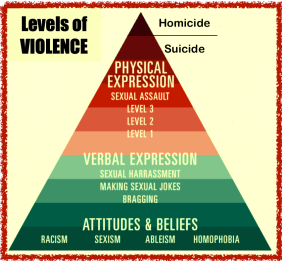
However, much of what many people accept as inevitable – especially women – is actually the outward expression of values & attitudes that  spiral down into progressively more abusive behavior, as seen in both pyramids.
As with all these tragic events, when anyone gets away with the attitudes & actions on the bottom tiers their ‘right’ to do so is reinforce, & so excuse those above. For this to change, the culture must change.  (More…..)

 SURVIVING & THRIVING
PHYSICAL: Look for safety when under threat. Pay attention to – and trust – your bodily sensations of stress. Find natural / nature environments that can soothe as well as expand your horizons.

SOCIAL: Get away from hateful & destructive relationships (avoid / hide), & only re-connect if the abuser gets help to change, or via an intermediary. Look for like-minded allies for support. Communicate your emotions without self-judgement, with safe people.

PERSONAL: Make use of trauma experiences as a way to learn about yourself – what your strengths are & where to make changes. Continue to express thoughts & emotions. Find or regain personal freedom from stressful people & situations. Learn when to bend as well as when to stand firm.

SPIRITUAL: Take time to mourn. Integrate your experiences into a broad & healthy world-view. Improve & strengthen beliefs, meaning, purpose & values. Stick to what’s real & true, & go beyond (transcend) by letting go of pain & resentment. (More…) (See all posts on RESILIENCE).

NEXT: Relationships

Pyramid Uses: RELATIONSHIPS

PREVIOUS: Reversed, #2


TRUST
NOTE:
this pyramid is constructed in relation to websites (Amazon, Facebook….) & its users – how safe is it, how much of our personal info to give….However, we can apply the same criteria to our personal relationships, whether family, friends, lovers, work mates…..

People must (should) have basic trust needs met before moving into deeper interactions (PMES intimacy).
HOWEVER, ACoAs have not been allowed to trust their gut & still small voice, & so often ignore red flag signals from others or situations which are available from the very beginning – continuing to form a connection with inappropriate PPT which, over time, is disappointing or causes us harm.

Establishing trust, in any category, should be gradual. As the relationship progresses, skepticism need to be overcome by proof that the ‘other’ is trustworthy, dependable, consistent…. .

Then comfort level can increase, & new demands / expectations can be made. The relationship should progress through the stages, built on progressive experience. Higher levels of commitment cannot be gained before the lower ones are proven.  (More…re. websites & users

♦ What’s BEST for RELATIONSHIPS : Passion or Dedication?
Robert Sternberg’s Triangular Theory of Love identifies 3 elements that combine in different ways for different types of relationships:
▪︎ Passion is associated with physical attraction & intense emotional arousal.
▪︎ Intimacy refers to a sense of emotional closeness, comfort, and support between two people
▪︎ Commitment is the choice to be dedicated to a relationship and make an effort to preserve it for the long-term

a. All 3 combined is called “Consummate Love”, but doesn’t last – for most couple – because over time Passion often diminishes or fizzles as the novelty wears out
b. A high level of Intimacy + Commitment, but lower level of Passion is “Companionate Love”, based on common interests, sharing & deep friendship

Research shows that (b) tends to be the stuff happy marriages are made of, AND – people who are very dedicated to their relationship can take a proactive approach to keeping passion alive, such as doing exciting things together, since increased adrenaline can heighten attraction. (More….)

DATING
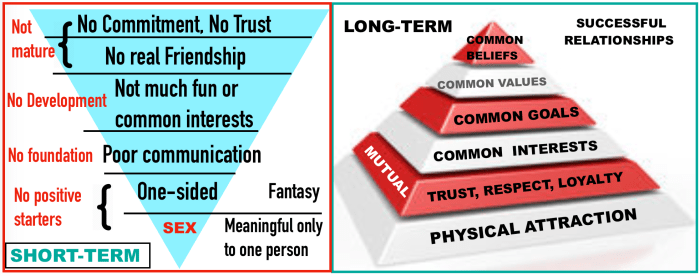
Healthy – Base needs: Physical attraction / chemistry, common interests, able to have fun, good communication, friendship
Middle: Respect, honesty, loyalty, reliance, physical affection, similar values, deepening friendship & communication, trust
Highest: Commitment, love, marriage, sex

ORDER of FORMING Relationships
1. Rubin’s theory of love:
▪︎ Caring – valuing the other person needs as much as your own – but not more
▪︎ Attachment – the need to receive care, approval & physical contact
▪︎ Intimacy – sharing thoughts & emotions, desires, hopes, dreams

2. Hattfield’s version:
▪︎ Compassionate love – based on respect, attachment, trust, and its reciprocation
▪︎ Passionate love – based on intense emotions, sexual attraction & affection.

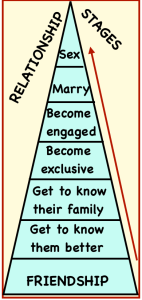
3. The relationship pyramid: It’s crucial to work from the bottom up, because if we consistently try to form relationships starting from the top, we could damage our heath…. :
…. Physically (STDs, unwanted pregnancy)
…. Emotionally (being used, ashamed/guilty, in fantasy)
…. Social (effect reputation, trouble at work, bad role model for siblings…)
So, following the healthier process helps prevent problems.

LONG-TERM vs. SHORT-TERM RELATIONSHIPS  (More….)


 SEXUAL activity
This is from a Christian perspective, looking only at the top 3 categories:
🔆
Everything but – intercourse, before marriage. These are people who aren’t deeply connected to a religious community (an island) & since they’re much looser in their sexual options, can easily get often run into value conflicts with someone they date.

🌺 Kissing only, & holding hands, but no form of sexual activity. These people are driven & deeply spiritual, able to keep a balance between personal goals and keeping up a pleasant romantic relationship, without feeling feel too frustrated. They can maintain their innocence, which helps them to not cross the line.

😘 No dating til marriage. The belief is that God has somebody perfect in mind for you, & you’ll recognize them…. so in the mean time you’re just going to live for yourself & God until you meet the person you recognize as your soul mate. (More….)

NEXT: Parenting

Pyramid Uses: REVERSED (Part 2)


PREVIOUS: REVERSED Pyramids #1

♦ RAISON d’ÉTRE
♦ FREEDOM

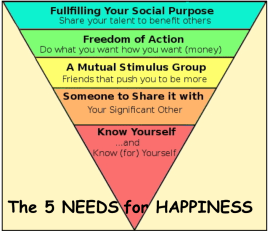
5 NEEDS for HAPPINESS
G. Filotto
(the “SJW Hunter”) says that self-actualization comes first rather than last – underpinning & supporting all other possibilities for a successful life.

1. Know yourself (Oracle of Delphi, ancient Greece). It both means : Know who you are inside, AND Find the truth of things & how they relate to you  – on your own, in your own way, that suits your purpose, ideas & abilities – to deepen self-understanding

2. Someone to share yourself with. We all have a powerful built-in need to be loved & to love, to share our minds & hearts with someone else who we know can appreciate it, & who we can do the same for

3.
A Mutual stimulus group, whether friend (supporters) or foe (challengers) = people who push us to be react, respond, improve, create, grow…. & where we can reciprocate – anything but stagnate

4. Freedom of action, to do what we personally want – when, how & with whom. This includes Having Money, but to truly achieve we need to have a handle on point #1 – a clear, realistic & healthy mind.

5. Give back to the world . If we achieve the first 4, we may still feel something’s missing. This void can be filled by using our specific talents to give back to the world – in whatever way – inspiration, help, guidance, pleasure, happiness, safety or comfort to others.

REVERSES EDUCATION
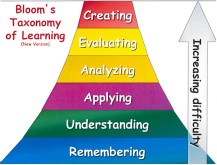
The 6 components of Bloom’s Taxonomy  pyramid can also be put in other words: (previously learned) knowledge, then comprehension,  application, analysis & finally synthesis – to identify the differences between knowing, understanding, & applying information.
However, this version suggests there’s a scarcity of talent & imagination in students – only those who can plow thru the lower levels & reach the top – can be creative. This is not true.

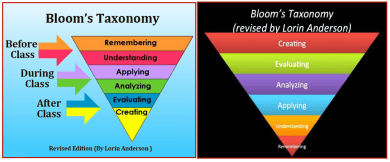
FLIPPED LEARNING reverses the traditional instructional goals for what happens in & out of class, so that students becomes increasingly pro-active. This makes it easier for them to master the process of thinking & thus now to learn.

The FLIPPED classroom starts with creating, & eventually it gives us the info needed. Students watch short instructional videos at home, then use in-class time for discussions, exercises & projects (More…):
▪︎ Based on the class topic, students are given real-world problem to solve
▪︎ They create something that shows their understanding (video, podcast, website, wiki….)
▪︎ They p
articipate in a discussion or debate (More….)

NOTE: Both reverse pyramids are suggested by Lorin Anderson – using creativity as the base  / or using ‘understanding’ as the base

WRITING ARTICLES
Journalists know that 80% of web readers don’t go thru a whole story, only scanning headlines. Web readers dislike long-winded, flowery, promotional writing with boastful claims. They prefer facts – realistic, useful information.

So the key to getting a reader’s attention is simplicity, addressing ‘What? When? Where? Who? Why? How? ‘
The writer must place the most important elements of the story at the beginning, starting with the conclusion / outcome of the story, followed by the most important supporting information, & end with the background.  (More….)

AA STRUCTURE
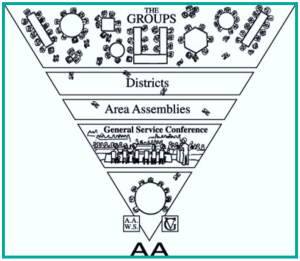
The AA 12-Step service structure is described as “the upside down triangle of AA“. Everything in AA begins at the group level. Every group is autonomous & is governed by it’s own group conscience. If there’s an issue outside the group that they would like to address, their General Service Representative or GSR will bring their concern to the District Committee.⬇️ (More…..)

NOTE: This arrangement applies to all 12-Step programs, such as Al-Anon, D.A., O.A., G.A……

PETS
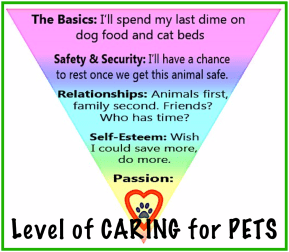
“No one goes into Animal welfare for the money. They do it for love. But when passion comes before self-care, the weight of the world takes it toll.”
Laura Young is the founder of NoSafeDistance.com (pyramid). She knows there’s a difference between being tired, even to the point of exhaustion, vs. the world-weary state of compassion fatigue….

Striking the balance between compassionate caring & trying to address the tidal wave of need that greets everyone who joins a cause, be it animal welfare, child welfare, addressing  race or gender related violence,or global climate change is quite another. (More ...)

NEXT: Relationships Pyramids
Pyramid Uses: REVERSED (Part 1)


PREVIOUS: Maslow’s pyramid & Music


RAISON d’ÉTRE

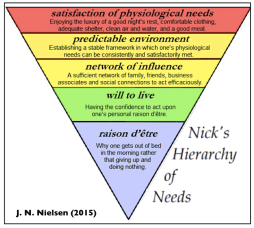
In  “Geopolicraticus”, N.J. Nelson objects to Maslow & Erickson’s stages of personality development as too simplistic, even misleading, They can contribute to the insidious assumption that if you’re not following their stages, there’s obviously something wrong with you for not developing naturally or normally.

Instead Nelson states that:
“…I don’t believe that a person can get out of bed in the morning without implicitly having formulated a philosophical judgment that life is worth living and therefore there is a reason to get out of bed, and not merely to lie there and do nothing.”

His inverted pyramid puts raison d’être at the foundation, so that the fulfillment of emotional & psychological drives can eventually build up to the final satisfaction of physical drives & needs. This doesn’t deny the crucial need for food, water, air….. but they don’t automatically provide a motivation for successfully getting going every day, especially in the face of life’s many stressors. (ALSO…..)

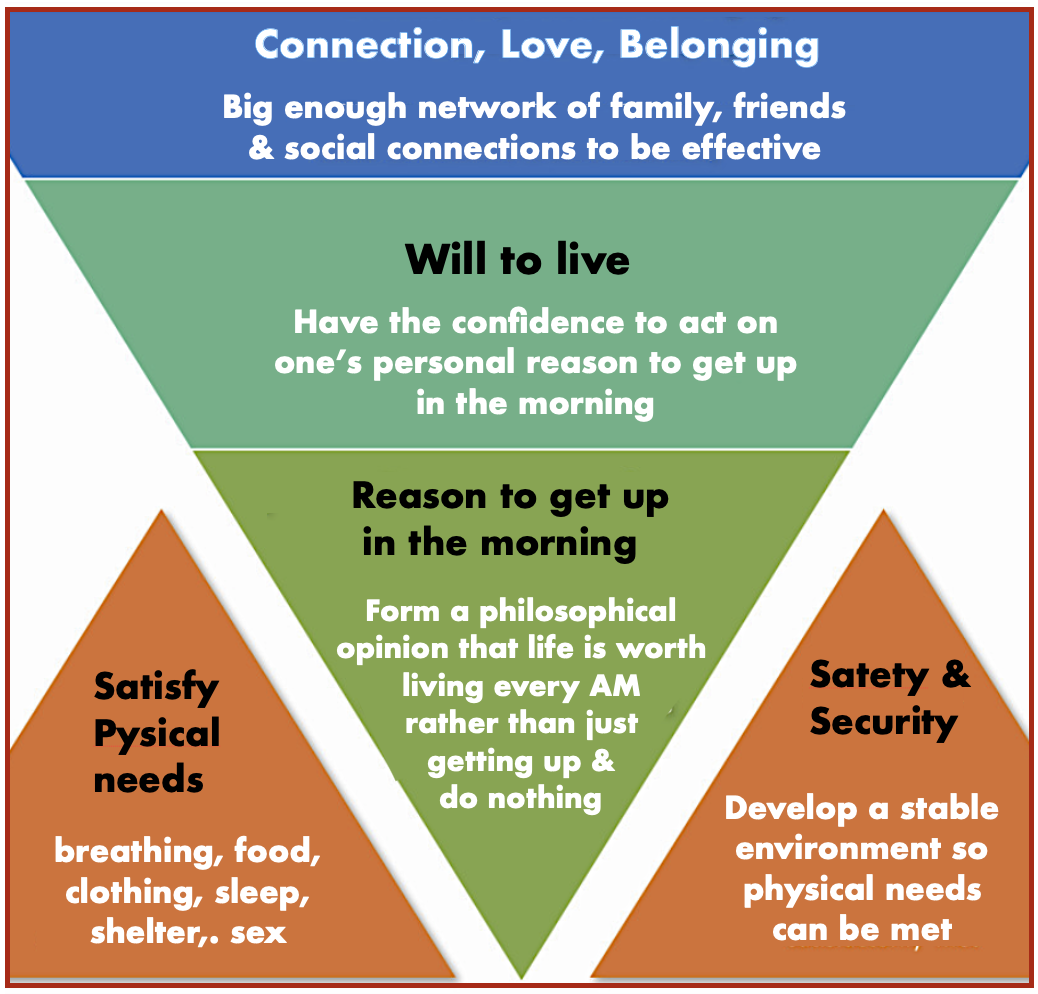
Similarly, Arjun Paul (Flipkart Stories, India) suggests in this reverse pyramid – a person’s entire existence balances on a single point. “Esteem is something that can be sought only after a person has satisfied himself.”

It seems obvious to him that in order to provide all our human & personality needs, first we must have a reason to get out of bed every morning.  Why should we have to move through a hierarchy to achieve what is already in us? In our mind? Also, nothing in nature is linear, so why would our development as human beings be linear? ”

He places Maslow’s levels 1 & 2 as supports to the fundamental one, & continues:It is safe to assume that reason & the will to live, coupled with forming connections, are what make us humans, & differentiate us from AIs – so far. So unless the higher needs are met with the utmost care & balance, the whole pyramid tips over on its side.

FREEDOM
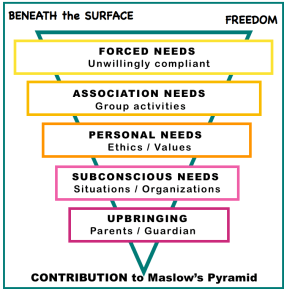
Maslow’s original hierarchy only works if a person is free. This reverse pyramid is Ravi Agrawal’s theoretical model : Moving from the bottom up ⬆️, more & more people are involved in our life at each stage, while the restrictions to our freedom decrease ⬇️. This means we have more choices with more opportunity to decide what we want to do.

At the same time, what kind of impact a particular negative event will have in our life depends on which level it occurs in…. the broader the category (the bigger our life is), the more disruptive it can be.

1. Base NEEDS – Upbringing: Only a few people contribute at this level, & their actions have a profound impact on a person’s psyche & thought process

2. Subconscious – Whatever your needs are for functioning, must be met. If they’re not, the whole structure is thrown off balance

3. Personal – where your ethics & values come into play. … if the previous levels aren’t met, you might be willing to sacrifice them just to ensure you can fulfill them
Agrawal suggests Ethics & Values are formed by repeated sets of experiences. At this level, everything is transactional (interaction with others, especially influenced by the role as parent, child, or peer), & is judged by the face value of events. Doing things in a certain way (positively?) leads to improvement in one’s mental attitude

4. Association – This need is stronger than anything else, more than physical ones. Even with restricted access (limited connectivity), people still want to be a part of the group. Religion, nationality, professional organizations, gangs (in jail as well)…. are all associative groups we gravitate to, without questioning the drive

5. Forced (final level before freedom) – life situations causing real-world pressures, force us to act in ways that often sacrifice basic needs like food & sleep (get a degree, don’t get fired, feed your family….) in order to achieve a goal or passion
EXP: a business person rushing to a morning appointment without enough sleep or breakfast.

IMPLIED – FREEDOM to choose: Able to function optimally with less interference from the demands of others. (See Iceberg model of Competencies)

NEXT: Reversed #2

MASLOW – UPDATED (Part 2)

PREVIOUS: Transcendence & the brain

SITE: “What is Self-transcendence?” 6 EXP

MODERN
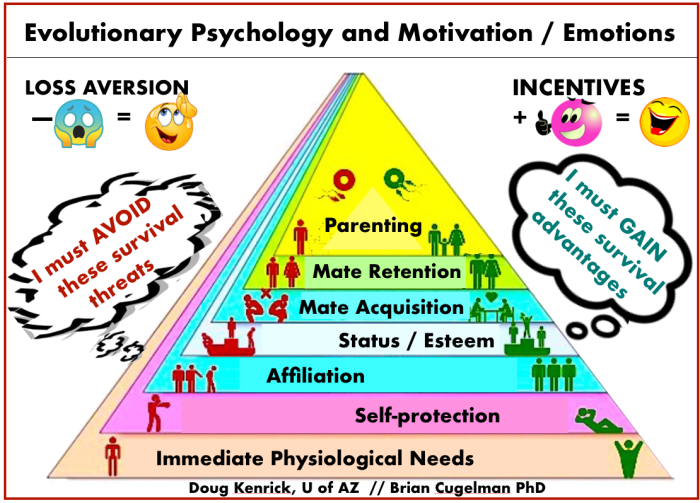
InRenovating the Pyramid of Needs: Contemporary Extensions Built Upon Ancient Foundations” Kenrick, Griskevicious, Neuberg, & Schaller, (2010) modified Maslow’s pyramid to reflect a controversial, more ‘up-to-date’ approach, based on findings from neuroscience, developmental & evolutionary psychology —> which assumes that everything in human nature is in our genes, & can only be there if it helped our Paleolithic hunter-gatherer ancestors to survive & reproduce.

😴 These sciences claim that Maslow’s Pyramid is old-fashioned & needs revamping because it missed some very basic facts about human nature not well understood in his time, but have since been emphasized by ongoing research & theory. (Arizona State U.)

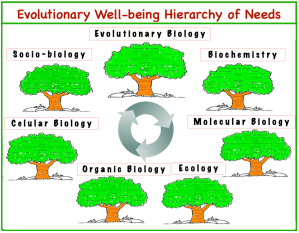
In the new pyramid, reproduction of our genes is considered one of humankind’s most fundamental drives. Self-actualization may be an important concept, but is no longer considered an evolutionary requirement, & so has been eliminated. Replacing it are 3 motives researchers believe Maslow did not account for: mate acquisition, mate retention, & parenting. Kenrick et al. pointed to universal human efforts to create & maintain family bonds, & the parental investment in raising young. (Explanation of each TREE ⬇️).

In addition to this dramatic change at the top, researchers add need- overlapping. This replaces Maslow’s initial idea that once a need is met it disappears & the individual moves on to the next level.
Kenrick et al. explained that this is not accurate. The reality is that even if a person had fulfilled a level & then gone on to the next – they may have to revert to earlier ones.

This is because there’s an ongoing interplay between our internal motivations & environmental situations, either by opportunities or threats, determining which needs capture our attention at any point in life. “Cognitive systems (the human mind) are biologically prepared to learn or have evolved a vigilance for stimuli relevant to fundamental goals. Neither the stimuli nor goals exist in isolation – the psychological system has co-evolved with features of the ecology.”

HOWEVER, other researchers – such as those in the emerging field of Existential psychology, & the subjective well-beingness of Positive Psychology – have called for retaining the emphasis on personal meaning & self-actualization.

▶︎ Lonnie Aarssen (Ontario, Ca) suggests that Kenrick’s version is also missing something important.
He offers a revision, where: ” …. the exalted pyramid cap represents gene transmission success – not a motivation as such, but the overarching functional (adaptive) consequence of all of the underlying needs / drives.”

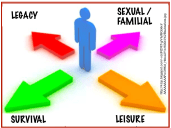
He combines Kenrick’s levels 1-3 into the Survival Drive, 4-7 into the Sexual/ Familial Drives. Between them he proposes a “…. greater emphasis on a ‘narrative of the Self’, involving motivational elements that include & expand on the idea of self-actualization…. important requirements because they help people deal with – & mask – the human reality of impermanence (we all die.)

Different ‘sub-selves’, defined by pyramid goals, are activated by environmental cues. So we might expect activation of the ‘Legacy-Drive’ subself vs. the ‘Leisure-Drive subself to be based on local ecology and culture.
One recent study of responses to mortality salience provided an intriguing example of this: European Americans tended to focus on achieving symbolic immortality (legacy), while East Asians generally wanted to engage in & enjoy life (leisure).

There can also be a blurring or blending of the various drives. For example, Legacy functions (2) also feel good, which satisfy the Leisure Drive (3), and can gather resources or earn favor in one’s social group, reaping advantage for the Survival Drive (1).

OR combining all 4 levels: Accumulation of wealth ensures survival, but also earns status (legacy), allowing for conspicuous consumption (leisure), & can attract romance (sex). (More….)

Aarssen notes that the evolutionary roots of Survival & Sexual/Familial Drives (1 & 4) are supported by a large body of literature. However, Legacy & Leisure Drives (2 & 3) are mostly hypotheses yet to be tested with more research. The assumption is that they served our ancestors well by masking consciousness of our limited life-span, (a potentially incapacitating ‘curse’) – at least until we reach reproductive maturity, so we can pass on our genes.
He believes such research can lay the groundwork for a new view of the evolutionary roots of human nature & social life.

NEXT: Modern Pyramids #2

MASLOW UPDATED (Part 1)

PREVIOUS: Personal Growth

SITE: HUMAN WELL-BEING

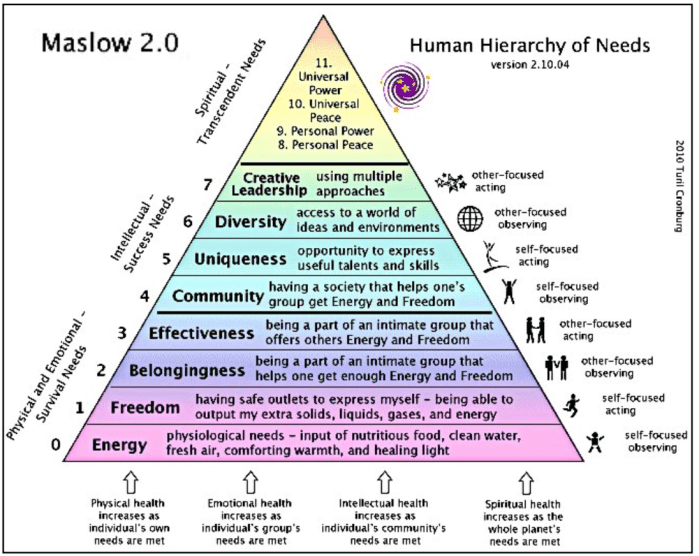
★ “Maslow 2.0” post by Turil Cronburg, 4/18/10
Fulfilling human needs can be thought of as the matter & energy requirements of each developmental stage, created by giving & receiving interactions. Each pyramid LEVEL ⬆️ of needs indicates what a person’s motivations & behaviors are generally like – the combination of personality traits.

😴 Physical : needs of one’s own body, 0-1
🧡 Emotional: of all members of one’s intimate group, 2-3
🔎 Intellectual: of members of one’s community, ie. society, 4-7
🔆 Spiritual : the broad spectrum of needs of all living things, Apex

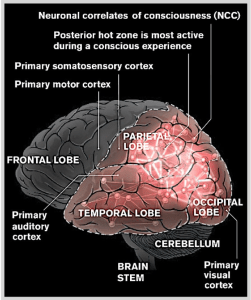
Consciousness is complex because it’s based on what someone is most focused on at any given time, fed mainly by the various arts of  the cerebral cortex, the outer surface of the brain. At first, as a baby, we have only a very limited awareness of our environment, but it’s still real & valid. With growth, we can pay attention to more & more PPT (people, places, things).

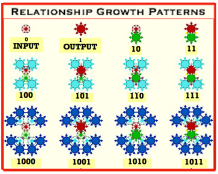
Cronburg visualizes human development as FRACTAL diagrams ⬇️, in binary form, showing the complex process of consciousness-growth, starting with pre-birth.
It’s a combination of input & output interactions between the Self (red) and family & close friends (green), human society (light blue), & all the species of Earth (dark blue).  Article: “Is Consciousness Fractal?

0 = fetus to birth : AWARE of self-input
1 = birth to 9 months : aware of self-output
10 = 9 months to age 2 : how others’ (family/friends) outputs meet internal needs
11 = 2-3 : how self & others’ outputs combine to create new things (connections, experiences)
100 = 3-7 : how self & others’ needs are met by society

101 = 7-13 : self-outputs + society’s needs, used to meet those of others
110 = 13-19 : others’ outputs + society’s, to meet self-needs
111 = 19-35 : how self, others & society’s outputs combine to make new things (community, projects, art….)

1000 = 35-60 : aware that the planet’s outputs meet self, others & society’s needs
1001 = 60-102 : aware of how one’s own outputs can meet the planet’s needs!

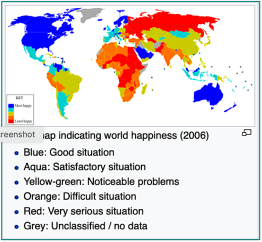
SATISFACTION with LIFE INDEX‘ by Adrian G. White,  (U of Leicester, Eng).
It was a collection of data from a metastudy, wanting to show life satisfaction in different nations, by directly asking how happy people feel, as well as considering social & economic factors.

Subjective measures of well-being correlated most strongly with health, wealth, & access to basic education.
In 2006, Denmark ranked #1, USA at #23, & Burundi the lowest

📌Edward Diener (U of ILL) helped create a Gallup poll survey on well-being, with 60,865 participants from 123 countries (2005-2010). Qs covered:
▪︎ Basic needs (food, shelter) /  safety / social needs (love, support) / respect / mastery / & autonomy.
▪︎ 3 measures of Well-being : life evaluation (a person’s view of his or her life as a whole) / / positive feelings (day-to-day instances of joy or pleasure) / / & negative feelings (everyday experiences of sorrow, anger, or stress).

Responses clearly indicated that Maslow’s basic list of needs does apply to everyone, regardless of culture. Diener commented that while our most basic needs tend to get the most attention when we don’t have them, we don’t need to fulfill them all before benefiting from higher level needs.”
EXP: Even when we’re hungry, we can still be happy being with friends (#4 over #1)

The human brain is a complex system with parallel processes running all the time, so that many different drives can be active at the same time.
However, it’s important to keep in mind that not all activities lead to well-being, which are called ‘pseudo-needs’. They’re unhealthy drives leading to behaviors which never bring mature, permanent satisfaction (addictions, people-pleasing, rescuing, isolating, being controlling….. ).

Diener’s study suggests that only when looking back on the quality of our lives do the basic needs become important indicators of well-being.
— Re. Troubles:  they come mainly from lack of esteem (3), lack of freedom (2), & lack of nourishment (1), in that order
— For everyday Satisfaction: interpersonal needs – such as love & respect (3 & 4) – are most important.
Healthy human needs work independently, & like vitamins, all are necessary…. “Since each of them correlates to certain aspects of happiness, all are important – all the time.”

Martin Seligman, (U of Penn) says governments should “focus away from monetary measures, especially in light of Diener & Tay’s findings – that income has little impact on day-to-day happiness, & is significant for well-being only in so far as it allows for basic needs to be met.”

NEXT: Maslow updates #2