
 PREVIOUS: DBs, Part 2
💟 PROCESS in Childhood (Part 1)
🧩 REVIEW
♨️ SENDERS (S)
S create DB, some unconsciously or ‘accidentally’- copying their own early training, others quite aware & unscrupulous about using it on their targets. The key to controlling a person or group (cleverly) is not by overt domination, not by forcing someone’s mind to do what it doesn’t want to do, the same as with hypnosis. (see DMs #2)
Rather, it’s by taking advantage of the paths the mind normally wants to go down – like teaching an animal to do tricks using what comes naturally to them. Once a person or group’s thinking is understood, DBs can be applied to making them compliant.
✦ DBs are designed to chronically bewilder, a devious way to control without having to be overtly forceful, in order to keep a Receiver (R) attached & do whatever the S wants.
This usually start with seduction – the emotional carrot on a mental stick. The S offers some bait to set the trap in the form of a (short-term) benefit to the victim.
Rs who are too trusting, ignorant or need to ‘believe‘ find out too late that the carrot is poisoned – the benefit comes with a blindfold & a gag! By then it’s much harder to get out of the snare – BUT not impossible.
• D.binding manipulation works because – while people feel an internal pressure to act on their survival instincts – yet they will follow powerful ‘others’ even when it’s at odds with those instincts.
External pressure can come from a peer group, an anonymous mob, national leaders & laws, orders from superiors, expectations of family & friends, or blindly obeying someone’s personal version of God & Scripture.
We ‘allow’ ourself to be swayed because of the Inner Child’s conflict between autonomy & attachment (DBs – Part 2). Any need or belief whi ch compels people to feel locked into a particular course of action — leaves them open to being misled. IF there seems to be no choice, the pre-planned “fate” devised by someone else is accepted unchallenged.
• There are as many variations of the bind structure as there are unhealthy egos.
One way to categorize the Game sequence is:
> conflict, dilemma, impasse, paradox (More….)
Another is:
> withdrawal, aggression, superiority/ inferiority, authenticity/ bullshit
🧩 LOGIC TYPES**
💢 RECEIVERS (Rs) of DMs are inevitably torn between the demands of conflicting ‘logic types’ in communication. They find themself in a painful & enraged state IF they try to understand & please a Sender, because no matter which way they turn, the R is not just continually mistaken, but also always bad
• All messages are made up of words ++ a context which modifies them (DBs, #1), so identifying the level of each statement becomes especially important when one can not tell if it refers to the whole set or some part of it.
 EXP: When speaking of ‘man’ – is it about one male human (lower level = narrow focus), or humanity as a whole (higher = wide focus)? (LEVELS…..)
**Logic Types: a category of Bertrand Russell’s hierarchy, where any Class of objects (Animals) is identified as a higher logic type than the elements of that class or set (cat, horse, koala…. (DMs, #1)
Higher = INCLUSIVE – ocean // Lower = a group in the overall idea – shoals // Lowest = individual parts of the whole – fish
EXP: ‘Context’ (the forest) is of a higher logic type than ‘Words’ (the trees). Likewise, the word ‘cat’ cannot scratch you but the animal can, so the word ‘cat’ & the actual cat are of two different logic types.
✦ According to Bateson, every organism is in its own specific “context”, not just as background, but shaping & shaped by it (family, education, religion….). 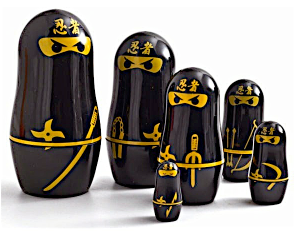
That context is embedded in a larger one (ethnicity, nationality, social class….), which in turn is related to its own context as well as still wider ones (country) – like stealthy Ninja Russian Nesting Dolls – into infinity. (‘Frames”, DBs #7).
Therefore D.Binds can be understood – but not embraced – if one steps back to look at the bigger picture.
EXP: We’re not just the genetic product of our 2 parents, but of their parents, & they of their parents…… as well as by the effects of their environment on each family member who preceded us.
NEXT: DBs #3b

