MBTI : INTROVERSION – Intro (Part 1)

PREVIOUS: E/I Anatomy #2

SITE: MBTI historical info

BOOK: “Introvert Guide to Self-love” – by Luna & Sol


NOTE:
Introversion is NOT isolation.
Dr. Carl Jung identified it as an “attitude type” (inborn), observing that Introversion & Extroversion are both healthy variations of personality style. (See earlier posts)

DEF: Introverts (Is) are both energized and relaxed by drawing energy from their own thoughts & feelings, comfortable with solitary activities, & so they place less emphasis on ‘people skills’ & talking. They perform well in analytical roles that require focus & logic.

Based on Jonathan Cheek’s research, there are 4 styles of Introversion:
• Social: Prefer to stay at home with quiet activities, or hang out with a few close friends, instead of at events with lots of strangers (NOT shyness)
• Thinking: Very introspective, thoughtful & self-reflective, highly creative, often daydreamers with a rich imagination. Occasionally don’t mind a busy social scene
• Reserved: Operate at a slightly slower pace, think before acting, careful decision-makers & take time to start things

• Anxious: Generally – not confident in social settings, often worried about what could go wrong (projecting).
May ne painful shy around others, especially strangers or with new people. Nor does the anxiety always go away when they’re alone, because later they obsess about how they ‘failed’

EDITORIAL: Since Is are naturally wired a specific way, the last type may actually be one of the other 3, but wounded in childhood. Introversion does not by itself cause dysfunction!

Interesting: Researchers discovered that Introverted participants who acted like Es – when taking cognitive tests – had slower reaction times than Is who were being themself. The effort & time they wasted trying to be something they’re not naturally wired for – was distracting & depleting.  This especially applies to Is having to fake it for a long time.
REMINDER : They can give themself permission & the freedom to be the way they’re ‘built’, even if the rest of the world keeps trying to mold them into Es.

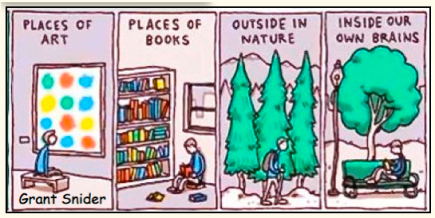
Misleading: Many illustrations & cartoons unfairly portray Is as awkward, misfits, fearful & unfriendly – which are signs of emotional damage. And Es often judge Is as isolators, but that’s caused by FoA, S-H & lack of Bs, not Introversion.
ACTUALLY – it’s not unusual for Is to be gregarious, helpful, charming, warm & prodigious talkers. It’s just that they need more alone-time than Es to recover from all that expended energy
)👄(
Using the O.C.E.A.N inventory, National Institute on Aging researchers Paul Costa & Robert McCrae expanded on the Big 5 characteristics, to include 6 facets within each dimension.
Introverts :
1. re. Activity Level – like to take it easy, are laid back & react slowly as situations develop
2. re. Assertivenesslet others lead the way, stay in the background & keep their opinions to themselves. Really don’t like to be pushy or demanding
3. re. Excitementneed peace & quiet, perfectly happy with daily routines. They make better roommates or neighbors since they prefer a steady, easy lifestyle
4. re. Gregariousnessare friendly but do just fine by themself, avoid crowds, preferring quiet activities such as reading or reviewing their day

5. re. Positive emotionare usually content without showing it outwardly. They’re not as likely to express strong emotions, but do feel them deeply
6. re. Warmthare hard to get to know at first, & can feel uncomfortable around people they don’t know well. They hold back in social situations, waiting to be approached, but may be the most interesting ones around

ACoAs
Most Introverts (Is) were not accepted by family, school & friends, the majority of whom are Es & think typical Is are weird or disobedient. But if only someone had understood their basic traits & been willing to accept & encourage them, it would have fostered self-esteem & made life much easier.

Now we can use this info helps us better understand & accept our mates, friends, bosses…., but especially ourself, so we can treat our WIC with greater clarity & compassion. And anyone who has an internally oriented son or daughter can help them flourish, no matter what age

• CHARTS : Illustrations That Are All Too Real For Is
posted by Anna Borges on BuzzFeed (8/12/15)

«
NEXT: Introverts = Intro #2

ACoAs & PROJECTING (not Projection) (#1)

projecting 

THE SKY IS FALLING! THE SKY IS FALLING!
or it will any minute now!

PREVIOUS: Book Suggestions

SITEs: “Mistakes of projecting your future” (AlcoholicsFriend.com)
• “Negative Risk (threat) & Positive Risk (opportunity)”
“You should Visualize Positive & Negative Outcomes More”

DEF: PROJECTING (a CD=cognitive distortion) – Imagining one or more bad / painful / disastrous things will always & inevitably happen in the future, in general or re. a specific person or situation (victim mentality / ‘learned helplessness’ / scapegoat)

NOTE: This is not the same as correctly knowing who someone or some situation actually is, & what to expect of them.
EXP: “My whole life my mom has said mean or insensitive to me or about me. She’s never changed, so I know any time I talk to her in the future it will be the same.”

❎ SIDEBAR
Projecting is NOT the same as Projection – a defense mechanism (via Freud), in which a person:
a. Re. US – When we unconsciously reject one or more unacceptable qualities we have – or believe we have – AND attribute / assign those same qualities to another person, animal or situation.
Often the ‘others’ do not have those characteristics. So it’s
inevitable that in some cases projection will result in false accusations.
Everyone Else’s Fault?…..” //  Don’t Project Your … Inadequacy Onto Others

EXP: “I can’t trust anyone because everyone lies” (deny being a liar oneself)
“I know she hates me” (deny our own self-hate OR that we hate that person)
VARIATIONS:
• Complementary = assume others think or feel the same way we do about things
• Complimentary = assume others can do the same thing  – as well as OR in the same way – as we can
📌These are both expressions of narcissistic thinking (you & I are “one” – the WIC’s desperate desire for a symbiotic connection) (MORE…..)

b. Re. FAMILY – To attribute actual negative characteristics of our dysfunctional family members on to others, who may be like them, only a little, or not at all.
EXP: My father was a mean abusive drunk, therefore all men are bad / dangerous // “All authorities are evil, out to get me”

✳️ Back to PROJECTING
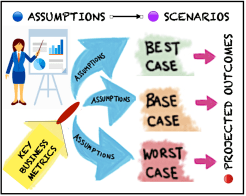
In BIZ: Positive OR Negative scenarios

In business it’s called forecasting, looking at all possible outcomes based on previous performance.
Projections are not budgets, rather “big picture, what if” exercises, done at a higher level of abstraction, ie context (See “D.Binds #3a“), with a ‘what is hoped for’ & “what could be” perspective.
NOTICE – a savvy business plan always includes 3 major possibilities. CHART

For ACoAs – However, most of us almost never project that things will work out, that we’ll be happy, that we’ll get what we asked for, that our relationships will be beneficial, that we’ll get the job we want…. No-o-o-o!
We assume the worst – only projecting negative outcomes – pain, disappointment, suffering, disaster.

▶️ The exceptions are the severe narcissists (& active addicts) who only project ‘positive’ possibilities, which often are simply pie-in-the-sky schemes which never come true, because either they don’t have the skill & inner motivation to make it happen, it’s a stupid idea, or not actually do-able.

WHY assume negatively? BECAUSE :
a. our childhood was filled with endless suffering & deprivation, so that’s our template for rdisaster forecasteality, becoming our world view  (POSTS: “Information & the Brain – How we learn“)

SCIENCE –Brain’s Negative Bias  : “The brain reacts more strongly to stimuli it deems negative, with a greater surge in electrical activity….. historically. our very survival depended on dodging danger. The brain developed systems that make it unavoidable for us not to notice danger & thus, hopefully, respond to it…..

b. we have unconsciously, but consistently been reproducing that original chaos & abandonment in our adult life. (Repetition Compulsion).
Unfortunately, it’s the WIC’s way of staying loyal to the family system, even though it was harmful to our parents & continues to harm us

PSYCH – Bad is stronger than good ….Many kinds of trauma produce severe & lasting effects on behavior, but there is no corresponding concept of a positive event that can have similarly strong, lasting effects……”

NEXT: Projecting #2

Victimizing OTHERS (Part 1)

office gossipI HAVE TO BE VERY CAREFUL –  to not let out my damage on others!

PREVIOUS: Victimizing Ourselves (Part 3)

SEE: ACRONYM Page for abbrevs.

TOWARDS OTHERS  – From us
a. Abandoning (5 posts : “How ACoAs Abandon Others” )
•  CONTROLLING : An outward manifestation of our disowned fear that has accumulated from childhood into the present
• IGNORING : Not hearing what someone is telling us about themself, their needs, their tastes, their point of view, their current availability

• REPRESSING Others’ Emotions:  To the extent we are still repressing our own Es, we try to suppress that of others
• IDEALIZING: Putting anyone on a pedestal – not being able or willing to acknowledge someone’s real personality, including their human limitations & their damage
• UNDERVALUING: At the other extreme are the ACoAs who find fault with everyone, all the time, OR when someone gets too close, emotionally (Posts “How ACoAs Abandon Others” )

b. Jumping (projecting our issues / pushing our opinions onto others)
✶ What does it mean to “Keep the focus on yourself”?  Many people misuse this phrase. They think it gives them license to say mean, insensitive, invasive things, as long as they start with “Well, it’s just my opinion, but I …”.  Expressing Emotions does NOT mean saying or doing what ever we want, because it can too easily become a form of violence.

WRONG WAY – If we are emotionally dishonest or unaware, we may say:
• “I think you should….”  – negating who they are, what they need or what they know how to do for themselves
• “I know I said I’d help you, but I can’t do it” – AT the last-minute, when they were counting on your promise!
• “It’s just my opinion, but your problem is….”  – & then tell them what’s wrong with them, unsolicited, of course, AND not helpful or even accurate!🔅

• “I don’t t h i n k so!” – when someone tells us an emotional truth or personal insight about themselves
AND if they object, we repeat “Well I have a right to my opinion…”
This is not an opinion, it’s negating our reality in favor of their own
• “I don’t understand how you could…..” – implying that since their action / opinion /emotion is different than yours, it’s not legitimate

RIGHT WAY –  while you can refer to what someone has said or done, you own your reaction to the other person BY :
I statements🔅 taking responsibility for your own feelings, thoughts & actions – “I’m sorry for what I said – a button of mine got pushed & I reacted!”

🔅knowing yourself well enough to identify what motivates you then be willing to say it, in an appropriate situation:
• “I didn’t do ____ because I wanted to be numb for a while / I fell into an old pattern / I’m not allowed to say what I really want

🔅 dealing with your own anger, disappointment or hurt, without blaming or attacking the other person:
• “I’m really angry that you lied to me – I trusted you!”
• “When you said _____, what I heard was ______, & it really it upset me!”
• “I don’t talk like that way (harshly) to myself!
BY
🔅
making ‘I’ statements about yourself in an uncomfortable situation:
• “Even if you 2 are OK with this, it so painful for me to hear you insult each other that I need to leave…..”
• “I feel abandoned / hurt / angry / sad that you’re so rarely available to see me, but I know you’re genuinely busy & it’s not personal”
• “I’m getting tickets for —– & I’d love your company. NO? Well, I’m disappointed but understand if you don’t like it, & don’t want to go
OR

🔅 knowing what you need and asking for it, BUT not trying to force the outcome. Al-Anon suggests: ‘Take the action & let go of the result’

• “I stay in that bad job / marriage / friendship… because I’m too afraid of being alone / not having an identity without them / of the abandonment pain I’d have to feel….”

• “That ___ doesn’t work for me because it hurts me too much / it’s not who I am / it goes against my principles….”

NEXT : Victimizing others #2