Their ATTITUDE Inventory (3 of 5)

inventory 3 

THIS IS HARD WORK
but I’m learning a lot

PREVIOUS: THEIR Attitude Inventory (2 of 5)

See ACRONYM page for abbrev.


FYI: This INTRO will be repeated for all 5 posts in this series, but with different topics

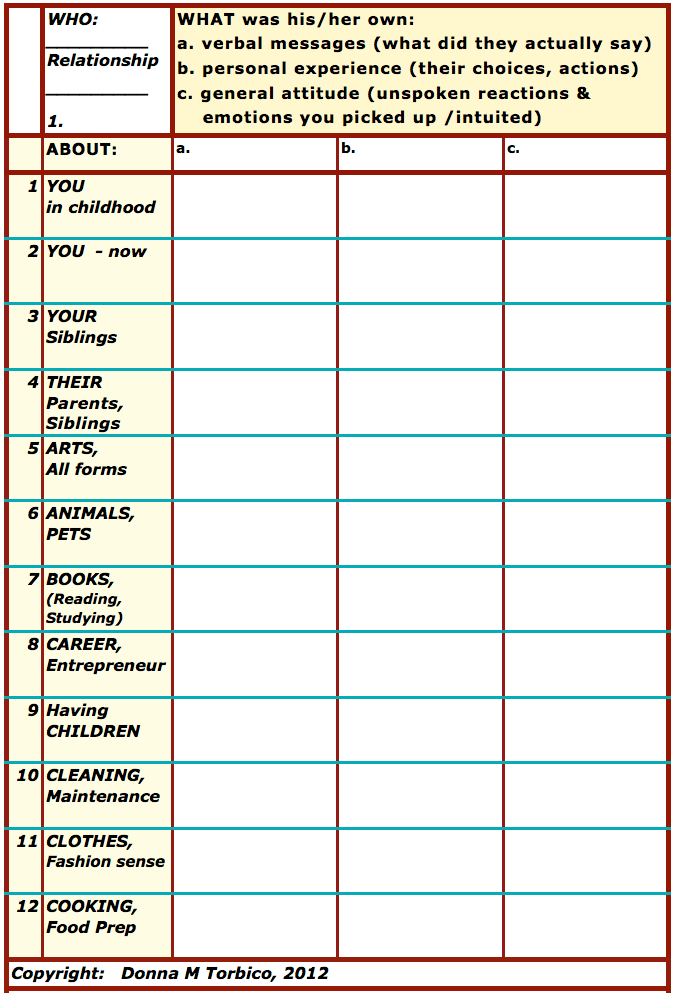
THIS CHART is much more specific & includes listing many of the statements family & others made to us (or we overheard, often) that have become our Toxic Beliefs. More issues in the next 2 posts.
List the people you want to ‘learn’ about.  To start, you can pick ONE you think you know more about & see how far you get.  Of course you can use this chart any way that suits the way YOU process info, so experiment.

* TAKE YOUR TIME. You may feel even more overwhelmed than with the previous chart (there are 62 possible topics altogether). There’s no rush – if you push it you’ll be more likely to give up or to miss important details.

** Naturally you won’t be able to fill in every category for every person. but if you make a separate page for each topic, you can play around by filling in anything that comes to you right away. If you can only write one line per category, start there. Fill in more info at any time later. That can encourage you to work on the rest.  PROGRESS not PERFECTION!

REMINDER: Not surprisingly, many of us don’t remember what
we heard, felt or experienced as kids – mainly we blanked out from fear, but our unconscious remembers.
As you proceed you might be surprised at how much you DO know, and at what will ‘be revealed’ about yourself as you go thru this exercise.  Siblings, other family members & friends or old notebook/ diaries / photo albums – may be helpful.

NOTICE that for each topic you’re asked to consider 3 aspects:
a. Verbal messages: What did this person actually say about the issue? If we pay attention to the way we talk to ourselves – & others – especially when we’re frustrated or angry – we can hear ‘them’ coming out of our mouth.
Also, if someone you’re inventorying is still alive, you can get it from the ‘horse’s mouth’. Without being confrontational or angry, just slip some questions into your conversation & you may get lots of material for your writing. Even what they leave out is very informative!

b. Personal experiences: this is usually the easier one to remember – what  actions did they take about each issue – what did they go thru? Lots of jobs, kinds of relationships, the many ways they did something stupid / abusive / self-destructive / OR helpful / kind / amusing ….. especially any repeated patterns

c. General Attitudes: This may be the hardest because you are the repository of their unspoken, disowned parts! But there are things you’ve always known about them (or at least suspected) that you may not want to admit. Remind yourself – “I know what I know”. You’re NOT crazy – kids are very intuitive & absorb everything!

Suggested PROCEDURE:
More than likely you’ll be doing this on some kind of device.  Make a separate page for each topic & perhaps each subheading
• OR you can use a loose-leaf notebook, & maybe 3 different color pens
• Take as much room for each a. b. & c. as needed, filling in first the things you’re sure or have an idea about – in NO particular order!

• Include all positive & negative points, to get a rounded picture
• Skip any topics that don’t apply to a specific person or that you simply don’t know about, & include more later
• Add any topics not listed which applies to a specific person
PS: If a topic specifically impacted you – growing up – you can make a separate column / page to comment

NEXT: Attitude Inv. (4 of 5)
THEM Inv 3

Their ATTITUDE Inventory (#1 of 5)

writng inventory 

TAKING THEIR INVENTORY
helps me know what I absorbed!

PREVIOUS: 2011 Blog Stats

See ACRONYM Page for abbrev.


FYI: This INTRO will be repeated for all 5 posts in the series, but with additional topics
THIS CHART is much more specific & includes listing many of the statements family & others made to us (or we overheard, often) that have become our Toxic Beliefs. More issues in the next 4 posts.
List the people you want to ‘learn’ about.  To start, you can pick ONE you think you know more about & see how far you get.  Of course you can use this chart any way that suits the way YOU process info, so experiment.

* TAKE YOUR TIME. You may feel even more overwhelmed than with the previous chart (there are 62 possible topics altogether). There’s no rush – if you push it you’ll be more likely to give up or to miss important details.

** Naturally you won’t be able to fill in every category for every person. but if you make a separate page for each topic, you can play around by filling in anything that comes to you right away. If you can only write one line per category, start there. Fill in more info at any time later. That can encourage you to work on the rest.  PROGRESS not PERFECTION!

REMINDER: Not surprisingly, many of us don’t remember whatchildhood memories
we heard, felt or experienced as kids – mainly we blanked out from fear, but our unconscious remembers.
As you proceed you might be surprised at how much you DO know, and at what will ‘be revealed’ about yourself as you go thru this exercise.  Siblings, other family members & friends or old notebook/ diaries / photo albums – may be helpful.

NOTICE that for each topic you’re asked to consider 3 aspects:
a. Verbal messages: What did this person actually say about the issue? If we pay attention to the way we talk to ourselves – & others – especially when we’re frustrated or angry – we can hear ‘them’ coming out of our mouth.
Also, if someone you’re inventorying is still alive, you can get it from the ‘horse’s mouth’. Without being confrontational or angry, just slip some questions into your conversation & you may get lots of material for your writing. Even what they leave out is very informative!

b. Personal experiences: this is usually the easier one to remember – what  actions did they take about each issue – what did they go thru? Lots of jobs, kinds of relationships, the many ways they did something stupid / abusive / self-destructive / OR helpful / kind / amusing ….. especially any repeated patterns

c. General Attitudes: This may be the hardest because you are the repository of their unspoken, disowned parts! But there are things you’ve always known about them (or at least suspected) that you may not want to admit. Remind yourself – “I know what I know”. You’re NOT crazy – kids are very intuitive & absorb everything!

Suggested PROCEDURE:
More than likely you’ll be doing this on some kind of device.  Make a separate page for each topic & perhaps each subheading
• OR you can use a loose-leaf notebook, & maybe 3 different color pens
• Take as much room for each a. b. & c. as needed, filling in first the things you’re sure or have an idea about – in NO particular order!

• Include all positive & negative points, to get a rounded picture
• Skip any topics that don’t apply to a specific person or that you simply don’t know about, & include more later
• Add any topics not listed which applies to a specific person
PS: If a topic specifically impacted you – growing up – you can make a separate column / page to comment

NEXT: Attitude Inv. (2 of 5)

THEM Inv 1

POSITIVE Responses to Painful Events (Part 1)

flowers 1


THIS ISN’T RIGHT!
I don’t like the way I’m being treated

PREVIOUS: Negative Reactions (#3)

REVIEW:  Negative version of chart

POST : Emotional  Maturity


1. EVENTS
Circle
This new chart is the correction for the previous one, showing how to deal with stressors in a more appropriate & productive way. The first circle includes the same set of observations as in “Noticing Painful Events”

a. ACoA DIS-EASE
Lack of Acceptance: Even though ACoAs tend to accurately observe our environment, we often refuse to acknowledge what we see & hear, because:
i. we’ve been taught to repress what we know, developing a built-in forgetter / rose-colored-glasses / horse blinders, to keep us from looking around to see the truth or noticing other options. It’s a definite way to be loyal to the family toxic rules & stay the ‘good kid’ .


ii.
we don’t want to deal with the consequences of being awake – otherwise we’d have to make some hard decisions like speaking up for ourselves, having it out with someone, being less involved, or leaving. This prevents us from feeling old or new abandonment pain

EXP: You’ve know your BFF for a long time & have been thru a lot together. You’re in 12-step Recovery, learning to face your issues & own your CDs, she isn’t.  You’ve both had lots of lousy relationships, but now she’s married a young, gold-digging philanderer & she’s hurting – but doesn’t want to face being alone again.
You’re very upset for her & really angry at her denial – why can’t she admit she made a big mistake & dump him? She has blinders on, but so do you in some ways. She has never been willing to look at herself, her choices, her damage…. why do you think she’d start now?

b. RECOVERY
Awareness:
Accurately identifying & acknowledging what we experience is an important part of Recovery, & eventually leads to a better life, because it:
• honors our truth by respecting our cognitive abilities (info from our brains & intuition)
• allows us to make self-caring decisions, choosing what’s best for us
• encourages us to leave bad situations which would add to the original abandonment, causing more mental & emotional stress
Keep repeating: I KNOW WHAT I KNOW – but I can’t know everything!

For our observations to be reliable / valid, we need to (IMPERFECTLY) have:Screen Shot 2016-06-22 at 9.30.18 PM
❥ a lot less self-hate
❥ a clear distance from the bad voice (PP)
❥ decent boundaries, so less co-dependence
❥ a loving relationship with the Inner Child
❥ a connection to some kind of spirituality

EVENTs needed to be dealt with can be about:
a. any painful internal thought or emotion, not immediately triggered by a present event, but likely from our damaged past
b. a more immediate upset – having a fight, someone being mean, losing something valuable, a disappointed expectation….

c. a distressing situation of our own – death of a parent, a big break-up, losing a job, being in an accident, a fire…..
d. our reaction to a painful external info – like 911, pictures of people suffering anywhere, news of a death… not directly related to us

HEALTH means:
🌱 being able to quickly catch that we really are effected by something
🌱 acknowledging it withoutOR in spite of feeling shame, guilt, self-hate & anxiety, so we don’t have to deny or repress it
🌱 asking for support from appropriate people when we need help understanding & coping with a painful event
🌱 learning mental & emotional tools, & remembering to use them to take care of ourselves when distressed

EXP: Sam’s younger brother was in a terrible accident, has been in the ICU for some weeks Screen Shot 2016-06-22 at 9.30.26 PM& doesn’t have long to live (Event). Sam & all his family are devastated (Es), both by the upcoming loss, & because it reminds them of their own mortality

Some are in various states of denial (Ts) about how serious the brother’s damage is, but Sam is valiantly grappling with his shock & fear (Es). He shares his pain in Recovery & makes shifts in some of his long-help beliefs (Ts). Through the pain he’s using this Event as an opportunity for growth (As).  YOGA man: Grudging Acceptance 🥺

NEXT: Positive Responses – Emotions