Co-Dependent Anger-Niceness (Part 3)

over-giving
THEY NEED ME, THEY NEED ME!
If I can carry them, I’ll be loved

PREVIOUS: Secretly angry-nice #1

SITEArticle 1 // Article 2


KINDNESS vs Angry-NICENESS
True Kindness is a positive trait, coming from an inner place of abundance – the person having enough of their needs & wants met from their healthy family, themself & in the world. It allows them to be reasonably happy with their life, but not complacent. As a result, they can be thoughtful & generous, without needing or expecting a return.

This satisfaction translates into relating positively to others, but not a as pushover, victim or martyr. AND developing a safe support system carries them thru hard times – showers or storms  – which happen to us all.  Being a genuinely kind person is never a liability when it’s an outgrowth of personal strength, emotional stability & humanity.   nice neighbors
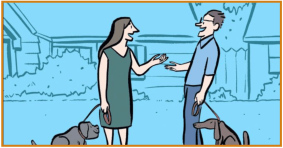
True Kindness is totally the opposite of co-dependence. It honors our own needs & values, expressing this to others so they know where they stand with us.
Sometimes healthy kindness is uncomfortable. Sometimes it means saying ‘No” to someone’s request or demand, because it’s not good for us, or not good for them – like not giving money to an active addict, not spending the night with a stranger, not over-doing when sick or tired….

NOTE:  Our True Self may indeed be helpful, caring & kind. And for wounded people who want to scrub off the False Self layer, with enough Recovery we who are ‘natural helpers’ can find a balance between legitimate giving & appropriate self-care.
Other personality Types can finally uncover & admit that ‘helping’ is not really their style at all – they need more privacy & solitude to fulfill healthy goals & natural talents.
ARTICLE:”For Everyone who has been called ‘Too Nice’.” Re. Positive niceness!!

Co-dependent Fake Niceness
Most people occasionally need to hide their anger behind the face of politeness –  especially when it’s the only way to protect oneself.  This is normal.
Here
we’re focusing on suppressed-anger-niceness as a way of life. It’s a defense mechanisms, one of many ways damage shows up, used to disguise unhealed wounds of the past. Childhood abandonment always leaves us with a great deal of anger, which ‘nice’ people turn in on themself. Lacking genuine self-esteem, we latch on to others so we can manipulate them into providing our many unmet needs, instead of working to develop these for ourself.

Co-Dep is an outgrowth of self-hate, which tells us that we caused our own pain, from birth – on. And according to this distorted thinking, if we caused it then we surely can cure it. This is the WIC’s sense of false power, who is convinced it can control how we’re  treated – by being extra good – no, perfect!   (opposite of Al-anon’s 3 Cs)
But all we end up doing is twisting ourself into whatever pretzel we think others want, and trying to fix people who are the least likely to change – the narcissists & addicts around us who are too self-absorbed to even see us, much less care. Neither effort ever works!

In reality we could not possibly have caused any of our early suffering, since the damaged adults who raised us were already fully formed before we arrived!  It’s not fair that we have to clean up the mess they left us with, but we do have the ability to heal much of it to better out life. Yet many people are unwilling to shed deep-seated defenses, since it would mean dealing with the original wounds that caused a need for them.

Without a strong inner core of self-esteem, clear thinking & good boundaries, hoe we interact with others is not ‘clean’. At the very least, the surface agreeableness of our angry-niceness is a pretense. At the extreme, being overly-sweet, overly-solicitous, overly-helpful hides our anger , but will come out sideways.

Actually, our carefully controlled actions are basically self-serving, because we’re only being ‘so good’ as a way of conning others into taking care of us – emotionally, psychologically – & often in all 4 PMES way. Whether or not we’re aware of our compulsive patterns is not the point. (See Part 1 re. Selfishness).too helpful
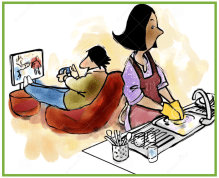
If you’re still actively Secretly-Angry, you want to be seen as a kind person, in spite of how you feel inside, because society considers that a virtue. And being desperate for positive strokes, you assume that’s what is always required & expected of you. But you’re still living in emotional deprivation, so no amount of people-pleasing will fill the void.
Then, the more you do for others, especially if there’s no acknowledgement or appreciation – the angrier you get. But ‘nice’ people aren’t supposed to get angry – so the feeling transforms into resentments.

NEXT: Co-Dep defined #2
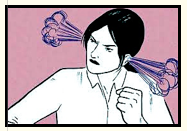
Anger & CO-DEPENDENCE (Part 2)

co-dep angerTHERE’S NO WAY
for me to win!

PREVIOUS: Anger & Co-D (#1)


1. Re. OUR Anger (cont.)
a. MISSING Emotions (cont.)
i. Numb
ii. Disconnected
And then there are the times we FEEL something – that punch in the gut or the stab in the heart, BUT don’t know where it came from.
Our body’s legitimate reaction to abuse is disconnected from our mental center (cortex) because of years of involuntary denial. So —
√ we blame ourself for the pain, thinking we’re making it up, over-reacting / too sensitive, it’s hormonal….
AND
√ if we do make a vague association between our discomfort & a particular person, we justify & excuse it by thinking “they didn’t mean anything by it, it’s just the way they are, she/he DOES love me….”
cat collarIt’s as if we’re wearing one of those animal medical collars: we can see over the top of the stabbers face, but can’t see the knife in their hand as they shove it in!
However, if we take the collar off, & ask the Inner Child how it feels around that unhealthy parent/ friend /boss/ lover….. & if the Child is willing to respond – we find out exactly what’s going on!

So when denial starts wearing off, we’re shocked – first by the pain, & then realizing that all this time our thinking has been way off!
That’s liberating but also very scary, seeing that we’ve built much of
our world on mental sand.
We have to revamp our whole concept of reality, which can leave us with a lot of anger, realizing how great the abuse really was.

For a long time we may hate our parents, the rage coming in waves. We still want them to be what they can’t & never could be.
Eventually we can accept that we no longer need them to take care of us – we are our own parent NOW, so we can learn to deal with them realistically – whatever that means for each of us.
BOOK: “Coping w/ Codependency” ~ Kay Marie Porterfield

b. INAPPROPRIATE anger/rage
Self-Hate: As co-dependents (Co-Ds) we are brutally critical of our own imperfections, even when they are absolutely normal for being human – whether making a mistake, not knowing something or making an error in judgment.

We also rage at ourselves any time we don’t get a need met or feel hurt – taking on the responsibility for other people’s limitations or unhealthy behavior.
At the same time – we sabotage opportunities for getting those very needs met – to stay loyal to our early training. (“People should treat me better, but….“)

🔹Repressed
In Claudia Black’s book “Deceived”, she places Co-Dep anger on a continuum: Avoidance <– Sideways anger — Anger –> Rage
At the far left it’s sometimes described as feeling dazed & defeated, often part of low-grade chronic depression. For many people (more often women), avoidance is a learned response to stress over time, starting in childhood, along with long-term painful / abusive adult relationships.

🔹Boiled frog syndrome
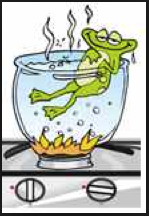
If placed into a pot of boiling water, a frog will immediately jump to safety rather than burn to death. However, if the frog is placed in a pot filled with room-temperature water, which is then very slowly brought to a boil, it will happily do the backstroke until it’s cooked from the inside out.

boiled frog syndromeCo-Dep anger can be like that as well. In a volatile situation we may fight back or just leave. But if we let our emotions accumulate in the POT, we end up stewing in our own juices until it feels like we’re choking.
Then the anger (& all the pain underneath) bursts outward in harmful ways, or inward with silence, uncontrollable crying, anxiety, constant fidgeting, physical illness…..

🔹Sudden flashes
On the other hand, unexpected burst of anger at others can be a sure sign of co-dependency at its tipping point – in reaction TO:
• always considering what someone else needs AND they rarely / never reciprocate
• being constantly disappointed, but still depending on narcissists to come thru for us – against all evidence
• hearing a correction or suggestion as criticism, triggering S-H
AND / OR
• not being able to get thru to someone, no matter how often we try
• someone not reading our mind – about what we need or want (so we don’t have to ask)
• trying to force someone to be or do something they either don’t want to do, or simply are not able
• trying very hard to please someone who will never be pleased, but we keep trying
• wanting someone to take care of us, but they won’t (& shouldn’t)

NEXT: Anger & Co-D – #3

Toxic Family ROLES (Part 1)

SHE HAS TOO MUCH TO DEAL WITH – so it’s up to me to help everyone!

PREVIOUS: Family ROLES – general

BOOK : “Living With Alcoholism & Addiction: The Elephant in the Room” Meilena Hauslendale


✅ NORMAL HIERARCHY

❎ DYSFUNCTION
These posts are focused on the alcoholic family, but these Roles can also be applied to other dysfunctional systems.
DEF: Drug = anything used compulsively (not only chemicals)
Addiction = any substance, person or activity which is used as a numbing agent against inner pain, becomes the only center of someone’s life & which cause chemical changes in the brain – ‘love’, sugar, alcohol, over-exercising, drugs, porn, pot, religion ….

Reality – In any addictive system :
• the addict’s use of their chosen drug(s) is the most important thing in the life of the whole family, & nobody’s allowed to discuss the problem with others outside the home

• addiction in not the only cause of problems, but is combined with :
— the denial of it & the emotional pain everyone’s feeling
— no-one saying what they really feel or think, to themself or others
— not talking about the “use” & actions that cover it up, blaming others
— providing alibis & undeserved loyalty of the family to the active addict & to the whole toxic system – enabling addictions to continue

ACoA painTYPICAL emotions of an addictive system
Anger: kids resent the drinking parent, but often transfer that anger to the non-drinking parent for being over-controlling, not providing support & protection, &/or for not leaving the addict

Anxiety: fear because of arguments, neglect & violence, creating constant worry & emotional hyper-vigilance (never relaxed)

Confusion: the drinking parent’s mood swings & unpredictability cause uncertainty & inner turmoil, paralyzing kids who don’t know what to do first, second or next. Also confusing, contradictory messages & rules

Depression: feeling lost & lonely, helpless & hopeless, powerless
Distrust: constant disappointments, broken promises & mistreatment make it hard for kids to trust anyone or develop close bonds with others

Guilt: kids assume they’ve somehow caused the parent’s drinking & chaos, & not being able to ‘fix’ things  
Shame
:  kids are ashamed of the family “secret” – including physical abuse – & withdraw from other family members, classmates, friends….

Alcohol-ISM is the organizing principle in a dis-functional family system, says Claudia Black. The active addict becomes the central figure around which everyone else arranges their actions & reactions, usually in a slow insidious process, forming the family mobile.

Members do what they can to bring as much consistency, structure & safety as possible into a family that’s unpredictable & dangerous. They adopt certain roles, while the ‘problem’ becomes the “elephant in the room”, which they all carefully ignore

• In these addictive & other narcissistic homes, with the endless tug-of-war between personalities & the ‘problem’, children’s need for love, support & emotional nurturing is often minimized, made fun of, forgotten altogether – even punished.
With few role models to show how emotions can be expressed positively, children shut down & stuff themselves into the straight-jacket of the Roles.

• Trouble follows when the people or tasks in a subsystem overlap, becoming blurred with those of others (such as role reversal).
Some members may be well-meaning, but the impulse for secrecy prevents anyone from reaching out for help, so the only option they have is a misguided attempts to protect the group by denying or minimizing the stressors.
The need to look “normal” comes out in distorted ways because they don’t know what normal is. They compare their insides with everyone else’s outsides, & always loose by comparison

• At the same time – their worry about & love for the addict, & the all-pervasive fear of change – inevitably cause family members’ to gradual slide into a psychological & social hole. As a parent’s substance abuse progresses, everyone has to play a part in preserving the home.

Toxic Family Roles (TFRs) may seem to be the ‘recipe for living’ in that barely surviving environment, but they actually discourage growth, preventing everyone from responding from their True Self. That makes it hard to give or receive support.
And the Toxic Rules attached to the Roles are unrealistic, & difficult or impossible to obey, which encourages dishonesty & manipulation, to avoid rejection or punishment.

NEXT: Toxic Family ROLES (Part 2)