‘GETTING TO KNOW YOU’ Stages (Part 3)


I’M INTERESTED

what he’s saying
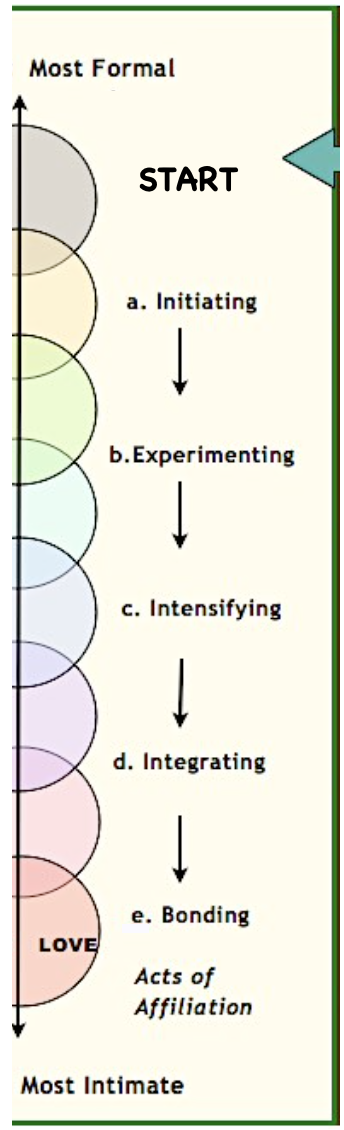
PREVIOUS: Part 2 – Experiment


♥ ACTS OF AFFILIATION ♥
(cont) indicated by Types of Communication 

3. INTENSIFYING (Exploratory)
a. Normal: ‘Partners’ start opening up, sharing deeper personal info, taking more risks.  Much more emotionally intense &/or passionate stage, using intimate language

“I love you” <> “Me too” ✥  “I think you’re the best” <> “ I’m glad we found each other”  ✥   “It’s great to be with someone with the same tastes” <> “Yeah, we have a lot in common. Makes me feel at home”

• Begin to use ‘we’, develop favorite palaces, nicknames, share / swap possessions, understand non-verbal cues, give gifts, idealize each other, even finding their flaws endearing.  People can be so excited with each other at this stage, they’ll spend hours talking – time passes quickly. There’s a feeling of exhilaration, & depending on the type of relationship, a strong sexual pull

This is the pivotal stage. Depending on whether or not both feel a chemistry (comfort, mutual value & excitement), and if the revealed info, attitudes & activities are sufficiently shared – people either continue to #4 & #5, or fall apart.

The connection at this point may be intense but short-lived, which is a shock to some who mistakenly assumed it would last because of the surface siminfatuationilarities & the emotional / sexual intensity.

➼  In some cases, there’s an intermediate stage called “Revising Communications” – when the euphoria has worn off.
The partners are able to review the strengths & weaknesses of the relationship from a more rational place, to see if they want to go on to the next phase. If they do, they begin working thru any problems or obstacles to further intimacy

b. ACoAs: we usually rush into this stage soon after meeting! Spoken or not, the communications is something like:
“Hi, my name is Sara, let’s be together forever!” <> “”OK, I’ll keep my eyes closed, as long as you make me feel good!”

✶✶✶ WARNING: ACoAs often misinterpret the ‘euphoria’ of this stage to mean there’s real intimacy happening! Spending every day for a week deeply immersed with a new friend or lover can end abruptly when they disappear on us!
Whatever their reason – they got scared, they feel suffocated… we feel conned, betrayed, angry… & are left with an acute sense of longing!

REALITY: We went too deep too soon, & now we’re alone – again!
• TYPICAL ACoA reaction: beside feeling rage, we obsessively ruminate on what we did wrong (S-H) without knowing what the real issues are! We either withdraw into a depressed ball or use all our energy to chase after them. We want the pain to stop & get back the HIGH. heart illusion

REALITY: WE got it wrong. Yes, the other person is also responsible for their part, but we can only deal with ourselves.  This is supposed to be stage 3, NOT instant love! It was not intimacy.

• HINT: if a ‘relationship’ develops too close, too fast – it’s likely NOT going to be healthy or real, but coming from both WICs!  ACoAs are addicted to fantasy & magic, as powerful as any chemical narcotic.
We have to work at going slowly or we’ll keep getting abandoned.

NEXT: Part 4 (Ingratiating)

‘GETTING TO KNOW YOU’ Stages (Part 2)

 GOING DEEPER!
Now we’re together forever – I think

 PREVIOUS: #1 Initiating

♥  ACTS OF AFFILIATION ♥ indicated by types of Communication

2. EXPERIMENTING (Potential)
a. Normal: Time for small talk, presenting our public face. The focus is on light, humorous, informative conversation:
“ Did you like Thai food?” <> “I don’t know – never tried it” . “I went to France this summer” <> “Really! I’ve always wanted to go there! Tell me about it”

• There is mutual attraction & also a desire to reduce uncertainly about one another. Telling more about oneself implies an increase in trust, & we expect others to do the same – so that neither will feel too vulnerable

• People use (secret) tests to check how attentive the other person is by how they respond to what we say (laugh at our jokes, respect our boundaries…).  Each has certain expectations of the other, which must be met for our interest to continue : being upbeat, neatly dressed, polite, interesting ….

b. ACoAs: People give us info about themselves all the time – by thchit chateir presentation, their actions & of course words — their tastes, interests, like & dislikes… and we need to PAY ATTENTION!
Yes, it takes months of regular contact to get a realistic picture of the other person, but we can glean a great deal from each conversation right from the beginning.

So after every encounter, always ASK:
“What did I learn about them? How did I feel when I was with them, & afterward? Are they moving too fast? How do they handle situations & other people?”
✶ How much are they truly reciprocating, or am I the only one sharing – OR only them?

If so – we can take that as a warning sign. They’re either too scared or too self-centered. If we proceed, we have to accept the consequences.
➼ This constant evaluation is crucial for us to do at each stage, because ACoAs have such strong training & defenses against seeing others accurately.  If the WIC likes someone AND they feel familiar (in some way like our family), WE may :

i.  be in ‘Lala Land’ = don’t want to know they may not be an appropriate fit, especially if we feel a very strong pull – so we idealize them, convinced they’re ‘the one’, or a BFF…  Actually, at this stage it’s just too early to know for sure

ii. get “the ICKs” (scroll down) = If we’re not quite comfortable with them, but they’re not blatantly abusive, we need time to find out if it’s becauselearn more
— the WIC &/or PP is acting up – with self-hate, lack of trust, old buttons triggered, our FoA, weak boundaries…
OR
— the person is actually icky in some way – their damage is showing & we’re picking it up, but can’t verbalize it yet
OR
— they’re genuinely NOT suited to our True Self, no matter how smart, competent, nice, or how much they may like us.
SO – we wait & LISTEN, hopefully with a clear, fair & open mind

IMPORTANT – Going slowly will allow us to:
• see how much like our family they are or aren’t (requires knowing ourself well, & paying attention to every interaction with the other person)
• find out if they are genuinely compatible with our Real Self
AND
• observe if they can truly see us for who we are, value, admire & respect us – realistically, not just for what we can give them
• how well or badly they handle our damage/ defects
AND
• what their character defects are, & how it will impact us over time
• see if the205108791ir positives outweigh the negatives (which everyone has), so that being with them will add value to our life
AND
• how capable & willing are they to take responsibility for their own life, so we don’t have to rescue or clean up after them
ALSO, if they have a spiritual life, is it internalized? does it show in the way they live? or is it just another band-aid or diversion from unresolved deeper issues

NOTE: When someone has too many negatives – no matter how much we like or love them – they’re unsafe to be with! Take stock & be honest with yourself. Get a trusted 2nd & 3rd opinion!  If we ACoAs are willing to take these stages a little at a time & ‘stay awake; with many of our relationships – we’ll save ourself a lot of heartache!

NEXT: Part 3 – Intensifying, Integrating