

PREVIOUS: Taste 3a
BOOK: “What the Nose Knows....” (Review) ~ Avery Gilbert
GUSTATORY Learning (Taste, cont.)
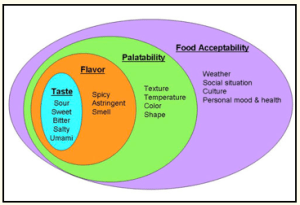
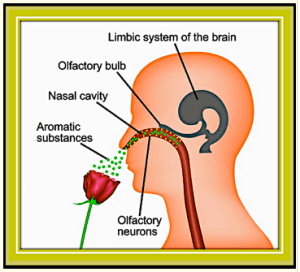
Tastes, smells & chemo-sensory irritants are often experienced together in food or beverages – such as a burning sensation when eating spicy foods. In this case, the trigeminal nerve ( responsible for sensation in the face. & motor functions such as biting and chewing) carries info about chemo-sensory irritation detected in the mouth & throat, while other nerves carry info about tastes & odors collected from other parts of the mouth & nose.
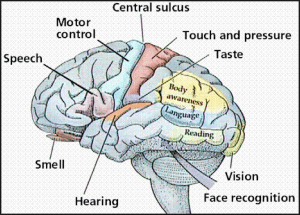
All these sensations are combined in the brain to produce what we think of as the ‘taste’ of a particular food, but is actually a combination of inputs. ARTICLE: “Why does food taste so delicious?”
At the Institute for Food Research (UK), classes introduce students to the science of the sensation of taste. Subjects including chemistry, biology and food science, c overing topics such as the nervous system, healthy eating, genetics, anatomy, molecular biology and organic chemistry.
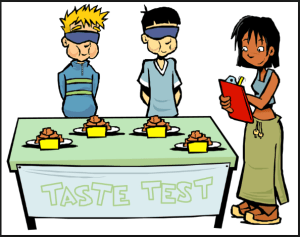
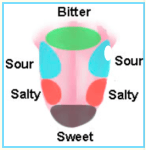
One of their exercises: Pupils try a set of compounds that represent the five basic tastes. The solutions used are sugar, salt, citric acid, MSG & flat tonic water. Subjects should be able to identify these equally well with or without holding the nose, because these flavors do not depend on smell.
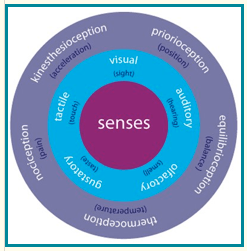
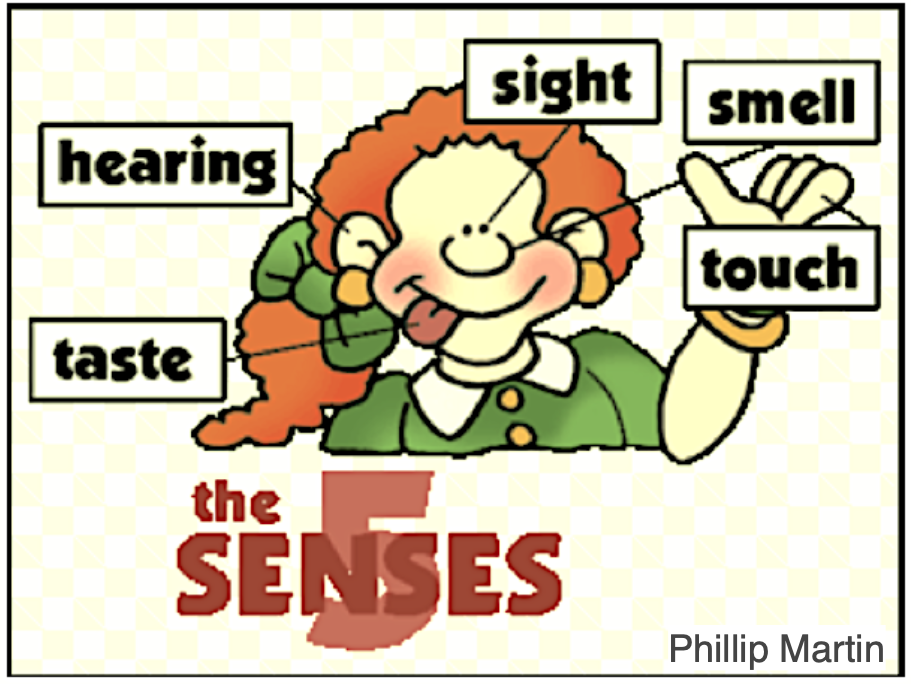
Research also tells us that taste & smell combine with other senses when tasting.
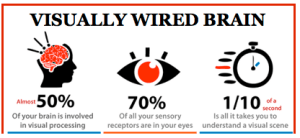
EXP: Color has significant effects on our ability to recognize flavors of soda. Experiment participants were less likely to accurately identify fruit-flavored beverages when they were unaware of the color. This shows a correlation between taste & vision. The greater number of senses used with taste, like smell & vision, the more accurate the detection of flavored stimuli will be.
Since color plays a role in identifying flavors, then there must be top-down processing before we actually taste something,  which starts with familiar knowledge & only then is experienced by the senses.
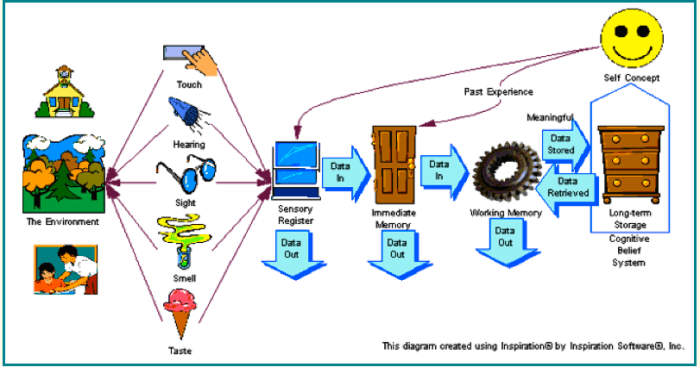
NOTE: SENSATION = bringing in info thru the 5 senses
PERCEPTION = how the brain makes sense of that info
Together they form PROCESSING, either Top Down or Bottom Up.
In any learning situation, associating a fact with a fun experience or memory helps to retain more information, so the love of food can be used educationally. Aside from Food Technology classes, taste can play a large part in the broader curriculum, such as:
• for History & Geography lessons, making dishes from around the world or tasting a famous historical food are fun for students & make for memorable lessons
• learning about Yeast Reactions in Science can be enhanced by actually baking bread with yeast & then tasting it, providing a vivid connection between the two modalities
• food can be used to demonstrate Irreversible Reactions in Chemistry, such as boiling eggs or making jelly.
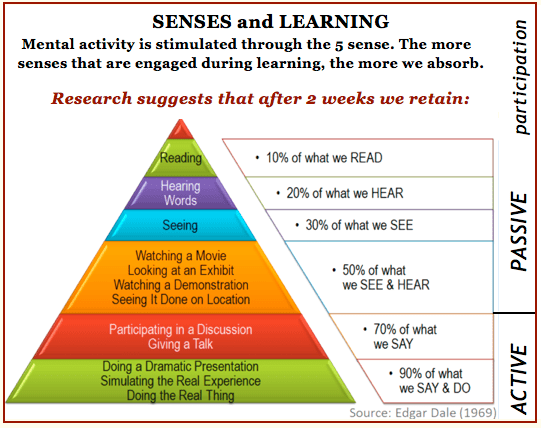
So, although cooking/baking might not seem relevant to science, engaging multiple senses will in fact increase memory. Also, baking as a classroom group activity can reinforce team spirit & cooperation in students.
LESS: People being treated for cancer are keenly aware of how vital taste is – even when their sense of smell is not impaired. In the short-term, chemotherapy tends to produce many small sores in the mouth, a chemical aftertaste & numbing of the tongue – which significantly cut down on the ability to taste food.
ALSO – Disorders of taste, long-term or permanent:
Ageusia (complete loss) // Hypogeusia (reduced sense) // Dysgeusia (distorted sense) // Parageusia (persistent abnormal) // Hypergeusia (abnormally heightened sense)
MORE: Super-tasters are people whose sense of taste is significantly more sensitive than average. At least in part, this is due to a greater number of fungiform papillae, structures in the tongue with taste buds on their upper surface. The ‘average’ person has about 184  buds per square centimeter, while super-tasters have around 425 pr cm/2.
Studies have shown that super-tasters require less fat & sugar in their food to get the same satisfying effects. However, contrary to ‘logic’, they actually tend to use more salt than most – because of their heightened ability to taste bitterness, since salt drowns that out.
ALSO: Patients with Addison disease, pituitary insufficiency, or cystic fibrosis sometimes have a hyper-sensitivity to the 5 primary tastes.
NEXT: Others (Part 4a)












 HEAL & GROW for ACoAs