How to STOP LYING (#1)

PREVIOUS : Dealing with Liars

SITE : “Fight, flight, freeze, and fibbing: Lying as a trauma-based behavior


Loosely based on wikiHow

1. DECIDING to Stop
Being consistently dishonest may not seem to cause harm, but it’s often used to manipulate other people’s behavior & their attitude toward the liar. Exposed to a liar over time slowly whittles away at the victim’s free will & their right to make choices based on truth.

to protect yourself from being abused (socially, verbally, physically….) ? A child may have few or no other ways to find some safety – a neighbor, teacher, best friend…… AND as an adult – if you’re in a truly dangerous situation, keep looking for a safe way to escape, so you won’t need lies to cope.
✴︎ to have some control over situations? When you can see an obvious way to get what you want by telling a lie, telling the truth is tough.  You may believe dishonesty is the only way to make other people do what you want, since you haven’t developed internal permission to get your needs met directly.

✴︎ to make yourself look better?  If you’re low on self-esteem, it seems like a shortcut to boosting your status at work, in your social circle, even with loved ones – until you’re caught! People with healthy self-regard (not arrogance like narcissists) don’t need or want to lie, unless in an emergency.

✴︎ to comfort yourself ? Telling the truth can be very hard. In specific situations it can causes you awkwardness or anxiety (making a difficult statement, asking for a need….). And it can make others uncomfortable – if it’s something they don’t want to hear. Lying to others, and even more to yourself, prevents from having to face painful emotions & situations

If you don’t have strong enough reasons for quitting, it’s a lot harder to give up lying about yourself or to others. Consider seriously what effect it’s had on your sense of self & on your relationships. Sticking to this defensive pattern undermines your ability to develop self confidence & self worth. A deep part of yourself knows you’re not living from integrity, even though you may think you’re protecting yourself

Some reasons to work on changing:
• TO experience yourself as a valuable person. Lying cuts you off from reality when you camouflage large parts of yourself by projecting a fake image to the world

• TO express real emotions & opinion, so your True Self can be seen & valued. Being able to feel good about yourself is the main reason to stop lying. You may find it’s a relief to show the best parts of yourself that have always been there. This means slowly shedding the False Self developed in a toxic family environment, which need lies to keep it propped up.

• TO connect with others . Under everything – we want to connect with others, to not feel isolated & alone. Lying gets in the way of that deep need. Positive relationships are based on compatibility – and the ability to express our native personality to each other. With the right people, the more each one reveals, the closer we get.

• TO gain back people’s trust. Naturally, this refers to your relationship with people who have known you a long time & know your tendency to distort information, so they know they can’t rely on whatever you say – even when you’re telling the truth.

Having caught you in lies, they’ll protect themself from frustration & disappointment by keeping you at arm’s length or ending their connection. If that matters to you, you’ll need to start being honest – a little at a time – & continue until they can depend on your word. This may take years, so don’t be surprised & don’t give up.

Treat lying as you would any other addiction, making a serious commitment to change. It requires a lot of hard work & self-awareness, so❣️set the worthwhile intention every morning – as you start your day that “I will stop to think, & then tell one less lie today than I want to perpetrate”.
Follow thru & see how that feels. Over the weeks, make it 2 less a day, then 3 …..

NEXT : How to STOP LYING (#2)
DEALING with LIARS

PREVIOUS : LYING & the BODY

BOOK :Big Liars What Psychological Science Tells Us About Lying and How You Can Avoid Being Duped

🚫 HOW to MANAGE being around them

🔸 Consider the Source
When hearing facts that don’t add up, our first instinct may be to assume someone is lying to hurt us, & so approach them with that attitude. Before reacting, stop to consider who this person is to you, & base your response on that.  Are they a close friend who is typically supportive & appreciates all your good points?  or a colleague who is jealous, & constantly puts you down?….

🔸 Look Inward
It may be hard, but it’s worth asking yourself what’s your reaction to hearing the actual (brutal?) truth from someone? If you get hurt, offended or angry every time, you should expect people to start omitting details or even lying to you.

Would you rather be lied to, like getting an insincere complement on a new blouse, or more seriously – a buddy agreeing with your idea of going for an unrealistic goal, even knowing it wouldn’t work ? Be honest with yourself about your expectations of others, & see if you may be holding them to an unfair standard.

🔸 Document the Evidence
If someone is gaslighting you – making you feel crazy for questioning things – it’s very important to document the evidence,  journaling your experiences, not just your opinions. Some people who lie are very clever at demolishing your sense of reality, so keeping a record is an excellent way to stay grounded in “I know what I know”.

🔸 Have Realistic Expectations
The reality is that some people will continue to lie. Accept what you know – identifying what you can & can’t count on them for. That will save you a lot of future heartache.
IF you must stay in contact, based on their role in your life (parent, addicted adult-child, boss ….), decide to relate to them only superficially, & never rely on them for the truth.

🔸 Think Before Confronting
When you want to talk to someone you know has been lying to you, first identify the main points you’ll want to get across. Next, practice saying them out loud – alone or with a neutral person. When emotions are intense, it’s easy to lose focus & get sidetracked – especially by the liar. Rehearsing ahead of time will help to stay anchored when the time comes.

🔸 Express Boundaries 
Knowing your boundaries – in any situation – is important for self-esteem & self-empowerment, but especially in any relationship that’s been fractured by dishonesty.
Boundaries are not about telling someone what they should or should not do. It’s about setting limits on what you will tolerate & stating what you do find acceptable. Make the consequences very clear about what you will or won’t do if someone doesn’t respect your boundaries, & be ready to enforce it.

🔸 Give them a Chance to Rebuild Your Trust
IMP: This does not apply to compulsive, narcissistic, pathological liars!
Being lied to can trigger a grief process, which you won’t get over quickly. If the other person admits to their harmful behavior (is accountable) & understands how/ why they hurt you, that’s a good sign. If not, the relationship won’t grow. Sometimes the only realistic, self-caring option is to distance yourself. Either way, take your time to heal.

🔸 Practice Kindness
Consider – what you heard may not be what was said or meant. It could have been a misunderstanding. If you decide to confront someone about a lie, start out with a willingness to give them a chance to explain. Share how you found out about the lie & ask for their take on it. Accusing someone of something big requires big evidence.

🔸 Stay Levelheaded
When planning a conversation about someone lying – even if it’s an important lie, try to stay in charge of your feelings & behavior.  You don’t want to turn into someone you don’t respect. Your emotions of anger, frustration, disappointment…. are valid.  You have a right to an outlet for them – so express them appropriately, rather than in a way you’ll regret.

🔸 Take Time for Recovery
From white lies to big omissions, lying covers a broad range of untruths, & so are our reactions. You may feel annoyed, scared, shocked…..  Stop to experience your emotions, write about them & maybe share what happened with a trusted confidant – so they don’t come out sideways later on.

For a big lie, like an affair, you’ll need lots of time to collect yourself & recover. When your reality has been shaken, do things you enjoy as a great way to soothe your wounded heart, & use grounding exercises like deep breathing ,  polyvagal exercises…. to calm your nervous system.

🔸 Therapy
A therapist can be a great short-term tool or an ongoing resource. You don’t have to wait until things become unmanageable or as a last resort. Therapy can be situation-specific & end when the issue feels resolved.

If lying has created a wedge between you & your partner, a neutral person in couples therapy can help to process painful emotions, examine each person’s beliefs, underlying needs & expectations, as well as explore where you want the relationship to go from here..

Modified from EVERYDAY💚HEALTH article by

NEXT :

LYING MATES

PREVIOUS : Lying & the EYES

SITE : “….When Your Mate is LYING ALL the TIME


Signs of a Lying Mate
Your mate may think they’re hiding the truth from you, but if you pay closer attention to both their words & non-verbal language, you’ll admit you’ve been seeing signs from early on in the relationship – maybe even on the first date!

WHY it’s Hard to be Sure a Mate or Partner is Lying
In spite of the assumption that the most reliable cues of lying are nonverbal, research suggests that when it comes to the truth of another’s story, the most accurate cues are verbal, which included how plausible the story was.

1. Crossing the Line. It’s uncomfortable & seems impolite to accuse someone of lying. Our sense of family training & social etiquette often keeps us from being correctly suspicious. And without being able to cross-examine the potential liar, it makes the lies much harder to notice & acknowledge to ourself

2. Differences in Motivation.  A lying mate may have a deep need to successfully deceive you. Unless there are blatant reasons for you to be suspicion, you may not be very motivated to test the truth of your mate’s ‘stories’. You may say to yourself – “I’m just not sure”.

3. Differences in Skill. Lying successfully is a skill that can be developed over time. Your mate may be a much better liar than you are a being a human lie-detector. In fact, there’s good evidence that even people who are specifically trained to catch the signals don’t get that much better at it. Good liars tend to have the upper hand.

4. Trusting Bias. Research clearly shows that we trust others too much. Even in studies where people are told that they will hear 50% lies and 50% truths, they choose to believe well over half as “truthful.” (70- 90%). Naturally, this trusting bias is even stronger toward people we love. In everyday interactions with those close to us, we bend over backwards to give them the benefit of the doubt.

6. You Fear the Consequences. Many times in relationships, we don’t want to test our mate’s honesty because there can be severe consequences. It may drive a wedge between the 2 of you, with a threat of emotional abandonment or divorce.  They may become very angry & in some cases violent….. So, for many people, not knowing the truth may be more bearable than the alternative. (from : R. E> Riggio, PhD)
♥️                 💙                     ♥️

IMPACT of a Lying Partner
A lying mate hurts the entire family system. Some effects include loss of intimacy, increased conflicts, & divorce. Once an ugly truth comes out it leaves the spouse & children feeling confused, rejected, angry, sad, scared, even foolish. Previous trust in the lying mate is damaged, & depending how big the lie is – it dramatically changes the family’s relationships with each other, & can be very hard to recover from.

HOW to RESPOND
If you’re talking with your mate & become aware that they’re lying, it’s best to address it right away. How much you say & how you say it – is ultimately up to you, but there are some things it’s best to always do, regardless of the situation :

❥ Immediately.  As soon as you think or know your mate is lying, speak up. Always listen to your body & mind – you have intelligence & experience. Let them know what they did or said that triggered your gut reaction.

❥ Be assertive – but not aggressive, if possible.  If you suspect your mate may be lying, state your concern about wanting to be able to trust them. Clearly identifying the honesty you need & expect in your relationship. Set healthy boundaries for what is & is not acceptable, being prepared to leave if your mate consistently violates them.

❥ Check their understanding. Do not assume your mate fully understands your objections to their lying. Be sure they understand what you mean you by asking them to repeat back or paraphrase your point. Encourage them to ask clarifying questions, to prevent any misunderstandings.

💔  Leaving a Lying Spouse
A mate lying is a major violation against you & the union. With lots of patience & perseverance (couples therapy, 12-step Program, church) – the emotional damage may be repaired & trust restored.
However, if you’ve been hurt too much & for too long, or your mate doesn’t have what it takes to change, it may be time to walk away.
« EXPLANTIONS ⬇️


«
NEXT :

LIARS & the EYES (#4)

PREVIOUS : LIARS & the BODY (Part 3)

SITE : “How to Read People’s Eye Direction and Behavior”


Eye Contact is among the most basic ways of social communication used by humans. In Western Cultures people tend to make eye contact 45-65 % of the time while talking, & 65-85% of the time while listening.
• Too little eye contact indicates the person is avoiding telling you something.
• Too much can mean they’re trying to convince you that what they’re saying is true.
Watch their eye direction. A person may have a favorite side – left, right, up, or down – when thinking of something. Any dramatic shift can alert you the a listener that they might be stressed or anxious.

The MOVEMENT of someone’s EYES shows what part of the brain they’re accessing. 
Estimating a subject’s looking-direction is a challenge, but eye contact can now be effectively captured by a wearable point-of-view camera.  One group of scientists developed a deep neural network model to automatically detect eye contact in egocentric video, the first to achieve accuracy equivalent to human experts.
You can tell if someone is constructing made-up information or genuinely recalling what actually happened – by which direction their eyes move to. ⬇️ Chart : as you look at someone
«

«
FEAR micro-expression are closely linked to shock. When we’re scared & widen our eyes, our field of view increases. This lets us see any threats that might lurk nearby.
A 1996 study found that when we see someone showing fear on their face – obviously or by micro-expression – we too may feel frightened. EXP – watching an actor in a scary movie makes us feel anxious in reaction, triggered by mirror neuron activity in our amygdala, the part of the brain responsible for emotions such as fear

Watch for Eye-blinking Changes
There’s some truth to the saying, “The eyes are the window to the soul”,  especially when it comes to spotting deception.
When someone is lying, it’s common for them to stare into your eyes & avoid breaking eye contact, “gauging” if you believe them or not – in an effort to control & manipulate.

The Science: Researchers have evaluated various physical measures. In one case, they wanted to determine if changes in eye blinks could be used to detect a person’s false intention. The study concluded that eye blink rate decreases when lying. After lying has finished, that person will tend to yawn & blink more, to refresh their eyes. 

The Key: However, some will blink more when they’re lying. To become a more accurate lie-spotter pay attention to how someone normally blinks, & then compare.   So look for inconsistencies.
If someone is usually an eye-contact champion but suddenly seems like they’re tracking a fly buzzing around the room, or staring at you so hard you wonder if they’re competing with you, that’s your cue. Or vice versa. It’s all about changes in behavior.

Baseline their eyebrow movements.
Are they expressive, free?  OR – look for a combination of HINTs:
• brows stay motionless like a tree stump
• brows are raised & drawn together, usually in a flat line
• upper eyelid is raised, but lower lid is tense & drawn up
• upper white part of the eyes is showing, but not the lower white
• forehead wrinkles are in center between the brows, not across

NEXT : Lying MATES

LIARS & BODY PARTS (#3)

PREVIOUS : LIARS & the BODY (Part 1)

SITE : “Nonverbal Communication and Body Language


GENERAL HINTS
BODY
✒︎ Grooming behavior  – playing with / twirling hair, pressing fingers to lips, picking at or brushing off imaginary lint, rubbing excess sweat off back of neck

✒︎  Indifferent or bored posture  – to avoid expressing their emotions. Crossing arms at chest – as self-protection. A rigid stance can be a red flag, since small, relaxed, automatic movements are natural in a truthful conversation

✒︎ Pulling the center of their body inward (concave).  Shrugging one or both shoulders – trying to make themself smaller & less noticeable. Movements can be stiff & awkward

✒︎ Putting barrier-objects between self & another person, on lap if sitting….. When you hit a nerve in a liar they instinctively cover vulnerable body parts (throat or neck, chest, stomach area)

✒︎ HEAD : suddenly jerks head away when asked a direct question abut a lie. Breathing can become rapid & labored

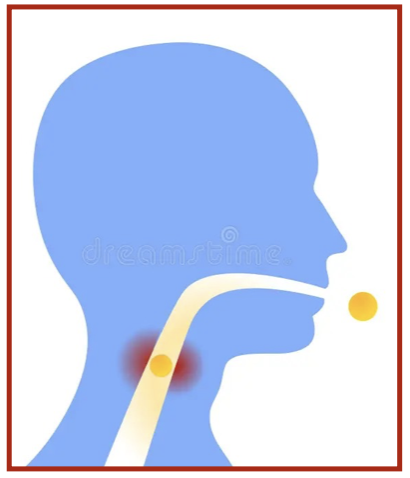
Watch The NECKTelling a lie doesn’t always come from the mouth. It can get stuck in the neck on the way down (from the brain), making that a great hotspot to notice deception.

If a person touches their neck, it can indicate increased sweat from anxiety about being caught. If they’re wearing a collar, they might instead tug at or adjust it, to seem less obvious.
The act of lying has been found to cause tingling in facial & neck tissues, so a liar will scratch their neck to soothe it, on an average of 5x whenever it itches – rarely more, rarely less.

✒︎ FACE : Touching the face, as if trying to calm themself down. Changing color to a light shade of pink, or blushing.

Mouth is open, with lips slightly tensed or stretched & drawn back.  Watch a person’s smiles — being genuine always includes the entire face, with crow’s feet at the corners of eyes, & contracted cheek muscles.

But when lying : lips are pressed together or are being bitten. The smile looks forced or tense (not from pleasure or as a welcome), & it “does not reach the eyes” which show other emotions such as anger, contempt, disgust, or fear

Other hints :  Swallowing or yawning, voice getting shallower as they breathe heavier. If they’re smoking or chewing gum, it’ll likely to be at a faster pace. Putting a pen or pencil in mouth, chewing on a fingernail, tapping teeth….

The liar may unconsciously cover their mouth to avoid answering a question – an indirect form of dishonesty, or place the hand near it, as if to prevent a lie coming out, which stops communication.

✒︎ HANDS : People tend to fidget the lying, which is a displacement activity that indicates nervous energy. EXP: turn a ring, bracelet watch. Wring their hands, or if sitting, rub palms on pant legs. Chatter with fingertips or hide hands.

It’s very hard to lie with gestures. Say “3” but hold up 4 fingers. However, liars get defensive when caught, which can make them waive their arms, or point a lot with an arm or finger to try to con others into believe their point.
EXP: When asked about Monica Lewinsky, Bill Clinton clearly looked to his left – as he lied – but pointed directly ahead with his arm. This gesturing disconnect is a surefire symptom.

✒︎ FEET : When people lie, nervous behavior shows by their feet doing a little dance, often unconsciously. This could include squirming, tapping, wrapping one foot around the other, or Pointing in a direction away from the conversation – toward an available exit.

Some may cross their ankles, then pull their feet under the chair. Some alternate crossing legs at the knees & then at the ankles.

Nitty-Gritty: The feet are generally considered the most honest part of the body – because people rarely try to control their feet when spinning a tall tale.  It’s psychological “leakage” when hidden feelings are repressed or hidden, & feet are a main body part for this leakage.

Disclaimer: Fidgety feet don’t always indicate lying. Instead they may indicate boredom, discomfort, or a need to move. But when combined with other suspect cues, they’re a helpful hint.
«

«
NEXT :

LIARS’ LANGUAGE & SPEECH (#2b)

PREVIOUS : Liars’ LANGUAGE & SPEECH (#1)

SITE: “How to Lie


The Statement Validity Analysis (SVA), developed in Germany, listed a set of 19 criteria used to assess the truth-value of one or more statements. The more that are present, the more truthful the statement is likely to be. Some are :
— General characteristics (quantity of details)
— Specific content (descriptions of interactions)
— Peculiarities of content (unusual details)
— Motivation-related contents (self-description)
— Offense-specific elements (details characteristic of the offense being lied about)

Studies indicate that statements are more likely to be true if they have —
a.  greater variety & richness of detail, including spatial, temporal, contextual & perceptual specifics
b. information that’s more realistic, relevant & logically coherent or plausible.

While most people only focus on considering realism when trying to decide if a statement is T or F, this research strongly indicated that both a. & b. are needed to accurately evaluate communications.

Liars seem to have a problem with this complexity, which shows up in talking & writing.  These can be signs of emotions that don’t fit what’s being talked about (smiling when describing a tragedy) or of thinking too much when an answer shouldn’t need much time.
EXP: to give themself time to come up with a lie, they may making qualifying statements that leave them an out : “As far as I recall… If you really think about it…What I remember is…” Since the task of lying causes mental strain, small pieces of the story will be overlooked & left out, such as :

🫦 Missing Subjective mental states: People who are telling a true story will often add their own emotions & feelings about what they were experiencing. They might talk remark about how cold it was, how tired they were, the fear they felt or anger …. Liars tend to leave these things out unless specifically asked for them, but offer less than those telling the truth.

🫦NO Contextual embedding: Details of time & place are left out, which normally would indicate the context for a word appearing in a sentence or document. Liars, generally motivated to use an ‘unverifiable-information’ strategy, tend to avoid providing context. The proportion of such details can be used to separate T from F accounts

🫦 NO Story specifics  : Notice – Does the person include quotes to validate their version? Do they report specifically what they said to others & what was said to them? Do they say what they thought to themself at   the time (inner dialogue) ?
These are natural parts of a true story. Liars often skip them.

🫦 NO Irrelevant or Unusual details: True stories often include odd details that don’t belong or don’t seem relevant but that represent part of the person’s experience —”I heard the Johnson’s dog barking,” “A jet went overhead.”
Instead, liars tend to leave out such extraneous details, whether because they’re concentrating on getting the story right or because they haven’t considered mentioning them

Cues to the liar’s motivation & attempts to sound accurate or trustworthy :
🧠 NOT admitting poor memory skills: Liars assume that the truth should be seamless, read or spoken like a scripted tale. Someone remembering a real event will occasionally have memory lapses & easily admit it.
A liar may not. While they may claim a lack of memory, it’s usually from a different motive – as an excuse for missing some detail rather that being self-corrective

🧠 NOT expressing doubts about accuracy:  Honest witnesses are very aware their stories are incomplete or faulty, & acknowledge it.  As mentioned, liars tend to think their stories have to be perfect, They will swear on their mother’s life that every word is true & almost infallible (or so it would seem).

🧠 NO spontaneous correction: People telling the truth seldom go straight through their story & then will revise some detail. Liars stick to the script they’ve prepared, like politicians with talking points. Since they believe that self-correction or a revision will make them look unreliable, &/or because it will mess up their ‘flow’, they usually don’t risk it.

From: Prof. Richard Gray. Fairleigh Dickinson U.

NEXT : Lying & Body Language, #1

LIARS’ LANGUAGE & SPEECH (#2a)

PREVIOUS : Types of LIARS (Part 2)

SITE : “How Do We Stop Listening to Liars?” (Breaking denial)


❖ DETAILS
Compared to making a truthful statement, it’s harder for ‘normal’ liars to stick to their false story and use complex language.…. This is because of the increased cognitive load & the mind’s finite processing capacity in the moment, so the harder it gets for them to concoct a believable response, the more they resort to simpler language.

People usually avoid specific details when being deceptive, but occasionally will let one slide through. When that happens there are ways to tell if they’re lying.
EXP :  You’re having dinner with someone, & they tell you this whole story about their fancy new job, but you think they’re lying, not just exaggeration.

If you ask about it, they keep dancing around the point, giving a bunch of vague answers. So you decide to hone in on something specific – you ask where their office building is – & they say something general like “Oh it’s downtown. ”

When you want details, like – what are the cross streets it’s at or near – you get “It’s confusing”. If they had been telling the truth they’d consider this a weird Q. but easy to answer. After all, they have to know how to get to work.
But when lying, they’ll start floundering for a response, or suddenly change the subject. Either way they’re caught red-handed.

A 2012 study published in the journal ‘Group Decision and Negotiation’ found that lying has a huge impact on the way we speak. It discovered around 150 potential indicators of deception, & narrowed them down to 7 powerful constructs (abstract, theoretical concept) used when lying.

🔸 One is vocal diversity. Tone of voice is like the rifling in a gun barrel – which are the grooves that spin the projectile so it will fly accurately & hit its mark. Without proper rifling, the bullet starts to tumble as soon as it leaves the barrel & will go wild. When listening to someone’s story, ask yourself  “How diverse is their language? Are their answers hesitant”?  Pay attention ! You can actually say : “Hmm, you sounded a little hesitant. Why is that? Is there anything else you’d like to tell?…”
🔹 Another is vocal uncertainty, (“uh, umm, well, see…) subtle ways liars distance themself from admitting their dishonesty – to themself.  It’s the same reason they avoid using first person (“I, me, mine, myself”), since including them would indicate the speaker is admitting the lie. Instead, they create as much wiggle room as they can.

Others hints include using:
• more negative emotion words such ‘hate, sad, worthless”, liars being anxious & sometimes feeling guilty
• fewer exclusionary words such as “except, but or neither/ nor” which would normally distinguish what they did from what they didn’t do.
• verbal stalling technique, like ‘Why do you ask that?’ or repeating the other person’s question – with a tilt at the end “Where was I yesterday?” — rather than a direct & open response.

Fraud-speech tends to be more “fuzzy”, with strategies used to distance themself, using :
— short & uncertain statements
— formal language, non-contracted denial (“I did not have…)
vague or hedging language (“I guess, maybe” or “could / might”)
— convincing language “To tell you the truth, In all honesty …”
— repeated words & phrases (“I didn’t… I didn’t…”)

At one extreme re. details – (maybe ACoAs, Introverts….) – if a guilty person is being questioned about an action or a motive, they can find it harder & harder to talk – at all – as when a child, a mate…. is forcefully challenged : “Why did you….?”
When someone’s under stress causing high anxiety, the automatic nervous system decreases salivary flow, drying out the mucous membranes of the mouth.

At the other end (more likely Extroverts) – a liar can actually give away too many details – even if some or all are made up! A nervous liar may go on & on with too much information – especially adding what has not been asked for.
And experiences liars can end up telling longer & more detailed stories, with fewer negative & more positive emotion words – to make themself sound more convincing.

NEXT : Lists & the Body

LIARS & the BRAIN (Part 1)

PREVIOUS : How to LIE (Part 2)

SITEs : ✐ “Secrets of Body Language” documentary film

«
LYING & the BRAIN
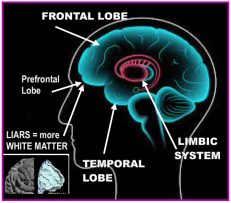
The neocortex, made up of the Frontal & Temporal Lobes, is ‘intellectual’ (not emotional). When lying, a person’s activated frontal lobe is capable of dishonesty, & therefore involved in suppressing the truth, which makes it hard for others to know if you’re being lied to

The limbic system (emotions) compels a person to react subconsciously to situations, so their non-thinking reactions are very honest & can reveal a person’s true feelings, like a poker players ‘tell” when trying to hide a bluff. When it’s activated a person’s anxiety increases because of their deception.

When someone tells the truth, fewer brain cells are activated in the frontal lobes & limbic system, which which have to do with memory encoding & retrieval, needed to check whether the mental imagery used when communicating – is accurate .

🧠 The Nucleus Accumbens is considered the ‘pleasure dome’, known for its roles in pleasure, reward, & addiction. It allows us to perform 2 fundamental human activities – to survive & procreate. Activated neurons in this region release dopamine, a hormone that gives us the feeling of happiness &  satisfaction.

When we exploit these natural needs for selfish ends (over-eating, living in fantasies, chasing money & power….), the pleasure dome shrinks, not releasing dopamine, even when an original desire is fulfilled.

The resulting discontent propels us to keep  looking for ways to fulfill the craving for pleasure – choosing unhealthy activities – which often include manipulation & lying. EXP : Someone who lies, cheats or steals compulsively finds it ‘rewarding’ to deceive others.
But, like with any addiction, the moments of enjoyment are short-lived, inadequate & disappointing, so the person becomes a slave to repetition.

Much research has allowed neuro-psychologists to identify distinct area in brain when a person tells the truth vs when they’re lying, because different parts are used when deliberately telling a falsehood. Neuro-imaging studies in volunteer-participants showed activation patterns when they were asked to lie or tell the truth. Results : the ventro-lateral & dorso-lateral areas of the prefrontal cortex become more lit up when lying .

Also, if we think of the brain as a computer, Gray Matter is the hardware, & White Matter makes up the cables that connect the network & transmitting signals. 

Interestingly, brain scans have revealed that the prefrontal cortexes in frequent liars are built differently from those in a typical brain. A 2005 study showed that in this region they had about 14% less gray cells -which play a role in impulse control. AND the scans showed they had 22% more “white matter” than average, allowing them to be better at manipulate information & words- so they can weave thoughts in ways others probably can’t.

Another study also found that compulsive liars have up to 26% more white matter in their prefrontal cortex, showing they’re better at making connections between various thoughts not based in reality.  EXP : an airplane mechanic might falsely combine ‘Me’ with ‘fighter pilot’.

While the key to success in both personal & professional relationships is the ability to communicate well, it’s not only the words used but the nonverbal cues or “body language” that speak the loudest. They include physical behavior, expressions & mannerisms that ‘speak silently’, often instinctive rather than conscious.

POLYGRAPH : the lie detector machine measures the activity in the limbic system, the anxiety felt by the subject (person being tested).
It can therefore be fooled if they’re usually calm (telling the truth) or are a Pathological Liar without a conscience -because they’re internally congruent (not in conflict) .
The information gathered by the machine is only 50 – 90% reliable, so polygraph test results are inadmissible in court, not being scientifically reliable enough when the stakes are so high.

NEXT : Liars & the BODY (Part 2)

DETECTING LIES (Part 3b)

PREVIOUS : DETECTING LIARS (#1)


HOW TO SPOT A LIAR (cont)
1. Reverse story
2. 
Answer delay


3. MISSING FEELINGS

In the interrogation literature, there’s a concept called “reality monitoring” –  how we store memories, compared to storing fiction.
◆ When recalling a true memory, we’ll refer to sensory details (how things looked, smelled….), as well as how we felt about a specific event – annoyed, bored, amused, uplifted…..

► On the other hand, when rattling off a made-up version, a liar is more likely to use “cognitive operations,” mental gymnastics that are literal, logical & matter-of-fact, without including emotions or body responses. (Post : “Repressing Es”)

EXP :  Suppose you’re talking about walking home from a movie. If it is a true memory, your may focus on the sound of the bus splashing a puddle or your annoyance at being wet. Truth-tellers tend to include sensory descriptions, liars do not.
If it’s made up, your version will sound more rational —  “It was raining, so I must have had my umbrella.”

4. HOLD your EVIDENCE
If you’re suspicious of someone, direct confrontation is one of the worst ways to get to the truth, as it gives your whole plan away. Don’t start by saying : “I know you did it!”
If you show your cards too soon, all they have to do is say No & you won’t know what’s real.
Also, experienced liars don’t show the usual signs – they don’t look stressed or make obvious mistakes.  With them, the best route is to sit back & wait, letting the liar sabotage themself.

According to the “Journal of Investigative Psychology & Defender Profiling” you should continue asking questions no matter what they say (unless you know you’ll be physically injured by them).
Just assume at first they’re telling the truth.
Eventually – if you keep pushing for more & more info about a situation, they’re going to run out of the prepared story & start contradicting themself.
IF you’re prepared – that’s the perfect time to spring the evidence   you have as proof of their lie.
In an intimate relationship, as soon as you flip the switch, they :
— may make elaborate excuses / justifications/ blame you
— act insulted, try to make you feel guilty for doubting them
— OR get very angry & verbally attack you
— OR laugh, make fun of you & walk away
— OR most often, the partner will just clam up.
RARELY – show signs of stress, stutter, crumbling the cool facade

5. ADD the UNEXPECTED
Whether trying to finagle the truth from a teenager or suspecting a friend of fabricating a story, catching someone in a lie takes some effort & knowhow.
When someone’s telling you a story you suspect is false, interrupt with weird questions as they talk. A good way to spot a liar is to throw them a curve ball in the middle of their story.
Scientific American looked at military interrogation tactics to see what works in everyday life, & found that posing left-field questions can trip up a liar.

Ask for random information  – something they weren’t expecting, & watch their reaction. Specifics are good – the more unrelated to the version they’re telling the better.
Example: If you think someone’s lying about having been to a movie theater, ask what the previews were, if a particular B-list actor was in the film….. (MORE …. )

A 2011 essay in the Journal of Applied Cognitive  Psychology – agrees that unexpected questions forces a liar to improvise, which can throw them off. It means having to make up something they didn’t have planned, so their initial story will fall apart as they make more & more mistakes. Most people caught in a lie will stumble or burble when put on the spot.

WITH FRIENDS
A 2012 study published in the Journal of the Human Factors & Ergonomics Society found that social behaviors change when a person is lying. They’re more uptight, even if everyone else is relaxed.
Truth-tellers tend to fall in sync with the people around them, easily making eye contact, laughing & mirroring the body language of their friends or partner.

CAVEAT: Tare care to not repeat a version of Othello’s error – Shakespeare’s tragic hero – who, after inaccurately accusing his wife of infidelity, mistakes her fear for signs that she’s lying —> & kills her!

NEXT : DETECTING LIARS (Part 3)

DETECTING LIES (Part 3a)

PREVIOUS : Types of LIARS (Part 2b)

3 POSTs :  “Why ACoAs Lie

SITE: Culture & Deception
(Can we tell ?)


NOTE for ACoAs
The following suggested tools are not only for law enforcement & legal uses.
WE grew up with blatant or subtle lies from family, school, news & social media …. SO we can too easily attach to mates, friends & groups who also control others, pushing their world view by cleverly concocted lies. Narcissist are particularly adept.

CATCHING a LIAR
“Americans consider themselves a “truth-default group, unconsciously assuming people are telling the truth.
HOWEVER – author Pamela Meyer, in her very popular TED Talk on Spotting a Liar, suggested that most people are on the receiving end of 10 – 200 lies every single day.  But it’s tricky to get lying just right, so it has to be done carefully & sparingly.
⁍ Too much, & no one trusts you
⁌ Too little, & you get laughed at, called “blunt,” or shunned as socially inappropriate. ”

1. STORIES in REVERSE
IF you want to check if someone is going to answer your Q honestly – & you know or suspect they tend not to :
a. Ask the same question 3x in different ways —-> to uncover their lie-pattern. The 1st time – you’re likely to get a well-planned answer – the details, the words they’re going to use…

b.
What happens when you ask again, in a different way?
IF they’re telling the truth, they may add some details or tell the story differently.
To spot a liar, be a good listener. Research found that liars often hesitate or don’t talk ‘smoothly’ because “they can’t draw on real memories, lack the imagination to make up a detailed, plausible story, or are afraid they’ll give themselves away.”  Since they only have one version about an event, they’ll rehash the same words, details, even the same phrases.

c. Ask a 3rd time – about details – the less important things in a situation.
◎ If they were at a restaurant, “what color were the chairs?”
◎ If they were staying with friends, “which bedroom did they sleep in? What did it look like? ”
Keep them talking & it gets even more obvious – the first version you heard is repeated – again.
SO ask them to tell their story in reverse.

By the ‘law of human behavior‘, when asked to tell the false story backwards, it’s much harder – if it’s a lie – as they try to imagine details in reverse. It increases the “cognitive load” exponentially. They get confused, talk slower, make more mistakes or leave out important derails, give contradictions.

Opposite – when you’re being told Truth, a ‘story’ is almost always easier to explain, even in reverse, actually uncovering new info or details missed before.

◘ KEEP them BUSY – a variation
The “cognitive load model” of deception says that “lying is multi-tasking, & therefore difficult. Liars must plan what they say, remember to play a role, & suppress the truth.” So, make it harder for them.
Professor Albert Vrij et.al. (Portsmouth, UK) suggests getting a known liar to focus part of their attention on some important concept or task, or sometime they love to do.
Then at the same time question them about a suspicious behavior, unhealthy plan, abusive comment (“Why did you….?”). If their brain is busy doing other things, they won’t have as much mental resources left over to lie, or at least, not as convincingly.   (MORE….)
EXP: ◎ If you suspect your partner of cheating, ask them questions while they’re driving. ◎ If you suspect your teen is using drugs, ask about it while getting them to do household chores…..

2. ANSWER DELAY
Normally, when someone asks a question you were not expecting, you pause, taking a second to think about your answer – honestly.
BUT practiced liars often jump the gun. They have something already prepared, always wanting to be a step ahead, so they’re anxious to get that lie out of their brain & into the world (on you).

When checking to see if someone is lying (you know they often are) –  listen for that little pause. If they skip it & answer right away, there’s a good chance they’ve planed their excuses / justifications / ‘false proofs’ – way in advance – just in case they get caught!

NEXT : DETECTING Liars, (#2)