MBTI Type – ENFP


PREVIOUS: ENTJs

SITE: ‘Styles of Worshippreferences by MBTI dichotomy categories

BOOK:Personality type in Congregations


EXTROVERTS (EX)

ENFP – The INSPIRER / Motivator / Cause promoter  E-Intuition-Feeling-Perceiving

Most OPTIMISTIC –  “Happy procrastinator”
• 9.7% females 6.4% males

NATURAL
GOAL: To create. ENFPs are warm, enthusiastic, bright & full of potential.  They’re imaginative, consider life as full of possibilities, excited by new ideas.
Their energy is stimulated by new people & experiences. The life of the party, they have great people skills – wanting harmony with others, & have a need to live by their inner values.

They’re open-minded & flexible, with a broad range of interests, & do well at whatever interests them. They quickly see connections between information & events, able to move forward with confidence based on what they see.  Going quickly from one project to another, they’re willing to consider almost any possibility, often developing multiple solutions to a problem. They’re better at starting than finishing, bored with details.

They’re: creative, energetic, enthusiastic, expressive, friendly, gentle, idealistic, innovative, quirky, people-oriented, scattered, thoughtful, upbeat. And they’re not all bubbly klutzes.

Hidden Side
They may be Es, but not typically outgoing because their Fi (Introverted Feeling – in their stack) prevents them from wanting to over-extend themself emotionally. Their extroversion shows up more in exploring various interests, by gathering external info, & interpreting it by figuring out how different pieces connect. While they almost always have an unconventional senses of humor, they’re not necessarily ‘goofballs’  – because  they take their moral causes, values & social relationships very seriously.  This intensity can be seen any time these topics are brought to the ENFP’s attention. (much MORE re. stacks in future posts)

Life’s Purpose: Inspire those who have given up
• Their Law: You shall always follow your heart
• They Comfort others by saying: Everything’s going to be alright!

• They Say: Oops – I didn’t realize there were rules :). Laughter is the best medicine. Chill! I have a wide range of feelings & many are intense.
• Communication: Will start the conversation & likely direct it. They know what they want to talk about – probably something fun.
They should stop talking about how offended they are.

Weaknesses: Easily stressed, highly emotional, not practical, overly independent, over-think things, too talkative, trouble focusing
Manipulate: They use their ‘gift of gab’ negatively, justify ‘handling’ others emotionally as just being charming, but it’s ok ? because they’re ‘being authentic’

Paradoxes: Incredibly open-minded & totally stubborn. Lively & lonely.
Judge people : by their values  • Fear: Being ignored
• Are Judged for : thinking everyone hates them

Become STRESSED from situations shown in the illustration.
ENFPs in distress will feel overloaded & overwhelmed by too much to do – heart rate going over 9000 rpm! They believe they’re trying to help others by making their lives better, but feel their efforts are unappreciated, & that there are always more expectations or demands on them. Then they become overly-emotional, too worried, withdrawn & have tunnel-vision. In such cases, ENFPs are likely to start shirking all responsibilities, forgetting appointments, being late for deadlines…..

They see other people’s annoyance with ENFP’s unpredictability as a lack of consideration & respect for the ENFP’s rights & priorities. They want to be free to respond to possibilities as they occur, & to change their mind whenever they want. Requests or previous commitments that don’t support their present agenda are felt as unreasonable & limiting, so will be ignored.

• Hate: Being inauthentic & anyone questioning it. Feeling bored or betrayed. Being made to do something simple for hours by a tough authority figure. Their ideas being stolen. Subjective logic & unchallenged beliefs.  Asking for Help, because they’d rather do it their own way

Don’t argue with ENFPs when they’re holding: Their temper
• Never rein them in.   • Never tell them: You’re boring & unoriginal

GROWTH
Advice:
There’s a line between being charming & emotionally manipulative.
They’re lighting in a bottle, full of inspiration, humor & unfettered ideas – but risk burning out from over-committing or following every possibility.

They can have trouble determining priorities, not good at follow-through on decisions or projects. So each time they have a great idea, it would help to immediately break out a pros & cons list, & be as realistic as possible. No matter how strongly they feel about it, it’s best to weigh the consequences of their actions honestly & logically, because others are counting on them.

ENFPs need to find what will really fulfill them – long term – instead of what’s attractive at the moment. By working to achieve their true ideals & values, they can build a consistent lifestyle that fits who they are, not just as a temporary escape from feeling trapped by life. (LARGE CHART)

ENFP Relationships
You‘re keenly perceptive about people, with a wide range of feelings & as well as intense emotions. Your partners & friends will see you as versatile & enthusiastic

• Thrive in any situations that are:  passionate & growth oriented (More…)
As a Friend, you’re the gorgeous one who makes sure everyone is having a good time
• Annoyed when: someone thinks you hate them

ENFP Parent, Child of ENFP, ENFP child

• Still single because: you’re too ‘flaky’ to be taken seriously
• Unhealthy behavior: Communicate only with emojis to avoid intimacy

Show interest : Can’t stop smiling (more than usual)
Show Love: You cheer them up, boost their confidence, help brighten their outlook on life
• You want to hear: I feel you

• You’re attractive/sexy because : you radiate charm & positivity. A youthful need for adventure & possibilities are contagious, making you magnetic & sensational
<—-  Why these 2 types are compatible

• You should DATE someone who: will beat you at your own game & keep your interested. Someone you can depend on, but doesn’t give in when you’re in a mood to be demanding. Someone who can bring excitement, but show you that relaxing can also be fun.

• To attract you someone needs to: flirt with you once & then act completely uninterested. You love a challenge!

• Some Famous ENFPs: Carol Burnett, Dom Deloiuse, Buster Keaton, Regis Philbin, Hayden, Mark Twain, Dr. Seuss, Robin Williams

NEXT:  ENFJ

MBTI Type – ENTJ


PREVIOUS: ENTP

SITE: How to attract each MBTI type


EXTROVERTS (EX)


ENTJ – The EXECUTIVE / Chief / Mobilizer
E-Intuitive-Feeling-Judging

Most COMMANDING  – “World Dominator”
2.7% males, 0.9% females

NATURAL
GOAL: To strategize.  
ENTJs are assertive, decisive, outspoken & straightforward. They’re driven to be in charge, readily stepping into leadership roles, & express their ideas forcefully. They value knowledge & competence, with little patience for inefficiency or disorganization. Intelligent & well-informed, they usually excel at public speaking.

They’re career-focused, & live in a world of possibilities, viewing problems as challenges to overcome.  Excellent at understanding difficult organizational problems, they can create solid solutions.  Because they see the big picture & think strategically about the future, they can efficiently mobilize people & resources to meet long-term goals.
Although not naturally tuned into others’ feelings, they can a have strong sentimental streaks.

They’re: authoritative, calculated, challenging, efficient, intense, questioning, strong, strategic, structured.  But not all are bossy & narcissists.

«
Hidden Side : They’re usually not Machiavellian. Their strong sense of individualism often extends to others, making them respectful of others’ uniqueness – using their brave, outspoken nature to amplify the voices of others who may be unheard. They’re often the ‘bully’s bully’ – if they see someone being picking on who can’t fight back, you can bet they won’t hesitate to put that offender in their place. They may seem tireless & unsinkable, but when they don’t live up to their own standards, they’ll temporarily withdraw from their efforts to regroup

Life’s Purpose: Thrive in the impossible
• Their Law: You shall always obey my orders!
• They Comfort others by saying : You don’t have to be sad – we’ll get ice cream or something

• They Say: I make the rules. I’m in charge here! You can’t make an omelet without breaking eggs. I can be tough when the situation calls for it
Communication:  They’ll start the conversation if you catch their eye, but you may be doing something they don’t like, so be prepared to run.  They should stop talking about world domination.

Weaknesses:  Arrogant, cold, controlling, dominant, impatient, intolerant, ruthless, stubborn, deny & mishandle emotions
Manipulate: Make others seem less-than with their holier-than-thou attitude, & treating everyone like pawns in their personal life-game

Paradoxes: Leader & stubborn. They’re good at organizing others, & their plan is always better than yours.
Judge people : by their competence  • Fear: Of intimacy
• Are Judged for : not being competent at ‘doing’ life

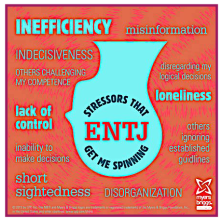
Become STRESSED from situations shown in the illustration.
ENTJs believe the source of their distress is totally outside themself, so they’re quick to blames others for their problems. They see people as needy & illogical, & systems or organizations as inefficient & hindering. They think everything & everyone is holding them back, afraid of being crushed underfoot, so they feel compelled to take matters into their own hands & set things right.

This makes them controlling, stubborn & insensitive to the delicate human element – which includes people’s emotions, ideals & limitations. Feeling increasingly stuck in a frustrating situation, ENTJs will feel out of control & act on gut impulses – such as physical & verbal violence, manipulation, sexual addiction….

• Hate: Being wrong, close-mindedness, failure, immaturity, not being listened to, people who are ignorant or won’t work together, having to handle something with kid gloves. Someone getting into a position of power over them who is really dumb. Asking for Help, because they’d rather do it their own way

Don’t argue with ENTJs when they’re holding: you in high respect
• Never ignore them. • Never tell them: I want you to redo everything – this just isn’t good enough.

GROWTH
Advice:
There is more to ‘stupid people’ than you think.
ENTJs live in the dog-eat-dog world (often of their own choosing), driving themselves strongly, so they unfairly expect the same from others, intimidate people with their take-charge attitude.
They often overlook the contributions of others, ignoring the emotional needs of the people who implement their plans. To soften their harshness, they need to cultivate a confidant or small group of trusted supporters.
Also, playing games in their personal life is a waste of precious time. Finding the right mate may not be easy, but worth the effort. Until then, it would benefit them to get involved in something altruistic or ‘spiritual’ – to cultivate empathy & patience.

ENTJs need to accept that life’s imperfections & everyone’s subjective experiences (emotions) – are normal & natural. Logic is not the answer to everything, so insisting on it only creates an irrational, distorted worldview, causing frustration & disappointment.

ENTJ Relationships (More….)
You enjoy & are energized by stimulating interactions with people. You’re seen by your partners & friends as decisive & fair

• Thrive in any situation that : has shared long-term goals (More…)
• As a Friend, you’re the who’s always commenting on everything that everyone does  • Annoyed when: someone’s not very good ‘at life’

ENTJ parent, child of ENTJ, ENTJ child

• Still single because: you’re too busy building your empire
• Unhealthy behavior: plant a keylogger to track your lover’s texts

Show interest by : Being hyper-critical 😦  (cleverness??)
Show Love : You give time & attention, offer advice & help, help them plan
• You want to hear: I’ll follow you

• You’re attractive/sexy because: you’re usually charismatic, calculating & confident in thought & deed – knowing what you’re doing, & pursue goals without second-guessing yourself. It makes others feel safe.

• You should DATE someone who : you can take care of & teach them how to be more practical. But also someone who can keep your ego in check, who helps you get in touch with a wider variety of emotions, & can teach you to be more sensitive to other people’s feelings.

• To attract you, someone needs to : have a strong character but not stronger than you. Who will assure you that being with them is a low-risk investment that will yield a sizable emotional return.

• Some Famous ENTJs: Presidents FDR & Nixon. Al Gore, Margaret Thatcher.  Harrison Ford, Steve Jobs, Dave Letterman, Whoopi Goldberg, Sigourney Weaver

NEXT: ENFP

MBTI Type – ENTP


PREVIOUS: ESFJ

SITE: ‘How each type handles feeling Ashamed’


EXTROVERTS (EX)

ENTP – The VISIONARY / Originator /Debater
E-Intuitive-Feeling-Perceiving

Most INVENTIVE  – “Explosions maker ”
• 2.4% females, 4.0% of males

NATURAL
GOAL: To invent.  
ENTP’s are ‘idea people’ – resourceful & mentally quick, good at many things – upbeat visionaries who value knowledge, understanding & possibilities. They can solve problems creatively & in unusual ways, because they see connections & patterns, able to spot & capitalize on new opportunities.

They enjoy developing strategies, but are more interested in generating ideas & options than specific actions. They get excited about new ideas & projects, but tend to neglect mundane parts of life – bored by routine

They like people, & make interesting company, good at reading others, intuitively understanding them & situations. Generally alert, outspoken & assertive, they may be into one-up-manship – fluent conversationalists who enjoy debating issues & lively verbal sparring.

They’re: charming, eccentric, flexible, given to brinkmanship & testing limits, ingenious, innovative, theoretical, undisciplined. They enjoy arguing both sides, loving challenges. And not all want to debate every single thing. (More… )

Hidden Side
ENTPs are probably the least self-aware of all iN types. They seem ‘non-committal’ to people who don’t know them, because they’re already so committed to someone or something that it keeps them from sticking with a new possibility long enough to get anything from it.  A bit like a fish struggling to get away, only to be reeled back in over & over, not realizing it’s attached to a hook. Also, contrary to popular belief, they’re not reckless, even when involved in what seems like reckless activities, since they’re extremely cautious in how they go about it

• Life’s Purpose: Find what’s possible in what seems impossible
• Their Law: You shall always order pizza with double cheese
• They Comfort others by saying: Come on – there’s got to be something that’ll cheer you up!?

• They Say: I’ve figured out that these rules aren’t doing their job – let me explain…. I value adaptability & innovation. All’s fair in love & war – fight me!
Communication: They’ll start the conversation & probably end it if they don’t like the way its going.  They should stop talking too much.

Weaknesses:  Don’t like practical things, hard to focus, insensitive, intolerant, very argumentative, too uncommitted, too unrealistic
Manipulate: Always have a backup of convincing bull— when they’re called out on their convincing drivel.

Paradoxes: Eccentric & narcissistic. Everything planned & nothing solidified.
Judge people: by their ‘smarts’.   • Fear: Not understanding things
• Are Judged for : making others feel stupid

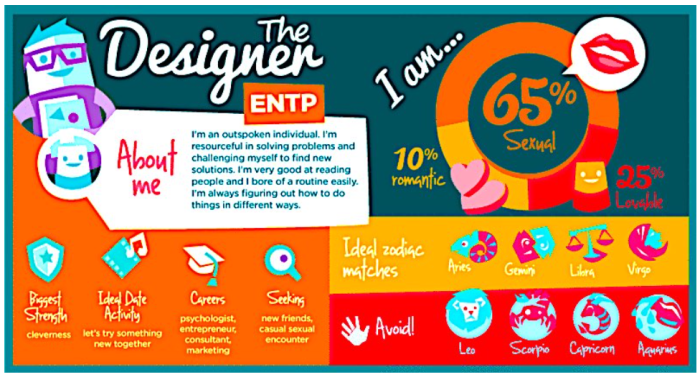
Become STRESSED from situations shown in the illustration.
ENTPs become so focus on possibilities/options, they don’t DO anything. They can get flighty, over-concerned with personal freedom & how other people’s wishes might threaten it. They act impulsively, rationalizing their whims & inability to stick to a project or commitment by saying they’re avoiding entrapment

As internal pressure increases, ENTPs tend to go against or ignore rules, assuming these don’t apply to them. At the same time they unconsciously rely on others to provide them with stability & to do the chores they hate.

Interpreting others’ dissatisfaction with them as manipulation, they reject any responsibility, being intolerant & unpredictable. They’ll only do as they please, refusing to limit their options or follow through with obligations.

• Hate: Growing old. Hiding their power level, ignorance, objective morality, not being listened to, rules. Being written off for being too unorthodox. Anyone being very controlling, ignorant or close-minded. Asking for Help, because they’d rather do it their own way

Don’t argue with ENTPs when they’re holding: back their thoughts
• Never dismiss them.  • Never tell them: You shouldn’t always give your opinion, because you’re usually wrong

GROWTH
Advice:
Just because you can get away with it doesn’t mean you should.
They’re visionaries, but tend to avoid making decisions, & can get excited about grand impractical ideas, not do-able because of limited time or resources.  They challenge others & their ideas too much. They have a way of bringing others in on their vision, but that are unpredictable & unstable.

ENTPs are like a living tornado. While it may be in their nature, everyone they’ve left behind in the wreckage of their adventures – could use an apology.  If unwilling to apologize, the ENTP should find ways to clean up their mess with people in their life now by being counted on 100% from now on, & showing appreciation.

ENTPs can change dysfunctional patterns by assuming responsibility for the situations they create & for how they treat people they deal with. By acknowledging their importance in the larger scheme of life, they become more focused & self-disciplined, able to inspire others & offer consistent, trustworthy leadership.

ENTP Relationships
You enjoy a good debate, your conversational style can be challenging as well as stimulating. Your partners & friends will see you as energetic & lively, & independent

• Thrive in any situations that are: Dynamic & constantly evolving (More…)
• As a Friend, you’re the one who has a new hobby or interest every week
• Annoyed when: someone tries to makes you feel stupid

ENTP parent, child of ENTP, ENTP child 

Still single because: you consider trolling a form of flirting
• Unhealthy behavior: Only express emotions through memes, (indirectly)

Show interest: try to ‘prove’ you importance by arrogance & arguing
Show Love: You’re attentive to their needs, motivate with fun ideas & activities
• You want to hear: I disagree with you

• You’re attractive/sexy because: you’re charismatic, novel & witty – a flame people are drawn to. You’re usually smooth, knowing how to persuade. & your sharp, piercing humor is a big draw.

• You should DATE someone who : can stand up to your strong will, who has their own clear sense of purpose so you can’t overshadow them. Someone who is always willing to grow, & wants to grow with you.

• To attract you someone needs to : be able to challenge your ‘logic’ & not fall for your manipulative tactics

• Some Famous ENTPs: Alexander the Great, Presidents – Thomas Jefferson, Teddy Roosevelt. Julia Child, Rachel Ray, Alfred Hitchcock, George Carlin, Céline Dion, Tom Hanks

NEXT: ENTJ

MBTI Type – ESFJ


PREVIOUS: ESFP

SITE: How each MBTI type shows affection


The EXTROVERTS (EX)

ESFJ – The CAREGIVER / Supporter / Provider/ Consul
E-Sensing-Feeling-Judging

Most HARMONIOUS  – “Popular friend”
• 7.5% males, 16.9% females

NATURAL
GOAL
: Harmony, Cooperation = best accomplished when everyone follows the same set of rules. . ESFJs are generally popular, sociable & outgoing. For example, in High School, they take the spotlight & set the tone, such as cheerleaders & quarterbacks, who help lead their teams to victory & fame. Later in life, ESFJs continue to enjoy supporting friends & loved ones, organizing social gatherings & doing their best to make sure everyone’s happy.

Their clear set of values are related to the external world (family & community) rather than about their inner self. Feeling a strong sense of responsibility & duty, they value tradition & security, with a desire for things to be pleasant.

With a strong wish to be liked, they tend to put the needs of others before their own. They’re interested in being of service, but need positive reinforcement to feel good about themself. They’re conscientious, good-hearted, cooperative & supportive. Gifted at making others feel good about themself, they understand what people need & to be appreciated for their contributions to society.

Re. projects & plans, they take time to collect necessary facts to help them make decisions, & enjoy creating effective procedures. Are extremely organized, with a well-developed sense of space & function.

They’re: Accomplished host/hostess, dedicated, empathetic, friendly, gracious, respectful, shallow. They live to please. And not all are gossipy. (More…)

Hidden Side
Usually kind-hearted & well-intended, ESFJs are not warm & fuzzy – because they try to ‘love’ people before they see if they actually like them. Of all the ESxx types, they’re the biggest nerds, & gravitate to Enlightenment Era ideals. They can also be great pranksters, because they’re clever & love to get reactions from people.
«
Life’s Purpose: Bringing together those who are apart
• Their Law: “You shall always take care of your friends
• They Comfort others by saying: I’m here to help you feel better, so let’s get started

• They Say: I’m loyal to people, institutions & causes I believe in. We’re all fiends here – there’s safety in numbers. I’ve bent over backwards to fulfill all the rules.
• Communication: They’re so friendly & inviting – like a mom-friend – that people love talking with them.  They should stop talking about their sorority or fraternity

Weaknesses: Inflexible, sometimes too needy, reluctant to innovate or improvise, take things too seriously, think they always know what’s right, too selfless, vulnerable to criticism, worried about their social status
Manipulate: To make themselves ‘interesting’, they gossip about the back-story of people they don’t know

Paradoxes: (Un-developed ESFP) Friendly & ‘difficult’. Take ‘5 minutes’ to gather everyone – for a ‘1 minute’ group project
Judge other people: about their selfishness  • Fear: Of isolation
Are judged for: caring too much what others think

Become STRESSED from situations shown in the illustration.
Under stress ESFJs usually keep their inner conflicts & upset out of public view. They’re terrified of being judged or criticized by others, but can be highly intolerant of others’ behaviors they judge as inappropriate. When they feel used & unappreciated, their resentment leads them to rash, thoughtless actions that can damage the very relationships they care so much about.

As frustration increases, they complain, manipulate & go behind people’s backs to make decisions for them – that benefit themselves much more than for the other. They rationalize their insensitive behavior by being convinced their actions are the right ones for solving problems.

• Hate: Being disliked. Insensitivity. Know-it-alls. Lack of community. Selfishness. Anyone who hurts other. People who don’t listen. Asking for Help, because they think they’ll burden others. Someone suggesting a lot or ridiculous ‘novel’ ideas – that obviously won’t work – while the ESFJ is trying to make a plan.

Don’t argue with ESFJs when they’re holding: a Frying pan
• Never: Abandon them.  • Never tell them: This is all your fault

GROWTH
• Advice: 
Remember that what you say about others reflects on who you are.
While ESFJs are good at making friends & being popular, unfortunately many are also prone to gossiping.  When making decisions, they can be overly influenced by what they think others want, & so can have trouble adjusting plans when faced with unexpected changes or opportunities.

They risk being too accepting of -or- deferential to those in charge.
ESFJs can help themselves by accepting that they can be loved for who they are, rather than what they do for others, & that they don’t have to fulfill everyone else’s wishes. They need to define who they are & what they want, apart from how others see them or want them to be.

ESFJ Relationships (More)
Because you‘re highly attuned to your partners’ emotional needs & concerns, mates & friends see you as responsive & persuasive

Thrive in any situations that are: old-fashion-romantic (More…)
• As a Friend, you’re the one who can be counted on for advice on almost everything.
• Annoyed when: someone won’t go anywhere with you

 ESFJ Parent, child of ESFJ, & ESFJ child

Still single because: You’re still in love with your ex
• Unhealthy behavior: Over-react when your S.O. forgets your anniversary

• Show interest by: Bragging
• Show Love:
You lessen their stress, motivating with affectionate pep talks
• You want to hear: I need you

• You’re attractive/sexy because you’re: warm & generous, have a need for beauty & harmony, creating a haven of light & love, which are sensual & very desirable.

• You should DATE someone who: CAN live without you but doesn’t want to. Who makes you feel appreciated because you care. Who doesn’t NEED you, so you can focus on our own needs as well.

• To attract you, someone has to: Be popular in their circle of friends, so they can tell everyone you sometimes forget lunch or the need for sleep. Then everyone will be desperate to be the one who’s taking care of you. 

• Some Famous ESFJs: Pres. Bill Clinton, Prince William, Martha Stewart, Barbara Walters, Sally Field, Mary Tyler Moore, Terry Bradshaw, Dr. McCoy of Star Trek

NEXT: ENTPs

MBTI Type – ESFP


PREVIOUS: ESTJ

SITE:  R & L brain horse types

“Horsenalities” – using Types to identify horse temperaments


The EXTROVERTS (EX)

ESFP – The PERFORMER / Entertainer / Demonstrator / Dynamo
Extrovert-Sensing-Feeling-Perceiving

Most GREGARIOUS  – “Dramatic spotlight” • 10.1% females, 6.9% males

NATURAL
GOAL: To conquer. 
ESFPs are Active Types who live in a world of possibilities, drawn to new experiences, since they view the world as a stage.  They’re playful & love being the center of attention. Excellent team players, they’re focused on completing tasks with the most fun & least discord. Traditional schoolwork can be hard, since they don’t like theory or impersonal analysis, but will do well when a subject interests them, or when they see its practical relevance.

ESFPs love to talk to people & about people (endlessly), & are some of the most colorful storytellers. But annoyingly they can jump from thought to thought in mid-sentence. And they love anything / everything new.

They’re also interested in being of service, great at working together with others to get things done, making things more pleasurable for others by their own enjoyment. They have well-developed common sense & practicality (S). They’re often in the role of peacemaker because of their warm, sympathetic & tactful nature (F). Rarely following convention, they find creative ways to help, being especially good at mobilizing people in crises. (More….)

• They’re : accepting, colorful, daring, generous, optimistic, persuasive, reckless, sociable, spontaneous, theatrical.  But not all like to perform.
They – cut thru red tape, share readily, juggle many projects, love surprises«

Hidden side
Of all the Feeling types, ESFPs often have the most trouble dealing with emotions – not good at facing their own psychological issues because they tend to minimize problems. However, their Feeling side does shows up – in their genuineness – not playing games with others’ feelings or pretending to be someone they’re not, in order to be liked. Their natural confidence is usually enough to win friends & influence people.

Life’s Purpose: Making lively that which has become dull
• Their Law: “You shall always have fun
• They Comfort others by saying: I hear there’s a really good karaoke bar in town

• They Say: I enjoy the good things in life – physical comfort & happy times.  Seize the day. Is there a fine for breaking the rules? OK I’ll pay that. SURE, but I can’t physically calm down right now!
• Communication: They’ll talk to anyone & everyone, as long as they feel the other person isn’t too intimidating to approach.
They should stop talking about partying.

Weaknesses: Arrogant, conflict-averse, easily bored, impatient, poor long-term planners, over-sensitive
Manipulate: Everything has to be about having fun. Just went bankrupt? Not to worry – let’s go out, get drunk, find some ‘entertainment’….

Paradoxes: (Un-developed ESFP) Exciting & visionless. In tune with their environment, & oblivious to what’s really going on
Judge people: by their own values   • Fear: Not being appreciate
Are Judged for: needing too much attention

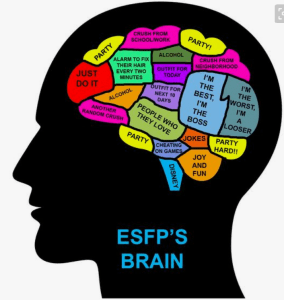
Become STRESSED from situations shown in the illustration.
Under stress, ESFPs need space to figure things out. They’ll get overwhelmed by ‘downer’ thoughts & projecting negative outcomes. First they’re likely to feel depressed & disinterested, with diminished physical & emotional energy. Then become self-absorbed & indifferent to other’s needs, finally leaving their current situation altogether in search of a whole new alternative.
As psychological pressure increases, ESFPs can lose their individuality by acting flighty & superficial, wanting instant gratification, & ignoring the consequences of their actions. Others will see their unpredictability, as they indiscriminately go for what’s popular or try to fit into their environment, which damages their credibility.

 Hate: Boundariesbeing judged, co-dependent or lonely, lack of excitement. Not being able to express themself. People asking them “But, why?” to everything they say. Anyone talking about their life in great detail – or worse, drone on & on about it at a social gathering where the ESFP just wants to relax.
Asking for help because it makes them think they won’t be able to learn it

Don’t argue with ESFPs when they’re :  holding a Celebration
• Never: Belittle them  • Never tell them: I don’t like you

GROWTH
Advice: Don’t fall for sweet words. Look for ‘right’ actions.
ESFPs are the life of the party, but need to find healthier ways to have fun. It’s important to say ‘no’ to pointless experiences, make wiser choices & try not to jump in impulsively, or they’ll likely to being taken advantage of. It’s best to stick to those who really care about them, whether they’re feeling happy or sad.

ESFPs can get easily distracted, not always finishing what they start & so have trouble meeting deadlines. It will help if they focus on a purpose that satisfies their inner values, figuring out their own priorities & what really matters to them, ignoring current trends.

ESFP Relationships (More….)
You love life, enjoying food & clothes, animals & human companionship. Partners & friends see you as supportive, fun-loving & spontaneous

Thrive in any situations that are: exciting & exploring (More…)
• As a Friend, you’re the one who gets excited by everyone & everything.
• Annoyed when : someone’s a total buzzkill

ESFP parent, child of  ESFP, ESFP child

Still single because: it’s what you want to be
Unhealthy behavior: Keep complaining “You don’t love me!”

Show interest by: Making a complete fool of yourself – but in a cute way
Show love: You listening to them warmly, paying attention to practical needs
• You want to hear: I notice you

• You’re attractive/sexy because you’re : radiant, glowing with vivacity, with an added earthy ‘I know what I’m doing’ vibe. Your inner strength & pure willpower are very attractive & admirable

• You should DATE someone who : can handle your spontaneity & let you be yourself, but can keep you in line. Who can help you take things more seriously & organize your sometime messy life

• To attract you, someone needs to : look good, make it clear they’re available & then wait a while. Your natural ‘people curiosity’ will eventually drive you to go after them

• Some Famous ESFPs: Adele, Arsenio Hall, Deepak Chopra, Goldie Hawn, Janie Foxx, Marilyn Monroe, Tony Robbins, Stephen Spielberg

NEXT: ENTJ

MBTI Type – ESTJ


PREVIOUS: ESTP

SITEs: Each MBTI type at their Best


The EXTROVERTS (EX)


ESTJ
– EXECUTIVE / Supervisor / Overseer
E-Sensing-Thinking-Judging

Most FORCEFUL  – “That boss”  • 11.2% males, 6.3% females

NATURAL
GOAL: To execute.  
ESTJs are realistic, matter-of-fact, take-charge types. They usually have a definite vision of how things should be – easily stepping into leadership roles. They honor traditions & laws, with a clear set of standards & beliefs, highly valuing honesty, dedication, dignity & security.

They’re practical & organized, putting a lot of effort into all they do. They excel at getting projects & people to their goals, as well as handling routine details. ESTJs are not interested in theories or abstractions unless they have practical applications.

Living in a present world of facts & concrete needs, many are likely to be athletic. As the loyal “Good citizen” they constantly scan the environment to make sure everything’s running smoothly & systematically. They use their understanding of what’s right, wrong & socially acceptable – to bring families & communities together.  (More….)

ESTJs are: anal, determined, fair,  efficient, opinionated, productive, responsible, sociable, traditional. And not all are complainers.

HIDDEN side
Most ESTJs aren’t actually self-righteous. If they are, it’s only toward their family, mainly from insecurity rather than because they think they’ve made the best decisions for everyone they love. In fact, when someone close to them makes life-choices different from their own, they secretly worry that maybe they should have taken a different route in their own life. Of the SJ types (Sensing-Judging), they’re probably the worst at teamwork.

• Life’s Purpose: Bringing direction to the leaderless
• Their Law: You shall never make excuses for your incompetence
• They ‘Comfort’ others by saying: What the @#$% are feelings & why do you feel that way anyway??

• They say: I’ve written the rules down, & made copies for every one. I like to see things done correctly. Good order is the foundation of all things. Business before pleasure!
Communication: The ESTJ will tell someone if they’re making them angry. Please. Stop.
They should stop talking about how nobody listens to them.

• Weaknesses: Inflexible, judgmental, stubborn, trouble expressing emotions, trouble relaxing, too dependent on structure / trouble with unconventional situations, too subjective
Manipulate: Push their will or idea by preaching about something 20 different ways to make sure others really get it

• Paradox: (Un-developed ESTJ) Orderly & unchanging (rigid: won’t allow whining in a hospital)
Judge people by: How competent they are
Are judged for: being too bossy  • Fear: Of uncertainty

Become STRESSED from situations shown in the illustration.
Under stress, ESTJs can too easily become domineering & inflexible, with an “Do exactly as I say….or else!” attitude. They’ll see others as ‘too sensitive’ & weak, so assume it’s time to take control & set things right, Impose their viewpoint on everything & everyone, they’ll be convinced their logic is the only valid standard.
Ironically they’ll also be hypersensitive & emotionally reactive (rather than proactive). They crave personal contact & affection, but are unwilling to let emotions show, taking it as the weakness they despise in others. (Similar to lower-level Enneagram 8s).
They accuse others of being corrupt, subjective & disrespectful, justifying their self-righteous anger. As the pressure becomes intolerable, they let out frustration inappropriately: bursts of rage, intense controlling, impulsive actions, addictions

• Hate: Anyone constantly goofing off, being disrespected or ignored, disorder, others making dumb jokes – or just crying. Forced to be emotionally open. Not in control of their life. Anyone showing up very late to a planned meeting, & telling the ESTJ they just ‘lost track of time’.  Asking for Help, as it makes them feel incompetent (EnneaType #1 ?)

• Don’t argue with ESTJs when they’re : holding a frying pan
• Never: Underestimate them.  • Never tell them: You’re not good enough

GROWTH
• Advice: Don’t expect everyone to be the same or try to make them be like you! 
ESTJs are very much a been-there-done-that type. In boring situations why not use the time to quietly plan something interesting? Always giving too much of themselves to their tasks, it would be good for them to occasionally forget about work & people – taking time to actually live in their life, letting each second slow to a halt to drink in their surroundings.

Focusing too much on the objective pursuit of goals, they ignore ideas or feelings of others, because they’re not comfortable when emotional intimacy is required. They need to learn to accept the personal, subjective parts of themself in order to connect with others – preventing isolation & loneliness.

Not waiting to get enough info before jumping into action, they can miss opportunities not already part of their plans. It would help to accept that they can’t control every outcome, no matter how hard they work. Not everything fits rational principles, so act on things they can legitimately be in charge of.

ESTJ Relationships
You
enjoy interacting with others, take relationships seriously & want to fulfill your roles responsibly. Partners & friends experience you as conscientious & dependable

• Thrive in any situations that are : steady & predictable (More…)
• As a Friend, you’re the one who takes the lead & makes sure everyone is getting their work done • Angry when: someone publicly humiliates you

• ESTJ parent, & child of ESTJ, ESTJ child

Still single because: you give off control-freak vibes
• Unhealthy behavior: Run way from hearing “I love you” for the first time
Show interest by: Being attentive, & an ‘ultra’ listener
Show Love: Handle practical matters for them, share useful info & advice
• You want to hear: I listen to you

• You’re attractive/sexy because: You have a commanding presence, seem strong, secure & in control. People wish they could handle things thrown at them the way you can. It’s hard to miss you with all that confidence.
• You should date someone who : can let you take charge, but also can stand up to you & put you in your place when you get too head-strong

• To attract you, someone needs to:  Have excellent hygiene, & constantly tell you that you’re right.

• Some famous ESTJs: Presidents Truman, G.W. Bush & LBJ, actors Bette Davis, Barbara Stanwyck, Frank Sinatra, Rev. Billy Graham, Judge Judy, Ann Coulter (More….)

NEXT: ESFP

MBTI Type – ESTP


PREVIOUS: Introverts vs Extroverts

SITEEach MBTI type as enemy


The EXTROVERTS (EX)

ESTP – ENTREPRENEUR / Doer / Persuader
Ex-Sensing-Thinking-Perceiving

Most FUN  – “Adrenalin junkie”   • 3.0% females, 5.6% males

NATURAL
GOAL: To win. 
ESTPs are adaptable & action-oriented, who like to take a practical approach to problem-solving that will produce immediate results.  They apply common sense & experience to problems, quickly analyzing what’s wrong, & then fixing it, often in an inventive or resourceful way. Living in the here-and-now, they’re risk-takers who live fast-paced, traveling the world. They tend to be bored by abstract theories, impatient with long explanations, & learn best by doing. 

They have great people-skills – friendly, outgoing straight-shooters, & extremely loyal to their peers. Are good at picking up on little clues about others’ personalities & feelings, & can motivate people by bringing energy into situations. They’re not usually respectful of laws & rules if those get in the way of accomplishing a goal. ESTPs leap before they look, fixing their mistakes as they go rather than being idle, but do prepare contingencies & escape clauses.

ESTPs are: charming, confident, crude, fearless, logical, spontaneous, trustworthy, unconventional. And not all are obsessed with sex. 

HIDDEN side
Surprising to some, ESTPs value book-smarts & often enjoy conversing with Rational types. They may not grasp ‘heady’ concepts as easily (nor apply them responsibly), but they find philosophical topics stimulating – just another piece of equipment in life’s big playground. While they’re naturally persuasive, they’re not usually interested in corporate & political arenas where they could thrive. Ladder-climbing in organizations doesn’t appeal to them – in fact, many ESTPs cringe at the very idea, so they rarely pursue those career tracks.

Life’s Purpose:  DOing when others don’t
• Their Law: “You shall always live in the moment!”
• They Comfort others by saying: “Alright…..So you’re sad. Why is that?”

• They say: I get more from first-hand experience than from study. Rules are made to be broken – so watch me break them! Life’s either a daring adventure or nothing at all
Communication: They’ll talk whether someone likes it or not – look out world! They should stop talking about ‘nothing’.

• Weaknesses:
Defiant, insensitive, impulsive, impatient, misses big picture, risk-prone, unstructured, contradicting themself
Manipulate: Frustrate others because – one day they’re hung-ho about a life-changing project or promise, then lose interest the next day

• Paradoxes: (Un-developed ESTP) Know they shouldn’t, & do it anyway. Bold & undependable. Think they’re funny, but only to those who are similar
Judge people : on their ‘smarts’  • Fear: Of commitment
Are Judged for: not taking life seriously

Become STRESSED from situations shown in the illustration.
Under stress they act first, figure things out later. They deal with problems & frustrations by going after more & more external stimulation & adventure (similar to EnneaType 7s). When disappointed or restless, they think it’s time to re-create their (lagging or previous) successful public persona. They either find a new audience to charm, or resort to some grand gesture to reinforce their image & make them feel desirable/popular again (Ennea #3)

However, internally they suffer from a deep sense of emptiness, so intimacy becomes almost impossible, as they get increasingly detached from true emotional connections. As stress mounts, they get more agitated, chronically anxious, distracted & paranoid, but overactive, frivolous & too concerned with people’s opinions of them.

• Hate: Authority.Asking for help – it makes them feel stupid. Limits. Conventional or monotonous situations. Over-sensitive people. Constantly being asked ‘how they feel’ about things. Forced to ‘tone it down’. Stupid people. When someone wants a heart-to-heart talk just as the ESTP is ready to go out for some fun

• Don’t argue with ESTPs when they’re : holding the door open for you
• Never: Dominate them.  • Never tell them: Nothing you do is very impressive

GROWTH
Advice: Keep your promises, or don’t make them at all.
ESTPs tend to have trouble managing their time, so they can lose interest in long, complex projects. Being so focused on immediate problems will lead to ignoring long-term ongoing issues. They live for excitement!, being the life of the party, thriving on adrenaline!  However, periodically taking some time to shut out the world – & writing down all their adventures – could help to create much-needed balance.

ESTP Relationships (More….) 
Many ESTPs are uncomfortable focusing on, exploring & talking about relationships. They need to take time to consider their true priorities, & to realize the effect their choices have on others around them. When they take responsibility for their actions & acknowledge their importance in a larger context, they become more stable, reliable, & emotionally honest.

You truly love life, immersing yourself in it. Partners & friends experience you as adventurous but also pragmatic
• Thrive in any situations that are: fun & easy-going (More….)
• As a Friend, you’re the one obsessed with that‘ thing’, & will. not. stop. talking. about it!
• Annoyed when: someone never wants to go outside

ESTP parent, & child of ESTP, ESTP child

Still single because: it’s your choice
• Unhealthy behavior: Cheating

Show interest by: Being awkward
Show love: You’re attentive to their comfort, will motivate & boost their courage
• You want to hear: I’m excited with you

• You’re attractive/sexy because: Something about your down-to-earth, hands-on style is tantalizing – you ooze ‘tactile’. It’s hard to resist your passion & will-power
You should DATE someone who : won’t take your occasional stream of b.s. Who’s intelligent & can stand up to your know-it-all attitude. Who can keep you from taking too many risks, but lets you be yourself, & can also keep you excited

• To attract you (men?), someone needs to: Act sweet, wide-eyed, impressed with everything you do. Your ego will respond well to their fuel.

FAMOUS ESTPs: Donald Trump, cowboy Roy Rodgers, actors Eddie Murphy, Madonna, Bruce Willis, Biblical Jacob (OT) & Peter (NT) (More….)

NEXT: ESTJ

MBTI – Introverts vs. Extroverts

PREVIOUS:
MBTI basics #2b

SITE: ‘Key differences between Es & Is – info for bosses

• “Are Es or Is better salespeople?


NOTE:
In the next 2-3 months posts will focus extensively on the 16 Types, first the 8 Extroverts, starting with 😀ESTP, & then later the 8 Introverts, starting with 🤫ISTP.

🚎/🚗 The charts below outline some of the main differences between the 2 types. These descriptions represent extremes. Remember that most of us are a combination of both, in some proportion (90-10, 70-30, 50-50…..),  favoring one style or the other throughout our lives. Because the 2 groups are bio-chemically pre-set (next post) we clearly express their preferences from the beginning of life – before the harmful effects of our upbringing distort them. But they’re always part of us, so we can reclaim them as we Recover.

ALSO: to understand ourselves well, we need to factor in other character parts that make each of us unique.
Beside the basic MBTI designation (INTP….), each type has a <—- ‘Cognitive Function stack, & a Temperament (Artisan, Guardian….) in combinations of the basic 8 options  (NT, SJ….). Along with the MBTI, each of us also has our own Enneagram Type, Astrology sign, childhood experiences, social environment.spiritual belief,…. & taken together they make up our identity.

EXP: An ENFJ + Christian + Enneagram #8 + Pisces + Numerology 22/4 + an AGoA +++….. G=grandchild 🙂
All-in-one: Inside the Pisces is very soft & passive, but the #8 is tough & assertive. The 22/4 is the entrepreneur, called The Master Builder, while the ENFJ is the Teacher / Giver.  Add in – being Saved, raised by 2 un-recovered ACoAs, an American growing up in 3 post-WWII European countries….  & we get a very different ENFJ or Pisces or #8…. than all the others in the world.

What’s YOUR unique combination?

Tongue-in cheek, but not totally : «

«

One of many example of how the 2 styles show up in business / entrepreneurial environments.
«

«
NEXT : MBTI type – ESTP

Myers-Briggs INTRO (Part 2b)

PREVIOUS: MBTI Basics #2a

OVERVIEW of MBTI dichotomies (cont.)

The 2 ‘INNER’  (S-iN & T-F)

2. SENSING (S) vs INTUITION (iN)
The kind of INFORMATION we prefer to gather & trust.
It can be either Introverted or Extroverted (Si or Se / iNi or iNe) , & each part of the Judging style.  We use both, but to different degrees of effectiveness & with different levels of comfort. 

Sensing (S) / Concrete
To be mainly Sensate means that a person primarily believes in the kind of information he/she receives directly from the external world.

They absorb info thru the 5 senses – are detail oriented (micro) types, who prefer to focus on facts & concrete data, wanting to see the hard numbers.
They keep track of available material & resources, appreciate knowing the “HOW” of something, & then do what works. They love to observe, are good at remembering specifics, & understand things piecemeal, working through concepts from the bottom up.

Sensors LOOK for:  how much, how many, how often, what kind….
EXP: When we – taste food / notice a stoplight has changed / memorize a speech / follow steps in a plan / use a map / look up info on Google….

— 🍀
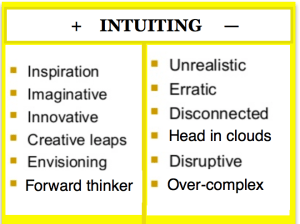
Intuition (N) /Abstract
To be mainly Intuitive means that a person more likely believes the kind of information they gather from their internal, private world.

They’re are highly imaginative, focusing on patterns & the meaning of data, taking in info from impressions, insights & patterns. They start with the big-picture (macro), extrapolating abstract possibilities from a wide variety of ‘real’ sources, understanding concepts using a top-down approach, & data as it relates to other data. They have a grasp on trends, interested in what hasn’t been tried before.

Intuiters ASK: “….for example? / Tell me more, what else should I know? /Why do you say that? “-….  and then echo the response

EXP: Those who find a new way of doing something / think about future implications for a current action / ‘get’ the underlying meaning in what people say or do / see the big picture….

NOTE: Of the 4 dichotomies, at their extremes these 2 opposites cause the most emotional difficulty in any relationship. Such people tend to be highly frustrated by & may even feel disdain for each other’s style. It can be particularly painful for a sensitive child -strongly NF- to be raised by a mother who is strongly ST.

Ns use the same concrete / real-world experiences to ‘see’ things as Ss, but much of it is subliminal, so they can’t always put into words how they reached conclusions – they just know.
✓ To the S this is hocus-pocus, since they don’t trust anything they don’t gather from their own experience or from empirical research, & which can be clearly, logically verbalized.3. THINKING (T) vs FEELING (F)
Preferred way of coming to DECISIONS.
 Can be either Introverted or Extroverted (Ti or Te / Fi or Fe) , & each is part of the Perceiving style
We all use both forms, but put more trust in one, some decisions being made entirely from the T or the F side.

What makes some Decisions very difficult is when there’s an intense conflict between head & heart (T & F), in which case our dominant preference will win.
Easier decisions, the ones that feel good, are usually the result of our T & F sides being ‘on the same page’ (in agreement).

• Thinking (T) – These are the analytical/ logic types – but does not indicate how smart one is.  They tend to make decisions in a rational, impartial way, based on what they believe to be correct info, using pre-defined axioms & rules of behavior, as well as Fairness (everyone treated equally).

Ts assess & analyze whether the info received makes sense & whether or not something works – such as the concept of gravity. Then decisions come from using cause/effect, if/then, true/false choices to for validity.

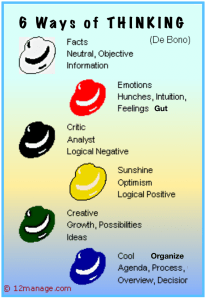
EXP: Those who research a product via Consumer Reports, buy the best one to meet their needs, whether or not they like it, do the ‘Right Thing’, form guidelines to follow for performing tasks ….   (Re. HATS ➡️ )

— 💛 —
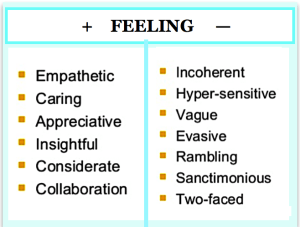
• Feeling (F)
– The importance of info is determine holistically, & perceptions are evaluated based on a sense of harmony, to maintain peace. It’s about making value judgements – whether things are good or bad.
EXP: The person who ‘Feels’ that stealing is right/wrong
NOTE: This MBTI category is not about emotion, but rather a reasoning process handled in the higher brain (cortex). Contrast this with the inner brain’s limbic system which responds to stimuli we (call) experience as emotion.
‘Feelers’ are more empathic (pick up on others’ emotions), make subjective decisions on a case-by-case basis, & use feelings they believe to be right rooted in their own values. Here ‘Fairness’ means that individuals is treated equally.

EXP: When we – buy something because we like it / don’t say something that ‘ll upset another person / decide not to take a job because we don’t like the work environment / decide to move somewhere new to be close to someone we care about….

NOTE:  The Thinking – Feeling level is the only one that generates a gender bias.
The Thinking Woman swims against the current in most areas of life, especially at work. If she’s decisive & objective — she’s branded hard, cold, unfeminine……
The Feeling Male is also disrespected – called soft, weak, a pushover …… for having a caring nature.

NEXT: Intro- Extra-verts

Myers-Briggs INTRO (Part 2a)

PREVIOUS: MBTI Basics #1b

SITE: How Each Myers-Briggs Type Reacts to Stress (& Help!)

NOTE: Each dichotomy is on a continuum, from most….<— to —>most…..

OVERVIEW
The 2 ‘OUTER’  levels (E-I & J-P)

1. EXTROVERSION (E) vs INTROVERSION (I)
Where we prefer to put our ATTENTION, & get our energy from
Extroverts
focus on what’s happening in the real world around them – always in the present moment. Outward-oriented, Es get their mental energy by being around other people & in social situations. They think out loud, so can be quite talkative.

Strongly Extroverted people will gravitate to big events such as rock concerts, have season tickets to sporting events, go to big parties, conferences, loud family gatherings…. energized by conversations, excitement, noise, activities…… After a big events, they’ll look for the stimulation to continue, going on to another location &/or hanging out with friends

EXP: Es can get into a lively discussion or debate while paying attention to what everyone is saying / make a meal for a party / participate in a rally / play a group game / join a study group / lead a class …..
— 💋 —
• Introverts focus on what’s going on inside their mind, which can involve the past, present or future events. They’re usually more private, contained & a lot quieter than Es, but internally very ‘busy’. They get their mental energy from being alone, needing privacy to recharge, preferring to work through ideas by thinking about them first, before expressing them out loud. Large groups of any kind are draining.

Is still need & like people, but want their interactions to be a lot less noisy, less crowded & less chaotic. They can also be found at big events, along with the Es, but after all of that external input they can’t wait to get away & regroup in a quiet environment. If possible, they’ll leave early. And unless they really love it – or if work requires it or family insists – they’re not likely to repeat the experience.

Instead they do very well with 1 or 2 close friends or small groups, because their neuro-chemicals more sensitive. (See Posts ‘MBTI & the Brain’).

This characteristic even shows up in shopping – for an I to be in a store or mall with too many options to choose from  – like ‘Bed, Bath & Beyond’ – can feel just as confusing & overwhelming as being in a boisterous crowd (“Pick me, no pick me., no me…”) !!

EXP:  Is can get caught up in a good book / think about what they’re going to say or do / are aware of how they feel / daydream or imagine / think through a problem to understand it / review & process an interaction they’ve just had ….                                      4. JUDGING (J) vs PERCEIVING (P)
Preferred way of DEALING WITH the world around us,
& can be either Introverted or Extroverted

Judging (J) – These people prefer to be in charge, tend to be highly organized & methodical.
They’re neat, orderly, stable, & like to make extensive use of lists & calendars. They want things to be settled – so they plan & get things done way ahead of time.

EXP: Someone who form & expresses judgments / brings closure to an issue so they can move on / picks places to go ahead of time by doing research / concentrates on reaching goals & ‘doing’ their lists…..
— 👠 —
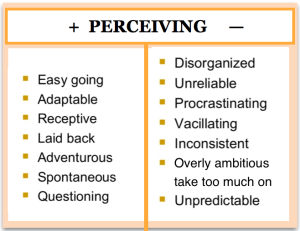
Perceiving (P) – These people prefer to let things play out by themself. They’re usually spontaneous & flexible, having a more open-ended approach to plans, deciding their next move in the moment, & tend to get things done at the last minute.
EXP: People who postpone decisions to see what other options are available / decide what else to do as we’re doing it, rather than forming a plan ahead of time / do things at the last minute / do a lot of research but not act on it because we can’t decide…..
NOTE: The practical differences between Js & Ps are quite noticeable & sometimes cause a lot of conflict.
EXP : A strongly J person can become very frustrated by a P’s careless casualness or indecisiveness, while a strong P can feel limited & controlled by a strong J , BUT even so will may make use of the J‘s extensive planning & preparedness (like on a trip), which can cause the J to feel angry for being taken advantage of!
On the other hand, a ‘mixed’ couple (one of each – friend, spouse, biz  partners…. ) can be complementary if they’re both mature enough to accept their different styles, & use those to accomplish mutual goals.

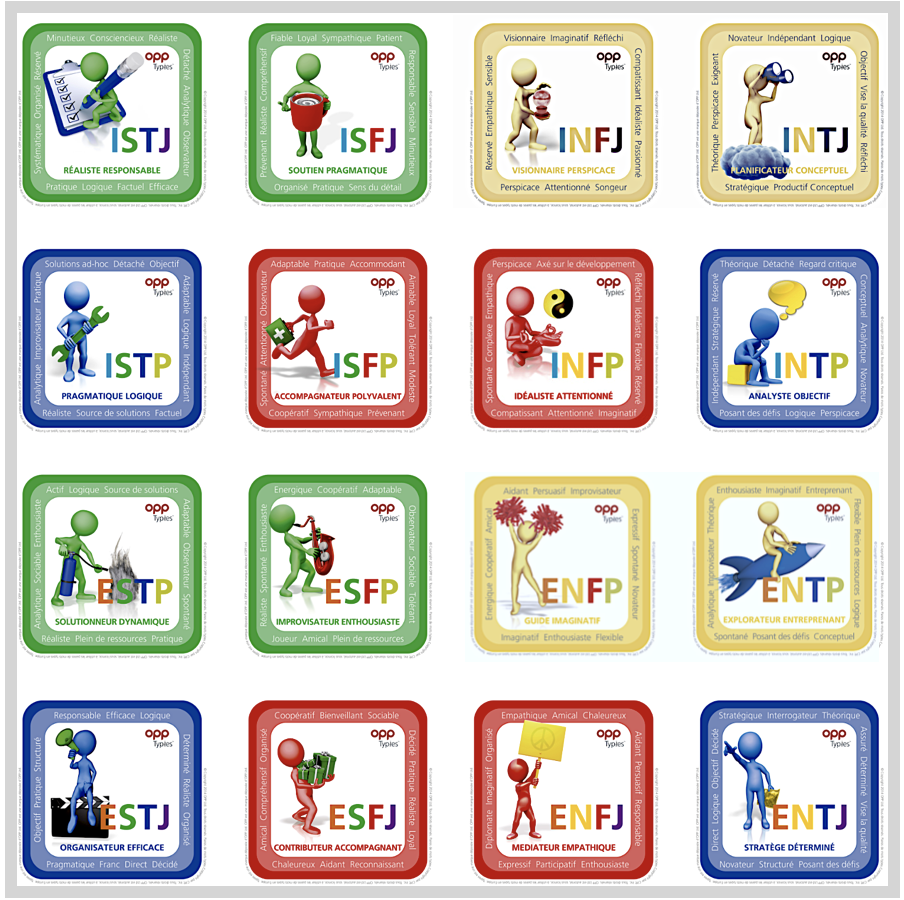
The 4 MBTI levels combine into 16 types, 8 Introverted & 8 Extroverted

«
 NEXT: MBTI Basics #2b