HELLO to all my READERS


A big post-Thanksgiving THANK YOU to all my readers & followers for your interest & faithfulness.

I’m told this time of year is “A 3-Fold disease: Thanksgiving, Christmas & New Years.” 🙂

For many of us this can be a painful time, with perhaps only a few good memories.  Please be extra kind to your Inner Child & let yourself have all your emotions, whatever may come up.

Best wishes,

Donna Marie

Useful & Clever RESPONSES


I WISH I HAD A GOOD COME-BACK
when someone’s mean or stupid

PREVIOUS: Dealing with Toxic People

REVIEW: “Effective Responses” Heal & Grow website

SITE:” How to Craft the Perfect Comeback, According to Experts”

BOOK: “Viva la Repartee: Clever Comebacks

FRUSTRATED: ACoAs are often stumped when others say something unkind, controlling or ridiculous. No matter how smart, educated or competent, we’re often rendered mute by what we hear. First we’re shocked by the comments, not expecting such outrageous or boorish remarks. Then we can’t figure out what to say.

• So, here are some ideas that may be useful – some straightforward, some tongue-in-cheek. You may be uncomfortable with them if you think they’re rude, confrontational or hostile.  Actually, they are not – because: a. they are statements of fact
b. when said with humor, from our Adult ego state, & NOT in anger – they are very effective

TOXIC RULE: “Only other peoples’ feelings count”, which really amounts to:
• not holding others accountable for stepping all over us. Why do we let them get away with it, but condemn ourselves for being direct?
• being willing to abandon our Inner Child in favor of others, inslike ideastead of protecting it using a Loving Parent ego state?

SUGGESTION: Use these lines as is, or modify them to your personal taste. They represent setting boundary & teaching others how we want to be treated.
Pick 2-3 phrases that suit you & memorize them. Say them to yourself all day long, to get them set in your brain. Then, when you really need one – it’ll fall out of your mouth without having to think about it!
🏈 —

THEM: That was a long time ago / just get over it, let it go / stop dwelling on the past / why are dredging up old ……
YOU: 🔹That works for you, but it’s not where I’m at right now. I’d appreciate your support, but I understand if you can’t
🔹That’s exactly what I’m working on, it’s just going to take time, & I want to do it right
🔹I understand you don’t want to talk about this, so we don’t have to
🔹Getting well is the beat revenge – that’s what I’m aiming for

THEM: “That’s just a lot of psycho-babble”
YOU: “If you think that’s psycho-babble, you must not understand it.”

THEM
: You’re too sensitive // YOU: And you’re too insensitiveclever

THEM: You’re crazy! // YOU: Maybe, but I’m never boring!

THEM: You laugh a lot at everything I say
YOU: I’m easily amused!

THEM: You’re too emotional, over-reacting
YOU: You mean I’m too happy?  // Well, at least I can feel! // Maybe you could be more sensitive // You could use Compassion Lessons

THEM: Why don’t you …. / you’re just…. / if you…. //
YOU: That’s not helpful

THEM: You shouldn’t feel that way
YOU: Do you mean what I’m thinking or my emotions?

THEM: You should……
YOU: I try never to ‘should’ on myself. So please don’t ‘should’ on me either

THEM: You have to do (XXX) for me! (or else you’re bad / I’ll die…)
YOU: I’m sorry, but I can only take care of myself right now

THEM: That’s a stupid way to….. You …….
YOU: I don’t talk to myself that way

THEM: Why don’t you get (another cat) / why don’t you do…..?
YOU: Thanks, but I was talking about how I’m feeling. I wasn’t looking for advice or suggestions

THEM:  Don’t bother with that / do it this way / why can’t you…..?
YOU:  I don’t respond well to threats / being bullied / treated like a kidstop it!

THEM: —- (fill in the blank)
  //  YOU: Don’t talk to me that way

THEM: You really like that…..? / do you actually believe in that….?
YOU: Why did you ask // why say it that way?

THEM: If I were you, I’d….  //
YOU: Thank you for sharing your way of doing things!

THEM: If you don’t —– You’ll never see me again / I’ll kill myself / I’ll end up…. (& it’ll be your fault)
YOU:  I’m sorry to hear that. But do whatever makes you comfortable

THEM: I ne-e-e-ed you…. you’re the only one who can do…. who understands me….
YOU:  Well, actually, I have my hands full taking care of my own life. And there are lots of other people, groups, books… that can help you

THEM: If your mother says something provocative (or dad)
YOU: “Oh, mother!” – accent on ‘mother’, with at smile, then zip-the-lip

THEM: I’m just trying to be helpful
YOU: I’ve already tried that / I didn’t ask for help / That doesn’t work for me / Your suggestion doesn’t aideaspply to my situation / That’s not who I am / I was just expressing emotions

THEM:
 // YOU:
—> Add your own

PS: Yes, there’s a time & a place to know when to respond to insensitive comments & when not to. That takes practice, information & self-esteem based on knowing our rights.

GREY ROCKINGgrey rocking

And for those of us who are still dealing with the severe form of dysfunction – the malignant narcissists in our midst – the ONLY way to cope appropriately is to be a GRAY ROCK around them!
(
from “Psychopathfree” Forum)

NEXT: ACoAs – Dealing with Criticism (Part 1)

Dealing with Toxic People

self-care

This is the outline of an article by
TRAVIS BRADBERRY,

Co-author of Emotional Intelligence 2.0, & President at TalentSmart


▶︎ READ explanations for each point

12 Ways SUCCESSFUL People Handle TOXIC People

1. They set limits (especially with complainers)

2. They don’t die in the fight

3. They rise above

4. They stay aware of their emotions

5. They establish boundaries

6. They Won’t Let Anyone Limit Their Joy

7. They Don’t Focus on Problems—Only Solutions

8. They don’t forget

9. They Squash Negative Self-Talk

10. They Limit Their Caffeine Intake

11. They Get Some Sleep

12. They Use Their Support System

🌈

Related articles:
14 Habits of Exceptionally Likable People
How Successful People Stay Calm      
9 Things Successful People Won’t Do

REMINDER:

self-care

Their ATTITUDE Inventory (5 of 5)

inventory  

FWHUH!
Glad it’s finally done

PREVIOUS: THEIR Attitude Inventory (4 of 5)


FYI:
This INTRO is repeated for all 5 posts in this series, but with different topics

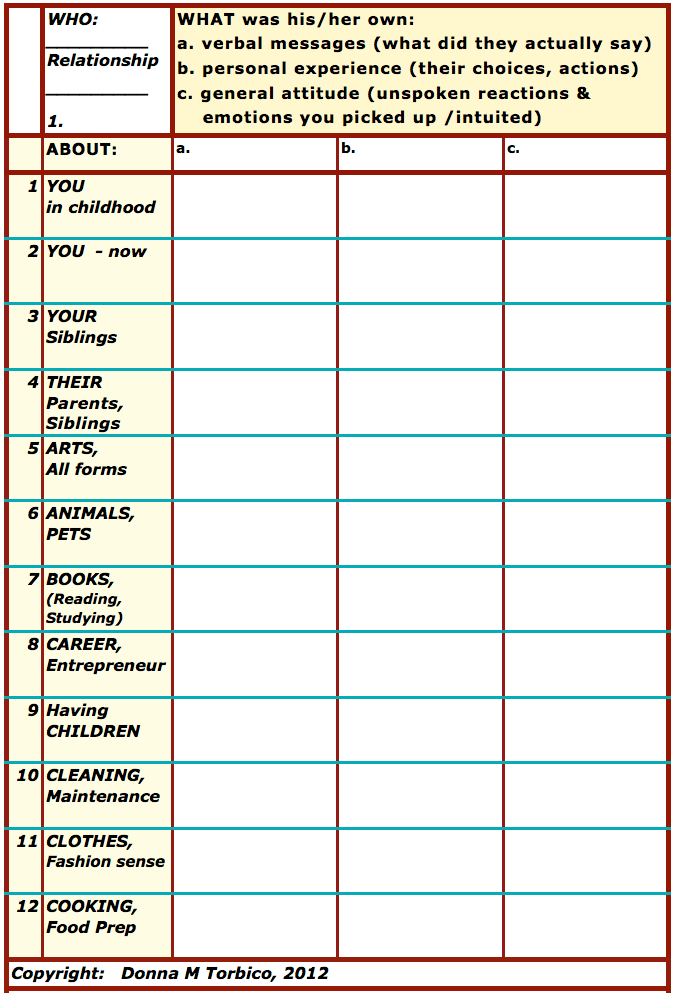
THIS CHART is much more specific & includes listing many of the statements family & others made to us (or we overheard, often) that have become our Toxic Beliefs.
List the people you want to ‘learn’ about.  To start, you can pick ONE you think you know more about & see how far you get.  Of course you can use this chart any way that suits the way YOU process info, so experiment.

* TAKE YOUR TIME. You may feel even more overwhelmed than with the previous chart (there are 62 possible topics altogether). There’s no rush – if you push it you’ll be more likely to give up or to miss important details.

** Naturally you won’t be able to fill in every category for every person. but if you make a separate page for each topic, you can play around by filling in anything that comes to you right away. If you can only write one line per category, start there. Fill in more info at any time later. That can encourage you to work on the rest.  PROGRESS not PERFECTION!

REMINDER: Not surprisingly, many of us don’t remember what
we heard, felt or experienced as kids – mainly we blanked out from fear, but our unconscious remembers.
As you proceed you might be surprised at how much you DO know, and at what will ‘be revealed’ about yourself as you go thru this exercise.  Siblings, other family members & friends or old notebook/ diaries / photo albums – may be helpful.

NOTICE that for each topic you’re asked to consider 3 aspects:
a. Verbal messages: What did this person actually say about the issue? If we pay attention to the way we talk to ourselves – & others – especially when we’re frustrated or angry – we can hear ‘them’ coming out of our mouth.
Also, if someone you’re inventorying is still alive, you can get it from the ‘horse’s mouth’. Without being confrontational or angry, just slip some questions into your conversation & you may get lots of material for your writing. Even what they leave out is very informative!

b. Personal experiences: this is usually the easier one to remember – what  actions did they take about each issue – what did they go thru? Lots of jobs, kinds of relationships, the many ways they did something stupid / abusive / self-destructive / OR helpful / kind / amusing ….. especially any repeated patterns

c. General Attitudes: This may be the hardest because you are the repository of their unspoken, disowned parts! But there are things you’ve always known about them (or at least suspected) that you may not want to admit. Remind yourself – “I know what I know”. You’re NOT crazy – kids are very intuitive & absorb everything!

Suggested PROCEDURE:
More than likely you’ll be doing this on some kind of device.  Make a separate page for each topic & perhaps each subheading
• OR you can use a loose-leaf notebook, & maybe 3 different color pens
• Take as much room for each a. b. & c. as needed, filling in first the things you’re sure or have an idea about – in NO particular order!

• Include all positive & negative points, to get a rounded picture
• Skip any topics that don’t apply to a specific person or that you simply don’t know about, & include more later
• Add any topics not listed which applies to a specific person
PS: If a topic specifically impacted you – growing up – you can make a separate column / page to comment

NEXT: Unrealistic Expectations – OVER – #1

THEM Inv 5

Their ATTITUDE Inventory (4 of 5)

inventory
I DON’T KNOW HOW MUCH MORE
of this I can take!

PREVIOUS: THEIR Attitude Inventory (3 of 5)


FYI: This INTRO will be repeated for all 5 posts in this series, but with different topics

THIS CHART is much more specific & includes listing many of the statements family & others made to us (or we overheard, often) that have become our Toxic Beliefs. More issues in the next post.
List the people you want to ‘learn’ about.  To start, you can pick ONE you think you know more about & see how far you get.  Of course you can use this chart any way that suits the way YOU process info, so experiment.

* TAKE YOUR TIME. You may feel even more overwhelmed than with the previous chart (there are 62 possible topics altogether). There’s no rush – if you push it you’ll be more likely to give up or to miss important details.

** Naturally you won’t be able to fill in every category for every person. but if you make a separate page for each topic, you can play around by filling in anything that comes to you right away. If you can only write one line per category, start there. Fill in more info at any time later. That can encourage you to work on the rest.  PROGRESS not PERFECTION!

REMINDER: Not surprisingly, many of us don’t remember what
we heard, felt or experienced as kids – mainly we blanked out from fear, but our unconscious remembers.
As you proceed you might be surprised at how much you DO know, and at what will ‘be revealed’ about yourself as you go thru this exercise.  Siblings, other family members & friends or old notebook/ diaries / photo albums – may be helpful.

NOTICE that for each topic you’re asked to consider 3 aspects:
a. Verbal messages: What did this person actually say about the issue? If we pay attention to the way we talk to ourselves – & others – especially when we’re frustrated or angry – we can hear ‘them’ coming out of our mouth.
Also, if someone you’re inventorying is still alive, you can get it from the ‘horse’s mouth’. Without being confrontational or angry, just slip some questions into your conversation & you may get lots of material for your writing. Even what they leave out is very informative!

b. Personal experiences: this is usually the easier one to remember – what  actions did they take about each issue – what did they go thru? Lots of jobs, kinds of relationships, the many ways they did something stupid / abusive / self-destructive / OR helpful / kind / amusing ….. especially any repeated patterns

c. General Attitudes: This may be the hardest because you are the repository of their unspoken, disowned parts! But there are things you’ve always known about them (or at least suspected) that you may not want to admit. Remind yourself – “I know what I know”. You’re NOT crazy – kids are very intuitive & absorb everything!

Suggested PROCEDURE:
More than likely you’ll be doing this on some kind of device.  Make a separate page for each topic & perhaps each subheading
• OR you can use a loose-leaf notebook, & maybe 3 different color pens
• Take as much room for each a. b. & c. as needed, filling in first the things you’re sure or have an idea about – in NO particular order!

• Include all positive & negative points, to get a rounded picture
• Skip any topics that don’t apply to a specific person or that you simply don’t know about, & include more later
• Add any topics not listed which applies to a specific person
PS: If a topic specifically impacted you – growing up – you can make a separate column / page to comment

NEXT: Attitude Inv. (5 of 5)

THEM Inv 4

Their ATTITUDE Inventory (3 of 5)

inventory 3 

THIS IS HARD WORK
but I’m learning a lot

PREVIOUS: THEIR Attitude Inventory (2 of 5)

See ACRONYM page for abbrev.


FYI: This INTRO will be repeated for all 5 posts in this series, but with different topics

THIS CHART is much more specific & includes listing many of the statements family & others made to us (or we overheard, often) that have become our Toxic Beliefs. More issues in the next 2 posts.
List the people you want to ‘learn’ about.  To start, you can pick ONE you think you know more about & see how far you get.  Of course you can use this chart any way that suits the way YOU process info, so experiment.

* TAKE YOUR TIME. You may feel even more overwhelmed than with the previous chart (there are 62 possible topics altogether). There’s no rush – if you push it you’ll be more likely to give up or to miss important details.

** Naturally you won’t be able to fill in every category for every person. but if you make a separate page for each topic, you can play around by filling in anything that comes to you right away. If you can only write one line per category, start there. Fill in more info at any time later. That can encourage you to work on the rest.  PROGRESS not PERFECTION!

REMINDER: Not surprisingly, many of us don’t remember what
we heard, felt or experienced as kids – mainly we blanked out from fear, but our unconscious remembers.
As you proceed you might be surprised at how much you DO know, and at what will ‘be revealed’ about yourself as you go thru this exercise.  Siblings, other family members & friends or old notebook/ diaries / photo albums – may be helpful.

NOTICE that for each topic you’re asked to consider 3 aspects:
a. Verbal messages: What did this person actually say about the issue? If we pay attention to the way we talk to ourselves – & others – especially when we’re frustrated or angry – we can hear ‘them’ coming out of our mouth.
Also, if someone you’re inventorying is still alive, you can get it from the ‘horse’s mouth’. Without being confrontational or angry, just slip some questions into your conversation & you may get lots of material for your writing. Even what they leave out is very informative!

b. Personal experiences: this is usually the easier one to remember – what  actions did they take about each issue – what did they go thru? Lots of jobs, kinds of relationships, the many ways they did something stupid / abusive / self-destructive / OR helpful / kind / amusing ….. especially any repeated patterns

c. General Attitudes: This may be the hardest because you are the repository of their unspoken, disowned parts! But there are things you’ve always known about them (or at least suspected) that you may not want to admit. Remind yourself – “I know what I know”. You’re NOT crazy – kids are very intuitive & absorb everything!

Suggested PROCEDURE:
More than likely you’ll be doing this on some kind of device.  Make a separate page for each topic & perhaps each subheading
• OR you can use a loose-leaf notebook, & maybe 3 different color pens
• Take as much room for each a. b. & c. as needed, filling in first the things you’re sure or have an idea about – in NO particular order!

• Include all positive & negative points, to get a rounded picture
• Skip any topics that don’t apply to a specific person or that you simply don’t know about, & include more later
• Add any topics not listed which applies to a specific person
PS: If a topic specifically impacted you – growing up – you can make a separate column / page to comment

NEXT: Attitude Inv. (4 of 5)
THEM Inv 3

Their ATTITUDE Inventory (2 of 5)

inventory 2 

I NEVER WANTED TO BE
just like them – but I am, sort of!

PREVIOUS: THEIR Attitude Inventory (1 of 5)


FYI: This INTRO is being repeated for all 5 posts in this series, but with different topics

THIS CHART is much more specific & includes listing many of the statements family & others made to us (or we overheard, often) that have become our Toxic Beliefs. More issues in the next 3 posts.
List the people you want to ‘learn’ about.  To start, you can pick ONE you think you know more about & see how far you get.  Of course you can use this chart any way that suits the way YOU process info, so experiment.

* TAKE YOUR TIME. You may feel even more overwhelmed than with the previous chart (there are 62 possible topics altogether). There’s no rush – if you push it you’ll be more likely to give up or to miss important details.

** Naturally you won’t be able to fill in every category for every person. but if you make a separate page for each topic, you can play around by filling in anything that comes to you right away. If you can only write one line per category, start there. Fill in more info at any time later. That can encourage you to work on the rest.  PROGRESS not PERFECTION!

REMINDER: Not surprisingly, many of us don’t remember what
we heard, felt or experienced as kids – mainly we blanked out from fear, but our unconscious remembers.
As you proceed you might be surprised at how much you DO know, and at what will ‘be revealed’ about yourself as you go thru this exercise.  Siblings, other family members & friends or old notebook/ diaries / photo albums – may be helpful.

NOTICE that for each topic you’re asked to consider 3 aspects:
a. Verbal messages: What did this person actually say about the issue? If we pay attention to the way we talk to ourselves – & others – especially when we’re frustrated or angry – we can hear ‘them’ coming out of our mouth.
Also, if someone you’re inventorying is still alive, you can get it from the ‘horse’s mouth’. Without being confrontational or angry, just slip some questions into your conversation & you may get lots of material for your writing. Even what they leave out is very informative!

b. Personal experiences: this is usually the easier one to remember – what  actions did they take about each issue – what did they go thru? Lots of jobs, kinds of relationships, the many ways they did something stupid / abusive / self-destructive / OR helpful / kind / amusing ….. especially any repeated patterns

c. General Attitudes: This may be the hardest because you are the repository of their unspoken, disowned parts! But there are things you’ve always known about them (or at least suspected) that you may not want to admit. Remind yourself – “I know what I know”. You’re NOT crazy – kids are very intuitive & absorb everything!

Suggested PROCEDURE:
More than likely you’ll be doing this on some kind of device.  Make a separate page for each topic & perhaps each subheading
• OR you can use a loose-leaf notebook, & maybe 3 different color pens
• Take as much room for each a. b. & c. as needed, filling in first the things you’re sure or have an idea about – in NO particular order!

• Include all positive & negative points, to get a rounded picture
• Skip any topics that don’t apply to a specific person or that you simply don’t know about, & include more later
• Add any topics not listed which applies to a specific person
PS: If a topic specifically impacted you – growing up – you can make a separate column / page to comment

NEXT: Attitude Inv. (3 of 5)

THEM Inv 2

Their ATTITUDE Inventory (#1 of 5)

writng inventory 

TAKING THEIR INVENTORY
helps me know what I absorbed!

PREVIOUS: 2011 Blog Stats

See ACRONYM Page for abbrev.


FYI: This INTRO will be repeated for all 5 posts in the series, but with additional topics
THIS CHART is much more specific & includes listing many of the statements family & others made to us (or we overheard, often) that have become our Toxic Beliefs. More issues in the next 4 posts.
List the people you want to ‘learn’ about.  To start, you can pick ONE you think you know more about & see how far you get.  Of course you can use this chart any way that suits the way YOU process info, so experiment.

* TAKE YOUR TIME. You may feel even more overwhelmed than with the previous chart (there are 62 possible topics altogether). There’s no rush – if you push it you’ll be more likely to give up or to miss important details.

** Naturally you won’t be able to fill in every category for every person. but if you make a separate page for each topic, you can play around by filling in anything that comes to you right away. If you can only write one line per category, start there. Fill in more info at any time later. That can encourage you to work on the rest.  PROGRESS not PERFECTION!

REMINDER: Not surprisingly, many of us don’t remember whatchildhood memories
we heard, felt or experienced as kids – mainly we blanked out from fear, but our unconscious remembers.
As you proceed you might be surprised at how much you DO know, and at what will ‘be revealed’ about yourself as you go thru this exercise.  Siblings, other family members & friends or old notebook/ diaries / photo albums – may be helpful.

NOTICE that for each topic you’re asked to consider 3 aspects:
a. Verbal messages: What did this person actually say about the issue? If we pay attention to the way we talk to ourselves – & others – especially when we’re frustrated or angry – we can hear ‘them’ coming out of our mouth.
Also, if someone you’re inventorying is still alive, you can get it from the ‘horse’s mouth’. Without being confrontational or angry, just slip some questions into your conversation & you may get lots of material for your writing. Even what they leave out is very informative!

b. Personal experiences: this is usually the easier one to remember – what  actions did they take about each issue – what did they go thru? Lots of jobs, kinds of relationships, the many ways they did something stupid / abusive / self-destructive / OR helpful / kind / amusing ….. especially any repeated patterns

c. General Attitudes: This may be the hardest because you are the repository of their unspoken, disowned parts! But there are things you’ve always known about them (or at least suspected) that you may not want to admit. Remind yourself – “I know what I know”. You’re NOT crazy – kids are very intuitive & absorb everything!

Suggested PROCEDURE:
More than likely you’ll be doing this on some kind of device.  Make a separate page for each topic & perhaps each subheading
• OR you can use a loose-leaf notebook, & maybe 3 different color pens
• Take as much room for each a. b. & c. as needed, filling in first the things you’re sure or have an idea about – in NO particular order!

• Include all positive & negative points, to get a rounded picture
• Skip any topics that don’t apply to a specific person or that you simply don’t know about, & include more later
• Add any topics not listed which applies to a specific person
PS: If a topic specifically impacted you – growing up – you can make a separate column / page to comment

NEXT: Attitude Inv. (2 of 5)

THEM Inv 1

Family INVENTORY – Looks

looks inv.
OH NO, THE OLDER I GET  –
the more I look like him / her! EEK!

PREVIOUS: Family Inventory – Overview

See ACRONYM Page for abbrev.

This series of Inventory Qs (Š Donna M Torbico, 1995) is specific to the topic of LOOKS, but can be modified to cover almost any other topic you want to evaluate: Food, Money, Sex, Work, House, Religion, Personal & family name, Ethnic / cultural / country background…..

APPEARANCE
Every aspect of our family made a deep impact on us, consciously or not. Since everyone is affected by & often judged by our appearance, we want to look at this aspect first.  It has a direct bearing on how we feel about our own looks – did we grow up proud or ashamed of it?

EXP: A very well known passionate Bible teacher who speaks in public all over the world – is not what most people would call ‘pretty’. She mentioned once that someone unkindly told her she had a “great face for radio”!

At the other extreme, millions of people follow, even adore, famous people who are gorgeous, & imagine / assume they’re also wonderful people. Not so! Many are addicts, cheaters, batters, sexual predators….
OR: Think “Father Knows Best”‘s Robert Young who presented as squeaky clean (in the days before the net & social media) but in real life was an active alcoholic…..

Describe each Q** in as much detail as you can remember, as if telling someone who has never seen them.  If you can’t think of much, start anywhere & then go on to the next point. Leave room for adding to it as memories come up.
If you need help, ASK anyone who also was part of OR knew your family members – what they can contribute
**DO a separate list for each parent & sibling, & any other relative who had an influence on you

1. In your opinion:
• what did each of them look like?
• how have they changed over the years?
• do you/ did you like their looks or not?
• how did their looks affect you?
• did other people have reactions to their looks or to any changes in them – from age, sickness, accidents….?
• who do you most look like & how do you feel about that?

2. What was their opinion:
• of their looks?
• of your? (list their comments)
• how did you feel about that?
— did anyone in the family favor your looks or someone else’s?
— what about others in the family?

3. Is there a pattern to the physical type they preferred or disliked? (gender, color, size…) – even if it now seems shallow or cruel
• What did you think of that?
• Did it affect you in any way?
• Did it have anything to do with ethnic background?

4. How did they dress?
• has it changed over the year? How?
• what aspect of grooming was most important to them?
• if it has changed, what life situations might have contributed to it?
• what was the difference in their choice of clothes at home vs going out?
• did they ever embarrass you by the way they dressed? When & how often? (Drunk?)Screen Shot 2015-08-10 at 3.07.52 AM

5.  How would you describe their style (if not already done so above)?
• frumpy, elegant, sloppy, careful, conservative, hippy, modern…..
• did other people (neighbors, school, church…) comment on their way of dressing?
• how did you feel about their style?
• what other people said?

6. Who chose your clothes & accessories?
• how did you feel about their choices?
• OR did you have to do it alone – when you were way too young?
• what emotions & thoughts did that cause?
• if an adult chose, at what age did that change?
• were your clothes hand-me-downs?
• what effect did that have on your self-esteem & social acceptability?

7. What was their attitude about personal hygiene?
• about themselves?
• about you?
• what effect did this have on you?shows

8. What were their favorite OR hated scent, color, fabric, era…. ?
• were any of these imposed on you?
• how did that affect you?

Add other thoughts relevant to your experience on this topic.

NEXT: OUR Time-Line Inventory

Family Inventory OVERVIEW

inventory writing
THIS IS SUCH A BIG JOB!
so I have to take it a little at a time

PREVIOUS: Inventories – beginning (#3)

BOOK: “GENOGRAMS in Family Assessment” by M. McGoldrick & R. Gerson (Another type of Inventory)

REVIEW the relevant “What To Do” section of “Our TIME LINE Inventory” post for suggestions about how to use this chart

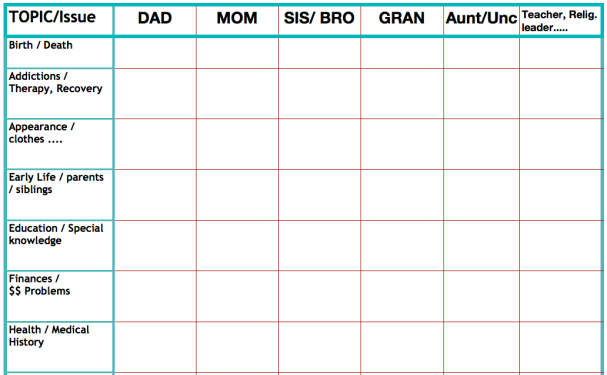
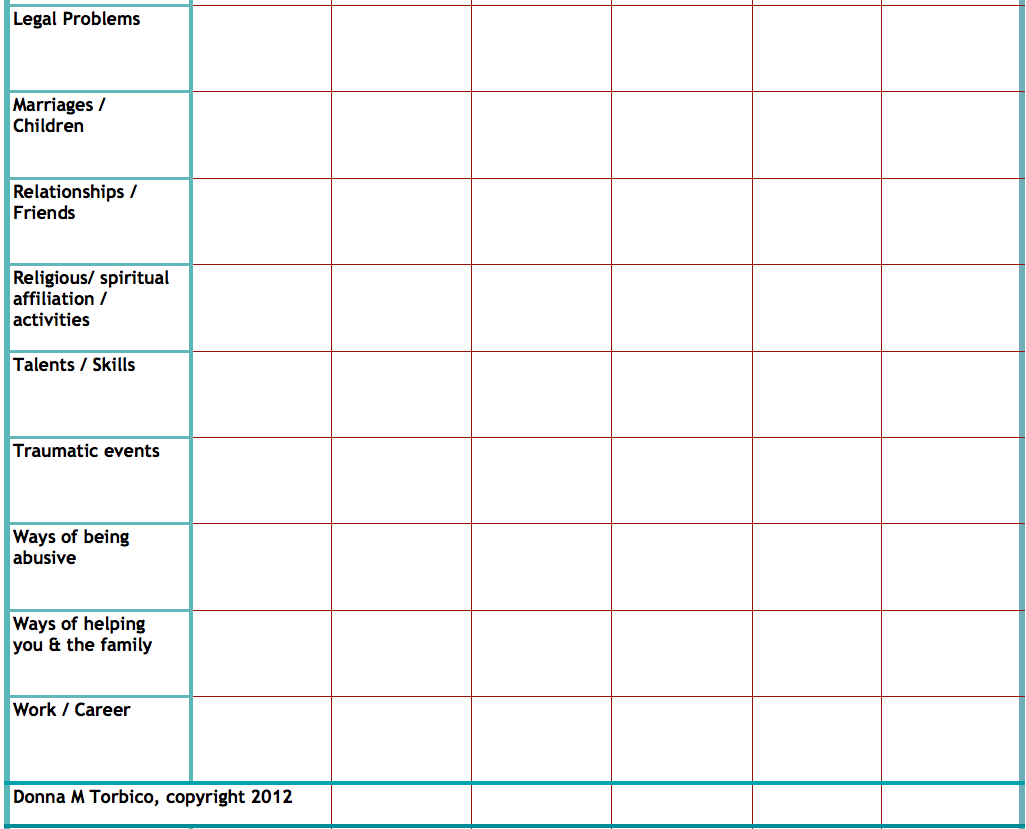
THIS CHART is for the basic facts of each person’s life. Adapt it to fit the number of people in your family members & for others important people from your childhood.
You can add (or subtract) any topic not listed which you feel is relevant to each person you’re writing about. Following posts will cover attitudes & positions in greater detail.
REMEMBER to include any good or beneficial features each person had, when filling in the boxes.

PROCEDURE:
• This design is just a way to get you started. Naturally you’ll need to make a lot more room for each category than is shown here
• You could use a pencil making it easier to add & subtract info, or try different colored pens for each person, to keep them clearly separate

• Try a very big sheet of light-colored wrapping paper to draw up your version. Or take a separate page for each person in a notebook, even for each column
• Add rows with other headings or separate the ones given. Again, don’t worry if you don’t don’t know what to put in some boxes.  Do as much as you can – jump around as ideas & memories come to you.  Go back & fill in as “more is revealed”.
MAKE IT OUR OWN.

AGAIN: DOING THIS on PAPER INSTEAD of ONLINE is BETTER for your BRAIN.
MY Fam Inv a

my-fam-inv-b

NEXT: Family Inventory – LOOKS