
 TRYING TO BE SOCIAL
is such hard work!
PREVIOUS: Disorders #4a
SITE: ‘Somatization’ & Psych terms used as swear words
HUMOR: 35 Undiagnosed Medical Conditions of Disney Characters
1. NORMAL // 2. NEUROSES
3. PERSONALITY DISORDERS (PDs) (cont)
PDs describe types of ‘damage’ in adults who have long-standing problems in forming deep, meaningful, positive relationships with others. These people often show unusual, rigid or extreme patterns of thought, emotional reactions, &/or impulsive behavior, which consistently lead to problems for themself & others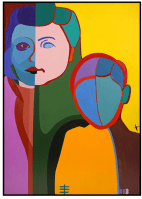
● The brain uses Self-concept as a guide for interpreting the world. People with this diagnosis have a wounded core identity. How dysfunctional they are depends on how intensely they act in self-defeating ways.
= At one extreme – some PD people assume they’re invulnerable & have a right to feel superior. They’re insulated in their carefully built shell of defenses, and flatly deny having a wounded core
= However, most feel empty, bad, ‘not right’ in their basic sense of Self. Their sense of badness has a physical quality – as if it’s in their very bones or cells. They they truly believe it they’re not, & say there’s never been a time when they felt OK.
 Transactional Analysis theory explains that this sense of wrongness comes from their WIC’s child parts (C1 or C0) – the most vulnerable aspect of personality. So this feeling is ego-syntonic – it ‘makes sense’ to them on a gut level, with no inner conflict, as there is with neurotics. So the damage started very early, likely at birth (Co).
Using the Gestalt technique, if we visualize putting a person’s Adult & Parents voices in 2 opposite chairs, & imagine the Inner Child between them, we ask the person “How do you feel about your IC?” Most people will have a fairly positive reaction.
In contrast, many PDs will say they hate their child – that it’s ugly, dirty, disgusting, full of needs ….. expressing their ingrained sense of worthlessness (typical of many ACoAs!).
💚 SIDEBAR: There is now a “Grand Unified Theory” of psychology (GUT) – the relationship between psychology & neuroscience …..which clearly defines how the field relates to other disciplines (biology & sociology….) . It’s made up of :
1) the Tree of Knowledge System // 2) the Justification Hypothesis
3) the Influence Matrix // 4) Behavioral Investment Theory (MORE….)
✥ Relational INFLUENCE Matrix (IM)
It maps how people represent themself in relation to others. It grew out of the Behavioral Investment Theory of social motivational & emotional processes, based on Attachment Theory. 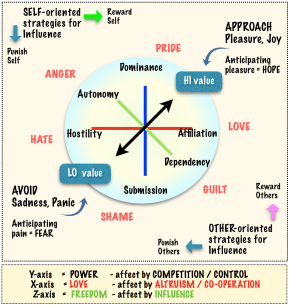 The Matrix makes 2 main points:
a. Humans are motivated by the need to be loved, admired & respected
b. They are equally driven by the need to avoid loss – being rejected, criticized or ostracized
(Freud’s Pleasure-Pain principal)
The green boxes at the BLACK axis points show that people have a mental/ emotional picture of how valuable different types of relationships are, & tend to approach or avoid them accordingly.
💗 EXP: Having ‘HI relational value’ can come from accomplishing something really hard that other people admire or love you for.
✥ Personality Disorder Star (these 2 CHARTS)
Karen Horney’s 3 main NEEDS – ways of relating to others – exactly parallel the IM dimensions (above) : Power is used to move against, Love for moving toward & Freedom for moving away – separate pathways to deciding relational value
HOWEVER – People with PDs consistently act in ways that reduce the relational value of themself & others – their self-defeating behavior causing everyone so much distress.
EXP: PDs are grouped by the direction of MOVEMENT –
• Against = Narcissistic – hyper-competitive, constantly act superior to others (Steve Jobs)
• Away = Schizoid – deep detachment, without emotional connection & responsiveness
• Toward = Dependent – desperate fear of abandonment, they submit to the will of others to avoid rejection, & a need to caretake then
This star shows how certain PDs are the opposites of other negative personality characteristics.
Cluster A people are extreme on the need for Freedom dimension
Cluster B people are mainly selfish, competitive, manipulative & controlling
Cluster C people (especially Avoidant & Dependent PDs) are deeply concerned with affiliation – come here or go away – at any cost
NOTE that only 6 out of the 10 PDs are represented. The others tend to be combinations.
EXP: Borderlines (BPD) fluctuate between strong displays of dependency/ neediness followed by extreme displays of reactive hostility – described in”I hate you, don’t leave me” by Kreitman & Straus. They are less rigid than most PDs, with a weak or fragmented identity, & strong need for all 3 (power, love & freedom), covering a basically insecure Self (LO relational value).
«
«
NEXT: Personality Disorders (Part 4c)
 HEAL & GROW for ACoAs