ACoAs: RISK-AVERSE (Part 2)

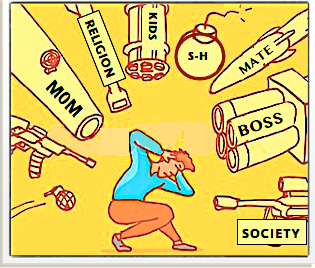
attacks
ATTACKS COME FROM EVERYWHERE!
I have to protect myself at all costs

PREVIOUS: RISK  – Intro

See ACRONYM page for abbrev.

T.E.A for ACoAs (cont)
EXP : re. Portfolio management
RISK Aversion –
a preference for safety & certainty over uncertainty, & the potential for loss or pain
vs. LOSS Aversion : 
a complex need for both risk aversion & risk seeking behavior. It’s not just the desire to reduce risk but an utter contempt for any amount of loss. These people feel the sting of loss twice as much as the joy from an equal size gain – & make financial investment decisions accordingly

Neuro-economic studies have found that when people are facing a loss, the amygdala – our brain’s fear center – begins to fire. It is the same area that reacts to being in mortal danger. No wonder many investors are influenced by loss-aversion.

So too, some ACoAs are :
a. MORE risk-averse – hardly ever taking risks of any kind, living mainly as victims, who stay in menial or unfulfilling jobs most of their work life, stay closer to home, don’t try new things, don’t reach out… And SOME are:
b. LESS averse : more adventuresome in ‘action’ ways, but afraid to risk in other important areas, most often not experiencing their emotions, & avoiding relationship intimacy

😩We learned to ignore potential options, because WE WERE:
• told anything we did was wrong, stupid or not good enough
• constantly interrupted by someone else’s needs or crises, so we couldn’t stay focused on what we needed to do for ourselves avoid risk

• punished equally for big or small infractions of ‘rules’, many of which made no sense or were unspoken! This made us put off or avoid taking normal activities, much less branching out to try things that are deeply important to us, or something more unusual to expand our world

IN the PRESENT – our reaction to childhood trauma is to avoid as much confrontation & newness as possible (co-dependence / risk-aversion).
We’re convinced that all forms of ‘taking a chance’ are bad & will guarantee a bad outcome.
We’ve been trained to assume that that’s the way life is, forever – at least for us! This is so ingrained that we don’t even know that’s what we believe. But we live it every day.
Because WE :

• copy a parent’s life-long fear of risk
obey our specific toxic rules
• rebel against family demands for success
• can’t take center stage in our own life
• don’t want to lose proof of their abuse
• not allowed to be visible, or out-shine them

also FEAR – of:
• abandonment, reprisals, punishment
• authority, not being perfect, not picking right
• being a ‘laughing stock’
• being shown as incompetent (not knowing)
• dealing with competition
• having to deal with others’ jealousy
• not getting our deepest desires, no matter how hard we try
AND / OR have to: 
• face our childhood damage AND CHANGE!
• S & I (outgrow & out do unsuccessful family)
• leave someone unsafe or incompatible (parent, friends, mate, children, job, addictions, locations….) if they prevent our growth
• deal with the discomfort of getting good things now, & being successful, which the WIC says it doesn’t know how to be
• then take riskier steps after that… maybe even scarier (like: write something, then publish, then promote, then…)

RECOVERY
In terms of positive T.E.A., while risk is primarily about Actions, there are many which fit into Emotion & Thinking, in spite of the WIC’s fear of personal growth.
WE CAN: leave home
T. – disagree with & disobey the Negative Introject, outgrowing the addiction & attachment to our family (giving up denial)

E. – tolerate the painful emotions what surface in the process of letting go, both from re-experiencing pent-up old pain, as well as facing being hurt by current family judgment & abuse for ‘leaving them’ ie. upsetting the family mobile by changing the dysfunctional dynamics.

A. …. & risk healthy actions : clearly objecting to abuse, disobeying Toxic Rules by doing positive things for our life, & sometimes having to distance ourselves from actual family members & dealing with the possible fallout.

NEXT:  Risk Addicted

ACoAs : RISK-AVERSE (Part 1)

trapping ALL I’M DOING IS BEING OBEDIENT
so what’s the problem?

PREVIOUS: ACoAs & RISK – #1

POSTS: Book-ending’ with the IC
‘What to DO when confused’

✦ ‘Weak Decision making styles
PROCESS


RISK AVERSION
is a preference for a sure outcome — over taking a gamble for an outcome with higher or equal expected value
⎖ Nobel Prize-winning psychologist Daniel Kahneman wrote, “For most people, losses loom larger than gains, so that the fear of losing $100 is more intense than the hope of gaining $150″

⎖ Columbia University’s Tory Higgins, from 20 years of research, suggests that we see goals as opportunities to provide a benefit. People are either :
⛔️ Prevention-focused, more risk-averse, to maintain the status quo & keep things running smoothly, BUT will embrace risk when it’s their only shot at returning to their status quo
OR —
💢 Promotion-focused, less risk-averse, to make progress & end up better off, with the potential for richer gains

IMP: To be able to risk – appropriately – everyone needs to have :
a. a True Self to make healthy choices, so we don’t need to keep procrastinating as a way to avoid any losses
b. a realistic ability to trust – in ourself, in process, as well as in a safe Higher Power

FAMILY TRAINING
We are all the products of our heredity & our early experiences. We interpret our upbringing thru the lens of our basic personality. But our orientation to Risk is colored by how our parents reacted to people & life events
UNDER-RISKERS
ACoAs see the world as always being dangerous – no matter the reality – IF :fearful parent
• one parent was particularly risk-averse AND we identified more with that parent
• they were depressed & not very functional
• we were constantly told not to trust ourselves AND we learned to not thrust our care-takers, with good reason!
• most adults around us were too scared to go towards new & better people/places/things
• they didn’t protect us from other crazy, abusive & dangerous adults….

EXP: One ACoA’s cold, abusive mother often told him that the world is a jungle, a survival of the fittest – the weak (him) are eaten by the strong (her) & no matter how big you think you are, there’s always someone bigger & badder who will get you! Naturally he grew up to be very timid.

For ACoAs, this style is T.E.A. resistance & withholding
MENTAL – NOT:
speaking up for ourself, asking for our needs or preferences, protecting the Inner Child
• asking for help, making calls, talking to unfamiliar people
• asking Qs when unsure or confused
• responding to a Q when we know the answer

EMOTIONAL – NOT
• being willing to feel all Es & deal with our damage (“You’re only as sick as your secrets”)
• opening up emotionally in the right way, in order to have positive intimacy in relationships

BEHAVIORAL
As all kinds of self-deprivation, not only with food but in many other areas of life ($$, love, career, self-care….). We prevent ourselves from accepting & absorbing many of the good things available to us, because of S-H, from the belief that we don’t have a right to prosperity & peacefulness.
But the deeper reason for not risking much is to keep the fantasy / demand that someone else will eventually rescue us from having to grow up & be responsible for ourselves. It includes —
NOT:
• avoiding pesilent screamople who are needy, users, leaches, abusers
• leaving a bad or outgrown relationship, OR rarely or never being in a good one
• having an adequate (or any) support system
NOT:
• having an adequate salary to live comfortably (under-earning), or not greatly increasing your income
• pursuing a career passion or vocation which has been a long-held dream, taking classes to expand your world, ‘following your bliss‘
• starting over, somewhere else that’s more suitable to you
NOT:
• trying out new foods, changing personal style of clothes or hair when appropriate (with age…), improving your living conditions
• looking for new, better or easier ways to do things ……
• learning & then doing something creative, & showing it off

NEXT: RISK AVERSE #2

ACoAs & RISK – Intro

risk 

TO RISK OR NOT TO RISK –
That is the question

PREVIOUS: Unrealistic Expect.-UNDER

See ACRONYM page for abbrev.

REVIEW posts on (not) TRUSTING


Basic MEANING of RISK

a. taking a chance on something, most often referring to the possibility of harm, misfortune or loss
b.
can also be about a positive outcome, resulting in pleasure, accomplishment & success
c.
OR a neutral / acceptable result – with no danger but no gain

STYLE “a” ⬆️ characteristics
PHYSICAL
• dealing with something or someone known as a source of danger
• a venture chosen without regard to possible loss or injury
• being exposed to the chance of damage or injury, not by choice

EMOTIONAL / PSYCHOLOGICAL
• a situation which causes suffering — being accused wrongly, manipulated & used, humiliated, misunderstood or shamed
• an element or course of action involving uncertain, unpredictable discomfort or distress
• the possibility that something unpleasant or unwelcome might happen beyond ones control

FOR ACoAsmany outcomes
Although the definitions indicate more than one possible outcome, only the a. meaning is considered an option for us – because of  Toxic family rules  such as: “Life is endless suffering’,  ‘You must always struggle but can never get ‘there’,  ‘Don’t expect anything good, ever”…..

In a ‘sane’ world, Risk is minimized or no longer a factor IF the outcome of a situation in known ahead of time based on experience, or is predictable based on dependable information
Then a person can take an action OR avoid a situation – with confidence. This is not wishful thinking, projecting or unrealistic expectations. It comes from realistic knowledge, using present-day Adult ego-state evaluation

• But that’s not how ACoAs operate. We persistently ignore info we do have from years of experience, only using the WIC’s distorted ‘glasses’.
We compulsively pursue unsafe actions, when we  —
✎ choose to return to dangerous situations, stay connected to harmful people…..
✎ & avoid beneficial opportunities, often refusing to take relatively safe actions.
Because of our very deep denial system we keep getting burned – then wonder why we don’t trust!

ANXIETY – ACoA issues around risk-taking are always about internal anxiety. One scared kidscharacteristics on the Laundry List is:
“We have become addicted to (negative) excitement after years of living in the midst of a traumatic & often dangerous family ‘soap opera’.”

ACoAs get things backwards. We keep trying to do the impossible & have trouble doing what is possible!
We’re not sufficiently afraid of some very dangerous ‘people, places & things’ while being overly scared of things that are not actually harmful (like having emotions)!

ALL ACoAs are fear-based**, the Inner Child’s terror of feeling out of control that we bring with us into adulthood, underscoring every aspect of our life. Anxiety is what drives all our character defects, our acting out, our addictions . It’s why the Serenity Prayer is so important for ACoAs!

** Fortunately, long-term recovery – if we’ve been doing emotion-release work – diminishes the intensity of our fear, so it’s not on the surface all the time.  But since our terror-base is very deep, it never dissipates completely.
So we should not be surprised when it occasionally grabs us in the gut – if or when some current event sets it off again. “If it’s hysterical, it’s historical”.

The difference is, or should be – that we’ve built a Loving Parent voice, with years of acting in healthier ways & using our tools, so we can soothe & comfort the WIC whenever we’re triggered (Use Book-ending)

CONTROLcontrolling
The counter-action defense against anxiety is to be controlling (as opposed to Having Self-Control).
It avoids any type of risk-taking that inherently implies unpredictability.
The greater the inner fear, the greater the need to control – in a futile attempt to keep anything or anyone from abandoning us – yet again.

This is why ACoAs try so hard to be mind-readers. If we can figure out what someone feels, thinks or needs – before they say anything – we assume we’ll be ‘prepared’ – for the worst, of course – to prevent being hurt, & stay connected by twisting ourselves into what we hope others will find acceptable.

NEXT: ACoAs & RISK – #2