What about EMOTIONS? (Part 4)

therapy couch 3 I CAN HAVE ALL MY FEELINGS, & still be in control of myself!

PREVIOUS: What about Es? (Part 2)


MASTERY vs CONTROL
EXTERNAL focus: Control : “TO direct & command & having authority over others, OR to hold back, curb, restrain”.
The need for negative control (being controlling) in our personal life comes from an intense desire to avoid feeling fear – fear we’ve been storing away a little at a time, year after year, until it’s a mountain too overwhelming to face

Without realizing it, we believe that if we can ‘direct or restrain’ other people & situations around us we can prevent feelings of terror & rage from surfacing.  Controlling our Es keeps us from knowing ourself fully, while trying desperately to manage other people’s perceptions of us.

INTERNAL focus: Mastery, on the other hand, is about becoming an expert in some area.
Regarding emotions (Es), it’s recognizing & accepting our True Self &  others’ – since we’re all emotional beings.  We can be in charge of our feelings & behavior, as well understand & be respectful of others

• In ACoAs language,  mastery of our Es means having our Healthy Adult & Loving Parent in charge (the UNIT), instead of the WIC or PP, while giving lots of room for the Healthy Child to thrive & express itself.
When we let ourself to have a wide range of Es & learn how to handle them correctly, their intensity fades because they don’t get back-logged & then have to explode.
painfull EsUNHEALTHY or UNUSUAL:  Painful Es that we feel continually over long periods of time (rage, fear, sorrow, hopelessness …..) may be:
• from a traumatic past, & are tightly linked to beliefs, fantasies, wishes, resentments…. that we haven’t processed yet, & so are harmful to us
• caused by sudden shock or unexpected loss we can’t seem to get over (such as with PTSD)
• the result of aging, a brain injury, chemical imbalance (like with clinical depression) or side0effects of legal & illegal drugs or medications

Many (but not all) of these causes of Es can be worked thru psychologically so they can be released, & in some cases be greatly helped by corrective medication.

NOT ALL EMOTIONS are big, scary or overwhelming.
The ones we have in the moment are usually subtle, short-lived & sometimes conflicting.  ACoAs have been so brain-washed to not recognize Es in general, that we barely acknowledge the big ones, so the subtler ones can get missed altogether (non-dramatic ones like – being pleased, relieved, quite comfortable, a little frustrated, mildly annoyed, glad…..)

Some ways to relieve the pressure of backed-up E:
• sometimes just writing them out is enough, or drawing them using pens or crayons
• call someone who won’t try to fix or control you, share your Es in Al-anon & therapy
• if angry, do a minute or more of under-your-breath yelling while pounding on the couch or bed, sit in the car, or go outside to vent
• if sad, listen to music, watch a movie, read a book…. to trigger your tears.  Some of us can only cry when we are with others – if they’re safe, some of us only when we’re alone
➼ In many cases you’ll feel lighter & be able to sleep better!

EXP: You got an email from an ex you haven’t heard from in a long time. You’re over him/her, & the content was ok – nothing special.
So — you don’t feel anything. Right?
Well — look inside, & you’ll find there are some left over from old wounds – still vivid & intense.  Don’t judge, just accept & use all your tools to process them.a little sad

• OR maybe there’s only a little sadness, or guilt, or loss or forgotten anger or disappointment – that got activated. But you’re not aware of it – because, you don’t really care anymore, you’ve moved on…. And yes, you really are not invested in this person now, BUT feelings are feelings & aren’t logical.  Just say “I might be feeling something – just quietly.” It’s normal. Acknowledge whatever Es you identify (quiet or loud), give your kid a warm hug & go on with your life – no drama!

NEXT: Es & the body (Part 1)
What about EMOTIONS? (Part 1)

PREVIOUS: “What others think of me is none of my business’ (#2)

REVIEW: 
Feelings Aren’t Facts

DEFINITIONS (Answers.com):
• The English word emotion (Es) is from the French émouvoir, from the Latin emovere, where e- means ‘out’, & movere means ‘move’, as TO emit & emote
• at its most basic: Es are pure mental & spiritual energy from the core of our being that makes us all one, where we meet & overlap as human beings
• they are short-lived psycho-physical phenomena that represent efficient adaptations to environmental demands (Levenson, ‘94)

• an E. is a particular mental state formed spontaneously rather than by conscious effort, often accompanied by physical changes
therapy couch 1• they are the part of our consciousness that involves sensibility: “The very essence of literature is the war between emotion & intellect” Isaac B. Singer

• Es are the result of combining external experience, brain chemicals, the way we think & the actions we choose —
— based on our native Self, our personal history, with the cultural rules & values we grew up with
• Es can be used to motivate us to take actions needed to connect, to protect ourselves, & to grow
• our Es liven those actions, which would otherwise be rigid or boring

• Emotions coordinate our many adaptive needs so we can function more efficiently, without those needs being in conflict or demanding attention all at the same time (food, shelter, reproduction, safety, sleep, communication….)

survivalEs make up an overriding brain-program that temporarily activates, deactivates, or modifies particular needs. This depends on the current situation – where 1 need is turned on, while another has to be put on hold  – so we can keep functioning properly (sleep vs go to work, stay connected vs withdraw from danger, achieve vs relax, socialize vs. regroup alone…..)

• From Affective NeuroScience (en.wikipedia)
Affect is an encompassing term, used mainly in psychology to describe emotion, feelings & moods, even though it’s more commonly used to mean Emotion

Feelings are our subjective impressions of emotions, private to the person experiencing them – based on perspective, beliefs & desires. A general state of consciousness independent of physical sensations and thoughts….

Moods are diffuse effects, generally lasting much longer than individual Es, but less intense. They represent an overall tone that effects one’s outlook on everything, for as long as the E lasts

• In “What are Emotions? And how can they be measured?” (2005) K. R. Scherer suggested 5 crucial elements:
📌 Action tendencies : motivational energy to prepare & direct motor responses – Es are the push to act in some way
📌 Bodily symptoms : physical aspect of an emotional experience, generated in the gut, but also experienced in other body parts
EXP: FEAR can be felt as tightening of the chest, stomach, throat, weakness in the knees…. & in panic attacks – as temporary blindness, inability to think, ‘clutched heart’, trouble breathing….

📌  Cognitive appraisal : Es provide an evaluation of events & objects. It’s the Mental component that which generate Es – what we think / believe about something, either healthy or unhealthy, accurate or not
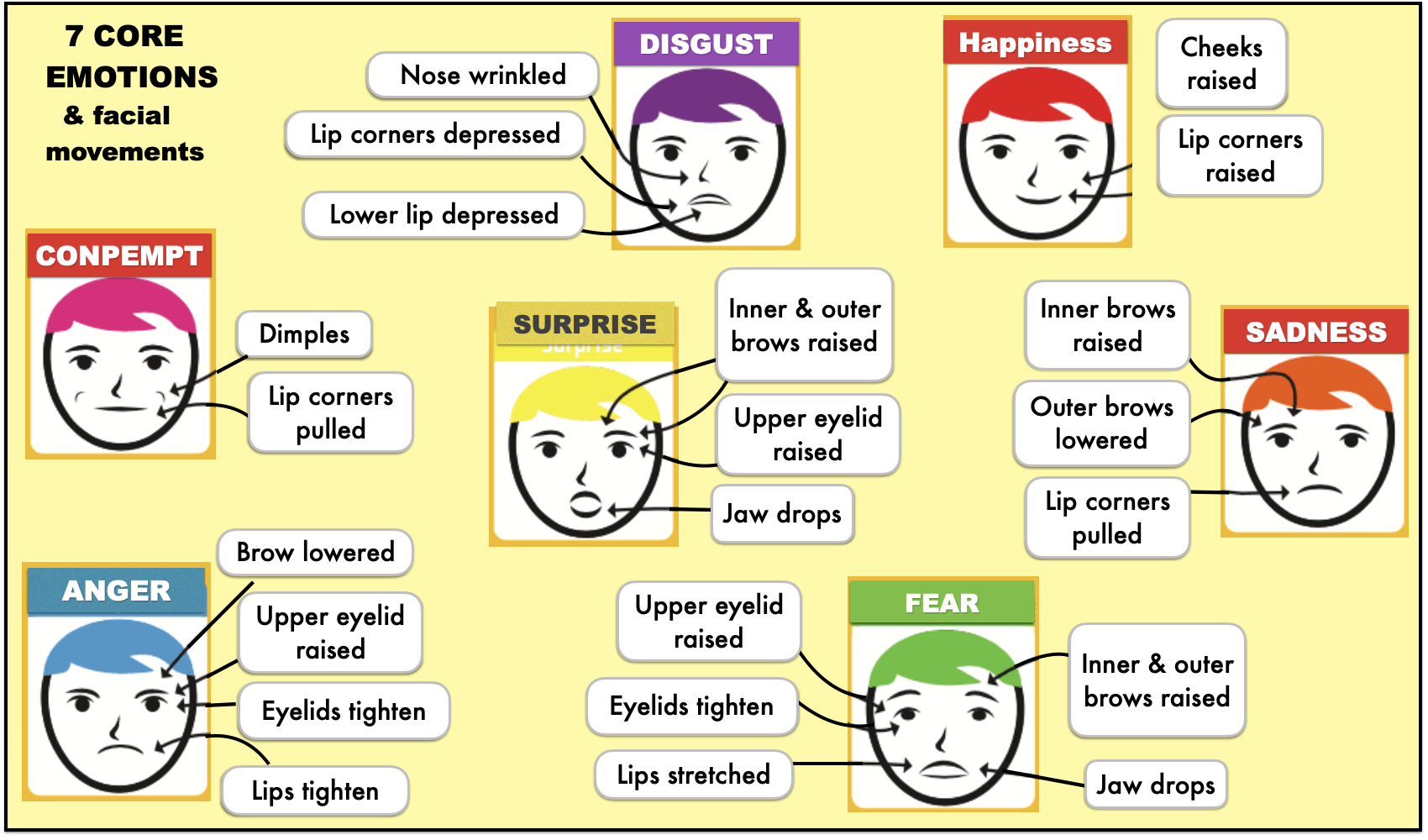
📌 Expression : facial & vocal output almost always accompanying an emotional state as a reaction to it, or indicate the intention of taking some action (unless using Botox! )
📌  Feelings : the person’s subjective experience of their emotional state, once it has occurred

BTW – Don‘t confuse feelings or emotions with:
obsessionCompulsions, which are actions we’re not in conscious control of – OR –
Obsessions (Os), which are over-focused, circular mental rumination, our hamster-in-the-wheel :
a. most Os are unconsciously —
— fueled by anxiety, trauma, S-H, FoA….
— supported by unhealthy thinking (CDs), wanting revenge, being one-up, proving oneself ….

b. less often (legitimate) Os may be:
POSITIVE uses • a way to rehearse phrases or counter-arguments from our Healthy Adult ego state
• ‘passions’, motivated by a deep need to connect with a H.P, to be of service to others or follow a creative goal.

BEST use • mentally reviewing a positive event recently experienced, to anchor it in memory. This is important for countering our “built-in-forgetter”, which automatically negates the good things in our life
Purpose : to solidify smarter ways of verbally responding, which can counter — ACoAs’ tendency to blank out when confronted or criticized (fear,) or — when told something outrageous, insensitive or mean (rage)

💎 Therefore, ‘obsessional repetition’ is a smart tool, creating new brain pathways, so the Frontal Lobes can stay ‘on line’ when we need them the most

NEXT: What about Es? (Part 2)