‘TRYING TO LEAVE YOU’ Stages (Part 3)

stay sadPREVIOUS: “Trying to leave you” (#2)


STYLES of  ‘Leaving’

1. ACoA AVOIDERS
(see Part 1)
COMMENTS
Re. ACoAs: It’s hard to make notes for each stage separately because we are so extreme – not going thru the steps at all, going thru them all in the first few weeks, or staying for years even when we know better….  We too experience endings (leaving or being left), but suffer more that people who are less wounded. So these are general observations of ACoA patterns

LEAVING:  Regardless of our style, personality type, previous experiences…. when we can’t bear it anymore – we leave, but rarely in a healthy way:
a. Even though weither ore know a friendship or relationship is dead & hopeless, we desperately try to hang on, begging, chasing, manipulating, threatening to kill ourselves….
OR
b. We cut someone off – cold turkey, without explanation – & refuse any opportunity for closure.  If the partner or friend is the Clinging type, they will be unprepared & dumbfounded.
We are angry or fed up. We don’t want to deal with their abandonment issues, their tantrums, their sulking & self hate. We don’t want to get sucked back in. Our boundaries are not strong enough & it’s just not healthy

c. One or both create such drama, fighting, emotional upheaval – that the only possible outcome is an explosion & then the big split.  We don’t want to feel our abandonment pain either – anger is a cheap, fast & sometimes cruel or physically dangerous way to get out

d. For some, no matter how bad the situation, there’s no leaving at all – only an ending when one partner dies
e. Some ACoAs are capable of more appropriate exits, but it’s rare

STYLES
1. ACoA AVOIDERS: Some ACoAs are so afraid of commitment, being trapped, being abused & then left, that they don’t have avoidersany love relationships, don’t make long-term connection, or only have short serial relationships, friends, jobs…

• If they try, they’ll go thru the 5 Stages very quickly – or stop at #2 – over & over,
♝ always finding fault with any hint of imperfection, OR
♝ always picking people & situations that reproduce the original abuse & abandonment, OR
♝ not giving healthy people a chance to develop connections that would be beneficial & uplifting

2. ACoA CLINGERS
a. Fantasy
• ACoAs often start relationships in a fantasy fog of symbiosis, all hopeful & excited. There may be very little thought, just a whirlwind of emotions (Es).
Or the thought is: ‘This time it will be different’

• Then the dis-illusionment. The other person says or does something so unacceptable – to us- that it breaks the trance of togetherness.  It may be :
✐ something TOO healthy (setting a boundary, not rescuing),disillusioned OR
✐ something truly hurtful / abusive / disappointing, OR
✐ it’s just that they triggered an old wound of ours.

• We may object, complain, attack…. but we stay rather than start over. We don’t investigate the actual source of our own reaction, & accept the unacceptable, spending all our effort covering up the problems. And then feel depressed.

b. Denial
• We convince ourselves the situation isn’t really that bad – that the mate / job / parent / sponsor / friend … has some ‘superior’ qualities we can’t live without. They may have, but it’s just crumbs, compared to the problems!

• Some of us even KNEW before we got married that this was not the right person – while walking down the aisle, but went thru with it anyway. (like Princess Diana….)

c. Shame (see posts) is caused by currently having any need some up that was regularly abused or neglected in childhood. Many ACoAs consider the Need for Love as a character defect. But needs never goe away. SO we keep picking people whose damage guarantees our continued abandonment!

c. Control
tug_of_war• We make a huge effort to change the other person so we don’t have to leave, instead of changing ourselves. We badger, cajole, lecture, push, punish, bribe, manipulate. We get back only more resistance – of course!
• We spend a lot time punishing the other person for not being who & what we want, instead of moving on or letting go of our demands & expectations of another.

NEXT: Part 4 (Clingers d. – j.)
‘TRYING TO LEAVE YOU’ Stages (Part 2)

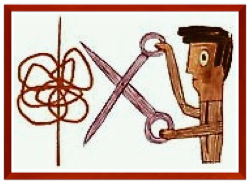
cutting strings

I GUESS THIS IS GOODBYE : (How could this happen to me!?)


PREVIOUS: Leaving
 (#1)

ACTS OF DISTANCING ▼  (cont)
5. DIFFERENTIATING
4. LIMITING

3. STAGNATING
Normal: They’re still together, but with a feeling of being stuck & not knowing how to make it better or how to get out. There’s not enough meaning or nourishment to keep it alive, but being in a long-term or committed relationship makes it harder to consider leaving.

They feel disconnected & depressed/ but stay together to avoid the pain of separation
Some form of talk is needed, but if either hints at starting an unpleasant conversation, they’ll find a way to prevent it so they don’t have to invest any feelings

stagnating• They have little to say to each other, are bored with the same old stories, don’t want any confrontation, & won’t talk about the relationship because it feels pointless

“Do you want to watch that program?” <> “No, but you go ahead” , “I don’t want to hear that again” <> “I know, you’re not interested in what I have to say!”

• One or both may be experiencing personal problems & possibly blame the other, rather than facing their own issues. But when people are no longer getting their needs met from their partner, they shut down the lines of communication & turn elsewhere

• People can start punishing each other for their own disappointment & loneliness: Well, she/he hasn’t helped me in a long time, so I’m not doing this for her/him”
– may be the kind of thinking behind further withdrawal.
💔

2.  AVOIDING

Normal: Now these 2 people who have been in a committed relationship, no longer see themselves in the dyad. They’ve withdrawn their emotions & are ‘spending‘ them elsewhere. Deep emotional distance is an indicator that the union is no longer salvageable. Each person knows in their mind  & heart they’ve detached, & need to protect themself

• They reorganize their lives to avoid being together & may even verbalize it: “I don’t want to talk to ____”.
It can also show up by sleeping in separate beds or rooms, & one or both looking for a new place to live

• People not living together will avoid calls, emails & texts.
“Leave me a message & I’ll get back to you” , “I’m really busy, so I’m sure you’ll understand if we don’t get together this week”

Usually there’s less fighting, but what’s left may be sniping, sarcasm, put-downs. Otherwise, communication is only about practical necessities, if at all
💔

1. TERMINATING (Final)
Normal: This stage can be done rather quickly or be dragged out for years.
• It’s the actual physical leaving of the relationship, with a little or a lot of psychological finality. If both parties can accept this, it makes it much easier to move on.

I can’t do this any more. This is the end for me.” <> “Yeah, sure, whatever separationyou say.”

• When one partner has come to their ending point, it’s important & respectful (be ‘clean‘) to actually tell the other person.  This is more likely with a longer-term connection.  Often with less developed ties, one person just stops taking calls, emails…..

• Verbal messages are used to prepare for the end by only using ‘I’ or ‘me’ statements, & meant to create finality & permanent distance “This relationship isn’t working for me anymore” , “Please don’t call me again” .

• It’s not uncommon for one or both people to have another relationship, job, even a new city… waiting in the wings, even if the new ‘love’ is temporary, to get them thru the transition.
✶ Leaving may actually be a benefit to both, even if it hurts. They may need the relationship to end so they can continue their career, their personal growth or to start a more suitable lifestyle.
♥               ♥                ♥

NEXT: “Trying to Leave you” (Part 2) – Clingers

‘TRYING TO LEAVE YOU’ Stages (Part 1)

 WE’RE NOT the SAME ANYMORE –
What’s happening to ‘us’?

PREVIOUS: “Getting to know you” (Part 5)

REVIEW: Relationship Continuum

BOOK :“Communication Patterns & Couple (Dis)satisfaction”.

Communication Indicators of DISSOLUTION
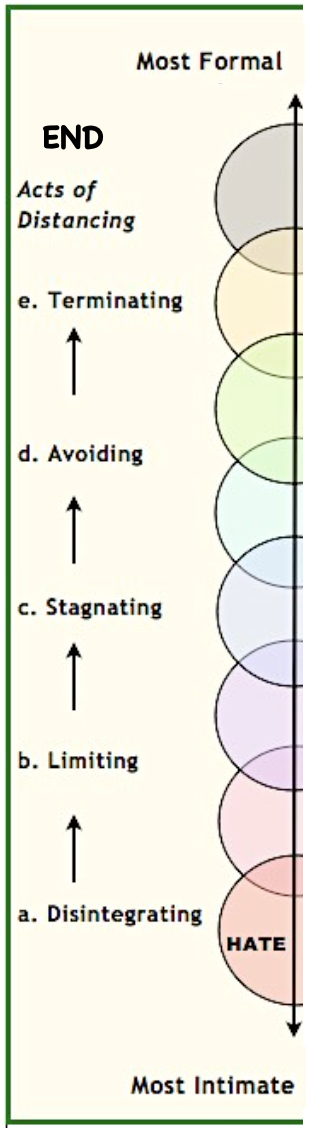
These 5 breaking-up stages are the ‘normal’ process of separating. The amount of time varies based on individual personalities, the length of the association & the type of relationship.
• The stages are listed ‘backwards’, from most intimate to most distant: #5 = Differentiation,  4 = Limiting,  3 = Stagnating, 2 = Avoiding, 1 = Terminating. The process applies to all types of relationships, not just romantic.

ENDINGS can be made by one or both parties:
When it’s mutual ….
a. …but not openly acknowledged:
both people become less & less interested & there’s a gradual fading of interactions.  There may be several attempt to -sort of- talk about it, & maybe one who is trying to fix it.
It can take a long time to actually end (this approach is more likely to be used by people with anxiety)

b. …and more direct: the couple is likely to have arguments or fights, each blaming the other, OR separation is negotiated & agreed on (less likely to try repairing)

When it’s one-sided ….
a. …if the end is in sight, & the ‘leaving’ person’s reaction is indirect – they’ll withdraw, avoid contact or get more annoying to be around, drop hints, try to be friends, manipulate
b. …if it’s more direct – the person will talk about what has gone wrong in the relationship, & is able to clearly say “It’s over”,  accepting reality

FOR ACoAs: Most of the time the ending of any relationship is painful & traumatic – from a job, an old friend, family member, sponsor, therapist… & even if it was with someone we met recently or with someone we barely like!

OVERALL COMMENTS will be in Part 3 & 4.

                              ▼   ACTS OF DISTANCING  
5. DIFFERENTIATING
Normal: Two people begin to notice a gap in their togetherness, less ‘we’, more ‘me’ statements. “Working together’ is gradually replaced by separate activities.

“I don’t see how you can like that group!”  <> “Well, I guess we’re not on the same page about that!” ,  “Why don’t we go dancing any more?” <> “You know I’m too busy”

Temporary separation is sometimes tried. The situation is uncomfortable & can lead to subtle disagreements or open fights, then more time apart….
This stage can occur when:annoying
• the relationship is still new-ish but the first idealized ‘bloom’ has worn off
• they’ve been together longer & one or both are disappointed in who the other turned out to be
OR
• something they first found macho, adorable, attractive… in the other person, now drives them crazy
• for longer-term couples, their personal interests may have caused them to grow apart
• with too much one-ness, togetherness – one person misses a sense of individuality, feels resentful, held down, maybe suffocated
💔

4. LIMITING (Circumscribing)
Normal: This stage has been called the ‘slow fade’, & is more likely to occurs in committed relationships, but not exclusively.
There’s a shift in the focus from each others’ differences to constricting & limiting communication, which decreases in amount & topics they talk about. It’s superficial, kept to ‘safe topics’ they know they can agree on, avoiding controversial subjects, iScreen Shot 2015-08-01 at 7.27.57 AMn order to prevent fights

This inevitably leads to less & less real sharing.
“Who was that on the phone?” , “What are we having for dinner?”  , “Do you like the food?” <> “It’s OK.”

• There’s a definite sense of not understanding each other any more, & their concern is with protecting themselves emotionally
• While still projecting a good public face as a couple, they’ve mostly stopped telling each other anything personal
 • Sexual intimacy disappears, & if there is fighting, it’s about not being heard.
💔

NEXT: Part 2: Terminating; ACoAs Leaving