S & I : Lack of Individuation (Part 1)

taken care of  

I WANT SOMEONE TO TAKE CARE OF ME – rather that “grow up”!

PREVIOUS: Separation – #2

HEALTHY – in future posts

DEF : Individuation “is the process of self realization, the discovery & experience of meaning & purpose in life. It’s the means by which one finds oneself & becomes who one really is.
It depends upon the interplay & synthesis of opposites e.g. conscious & unconscious, personal & collective, psyche & soma, divine & human, life & death.” (Carl Jung)

INCOMPLETE / DAMAGEDshut down Es
Damaging parents interfere with the Individuation process in many ways, including preventing us from having a wide range of emotions – such as when only one or two are acceptable (only happy, only scared, only angry…) OR when any expression of E. is ignored or punished.

A study from Belgium looked at the effect of parental dysfunction on their 20-Something adult-children, studying 2 extremes – unhealthy independence or dependence. Over all, psychologically controlling parents ignore their child’s needs using manipulative tactics (guilt, shaming, love withdrawal) to pressure the child into meeting the parents’ standards – causing anxiety, depression & perfectionism

Parents who use intrusive tactics scored high on:
dependency-oriented control (DPC) to keep children physically & emotionally close, not allowing them take independent actions.
They end up feeling threatened & anxious by being on their own
AND
achievement-oriented control (APC) to make children reach the parents’ goals of individual performance, where love and acceptance are based on meeting strict rules of achievement.
These children can become self-critical perfectionists, obsessed with showing off personal ability, while ignoring the need for closeness & at expense of satisfying relationships

RESULT : We had to shut down most Es – which would normally give us subtle but definite private information about what’s right or wrong for us. Being cut off from the cues Es would provide –
— we’re deprived of the ability to reflect on our internal process
— aren’t able to trust ourself, procrastinating & confused
— & decision-making becomes very difficult or distorted

a. One extreme is when a child is forced to experience a later stage of individuation – prematurely, out of order, like ACoAs who as kids had to be ‘little adults’: a parelittle adultnt’s confidant or rescuer, or someone’s object of sexual attention).
This can turns a child INTO:
i. an arrogant ACoA adult with an over-developed, inflated False Persona, preventing or severely slowing down self-examination & emotional growth

They can function quite well as long as they’re in familiar settings, but miss genuine spontaneity, the ability to let go of control, even to the point of being unnaturally rigid, lacking zest or authenticity

Others people can be taken in by their ‘so together’ exterior. But hidden under that surface there’s a lack of personal development – a very unhealthy WIC – which mainly shows up in private, as unavailable & harmful mates & parents
OR INTO:
ii. an isolated ACoA adult, going to work every day, maybe even being in the helping professions, such as nurse, social worker…. or trapped with an addict spouse, a severely disabled child…. to take care of. They continue playing out the Hero-rescuer role, but are plagued by constantly second-guessing themself & the accompanying anxiety

like father....b. At the other end of the spectrum are the children who were bullied, browbeaten & brainwashed into buying every aspect of their family & social culture – with no room to breathe. They conformed to the dysfunction from a combination of their natural personality (more compliant OR most like the parents), and from a deep terror of being punished for disagreeing

• They too grow up without knowing who they are as individuals apart from their training, so they’re out of touch with even their most basic tendencies, dreams, wishes. Many will continually react to everything & everyone like a child, emotionally & mentally, without realizing it

However, people in this category are more likely to seek out therapy & recovery, because they know they’re incomplete, feeling lost, stuck & unhappy. Unfortunately they blame themselves (S-H) rather than correctly identifying the source of their lack!

NEXT: S & I – Individuation #1
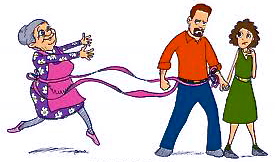
Separation & Individuation (Part 2)

TO BE MYSELF –
 I need to let go of them

PREVIOUS: S & I – Intro, Part 1

SITES: Lack of Object Constancy (causes Narcissism & other Personality Disorders)

Hole in my heart   re. BOOK about how Kathy Brous ” ….. accidentally regressed myself back to infancy and healed it all.” Includes interview with Goldie Hawn & Dr. Dan Siegel, about the brain & Attachment Disorder, from lack of Object Constancy in childhood.

S & I DILEMA – every child’s internal conflict between wanting to crawl around to explore their world, & needing to know they can always stay close to mom. This continues – as adults – wanting our needs to be met (by someone else) AND wanting to have personal freedom (autonomy). This dilemma is intensified for anyone deprived of original symbiotic safety.

If we only think in terms of either being dependent or being independent  – we put ourselves in a bind. It’s:
EITHER
• staying emotionally dependent, leading to the fear that if we speak up for ourselves or express our True Self we risk hurting the other person or making them mad – so, losing the connection with them (A.)
-OR-
• we the assumption that being independent means always being serious, being alone, not having fun, taking on responsibilities that we don’t feel ready for, being burdened or trapped …..

✶ However, genuine maturity (inter-dependence) includes a balance of these two needs. How much of each category will vary from person to person, & can vary from day-to-day!

🚴🏻‍♂️ SEPARATION – for ACoAs in the present: It’s about unhooking ourselves from the addictive symbiotic attachment to our dysfunctional family. This separation is not primarily physical, although sometimes that too is necessary, but rather needs to happen inside of us.

🚀 INDIVIDUATION
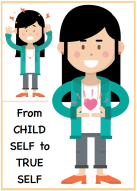
– the transition from our family’s ways of viewing the world & defining us as a person, to become fully ourselves – the True Self we were born as, but didn’t originally get to know or weren’t allowed to develop

S & I  – Growing up really means shifting away :
FROM– the FS which is controlled by our inner parental sub-self (Introject)
TO– our True Self. This gradually happens as the WIC realizes that it can rely on the ever-present Healthy Core which has actually gained a great deal of knowledge & wisdom over the years.

Our developing ‘UNIT’ (Healthy Adult & Loving Parent) is quite capable of being an effective internal leader & caretaker of the Child in a wide variety of situations, once we access all that accumulated experience.
Keep saying: “I know what I know”! Book-ending helps to make this shift.

DEVELOPMENTAL TASKS Theory (Robert Havighurst)
Development is continuous throughout a person’s entire life, in stages. Moving from one stage to the next comes by successfully solving a problem or accomplishing certain age-related tasks, common to the majority of people in a culture.

Tasks at each stage are influenced by
• biology (physical maturation, genetic makeup)
• psychology (personal values, goals)  • sociology (child’s specific culture) CHART

ORIGINS of S & I Theory describes how people develop an identity – pushed by biological urges & pulled by socio-cultural forces.
🚦🚥 Repeated disruptions in this all-important process usually results in great difficulty creating & maintaining a reliable sense of Self in adulthood.(Margaret Mahler (1897 – 1985)

The S & I  CYCLE – phases
Normal Autistic: (first month) Mahler eventually abandoning this phase, based on later infant research, leading her to believe it doesn’t actually exist – but is still included in many books
Normal Symbiotic : (0-5 mths) when the child is fused with the mother, & together they’re separate from the rest of the world. The infant is aware of its mother, but has no sense of individuality, with a barrier between the two of them & the rest of the world

S & I (6-24 mths), the infant begins to break out of the ‘autistic shell’ of self-absorption, into the world of human connections
Separation is the start of breaking the fusion with mother, developing limits, & the infant’s sense that there’s a difference between the mind of the mother & its own
Individuation is the development of the infant’s ego with a sense of identity & cognitive abilities (thinking), leading eventually to the formation of it’s own unique character – if allowed!

NEXT: S & I (#3)

ACoAs – ABANDONING OTHERS (Part 3a)


YOU’RE THE BEST!
Even if I have to make you up

PREVIOUS: ACoAs abandoning OTHERS (3b)


See ACRONYM page for abbrev.


6. IDEALIZING
DEF:
• Another dysfunctional way to cope with the painful fact that our parents were not safe (nurturing, emotionally honest, mentally clear…)
• A way to survive back then. Some part of our child-mind had to make them perfect, without flaws – to deny how angry & scared we were at them, & still are
• A form of splitting off the good parts of ourselves & the bad parts of them – an overt or covert toxic agreement in childhood, with the family, that we were the bad ones & they the good ones.

All small children idealize their parents, which helps them feel safe. If they grow up in a healthy family this safety allows them to cope with reality, gradually able see the adults more realistically, with both weakness & strengths.

But for us – from the very beginning our parents disappointed us when we most needed them to be our ‘gods’ so we’d feel protected. Not only did they not help us deal with the outside world, but were the ‘enemy within’.  (➡️ IMAGE from “See Mom for who she is, not who you want her to be

To compensate now, some ACoAs idealize others, even strangers, as a way to shut out the WIC’s earliest terror still lurking in the bushes of our unconscious, BY:
a. Putting anyone – who we feel is important – on a pedestal (parent, teacher, lover, friend, boss…), not able or willing to acknowledge their real personality, including human limitations & damage (character defects) – UNTIL that person does something that pushes a big button in us, & then we feel rage at them. The illusion we created is shattered & we can’t tolerate it. So we punish them &/or cut them off.

EXP: Carol started a new class & was immediately in awe of the professor.  She began staying after class, asking all sorts of questions, unconsciously flirting a little. The teacher became less & less responsive or available.  Carol kept trying to hold his attention, but finally felt the rejection, became very angry & stormed off, telling everyone else what a jerk he was.

b. VARIATION: Making a new lover the “Answer to all my prayers!” Screen Shot 2016-06-11 at 6.51.05 PMBelieving ‘This is the one!” OR immediately making a new friend into a BFF, without taking the time to find out :
• are they actually who they seem to be?
• who this person really is (character & type)

• how you’ll feel about them, in a year or less
• what personal problems they may have
• how their ‘issues’ are going to affect you
• how will your issues impact them?
• AND, if we’re fundamentally compatible!

➼ To know that, we need to have a clear sense of ourselves, good boundaries, reasonable self-esteem, not too much anxiety about abandonment, tolerate imperfections & have the ability to ‘go slow’. PHEUW!
BTW, we may find someone willing to play out the fantasy with us (some for a while, some much longer), because they too need to be symbiotic, feel needed, overly-important…anything to not focus on themselves & their issues. This does not diminish our responsibility for playing our emotional games.

CAUSE:
• This kind of ‘jumping into’… comes from an intense need of the WIC to symbiotically attach, to fill the emptiness left by inadequate mothering in early life.
The human person we now choose to idealize will:Screen Shot 2016-06-11 at 6.51.46 PM
— EITHER be someone who is similar in damage to our own family – the hope being that this time we can fix them & so get their love & approval, even if we can’t get it from our family.
We only end up (unconsciously) playing out our abandonment / victim role – since we can’t fix others or con them into loving us

— OR someone who is or seems to be completely the opposite of family – stable, competent, smart, nice….so we can finally be taken care of!  Even if they do, for a while, we pay too high a price – being controlled & staying immature.
But usually such people are too healthy to rescue us at all, so we get disappointed again, but not as much.

• Either way we’re trying to get from others today what we couldn’t get originally, but no one can’t make up for our losses! We need to heal from the inside.

NEXT: ACoAs abandoning others (3b)

Healthy HELPING (Part 1)

 I LIKE HELPING!
As long as I take care of myself in the process

PREVIOUS: Rescuing (#2)

REVIEW: Hero Family Role 


ACoAs:  Many of us were trained from birth to be helpers, regardless of our native personality style & interests. There’s an ironic saying in recovery circles: “ACOAs are born with an MSW (Masters in Social Work) and then get their Birth Certificate later”!

• This is most common with the child who has the Hero role, which is usually the first-born in a dysfunctional family.  They’re supposed to pick up the slack where the parents leave off – being the little adult to make the family look healthier than it really is, but at the expense of the child.

• This caretaker role becomes so deeply ingrained that it’s usually carried into all of our ADULT relationships.  It requires unceasing effort for the benefit of others, instead of caring fully for ourselves. (See ‘RESCUING – False Helping’).

✦ On the other hand, there are ACoAs who, by their very nature, are meant to be in the helping or service professions, like people born with strong Water & Air Sign influences in their astrological chart – such as Pisces, Cancer (the healers), Aquarius & Gemini (the teachers).

✦ For those of us so designed, the goal is to be of genuine help to others, as a way of expressing our Highest Self – without being motivated by the toxic patters of co-dependence, self-hate, boundary invasion, fear of abandonment & over-control.

GOAL of Heathy Helping (HH): Encourage someone to take care of themselves the best way they can, in their current circumstance
OPPOSITE of making / keeping someone dependent on you!

1. OVERVIEW  – before HELPING someone, ASK:
a. What do I know about the person I may help?
• are they responsible & self-caring?
• did they ask me directly & specifically, for something?
• will they be OK with me if I can’t do what they want?

b. What exactly do they want?
• can they truly do it for themselves?
• is the request ‘clean’ (emotionally & verbally honest)?
• how many parts to the request are there, actually?
• what are the consequences/ price TO ME?

c. Can I Comply?
• am I really able to do this? (it’s not beyond my ability, OR it’s not something impossible)
• do I WANT to do it?  If ‘Yes’ – what’s my motive?
• what does it require of me – specifically?
• will I be angry if I do it, or remorseful if I don’t?
• do I want anything in return? What are my expectations?

2. Prerequisites for H.H.
a. In ME – I need to:
• be able to keep the ‘focus on myself – not get enmeshed with the needs & emotions of others
• have basic self-esteem, a sense of identity that not dependent on others
relaxed• have developed real boundaries, not needing to be symbiotic
• know my individual human limitations, without judgment or self-hate
• not have to use people to feel good about myself
• KNOW what’s real in the recovery process, about:
— emotions: each person is responsible for their own, & they can learn how to managed them
— the growth process: it’s slow & has to be experienced personally
— what Mental Health is (from ACoA website)
— what can realistically be dealt with: what’s possible or not. ACoAs tend to get the Serenity Prayer backwards!

b. In THEM
✦ I can help – if they :
inner child• are actively doing self-care, & communicating with their Inner Child (taking personal responsibility)
• actually ask for the help they want or need
• are clear about what they need (direct & specific)
• apply to their lives what I give them & use it to grow
• IF they’re truly ‘dis-abled’ in some way (ADD, PTSD, depression, illness…)
➼ “Give a man a fish & you feed him for a day. Teach a man to fish & you feed him for a lifetime.” Chinese proverb

✦ I can help – as long as they DON’T :
• blame me for for that they can’t do, for things that don’t work, or for disappointing outcomes
• expect me to be perfect, know everything, take care of them
• need to suck me dry / cling, use me as a parent substitute
• try to copy my personality, instead of forming their own

NEXT: Healthy Helping, Part 2