
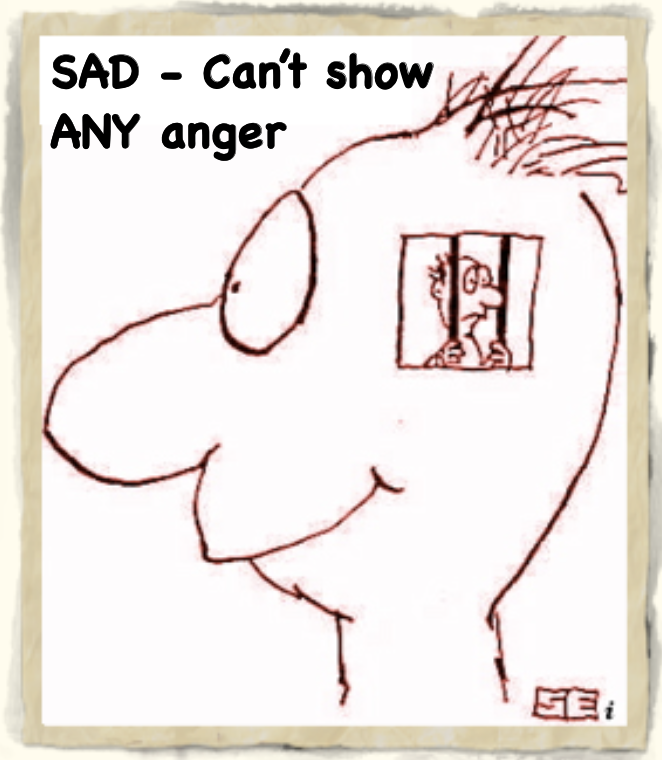
 I’M NOT ALLOWED TO BE ANGRY
– but you are (lucky you)!
PREVIOUS: Passive-Aggressive ACoAs (#1)
SITE: “When your Defenses lead you into trouble“
REMINDER: See ACRONYM page for abbrev.
REVIEW – (cont)
1.The GAME
2. WHO plays the game (Chart – slide #7)
a. P-As always look for & often find another person who is overtly angry / volatile* (V.) to play the game with – no fun being stuck with all that UN-expressed rage alone! (See: Inter-personal games, Eric Berne).
As adults, they desperately need to maintain their illusions of being perfect, in the faint hope of getting or keeping their parents’ approval, being taught that strong emotions are considered dirty, messy, dangerous – even murderous! Being P-A is another unsuccessful way of denying intense fear of abandonment
b. ✶ Volatiles need P-As (for their part, or the game wouldn’t work) :
• it gives them an excuse for letting out some of their rage ‘legitimately’
• it’s much safer than aiming the rage at the real target – their family
• the rage makes them feel powerful, to cover vulnerability & emptiness
• both Vs & P-As are addicted to finding someone they can act out their childhood ‘story’ with. Vs are used to being disappointed, too, & P-As do continually disappoint! It’s their trade-mark, & it can be used to identify them.
• sooner or later, usually later, it’s inevitable that Vs get angry, raging, even nasty at P-As – out of legitimate, intense, longstanding frustration at the P-As’ tactics! Of course: Vs have to stick around for this! They’re part of the game.
DIRTY POOL – P-As unconsciously, sometimes knowingly, will find & use ‘available’ Volatiles as their own personal pressure valve – as if getting the V. to explode with rage would relieve their own pent-up hostility. When Vs get angry, P-As get very self-righteous. They feel victimized & cry: “I haven’t DONE anything! Why are you attacking me?
SO THEY CAN
• Accuse Vs of being controlling, even though they set the V. up TO:
— take care of them emotionally & practically
— vent their anger/rage for them
— make all the decisions in the relationship!
— use the V a substitute for the original harmful parent
• Make Vs the crazy or bad one (instead of themself), of being abusive & unfair, of reacting to ‘nothing’. That way the Vs can be ‘the monster’ for pouring out that vile stuff (anger) which P-As are terrified in themself.
They can continue to feel superior & ‘clean’, keeping their ‘good-child’ status. After all, P-As can point to being easy-going, never raising their voice or letting out that ‘nasty‘ anger – right?
 ➼ BUT that is exactly the point – they don’t DO many things that are their responsibility. P-As make other people responsible for decisions they should be making themself, (even if they like the ones being made for them). They neglect to ‘show up’, hold up their end, be an equal partner or peer – ie. an adult. P-As stubbornly – yes angrily – demand to be rescued, never not expressing their needs / wants.
• THEN, if /when something goes wrong – when they don’t like the choices the V. made for them, or are disappointed with the outcome – they can blame the other person & continue to play the victim.
• AND P-As can say to the other person: “YOU’RE so controlling!” (& unspoken: “I hate you”). Wow! How dishonest.
✶ BUT if the V. stops playing the game, the P-A may finally tip their hand – if only briefly – showing the true rage behind their mask
EXP: Mark (P-A) & Sandy (V.) meet at a classical concert & become art-loving, theater-going friends. Mark regularly says self-deprecating things that are clever & funny, & Sandy obliges by laughing.
After a few months Sandy becomes increasingly uncomfortable with her complicity in  Mark’s self-hate. The next time he makes a crack about himself – she doesn’t laugh & is quiet. He gets annoyed & indirectly insults her for not responding ‘correctly’.
Later he buys her a B/day gift which deeply offends her artistic & Christian values – an ugly-made goddess statue – knowing her religious background! She can’t imagine his intention – but is outraged. She instantly blows up at him & gives the gift back. Naturally he’s shocked & insulted. After all – it was well-meaning. Instead he mails her a self-righteous note, asking “Is that any way for a Christian to act?”. End of friendship! Sandy feels ashamed for blowing up but also relieved to get away.
NEXT: Passive-Aggressive ACoAs, (Part 3)


 HEAL & GROW for ACoAs