
 I HATE HAVING TO
wait for results!
PREVIOUS:
Dis-comfort & Comfort #2b
<—- CHART
SITEs: How to Practice Being Comfortable in Uncomfortable Situations
— 3 Rules for uncomfortable conversations (excellent)
QUOTE: “Growth & comfort do not exist” ˜Ginny Rometty, CEO of IBM (Article)
1. Negative Comfort ➖➕
2. Negative Dis-comfort ➖➖
3. POSITIVE DIS-COMFORT ➕➖
Trying out new healthy thinking & actions make us feel anywhere from uncomfortable to highly anxious. It means disobeying each toxic rule, going against our training, dropping off of the family mobile, & bottom line : forcing the brain to find new pathways of functioning.
Too much prolonged stress causes physical ailments & psychological paralysis. That’s why we need to go slowly. Work on whatever issues you can tackle at the moment – ones that are the least scary. As you grow you’ll gain the emotional strength & mental clarity to tackle deeper one – like really ‘getting’ how much damage you have – without S-H or overwhelm, letting go of unsafe family, friends. jobs, locations……
For ACoAs, Growth means leaving behind our unhappy childhood to take our rightful place in the world – living in our True Self.
This is very uncomfortable because our family discouraged & punish any effort to exert ourselves – for ourself. And since personal growth is a slow process. we often live in uncertainty & confusion – between what we’ve always thought & felt, & what we aspire to become. In-between states are always uncomfortable & sometimes scary, but as we keep going we do see positive changes that encourage us. “Easy does it, but do it” (MORE...)
PROCESS (See post)
☛ Get started. This is often our biggest difficulty – putting things off that we actually want to do! as well as those we dread or find too tedious to bear, for all the reasons listed in previous posts (procrastination). What’s ironic & sad (for ourself) is that most of the time when we finally take the action it’s not such a big deal, doesn’t take as long as we thought, & we usually like the result – or at least are relieved. (see posts re. Action)
☛ Don’t Quit. Some of us are over-responsible, over-doers…. & others of us just obsess about doing, but rarely pull the trigger. Then there are the in-betweeners – those of us who start things but never seem to get around to continuing (keep going to the gym, stick to a food regimen, attend meetings….) or finishing projects. (See posts “Manipulating – 2b & 2c”). The WIC & the PP get in the way of going for the gold, so we let ourselves get distracted.
The 3 As are useful here:
1. Become Aware of what’s really stopping you from pursuing a positive goal. It will always be something from our earliest training & experiences.
2. Be in Acceptance – allow yourself any emotions the awareness brings up. Don’t try to fix or change deep-seated patterns by brute force (control, S-H, “forcing solutions“). Continue using all the tools of Recovery programs & remember that re-forming your brain takes time & persistence.
3. Take Actions. Give yourself credit for the actions you are already taking. Don’t fret about what you can’t DO yet. If you’re confused about what to do, make a list of the things you used to be interested in &/or still are. Look up what’s available in classes, groups… that can get you started. Some (useful) action is better than none.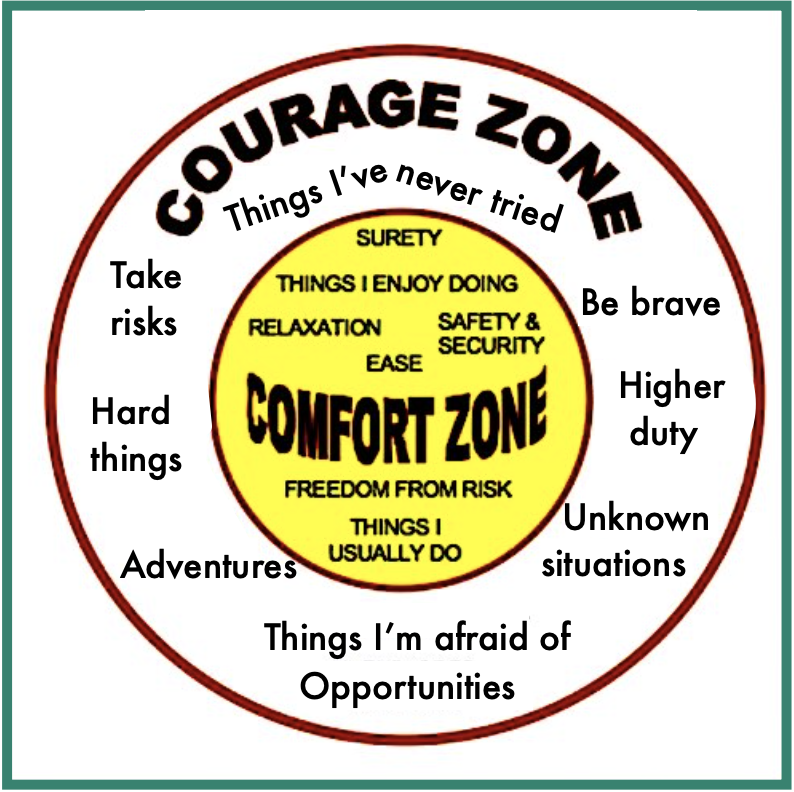
If you’re stuck for ideas, talk it over with safe people who know you & can give you suggestion.
Then follow thru. You don’t have to know what the end goal is & you don’t have to like the choice you’ve made – it’s won’t be a life changing mistake – only more info about who you are.
There’s no doubt that all forms of growth (personal, professional…) take courage – which means taking actions in the face of our fear. Courage is not needed if we’re not afraid, but we can’t wait until we’re not afraid to try new things. (⬅️ CHART)
NEXT: Dis-comfort & Comfort #3b

 HEAL & GROW for ACoAs