ATTACHMENT & FOOD : Reasons (#2b)

PREVIOUS : Attachment & Food #1

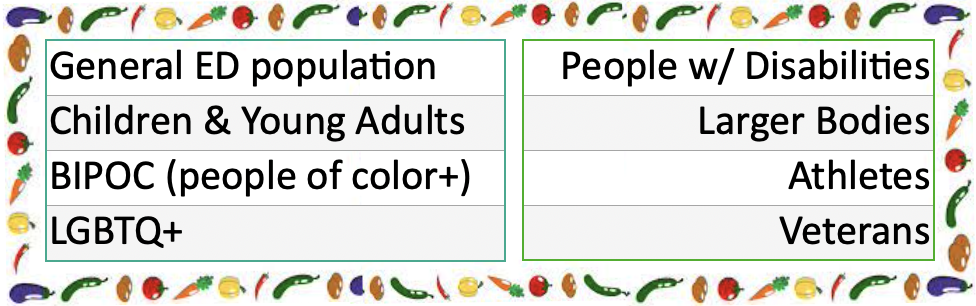
SITE: Prevalence of Eating Disorders in Adults, Co-morbidity with Other Mental Disorders (2001-2004 USA)

PERSONALITY & Eating Disorders (ED)
Character is defined as the sum of personality traits acquired through experience, including novelty seeking, harm avoidance, reward dependence, total persistence, & self-directedness.
Scientists have found distinct personality traits in people with eating disorders & that they’re relatively specific to each disorder.

Some studies associated aspects of these traits with alterations in serotonin & dopamine signaling. There is also evidence that maladaptive personality traits of borderline, histrionic & schizotypal disorders precede the development of EDs.

The two strongest risk factors for ED are Neuroticism & Perfectionism (anorexia), based on the “Big Five”- Neuroticism, Extraversion, Openness (to experience), Agreeableness, & Conscientiousness. EXPs for some ED categories :
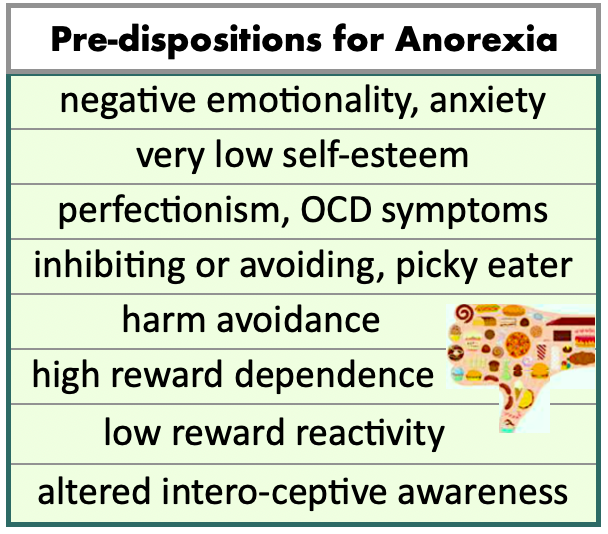
✒︎ sufferers score high on harm avoidance, impulsivity, obsessive-compulsiveness, reward dependence & sensation seeking
✒︎ combined with low self-direction, assertiveness, & cooperativeness.

✑ People with high scores for novelty-seeking were more likely to overeat or binge-eat, while
✑ a low value for novelty-seeking was linked with anorexia
Low scores for persistence were associated with patients dropping out of cognitive behavior therapy CBT) inpatient treatment for ED, and
bulimic patients, with high self-directedness scores, showed a rapid & sustained response to CBT.

Personality type also matters for outcomes. Using the Big Five model, Fairburn et.al. showed that improvement is more likely when personality features are addressed along with ED symptoms. EXP :
♚ under-controlled / impulsive, & avoidant/ insecure (attachment) patients have a poorer prognosis, than
♚ high-functioning ED patients, who fare better than average. (MORE…)

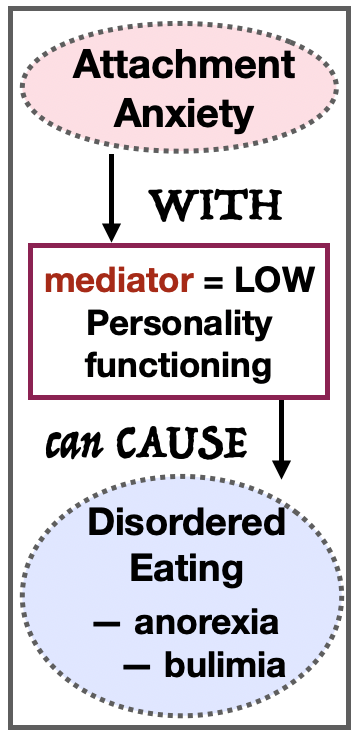
A review of 70 studies about ED  identified 3 personality facets – Trust, Anxiety, Depression – that share the most variance (highly similar scores) with general psycho-pathology. ED symptoms are a result of combining :
♚ low🔻levels of personality functioning, with
♚ high🔺levels of insecure attachment (= 77% of the total study).

UNHEAlTHY Personality ADULTS

«
ADULTS
Until recently eating disorders were considered only an adolescent problem. Now there’s growing evidence that adults also suffer from untreated EDs, which threaten their health & well-being, because of:
✒︎ eating habits that result in the condition going undiagnosed & untreated
✒︎ being diagnosed as teens, & continue into adulthood
✒︎ being triggered by inter-personal or environmental stresses / trauma (divorce, death, choking incident, fat-shaming)
✒︎ peri-menopause hormonal shifts triggering an ED in some women. Social-media pressure to look younger/ thinner can be another factor.

EXP : Research noted that roughly 9.2% US adults with ED meet the criteria for ARFID  (Avoidant/Restrictive Food Intake Disorder).  It can affect them by limiting professional advancement, if they don’t attend company outings or entertain clients. Personally, they may find social & romantic events curtailed by a fear of being judged for their limited portions.
Recovery centers for adults focus on understanding & correcting the three subtypes : Sensory sensitivities, Fear of aversive consequences & Lack of interest.

Exercise Addiction
While not technically an EDs, compulsive exercise is commonly associated with them (anorexia & bulimia), harming a person’s physical & mental health. Especially when combined with disordered eating behaviors, excessive exercise can cause problems with the heart, bone density, bone & tendon injuries….
«

«
This behavior can interfere with a person’s social life, & career. Addicts will exercise in inappropriate situations & at inappropriate times, in bad weather, make it a requirement for “permission” to eat, & compulsively resume after an injury or illness before full recovery…..
(More  …. )   ♥︎ Even if an eating disorder isn’t apparent, exercise addiction does require physical & emotional treatment.

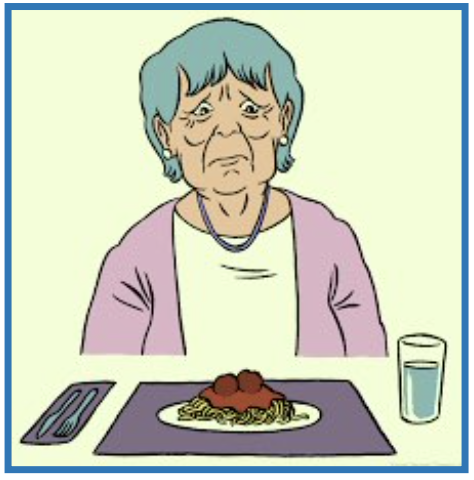
SENIORS  : If an older adult is suffering from an ED, it’s likely they’ve been plagued with the problem for decades. And sadly, since it’s gone on for so long, they’ve gotten used to the symptoms — the actions, thoughts, & feelings are simply a part of life. So, as things get worse, it’s less likely they’ll ask for help in their ‘golden’ years.

Because doctors & society still focus on treatment for adolescents & young adults, seniors are marginalized. And many signs are mistaken for other illnesses, or as a common part of aging.
Family members might also assume that malnutrition, diarrhea, vomiting, hair loss, reactions to prescription meds…. are a natural progression of aging, when these could very well be direct effects of a serious health disorder. (“Elder Eating Disorders)

NEXT : Attachment & FOOD (#3)

ATTACHMENT & FOOD : Reasons (#2a)

PREVIOUS : Food (#1)

SITE : access FREE
amazing worksheets in “Transforming the Living Legacy of Trauma

RESOURCE : HELP LINE  – National Eating Disorders Association

BOOK : “Attachment, Relationships & Food – From Cradle to Kitchen

Personal FACTORS
Some influences that contribute to a person’s food choices include individual characteristics such as = attitudes, beliefs & knowledge about food, ethnicity, taste preference & special diet requirements.
In the US – the order of importance has been reported as : taste, cost, nutrition, convenience & weight concerns.
In contrast, information compiled from 15 European member states listed theirs as : quality/freshness = 74%, price = 43%, taste = 38%, ‘trying to eat healthy’= 32% and ‘what my family wants to eat’= 29%.

Other determinants :
Biological = health status, hunger level, appetite, taste buds
Economic = availability, cost, personal income
Physical =  access, education, cooking skills, time
Psychological = guilt / shame, moods, stress
Social = culture, family, peers & meal patterns. (More…. expanded)

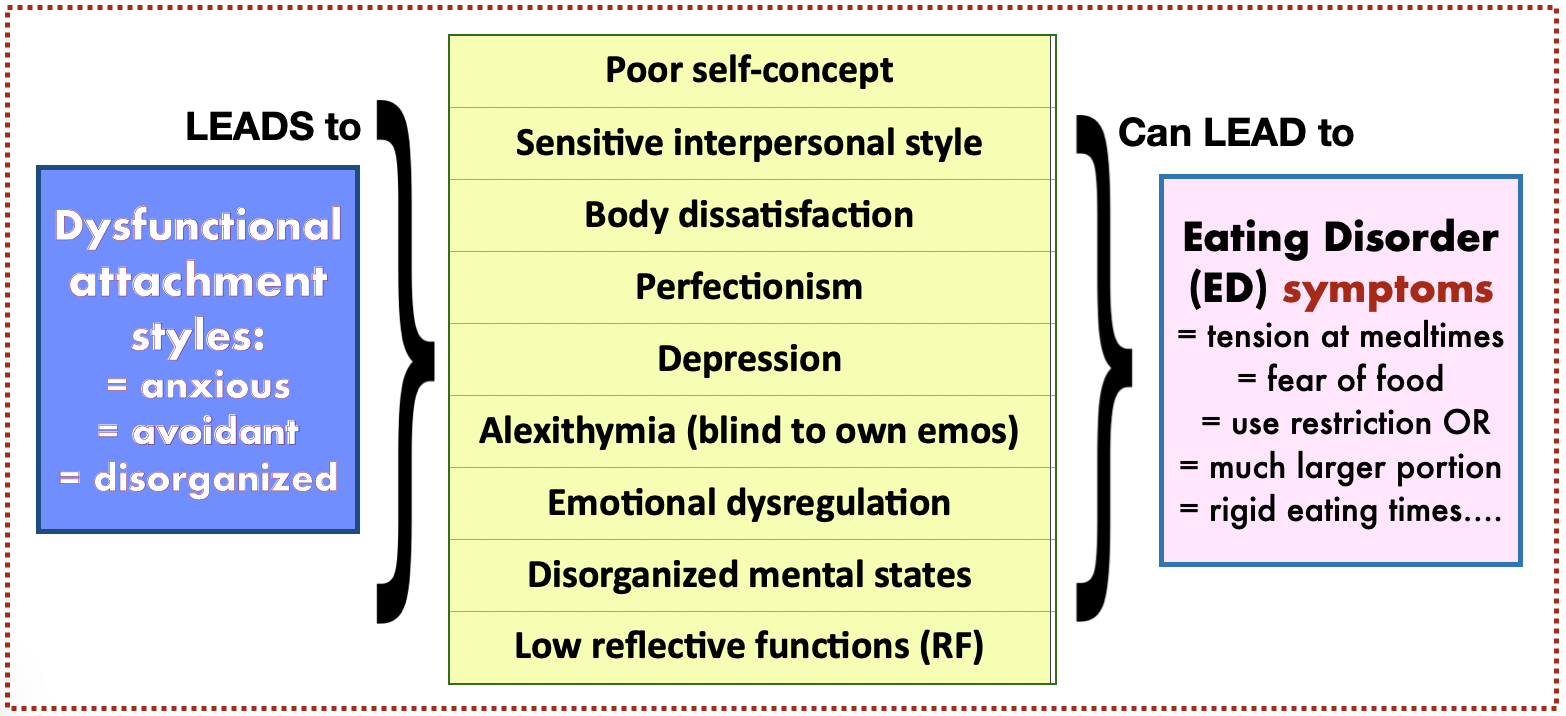
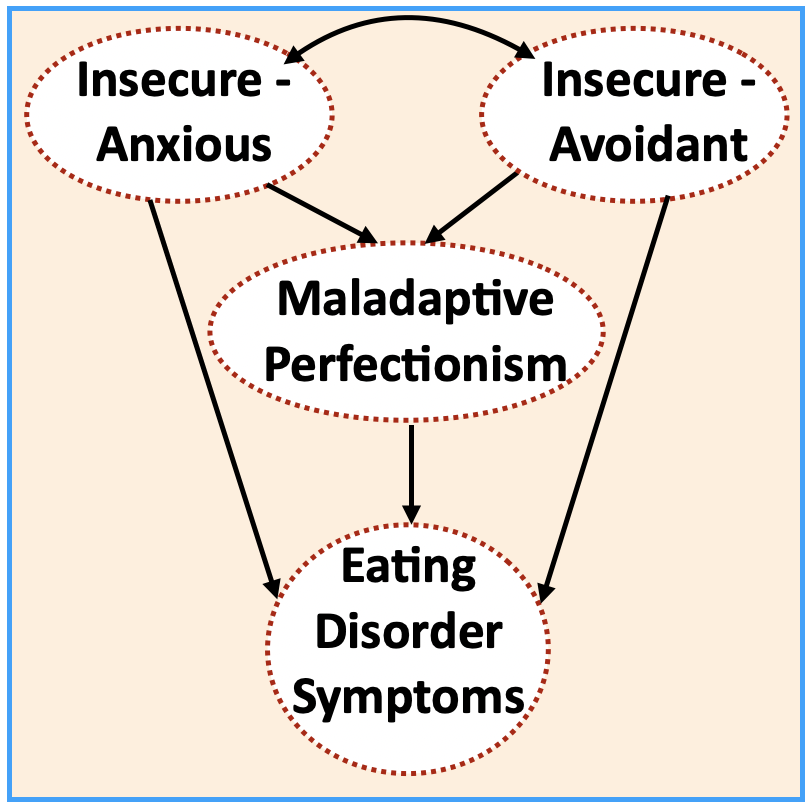
PSYCHOLOGICAL Reasons INSECURE Attachers DEVELOP an ED
😱 Emotional dysregulation
Insecures tend to have a hard time regulating (coping with) painful emotions.
Strongly Avoidant people suppress or deny feelings, while very Anxious are ‘high strung’, with hyper-intense emotions (not the the same as being a “Sensitive”).

Insecurely attached people may try to lessen their inner turmoil by activities like dieting to get the “perfect” body, binge eating to improve their mood, or purging to avoid gaining weight. These are forms of escapism, but of course – it doesn’t work. The vicious cycle gets re-activated every time Insecures face any kind of upset. (“Window of tolerance” scroll down)

Without Recovery, they naturally use unhealthy strategies that try to sidestep those feelings – instead of learning how to manage anxiety & anger safely & maturely.

😇 Perfectionism
In general, Insecure attachers are prone to perfectionism (especially Anorectics), in the form of self-criticism, based on believing the toxic family rules they grew up with. They hope to be accepted & approved of by family, mates & friends, if only they could reach their “perfect” image.

Some Insecures will develop an ideal aesthetic standard, such as unrealistic thinness or perfect musculature. So an unhealthy eating pattern may let them feel like they’re doing something to ‘fix’ physical flaws.
A 2023 study examining the connection between attachment to parents & friends and adolescents with ED, showed that trouble with trust, communication & alienation correlated with their body dissatisfaction.

NOTE: Adaptive perfectionism includes high but achievable standards for oneself, a preference for organization & order, a feeling of satisfaction & effectiveness when tasks are completed.
Maladaptive perfectionism involves unrealistically high standards with critical self-evaluation (debilitating self-doubt about actions, intense obsession over mistakes, & feeling like a failure due to them (More….)

🥸 Inaccurate self-beliefs
Related to self-criticism, Insecures come to false conclusions about themself because of how poorly their needs were met in childhood, such as thinking they’re “worthless, less-than, unlovable” . One symptom is obsessively comparing themselves to others they see as “better.”
Not getting the right kind of parental mirroring as kids, they’re not able to
see their body and Self accurately. Always coming up short, the negative comparisons keep eroding their self-image, which can encourage & promote disordered eating, in the delusion they’ll feel better about themself.

😎 Lack of Mindfulness
Generally, people with Insecure attachment styles are less awake in the present moment, not aware of what they’re thinking & feeling. In terms of T.E.A., they tend to worry (E), obsess (T) & over-focus on a distracting activity such as tv & social media. (A). There are also pockets of dissociation in one or more areas of their life, numb to their needs & self-care.

Most defense mechanisms take the person out of the present – they’re either in the past (ïf only”) or in the future (:what if”). Not paying attention to ‘where they are’ throughout the day can strongly affect some peoples’ ability to recognize physical hunger or fullness, or accept their weight & body shape – especially relevant in bulimia & binge eating.

The connection between lack of mindfulness, dysfunctional attachment, & eating disorders can be expressed in several ways : via trans-generational transmissions, between intra- & inter-personal experiences, in the mediation of personality traits, the link between maintaining-mechanisms and risk factors such as mood disorders, between EDs & dysfunctional family traits (active parental addictions, discouraging autonomy, enmeshment, overprotection, rigidity, triangulation, suppression of conflicts ….)
«

«
NEXT : Food -#3

ATTACHMENT & FOOD : Symptoms (#1)

PREVIOUS : Attachment & Siblings

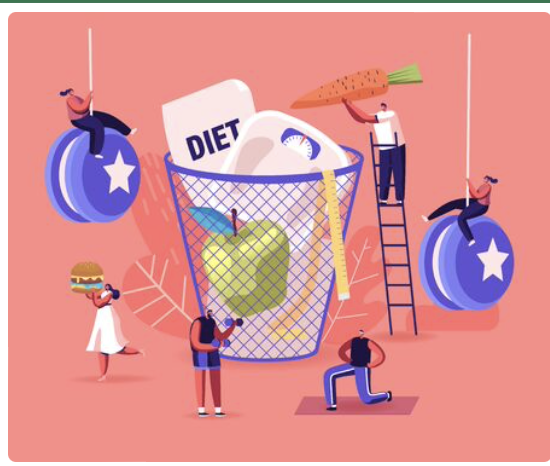
SITEs : ▫️ “How diet culture can lead to eating disorders”


🍔 🍟  🥤🍏  🥦 🥑
Attachment theory is expressed as an emotion regulation theory, & more than 80% of all adult ED patients studied have an Insecure attachment.

The attachment style we develop is crucial to whether or not we’re able to successfully deal with developmental stages. They include adjusting to physical changes during adolescence, forming a strong sense of an independent identity, & setting life goals. Basically, our attachment style is a way to buffer against actual & potential psychological anxiety or harm.

Some people are born with a predisposition to focus on food for pleasure & comfort, not just for survival. (Others have a stronger pull toward sports, or chemicals, or sex, or performing….as primary).
If a food-person also has any one of the Insecure attachment  styles – they can be at risk for an eating disorder, or it’s precursor – unhealthy  eating patterns with signs of a disorder that’s “waiting in the wings”. Signs can be : chronic restricted or compulsive eating, a heightened focus on appearance, worry about being overweight & being dissatisfied with body shape.

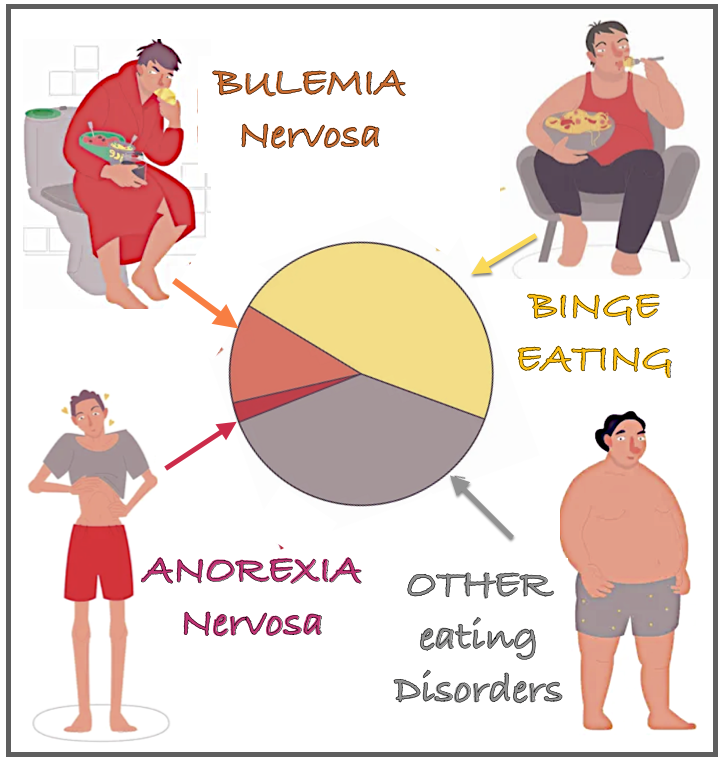
3 MAIN TYPES
♨︎ Anorexia nervosa –
trying to control weight by under-eating &/or over-exercising. 
♨︎ Bulimia –
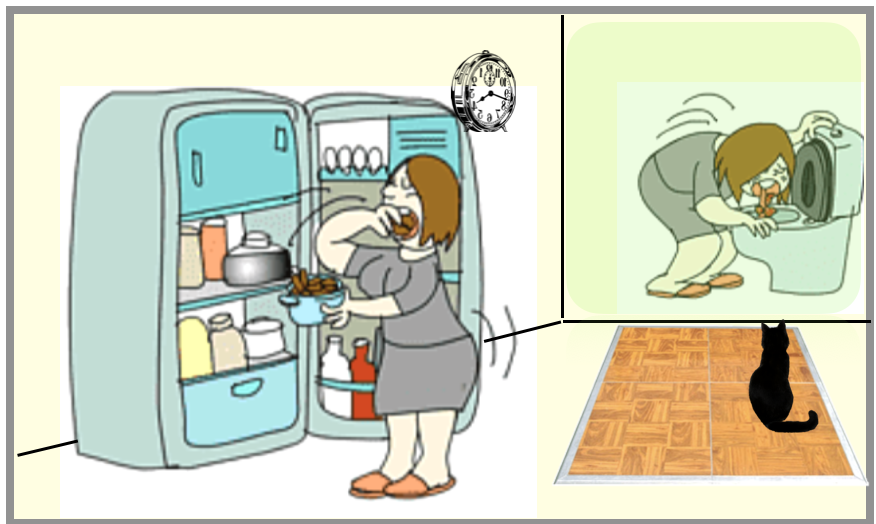
loss of control over how much food is consumed, then purged to avoid putting on weight
♨︎ Binging –
eating vast amounts of food until uncomfortably full. (List of signs for each type)

Eating disorders (ED) are not a lifestyle choice, rather an outward expressions of deep psychological & emotional distress, ‘encouraged’ by Insecure attachment styles. They are serious illnesses marked by an unhealthy relationship to food, used to manage negative feelings. They’re emotionally painful, obsessive & isolating, mentally distorting what the person sees when looking in the mirror. (More in posts : Attachment & Eating 1 & 2)

Evidence from meta-analysis research supports a strong link between insecure attachment styles & eating disorders, for the majority of adolescents & adults who were canvassed.
EXP 1 : One study of “food issues” showed that all the women involved were Anxiously attached, who identified having unhealed trauma or loss, especially with their mother.

It’s been established that the Anxious mother neglects her child’s emotional needs because she is too preoccupied with her own, & in a role-reversal she expects & demands that the child provide hers instead.
Because food is intimately connected with nurturing, the child’s response to emotional (& often physical) abuse & neglect can include how it reacts to eating — either over-focused on food as a symbol of longing for mom or rejecting it as a way to express anger at her.

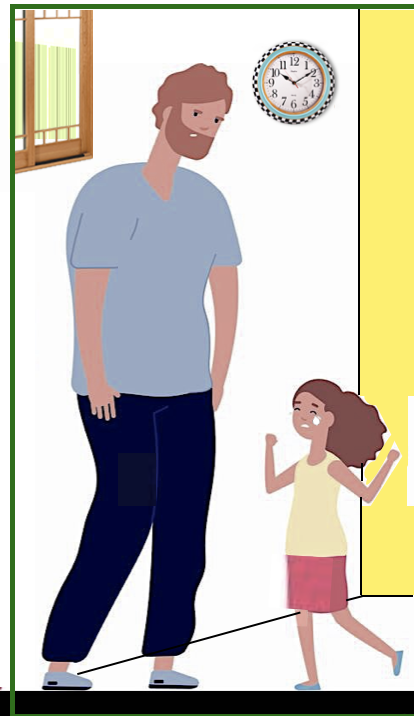
EXP 2 : The quality of a father’s bond & his emotional availability is also hugely important to a developing child.  Infants have the same connection-seeking behavior toward dad (arms outstretched) as they do with mom. Babies also react strongly to a father’s ‘still’ face. Over time, his repeated unresponsiveness takes a toll on their emotional development – affecting the child’s sense of safety. 

S0 – the fathers’ Avoidant style becomes another risk factor. Studies that have examined his role – found that an insecure bond with the father / father figure can predispose a child to developing an eating disorder.
In particular, the father being inattentive, detached &/or controlling – especially at meal times – can leave the child with anxiety about eating, using ‘food restraint’, & self-hate about body shape & appearance.

So understanding what underpins eating disorders (ED) must include either or both parents’ unresolved issues, not just those of the suffering teen.

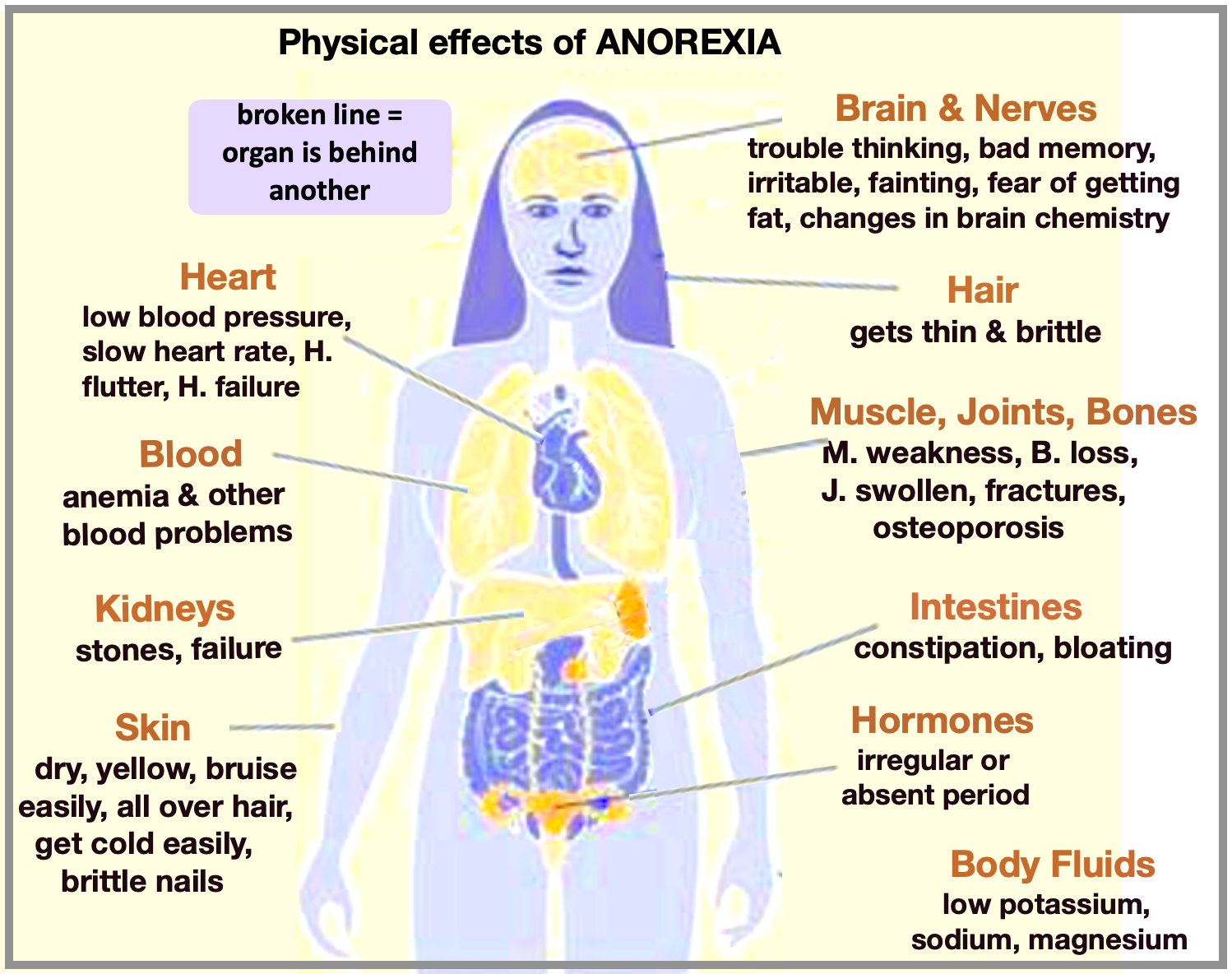
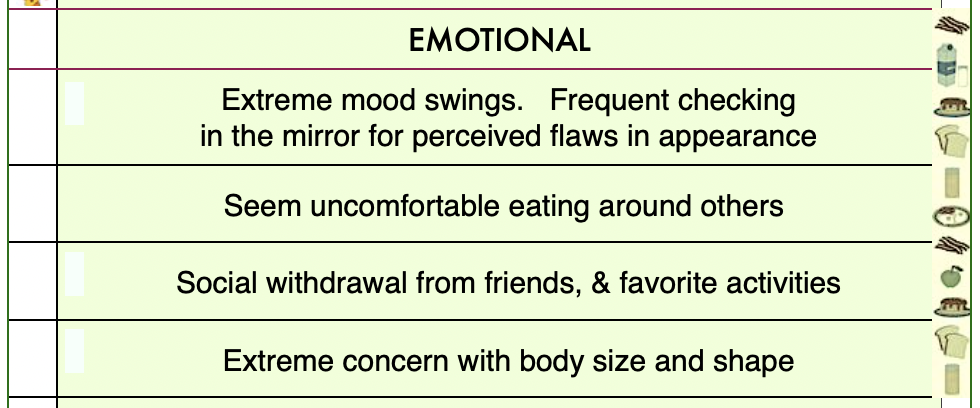
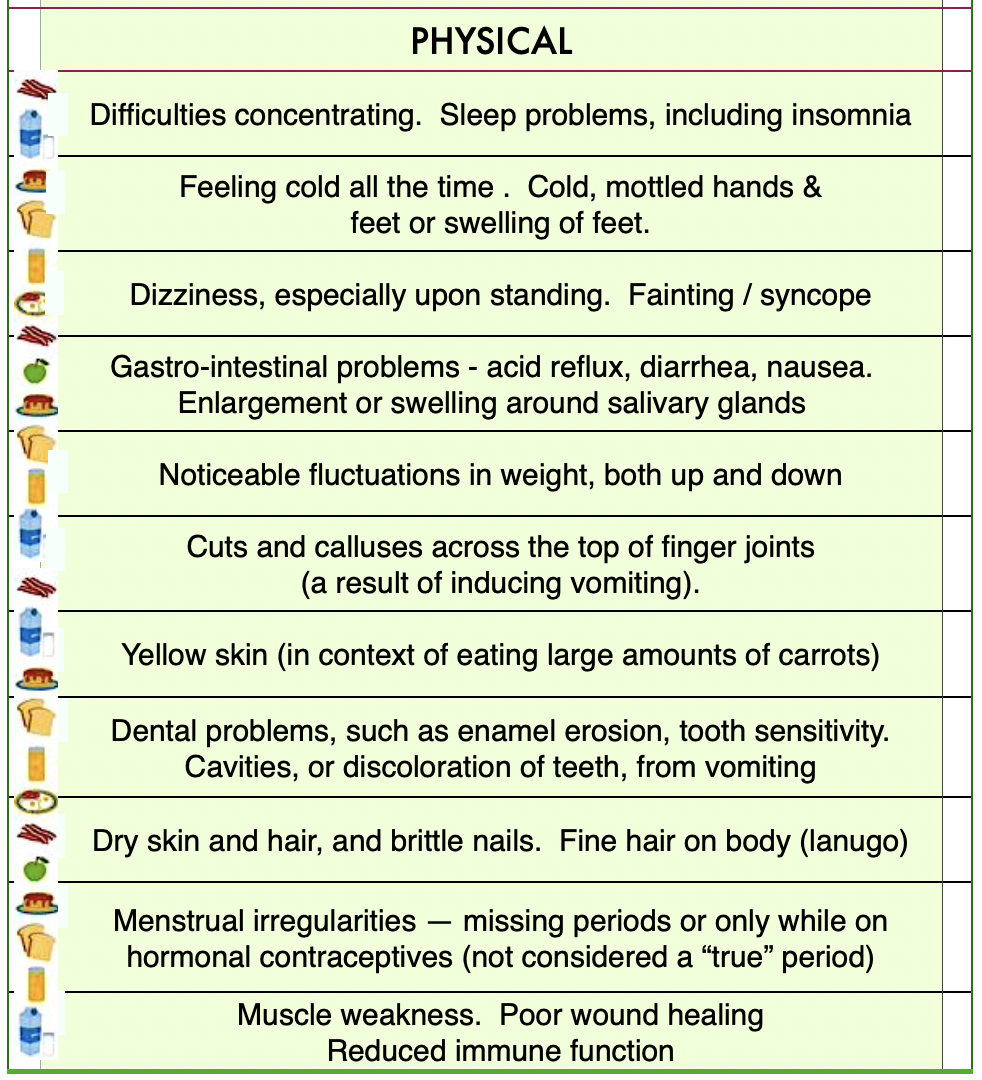
Eating Disorder (ED) SYMPTOMS  = The highest incidence of ED occurs between ages 10 & 19, but diagnosing correctly is challenging because symptoms of the various kinds & their behaviors overlap. Fortunately, most harmful complications are reversible with improved nutrition, & by stopping abnormal eating & purging.
Prognosis :
☀︎ Recovery from anorexia nervosa becomes much less likely the longer the illness persists (mortality rate increases).
This finding contrasts with that of bulimia nervosa – the chance of recovery becomes higher the longer the illness’s duration.

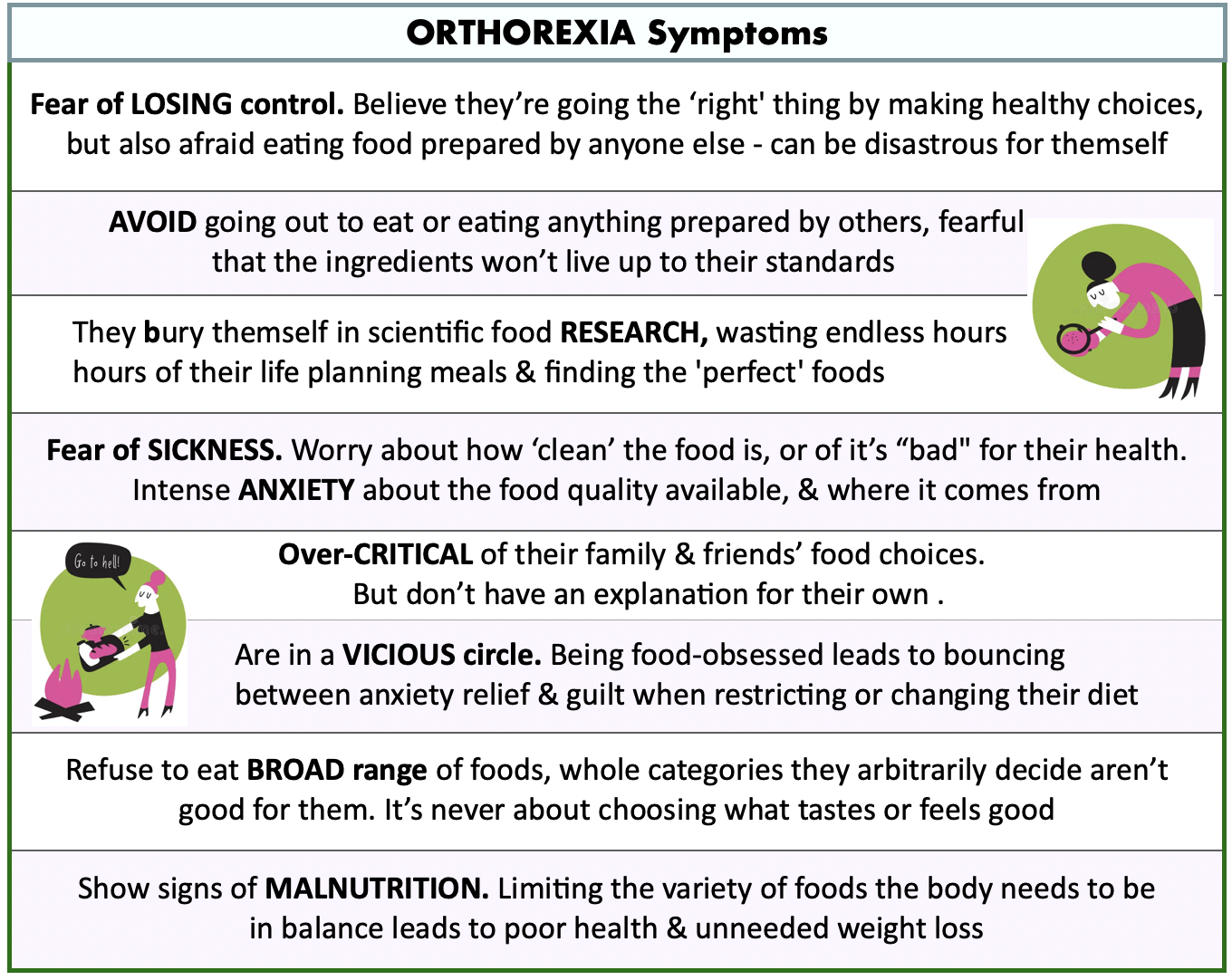
🔽 LIST combines characteristics of several styles. Symptoms vary across types, so someone struggling with an ED won’t have all of these, or not all at once.
«

«
NEXT : FOOD – #2
Attachment & SIBLINGS

PREVIOUS : Attachment –  FRIENDS

BOOK : “Bridging Bonds: Strengthening Sibling Relationships


⭐️ primary caregiver usually = the mother

1. GENERAL

Attachment is not just a ‘good relationship’, but is a much deeper bond based on how well another (trustworthy) person serves as a continued source of emotional security. This also applies to Siblings.

💌 A Secure connection with mother makes it more likely that our sibling connections are also Secure.
BUT – if Insecurely attached early on, there’s a 75% likelihood of developing Insecure connections with most others, & be 6x more likely to have insecure adult intimate mating.
«

«
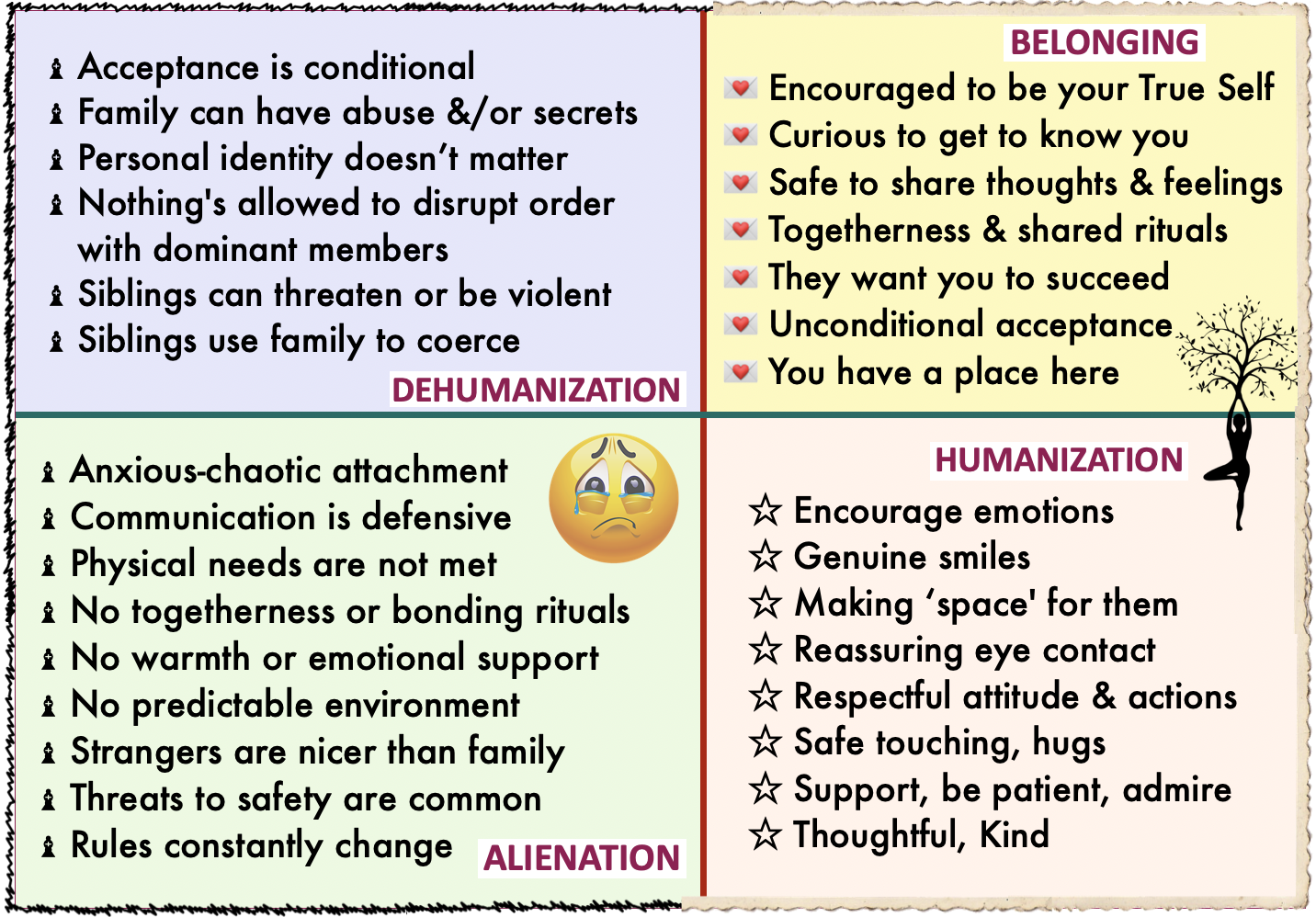
ROLES : In unhealthy families, often when there are only 2 kids, one may be more accommodating, sensitive & helpful, while the other may be loud, aggressive & controlling. With several children, one may be chosen by a parent to be the scapegoat, & perhaps one designated as the golden child, while the others will be invisible or escape as soon as they can. These differences can lead to broken trust  & alienation.

Later on – Insecurely attached adults who’ve experienced childhood mistreatment will be distrustful & emotionally distant, with several mental health problems, including depression, anxiety, co-dependence, personality disorders & various addictions….

Causes of estrangement include parental preference, physical disparity, a mental or psychological disability, & intense disagreements based on toxic rules. Also envy, distorted communication, an unwillingness to reveal feelings, lack of conflict resolution skills, even a different world view.

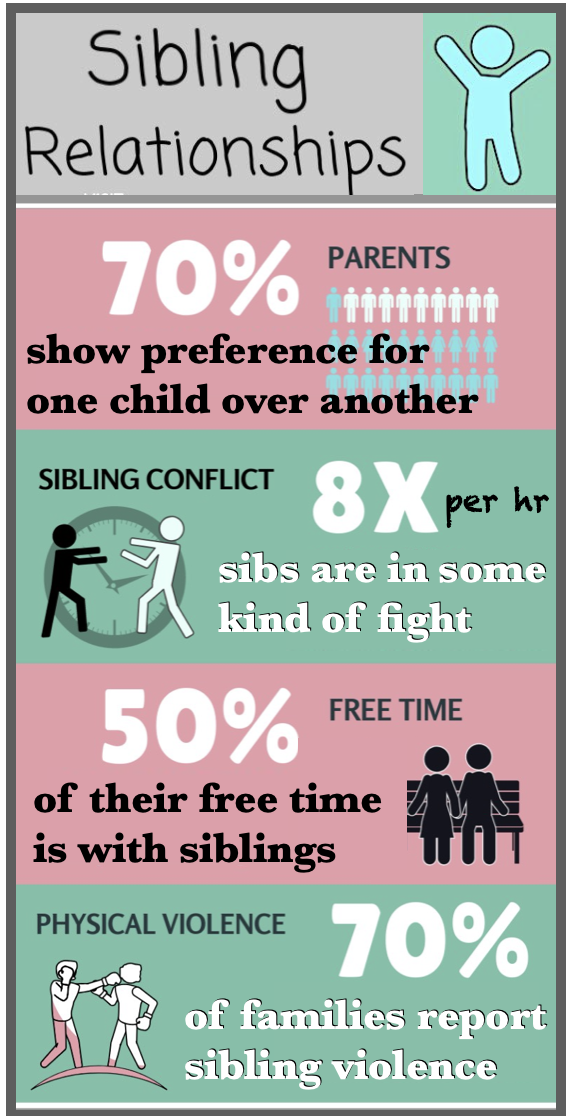
a. But it’s not automatically true for every sibling – surveys indicate that only about half (56%) mimic the mother-child style bond, even if they grew up in the same household,…. (see ‘Sib-Violence’ below).
✐ Other factors affecting how sibs get along include individual temperament, birth order, love-language preference & culture.

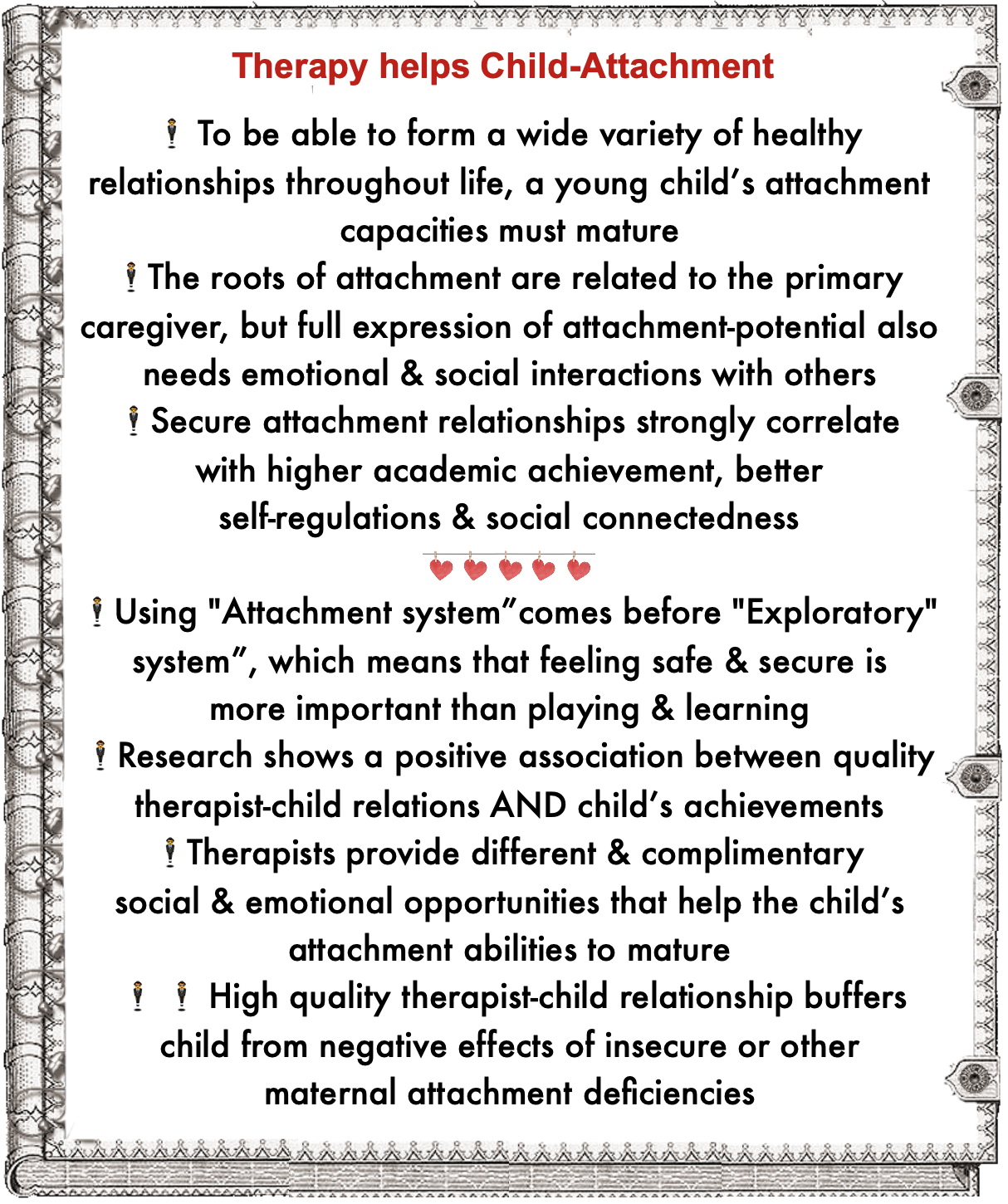
b. 💌 Someone in the other half (44% group) may provide their sibs protection against the harmful effects of insecure parental attachment. Studies found that older siblings can act as a comforting base for younger ones, who may then be able to gain the confidence to explore their surroundings & learn how to relate to & communicate with others – the way Secure kids do.

Feelings of emotional warmth & positive attention between sibs can partly make up for anything unavailable from mom & dad, & be a buffer against painful life events, such as parental separation or family death. This helps children develop healthy coping strategies to manage  a variety of stresses, making them less likely to use tactics like physical aggression, bullying, theft & defiance OR to withdraw & isolate – as a reaction to emotions pain.

🕳️ Another consideration is how children cope with the death of a sibling. For one thing – they can feel invisible, as their whole life is thrown into turmoil, especially for the younger ones because of the traumatic effect on the mother.

For another, this loss creates a need in surviving children for support rather than withdrawal, regardless of attachment style. Studies as the ones from PA & TX note that because siblings are important attachment objects, they can be bridging objects for each other – to modify aggressions, displace hostility, & transform incestuous fantasies.

And as adults, an EXP : a study of more than 1 million Swedes found that a person’s risk of dying of a heart attack themself spikes after a sibling succumbs, not only because of shared DNA but also from the stress of losing such a key figure. Siblings seem like they’re just there – until they’re not.

c. Alternatively, an unhealthy version can develop with a specific sibling – especially for those who have experienced or been exposed to traumatic events. Some ‘simpatico’ siblings who share an abuse history can form a trauma bond. Trauma has an impact on a child’s body & mind, & the resulting complex emotions & beliefs can lead siblings to act out rather than talk about the painful emotions, memories & experiences. (MORE….)

2. TOXIC
In families where alcoholism & severe narcissism &/or domestic violence are rampant, ‘normal’ sibling rivalry can easily escalate to cruelty.

Sibling violence is a power imbalance that makes it hard or impossible for the harmed child to protest, or defend themself. This is equally true for any gender combination or attachment style.  Obviously, children are greatly influenced by watching how the adults treat each other or are treated by others (spouse, close relatives, new partners….)  (MORE…)

Unfortunately, much harmful words & actions happen when adults are not around. And if it does, often parents will minimized the violence because of widely-held beliefs that it helps toughen kids up & prepares them for life.  So it’s not identified as abuse, even when a child is obviously injured.
«

«
NEXT : Attachment & FOOD

Attachment : HEALTH – Physical, Mental

PREVIOUS : Attachment & FRIENDSHIP

BOOK : “The Body Keeps the Score” and REVIEW
COURSE :
The Neurobiology of Attachment and How that Profoundly Impacts the Treatment of Trauma

1. MEDICAL
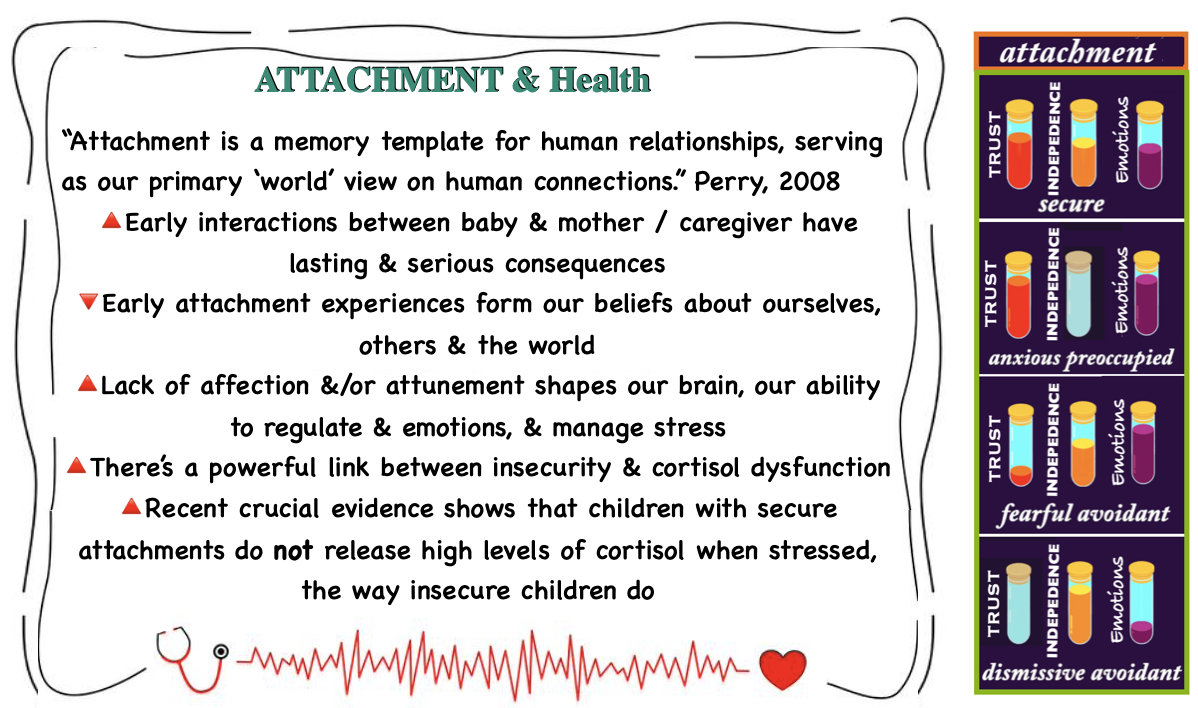
Attachment styles can shape physical stress-responses because they function as strategies for coping with distress, dealing with emotions, ‘explaining’ identity & moderating behaviors – in close relationships.
A person’s self-regulation ability & relationship interactions influence how they respond to stress at a physical level (cortisol reactivity/ recovery, cardiovascular reactivity, inflammation-related responses) & contribute to health outcomes over time.
«


«
HEALTH ANXIETY
Also known as hypochondriacs or Somatic symptom disorder. It usually shows up in behavior patterns, with a strong belief that something is wrong with them – usually physiologically, but sometimes psychologically also. They may focus on a specific illness, or look for signs of something serious without having any one problem in mind.

People with Health Anxiety are more likely to constantly consult their doctor & request testing, sure they’re “dying” of something terrible. However – typically, instead of feeling relieved when every medical exam comes back Normal, they’re sure something was wrong with the test or the doctor misread the results.

Others may react by not seeking care – avoiding the doctor entirely. This anxiety can have the opposite effect – convinced hospitals are risky places & determine to stay away. This can be a big problem when real treatable conditions go undiagnosed.  Harvard estimates ; 4% – 5%  (maybe as much as 12%)

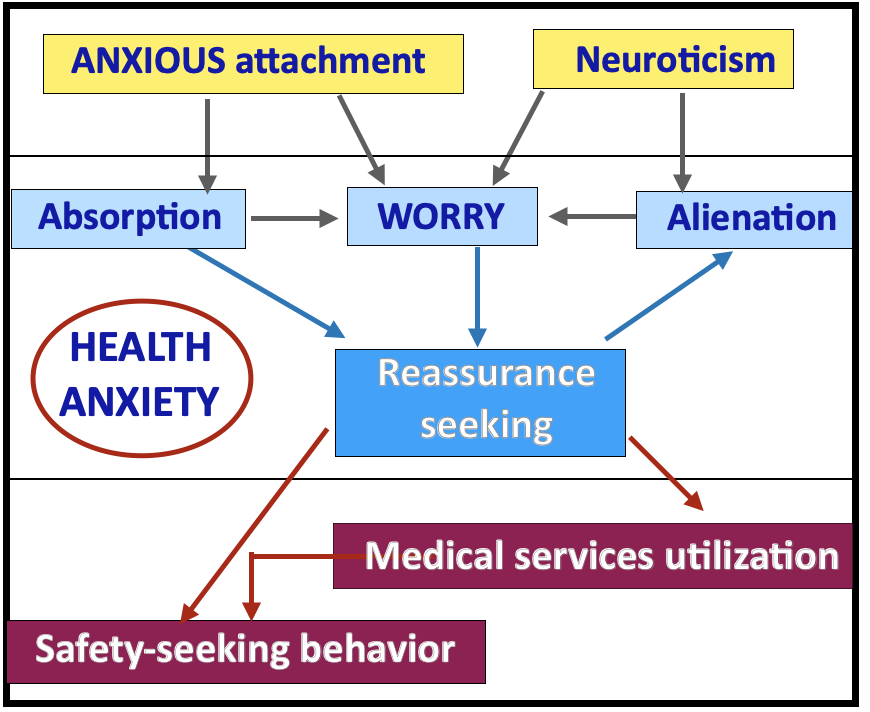
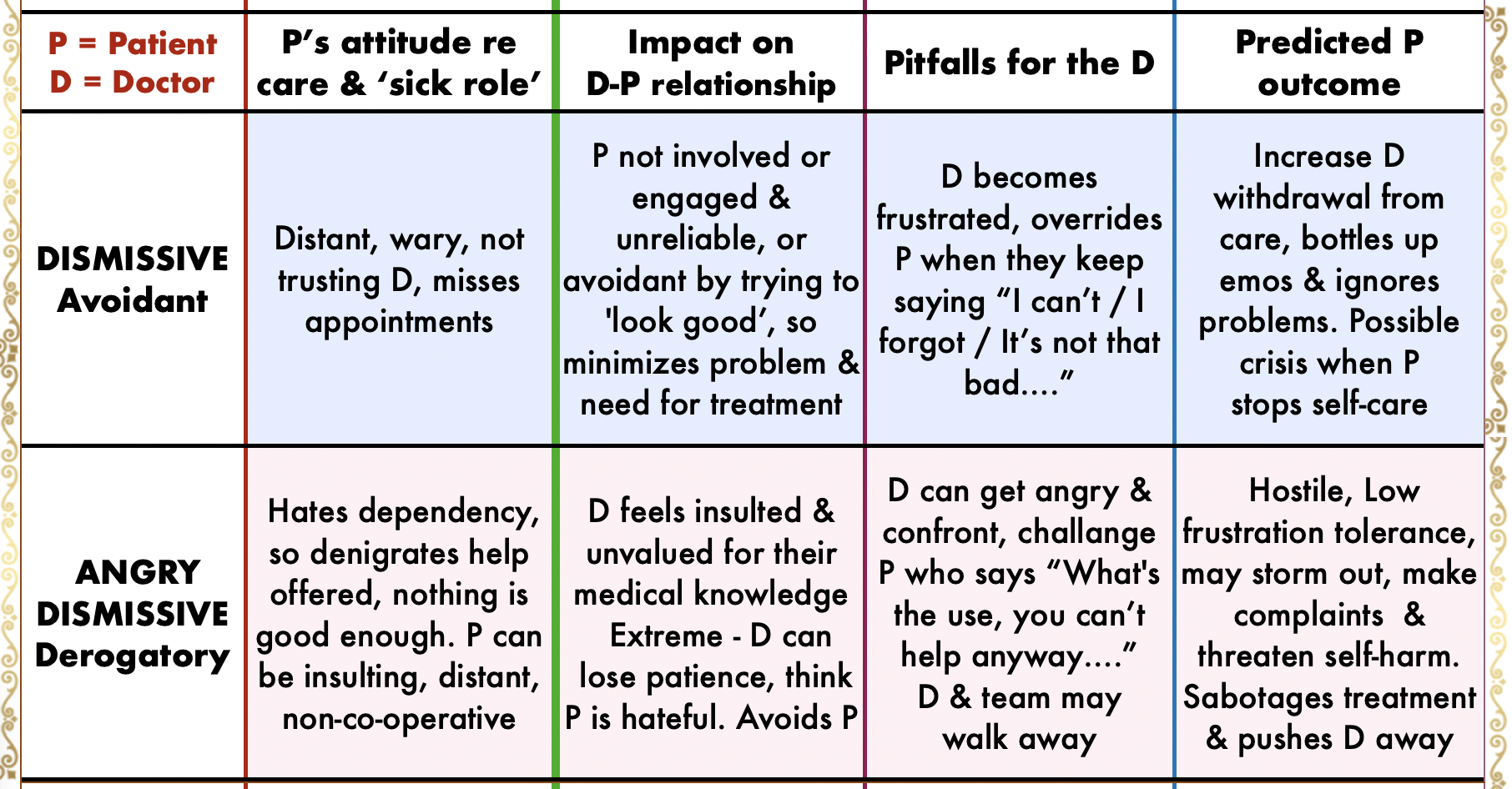
CHART ▼ From a Greek  study exploring INSECURE Attachment & Health Anxiety. Results highlighted that inter-personal (alienation from others) and perceptual factors (tendency to focus on bodily sensations) play key roles in maintaining this condition, noting the importance of Anxious and Avoidant attachment in safety-seeking behaviors.

Health anxiety symptoms
▸ Avoid hospitals & doctor appointments OR call “every 5 minutes” with a complaint & worry
▸ Constantly anxious about general health
▸ Frequently scan the body for something wrong
▸ Preoccupied re. health for at least 6 months, even if the ‘illnesses’ they’re worried about change over that time
▸ Over-estimate the risks of getting a disease & jump to worst-case scenarios
▸ Spend a lot of time reading about different symptoms (cyberchondria)
▸ Worry a lot about having or getting a serious illness
«

«
⬆️ Attachment style in medically unexplained symptoms & long-term illness
A UK study of medically unexplained symptoms (MUS) indicates that attachment insecurity is common in people with different forms of MUS & certain long-term physical conditions.

Insecure attachment is not in itself a pathology, but represents a struggle to manage stress & distress effectively.
It is common in the general population, about 40%, fairly equally divided between Ambivalent & Avoidant types.

When Insecure people become ill, their attachment system is especially activated, since illness (real or perceived) is experienced as life-threatening, so a sense of vulnerability increases.
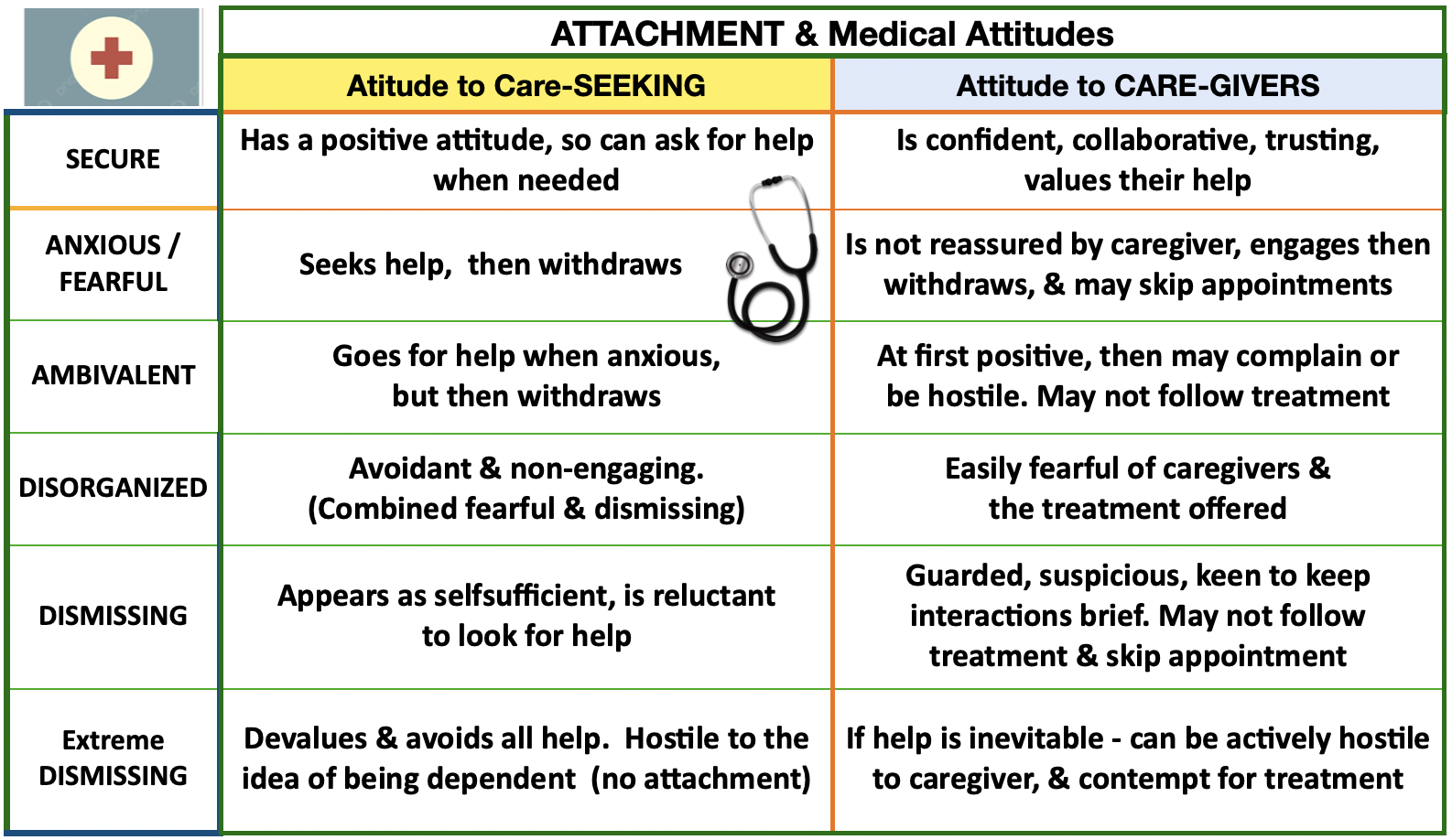
When identifying themselves as ‘patients’, they may experience intense dependence on the professionals, triggered by their early internal working model of the world.
Ironically, Insecure adults have trouble believing they’ll get the help they long for,  so don’t trust medical caregivers

CHRONIC PAIN  – There’s increasing recognition that unhealthy adult attachment styles play a role in the experience of pain…. & can be a risk factor for chronic pain which does not respond to ordinary analgesia. 

Also, Insecure attachment in physically healthy adults is associated with obsessions about minor “aches & pains” causing increased pain-related worry, even projecting suffering & death. It can take the form of hypochondria, hyper-vigilance about health, as well as a reduced pain threshold, & poor coping ability with actual pain.  (MORE…..)
«

«
2. RECOVERY GROWTH
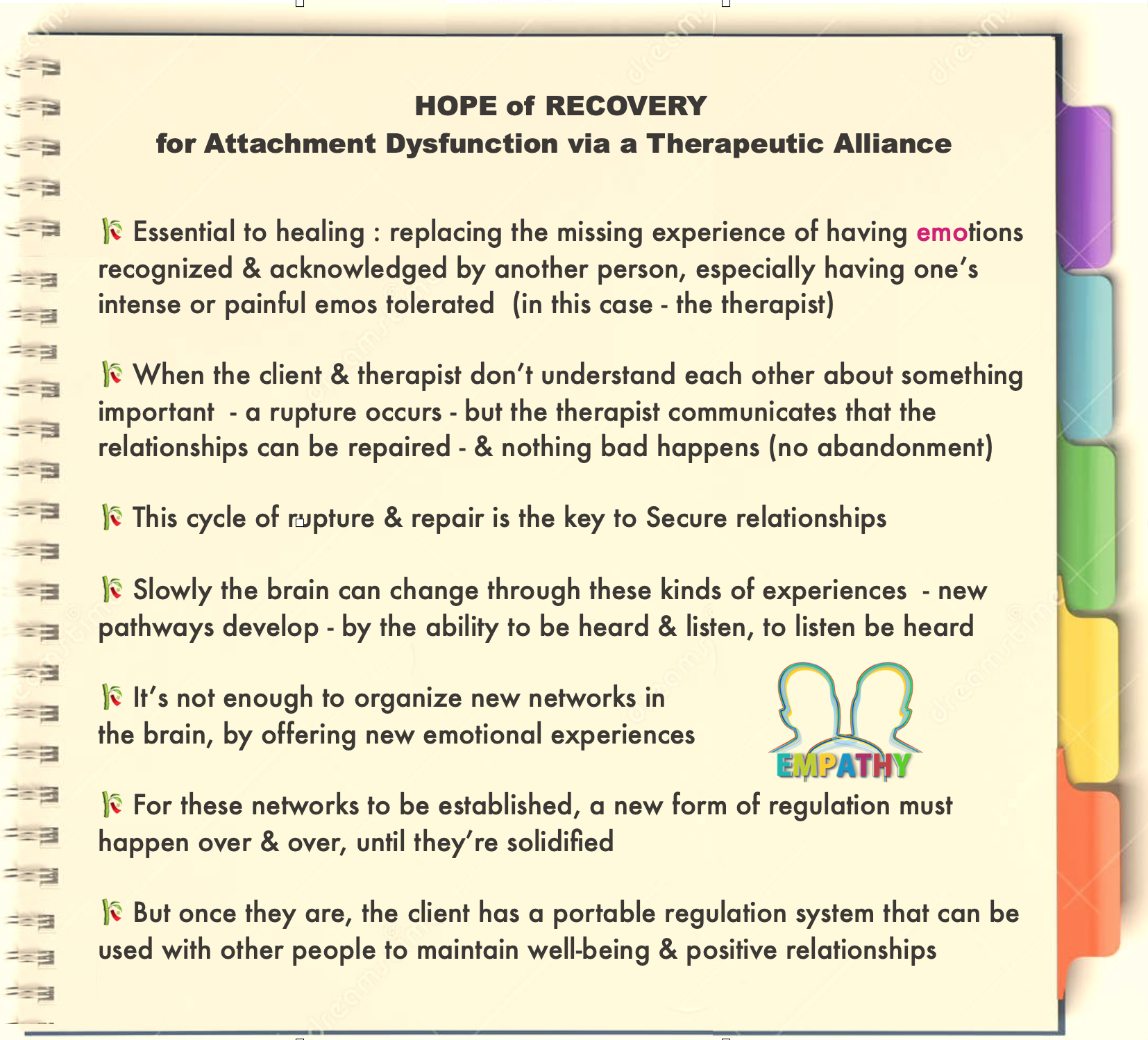
Healing from trauma is one of the most challenging things we do because we’re missing one key experience – a stable, secure relationship. RECOVERY has to include finding PPT (people, places, things) that will provide steady, caring connections to help us grow.
«

«


«

«
RESILIENCE (15 posts)
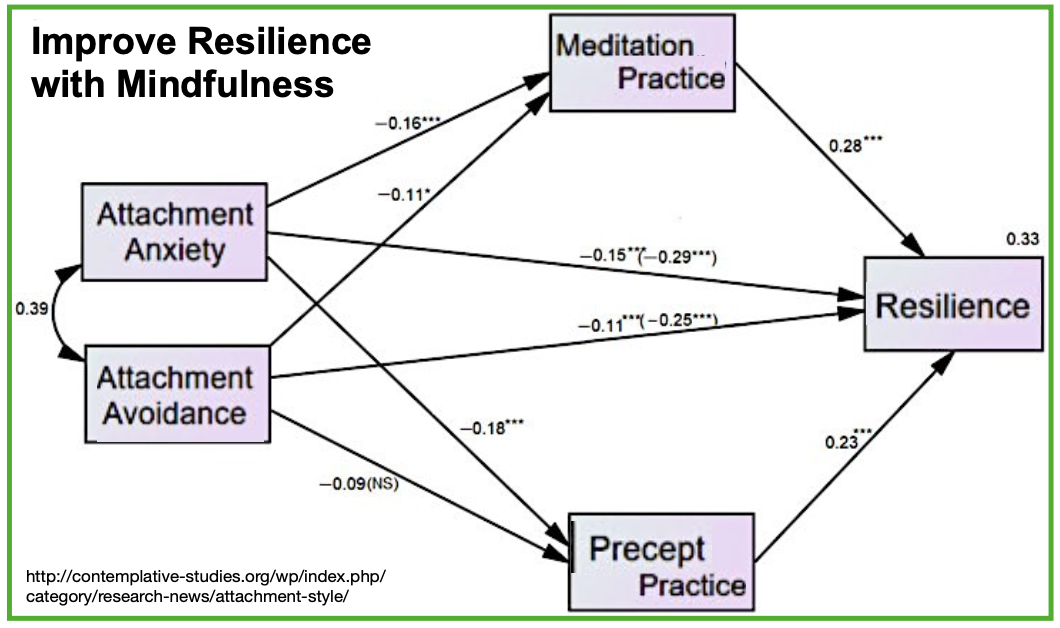
“Mindful people can better cope with difficult thoughts & emotions without becoming overwhelmed or shutting down feelings. Pausing to observe the mind can help resist getting drawn into wallowing when triggered” – Tom Jacobs

Being mindful increases happiness, improves the ability to bounce back from difficulties, reducing physiological & psychological responses to stress.

Research has established these effects : they found that the higher the levels of mindfulness —> the higher the levels of resilience. And, resilience is strengthened by being able to form attachments.  Combined, they helped to lower the levels of attachment insecurity, anxiety & avoidance.
‘‘


«


«
NEXT : Attachment & FOOD (#1)

ATTACHMENT Styles & FRIENDSHIPS

PREVIOUS : Anxious behaviors – Explained (#2)

POSTs : “Friends – Real ” (Part 1 # 2) // INVENTORY

SECURE
You’re able to form nurturing friendships, & work through conflicts that arise. You recognize your value as a person as well as that of others, & understand boundaries that come with friendships. EXP: you’re not one to take things personally if your friends cancel plans last minute…..

Your strong self-assurance allows you to form trusting & lasting relationship with anyone, able to reach out & connect to people, but also respect their boundaries. Your friendships are healthy, & it’s unlikely you have resentments or repressed feelings, since you like to find all kinds of interesting social groups & share them with your friends.

Anxious-PREOCCUPIED
You likely struggle with anxiety about & an intense focus on your friendships – attuned to their needs but rarely considering your own. You may not be aware of having low self-esteem, but you do depend too much on other’s assurances to feel loved & cared about. So, if a ‘good’ friend doesn’t text you back, you take it personally, blaming yourself for the silence.

About forming close friendships – you often worry that people  don’t reciprocate your feelings. However, if you a safe & secure friendship comes along, you’re likely to sabotage its value by obsessively negative thoughts that these healthy friends couldn’t possibly like you.
This can create a rift between you, threatening the connections. Seeing them hang out with other people makes you  convinced you’re not important to them & not really cared for – making you clingy, jealous & possessive.

Your friendship-history has been a roller-coaster ride, but it doesn’t have to stay that way forever. You can help yourself by correcting your toxic beliefs which will help to regulate your emotions when triggered by a situations that makes you anxious.  Ask yourself  &/or a trusted friend if your opinions are realistic.

Fearful-AVOIDANT
This type is a mixture of Anxious & Dismissive. What separates the 2 styles is that this type actually craves intimate friendships, so you’re constantly bouncing between wanting to be close & scared of rejection. Because of this inner conflict you come off as detached & distrustful, even though it comes from fear, which keeps you from connecting with strong & secure people.

This often leads to conflicts with someone in your friendship circle, even if you don’t mean to. EXP:  you miss hanging out with your friends but when you see them, you pick a fight with one or more of them.
Your unpredictable moods & ‘difficult’ attitude make it hard for your them to be with you. Not letting yourself be mutually vulnerable will eventually strain the relationships.

Even so, you can develop a secure attachment style, with a few tweaks. Understand that your thoughts & emotions may not be an accurate feedback loop about what’s going on in your friendship. Rather – it may have been a projection or trigger from old wounds. Instead, work on developing appropriate boundary with your friends so they know what can upset you & what you need in terms of closeness & intimacy.

DISMISSIVE-avoidant
You’re usually pretty happy with yourself – social, easygoing & generally fun to be around. But, you’re also too independent & self-reliant. Your special form of kryptonite is getting too close or personal with others, because being that vulnerable makes you uncomfortable & feel suffocated. So you disconnect emotionally.

You keep social bonds superficial because of your struggles with trust & intimacy, which prevents you from making deep connections with friends. And when you have too much on your plate, you’re not likely to ask for support or help from others even though you really need it.

To improve your social life, decide to slowly get in touch with your fear of personal closeness & mistrust of others.
Talk honestly to close friends, sharing your deepest concerns, even asking for compassionate feedback. Letting them get to know your true self (strengths & limitations) will allow them to be there for you in a way that may surprise you.  In time, this will improve you trust issues & gain a secure attachment style.

Modified from :
Attachment & Friendship” by Nina Fazil (5/22)

NEXT :

ANXIOUS Partner “Explained” (#2)

PREVIOUS : ANXIOUSLY Attached Partners, #1

POSTS: ANXIETY & T.E.A. //  “Relationship STAGES”

«
«

«

«

«

«

«

«
NEXT : Attachments & Friends

ANXIOUS Partner “Explained” (#1)

PREVIOUS : Attachment & Relationships #2
POSTs : ACoA LAUNDRY LIST

↘️ All ‘explanations’ in Part 1 & 2 are f
rom the “Secure Relationships” site 

«

«

«

«

«

«

«
NEXT : “Explained” Part 2

ATTACHMENT Styles & RELATIONSHIPS (#3)

PREVIOUS : RELATIONSHIPS (#2)

SITEs: ☸︎ “Why attachment Styles are more important than Love Languages

☸︎ “Attached: The New Science of Adult Attachment & How It Can Help You Find -and Keep – Love.” ∼ Dr. Amir Levine (AUDIO)

AUDIOBOOK : “Attachment in Relationships”

1. SECURE

2. INSECURE
a. Anxious // b. Avoidant // Disorganized

“Don’t confuse Attachment styles with Love. Insecure attachment is about fear & dependency, more to do with a narcissistic focus on self rather than on another”

😍 IF adult romantic pairings are attachment relationships, THEN :
— whether an adult has a Secure or Insecure bond with a mate, it will at least partially be a reflection of all the experiences with their primary caregivers, since they tend to ‘work’ the way infant-mother relationship worked originally.
«


«
Insecure relationships are often so stressful that they wreak havoc in our life, continuing toxic push-pull interactions.Recognizing how our attachment style meshes with our unmet needs – will show in what areas our Inner Child needs attention & love. This will extend to understanding our partner’s needs, based in their Attachment type.

To whatever degree possible, we can try building current partnerships on a solid base of mutual respect, empathy & kindness. While we can’t rewrite history, we can be responsible for ourself by using adult power to choose the way the rest of our story turns out. Putting positive attention on our relationships, we’ll see how the attitudes, expectations & actions we choose affect our interactions. The way we deal with people either encourages or hinders how they experience us & to some extent how they treat us.
«
STAGES
When we successfully move through Erikson’s 8 developmental rungs, he believed we develop a healthy personality with human virtues. Failure to provide the needs of any level – makes it hard to move into a fulfilling future, which harms our sense of self, & perhaps stunts growth, feeling inadequate & ‘stuck’.
»

«
TRIGGERs for the Insecurely Attached
‘Attachment triggers’ are unhealed reactions from old emotional wounds, that inevitably show up in intimate relationships. EXP:
a.
you sense a change in verbal communication & texting style ↵
b. you interpret this behavior, assigning it a negative meaning (rejection, judgement, cheating, they’re leaving …) ↵
c. anxiety grips you insides (chest, stomach, lower back…) ↵
d. you obsessively try to figure out what’s going on : over-think, review what was last said & done, re-read texts, troll social media….) to create a false sense of control, to figure out if you were right to wrong in some way – TO ease the anxiety.

INSTEAD : 🔺 Identify how your style shows up. Have you chosen someone who is also Insecurely attached?  Do you ignore red flags OR do you take you partner’s reactions too personally?
«

«
2 CONTRASTING Attachment  Styles
Anxious & Avoidants frequently end up together more often than with their own type. That may seem counter-intuitive, but there’s method behind the madness. Avoidants are so good at putting others off that maybe it’s only the Anxious ones who are willing to stick around & put in the extra effort to get them to open up & connect.
Most fearfully-avoidant adults are poorly adjusted despite their defensive nature, while the dismissing-avoidants are able to use defensive strategies to their benefit.

EXP:  In a study by Fraley & Shaver (1997), adult participants were asked to discuss losing their partner.  Dismissives, who tested high on attachment-related Avoidance but low on Anxiety, showed just as much physical distress as others – assessed by skin conductance measures. 

But when asked to suppress thoughts & feelings, Dismissives were able to do so effectively –  deactivating physiological arousal to some degree, & minimize attention to attachment-related painful thoughts.
On the other hand, Fearful-Avoidants were not as successful in suppressing their emotions.
«

«
GROWTH Suggestions
1.
Become aware of your Attachment style (Quiz)
2. Don’t be Hard On Yourself – change takes a lot of time
3. Build Secure relationships (see Part 1)
🕴🏻 Speak up for your needs, without blame or assumptions
🕴🏻Expect & ask to be treated well (Post:”Expectations“- scroll down)
🕴🏻 Notice your partner’s emotional needs as well
🕴🏻 Talk about your emotions & negative beliefs (be vulnerable but with healthy boundaries), especially if Avoidant,
«

«
NEXT : Attachment & HEALTH

ATTACHMENT Styles & RELATIONSHIPS (#2)

PREVIOUS: RELATIONSHIPS (#1)


1. SECURE (Part 1)

2. INSECURE
Our partner should be a complement to us, not used to complete us, & vice versa. (Good Men Project)

↘️ ARTWORK : “Show me the love… or Not = People Can Be Happy With Their Emotional Opposites (2012)
«

«
a. ANXIOUS type – about 20% of the population
1.
‘Protest behavior’ may be used to get the other’s attention, then later regret it
2. You’re always on the lookout for rejection – even when there is none
3. You’re always worried about losing the relationship. But if your partner is an Avoidant, there may be a reason – they’re more likely to cheat at some point
4. A partner who isn’t great at communicating their feelings directly may hope you’ll be quick to notice.

ANXIOUS Needs
These are the “pull” types – the co-dependent people-pleasers.. Even with very poor self-esteem they’re desperate to feel safe, which means always being connected to someone. 
i. Being Heard
Many have gone ‘silenced’ into their adult life, with no voice or are too scared to use it to stand up for themself. They need continual help to validate their inner experiences & external reality.
You don’t have to agree with their opinions or attitudes, but if you love them – then just listen, giving them the time & space to reflect, without judgment  & without conditions.

ii. Trust
This is a big one for Insecures because their original family couldn’t be trusted, or hypocrisy was disguised as trust, leaving them deeply confused.
Giving an Insecure partner time to trust us starts with admitting they don’t & not taking it personally. Getting through their carefully constructed self-protection armor is hard work for both – a long road, but do-able, with patience & the right information.
Both have to work at finding healthy ways to build reliability, such as paying attention to what we say & do, & that what’s being promised is what’s being done.
 «

b. AVOIDANT – about 25%
1.
They’re irritated or unnerved by too much closeness
2. They feel overwhelmed when bombarded with too much emotions
3. They focus on your faults & make unfavorable comparisons with past partners
4. They don’t deal well with intimacy, so are stand-off-ish
SITE :“5 Dismissive-Avoidant Breakup Stages” «

AVOIDANT Needs
These are the “push” away types. Most of their tactics are either indirect (long work hrs….), or dishonest, used to hide, cheat or punish.
i. Space
This is a ‘must’, to keep their sense of independence. To make this possible in positive ways the Avoidant has to be honest with their partner about that they need – consistently trustworthy, & clear about the legitimate ‘alone time’ activities that work best for them. (jogging alone, private time in their home office, quietly reading….). That way they can become more available without fear of suffocating.

ii. Privacy
This is the other big need, which can trigger the Anxious partner’s fears, although a Secure will not feel threatened. The Avoidant’s need for privacy & space is not necessarily a sign of being secretive or uninterested. Here too honest communication is crucial – to build trust & keep it there has to be integrity. They also have to be willing to some compromise, mutually figuring out when & how the Avoidant can meet their partner half way.
«

«
c. DISORGANIZED
** These types respond normally to casual friends or strangers and only react in disorganized ways in intimate relationships, since they too believe they’re unlovable.
1. Difficulty “opening up” // 2. Demanding
3. Acting out // 4. Trouble regulating emotions

DISORGANIZED Needs
They are both “push” & “pull” – a combination of needs, their deepest anxiety is both of being abandoned and of being engulfed.
i. Stability
Their biggest need  is to feel protected, for the relationship to be a safe haven. Because they grew up in chaos, they have a lot of fear (EXP:  physical abuse one day, & emotional neglect the next…. ). Stability offers emotional consistency, predictability & physical protection so they can grow to trust themself & others

ii. Patience
This is another critical need, because their reaction to triggers will be fight, flight, freeze or fawn – depending on which old button gets pushed, & how extreme the fear is. This complexity has to be understood & accepted, & the partner’s patience used with a great deal of compassion – so the Disorganized can feel heard, as well as given the space to feel secure.
«
NEXT : Attachment & RELATIONSHIPS (#3)