Enneagram – All POSITIVES for Type 4

PREVIOUS : All POSITIVES = Type 3:

POST : Enneagram Strengths


See “POSITIVES in us ALL – Definitions”


⚜️ Type 4 ENTHUSIASM – YOU CAN :
• acknowledge that even frivolous things can be fun to experience
• believe you can get your needs met – by the right people
• let yourself uncover your real emotions, not just the ones that instantly surface or are over-the-top when the situations doesn’t warrant it (EXP : no house fire, no parental death…. )
• look for all the simple joys in the world & have fun. Not everything has to be serious or ‘deep’
• realize that not every moment lasts forever, since everything is impermanent, so there’s space for new or even better things
• take time to relax every day, every hour, & shed your constant anxiety

⚜️ Type 4 FLEXIBILITY  – Recognize that your unique ideas are just as amazing as other people’s. Admit & accept that you are not unique – not more special than other Ennea-Types, but very similar to other 4s.
Self-Statement: I really created that! “This is Me” (song) Wow!

⚜️ Type 4  GENEROSITY of Spirit – You can be very supportive, empathetic & generous, which is usually emotion-based. But“generosity of emotion” is not the same thing. Generosity of spirit” has to also include generosity of mind & action.
Watch out for your ego-based need to feel connected by sharing deep feelings. A true act of the spirit is being totally there for another person, by setting your own distress aside for the moment.

⚜️ Type 4 GRATITUDEObvious idea: Spend just as much time thinking about what’s already available in your life , as with what’s missing. Appreciate what’s right in front of you.
Not-obvious idea: Make a list of what you have to offer as a person – then shorten it to 3 items. Draw a picture, create a song, write a poem, or take a pic that represents each item. Then put them someplace special in your home or work – to look at them every day.

⚜️ Type 4 INVOLVEMENT – You  can get passionately, intensely involved with activities that fit your values, or with people you feel deeply connected to . But ASK :
* Do I know the difference between intensity/passion and involvement? Is it possible I get overly-involved?
* Can I get fully involved if I don’t relate completely relate to all parts of a situation, don’t feel listened to or understood?
* Can I focus just as much on the hopes & drams of others as on my own needs & drives?

⚜️ Type 4  MOTIVATION – Hang on to your inner motivation even when ——> you feel someone is demeaning or rejecting you, when you have to do what you consider to be a mundane or boring task, or when you’re are stressed & upset with someone or something

⚜️ Type 4 PERSPECTIVE –  Too close lenses : don’t get so up-close & personal, paying too much attention every nuance of the other person & your emotional responses, that you can’t be objective about the whole person & how they fit to don’t fit with you.
Remedy: Use a refined zoom lens that allows for range flexibility & a conscious compass to know when to use it!

⚜️ Type 4 PROSPERITY – Move from waiting for prosperity to engaging in prosperity-based action.
Believe you really can & will get needs & desires met. This happens as you let more positivity into your life, along with limiting negative self-talk & other false beliefs.

⚜️ Type 4 RESPONSIBILITY – Being complicated , you’re both over-&-under-responsive to yourself and to others. For you – ‘over’ means too focused on you immediate feelings, but ‘under’ is not knowing for sure what your deepest emotions are. About others – too easily taking an ambiguous response as a slight, or someone’s negative comment taken personally. On the other hand – you don’t absorb or don’t even hear a compliment or expression of gratitude from others.

⚜️ Type 4 SPONTANEITY – You think you’re spontaneous by being in-touch with feelings & desires, trying to follow as inner vision & daring to be different. You tend to live in the past or an idealized future.  These do not represent spontaneity – being in the moment.  ‘Immediate responsiveness’ require being in the present, accessing your truest level of awareness in the Now. The most important step is paying attention to your breathing & checking what you’re experiencing. Then find what feels good in the ordinary & mundane.

⚜️ Type 4 VISION – Explore & trust what you believe about manifest your vision into reality. Find the words that communicate this possibility to others, & don’t get deterred if they don’t understand. Absorb constructive feedback as ideas & useful information – not criticisms – & then digest it. Enjoy when others do get it & support your vision.  Remember : you are not your vision, rather a person with a vision. This helps to not take suggestions or critiques personally.

⚜️ Type 4 WILLINGNESS – Be willing to hear & absorb compliments from others, rather than discarding them as if they hadn’t been said. Be willing to find every-day things – where you can make a difference – instead of dismissing them as not important. Allow yourself spontaneous acts of small kindnesses, rather than expecting everything you do to be deep & purposeful.

NEXT : Type 5 – All Positives

Enneagram – All POSITIVES for Type 3

PREVIOUS : All POSITIVES = Type 2

POST : Enneagram Strengths


See “POSITIVES in us ALL – Definitions” 


⚜️ Type 3 ENTHUSIASM – YOU CAN :
• be around good people who aren’t ‘successful’ by society’s standards
• have internal permission to spend time getting to know your deeper self
• identify what you really want & enjoy, rather than what you think you should
share more of your personal information with some people around you
• try something new each week that you’re afraid you’ll fail at. But maybe not & so what! You may even enjoy it.

⚜️ Type 3 FLEXIBILITY – Acknowledge the contribution others have made to your achievements, rather than hogging the limelight. Be able to tolerate occasional disagreements or being overlooked.
Self-Statements: I’m not alone.  I notice everyone around me!

⚜️ Type 3 GENEROSITY of Spirit – Genuine giving comes from inner most identity, rather than from image. To be truly generous, not ego-based “looking good”, first take introspective time to considering who you really are, “being” instead of “doing”. Spend a little time each day on something pleasant that has nothing to do with being useful, an obligation or having a practical outcome.

⚜️ Type 3 GRATITUDEObvious idea: Let yourself be grateful for what you actually have, not what you think you need to gain – to be accepted.
Non-obvious idea: Feel the deepest gratitude for letting yourself do something you really wanted to do, not for success or respect, but because you simply enjoyed the process of doing it, not the result.

⚜️ Type 3 INVOLVEMENT – You are highly driven & focused, so already have a high level of involvement. but ASK :
* Am I mainly involved with tasks & projects, but not enough with people & relationships?
* Am I may only “doing” engagements rather than “being” my True Self ?
* Any time I get involved, ask “Is this something I really want to accomplish, or is it something expected of me?”

⚜️ Type 3 MOTIVATION – Work at being the main source of your inner motivation, even when ——> others don’t think you’re being effective, don’t treat you with respect, or if your confidence is shaken for some reason.

⚜️ Type 3 PERSPECTIVENarrow focus lenses : When your peripheral vision is blinded by over-focusing only on details of a situation, or on the results of a goal, you’ll miss important elements which you need to prosper
Remedy: Change your lens prescription to appreciate & observe the ‘big picture’ in any situation

⚜️ Type 3 PROSPERITY – Move from external (false) to internally-driven prosperity. Rather than chasing what you think should want, that comes from external pressures, identify what suits your True self. Your prosperity is based on your personality needs that may not suit the image you’ve been pursuing.

⚜️ Type 3 RESPONSIBILITY – You are over-responsive to the reactions of others, especially those you admire & respect, & you choose goals you think will make you look successful.
True response-ability starts with facing who you are at your core, so you’re not just playing roles to look good. To prevent burnout from over-work, only be responsible for your portion of task & projects, know when to rest, & focus on
what’s right for you, apart from your social environment. 

⚜️ Type 3 SPONTANEITY – You may seem spontaneous because you’re generally optimistic & have effective interpersonal skills. But genuine spontaneous is not about an impressive self-presentation or having a  positive impact. Pure instinctive responses requires knowing that you actually feel & need, by having more access to your interior life, rather than living by ‘shoulds’.

⚜️ Type 3 VISION – Identify your personal vision, what ever it is – not what you think is expected of you.  Only pursue a vision that comes from deep inside you, even if the direction doesn’t fall within societal guidelines about what successful people should do. Search your mind & heart – go back to early life to recapture your vision for yourself –  then follow your path.

⚜️ Type 3 WILLINGNESS – Be willing to try something new you may not be good at.  Do something for others or the environment without anyone else knowing or seeing. Find little things you can do that bring satisfaction simply in the process, not because of the result.  Be willing to follow your own heart.

NEXT : Type 4 – All Positives

Enneagram – All POSITIVES for Type 2

PREVIOUS : All POSITIVES = Type 1

POST : Enneagram Strengths


See “POSITIVES in us ALL – Definitions” 


⚜️ Type 2 ENTHUSIASM – YOU CAN:
• have needs of your own & not always take care of others
• identify your own wishes & dreams, and chase down/ act on them
• let yourself express your own thoughts & feelings as they emerge
• let people you care about know you’re upset with them & everyone survives!
• permit yourself to do one thing each day simply because you want to
• tell yourself that it’s fine just to be yourself.

⚜️ Type 2 FLEXIBILITY  – It can mean letting others care for you when you’d much rather look after them. It also means accepting things from others you may not actually need, want or like ! because it’s being given with love, appreciation, or even from their co-dependence. It’s OK.
Self-Statements: I will ask someone, let someone, surrender to support!

⚜️ Type 2 GENEROSITY of Spirit – You’re already generous, but how much of it is ego-based “giving to get”?  Generosity of spirit requires “Clarity of spirit”, so check your deepest motivation. Before giving, ask what you honestly want in return – for yourself ! Once you know, then be sure you’re actually capable of it and really want to DO this ‘something’ . If yes, tell the receiver why you’re offenring to help.

⚜️Type 2  GRATITUDEObvious idea: Allow yourself to be grateful for your growth & how you’re better able to handle what previously were very stressful situations that  made you angry or self-recriminating.
Non-obvious idea: Write down 3 positive things about yourself that you feel deeply grateful for. Say these out loud & stick them on your bathroom mirror so you can read them every day.

⚜️ Type 2  INVOLVEMENT – You already put too much your attention on everyone else. So ASK  :
* Am I involved with people-places-things because it’s something I really want to do, or mainly for others?
* While helping others express their intentions & talents, am I also acting on my own deepest dreams?
* Can I be fully involved – in anything – when not focused enough on myself ?

⚜️ Type 2 MOTIVATION – Hang on to your inner motivation instead of always deferring to someone else to be your motivation. You can stay on your own side even when ——> being criticized, someone’s being “mean spirited”, or if your advice or suggestions are ignored.

⚜️ Type 2 PERSPECTIVEEmbellished focus lenses : remember that the idealistic false-abundance you assume is only potential – or fantasy – not actual reality. That rose-colored tint is pretty but deceptive & unsafe.
Remedy: Chang your prescription so you can see less of what you imagine & all of what’s truly there! 

⚜️ Type 2 PROSPERITY – Move from false abundance to true prosperity – by fully appreciate both what’s in front of you, & what’s inside. It comes from a well-developed inner-anchor that tells you that you have a right to any prosperity you create.

⚜️ Type 2 RESPONSIBILITY – Find a balance between your 2 extremes
OVER : too focused on your perception of others’ needs, & on how others respond to you
UNDER attentive : to yourself, your own needs, wants, hopes, feelings…..
Instead, be caring & helpful to others without overextending yourself at your own expense.

⚜️ Type 2 SPONTANEITY – True spontaneity (not people-pleasing agreement) is easier when anxiety is greatly lessened, which requires:
— noticing & rejecting the harsh “invisible audience” in your head by disagreeing with its constant judging comments
—  undoing the emotional habit of repression, your defense mechanism.  Connect to your deep emotions, so you have a choice about when, where & how to express them spontaneously.

⚜️ Type 2 VISION – You are already very, very good at helping others identify & implement their visions. Get clear about what you aspire to – apart from them – what you really care about & have a passion for. Don’t compromise your vision because of the false belief that to pursue it is selfish or not altruistic enough.

⚜️ Type 2 WILLINGNESS – Be willing to try many things that are opposites to your normal behavior (even ways you consider selfish). When doing something for others or the environment, do it without even a subtle hint of self-inflation. Be willing to ‘risk’ letting yourself be free of obligations, even for a few moments each day.

NEXT : Type 3 Positives

Enneagram – All POSITIVES for Type 1

PREVIOUS : POSITIVES in us ALL – Definitions

POST : Enneagram Strengths


See “POSITIVES in us ALL – Definitions”


⚜️ Type 1  ENTHUSIASM = YOU CAN :
• allow yourself to be “in the moment”
• be spontaneous, play more
• laugh at your own mistakes without anxiety
•  let go of control & be ok with making mistakes (once in a while)
• stop engaging with people who are irresponsible or lazy
• try at least one new thing each day (only for yourself)
• try something “outside the box” unless you know it won’t work

⚜️ Type 1  FLEXIBILITY  – Acknowledge there’s more than one right way to get things done
Self-Statement: I can relax, let go! Would I rather be right or effective?

⚜️ Type 1 GENEROSITY of Spirit – This comes from a deep acceptance of all that is, as it is – including others, work, & especially you. If you want to give a great gift, write a loving poem, maybe even send handwritten thank-you – make sure it’s not ego-based, not trying to be seen as perfect.

⚜️ Type 1GRATITUDEObvious idea: Focus on what’s wonderful & glorious about something that’s not completely stellar, instead of on what you see as ‘wrong’ with it.
Non-obvious idea: Tell 3 different people you care about – what they really mean to you, & how grateful you are to have them in your life. Don’t mention their imperfections !

⚜️ Type 1  INVOLVEMENT – You can be deeply passionate & engaged, propelled by a values-driven momentum that few others can match. But also ASK yourself :
* Can I be fully involved when someone else is in control of a situation, when there’s a high degree of uncertainty, or when its quality may not live up to my standard ?
* If being fully involved requires me to be absolutely in the moment, can I let myself be fully present without anxiety?

⚜️ Type 1  MOTIVATION – Work at keeping your inner motivation strong, even when ——> you or others around you are making mistakes, when you’re exhausted from over-work, being too self-controlled, or feeling irritated.

⚜️ Type 1PERSPECTIVEToo tight lenses : if you only look for what’s precise, right or clear, you may mistake something that looks fine for something that is not, or ‘see’ something as flawed, when it’s actually just fine as is.
Remedy: Observe everything with relaxed eyes so you can notice what’s truly important.

⚜️ Type 1 – PROSPERITY – Move from self-restraint to expansive abundance – moving away from poverty-mentality. Give yourself the freedom to function without the chains of rigid rules & strict controls, yet without throwing away all boundaries & ignoring consequences.

⚜️ Type 1  RESPONSIBILITY / “response-ability”. It’s not knee-jerk reactions, habits or your instincts. It’s a conscious choice to handle situations & relationships with integrity.  To be ‘legitimate’ your actions have to be based on real awareness about :
a. who you are + b. what’s needed practically + c. what will achieve the best outcome at the time.
Don’t let your natural sense of diligence & un-healthy perfectionism take on tasks you don’t really want to do, which will make you very resentful

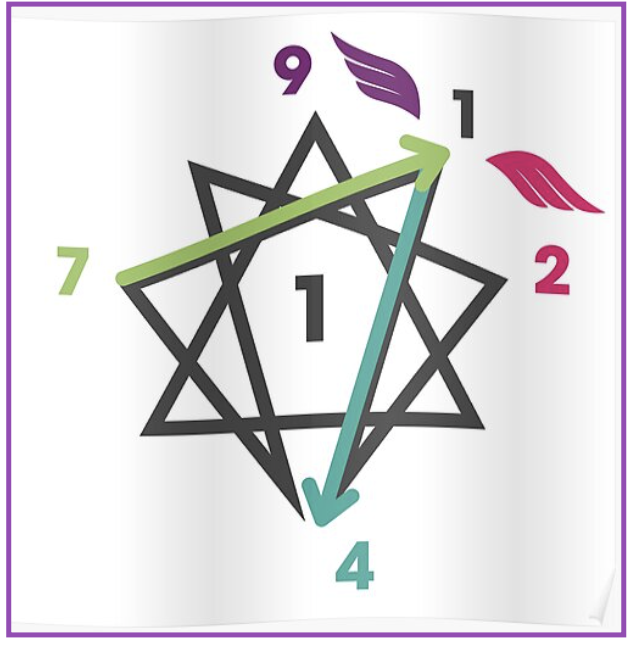
⚜️ Type 1  SPONTANEITY – You may think you are – when making quirky or extremely honest comments. But mostly you’re over-controlled, the opposite of spontaneity.  The ‘real thing’ comes from lowered anxiety, side-stepping all those rules about how to act. But don’t go to the opposite extreme – your Arrow #7’s recklessness – which is not true instinctual spontaneity, just impulsivity.

⚜️ Type 1  VISION – To put your vision into form means having fewer constrictions or pre-determined rules, & a deep belief in possibilities for yourself, others & the world. Let yourself dream really big without reservation, even for a while – moving past your judgments & perfectionism, into a world of many possibilities.

⚜️ Type 1  WILLINGNESS – Be willing to relinquish control once in a while, & experiment with trying new things you may not do ‘perfectly’. Practice suspending your demands for the Ideal. Lead by example without thinking “I’m such a good person, so everyone should be like me”.

NEXT : Type 2 Positives

Enneagram : POSITIVES in us ALL – Definitions

PREVIOUS : SAGE – Building Integrity

POSTs :  Enneagram “Flaws in us All”, Explanation & #1-9

REMINDER: As opposed to popular usage, in the present context “Ego” (in Latin) is identified in the psychological sense – The SELF – not arrogance, but rather having a HEALTHY EGO / identity.

EXPLANATIONS
Ginger Lapid-Bogda (Enneagram author, trainer, keynote speaker) on her site “The Enneagram in Business”, provides a variety of ways to understand how each Type handles the many positive & negative aspects of being human.

🤔 This series of posts is the opposite of the one published in 2014 about EnneaTypes’ Fixations (Habits of Mind).
H
ere it’s how each Type exhibits 12 qualities focusing on our best, based on Strengths /Virtues.


⚜️ ENTHUSIASM – it’s seeing potential, exploring possibilities, bringing energy to situations to find a way forward. It’s not blaming people-places-things when you’re disappointed, but looking for the positives in any situation or for lessons we can learn.

⚜️ FLEXIBILITY  – means going with the flow when you want to be in control. Letting others care for you when you’d much rather take care of them. Taking a risk rather than being burdened by worrying about the consequences, recognizing that your unique ideas are just as amazing as others’

⚜️ GENEROSITY of Spirit – being open & willing to freely share your “gifts” with others. Done joyously from respect & compassion, it involves experiencing & celebrating what’s important to the other person, without a hidden agenda, or the need for reciprocity.

⚜️ GRATITUDE – It can transform your attitude by appreciating what you already do have, & for the potential for success & serenity you carry inside. It can shift your perception of reality, to embrace self-acceptance & self-love, especially in the face of difficulties & disappointments.

⚜️ INVOLVEMENT – being engaged in the moment & experiencing what can be achieved, no matter the significance. When it’s aligned with what you’re passionate about, there’s no greater opportunity that will make a difference.

⚜️ MOTIVATION – “You are the only one who can motivate yourself.” You can be inspired by others to make a difference in your life, or change what you do or what you believe, but only you can make it happen for yourself.

⚜️ PERSPECTIVE – the ability to hold more than one point of view, from seeing both/and -rather- than either/or, while maintaining your own truth.  When we hold the world of “both/and”, we get to see different & better opportunities, pathways & solutions.

⚜️ PROSPERITY – is about abundance, reflecting a flourishing, thriving way of living. It’s means knowing that I already have what I need, in order to do what I need to do. It includes the concern & commitment to achieve benefit for the “greater good”.

⚜️ RESPONSIBILITY – the ability to respond appropriately when presented with a challenge, project, opportunity, situation, problem, task  – in a way that moves it forward. It doesn’t mean we always have to find a solution or take action, but rather identify & accept our impact on what’s happening, & modify the way we might be involved.

⚜️ SPONTANEITY –  being in the moment, trusting your instincts, & risk making a choice to show up. You can minimizes the judgments about whether they’re appropriate or not, so that taking the opportunity to give of your True Self – feels less emotionally risky.

⚜️ VISION – it can be a goal you work toward for yourself, your family, or career. A larger one is the goal of contributing to the sustainability & viability of our world through working with individuals, communities & organizations. It’s an aspiration, since we may not be able to have a large impact on the whole planet or everyone on it.

⚜️ WILLINGNESS –  you can share your feelings, “crazy” ideas, passions, & the little things that make you smile. So being a role model by willing to show up as well as do small things to make life easier for others – you’ll find that more people around you start responding the same way.

NEXT : Type 1 Positives

SAGE : BUILDING Personal INTEGRITY

PREVIOUS : Defeating Saboteurs

SITE :

BUILDING INTEGRITY
When we think, feel, & act with integrity, we stay on track. As life progresses, keeping in line with our values ensures we become the person we want to be. They also provide the stability of character needed to build lasting relationships of trust & mutual respect.

How do we become people with integrity?
In the book Indistractable, practical steps. Building it requires consistently following through on our word, to ourself & to others.

KEEP your COMMITMENTS
1. Only commit to things consistent with your values
When living in integrity, our actions are consistent with our words, & our words are consistent with our values. If you say you’re going to do something, integrity requires you to do it.

Don’t make promises you can’t keep. If you’re unsure whether you can keep a promise or not, don’t make it. Instead, give yourself time to reflect on the reasons for wanting to promise something, & on whether you can really deliver. It’s fine to say, “I’d love to help with this, but I can’t commit right now. Can I get back to you tomorrow?” Who’s going to say ‘no’ to that?

2. Show up when you say you will
Commitment includes being on time. A familiar comment may have come from family & teachers “Lateness is a sign of disrespect!” with a wagging a finger.
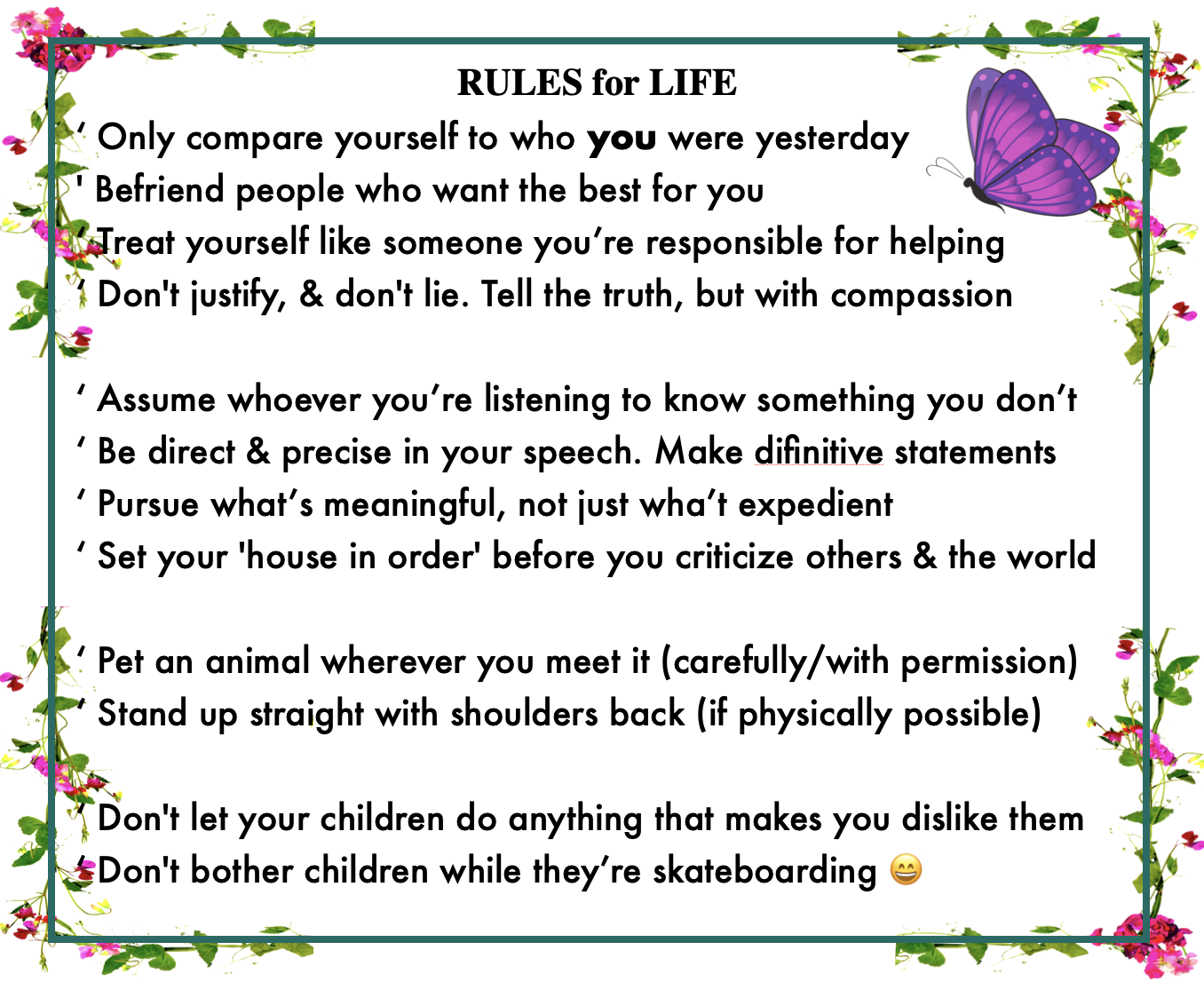
We can’t expect other people to respect us if we don’t respect ourself. Not showing up when we make a plan – is a way of signaling we lack self-respect & don’t take your own word seriously. (RULES  ➡️ )

3. Timebox
This is a schedule-making technique. an is the most effective tool for keeping your day on track.
The goal is to create a schedule that minimizes the chance of getting derailed by distractions.

Being on time all the time can be hard to manage when you have many commitments.  The chart helps to spend your time according to your values, greatly cutting down on lateness-anxiety, & being trustworthy.  Also – remember you can’t call something a distraction unless you know what it distracted you from – something you want to avoid. Admit & own it.

4. Be consistent with other people
It’s natural to make adjustments in your behavior tailored to the immediate situation. You wouldn’t act the same way at your friend’s bachelor party as at a brunch with your new in-laws. But when living in integrity, you don’t ignore your core values, whatever the situation.

5. Avoid hypocrisy
Integrity demands that we judge other people & ourself by the same standards. This who don’t are called hypocrites. Those people have a double standard – one set to judge other people & another for themself. EXP : they will ruthlessly criticize others for being late, driving too slow or cutting in line, but feel justified in acting badly inter own way.

Realistically – is natural to have different standards for different categories of people- what we expect of a child is not the same as someone we employ.  We don’t criticize our spouse for not knowing how to fix the drain, but we do criticize an incompetent plumber…
Also – there are people whose circumstances warrant different treatment: the disadvantaged, elderly, those who are chronically ill, or with some disability.

6. Avoid lying
No one wakes up in the morning and says, “I want to be deceived today, I want to be lied to, fooled, be taken advantage of.” We value the truth—at least for ourselves. If we lie to other people, we’re implicitly demanding they tolerate something we wouldn’t tolerate for ourself.
That kind of double standard is inconsistent with integrity—a sentiment Shakespeare expressed in Hamlet: “This above all: to thine own self be true, And it must follow, as the night the day, Thou canst not then be false to any man”…… (“Why ACoAs Lie“)
«

«
NEXT : Enneagram – ALL POSITIVE

SAGE – DEFEATING Saboteurs

PREVIOUS : SAGE – 

SITEs : “HOW to DEFEAT Internal SABOTEURS
🏋🏾‍♀️ The MAGIC of BRAIN PLASTICITY” 


1. WEAKENING your saboteurs – start with 2 or 3 of the strongest ones.
😍 Call your ‘favorite’ Saboteur a NAME – Brenda / Ralph….. to put distance between it & the True you.  Talk to it, ask it to calm down, wait ’till later to freak out, be quiet.…  OR
give each nickname s –  ”the executioner, the robot, the drill sergeant”… so you can easily recognize whichever one shows up when you’re stressed.

🧐 Keep observing how their telltale behaviors show up at work & in personal interactions. Helpful image: Think of them like a giant snowman that melts under the light of conscious awareness.

🔆 Repeat over & over : “I don’t agree with your negative belief”. There’s a difference between saying “I don’t think I can___” vs the Judge definitely insisting that you’re not capable.

▼ Don’t fight with it – at least not in the typical way. Don’t criticize it, because it’ll activate the ringleader, the Judge! If you screw up in some part of your life,  it will make you anxious. Instead – empathize & explore what happened, & come up with creative ways to handle upsetting situations.

❤️‍🩹 Practice gratitude : every day think of 3 things you appreciate like – your loved ones, if you have good health, a new creative project you’re working on… – OR very small things like being able to walk, having heat in in winter, money for food…..

2. BUILDING New Neural Pathways
Saboteurs push us into action through negative emotions : anger, anxiety, fear , guilt, obligation, regret, shame….
BUT
The Sage pulls us through positive emotions: compassion creativity, create meaning, curiosity & a desire to contribute.
«

«
We take 10,000 steps a day for physical fitness, now we can add 100 mental-muscle reps a day for mental fitness. They activate & grow our ‘self-command’ ability which helps to self-regulate our thoughts & feelings.

🏋🏼‍♂️ PQ REPs : Strengthening your PQ brain involves shifting as much of your attention as you can TO some part of your body & any of your 5 senses – for at least 10 seconds each time. That counts as 1 PQ rep.

Taking into account distractions & wandering thoughts, you should be able to do around 3 PQ reps per minute. It’s recommended you aim for 36 PQ reps a day to see a benefit. You need to do this for 21 straight days. While that sounds like a lot, you can divide them up throughout your day.
EXPs :
✑ during Daily Poutines, like when brushing your teeth, focus on the feeling of the toothbrush against your gums
✑ Before or when eating – focus on the taste or smells
✑ As you listen to music. When handling a book or report – feel the paper OR keys on the computer, finger tips when texting….
✑ Working out, exercising, playing sports (also e-sports)
✑ Being with (positive) family, friends, pets….

LISTEN : PQ GYM audios, 5 min. & 15 min.
⚬ Weekly hour-long videos deliver deep experiential exploration of the week’s focus.
⚬ 15 minutes/day of app-guided practice helps build stronger mental muscles (neural pathways). These exercises are bite-sized to fit your busy schedule & customized based on how you self-sabotage.

Mental fitness is increased when new patterns are strengthened through positive habits.  This can be encouraged by using these mental muscles, which become visible as new neural pathways – shown on MRI imaging – with at least 8 weeks of practice.
Saboteur Interceptor MuscleSaboteur Interceptor
The ability to intercept and discredit the Saboteurs (toxic rules, cognitive distortions….). Identify which one has your thoughts & emotions in its grip – at the moment – & step back from it. Know your Saboteurs so well that you can quickly discredit their lies & limiting beliefs.

Self-Command Muscle
Self-Command
Train yourself to be more in charge of your thoughts, rather than allowing the Saboteur-hijacked brain to run you.  Each time you intercept a Saboteur pattern, do 10-second PQ Reps to pause & choose a Sage response.  They are powerful ways to command your mind to quiet the area where your Saboteurs live, & activate the region where your Sage lives.
Sage Muscle
SAGE
Your Sage handles challenges with a clear, calm mind, with pleasant emotions.  Once you’ve activated your Sage brain through PQ Reps, you’ll have access to these 5 primary powers : Activate, Empathize, Explore, Innovate, & Navigate.

NEXT :

The SAGE & PQ = Positive Intelligence

PREVIOUS : SAGE – Archetypes

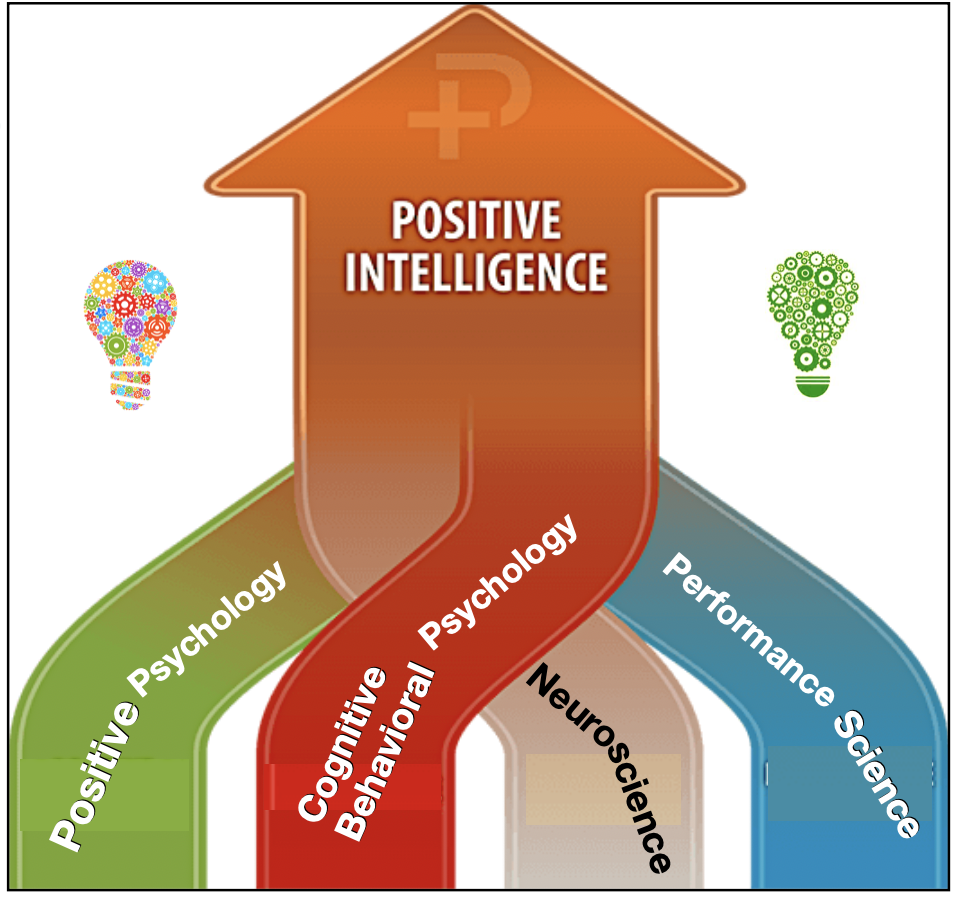
SITE : CHART    ⬆️

WHITE PAPERs : the research foundation behind their Positive Intelligence Assessments.

From : “Positive Intelligence“, Shirzad Chamine’s book.
See also, His TED Talk

DEF of PQ, your Positive Intelligence Quotient  :  An indication of the control you have over your own mind, & how well it acts in your best interest.”  Basically, what kind of neighborhood your mind lives in.

PQ is a synthesis of recent breakthroughs in neuroscience, cognitive & positive psychology, & performance science.  400,000 participants from 50 countries were studied, which included elite athletes. hundreds of CEOs, sales, operations, and technology teams, & Stanford students. Recent advances in functional MRI (fMRI), which measures how neural activity changes blood flow, shows the real-time working of the brain.

1. PHYSICAL PQ : Bodily-Kinesthetic Intelligence = The ability TO exert fine motor control, move our body with coordination, & be aware of where we are in space.
For some, this is consciously managing our physiology, a more complex extension of the basic PQ concept. It’s about creating a positive relationship between mind & body, actively working to create better conditions for our body to thrive, & ensuring we take steps to minimize physical harm. (MORE…..)

Enhanced PQ is linked with : stronger immune responses, reduced stress hormone levels, a diminished risk of heart-related health issues, better sleep patterns, & fewer common colds.

Studies also indicate that people with generally higher mental & physical positivity experience increased longevity, as seen in the youthful journals of nuns that expressed a bright perspective, & who surpassed the lifespan of their counterparts by almost 10 years. (Other Intelligeneces)

2. MENTAL PQ : According to Chamine, if you’re not physically fit, you’ll feel physical stress as you climb a steep hill.  If you’re not mentally fit, you’ll feel mental / emotional stress, such as anxiety, frustration, anger & depression – when dealing with work & relationship challenges.

Mental fitness requires building new brain-chemical structures, not just having intellectual insights. The PQ process creates new neural pathways (mental muscles), brain-retraining that results in sustained change, rather than efforts that fade over time.

Our potential is determined by many factors, including our experience, knowledge, skills, support network… our IQ = cognitive intelligence & EQ = emotional intelligence  ⬇️  (& the Differences).  While EQ training teaches positive qualities such as self-awareness & self-management…. it has little lasting success, because it neglects tackling our Saboteurs.
🚩 In contrast – PQ strongly predicts success using the formula :  Basic Potential x our PQ # = degree of Achievement

PQ is “the percentage of the time your mind is acting as your friend rather than your enemy” – as when it offers constructive suggestions or cues. This metric can indicate both self-doubt & self-action, on a scale of 0 to 100, which indicate how much control you have of your thought process.

Research shows that a PQ of ’75’  (% of the time ⬆️) is a tipping point. Above it, you’re uplifted by your mind’s internal dynamics, below it you’re constantly being dragged down.”
BTW : 80% of people tested scored below the minimum level of mental fitness required for peak performance & happiness. Alternately – business teams led by someone with a strong PQ showed a 31% improvement in their collective output.

EXP: Frank sought Chamine’s help as the stock value of his company plummeted. His PQ score of 43 reflected his overwhelming pessimism, self-doubt, & anxiety. Frank’s guidance was compromised, so his business’ growth was impeded by destructive internal forces.

A PQ score suggests your mind’s default ratio of thoughts between those that help you stay in forward motion vs. those that keep you stuck. This numerical indicator generally ranges from 20 to 80, but it’s extremely rare for scores to show up at ether end of the distribution. AND – it’s impossible to score 100%, so there’s no such thing as a right or a wrong total. (Perfectionists can breathe easier!)

Jamie Dandar McKinney, of JMD Consulting  : “You can only handle life based on the level you’re at – at the moment. The goal of the PQ score is to NOT judge yourself at all, but rather bring conscious attention to your thoughts so you can decide to lead with confidence & a positive outlook, to step into a more comfortable, resilient & functional Self.”
«

«
NEXT : SAGE Recovery

SAGE – & NEURO-plasticity

PREVIOUS : SAGE – Dark Side, #2

SITE : “The brain & our habits: Natural pathways to wellness

READ POST first : N-P= Retraining the brain (some overlaps)


NEURO (brain) PLASTICITY = Shifting the Balance of Power   🔆
“Neurons that fire together wire together” – Donald Hebbs
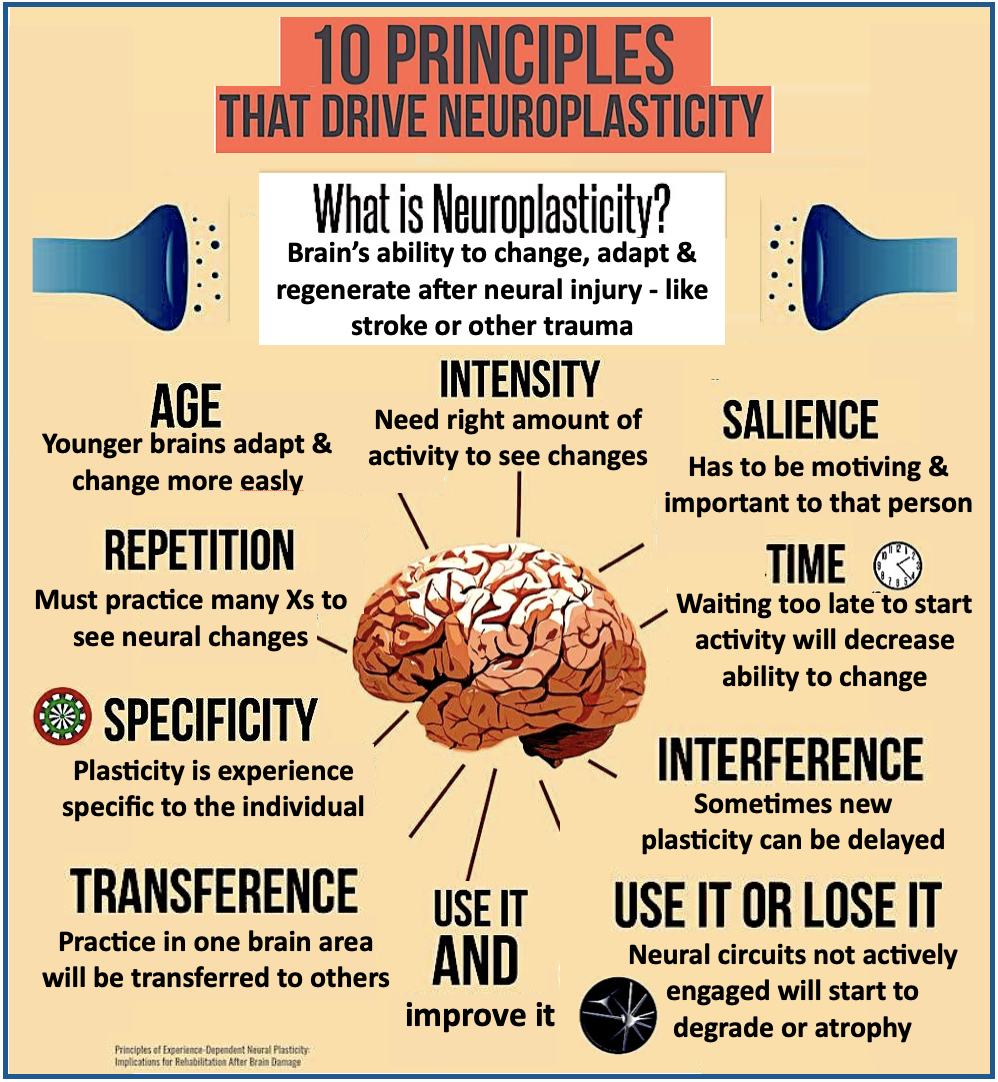
It’s the brain’s ‘biological, chemical & physical capacity to keep reorganizing its structure & function – allowing positive changes to occur (saboteur-to-Sage) .
Science tells us that our brain is not fixed – it’s a dynamic ‘environment’ with the possibility of continuous improvement – the remarkable ability to learn & adapt throughout life.
While younger brains are more malleable, humans can still keep learning past age 18-21 well into seniorhood – one key to protecting us from degenerative diseases such as Alzheimer’s, dementia & Huntington’s.

🧠 Neuro-plasticity occurs in 2 places :
• the hippocampus – focused on long-term & spatial memory,
• the cerebellum –  operating short-term & muscle-memory.

🧠 Brain’s 2 Neuro-plasticity abilities :
structural = to physically change its ‘architecture’ as a result of experiences & learning 
functional =  to restructure itself to compensate for damage or injury. So if one area is no longer working properly, others can take over. (MORE….)

The BRAIN is made up of neurons , tiny messengers that fire electrical & chemical signals throughout our body.  When we’re born, we have around 2,500 synapses per neuron in the cerebral cortex. Within 2-3 years, that grows to about 15,000. But by the time we’re adults, they have more than halved – known as synaptic pruning.

When a signal (from a thought or action) activates a neuron, it triggers the others it’s connected to, & when that happens they get somewhat joined. There are several directions that signal can go – dominant, well-formed routes, and lesser, fragile new ones. EXP : When the brain processes a new thought, it starts out as a lesser pathway. But when it gets activated again, it’s more likely to go down the same path.

❗️Over time repetition of the same thoughts & actions becomes a “neural pathway,” which become automatic habits – helpful or harmful.
Building new Neural Nets to increase personal growth happens by creating & strengthening more beneficial pathways —> through the repetition of positive mental & physical habits, which can be observed with MRI imaging.

EXP : Like a baby trying to walk for the first time, neurons connect from —> the brain to —-> various muscles, for balance… & battle for a while before stabilizing. Eventually, as adults, we don’t need to think about walking anymore, it’s become a well-ingrained pattern.

🌿 SAGE vs SABOTEURS
REVIEW : Our physical brain is made up of two halves & we need both.  However, in terms of imagery – think of the right side as healthy , & the left as unhealthy.
♠️  LEFT : The Survive Region –  houses harmful Saboteurs which destroy any attempt to increase our emotional happiness & practical performance. ⬅️
Most people go through life with the 2 halves continually playing tug of war, with their Saboteurs winning most of the time – if not always.

♥️ RIGHT : the Thrive Region (PQ brain), provides available mental sanity & stability.  The Sage lives in a different region of the brain – in the middle prefrontal cortex , the amygdala’s “empathy circuitry”, & parts of the right brain.  Activating this combination releases endorphins that counter the negative impact of stress-induced cortisol. (IMAGE w/ definitions ↗️ )

To reach our potential – as far as possible – requires strengthening the ‘Right’ & weaken the ‘Left’ sides.  Fortunately, the Sage provides the power to do this because it’s anchored in who we are at our core, & can resist the drama & lies of the toxic beliefs.
«

«
Sage-strengths generate positive emotions even when dealing with life’s challenges, such as compassion, empathy, gratitude, the joy of self-expression…
✧ It also allow us to be calm & have clear-headed, laser-focused thinking, with big picture awareness of what’s important, to choose the best course of action.

Using Sage-wisdom, we gain perspective, finding the opportunities we need & the gifts we long for.  With perseverance, intercepting Saboteurs & activating the Sage rewires the brain at the root level, rather than just treating symptoms. This has a wide-ranging impact :
🔅 internally, providing a sense of safety & peace
🔅 externally, as better stress management & improved performance in creativity, leadership, relationships, persuasion, resilience, selling ….
«


«
NEXT : Sage & PQ

SAGE – the DARK SIDE (Part 2)

PREVIOUS :  ARCHETYPES – #2

SITE : Feminine Archetypes Quiz 


Inner Sage’s WEAKNESSES
The Sage personality also has limitations. On good days, the Sage infused person can be articulate & helpful. On bad days, they can be one of the coldest & most arrogant individuals. Since knowledge is their ‘god’, they can look down on others who lack it as being inferior, & critical of others who don’t agree with their ideas.

🐽 Detachment: With its strong focus on introspection & its internal world, the I.S. may become too disconnected from the external world, making it hard for the person to engage with others or be present in day-to-day activities

🐽 Inability to say “no”: the I.S. can have trouble setting boundaries & prioritize your own needs, so you often take on too much responsibility for others, risking resentment &/or burnout 

🐽 Overthinking: the I.S. can sometimes become so deeply lost in introverted thought that you get ‘analysis-paralysis’, so you struggle to make decisions or take action

🐽 Perfectionism: the I.S. can harbor such high standards —
— for yourself, so you have trouble accepting imperfections, causing self-criticism…. and
— toward others, having unrealistic expectations, frustration & disappointments

🐽 Tendency to isolate: because of its ‘private’ nature & a tendency to obsess, the I.S. can too easily withdraw from social interactions, limiting personal growth & connection with other

DARK SIDE
Because the Sage is an incredibly powerful archetype, when negative, it is very dangerous. To safeguard against grandiosity requires self-compassion, humility & self-knowledge via inner work.
Sage personalities need to be wary of slipping into ivory tower thinking, dogmatism, & coming across as being without feeling or empathy. However – you don’t want someone as smart & powerful as a Sage to be without flaws, nor should they be picture-perfect.

Shadow archetypes related to the Sage
a.  Detached Manipulator (Trickster, shadow of the Magician) – the focus is on self-deception since the Sage is associated with cognition.
This archetype has a cynical disconnection from human life & values. Instead of sharing knowledge, it is focused on controlling others, by withholding specific knowledge to hinder the progress of others.

b.  Deviant Guru
Developing true moral character requires the completion of internal alchemical processes like shadow work , where the person brings their unconscious into awareness.
While gurus & spiritual teachers may be popular, getting to know one’s dark side is not. As such, the absence of moral refinement in culture & society manifests the shadow of the sage archetype in abundance.

Actually, very few gurus know their shadow. Instead, these narcissistic leaders believe they have “transcended” their body & mind. In reality, they have just dissociated from the True Self. 

With the prevalence of false gurus also comes the popularity of cultism. “Spiritual “cults are everywhere, some in physical groups, others virtual or purely ideological. They form as a psychologically symbiotic relationship between the False Guru & confused students/devotees.  The cult leader is driven by grandiosity & ego-inflation, feeding on the projections of their followers.

c. Delusional Mystic
This version has mistaken their own fantasies for Reality, secretly believes they are the sole proprietor of truth. In their grandiosity, the basic insights they might have originally gained turns progressively more distorted – eventually becoming completely divorced from reality.
Instead of comparing their insights with a community of equals (the “sangha”), they isolate from others. If they attract followers, the group instantly turns into a cult, that eventually can become self-destructive.

d.  False Prophet – Charlatan / False Teacher
They are a peddlers of “knowledge” whose real aim is to accumulate money & physical possessions. In the West this archetype is driven by what can be called “the Business of Enlightenment”.

The main difference between the Detached Manipulator & the Charlatan is that the latter knowingly deceives others. Obviously there are far more False Prophets in today’s world than authentic Sages. 

EXP : popularization of “sex techniques for spiritual development (Deviant Guru) was a combination of charlatans & marketers wanting to profit in the marketplace.
All genuine Sages & classical texts warn against falling for the hype.

(modified from “The Sage Archetype: Knower of Wisdom and Seer of Truth

NEXTthe DARK SIDE (Part 2)