
 PREVIOUS: Resilience – Spiritual #1
SITE: The Spirituality of Resilience
COMPONENTS of Spiritual Resilience (S>R>)
We need to take care of the sum of our parts first before we can be whole. Mind, heart, body & soul (PMES) are all elements of our core, so not nourishing each one regularly leads to negative thinking & disordered behavior. Without a spiritual life, people are more likely to live in monotony, uncertainty &/or narcissism.
BALANCE is an essential feature of mental health – in this case the balance between faith & free will. Both are true & both are necessary. Faith could be expressed as religious participation, trusting the unseen from positive experiences.
Free will would be actively practicing the Golden Rule: ‘Love thy neighbor as thyself, or Do unto others as you would have them do unto you’.
1. Spirituality – Faith, Belief
Human beings’ innate self-righting ability – the capacity for Resilience – is connected to our basic spiritual nature. Activist Patrisse Cullors said: “People’s resilience, I think, is tied to their will to live, our will to survive, which is deeply spiritual. The fight to save your life is a spiritual fight”. When people include spirituality in how they ‘understand’ a tragedy they’ve suffered (ascribe meaning to events), they come thru it with much less trauma-hangover
 As listed in Part #1 the term has several meanings, & people use it differently. It has been called Inner Growth, Mindfulness, a Spiritual Awakening….
In 2015 a request went out in the US & Germany: “How would you define the term ‘spirituality’?”and over 1,77o people answered. 10 concepts divided into 3 groupings (see chart above) emerged from an analysis of the responses
PRACTICAL Spirituality is the Regular Renewal of:
• Basic trust that we belong. Resilient people have learned to trust their experience, intelligence & intuition. They don’t depend on over or under-trusting other people, but have a deep reliance on a power greater than themselves
• Commitment to & relationship with a personal Higher Power of your understanding
• Community participation with others of shared spiritual values, nurturing interactions with people & nature
• Forgiveness – for oneself, & Reconciliation – with others, when possible
• Hope – believing in realistic possibilities & knowing practical options encourages constructive living in the present, thereby being responsible for future outcomes
• Self-acceptance – we are the way God made us. Value that!
• Sound values – a meaningful life philosophy to support & guide all relationships
• Transcendent experience (s) that energize – developing our higher self (the soul) (Christian renewal) (3 Cs of Spirituality)
2. Humility (not humiliation, which is = to shame another)
Being in charge of our own life is one of the cornerstones of Resilience (R.). That’s balanced against Humility – knowing & accepting our imperfections as human beings, without self-condemnation. Resilient people do not aspire to perfection! True resilience is based in reality, & Higher Truth is that only Higher Power is perfect – no human can even achieve it.
Perfectionism is a cognitive distortion (CD) many ACoAs are deeply committed to 😇 – from deep in the mind of our WIC. Catch yourself saying : “I don’t have to be perfect”. This implies you could be, you just don’t have to. NO – you can’t be – AT ALL.
Trying to be perfect is trying to be God! It’s true that not everyone believes in a Higher Power, but even on a psychological level – struggling to do the impossible always leads to disappointment, adding to our sense of abandonment.
Re. shame : John Bradshaw noted that there’s such a thing as psychologically ‘healthy shame’, which admits to realistic limitations. It’s the opposite of grandiosity – the child’s belief that they have no limits & there are no bad consequences.
 3. Emotions
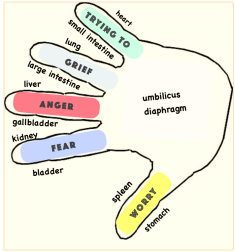
Developing emotional equilibrium is part of Spiritual Resilience, by correctly evaluating a situation, safely sharing the pain & receiving emotional comfort. Some psychologists have become aware of the connection between emotional regulation & religion.
Spirituality helps balance well-managed emotions with accurate healthy thinking, to form a spirit-in-action attitude that allows us to succeed by being ‘in the flow’ of life-energy.
Spiritual practices that help people cope with trauma-generated intense emotions include:
• Acceptance & Forgiveness, which nurture empathy & modify harsh emotions
• Meditating on Scripture & Mindfulness, reducing excessive arousal
• Prayer, for gratitude & asking for help = an exercise in religious re-framing of events
HAND – explanations // the Jin Shin Jyutsu version w/ healing exercises // as hand acupuncture
NEXT: Spiritual resilience #3
 HEAL & GROW for ACoAs
Thanks, Donna, for all your work, effort, research and care. Your posts are like God’s hand to me helping me to make sense of an old but still painful set of wounds. I have found a safe place in heal and grow because I am understood and emotions validated. This is one of my cornerstones of sanity and it’s changing my life. Again, thankyou 😄
LikeLike
You’re welcome, Margaret.
LikeLike