
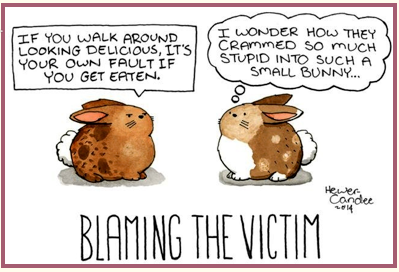
 TO BLAME OR NOT TO BLAME
is that the right question?
PREVIOUS:
ACoAs & Blame (#1)
SITE: Fixing Blame & Nurturing Resentments
NOTE: Emphasis is on this ‘flaw’ being used consistently
SET UP: In everyday life – outside events trigger us to respond. When we do act, we then decide if our response got us what we wanted.
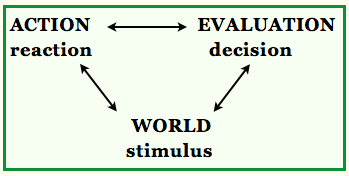 Normal FLOW is always 2-way: Red light <–> Stop <–> Be safe.
BUT – what if our action didn’t produce the desired result?
BLAME – the opposite of praise.
In general : it’s assigning responsibility for having a fault, for doing something wrong, or for causing someone’s pain. Used correctly, it’s a way to hold oneself or others accountable.
ALSO: It can be making negative statements about a person or group, saying that their action/s are socially or morally irresponsible – and therefore bad.
The BLAMER’S ‘reality’ is based on over-emphasizing themself, using a one directional cause-&-effect ‘radar’ scan (the WIC ego state in charge).
The only things in life that seem to register as blips on their ego-screen are those that affect themself & their emotions – good or bad – which they use to justify unhealthy actions. (MORE….)
 Because of this narcissistic, self-centered focus, habitual blamers either don’t notice or don’t care about the negative effect their words & actions have on others, or how they come across (arrogant, stupid, outrageous…..).
Since their view of reality feels normal & logical to them (ego-syntonic) – they don’t recognize the pattern as dysfunctional.
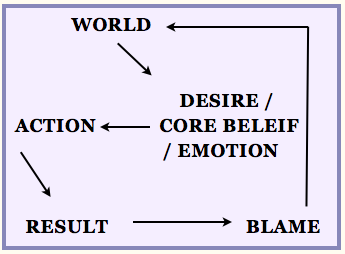
CHART :
• IRONY – the blamer’s unconscious core belief (“it’s not my fault!”) is based on their own S-H & shame – that they don’t deserve care / respect / help….
• Their emotion is rage at the unfairness of all their unhappy experiences. Under that is fear, loneliness, hopelessness….
• The desire (as compensation) is for everything to go their way, regardless of what’s real & possible, ignoring that others also have needs which may be different from their own
This combination (belief-emotion-desire) results in the blamer-victim’s insistence that all bad outcomes are always someone or something else’s fault. They’re dedicated to protecting the illusion that the world is against them.
It reinforces their ‘position’ —
• that they had nothing to do with things going wrong (running across the street against a red light, staying in a damaging relationship….)
• that they should not have to cope with adversity (don’t know how to self-soothe & don’t want to, anyway)
 • that it’s NOT up to them to make things better
🚫 ACoAs who habitually use blame as a defense hold ourself & others responsible for our life problems & emotional unhappiness – everyone except our family!
It’s a way of never having to look at one’s own self-defeating beliefs & life patterns – to avoid doing the hard work of growing & changing.
• But underneath, chronic blaming is also a way of expressing ACoAs’ sense of powerlessness – convinced we’re unable (not allowed) to get our needs met.
So we rely on others to make up for & provide us with all the things our parents couldn’t or didn’t want to.
Then we can accuse people of letting us down – when they ‘don’t come thru’ – even though what we expect from them is totally unrealistic & inappropriate!
<— IMAGE: The Al-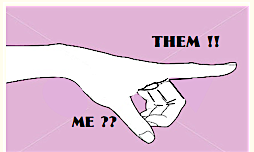 Anon handshake: one finger pointed at another, BUT 3 pointing back at ourselves.
CRUCIAL : When considering this character defect, it only applies to adults, not children. Also, there’s a difference between what’s legitimately pointing out a problem or abuse, & what’s not.
Legit’ blame (assigning responsibility), is on behalf of Children :
parents & other adults ARE answerable for the pain they caused us growing up – whether they think they had a choice to do so or not (physical & emotional abusive, or abandonment because of mental illness, divorce, death…).
Not Legit’ blaming OTHER adults, or about any group :
Only the unhealthy parts of us indulge in this attitude. Blamers look at everything that happens to them in the world thru the internal filter of their WIC (fantasy excitement or abandonment depression), but react externally as their PigP (superiority or finger-shaking).
And for the covert blamer, both filters can be well-hidden until something doesn’t work out the way they want.
NEXT: ACoAs & Blame (Part 3)
 HEAL & GROW for ACoAs
I think this is a great post. ☺️
LikeLike
Thanks. Liking the bunnies too? 🙂
LikeLike
Yes, the bunnies were good. I always wonder where you find the perfect art clips.
LikeLike
Hours of searching Google images. Perseverance pays off!
LikeLike
Love it! You inspired a renewed drive in me to keep up my work. 😃
LikeLike
Great!
LikeLike