

COME HERE — GO AWAY
You’re too close! Hey, why are you leaving?
PREVIOUS: Bs & ACoAs (Part 2)
3. The SYMBIOTIC DILEMMA
Sigmund Freud concluded that there were 2 main psychological forces in humans – Eros & Thanatos, love & death, sex & violence (where have we heard that before??).
They are strong instincts which he called “an original self-subsisting instinctual disposition in man”. These drives give people a kind of psychic “energy” which can be diverted into other areas (not repressed), giving some form of satisfaction.
Modern psychologists (Kohut, Mahler, Winnicut ….) have given us a revised understanding of these 2 forces: Attraction & Repulsion, Connection & Separateness, Attachment & Individuation. In balance, both extremes are necessary for us to be psychologically sound. To feel safe we need connection, but to be our own person we need to be separate.
• For ACoAs, however, this internal tug-of-war is lose-lose. No matter how ‘wonderful’ we think the various individuals to be (‘my mom is the greatest – honest!’….), in a toxic family system both of these basic needs are distorted.
The wounded caregiver can be: fearful or angry, withholding or intrusive, distant or controlling – all are scary & damaging. We end up as adults equally afraid of commitment AND of abandonment. 
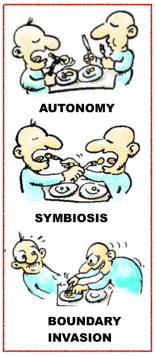
a. Fear of one-ness with mother —> being engulfed. The result in the child is the need to form Rigid Bs (walls).
Having absorbed an unsafe mother (introjected object), the child feel the threat of loosing it’s True Self because of the caretaker’s lack of Bs.
Any fragments of their own identity are very precious to the child & need to be protected. This may happen by regressing to an ‘autistic’ stage – a normal part of infant development outgrown in a loving environment, but for us became stunted, limited or suppressed
~ AND ~
b. Fear of separateness from mother —-> being abandoned Results in Weak or no Bs: At the same time, because the internalized mother is unhealthy & can’t protect the child’s True Self from her damage, the whole world feels unsafe.
The outside is assumed to be as threatening as our family, so we’re reluctant to venture out & stand on our own. The fear is that we’ll be set adrift in an alien, chaotic world knowing we don’t have a strong base to return to – so why leave?
 Wounded adults who STAY (Ss) too long – the clingers in any type of relationship, and the LEAVERS (Ls) – who are afraid of getting too close — are very often drawn to each other!
CHART : C = Conscious // Un = Unconscious
FoA = Fear of abandonment // FoC = Fear of commitment
• On a conscious level both types seem to be polar opposites – always at odds, demanding what the other cannot give. Ls want freedom, Ss want security.
• The key to understanding this unlikely attraction is what’s going on underneath. In the unconscious, each had the exact opposite fear, but the Ls are not aware of their FoA, & the Ss vehemently deny their FoC. The hidden part of each resonates with the other, acting as a magnet which keeps them repeating the pattern set up in their family
BTW – what proves that Stayers are afraid of commitment?
They keep is : they keep picking Leavers who are deeply unavailable, physically or emotionally, so they can avoid letting anyone get too close to their WIC. Just because they get married doesn’t mean they’re capable of actual intimacy!
• AND, what do the Leavers get from choosing Ss?
 Not only someone who will never leave them, but also someone they can rebel against!
They can have the illusion of being wanted, needed, loved… & still stay at arm’s length. It’s an illusion, because the Ls are just as afraid of someone knowing how vulnerable they feel inside that armor, & the damaged Ss they hook up with are looking to be taken care of, behind their wall of self-hate.
This core conflict goes unresolved as long as our WIC has a high level of anxiety, which is old FoA terror not discharged (by deep emotional release work) AND a weak or missing Loving Inner Parent to replace the cruel Bad Voice (the UNIT).
NEXT: Bs & ACoAs (Part 4)



 HEAL & GROW for ACoAs