
I CAN CONNECT WITH OTHERS
and still be myself!
PREVIOUS: Autonomy & Attachment (#1)
SEE ACRONYM Page for abbrev.
AUTONOMY (Part 1)
ATTACHMENT
ABOUT.com – …. attachment “may be defined as an affectional tie that one person or animal forms between itself & another specific one – a tie that binds them together in space, & endures over time.”
“Attachment is not just a connection between two people, but a bond that involves a desire for regular contact with a special person, & the experience of distress during separation from them.” says psychologist Mary Ainsworth
💛 Healthy attachment is NOT fueled by anxiety, low self-esteem, fear of abandonment, weak boundaries or neediness. RATHER, it’s grounded in the opposite:
• A clear sense & acceptance of our CORE personality, based on heredity, personal qualities, character, education, accomplishments, experience, tastes, & talents – as well as lacks, limitations & defects

• Having reasonable expectations of ourselves & others, in order to have mutually satisfying relationships, & not be devastated when others can’t be what we want them to be
• Having good boundaries – knowing what our needs are, how we’re the same or different from others, how we want to be treated. & be able to clearly state our needs & wants, when appropriate
THEREFORE :
• we can choose emotionally available people who are reasonably healthy, are generally compatible & don’t need us to take care of them
• can accept differences, limitation & imperfections in others
 • know it’s OK to be attracted to people who have some traits like our family (it’s normal to connect with the familiar), but choose those who can treat us better
• when people act in ways that trigger us, we don’t react as intensely & can respond from our Healthy Adult (not from the WIC or PP)
• are able to tolerate disconnections with others, even outright losses, while keeping a sense of our own identity, knowing that no matter what, we are OK, lovable, strong, capable of taking care of ourselves & being on our own, if necessary.
INTER-DEPENDENCE
Symbiosis ——> Autonomy ——-> Attachment —–> Inter-dependence
As ACoAs from wounded families – we need to slowly
🔪DETACH from the damage we brought with us from childhood , in order to —
🧲 ATTACH to the many gifts Higher Power has given us as our birthright, which makes it easier to identify & connect with peers !
Growing successfully thru the previous stages allows us to become more Inter-dependent.
Of course, most of us are in flux, sliding back & forth between stages. The goal is to keep working at the process, & not get stuck for too long in any one.
(Article: “Attachment & Adult Relationships”)
SimilarMinds.com
Inter-dependent people tend to see themself as basically good. THEY :
ARE – More likely to be content, emotionally expressive, positive, trusting
ARE – easier to get to know, open & relationship-oriented, comfortable with or love birthdays. Less ‘in their head’, less rigid
TEND TO: be traditional & value society, like some guidance, take advice & learn better with others, like to be part of a group & do things with others, feel grateful to parents.
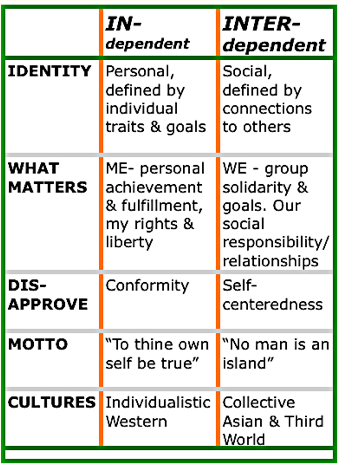 Wikipedia ….(interdependence) is being mutually & physically responsible to, & sharing a common set of principles – with others…..
✶ INdependent thinking is not suited to inter-dependent reality.
Independent people who don’t have the maturity to think & act inter-dependently may be good individual producers, but not good leaders or team players. They’re less likely to succeed in marriage, family, or organizational life.
(Stephen Covey, ‘The 7 Habits of Highly Effective People’, 1989)
✶ INTER-dependence is & ought to be as much the ideal of humans as self-sufficiency. Humans are social beings. Without interacting with society we cannot realize our oneness with the universe or suppress our egotism. Social inter-dependence helps us test our faith & prove ourself on the touchstone of reality. (2020 updated version of 1929 Mahatma Gandhi)
Need we say more?
NEXT: SYMBIOSIS & ACoAs – #1
 HEAL & GROW for ACoAs